



| Você sabe de algum fato da Segunda Guerra Mundial que a maioria das pessoas não conhece e que, provavelmente, não querem saber? | ||
|
Na periferia de Berlim, no parque Treptower, há uma estátua de 12 metros de um soldado soviético com uma espada na mão pisando em uma suástica quebrada e tem nos braços uma menina alemã (Google Maps). De acordo com o projeto original do escultor Evgenij Vuchetich, o soldado deveria segurar uma submetralhadora, mas Stalin "sugeriu" substituí-la por uma espada. A proporção colossal do monumento reflete o tamanho do massacre, mas é inevitável observar a inscrição na estátua que afirma que "o povo soviético salvou a civilização européia do fascismo". No entanto, para muitos, este memorial é chamado de "O Túmulo do Estuprador Desconhecido". Vladimir Gelfand era um jovem tenente judeu da região central da Ucrânia que, desde 1941, escrevia com franqueza brutal todos os detalhes das atrocidades da guerra. Descreveu como seus companheiros cercaram e destruíram os batalhões de combatentes alemãs. "Os alemães que capturamos disseram que estavam vingando os cônjuges mortos", escreve o tenente. "Nós devemos destruí-los sem piedade. Nossos soldados sugerem esfaqueá-los nos órgãos genitais, mas eu apenas os executaria". O historiador Antony Beevor diz que, enquanto pesquisava o livro The Fall, encontrou documentos de violência sexual nos arquivos da Federação Russa. Eles foram recolhidos pela polícia secreta e enviados a seu chefe, Lavrentiy Beria, no final de 1944. Há notícias de estupro em massa na Prússia Oriental e de como as mulheres alemãs preferiram matar suas filhas e a si mesmas para evitar esse destino, disse Beevor. |
||
 |
||
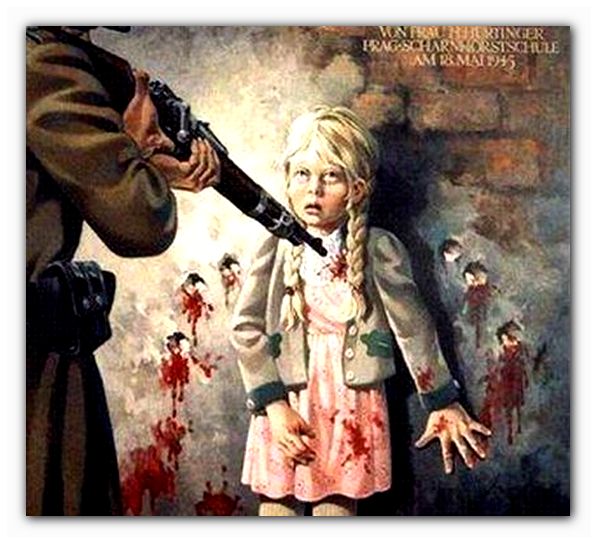
| A representação de Herbert Smagon da morte da neta da sra. H. Huntinger é cortada e mostra a morte dos austríacos nas mãos dos soldados da Checoslováquia | ||
|
No livro de Svetlana Aleksievich, "The Non-Female Face of War", que reúne as memórias e experiências de veteranos soviéticos na Alemanha, um ex-oficial russo lembra, "éramos jovens, fortes e estávamos sem mulheres há quatro anos. Tentamos fisgar mulheres alemãs mas não havia mulheres suficientes, toda a população estava fugindo do Exército Vermelho. Então pegávamos meninas de doze ou treze anos... Dez homens estupravam uma menina. Se ela chorasse, colocávamos algo na boca dela. Engraçado, agora não consigo entender como conseguimos, eu era um garoto de uma boa família ... no entanto eu fiz." Existem muitas histórias, cada uma mais horrível que a anterior. Aqui estão algumas pinceladas:
Gostou do conteúdo? Dê um voto positivo, compartilhe |
||
© Quora
| Знаете ли вы какие-нибудь факты о Второй мировой войне, которые большинство людей не знают и, возможно, не хотят знать? | ||
| На
окраине Берлина, в Трептов-парке, находится 12-метровая статуя
советского солдата с мечом в руке, наступающего на разбитую свастику и
держащего на руках немецкую девочку (Google Maps). По первоначальному
проекту скульптора Евгения Вучетича, солдат должен был держать в руках
автомат, но Сталин "предложил" заменить его на меч. Колоссальные размеры памятника отражают масштабы массового убийства, но нельзя не отметить надпись на статуе, которая гласит: "Советский народ спас европейскую цивилизацию от фашизма". Однако для многих этот мемориал называется "Могила неизвестного насильника". Владимир Гельфанд был молодым еврейским лейтенантом из центральной Украины, который с 1941 года с поразительной откровенностью записывал все подробности военных злодеяний в свой дневник. Он описывал, как его товарищи окружили и уничтожили батальон немецких бойцов. "Немки, которых мы взяли в плен, сказали, что мстят за своих погибших мужей", - пишет лейтенант. "Мы должны уничтожить их без пощады. Наши солдаты предлагали убить их штыком через гениталии, но я бы просто казнил их". Историк Энтони Бивор рассказывает, что во время работы над книгой "Падение" он обнаружил в архивах Российской Федерации документы о сексуальном насилии. Они были собраны тайной полицией и отправлены ее начальнику Лаврентию Берии в конце 1944 года. Там есть сообщения о массовых изнасилованиях в Восточной Пруссии и о том, как немецкие женщины предпочитали убивать своих дочерей и себя, чтобы избежать этой участи, говорит Бивор. |
||
|
||
| Изображение Гербертом Смагоном смерти внучки миссис Хантингер вырезано и показывает гибель австрийцев от рук чехословацких солдат | ||
|
В книге Светланы Алексиевич "У войны не женское лицо", в которой собраны воспоминания и опыт советских ветеранов в Германии, бывший русский офицер вспоминает: "Мы были молоды, сильны и четыре года жили без женщин. Мы пытались подцепить немецких женщин, но их было мало, все население бежало от Красной армии. Поэтому мы брали девочек двенадцати-тринадцати лет... Десять человек насиловали одну девочку. Если она плакала, мы засовывали ей что-нибудь в рот. Забавно, но сейчас я не могу понять, как мы это делали, я был мальчиком из хорошей семьи... и все же я это делал". Существует множество историй, каждая из которых ужаснее предыдущей. Вот несколько мазков кисти:
Gostou do conteúdo? Dê um voto positivo, compartilhe |
||
 Portuguese
On the outskirts of Berlin, in Treptower Park, there is a twelve-metre statue of a Soviet soldier holding a sword, standing on a broken swastika and carrying a German girl in his arms (Google Maps). In sculptor Yevgeny Vuchetich’s original design, the soldier was supposed to hold a submachine gun, but Stalin “suggested” replacing it with a sword.
The colossal size of the monument reflects the scale of the bloodshed, but it is impossible not to notice the inscription on the statue stating that “the Soviet people saved European civilization from fascism.”
For many people, however, the memorial is called the “Tomb of the Unknown Rapist.”
Vladimir Gelfand was a young Jewish lieutenant from central Ukraine who, beginning in 1941, recorded all the details of wartime atrocities in his diary with striking frankness.
He described how his comrades surrounded and destroyed a battalion of German female fighters.
“The German women we captured said that they were avenging their dead husbands,” the lieutenant wrote. “We must destroy them without mercy. Our soldiers suggested killing them by stabbing them through the genitals with bayonets, but I would simply execute them.”
Historian Antony Beevor says that while working on his book The Fall he found documents on sexual violence in the archives of the Russian Federation. They had been collected by the secret police and sent to their chief, Lavrentiy Beria, at the end of 1944.
The documents contain reports of mass rape in East Prussia and of German women preferring to kill their daughters and themselves rather than face that fate, Beevor says.
A caption on the page reads approximately: Herbert Smagon’s depiction of the death of Mrs H. Huntinger’s granddaughter is cropped and shows Austrians dying at the hands of Czechoslovak soldiers.
In Svetlana Alexievich’s book The Unwomanly Face of War, which brings together the memories and experiences of Soviet veterans in Germany, a former Russian officer recalls:
“We were young and strong and had lived without women for four years. We tried to pick up German women, but there were not enough women; the whole population was fleeing the Red Army. So we took girls of twelve or thirteen… Ten men raped one girl. If she cried, we put something in her mouth. It is strange, but now I cannot understand how we did it. I was a boy from a good family… and yet I did it.”
There are many stories, each more horrific than the last.
Here are a few examples:
The hidden drama of the mass rapes during the fall of Berlin
Mass rapes of German women during World War II: the atrocities of the Red Army | Guioteca.com
Did you like the content? Give it an upvote and share it.
