Oleg Shein
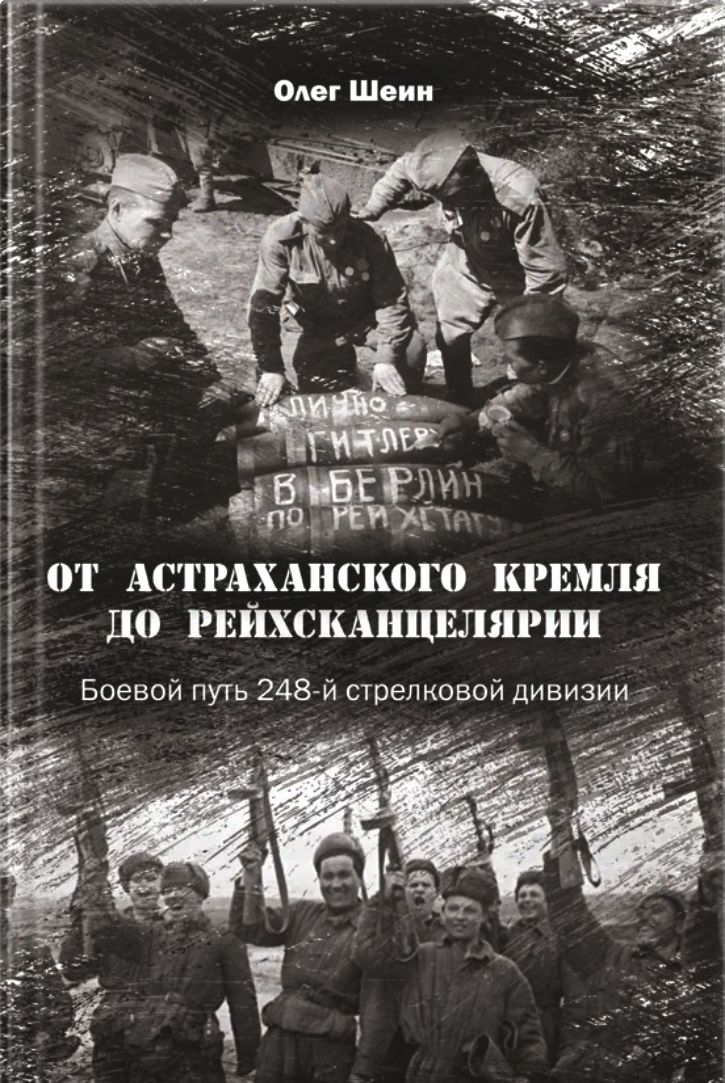
“From the Astrakhan Kremlin to the Reich Chancellery: The Combat Path of the 248th Rifle Division”
Author: Oleg Vasilyevich Shein
Title: From the Astrakhan Kremlin to the Reich Chancellery: The Combat Path of the 248th Rifle Division
Shipping weight: 425 g
Pages: 224 (offset printing)
ISBN-10: 5-906947-15-9
ISBN-13: 978-5-906947-15-4
Format: 84x108/32
Year of publication: 2017
Binding: Hardcover
Publisher: Algorithm
Publication language: Russian
Coated paper: yes
Edition type: Standalone edition
Print run: 1,000 copies
Price: 325 rubles
Publisher: LitRes Published: May 14, 2020 Pages: 280
ISBN: 9785042538308 Features: Flowing text, Google-generated PDF Best
for: Web, Tablet, Phone, eReader Language: Russian Genres: History /
General History / Military / Special Forces Content protection: DRM
protected Read aloud: Available on Android devices Eligible for Family
Library
Oleg Shein
From the Astrakhan Kremlin to the Reich Chancellery: The Combat Path of the 248th Rifle Division
Alistorus 2017
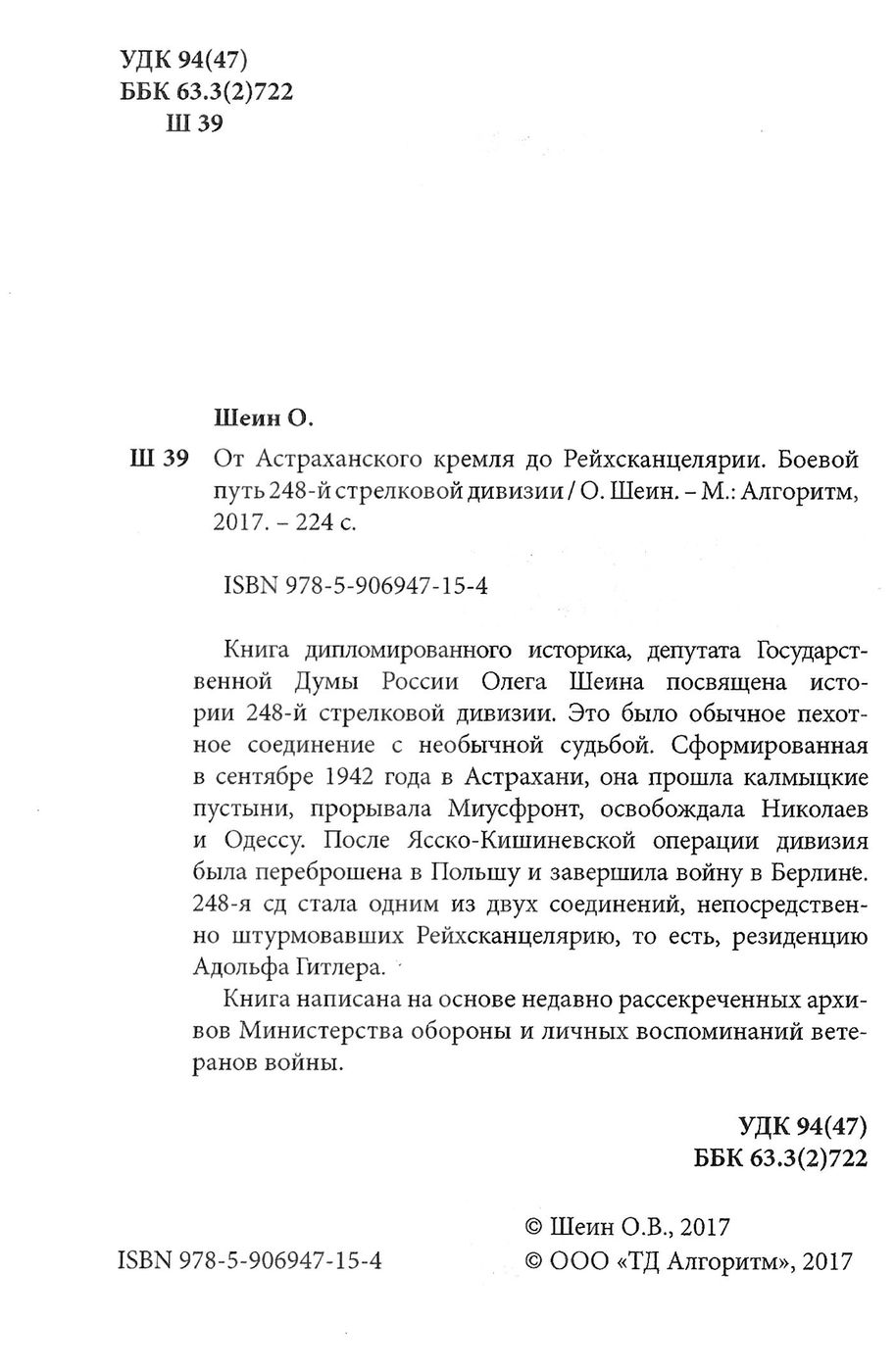
UDC 94(47) BBK 63.3(2)722
Shein, O. V. From the Astrakhan Kremlin to the Reich
Chancellery: The Combat Path of the 248th Rifle Division / O. V. Shein
— Alistorus, 2017
ISBN 978-5-906947-15-4
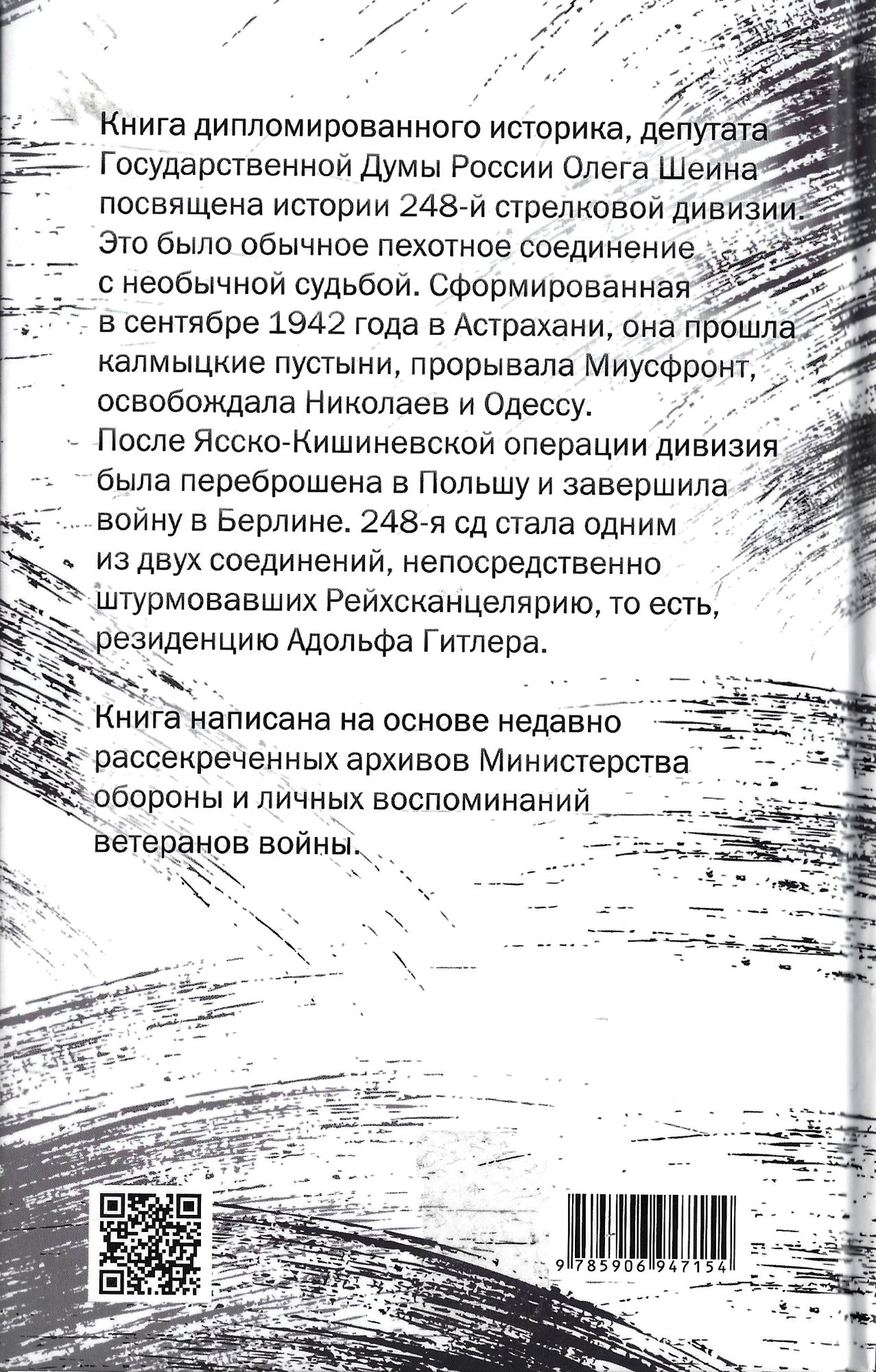
This book by trained historian and Russian State Duma
deputy Oleg Shein is devoted to the history of the 248th Rifle
Division. It was an ordinary infantry formation with an extraordinary
fate. Formed in Astrakhan in September 1942, it crossed the Kalmyk
deserts, broke through the Mius Front, and liberated Nikolayev and
Odessa. After the Jassy–Kishinev Operation, the division was
transferred to Poland and ended the war in Berlin. The 248th Rifle
Division became one of the two formations that directly stormed the
Reich Chancellery, Adolf Hitler’s residence. The book is based on
recently declassified archives of the Ministry of Defense and the
personal recollections of war veterans.
UDC 94(47) BBK 63.3(2)722
ISBN 978-5-906947-15-4 © Shein O. V., 2017 © Alistorus, 2017
Contents The Wehrmacht Breaks Through Beyond the Don
— 6 The Battlefield Is a Desert — 7 Mobilization of the
Astrakhan Cadets — 9 At the Sarpinsky Lakes — 11 Formation
of the 248th Rifle Division — 12 First Clashes — 14 Bergin
— 16 The 899th Rifle Regiment at the Sarpinsky Lakes — 17
End of the Preview Excerpt — 18
Oleg Shein From the Astrakhan Kremlin to the Reich
Chancellery: The Combat Path of the 248th Rifle Division © Shein
O. V., 2017 © Algorithm Trading House LLC, 2017
Our country has a history rich in military events.
But there was only one Great Patriotic War for us. When those words are
spoken, there is no need to explain what period they refer to. That war
affected everyone. Some people had relatives fighting at the front;
others had relatives who found themselves under occupation. The entire
country worked in production for victory.
Today it is almost impossible even remotely to
imagine the hardships that fell upon people: how bitter the news from
the front was; how many soldiers called into the army never returned
home or suffered severe mutilation; how exhausting the work was; and
how immense the joy of victory was in May 1945.
Today, every spring, millions of people walk in the
columns of the “Immortal Regiment” carrying portraits of
their fathers, grandfathers, and great-grandfathers. Many try to
reconstruct the combat paths of relatives who fought at the front and
to find information about them. Collective memory is therefore all the
more important, because units and formations that followed their own
wartime roads were created in dozens and hundreds of cities and
districts throughout the country.
In my native Astrakhan, a division was formed that
reached Berlin, all the way to the Reich Chancellery itself. It began
its war in the dune deserts of the Lower Volga, crossed Kalmykia,
liberated Rostov-on-Don, broke through the Mius Front, crossed southern
Ukraine, drove the enemy from Odessa and Moldavia, and after the
assault on the Seelow Heights took part in the Berlin Operation.
This formation received the designation 248th Rifle Division (3rd formation).
There are quite a few published sources on its
history. But the Ministry of Defense’s decision to declassify
wartime combat documents and place them on the “Memory of the
People” website has greatly simplified historians’ work.
The combat journals of the division itself and of the 899th Rifle
Regiment have survived. The latter was also fortunate to have talented
men among its ranks who left memoirs: Vasily Skorobogatov, Yakov
Savchenko, Alexander Kharchenko, and Vladimir Gelfand. The combat
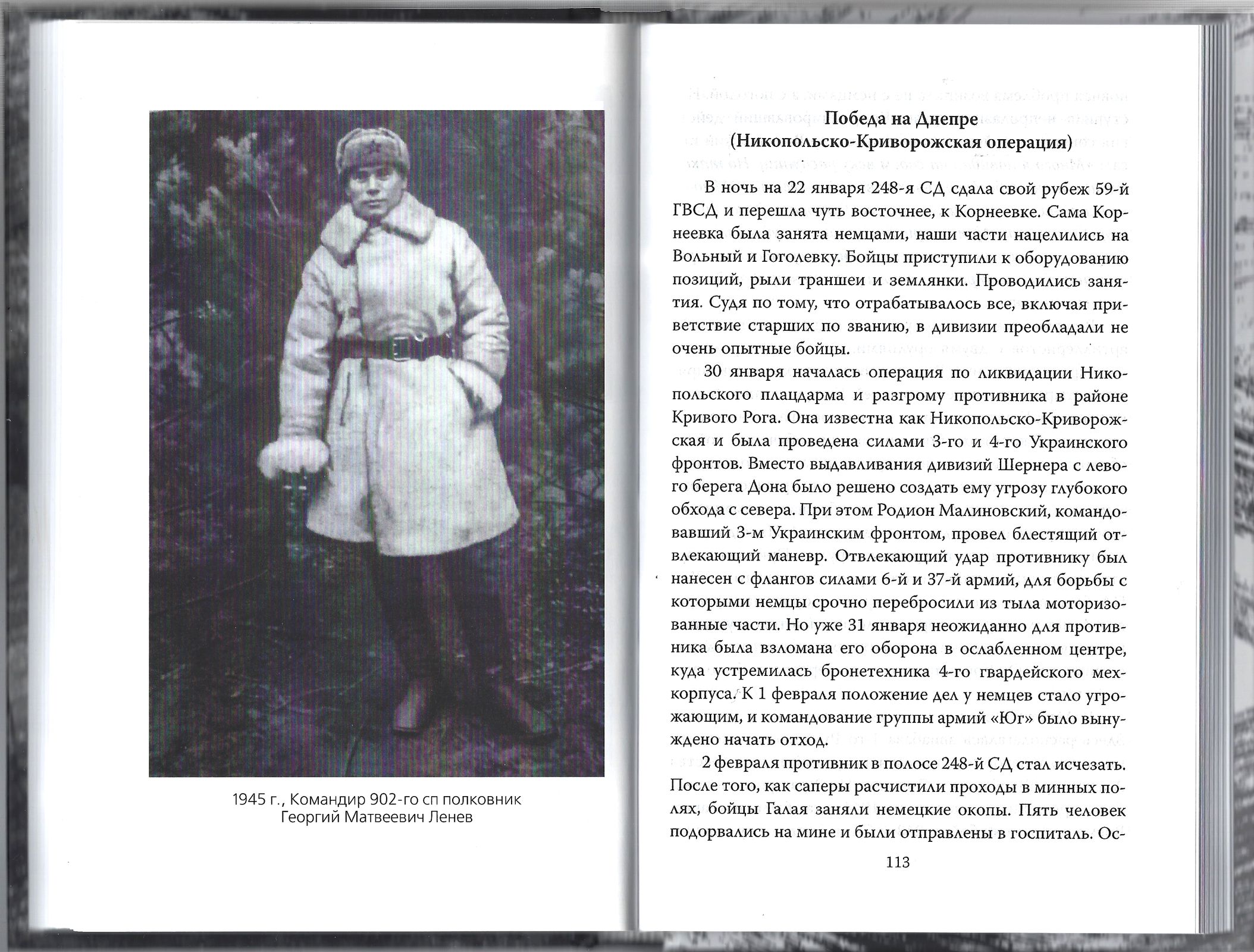
journals of the other two regiments did not survive, but Lenev,
commander of the 902nd, became the author of very detailed memoirs,
while the actions of the 905th Rifle Regiment are well described in the
regimental “History of the Combat Path.”
The Wehrmacht Breaks Through Beyond the Don
In May 1942, the position of our forces on the Don entered an extremely serious crisis that threatened to turn into catastrophe.
On May 12, troops of the Southwestern Front went over
to the offensive from the Barvenkovo salient with the aim of liberating
Kharkov and then breaking through toward the Dnieper. Four days later,
the German army struck the flanks of the Soviet assault grouping. The
grouping consisting of the 6th, 9th, and 57th Armies was encircled and
soon completely destroyed. The weakened front could not withstand the
subsequent German blow against its positions on June 28 and began to
disintegrate, opening the road to the North Caucasus and the Volga for
the Germans.
Four weeks later, motorized Wehrmacht units
approached Volgodonsk, cutting the supply lines of the 51st Army, which
was defending southwest of Stalingrad. The 51st Army began a forced
withdrawal beyond the Sarpinsky Lakes. By then, however, little more
than three thousand soldiers remained in the army itself, and it was
completely incapable of resisting the vigorous advance of the mobile
German formations. A ninety-kilometer gap opened in the front.
At noon on August 12, forward units of the
Wehrmacht’s 111th Infantry Division, supported by armored
vehicles, entered Elista after a brief battle. The defending garrison,
consisting of an infantry battalion and seven tanks, withdrew northeast
to join the remnants of the 51st Army. Three hundred kilometers farther
east across the waterless steppe, beyond dunes and salt lakes,
Astrakhan stood on the bank of the great Volga.
The Volga transport artery was of decisive importance
to the country’s defense. Its significance lay in the supply of
raw materials for the defense industry: Transcaucasia and the North
Caucasus accounted for 86 percent of the oil, 65 percent of the gas,
and 56 percent of the manganese ore produced in the Soviet Union. These
strategic cargoes then traveled mainly through the Lower Volga by river
and rail.
The Battlefield Is a Desert
In November 1941, construction of a defensive
perimeter west of Astrakhan began in great haste. The perimeter
consisted of an antitank ditch extending in a huge arc for dozens of
kilometers. There was, however, no artillery to cover the ditch. Work
proceeded urgently because von Kleist’s 1st Panzer Army
threatened to cross the Don and break into the open operational spaces
of southern Russia.
But as soon as the Red Army stopped the offensive
drive of Army Group South and even managed to retake Rostov-on-Don,
construction of the Astrakhan defensive perimeter was halted.
Even what had been completed did not conform to the
plans, and in some places it had already begun to deteriorate. In the
summer of 1942, Captain Danilov reported from the Dzhakuyevka area (now
the village of Volzhskoye), thirty kilometers north of Astrakhan:
“In the area of the 2nd Rifle Battalion, five pillboxes were
built in 1941; of these, one pillbox has been destroyed, two have been
brought to combat readiness, and two are not prepared. Trenches are
being dug for rifle squads with communication trenches to the rear. The
command post is not equipped. Individual firing positions have been dug
to knee depth. In the area of the 3rd Rifle Battalion, three pillboxes
have not been brought to combat readiness, the command post is not
equipped. Individual positions have been dug to knee depth. In the area
of the 1st Rifle Battalion, two pillboxes are suitable for defense and
one is unusable. They have not been brought to combat readiness. The
command post is not equipped. Knee-deep individual positions have been
dug for 50 percent of the personnel.”1
There are no significant natural obstacles west of
Astrakhan. Kalmykia is a completely open plain with neither forests nor
natural shelters. The terrain is flat, though hilly in places. The
hills here are unusual: they formed during the Quaternary period as the
sea retreated, extend from east to west, and are steep on their western
sides. They reach twenty meters in height and 120–150 meters in
length. They are former islands situated some distance apart. Karl Baer
was the first to describe them, and they were named after him.
There is no water here apart from wells, and many of
the wells are saline. The struggle for water sources therefore becomes
critically important. West of Elista, along the line where the waters
of the Caspian met the Black Sea ten thousand years ago, lies the
elongated, arrow-shaped Lake Manych-Gudilo. Its water is brackish, and
several islands lie in its center. The lake is fed by the Manych River
and continues southward into the Manych Canal, which runs southeast
toward the Caspian. Farther east, on the approaches to Astrakhan,
hundreds of ilmens2 fed by the Volga are scattered across the
landscape. In summer most dry up and form salt flats—patches of
ground that never fully dry and on which salt appears at the surface.
Even tracked vehicles have great difficulty crossing such terrain, and
in places passage is impossible. Reeds dominate the vegetation in these
areas. They grow taller than a person, and reed beds often extend for
several kilometers.
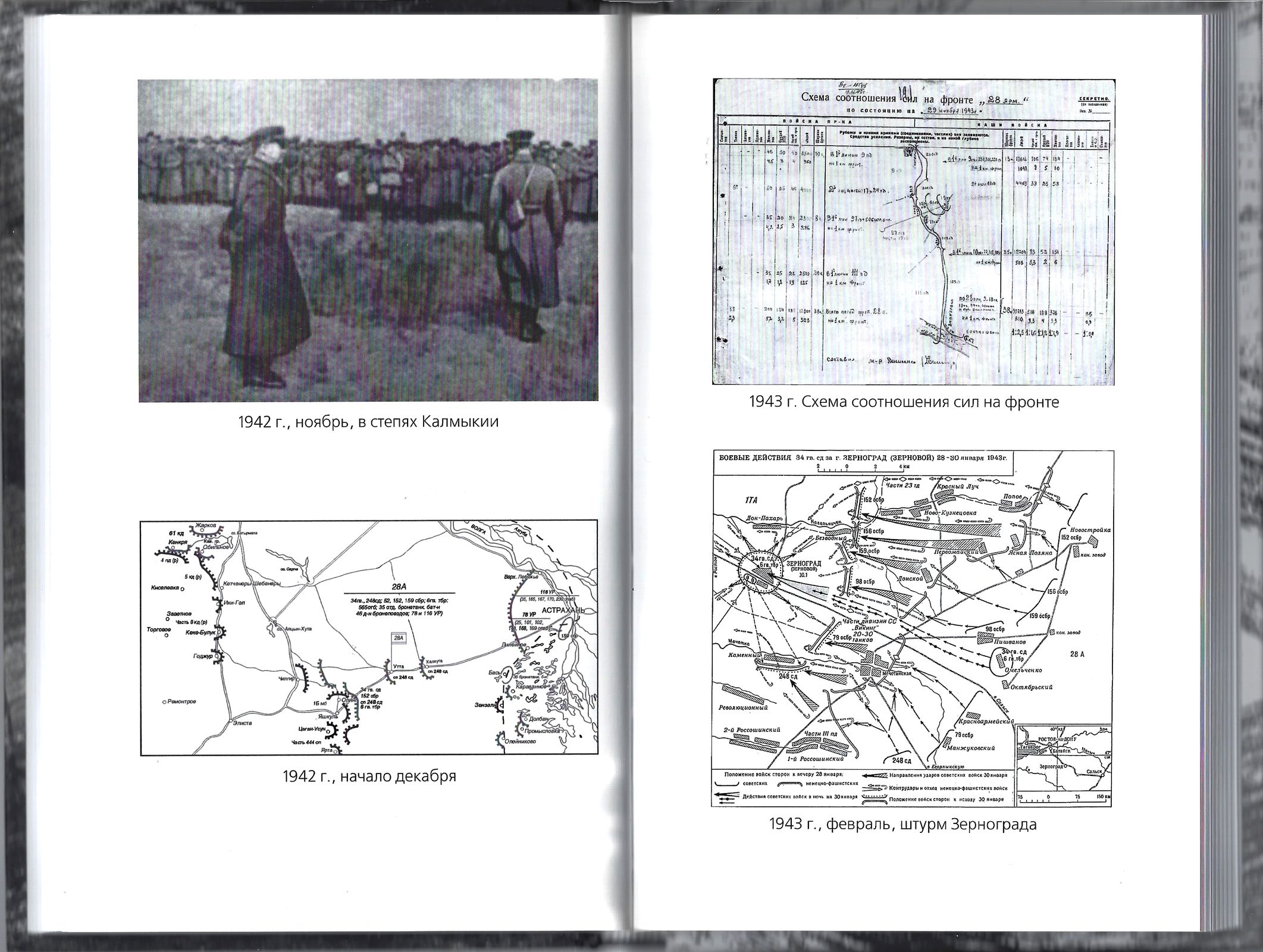
Major General Ustinov, commander of the artillery of the 28th Army, gave a very precise description of the terrain:
“The populated places shown on the map are such
only in name. In Khulkhuta, of twenty-one houses, not one actually
remains. In Syantsik there is one half-ruined house. In Utta there are
ten to twelve half-ruined houses. There is no local population. The
troops are therefore forced to quarter exclusively in the open field or
in dugouts. The complete absence of building materials and fuel makes
it impossible to roof and insulate these dugouts.
“The only source of water supply is wells,
located singly or in groups at road and trail junctions at intervals of
twenty to thirty kilometers. The water in the wells is very often of
poor quality, containing various salts. The wells contain only a
limited quantity of water.”
All of this creates major difficulties in supplying good-quality water to personnel and especially to horses.
“The only motor road in the area of operations
is the Astrakhan–Elista road. But in wet weather, on its clay
sections, this road becomes difficult for vehicles to pass.”3
In the northeast of the territory lie the Sarpinsky
Lakes. They are about 150 km west of the Volga and are remnants of an
ancient channel of the great river. The lakes stretch from north to
south and are likewise overgrown with reeds. In spring the steppe is
covered by huge numbers of steppe poppies, but the summer sun burns
them away completely. There are no trees anywhere; only short steppe
grass grows.
In July the temperature reaches 40–45 degrees
Celsius in the shade. For a resident of Astrakhan or a Kalmyk this is
ordinary, especially since the climate is not highly humid, but
newcomers find it difficult. Dust storms occur at times, reducing
visibility to a few dozen meters. Clouds and precipitation are very
rare in summer. At night, however, it becomes cool. The climate is
continental, and without warm clothing one can become chilled.
Autumn is short and begins in the second half of
October. Fog is frequent in the steppe and severely limits visibility.
After heavy precipitation, the soil—vegetation-free
loam—becomes difficult to cross even on foot. Clods of mud stick
to footwear and every step becomes arduous. Rapid movement under such
conditions is impossible.
Winters are mild now, but even today on individual
days the temperature can fall sharply to 20–25 degrees below zero
Celsius. Cyclones are very frequent at this time of year: the sky
becomes covered by leaden clouds, creating a depressing atmosphere.
The capital of the Kalmyk Autonomous Region was
Elista (Stepnoy). By the beginning of the war, although small, it was
already a town. It had a population of 13,600 and about sixty small
enterprises. The other settlements were either villages inhabited by
Europeans—Russians, Ukrainians, Germans, Estonians—or
groups of adobe huts, the clay houses of local Kalmyks.
On the other side of the steppe lay the objective of
the German offensive—Astrakhan. At that time about 240,000 people
lived in the city. There was no separate Astrakhan Region; it formed a
district within the Stalingrad Territory.
North of the Elista road there are almost no ilmens.
Here the sands begin, stretching far to the north and giving way around
Yenotayevka to loam and sandy loam. There are no rivers or lakes in the
area, so all settlements cling to the Volga. Apart from Dzhakuyevka,
there were no large settlements between Astrakhan and Yenotayevka at
the time. Accordingly, there were two main roads to the Volga: one,
mentioned above, ran directly from Elista to Astrakhan via Yashkul,
Utta, Khulkhuta, and Krasny Khuduk. At Utta the road forked, and by
turning north through Yusta one could reach Yenotayevka.
In the northern districts of Kalmykia there were more
routes, because the freshwater Sarpinsky Lakes are located there; from
that area one could reach the Volga by several roads across the steppe
toward Yenotayevka, Nikolskoye, and Cherny Yar.
Mobilization of the Astrakhan Cadets
At 2:00 a.m. on August 6, 1942, a meeting of the
Military Council of the Stalingrad Military District was held under the
chairmanship of the district commander, Lieutenant General Vasily
Gerasimenko. The district headquarters was then located in Astrakhan. A
decision was made to urgently form new units and transfer forces from
farther north to the Astrakhan direction.
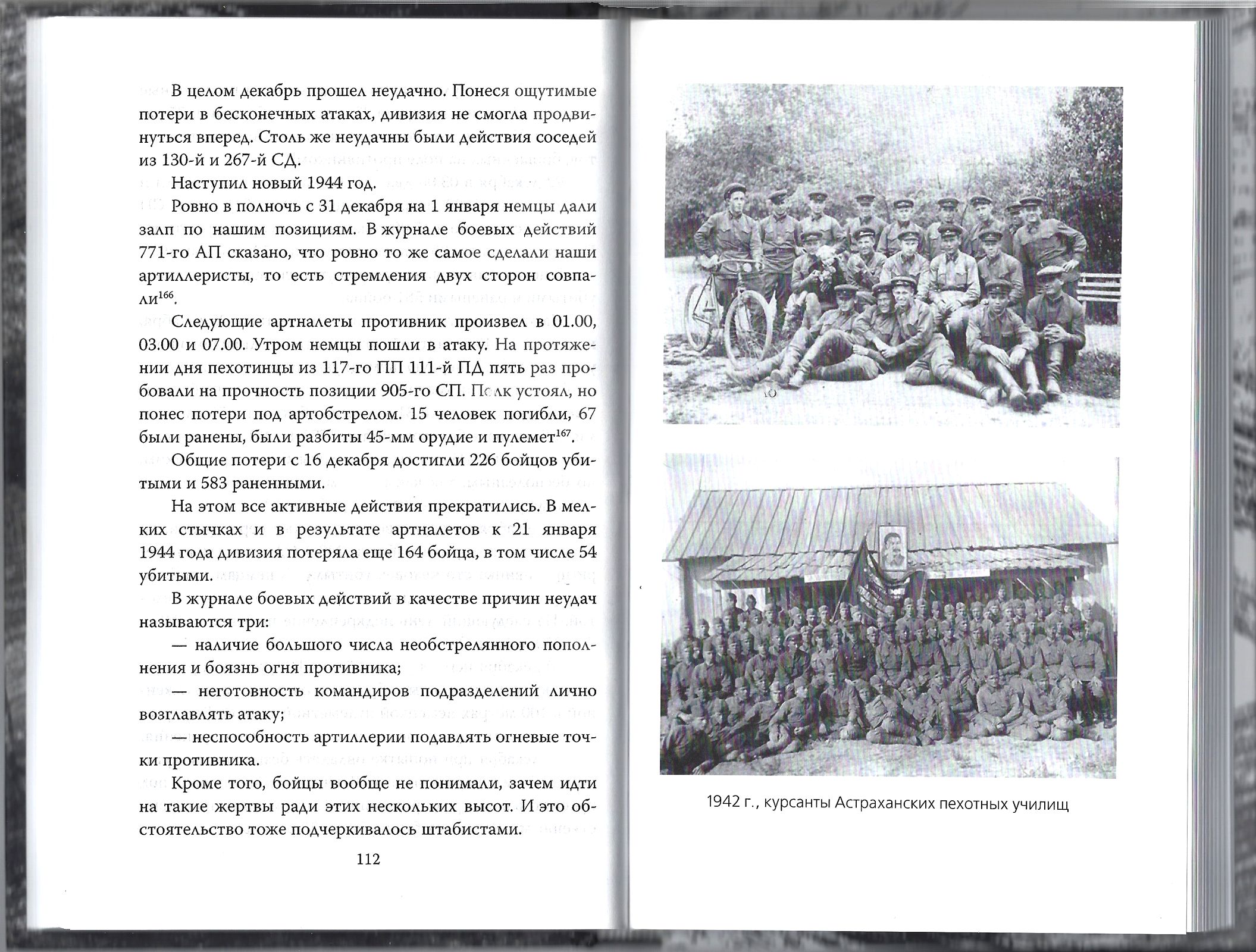
The resources of the Astrakhan military schools were
used first. Military personnel had already been trained in Astrakhan
for two and a half years.4
The cadets were taught the basics of military affairs
and studied small arms, machine guns, and mortars, but they had not
seen artillery systems. They mainly trained with the Mosin rifle, PPD
and PPSh submachine guns, RGD-33 and RG-42 grenades, and F-1
“pineapple” grenades. Tactical and drill training was
conducted every day.
At 8:00 a.m. on August 6, the cadets of the 1st
Infantry School of Colonel Ivan Ivanovich Shapkin5 occupied a defensive
line northwest of Astrakhan in the
Streletsky–Durnoye6–Dzhakuyevka area. This marked the
beginning of the 1st Composite Cadet Regiment, later renamed the 899th
Rifle Regiment and transferred toward Yenotayevka.
In total, the school had fourteen reinforced
companies of 160 men each. Excluding the sick and those left at the
school, 1,882 men went to the front, including 1,743 cadets. Their
armament left much to be desired: 882 rifles, 62 submachine guns, 18
light and 9 heavy machine guns, only six guns (two 75-mm and four
45-mm), 38 mortars (two 120-mm, eight 82-mm, the rest 50-mm), and 14
antitank rifles. These figures show that there was only one rifle or
submachine gun for every two men.
The regiment lived up to the description
“infantry”: for two thousand men it had six motor vehicles
and one tractor.7 The cadets were not spoiled with uniforms either,
though they were supplied with peaked caps with enormous crowns and red
infantry bands. The cadets marched into the steppe proud of the chance
to demonstrate what they could do. In fact, they could be called cadets
only conditionally. As the regiment’s chief of staff, Captain
Danilov, noted, “the regiment is manned by young cadets of the
1st Astrakhan Infantry School who have completed only a ten-day
training program.”8
The next day, August 7, at 2:30 p.m., the 2nd
Composite Cadet Regiment began moving out of the city. It was formed on
the basis of the 2nd Infantry School of Colonel Mikhail Semenovich
Yurgelas and the Astrakhan Aviation Technical School for Mechanics.9
Yurgelas’s regiment, later renamed the 902nd Rifle Regiment, took
up positions astride the Elista road near Yango-Asker. The regiment had
100 officers and 1,637 enlisted men.10
In addition, on August 14 an advance detachment of
the 2nd Cadet Regiment under Senior Lieutenant V. M. Alyabyev was sent
in eight trucks to the Yashkul area. It took up defensive positions
there and seized the junction of six roads leading west, east, and
north from the settlement. Soon the detachment redeployed to the
Znamenya Borby state farm. In the steppe Alyabyev found scattered
groups of horsemen from the 110th Kalmyk Cavalry Division. Alyabyev had
a rifle company, a platoon of heavy machine guns, and two antitank
guns, most likely 45-mm guns. In all, one hundred men blocked the road
to Astrakhan. Adrenaline surged in the cadets’ blood. Those among
them who survived the war always recalled with pride their service in
Alyabyev’s detachment.
The 78th Fortified Region was supposed to send tanks
to support the detachment, but in oil-filled Astrakhan there was no
fuel for the tanks.11 Moreover, the tanks were short of machine-gun
magazines and had no shells for their guns at all.12
The Germans had difficulties of their own. At
Führer Headquarters there was a fierce debate over which direction
should be considered the priority—the Caucasus or Stalingrad. The
decision was ultimately made to operate in both directions. Under such
a scenario, allocating sufficient forces for a breakthrough toward
Astrakhan was extremely difficult. Nevertheless, the fresh 16th
Motorized Division was transferred there. Its authorized strength was
14,000 soldiers and officers, 56 field guns, 108 mortars, 73 antitank
guns, and 2,415 vehicles and tractors. The division was reinforced by
Captain Tebbes’s 116th Tank Battalion: eight PzKpfw IVs,
thirty-five PzKpfw IIIs, and ten light PzKpfw IIs.13 The IIIs and IVs
were armed with long-barreled 50-mm and 75-mm guns.
Astrakhan was fortunate that the redeployment of the
16th Motorized Division, which had been engaged farther south, took a
couple of weeks. The forward units of the 16th Motorized Division did
not arrive in Elista until August 26. After that, events developed more
rapidly.
Already on the evening of August 26, motorcyclists of
the Laroche combat group from the 16th Motorized Division replaced an
infantry battalion of the 370th Infantry Division at Ulan-Erge, 45 km
east of Elista.
By that time, at Yashkul farther east, the Astrakhan
road had been blocked by airborne troops of the 107th Guards Rifle
Regiment of the 34th Guards Rifle Division, transferred to the Kalmyk
steppes from the Moscow region. South of Yashkul, combat security was
provided by Alyabyev’s cadet group.
On August 28, the advancing 16th Motorized Division,
using the forces of the 60th Motorized Regiment, captured Yashkul; on
August 29 it took Utta, and on August 30 Khulkhuta. The Guards suffered
105 killed and about 250 wounded.14 At the beginning of September, the
152nd Separate Rifle Brigade arrived. On September 5–6, a meeting
engagement took place in the Armazryk sands, causing serious losses to
both sides and forcing them to shift to positional warfare east of
Khulkhuta.
The Astrakhan cadets, apart from Alyabyev’s
mobile group, did not take part in these events. The 1st Composite
Regiment was then holding the defile of the Sarpinsky Lakes, while the
2nd Composite Regiment stood in the second line near Yashkul.
At the Sarpinsky Lakes
On August 16, the 1st Composite Cadet Regiment left
the Astrakhan Kremlin, passed along Kosa, the old quarter of hotels,
cafés, and merchants’ mansions, and boarded barges to
cross the Volga. The regiment was to move 300 km northward to the
Sarpinsky Lakes, where the surviving units of the 51st Army were
digging in.
On August 21, the advance detachment of the 1st
Composite Regiment, numbering 309 men, reached its destination at Lake
Sarpa. The cadets deployed near Farm No. 1, the Tsatsan-Usun well, and
the Orsa Khag tract. The detachment was commanded by Captain Postnov.
The regiment’s chief of staff, Captain Rodimov, reported to
Astrakhan: “Within a radius of up to 100 km from State Farm No. 1
Sarpa, armed bandit detachments numbering 5–30 men are operating.
Reconnaissance has established that in the vicinity of State Farm No.
10 up to 7,000–8,000 head of livestock are wandering unattended
in the fields. The advance detachment is evacuating them
eastward.”15
The evacuation did not proceed smoothly. On August
22, near Omn Keryulchi, the 1st Composite Regiment suffered its first
losses in a clash with local residents: Junior Lieutenant Chistyakov
and Red Army soldier Brovin were killed.16
On August 24, Major Shcherbak’s cadets suffered
further losses. At 10:00 a.m. a German aircraft flew over Sarpa and
dropped a bomb. Two soldiers, Pyotr Andreyevich Kudiyarov and Boris
Vladimirovich Pedan, were killed. They were buried in the cemetery at
Tsagan-Usun-Khuduk.17
On August 27, during another air raid on State Farm
No. 10, four bombs were dropped. Medical orderly Raisa Kurbanova was
seriously wounded by an explosion. She did not recover from her
injuries and was buried in Yusta.18
Because Astrakhan was very far away, Shcherbak asked
the 91st Rifle Division of the 51st Army, positioned on his right, for
support with food and fuel. Assistance was provided, and on a
continuing basis.
Formation of the 248th Rifle Division
At this time the 2nd Composite Cadet Regiment was
deployed in the Davsna–Krasny Khuduk area, forming the second
echelon of the Khulkhuta front.
On September 5, the units defending the Lower Volga
were consolidated into the 28th Army. The core of the new army
consisted of the 34th Guards Rifle Division and the 152nd Separate
Rifle Brigade, which had been fighting near Khulkhuta. On September 10,
the 248th Rifle Division, with three regiments, was formed on the basis
of the cadet regiments of the Astrakhan Military School. The cadet
regiments formed its core: the 1st Composite Rifle Regiment was
redesignated the 899th Rifle Regiment, and the 2nd Composite Rifle
Regiment became the 902nd Rifle Regiment.
The 905th Rifle Regiment was created on September 3
at a base in Moshaik, an eastern Tatar suburb of Astrakhan. Its
officers arrived from the personnel department of the Stalingrad
Military District. Half of the officers had already fought and came
from hospitals; the others were supplied by the Astrakhan infantry
schools. The enlisted men—1,300 people—arrived on September
10, and the sergeants on September 19. The regiment was extremely
diverse: twenty-seven nationalities, ranging in age from nineteen to
forty-three.19 “All of this was raw, untrained material with
different habits, customs, and ways of life.”20
The same, however, could be said of the entire division.
In addition to the three rifle regiments, the
division was assigned the 771st Artillery Regiment. The regiment formed
very slowly and spent a remarkably long time searching for a place to
deploy on different outskirts of Astrakhan until it was decided to
settle in the right-bank settlement of Trusovo. Major Mironov became
the regiment commander. Means of transport—300
horses—arrived from the Tashkent Cavalry School. The regiment
continued to be equipped until the beginning of October because the
Luftwaffe controlled the sky over the railway and some of the arriving
guns were damaged in bombing raids.21 No tractors ever arrived, so
camels were used to tow the heavy howitzers. The camels proved
difficult. They refused to pull the harness together, and the drivers
had to place the more disciplined horses in front of the “ships
of the desert.”
Command of the formation was entrusted to
thirty-nine-year-old Colonel Leonid Alexeyev. Leonid Nikolayevich
Alexeyev was born on the outskirts of St. Petersburg, took part in the
Civil War on the side of the Red Army in his youth, and after the
fighting ended enrolled in artillery courses. From that time on, his
entire life was connected with the army. He studied, became a career
officer, and by the summer of 1941 commanded the artillery of the 162nd
Rifle Division in Kharkov. After the outbreak of war, Alexeyev was
transferred to the Western Front and lived through the difficult days
of the Battle of Smolensk while commanding the artillery of the 127th
Rifle Division. The division participated in the successful
counterattack near Yelnya and was converted into a Guards formation;
Alexeyev was promoted to deputy division commander. In June 1942 he was
transferred to Stalingrad to command a militia being hastily formed
from local men, and from there he was sent to command the equally
hastily created 248th Rifle Division in Astrakhan.
The 248th Division created near Astrakhan in the
early autumn of 1942 was already the third formation to bear that
number. The previous two had been destroyed in the first year of the
war.
The first formation of the 248th Rifle Division,
operating on the Moscow axis in October 1941 under General K. A.
Kovalenko, was almost completely destroyed near Vyazma—only 681
men remained. In May 1942, the second formation of the 248th Rifle
Division took part in the tragic offensive near Barvenkovo, was
encircled, and almost entirely perished. V. Kalenda, chief of staff of
the 902nd Rifle Regiment, for example, escaped from the encirclement
accompanied by only five soldiers.
In September 1942 the division was re-created for the
third time. It had no experienced fighters. It consisted of enthusiasts
whom different circumstances had brought to dusty southern Astrakhan
during that hot summer. Cadet Andrei Dzhimbev, a native of Lagan who
had enrolled in six-month officer courses at the Astrakhan Infantry
School, recalled: “Our 902nd and 905th regiments were cadet
regiments; cadets who had not completed their training ended up in
them, all very young, eighteen-year-old boys. Those who had studied for
two and a half months received no ranks, while those who had studied
about two months longer than us were given sergeant ranks.”22
Composition of the 248th Rifle Division: •
899th, 902nd, and 905th Rifle Regiments, • 771st Artillery
Regiment, • 302nd Separate Antitank Battalion, • 323rd
Reconnaissance Company, • 442nd (412th) Engineer Battalion, •
664th Separate Signals Battalion (241st Separate Signals Company),
• 277th Medical-Sanitary Battalion, • 242nd Separate Chemical
Defense Company, • 175th Motor Transport Company, • 469th
Field Bakery, • 74th Divisional Veterinary Hospital, •
16200th (1803rd) Field Postal Station, • 7208th Field Office of
the State Bank.
First Clashes
On September 1, Captain Postnov, defending near State
Farm No. 1 Sarpa, reported the destruction of his reconnaissance
detachment.23 A seventeen-man detachment in a truck had been sent
southward on reconnaissance from Yusta. After covering a couple dozen
kilometers, the driver suddenly came face to face with a German tank.
The Germans opened fire and set the truck ablaze, then captured all the
soldiers. “One cadet (Nikolai Morozov) was put on a motorcycle
and taken to headquarters as a prisoner for interrogation. The
remaining sixteen men, led by platoon commander Lieutenant Polyakov,
were machine-gunned and then finished off with a pistol.”24
On September 2, cadet Nasibulin Bakeyev was found in
the steppe with a wound to his forearm; he told how the detachment had
been destroyed. Meanwhile, other scouts encountered the same German
detachment and suffered four wounded. According to their observations,
the German column consisted of three tanks, ten trucks, and several
motorcyclists. They were moving toward Yenotayevka. This was Lieutenant
Euler’s group: an armored personnel carrier armed with a 20-mm
cannon, a motorcycle platoon of twenty-four men, a self-propelled gun
with a 20-mm weapon, five trucks—two carrying fuel, two water,
and one food—an all-terrain vehicle with a repair and recovery
team, and an ambulance.
On September 2 at Kharba, a lieutenant of the VNOS
air-observation, warning, and communications service reported the
discovery of two tanks, four armored personnel carriers, and six trucks
carrying infantry. The Germans were moving east toward Yenotayevka but
became bogged down in the sand and were forced to return to Kharba
before withdrawing farther south. On the same day, officials of the
Elista city committee of the Communist Party who were collecting
livestock ran into the German group. Since mid-August they had been
based in Yenotayevka, and now they had driven into the steppe toward
Yusta in four ZIS-type vehicles. There they encountered a German unit,
which they estimated at ten armored personnel carriers and fifteen
motorcycles. Of twenty-three people, four died in burning trucks, six
were wounded, and three were taken prisoner. The fate of the rest
remained unknown. This was reported by ZIS driver Olkhovsky, who
reached the village of Lenino in Yenotayevka District late in the
evening of September 2.25
The following day, the German group was observed
15–20 km southwest of the village of Vostok, while Kalmyks
following it drove livestock found there westward. The Germans then
moved on. They came within only nine kilometers of Yenotayevka,
stopping one kilometer from the wooden cottages of the village of
Vladimirovka. Astonished fishing families watched the armored vehicles,
seemingly emerging from the sands and gleaming steel in the sunlight.
Contrary to local fears, however, the Germans turned the detachment
around and headed west. One and a half kilometers short of Kharba, it
turned toward Bergin, near which it stopped for the night.26
On September 4, aerial reconnaissance detected three
tanks and twenty vehicles near Kharba moving around Buykegachi. To
clarify the situation, two vehicles carrying fearless scouts of the
899th Rifle Regiment set out into the steppe toward Kharba and the
unknown.
On the same day, motorized infantry from the 156th
Motorized Regiment attacked the cadet positions at State Farm No. 1
Sarpa. The Germans had ten tanks, four armored personnel carriers, and
six trucks carrying infantry and were attempting to reconnoiter the
road to Tsagan-Aman on the Volga. Two cadet companies and the
supporting rifle company of the 91st Rifle Division withdrew but
reoccupied the state farm that evening. Another German
detachment—or, more likely, the same one—consisting of
seven tanks, fourteen motorcyclists, and seven trucks occupied
Prisarpinsky, while four vehicles carrying infantry entered
Kizil-Khusun and fired on an outpost of the 115th Kabardino-Balkar
Cavalry Division. The next day the German column withdrew to the
southeast.27
On September 10, the same German detachment
approached State Farm No. 1 Sarpa from the south: five tanks and two
armored personnel carriers. Another armored group appeared to the
northeast. The Germans occupied Khanata, while near Zurgan the men of
the 16th Motorized Division were met by Astrakhan cadets—two
rifle companies of Captain Postilov’s 2nd Battalion. At five in
the afternoon, a battle began on the sun-scorched shores of the
Sarpinsky Lakes.
According to the recollections of N. I. Mordasov, who
served in the reconnaissance group of the 2nd Battalion, German
motorized infantrymen jumped from their trucks and attacked in a
skirmish line the comrades of Mordasov who had occupied trenches.
Encountering fire resistance, they abandoned the idea of pushing
forward and departed for Khanata. The Germans somewhat exaggerated the
strength of the screen. The cadets had only five to eight cartridges
for each rifle.28
Meanwhile, along the western shore of Lake Sarpa
passed a column of ten trucks escorted by one armored personnel
carrier. One of the trucks towed an antitank gun. Slightly farther
north Romanian cavalrymen appeared, but they were stopped by cavalrymen
as well—Kabardians from the 115th Cavalry Division.29
At 1:55 p.m. on September 11, the Germans conducted
reconnaissance northwest and southwest of Yusta. They were secretly
observed by Lieutenant Gudz’s patrol, which had driven into the
steppe in two vehicles for a free-ranging raid. The cadets unexpectedly
attacked the Germans, destroying the entire enemy group except for
seven men who were taken prisoner. Two heavy machine guns were also
captured.30 On the evening of September 11 at 6:00 p.m., a company of
German motorized infantry reconnoitered the fighting near Kharba, west
of Yenotayevka. After a brief exchange of fire, the Germans withdrew
northwest.31
All these events caused concern in the Soviet
command. The cadets were inexperienced, poorly armed, and immobile, and
it would have been reckless to rule out an enemy breakthrough to the
Volga in the Tsagan-Aman–Nikolskoye sector. Aviation forces were
sent to assist the men of the 899th Rifle Regiment. At 1:55 p.m. on
September 14, a flight of Il-2 aircraft led by Senior Lieutenant
Goverdovsky of the 232nd Ground-Attack Aviation Regiment found a German
mechanized group near Bergin—seven armored personnel carriers,
fifteen vehicles, and fifteen motorcyclists. Delighted, Goverdovsky
dived on the target, followed by the other pilots. Over the next half
hour the attack aircraft dropped sixteen FAB bombs, fired twenty-two RS
rockets, and expended 750 Yartsev cannon rounds. According to the
flight commander’s estimate, his group set twelve vehicles on
fire, knocked out two armored personnel carriers, and destroyed five
motorcycles.32
It is difficult to judge how much damage was
inflicted on the mobile reconnaissance of the 16th Motorized Division,
but Euler’s group, which was most likely the one spotted by
Goverdovsky’s pilots, turned southeast. Bypassing Yenotayevka, it
approached Dzhakuyevka. Astrakhan was 35 km away, and the Volga only 7
km.33 This unit advanced farther east than any other Wehrmacht group.
Near Dzhakuyevka, Euler saw an antitank ditch and bunkers arranged in a
checkerboard pattern. In a brief clash, Euler captured two prisoners,
including an officer, and then withdrew toward Khulkhuta.
Bergin
After the German reconnaissance raid on Lenino, the
8th Cadet Company was moved forward to Bergin, a remote Kalmyk
settlement of eighty households. Bergin lies 50 km west of the Volga
and 130 km south of Sarpa. It is an utterly isolated, forgotten place,
surrounded only by wormwood-covered steppe. Yet six steppe roads
converged at Bergin, and from there a direct road led to Yenotayevka
and the Astrakhan–Stalingrad highway. The only landmark was a
thirty-meter-high triangulation tower, which was immediately designated
as an observation post.
Fifty-three soldiers under Lieutenant Nozdrin,
equipped with thirty-eight rifles, ten submachine guns, one light
machine gun, and four antitank rifles, took up positions there in the
warm September weather.
On one occasion—this episode is described only
in the regiment’s “Combat Path” and carries no
date—German tanks appeared from the west. The cadets often
mistook armored personnel carriers for tanks, but in this case that is
unimportant. What matters is that the soldiers managed to knock out the
lead vehicle and created the impression of such a serious garrison that
the Germans did not continue their advance. They turned west, towing
the damaged vehicle with them.
On another occasion, a vehicle carrying armed men
suddenly burst into the settlement. Naturally, the cadets opened fire
and stopped only after groans and obscene shouting in Russian were
heard from the vehicle. It turned out that the garrison had simply been
forgotten. Higher headquarters believed the Germans had destroyed
Nozdrin’s detachment and sent reconnaissance there, whose members
had decided to drive in at speed.
That was not the end of the story. The next day Il-2
aircraft appeared in the sky. They made an attack run and bombed the
settlement, blowing eight households to pieces. There were no
casualties among the cadets or local residents because everyone fled
into the steppe as soon as the air raid began.
Otherwise, the detachment served as a screen against
raids by pro-German mounted groups formed from part of the local
population. In one clash, a prisoner was captured, after which forty
cadets mounted horses and headed toward a remote farm where an enemy
detachment was located. After surrounding the farm, the cadets stormed
it at two in the morning, killing twelve enemy fighters and putting the
rest to flight.34
The 899th Rifle Regiment at the Sarpinsky Lakes
On September 11 near Sarpa, four servicemen of the
60th Motorized Regiment were taken prisoner. This event, unusual for
the early stage of the war, encouraged Soviet commanders to take more
decisive action.
On September 16, a Soviet patrol dressed in German
uniforms and traveling in German trucks reconnoitered the area toward
Omn Keryulchi.35 Major Durnev, commander of the 503rd Rifle Regiment of
the 91st Rifle Division, who had distinguished himself in the fighting
near Elista, had long had his eye on this isolated strongpoint of the
16th Motorized Division. Apparently on his initiative, on September 17
the headquarters of the 115th Cavalry Division, which covered the gap
between the 91st and 248th Rifle Divisions, approved an order to
destroy the German garrison at Omn Keryulchi. For this purpose, a
composite detachment was formed from a company of the 91st Rifle
Division, a composite squadron of the 115th Cavalry Division, and a
company of the 899th Rifle Regiment of the 248th Rifle Division,36 with
reinforcing weapons.
At two in the morning on September 18, a company of
the 899th Rifle Regiment and a company of the 91st Rifle Division,
under the combined command of regimental commander Major Durnev, who
personally led the risky operation, reached a road fork five kilometers
southeast of the settlement. The cadets stood slightly to the left. One
cadet platoon was pushed three kilometers farther south, while one
squad with a light machine gun was placed to the west for cover. The
remaining forty cadets were to attack Omn Keryulchi from the southwest,
while the company of the 91st Rifle Division attacked from the south
and southeast. A reconnaissance group was sent toward Shokta through
Tsatsa-Khogun.
The cavalrymen of the 115th Cavalry Division were
ordered to concentrate near a sheepfold four kilometers northeast of
the settlement. As a precaution, two sections of the squadron
dismounted and deployed a little farther north, covering the area of
the operation against possible German reinforcements: twelve men with a
machine gun took positions at the Dund-Keryulchi road fork, while
fifteen men with a machine gun and an antitank rifle deployed on the
graded road along the northern shore of the Borea and Kimgin limans.
Four kilometers farther northeast stood Lieutenant Poluyanov’s
group. It protected the command post of the 115th Cavalry Division,
which had moved directly to the scene. Each unit was assigned a guide
from among the local residents.
At 3:00 a.m., green rockets rose into the night sky.
Without shouting “Hurrah,” our soldiers moved forward.
Pieces of white cloth had been tied around their sleeves so they would
not shoot one another in the darkness. Making extensive use of hand
grenades, they broke into the positions of the 2nd Company of the 60th
Motorized Regiment. Communications between the German garrison and
Elista had been cut in advance.
In the brief battle, the garrison was completely
destroyed. Up to one hundred Germans were killed or wounded; thirteen
motor vehicles, including two passenger cars, four motorcycles, three
guns, four machine guns, one mortar, two radio receivers, up to twenty
rifles, and a substantial quantity of ammunition were captured.37 Two
passenger cars, three trucks, and an all-terrain vehicle were
destroyed. Soviet losses were minimal—five killed and eleven
wounded.38
The command of the 16th Motorized Division learned of
the incident only twelve hours later from a signalman who happened to
survive. The pursuit achieved little. Wilhelm Tieke, however, writes
that the reinforced 2nd Battalion of the 156th Motorized Regiment,
accompanied by an engineer company, managed to catch up with a lagging
Soviet group near Zhaska. In the engagement the Germans captured four
trucks, two of which had previously belonged to the 60th Motorized
Regiment, and four antitank guns. The Germans destroyed another
antitank gun. The combat journal of the 91st Rifle Division describes
the episode differently: “By the end of the day, the 503rd Rifle
Regiment at State Farm No. 1 Sarpa was attacked by sixty enemy vehicles
and eight tanks. The mobile detachment of the 503rd Rifle Regiment
withdrew to Tsagan-Nur. Our losses: one killed, two wounded; two 45-mm
guns, one captured gun, and five vehicles destroyed.”39









 Russian