Yandex Publishing + History of the Future — “The Real 1945”
Vladimir Gelfand
Red Army soldier; took part in the liberation of Poland and in combat
operations in Germany. Vladimir Gelfand's blog is part of the
“The Real 1945” project by the History of the Future
studio, created with the support of Yandex Publishing.
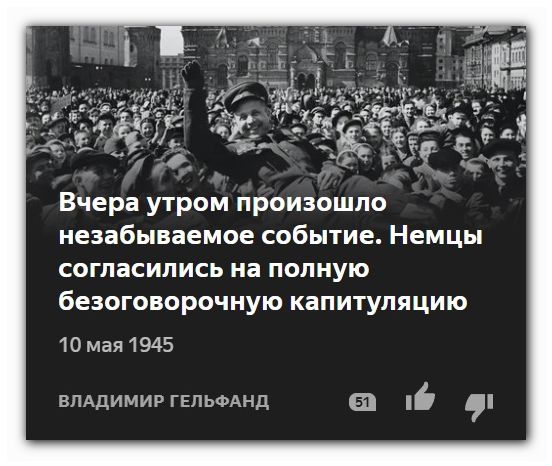
Yesterday morning an unforgettable event took place. The Germans agreed to complete and unconditional surrender
10 May
Soldier. May 10, 1945
Published as part of the “The Real 1945” project
Yesterday morning an unforgettable event took
place. The Germans agreed to complete and unconditional surrender. The
newspapers reported it sparingly but solemnly.
ITAR-TASS News Agency / Alamy Stock Photo
Source: Vladimir Gelfand, Diary 1941–1946. Moscow: ROSSPEN/Knizhnik, 2015.
It was pleasant and cheerful to listen to the
marches, all the more because the performers themselves made a very
amusing company
8 May
916 views. Unique page visitors.
415 full reads, 45%. Users who read to the end.
1 min. Average time to read the post.
Mortar platoon commander. Berlin, May 8, 1945
The orchestra under the direction of bandmaster
Senior Lieutenant Grichin thundered its marches across the entire
square. It was pleasant and cheerful to listen, all the more because
the performers themselves made a very amusing company.
Suddenly the orchestra fell silent. An alerting
“Dress ranks!” swept through the formation, then
“Attention!”, and to the surge of a turbulent, bubbling
march the division commander, Hero of the Soviet Union Colonel Antonov,
galloped into the square on horseback. For a moment the fiery sun
emerged from behind the clouds and, reflected in the many orders and
medals on his chest, blinded us. Look, there he is, your commander!
— and then it vanished again, hiding in the wet clouds.
As Antonov rode along the ranks, greeting his
regiments — “Greetings, Stalin's heroes!” — the
square roared in reply, the air thundered and shook with “We wish
you good health, Comrade Colonel!” The nervous horse reared, not
understanding all the greatness of its master, and shuddered
resentfully all over — it did not like this ceremony.
And when the final greetings had thundered away,
when a mighty threefold “Hurrah!” rolled through the ranks
and escaped into space, the colonel dismounted and, drawing his sabre,
brought it to his shoulder; then, swinging his elbows and holding the
sabre, he headed for the front of the column.
I marched in the third row behind the colonel. I enjoyed this closeness to the man, however limited it was.
“Attention!” Antonov commanded after
dismounting and drawing his sabre in salute to the visiting generals. A
tall, stately major general, a Hero of the Soviet Union, accompanied by
two colonels and the short, stout division commander of the 248th Rifle
Division, also a major general, walked along the ranks, greeting each
regiment and unit separately.
They came up to us: “Officers without
decorations — what, are there none?” Antonov began to make
excuses, while I longed to step forward and say aloud: “Yes,
Comrade General, there are no decorations. There is nothing to be proud
of; all I have carried away from so many bloody, dangerous battles is
pain and bitterness.” But I restrained myself, because I
understood that I would achieve nothing by it, only compromise the
division commander and provoke his anger; and if he wished, he could
blacken my name, portray me as a scoundrel, a criminal, or anything
else he could think of — after all, he would have to defend
himself somehow.
The general and his entourage went toward the
table that served us as a reviewing stand. I was interested in the
small major general. Who was he? I had never seen him before. Probably
a political officer or a doctor. Not a line officer, because when he
saluted he held his hand barely at face level.
Source: V. N. Gelfand, Diaries 1941–1946 // Samizdat magazine, 2004.
I became a presentable-looking man. Only my trousers were very dirty, and that spoiled the whole impression
7 May
1.6k views. Unique page visitors.
828 full reads, 49%. Users who read to the end.
30 sec. Average time to read the post.
Soldier. Berlin, May 7, 1945
Published as part of the “The Real 1945” project
Today there was a parade of the division's units.
The chief made me attend as well. Major Yarovoy lent me his cap, and I
became a presentable-looking man. Only my trousers were very dirty, and
that spoiled the whole impression.
I am terribly untidy in every respect. There is
disorder in my head, the same with my papers, and my belongings remain
in a permanent chaotic state. But I will say no more about myself:
well, I got my uniform dirty, well, I cannot look after myself —
in short, I am a slob. But I did attend the parade.
Our group of staff officers was at the very head
of the divisional column and was a mixture and tangle of different
officer ranks, specialties and posts: majors, lieutenants and captains;
signalmen, chemical-service officers, submachine-gunners, journalists,
the chief financial officer, the prosecutor, and so on and so forth.
We do not know how to march properly.
Source: Vladimir Gelfand, Diary 1941–1946. Moscow: ROSSPEN/Knizhnik, 2015.
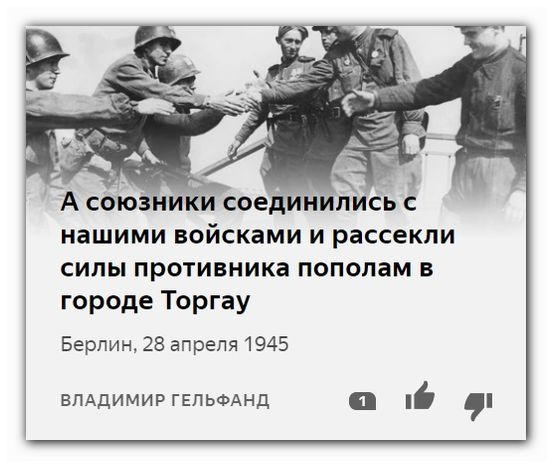
The Allies joined up with our troops and split the enemy forces in two at the city of Torgau
28 April
1.3k views. Unique page visitors.
637 full reads, 47%. Users who read to the end.
40 sec. Average time to read the post.
Mortar platoon commander. Berlin, April 28, 1945
Published as part of the “The Real 1945” project
The streets of Berlin are noisy and crowded. The
Germans, every one of them, wear white armbands. They are no longer
afraid of us and stroll openly through the streets. So much is
happening, and the events are so powerful and impressive that it is
difficult to put them into words. General Berzarin, my army commander,
has been appointed commandant of Berlin and has already issued an order
and appeal to the local population, demanding that it establish a
peaceful life and resume work.
And the Allies have joined up with our troops and
split the enemy forces in two at Torgau. The three heads of government
announced this to their troops in a special appeal, calling on them to
direct their efforts toward the final blow against the enemy.
I have just been in the underground. Very
interesting! Underground corridors extend in several rows or levels. On
the second level down there is railway track on both sides.
Source: V. N. Gelfand, Diaries 1941–1946 // Samizdat magazine, 2004.
Around the palace there is an entire
settlement of large, beautiful buildings. It is hard even to imagine
how one man could live here and possess such wealth
18 April
43k views. Unique page visitors.
19k full reads, 45%. Users who read to the end.
40 sec. Average time to read the post.
Red Army soldier. Near Berlin, April 18, 1945
Published as part of the “The Real 1945” project
The palace of a German nobleman — luxury and magnificence.
The road is congested and there is only one route.
On all the other roads the bridges have been blown up and it is
impossible to pass. We are forced to stay here overnight.
The palace is almost entirely intact, with only a
small breach in one place. A mirror-like pond surrounds the palace on
all sides, and the building itself is beautifully reflected in the
water. Greenery, greenery, greenery. The rooms are enormous. There are
so many of them, and all are rich with fine furnishings, chandeliers,
cupboards, shelves and, finally, books. Paintings hang on every wall.
Around the palace there is an entire settlement of
large, beautiful buildings. It is hard even to imagine how one person
could live here and possess such wealth. From now on, however, all of
this is ours, all Soviet, and it is so joyful today to feel the
greatness of our victory.
Yesterday on the road we overtook the wagon train
of the third battalion. My heart jolted: on the carts I saw several men
from my mortar company. The road was clogged, and we happened to stop
not far from them. The mortar men said that the entire company had been
put out of action: Kanonenko, his orderly and several other men had
been killed. Rysev, Shitikov and all the rest, with the exception of
six men, had been wounded.
Thus tragically ended the existence of the mortar
company in which I had sought glory and which, after becoming renowned
with my help and participation, left me on the sidelines.
The fighting is not far from here, but
representatives of the army, the front and the corps are already here,
and there are so many vehicles and people all around that it is
crowded. Everyone wants to get to Berlin as quickly as possible; the
wagon trains are catching up with the forward units, and the rear
services are catching up with the wagon trains. Berlin is not far now
— forty kilometres, perhaps even less.
Source: V. N. Gelfand, Diaries 1941–1946 // Samizdat magazine, 2004.
All night I did not close my eyes for a single second. Even if I have not slept, to Berlin — absolutely!
16 April
687 views. Unique page visitors.
327 full reads, 48%. Users who read to the end.
20 sec. Average time to read the post.
Red Army soldier. April 16, 1945
Published as part of the “The Real 1945” project
The enemy is nervous; he senses what is coming.
Major Zhadreyev says that by this evening we should be in Berlin. The
work will begin at five o'clock. I am officer of the day, so I will not
get to sleep during the daytime either. All night I did not close my
eyes for a single second, and all night a girl typist slept at my feet.
Someone deliberately put out the lamp when I stepped out of the room
for a moment, but even then I did not fall asleep.
Keeping the combat journal is not so difficult
when the necessary material is available. But everything here smells of
a brothel — people write illiterate, empty reports, and it is
hard to transform such rubbish in one's mind.
Even if I have not slept, to Berlin — absolutely!
Source: V. N. Gelfand, Diaries 1941–1946 // Samizdat magazine, 2004.
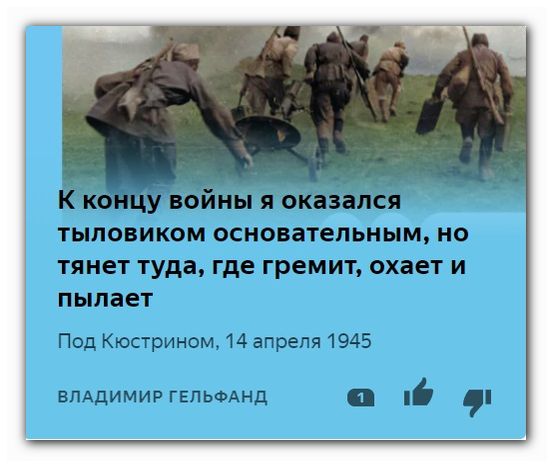
By the end of the war I had become thoroughly a rear-area man, but I am drawn to where it thunders, groans and burns
14 April
654 views. Unique page visitors.
527 full reads, 81%. Users who read to the end.
30 sec. Average time to read the post.
Red Army soldier. Near Küstrin, April 14, 1945
Published as part of the “The Real 1945” project
Combat journal — the journal of military operations. I spent the whole day preparing the division's combat journal.
Our artillery gave the Germans a concert that was
not especially strong, yet even that affected the enemy so much that he
withdrew much farther than our command had expected. A complete
surprise: many prisoners. There are wounded on our side as well. Our
section will now move farther forward. The regiments and the division
commander are far away — about three kilometres from here. The
artillery is developing the success; even “Ivan the
Terrible” has just puffed at the enemy. The explosions are far
away; they cannot even be heard. Apparently the enemy is about six
kilometres from here, though everything will become clear on the spot.
By the end of the war I have become thoroughly a rear-area man —
I am never closer than two or three kilometres to the enemy. But this
prospect does not please me, and I am drawn to where it thunders,
groans and burns.
Source: V. N. Gelfand, Diaries 1941–1946 // Samizdat magazine, 2004.
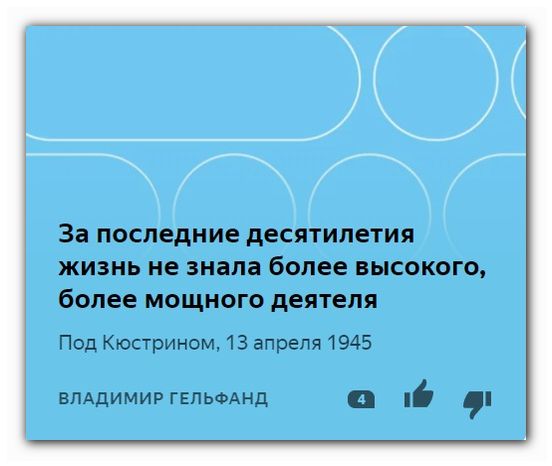
In recent decades life has known no greater, more powerful figure
13 April
1.1k views. Unique page visitors.
487 full reads, 42%. Users who read to the end.
40 sec. Average time to read the post.
Red Army soldier. Near Küstrin, April 13, 1945
Published as part of the “The Real 1945” project
Bridgehead beyond the Oder, west of Küstrin.
The postman has just brought the most tragic and
bitter news for me of all the reports from abroad: Roosevelt has died.
How I always respected and valued him for his charming, intelligent
nature, for his exceptional popularity among Americans, which allowed
him to rise above all American politics and above all the politicians
of the anti-democratic opposition. He alone managed to turn American
policy sharply and decisively away from fascism and reaction, to make
the American citizen turn away from all the large and small anti-Soviet
slanderers and national renegades who wanted to return civilized
America to the old laws of slave-like, inhuman existence.
Roosevelt — the all-American, the universal
man — therein lay his enormous strength and greatness. In recent
decades life has known no greater, more powerful figure. In one of his
last, very popular speeches, Roosevelt seemed to prepare the world for
this tragic news, saying that one must be prepared for every kind of
surprise.
All the policy of the United States in recent
years rested on Roosevelt. Roosevelt was the triumph of American
democracy, its magnitude and its face. He has no equal abroad, and the
Englishman Churchill is not the equal of the brilliant Roosevelt
— not in intelligence, stature, popularity throughout the world,
or even among his own people.
Who will replace Roosevelt? What will the
political face of America become now — I deliberately do not say
“the USA”? Will the bitter political struggle between the
Democrats and reaction resume, and how will it end if that does happen?
Many fears arise now, but there is also something reassuring: the
progress of our allies' military operations at the front. It will be
difficult for reaction now to turn the wheel of history back, however
hard it tries; and may the death of President Franklin Delano
Roosevelt, however grievous and unwelcome it is to every honest person,
not affect our great victorious movement forward toward happiness,
greatness and life.
Eternal memory to Roosevelt, my beloved foreign statesman. I bow my head, burdened by the bitterness of loss.
Source: V. N. Gelfand, Diaries 1941–1946 // Samizdat magazine, 2004.
So this is what you are like now, Küstrin. I do not rejoice at your ruins, but with all my heart I welcome your fall
12 April
1k views. Unique page visitors.
594 full reads, 55%. Users who read to the end.
50 sec. Average time to read the post.
Red Army soldier. April 12, 1945
Published as part of the “The Real 1945” project
At last, in Küstrin. I inspected it today: a
large city, but destroyed to the ground. Here and there cellars have
survived, and occasionally the ground floors of once enormous buildings
— an answer to Stalingrad, though a milder one; in Stalingrad
even the cellars were wiped from the face of the earth. The Germans
took great pains in carrying out their criminal designs.
Küstrin sprawls widely, and the variety of
forms and the size of its buildings make the city resemble a gigantic
dead anthill crumbled by wind and heat. The streets are beginning to
turn green. Nature — no, it never dies and never tires of
delighting the human eye with its fresh beauty. It is not to blame that
in its luxurious chambers monsters insatiable for blood and baseness
bred, defiling the cities and villages of their homeland with eternal
shame.
During my one-day stay here I walked around
perhaps a quarter of the city. With my own eyes I became convinced of
the former strength and toughness of the enemy defenses on the
approaches and in the city itself. Huge concrete cellars are surrounded
by several rows of barbed wire; at the entrance to each cellar powerful
machine-gun pillboxes were built with all-round fields of fire, and the
cellars themselves were equipped with firing slits. Inside the
buildings and cellars are sandbags of every size, filled to the top.
Numerous winding trenches run from one building to another — in
military terminology, “communication trenches.”
But none of this saved the marauders. I saw masses
of German corpses that had found the death they deserved beneath the
rubble of buildings, in rooms and cellars that had borne all the
horrors of the bloodshed that passed through here.
So this is what you are like now, Küstrin. I
do not rejoice at your ruins, but with all my heart I welcome your
fall. You deserved it, vile home of vile marauders! You deserved it,
fortress of suffering, fortress of horrors and violence against people,
fortress of blood and tears, so mercilessly and justly crushed by our
guns and bombs. I love beauty, freshness and life, but in you —
alongside beauty — I am glad to see ugliness.
Source: V. N. Gelfand, Diaries 1941–1946 // Samizdat magazine, 2004.
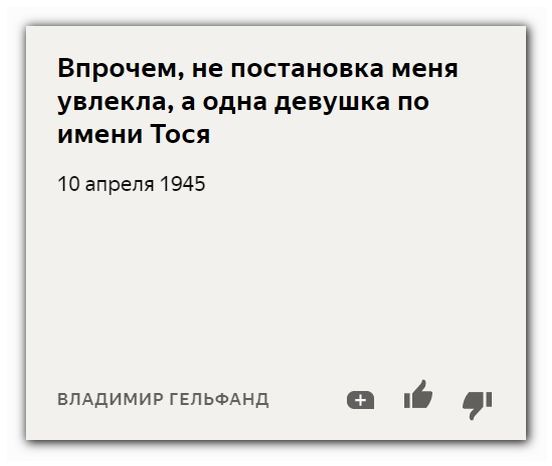
It was not the production that captivated me, however, but a girl named Tosya
10 April
567 views. Unique page visitors.
439 full reads, 77%. Users who read to the end.
10 sec. Average time to read the post.
Red Army soldier. April 10, 1945
Published as part of the “The Real 1945” project
Farewell, Bärwalde! At five we leave for Küstrin.
I have just come from the theatre. For the second
time I watched The Marriage of Figaro performed by Moscow artists
— they perform badly because they try to serve as many people as
possible. It was not the production that captivated me, however, but a
girl named Tosya, beside whom I sat and whom I embraced and held close
throughout the performance. She did not stop me, but I hurried too
much. Ah, I have wandered onto the wrong subject! I must turn the page;
I will continue the story there — this sheet is intended for
other notes.
Source: V. N. Gelfand, Diaries 1941–1946 // Samizdat magazine, 2004.
It was pleasant there, like on the boulevard back home; the place invited love and dreams
9 April
253 views. Unique page visitors.
159 full reads, 63%. Users who read to the end.
1 min. Average time to read the post.
Red Army soldier. Germany, April 9, 1945
Published as part of the “The Real 1945” project
In the evening I decided to go to the film March,
April. I hurried into the auditorium first so that I could get a good
seat. There were few people, and I wanted to sit next to a girl. I
asked a captain to keep three seats while I ran out of the hall to the
lake. It was pleasant there, like on the boulevard back home; the place
invited love and dreams.
Right by the lake I saw two girls, one in a headscarf, the other in a Kubanka cap.
“Well, girls? Come to dream by the
lake in Bärwalde?” I asked, and immediately interrupted
myself: “Come to the cinema!”
They were confused and instantly turned to face me.
“Seriously, there is nothing stopping
you from going to see a film, especially since it will be shown quite
near here and I have saved seats for you.”
They were confused and pleased, but natural
shyness made them hesitant. They conferred for a long time and made me
persuade them. At last they agreed, but on the way to the cinema they
continued to hesitate and play hard to get. The sentry noticed their
timidity and guessed that they were not from our unit. He asked what
unit they belonged to; before they could answer I gave the number of my
own unit, after which they flatly refused to go to the cinema. I had to
say goodbye. I shook both their hands. They were pretty, especially the
one in the Kubanka cap.
“Come to the lake; we will dream
together and get acquainted at the same time. I will read poems to you
and you will not be bored.”
“We will definitely come,” one girl answered.
“We love poetry,” the other said, remembering something.
I ran back to the club. There were already many
people, but the captain had kept one seat for me. I had seen the
picture before. The only thing I found interesting was a newsreel about
the Tehran Conference.
Before the end of the film I noticed that a seat
had become free beside two pleasant female figures, and I hurried to
use the opportunity to make their acquaintance. From the other side
another lover of adventure hurried to the same place, but the girls
told him the seat was taken. There was not much time to talk: the film
ended and majors swept the girls away. I left them.
Yesterday I watched Beaumarchais' The Marriage of Figaro. There were many girls and senior commanders there.
Source: V. N. Gelfand, Diaries 1941–1946 // Samizdat magazine, 2004.
The whole day there was bustle around our billets — the newcomers were looking for featherbeds, beds, sheets and blankets
9 April
489 views. Unique page visitors.
259 full reads, 53%. Users who read to the end.
50 sec. Average time to read the post.
Red Army soldier. Germany, April 9, 1945
Published as part of the “The Real 1945” project
The middle of the night. A hospital belonging to some army has arrived here — all women.
The whole day there was bustle and movement around
our billets — the newcomers were looking for featherbeds, beds,
sheets and blankets (alas, there was very little bedding; everything
usable was already in use), and they found only old junk. Several
visits were also made to our yard, and we actually caught two of them
rummaging in our attic.
We got talking. The fellows became very excited
and wanted to keep them longer and get acquainted — what a
prospect! I myself am hungry for love from tender creatures, but these
women did not attract me; they were too tall and unattractive. Still,
for the sake of our company I invited them into my room. They refused,
but when they were told that I wrote poetry, they gave in. Behind them
burst my whole noisy company of youngsters in junior lieutenant
uniforms — some of the young officers behave far too boisterously
and mischievously.
My furnishings: a table with papers scattered
across it; a three-compartment cupboard that can be locked with a key,
stuffed to the top with bags, papers and other rubbish; two mirrors,
one full-length. Portraits all around, mainly of women; geographical
maps. On the large mirror I pinned a naked woman with her back to the
people. One cannot help looking into the mirror — and at the
beautifully built woman as well.
Source: V. N. Gelfand, Diaries 1941–1946 // Samizdat magazine, 2004.
Captain Shestobitov introduced me: “Here he is, the very author of those poems”
4 April
329 views. Unique page visitors.
203 full reads, 62%. Users who read to the end.
20 sec. Average time to read the post.
Red Army soldier. Bärwalde, April 4, 1945
Published as part of the “The Real 1945” project
Night. Bärwalde.
Early in my stay in Bärwalde I visited the
editorial office with some poems. Captain Shestobitov, the assistant
editor, proved very kind. It turned out that he writes too. He liked
the poems and asked me to copy several for the newspaper.
The next day, when I came to see him, a prominent
representative from the army — a journalist with the rank of
major — was visiting him. Captain Shestobitov introduced me to
the journalist: “Here he is, the very author of those
poems.” Comments were mixed with praise and compliments. We sat
talking until deep into the night, and I stayed overnight at the
editorial office with Shestobitov.
In the morning, while the major was still asleep, the captain let me in on his creative plans.
“You see, I am now working on a song for our division. Would you undertake to write it together with me?”
I agreed. And when the major woke up, Shestobitov
told him: “You know, I want to introduce him to the division
commander and bring him closer to him. We will write the division song
together.”
Source: V. N. Gelfand, Diaries 1941–1946 // Samizdat magazine, 2004.
© Yandex Publishing + History of the Future
Text written directly on the project images
Image 1 — site banner and project
description: “THE REAL 1945”; “Home”;
“About the project”; “Yandex Publishing + History of
the Future.” Main text: “THE REAL 1945 — a project
telling the story of spring 1945 in real time.” “We use
documentary materials only. All texts by the participants in ‘The
Real 1945’ are taken from their letters, memoirs, diaries and
other authentic documents of that period: we tell history through the
voices of its participants, without interpretation.” “The
‘Real 1945’ project was created with the support of Yandex
Publishing as part of a programme aimed at developing cultural and
educational initiatives in history, literature, art and
philosophy.”
Image 2 — “Project
consultants.” Oleg Vitalievich Budnitsky — Doctor of
Historical Sciences. Kirill Anatolievich Boldovsky — Candidate of
Historical Sciences. Vera Sergeevna Dubina — Candidate of
Historical Sciences; consultant on the list of characters and diaries
used in the project.
Image 3 — “Team.” Ivan
Vukolov — editor-in-chief. Vera Makarenko — producer. Aren
Vanyan — historical editor. Ivan Korneev — historical
editor. Denis Panfilov — historical editor. Mikhail Degtyarev
— scriptwriter. Olga Terekhova — art director. Sergey
Dmitriev — IT director. Mikhail Zygar — general producer.
Maria Shashaeva — operations director of “History of the
Future” and marketing director. Pavel Krasovitsky — head of
historical research at the “History of the Future” studio.
Anna Bocharova — video production director. Alexander Smirnov and
Alexey Fisun — directors. Evgenia Yudzhenich — SMM.
Jean-Michel Shcherbak — PR director of the “History of the
Future” studio. Maksim Sergeev, Ekaterina Loginova and Grigory
Avoyan — designers. Aya Gadymova — motion designer. Fyodor
Onufriev — sound designer. Andrey Cherkasov — supervisor.
Maria Rozhkova and Anastasia Indrikova — photo editors. Yulia
Zakrevskaya — video editor. Darya Ilay — partnerships
director. Irina Ivanova — finance director. Vladimir Ozherelyev
— lawyer.
Image 4 — “Copyright.”
AKG-Images; Sovfoto / Universal Images Group / East News; Vladimir
Savostyanov / TASS; TASS; Granger / Diomedia; Mary Evans / Diomedia;
AKG Images / East News. “The ‘History of the Future’
studio thanks Maria Kosareva for her cooperation in preparing the
series and for providing photographs of Boris Kosarev from the family
archive. More information about the archive is available at
boriskosarev.com.”
Card 1: “Yesterday morning an
unforgettable event took place. The Germans agreed to complete and
unconditional surrender.” May 10, 1945. Vladimir Gelfand.
Card 2: “It was pleasant and
cheerful to listen to the marches, all the more because the performers
themselves made a very amusing company.” Vladimir Gelfand.
Card 3: “I became a
presentable-looking man. Only my trousers were very dirty, and that
spoiled the whole impression.” Berlin, May 7, 1945. Vladimir
Gelfand.
Card 4: “The Allies joined up with
our troops and split the enemy forces in two at the city of
Torgau.” Berlin, April 28, 1945. Vladimir Gelfand.
Card 5: “Around the palace there
is an entire settlement of large, beautiful buildings. It is hard even
to imagine how one man could live here and possess such
wealth...” Vladimir Gelfand.
Card 6: “All night I did not close
my eyes for a single second. Even if I have not slept, to Berlin
— absolutely!” April 16, 1945. Vladimir Gelfand.
Card 7: “By the end of the war I
had become a thorough rear-area man, but I am drawn to where it
thunders, groans and burns.” Near Küstrin, April 14, 1945.
Vladimir Gelfand.
Card 8: “In recent decades life
has known no greater, more powerful figure.” Near Küstrin,
April 13, 1945. Vladimir Gelfand.
Card 9: “So this is what you are
like now, Küstrin. I do not rejoice at your ruins, but with all my
heart I welcome your fall.” April 12, 1945. Vladimir Gelfand.
Card 10: “It was not the production that
captivated me, however, but a girl named Tosya.” April 10, 1945.
Vladimir Gelfand.
Card 11: “It was pleasant there, like on
the boulevard back home; the place invited love and dreams.”
Germany, April 9, 1945. Vladimir Gelfand.
Card 12: “The whole day there was bustle
around our billets — the newcomers were looking for featherbeds,
beds, sheets and blankets.” Vladimir Gelfand.
Card 13: “Captain Shestobitov introduced
me: ‘Here he is, the very author of those poems.’”
Bärwalde, April 4, 1945. Vladimir Gelfand.