




 |
||
 |
||
 |
||
 |
||
 |
||
 |
||
 |

© Преподавание истории в школе 2016
 Russian
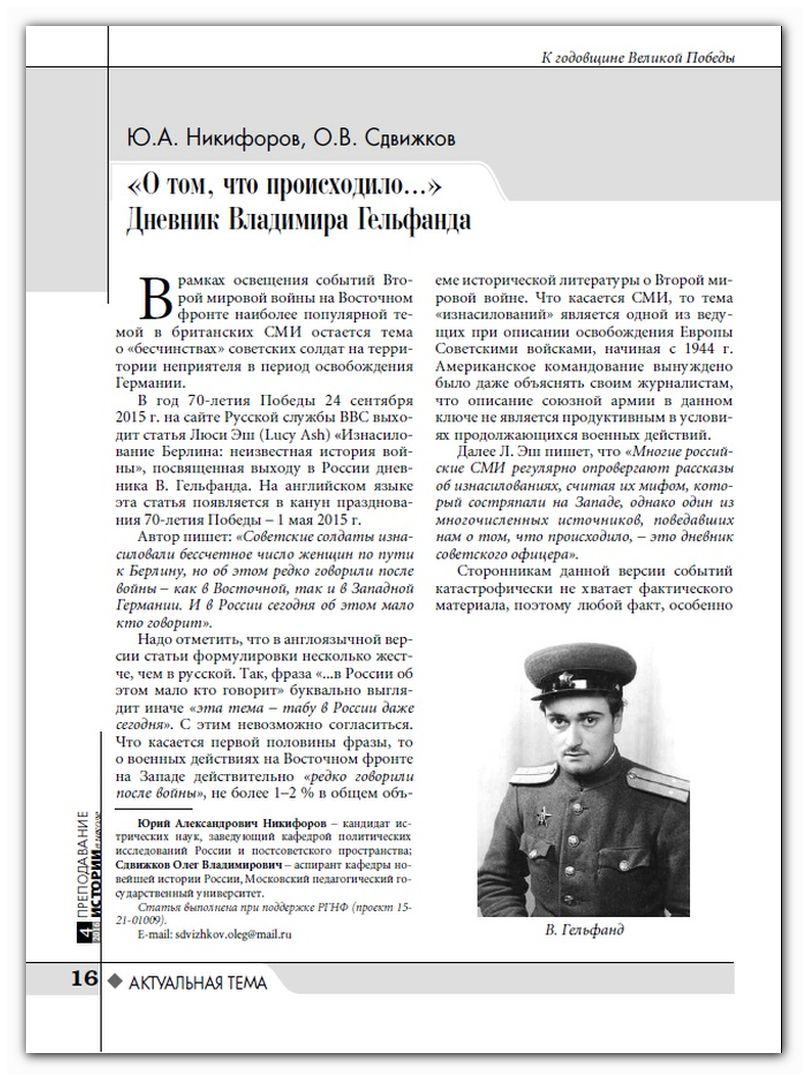
Teaching History at School, No. 4, 2016 — On the Anniversary of the Great Victory
Yuri Alexandrovich Nikiforov, Oleg Vladimirovich Sdvizhkov
Yuri Alexandrovich Nikiforov — Candidate of Historical Sciences, Head of the Department of Political Studies of Russia and the Post-Soviet Space; Oleg Vladimirovich Sdvizhkov — postgraduate student at the Department of Modern Russian History, Moscow Pedagogical State University.
This article was prepared with support from the Russian Foundation for the Humanities (project 15-21-01009).
E-mail: sdvizhkov.oleg@mail.ru
In coverage of the events of the Second World War on the Eastern Front, one of the most popular topics in the British media remains the subject of the “outrages” of Soviet soldiers on enemy territory during the liberation of Germany.
In the year of the 70th anniversary of Victory, on 24 September 2015, the website of the BBC Russian Service published an article by Lucy Ash, “The Rape of Berlin: The Unknown Story of the War,” devoted to the publication in Russia of V. Gelfand’s diary. The English-language version of the article had appeared on the eve of the 70th-anniversary Victory celebrations, on 1 May 2015.
The author writes: “Soviet soldiers raped countless women on their way to Berlin, but this was rarely spoken about after the war — both in East and West Germany. And in Russia today, few people talk about it.”
It should be noted that the wording in the English-language version of the article is somewhat harsher than in the Russian one. Thus, the phrase “…in Russia few people talk about it” literally appears differently: “this subject is taboo in Russia even today.” It is impossible to agree with this. As for the first half of the statement, military operations on the Eastern Front were indeed “rarely spoken about after the war” in the West, accounting for no more than 1–2 percent of the total volume of historical literature on the Second World War. As for the media, the subject of “rape” has been one of the leading themes in descriptions of the liberation of Europe by Soviet troops beginning in 1944. The American command was even forced to explain to its journalists that depicting an allied army in this way was not productive while military operations were still continuing.
Further, L. Ash writes that “many Russian media outlets regularly refute stories of rape, regarding them as a myth concocted in the West, but one of the many sources that told us about what happened is the diary of a Soviet officer.”
Supporters of this version of events suffer from a catastrophic shortage of factual material, and therefore any fact, especially one presented by a participant in the events, attracts close attention.
The first is dated 21 February 1945, when the unit in which he served was located not far from the Oder River. “The day before yesterday a women’s battalion was operating on the left flank. It was completely smashed, and the captured German she-cats declared themselves avengers for husbands killed at the front. I do not know what was done with them, but the scoundrels ought to have been executed without mercy.”
The second episode was recorded by V. Gelfand on 25 April on the outskirts of Berlin. Riding a bicycle along the bank of the Spree, he noticed a group of women walking somewhere with bundles and suitcases. “I asked the German women in broken German where they lived and wondered why they had left their home. With horror they told me about the grief caused them by the frontline troops on the first night of the Red Army’s arrival… ‘They stuck it in here,’ the beautiful German woman explained, lifting her skirt, ‘all night long, and there were so many of them. I was a virgin,’ she sighed and began to cry. ‘They ruined my youth. Among them were old men, pockmarked men, and they all climbed on me, all stuck it in. There were no fewer than twenty of them, yes, yes,’ and she burst into tears… ‘They raped my daughter in front of me,’ the poor mother added, ‘they may come again and rape my girl again.’ At this everyone was seized by horror again, and bitter sobbing rolled from one corner of the cellar to the other, where the owners had brought me. ‘Stay here,’ the girl suddenly rushed toward me, ‘you will sleep with me. You can do anything you want with me, but only you alone!’”
Now let us examine the two episodes quoted above.
The episode involving the “German she-cats” first appeared in print long before the publication of the notorious Diary, back in the Soviet Union (!), in the collection of frontline veterans’ memoirs We Must Not Forget These Roads, published in Kyiv in 1980 by the Political Literature of Ukraine publishing house, but there it is described differently:
“The last reserve. Treptow Park. Tanks and armored personnel carriers with SS cutthroats were advancing on us. Then drunken criminals released from prisons rushed into the attack. Behind them came tanks again. And after a short respite came this ‘psychological’ attack. To the beat of drums, marching in step, with submachine guns and fixed bayonets, a women’s battalion was approaching: girls about sixteen to eighteen years old. ‘Avengers.’ Apparently one of the enemy’s last reserves. Behind them, two or three hundred meters away, stood a group of SS officers with light machine guns aimed at their backs. So to speak, as ‘insurance.’
“Our soldiers, who had just steadfastly repelled the assault of the Tigers, looked on anxiously and in bewilderment. This had never happened before! Where are you going, you drugged fools? They are coming at us with weapons and are about to use them. But a Soviet soldier does not fight women! Our command immediately called artillery and Katyusha fire onto the officers. One accurate volley — and their entire detachment was swept away. Sobbing, their eyes frozen with horror, the ‘avengers’ lay down on the ground. Their battalion escaped destruction and was taken prisoner.”
In this version, the “psychological” attack of the women’s battalion takes place not on the Oder River at the end of February, but in Berlin, probably at the end of April. It should be noted that to this day nothing is known about the existence of women’s battalions in Germany.
What follows is the text used by the BBC. In the Diary this episode first appears in the entry of 21 February 1945, while in the entry of 20 March some rather piquant details appear:
“Senior Sergeant Andreyev arrived. During the march he fell behind, experienced a mass of adventures, rode with a tank-borne infantry force, but then ended up in the hands of counterintelligence, which ‘gave him a bit of a ride’ and sent him to our battalion, though to a rifle company. Now he came to visit us, and I listened to his story with interest.
“In the fighting for the town of Bernlikhet he came face to face with a counterattacking enemy women’s battalion. By that time our tank-borne infantrymen had dug in well and calmly met the enemy sortie. But when they saw women, the soldiers’ hearts began to pound. Nevertheless, they were ordered not to fire. The women advanced in orderly lines: one, a second, a third, firing submachine guns. The fourth and final line consisted entirely of men. Our men remained silent. The women grew brazen and, as they approached, fired point-blank at our infantry. They came very close and seemed to have reached their objective. But suddenly a wave of bullets swept through them from behind. Like sheaves, those attacked from the flanks fell dead, and the mixed ranks slowly and awkwardly sank to the ground. Machine guns on the flanks did not stop hammering at the enemy, and the women, as if possessed, throwing down their weapons in fear and panic, rushed to a place in the town street that was not under fire — into safe hands: our soldiers met the women with pleasure, hatred and triumph. And the unfortunate ‘warriors,’ many of whom were not yet seventeen, huddled fearfully together and cried: ‘Oh, Gott, Gott, Gott’ (God). One of the young girl-soldiers bitterly repeated, ‘Mein Gott, Gott!’ and her beautiful eyes shone with emerald tears of repentance.
“The tank-borne infantrymen dealt with things quickly. The prisoners were divided into three groups.
“1. Russians. There were two of them.
“2. Married women and those whose husbands and relatives were in the same unit in which they themselves served (some identified themselves: ‘My husband is an officer!’).
“3. Girls.
“Only the third group of prisoners was kept. The Russians, who were no more than nineteen, were the first to be shot after interrogation. From the third group they began dragging away ‘trophies’ to houses and beds, and there, over the course of a number of days, conducted experiments on them that cannot be put on paper. The German women were afraid and did not resist, and in order to avoid abuse by older soldiers, they themselves begged the younger ones to sleep with them. Andreyev was among the lucky ones. He chose the youngest and took her away to sleep with him. But when he proposed that she satisfy his more fundamental desire, she shook her head and shyly whispered: ‘Das ist nicht gut’ (that is not good); after all, I am still a virgin. The last words inflamed our hero still more; he became more insistent and took out his pistol. Then she quieted down and, trembling, lowered her riding breeches. He asked her whether she knew what ‘podmakhivat’ meant. For a long time she did not understand, but then she nevertheless answered ‘gut machen.’ Then, nodding at the pistol, he advised her: ‘only gut machen, and in no way schlecht,’ and she understood, grabbed him tightly, and began thrusting toward him. He felt that something had torn; the girl cried out and moaned, but soon managed to force herself to smile. He dressed her in civilian clothes, and she came out to her fellow sufferers cheerful and confused.”
Which of these stories should we accept as authentic? Obviously neither one nor the other. Leaving aside the style of this story (worthy of a pornographic novel), we note that V. Gelfand himself was not a witness to it; he was merely retelling first some rumors and then the words of a certain “Sergeant Andreyev,” who either really had fallen behind his unit or had tried to desert but had not succeeded. In notes to the text, the diary’s publisher observes that “the fragment about the women’s battalion is an example of frontline soldiers’ folklore. Women did not serve in combat units of the Wehrmacht…”
V. Gelfand was a poetic man, inclined toward literary creativity, and at that time had no experience of intimate relations with women, something that troubled him greatly; therefore the appearance of such an episode in his notes is not surprising. What is striking is something else: the use of his notes as a historical source by the BBC author.
Let us consider the second episode and not reject it “as a myth made in the West.” Such excesses could undoubtedly have occurred. We shall note only some less obvious aspects of this story. When the German women see an officer, they do not run away to hide; on the contrary, they approach him with a complaint, i.e. they do not perceive every Soviet serviceman as a potential criminal. If this story was not invented by frightened women in order to lure an attractive young officer into staying with them (and thus obtain protection), then besides Soviet soldiers the perpetrators could have been Polish soldiers, Soviet or Polish deserters (it is incorrect to count that category as servicemen), or some of the displaced persons of any nationality living in the area. The presence, for example, of military uniforms or weapons on the criminals proves nothing. In combat conditions, not all servicemen strictly observed dress regulations, while many civilians preferred (or were forced) to have some items of military uniform in their wardrobes, and confiscating weapons from the civilian population was one of the first tasks of Soviet commandant’s offices in occupied territory. One Soviet document contains the following entry: “…an unknown citizen was detained, on whom a Soviet carbine was found… The unknown man is dressed in a Red Army greatcoat, German trousers, a Polish hat, Soviet boots…”
The entry of 25 April is not the author’s only impression of conditions in the city at the end of April 1945. Three days later he notes: “The streets of Berlin are noisy and crowded. The Germans all wear white armbands. They are no longer afraid of us and are walking freely through the streets.” At that moment fighting was still continuing in the city.
Does the text of the Diary allow the story of 25 April to be regarded as a typical phenomenon in the zone of Soviet military operations?
Lieutenant V. Gelfand was only twenty-three years old; he tried to meet attractive girls (and he was very choosy in this matter) whenever possible. These included Polish women (seven in all) and Russian women, both servicemembers and civilian employees from among displaced persons who went to work in various Red Army services. On 27 September 1945 he wrote: “In our dining halls there are many pretty waitresses from among the female civilian staff. I tried to court almost all of them, had superficial conversations with several at different times and with each separately, and gave flowers. With one, who at first glance seemed most favorably disposed toward me, I once walked home after supper and tried to explain myself, but it turned out that she was married. Another rejected my [the continuation is missing].”
And there were also German women, more than sixty in all. German women make up about half of those mentioned. The forms and duration of the relationships varied: purely friendly ones, occasional intimate contacts (the author even contracted gonorrhea once), and prolonged cohabitation. At one point he had two regular girlfriends at once in different towns, one German and one Russian.
Not one of his innumerable female acquaintances complains about the behavior of Soviet soldiers or tells him anything resembling what he heard on 25 April on the bank of the Spree. At least there are no such entries. That the story was an exceptional occurrence is indirectly confirmed by an entry made a year after that encounter (May 1946). He writes: “I dream of visiting Biesdorf. This name is connected with significant memories that have remained indelible: the tears of despair of a young, beautiful German woman who had been brutally raped, the grief of her parents, my intervention and help.” Evidently, after meeting several dozen girls during the intervening year, he had heard nothing similar again.
The author’s own personal experience provides a curious illustration of relations between Soviet servicemen and German women. V. Gelfand, a gentle and sensitive man, was incapable of violence. On 24 June 1945 he recorded:
“During the day, when, tired from working with books, I looked out the window, I noticed a beautiful girl walking along the street… I called her over. She came up. Then I ran out of the room and, without prolonging the conversation, bluntly suggested that she go into the house.
“‘What will I do there?’ the Fräulein asked.
“I answered in her language — read books.
“‘But that is boring…’
“I put my arm around her — ‘let’s go to the second floor…’ I advised her. She agreed to that too… ‘Take everything off; we’ll do fik-fik, all right?’ She had been expecting this and willingly carried out my proposal.”
Here is another of the author’s adventures, from November 1945:
“I met the woman on the street when it was already dark. She was walking with a friend and seemed interesting to me in appearance. Both mistook me for another officer they knew, but I invited them to my place and, almost without objection, brought them to the window of my barracks…
“The one I liked… I pressed to myself… began warming her with warmth and affection… I invited her in through the window, and she agreed after a minute of indecision and hesitation… It was clear that she had come only from sexual attraction and was devoid of feeling and conscience. But my opinion turned out to be premature…”
One may speculate here about the moral character of the Soviet officer and the German Fräuleins, but it is impossible to find in the quoted text signs of “rape” or an attempted rape.
At the end of May 1946 V. Gelfand writes: “I do not see girls, I meet with no one, although there are thousands of them at our factory. They themselves bring flowers and wait for me. But time lets me down… Even today one lovely little doll insisted that I be home at four o’clock…”
And this is how he describes German women’s reaction to a Soviet officer (the author had an attractive appearance) in June: “They smiled at me on the streets, in the tram, on the train, waved their hands from house windows, shouted after me in different voices and with different faces when I was on my bicycle… I only had to stop a little German girl and say a couple of words to her — she would light up like a star… She was mine and agreed to everything for me from the first time. I was little interested in Russians. Here they are in great demand and rare.”
And here is an observation about relations between German women and soldiers in December 1945 in the town of Kremmen, where he was supervising the loading of railway cars:
“We work from eight to eight. The soldiers are good, but soft-hearted. Now they have given us women and girls [from] the town. Fifty people in all, and only about ten men among them. It is very difficult with them, especially because they shirk work by every possible means. The girls, for example, charm my soldiers with their eyes and smiles, of which they alone are capable. The soldiers melt, and no words can bring them to their senses. In the evening they promise manfully and resolutely to be demanding and even angry, but in the morning the fellows change, and it is already difficult for me to alter their, I would say, touching attitude toward young beautiful German women. And yet all of them were in German bondage, and most experienced the horrors of fascist concentration camps and torture chambers…”
In this episode it is difficult to see the soldiers as “male beasts,” as L. Ash calls them.
The diary’s author also happened to observe some excesses. In November 1945 he witnessed the following scene: “…two sergeants from the commandant’s office came by car for our lieutenant, who had allegedly beaten a German woman… The sergeants from the commandant’s office were drunk, had themselves been courting the German woman, and were chasing the also-drunk officer out of jealousy…”
The German population quickly adapted to the new situation. Less than a year after the end of the war, in April 1946, the author writes:
“The Germans are getting insolent. They have stopped respecting us; they are not afraid to play petty dirty tricks, to pester us nauseatingly, cling to us, beg, and in general have sensed in us good ‘comrades’ with whom they can become overfamiliar. We have two tactics of behavior here: the official one — correct, humane, but firm — an occupation policy. Our people do not follow it in everything, always, and everywhere… Some are restrained and cultured, but angry at the Germans… There are [those] who avoid them and, when the opportunity arises, emphasize their contempt for them…
“But there is another category of people — drunkards, thieves, hooligans, psychos. By making scandals, they undermine authority. And a third category — extreme liberals who have not known grief from Hitlerites: here there is love, cohabitation, and even adoration.
“All this diversity in the level of development and in the behavior of Red Army men toward the local population leads to the fact that we are regarded as kind and simple and at the same time as coarse and even wild people; we are often mocked, although we are the masters-victors.”
V. Gelfand does not idealize the Red Army and records many unattractive facts. For example, at the end of January 1945 in Kutno he writes: “The soldiers are behaving disgracefully. Not only do they steal and take away horses, but they also manage to rummage through apartments, steal and seize bicycles, property, pigs, cows and so on. People who are wholeheartedly glad to see us, after this robbery look at us with distrust and sometimes hostility.” In one place he himself takes someone else’s bicycle and, after realizing that the owners have not fled, is ashamed (or afraid) to return it.
A few days later he writes: “No one forbids anyone to take and destroy from the Germans what they looted from us earlier. I am quite satisfied. I only dislike senseless rowdy behavior…”
Such behavior did not always go unpunished. On 1 April 1945 the author attended a session of a military tribunal: “The final court session in the case of the bandits from Lieutenant Abdurakhmanov’s gang… Twenty-three people are on trial. With the exception of two, they all took part in robberies and attacks on individual enterprises and military units… They tried to explain their actions by saying that they had strayed from the proper road by accident and that there was no one to turn them onto the path of truth.”
L. Ash claims that “Soviet soldiers raped countless women on the way to Berlin”; Russian media, according to her, deny this, and she recommends to readers “one of the many sources that told us about what happened” — V. Gelfand’s Diary. One of the two facts she cites is simply a frontline “legend,” while the second, even if one accepts the victims’ interpretation of it, is not something typical, as follows from the text of the source.
The facts are clearly insufficient to create an epic picture of Soviet “atrocities” in occupied territory, and there are no other similar facts in the text of the diary. They are not sufficient even for a single article, and Ash moves on to a detailed retelling of another Diary, first published in 1954 under the title A Woman in Berlin, a vividly literary text having no scientific value.
Keywords: V. Gelfand, Eastern Front, liberation of Germany, occupation, women’s battalion, conduct of servicemen.
