В
поисках утраченного времени.
29
апреля 2018 Солдат Победы Аркадий Бляхер. Часть 9. Нелюбовь. |
|||
| © Василий Сарычев © 2014 - 2018 РГ «Вечерний Брест» ООО |
 Russian
29 April 2018
Project “In Search of Lost Time”
Part 8
As in every war, the most terrible time for the civilian population was the first few days after a town had been taken — days without restraint, a kind of anarchy beyond the commanders’ control. Excited by the victors’ sense of impunity, embittered and starved of women, soldiers lost self-control. The rules that applied in ordinary life no longer worked. Propaganda had worked hard on people’s minds, and many also had personal scores to settle that required no additional encouragement.
This was foreign, enemy soil, a place soldiers had come to for revenge. War seemed to strip the layer of culture from people. The women and girls of defeated Germany were seen as trophies. Where there was no strong, morally responsible commander, terrible things happened.
Sexual violence was not the prerogative of the Red Army. According to researchers, Allied soldiers in the western occupation zones raped around a million German women. British and American troops were involved, and the Moroccan division serving with the Allies became notorious for horrific crimes near Monte Cassino.
But Moroccan soldiers concern us only marginally. We have our own story.
There was one scene in Berlin. An artillery battalion was standing at the edge of a square when a large group of women appeared from one of the streets, apparently heading for a shelter. Some joking artillerymen uncovered a gun and fired over their heads. The women screamed and huddled together, then, once they realized the shots were not aimed at them, moved on submissively. Young girls hid in the middle and covered their faces so that their age could not be guessed.
Rumors traveled fast, and German women knew very well what might await them. In Germany, between battles, Senior Lieutenant Blyakher saw all kinds of things.
Alcohol also played its part. Strictly speaking it was not vodka: the frontline ration of one hundred grams was diluted spirits, usually delivered in milk churns. It did not taste very good, but it intoxicated people, and when men drank too much it could end in fights and scandals.
There were also many cases of voluntary submission. Berlin women later joked: “Better a Russian on top of you than a Yankee above you,” referring to carpet bombing. One eyewitness said German women were often so frightened that sometimes a mere gesture was enough. During street fighting in Berlin soldiers rushed into a cellar where a whole group of women was sheltering. An Armenian sergeant stared at them for a while, pointed to one woman, and she stood up. They went aside; afterward he escorted her back to her place.
While the unit moved through Germany without fighting, soldiers entered houses and were sometimes astonished by the women’s submissiveness. Understanding what was expected, a woman might close the door herself and brace it with her shoulder. If a family member knocked, she would say calmly: “Alles gut...” Perhaps by doing so she was saving them.
They entered Berlin on 22 April. All along the way the men had been warned not to eat German food because it might be poisoned. Yet the suburbs were beautiful, each detached house built to a different design.
They went down into a cellar high enough to stand in, with electric lighting and shelves full of preserved food and wine. A jar of preserved chicken made them hesitate. It was a glass jar with a hinged lid and rubber seal; everything appeared airtight. It looked so appetizing that their mouths watered, but what if something had been added to it?
They went upstairs, caught an elderly German in the street and brought him into the cellar. They opened a bottle and poured him half a glass. “Danke, danke,” he said and drank it. He seemed to remain alive. They opened the chicken and gave him some. Again: “Danke, danke!” He was ready to swallow the lot, but of course they did not let him.
Once they had eaten the food he had tested, they opened more jars. The German indicated that he was full, but that did not help. “Eat!” they ordered, swearing at him. He choked the food down even though he could barely manage any more. When he finally went back upstairs, he was swaying.
The day before, Hitler had addressed his soldiers, promising that Berlin would remain German and that the Russian offensive would “drown in its own blood.” Few people still believed it. The Führer demanded the immediate execution of anyone who retreated or ordered a retreat, regardless of rank or position. The remaining inhabitants of Berlin — at least 2.5 million people — were forbidden to leave the city. If the Third Reich was to perish, Hitler believed all its citizens should share its fate.
At the end of April, while riding a bicycle along the bank of the Spree, Lieutenant Vladimir Gelfand saw a group of women dragging bundles and suitcases and asked why they had left their homes.
From his published diary:
“They poked here,” a beautiful German woman explained, lifting her skirt, “all night, and there were so many of them. I was a virgin,” she sighed and began to cry. “They ruined my youth. Among them were old men, men covered in pimples, and every one of them climbed on me, every one of them poked me. There were no fewer than twenty, yes, yes...” And she burst into tears.
In a German archive, blue cardboard folders contain miraculously preserved records of abortions performed between June and October 1945 in Neukölln, one of Berlin’s twenty-four districts. Abortion was prohibited in Germany, but after the war there was a short period during which women were allowed to terminate pregnancies. This was connected with the mass rapes. From June 1945 through 1946, 995 applications for abortion were approved in that district alone. In one statement, written in a rounded childlike hand, a girl explained that she had been raped at home in the living room in front of her parents.
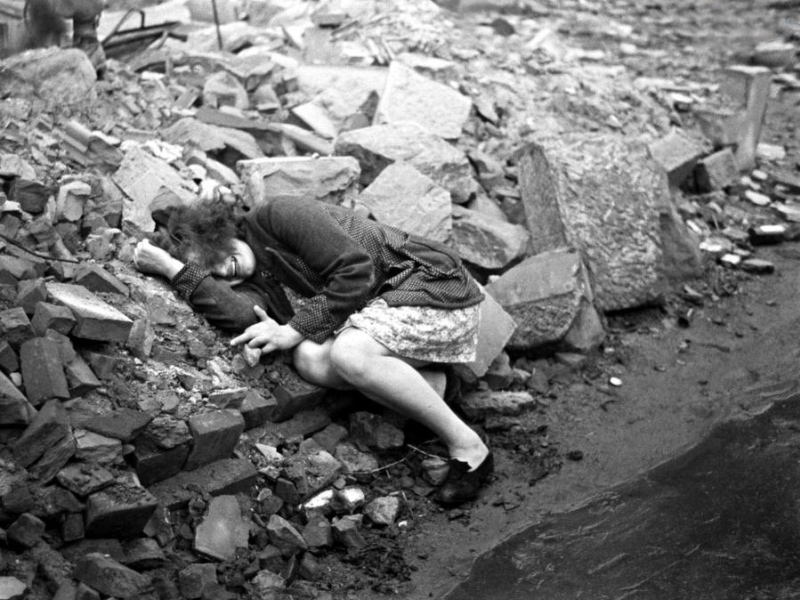
The center of Berlin, as Arkady saw it, lay in ruins. American “Flying Fortresses” had bombed it almost as they had Dresden. The Americans valued the lives of their own soldiers differently — as, indeed, the Germans had during the first part of the war: several days of heavy bombardment usually preceded an attack. In our army, throughout the war, it was generally the reverse: infantry first, and tanks only afterward.
Many civilians died beneath Berlin’s ruins. Later, during the occupation, when Arkady walked to see his Trudi, the smell of corpses came from under the rubble.
Part 1 — “Graduate”
Part 2 — “Cadet”
Part 3 — “To the Front”
Part 4 — “First Blood”
Part 5 — “Son of the Regiment”
Part 6 — “War Is War”
Part 7 — “Decorated Men”
Part 8 — “There It Is, the Damned Place!”
Part 9 — “Lovelessness”
Part 10 — “The Victory Banner”
Vasily Sarychev
© Vasily Sarychev
© 2014–2018 Evening Brest