- The book of
Paul Steege "Black
Market, Cold War: Everyday Life in Berlin,
1946-1949"

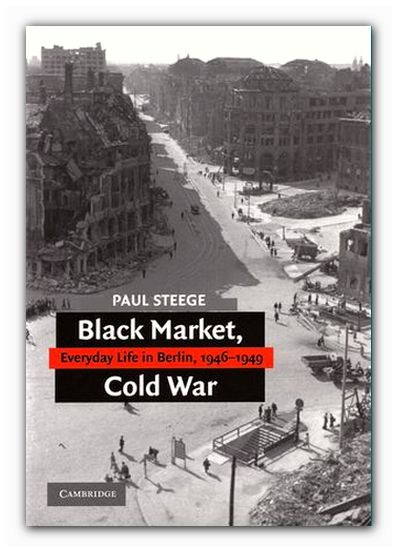
- Artikel: "Black Market, Cold War:
Everyday Life in Berlin, 1946-1949"
- Autor: Paul
Steege
- Gebundene Ausgabe: 372
Seiten
- Verlag: Cambridge
University Press (5.
März 2007)
- Sprache: Englisch
- ISBN-10: 0521864968
- ISBN-13: 978-0521864961
- Größe und/oder
Gewicht: 15,2 x 2,8 x
22,8 cm
- Preis: EUR 79,63
|

|
|
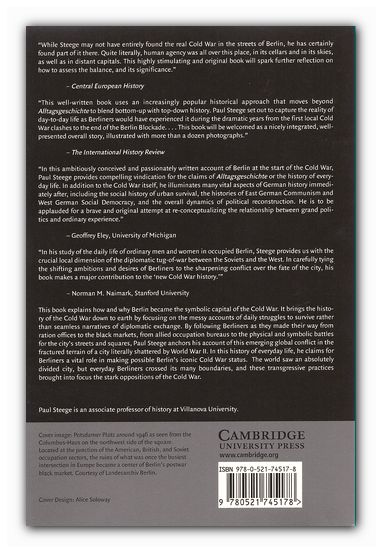
- Artikel: "Black
Market, Cold War:
Everyday Life in Berlin, 1946-1949"
- Autor: Paul
Steege
- Taschenbuch: 372 Seiten
- Verlag: Cambridge University
Press; Auflage: 1 (13. Oktober 2008)
- Sprache: Englisch
- ISBN-10: 0521745179
- ISBN-13: 978-0521745178
- Größe und/oder Gewicht:
15,6 x 2,1 x 23,4 cm
- Preis: EUR 27,46
|
|
|
|
|
|
|
|
|
|
Краткое
описание:
Эта книга объясняет, как и почему Берлин стал символической столицей
Холодной войны. Она переносит историю Холодной войны на уровень
повседневной жизни, сосредотачиваясь на реальных отчетах о борьбе за
выживание, а не на дипломатических обменах. Следуя за берлинцами,
которые переходили от магазинов продовольствия к черным рынкам, от
союзных оккупационных бюро к физическим и символическим сражениям за
улицы и площади города, Пол Стиг закрепляет свой рассказ о глобальном
конфликте в разрушенном городе, буквально изуродованном Второй мировой
войной. В этой истории повседневной жизни он утверждает, что берлинцы
сыграли жизненно важную роль в формировании статуса Берлина как символа
Холодной войны. Мир видел город, разделенный на части, но повседневные
берлинцы пересекали его многочисленные границы, и эти трансгрессивные
действия подчеркивали резкие противоречия Холодной войны.
Пресса:
«Увлекательная книга Стига
— превосходный пример «истории снизу». Он далеко не
первый, кто исследовал жизнь берлинцев в этот период, но ещё никто не
показывал взаимодействие повседневной жизни и глобальной политики столь
убедительно».
Journal
of European Studies
Об авторе:
Paul
Steege, Universität Villanova,
Pennsylvania
Paul Steege — адъюнкт-профессор истории в Университете Вилланова и со-редактор электронной дискуссионной рассылки H-German
© Paul
Steege 2007
Black Market, Cold War: Everyday Life in Berlin, 1946–1949
Summary: This book explains how and why Berlin became the symbolic
capital of the Cold War. It brings Cold War history down to the level
of everyday life, focusing on concrete accounts of the struggle for
survival rather than on diplomatic exchanges. Following Berliners as
they moved from food shops to black markets, from Allied occupation
offices to physical and symbolic battles over the city’s streets
and squares, Paul Steege anchors the story of a global conflict in a
devastated city literally scarred by the Second World War. In this
history of everyday life, he argues that Berliners themselves played a
vital role in shaping the city’s status as a symbol of the Cold
War. The world saw a divided city, yet ordinary Berliners crossed its
many boundaries, and those transgressive acts exposed the sharp
contradictions of the Cold War.
Press: “Steege’s fascinating book is an excellent example
of ‘history from below.’ He is by no means the first to
study the lives of Berliners in this period, but no one has illuminated
the interaction between everyday life and global politics as
effectively as he does.” Journal of European Studies
About the author: Paul Steege, Villanova University, Pennsylvania. Paul
Steege is Associate Professor of History at Villanova University and
co-editor of the H-German electronic discussion list.
© Paul Steege 200 7