




Выпуск 74 (2568), 15 марта 2007
Контурная карта великой войны
  |
Идея создания "Русско-немецкого солдатского разговорника" принадлежит Елене Харламовой и Аглае Романовской, которая и стала режиссером спектакля. Ее документальная постановка, основанная на интервью с женщинами, находящимися в тюремном заключении, идет в Театре.doc. Где же можно будет увидеть нынешний проект, недавно показанный в Берлине, пока не известно. В ближайшее время - на Малой сцене петербургского театра-фестиваля "Балтийский дом", а потом, вероятно, на всевозможных фестивалях. Допускаю, что он даже получит премии. Ведь тема повседневности войны считается не исторической, а остросоциальной, а формально-пластические принципы построения спектакля попадают в разряд перспективных театральных экспериментов. Но, рожденный как проект, "Разговорник" так и не стал шедевром.
В нем слишком много сделанного. Не придуманного, открытого, угаданного, а честно собранного из лабораторных шаблонов. Пустая, болезненно обнаженная сцена. Освобожденное от эмоций интонирование. Трое юношей и три девушки попарно или все вместе разыгрывают обрывки каких-то историй, произошедших во время или сразу после Второй мировой войны. Например, о том, как русский солдат остался у немецкой девушки. Или о том, как немки шьют американский флаг. Так и не вспомнив, сколько там звездочек, они решают спороть с нацистского полотнища свастику и приклеить на это место серп и молот из детского желтого платьица. Или о том, как немец, вернувшийся невредимым с войны, не может найти со своей женой общий язык. Сюжеты имеют свою документальную основу: дневники 23-летнего украинского офицера Владимира Гельфанда и неизвестной 30-летней жительницы Берлина.
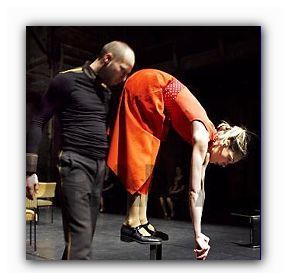
Каждый диалог обязательно сопровождается странными телодвижениями, назначение которых не всегда удается прояснить. Когда влюбленные представители двух воюющих народов меняются обувью и одеждой (Ева Янковски и Илья Плетнер), это еще понятно и даже как-то оживляет действие. Когда на заднем плане монотонно и условно дерутся мужчины, вскидывая и опуская руки (Илья Плетнер и Федор Степанов), это тоже, в общем-то, можно считать военной аллегорией. Но когда актеры вдруг ни с того ни с сего начинают многозначительно оседать на пол, пролезать под стульями и извиваться вокруг друг друга, тут уже не знаешь, что и думать. То есть ясно, что персонажам как-то нехорошо, но что именно они чувствуют, чего боятся и о чем мечтают - не понятно, несмотря на то что слов со сцены произносится очень много, может быть, даже слишком.
Зрители заходят в зал, уже наполненный гулом. Актеры шепчут на русском и немецком языках отрывочные фразы, кажущиеся поначалу полной бессмыслицей. Всевозможные "здравствуйте", "чего вы хотите", "я не понимаю", "вам чай или кофе", "имеются ли парашютные части" и "где ваш правый фланг" еще не раз появятся во время спектакля. Это точные цитаты из двух солдатских словарей: немецко-русский был выпущен для нужд вермахта в 1941 году, а русско-немецкий издали для Советской армии на несколько лет позже. Собственно, тема "язык мой - враг мой", тема трагического несовпадения языка и его носителя, чужеродности слова и сердца, что ни говори, благодатная. Великий абсурдист Эжен Ионеско когда-то специализировался именно на ней, заметив, что языковые конструкции в учебниках и разговорниках не имеют ничего общего с реальной человеческой жизнью и живым человеческим разговором. В спектакле же красивая идея о "встрече двух миров, двух тел, двух языков" теряет какую бы то ни было определенность: "Тишина. У нас есть фигуры - трое женщин и трое мужчин. Кто-то из них немец, кто-то - русский. Фигуры действуют в пространстве, в котором все смещено, перепутано, перевернуто".
Драма, разворачивающаяся в спектакле, действительно языковая. Но вовсе не та, которую задумывала режиссер. Слова, большинство из которых не выдумано, не выпрыгнуло из бумажного мира, а выжато из мира любви и смерти, перестали свидетельствовать. Они слишком "отдают малокровием" и напоминают тени. Ни одна история не трогает по-настоящему, а война, появляющаяся в спектакле, похожа пусть не на главу в учебнике, но на вырванную страницу из контурной карты. Впрочем, для любого проекта главное - четкая формулировка концепции, чего, конечно, у "Русско-немецкого солдатского разговорника" не отнимешь. И чтоб раздаточного материала на всех хватило. Но вроде и с этим проблем нет.
©
1999-2006 "YTPO"
An Outline Map of the Great War
15 March 2007. Yulia Chernikova
Nowadays no one says: I am writing a book, making a film or staging a play. That is yesterday's language. The age of art somehow ended unnoticed, and the age of projects began. Instead of the traditional "the play premiered," we now have to say that the Russian presentation of the project The Russian-German Soldier's Phrasebook took place - and then recite a long list of organizations that supported it, among them Teatr.doc, the Goethe Institute and the Berlin Senate. Saying this is easy enough; deciding how one should respond to a stage "project" in a post-theatrical era is a question that seems suddenly to have materialized out of thin air.
The idea for The Russian-German Soldier's Phrasebook belongs to Elena Kharlamova and Aglaja Romanovskaya, who also directed the production. Romanovskaya's documentary performance based on interviews with women in prison is presented at Teatr.doc. Where the present project, recently shown in Berlin, will eventually be seen is not yet clear. In the near future it will appear on the small stage of St Petersburg's Baltic House theatre-festival and then, probably, at various festivals. I can imagine it even receiving awards. The everyday life of war is now treated not as a historical theme but as an acutely social one, while the formal and physical principles of the production fall into the category of promising theatrical experimentation. Yet, born as a project, the Phrasebook never became a masterpiece.
There is too much in it that feels made. Not invented, discovered or guessed, but conscientiously assembled from laboratory templates. An empty, painfully exposed stage. Intonation stripped of emotion. Three young men and three young women, in pairs or all together, act out fragments of stories that took place during or just after the Second World War. For example, a Russian soldier stays with a German girl. Or German women sew an American flag and, unable to remember how many stars it should have, decide to remove the swastika from a Nazi banner and glue in its place a hammer and sickle cut from a child's yellow dress. Or a German man returns from the war unharmed and cannot find a common language with his wife. The plots have documentary foundations: the diaries of twenty-three-year-old Ukrainian officer Vladimir Gelfand and an unknown thirty-year-old Berlin woman.
Every dialogue is accompanied by strange physical movements whose purpose is not always clear. When lovers from two warring nations exchange shoes and clothes - Eva Jankovsky and Ilya Pletner - this is understandable and even enlivens the action. When men fight monotonously and conventionally in the background, raising and lowering their arms - Ilya Pletner and Fyodor Stepanov - this can also be accepted as a military allegory. But when the actors suddenly, for no apparent reason, begin meaningfully sinking to the floor, crawling under chairs and twisting around one another, it becomes hard to know what to think. It is obvious that the characters feel bad in some way, but what exactly they feel, what they fear and what they dream about remains unclear, despite the enormous quantity of words spoken on stage - perhaps even too many.
The spectators enter a hall already filled with a murmur. The actors whisper fragmentary phrases in Russian and German that initially seem completely meaningless. "Hello," "What do you want?", "I don't understand," "Tea or coffee?", "Are there airborne units?" and "Where is your right flank?" recur throughout the production. They are exact quotations from two military phrase books: the German-Russian one was published for the Wehrmacht in 1941, while the Russian-German one appeared for the Soviet Army several years later.
The subject "my language is my enemy," the tragic mismatch between language and its speaker, the alienation of word and heart, is in itself fertile material. The great absurdist Eugene Ionesco once specialized in precisely this, having noticed that linguistic constructions in textbooks and phrase books have nothing in common with real human life and living human speech. In this production, however, the attractive idea of a "meeting of two worlds, two bodies, two languages" loses all definition: "Silence. We have figures - three women and three men. Some are German, some Russian. The figures act in a space in which everything is shifted, confused and turned upside down."
The drama unfolding in the performance really is linguistic, but not the one the director intended. Most of the words were not invented and did not leap from a paper world; they were pressed out of a world of love and death. Yet they have ceased to testify. They are too bloodless, too much like shadows. Not one story truly moves us, and the war that appears in the performance resembles, if not a chapter in a textbook, then a torn-out page from an outline map.
For any project, of course, the main thing is a clearly formulated concept, and The Russian-German Soldier's Phrasebook certainly has that. And there must be enough handouts for everyone. There seems to be no problem with that either.