


 |
 |
Продолжение стенограммы конференции «Память о Холокосте в современной Европе: Общее и разделяющее», состоявшейся в Москве, Международном Мемориале, 25 – 26 сентября 2013 г. Доклад Олега Витальевича Будницкого, диретора Международного центра истории и социологии Второй мировой войны и её последствий, Высшая школа экономики, Москва.
Часть III. Память о Холокосте в СССР
Елена Жемкова (член правления Международного Мемориала, модератор):
Дорогие друзья, мы продолжаем нашу конференцию, и сейчас начнётся секция, которая, как мне кажется, довольно важна для нашей заключительной дискуссии – а что же, собственно говоря, происходило с памятью о Холокосте в советские годы? Я рада представить коллег, которые участвуют в этой дискуссии. Олег Витальевич Будницкий, доктор исторических наук, профессор Высшей школы экономики, директор Международного центра истории и социологии Второй мировой войны и её последствий, автор очень многих монографий по истории еврейства, в том числе, непосредственно касающихся нашей темы, единственный российский представитель в том комитете, который, фактически, создал весь контент Еврейского музея, где многие из вас вчера были. Также я рада представить Павла Поляна, профессора, доктора географических наук, научного сотрудника Фрайбургского университета, автора многих ключевых исследований по депортации, и, конечно, очень важно, что Павел Маркович много лет занимается историей советских военнопленных. Третий участник нашей секции – мой коллега Алексей Макаров, хранитель архива истории диссидентского движения и, что важно, одновременно действующий учитель обществоведения, автор многих статей по теме Холокоста, в частности, победитель одного из конкурсов Фонда «Холокост».
Олег Будницкий (Международный центр истории и социологии Второй мировой войны и ее последствий, Высшая школа экономики, Москва):
Уважаемые коллеги, я буду говорить об антисемитизме в период Второй мировой войны. Две предварительных ремарки. Первая – о советских или пост-советских евреях, которые помнят 1930-е годы. Это время осталось в памяти как золотое, когда не было никакого антисемитизма и советское еврейство имело потрясающие возможности в самых разных сферах, что подтверждается статистически. Назову только один факт: евреев с высшим образованием в абсолютных цифрах было больше, чем украинцев. В относительных – накануне войны это было больше 10% всех студентов СССР. Если говорить о военной памяти – это единство и дружба всех народов Союза и опять-таки никакого антисемитизма, тем паче на фронте не было. Если посмотреть интервью евреев-ветеранов, записанные в самых разных странах, поскольку советские евреи рассеялись по миру, то доминантной темой будет боевое братство и дружба. Антисемитизм возник после войны отчасти как государственная политика, отчасти как следствие нацистской оккупационной пропаганды. Если говорится об антисемитизме в войну, то обычно это связывается с Украиной и Белоруссией, в существенно меньшей степени с российскими территориями. Не могу не упомянуть, что есть и другой подход, уже основанный не на памяти, а на исследованиях. Скажем, Геннадий Костырченко считает, что политика государственного антисемитизма в СССР начала проводиться с 1938 года. Не обсуждая сейчас по существу, скажу, что с моей точки зрения это совершенно неверно, никакой политики государственного антисемитизма в довоенном СССР не было.
В своем выступлении я хочу оспорить те устойчивые стереотипы, которые остались в памяти людей. Я считаю, что антисемитизм не возник как следствие нацистской оккупации, он никуда не девался и проявился с первых же дней войны, причем я хочу специально говорить о территории Российской Федерации, которая до последних дней Советского Союза оставалась одной из самых моноэтнических республик, уступая в этом отношении только Армении. А на тех территориях, которые были оккупированы или прилегали к оккупированным районам, русское население превышало 90% (скажем, в Смоленской области 96%). И даже Москва и Ленинград вовсе не были космополитическими городами, свыше 80% населения составляли этнические русские. Если посмотреть на источники, причем такие, где тема антисемитизма не является центральной, видно, что они буквально переполнены свидетельствами ярко выраженных антисемитских проявлений с первых же дней войны. Например, Пушкин (Царское Село), цитирую дневник Лидии Осиповой-Поляковой:
«В Екатерининском парке выставлены три новых мраморных бюста, один из них совершенно замечательной работы, очень портретен, римский молодой патриций. Сегодня с соседкой Стелой, еврейкой, пошли смотреть. К нашему отвращению, патриций был весь в плевках. Стела говорит, что это потому, что у него еврейские черты лица. Я раньше этого не замечала, но после её слов действительно увидела. Стало противно».
Ну, тут же она рассуждает, что никакого антисемитизма или антикитаизма в русском народе нет, есть только антикоммунизм, и что это просто хулиганская выходка. Может быть. Но вот такая запись от 15 августа 1941 года. Три дня спустя среди населения антисемитские настроения всё же прорываются, от призывников можно услышать: «Идём жидов защищать». Август того же 1941 года, Ленинград, из воспоминаний Игоря Дьяконова, великого учёного-востоковеда, рассуждающего, что делать – уезжать из Ленинграда или нет. Только один член семьи, нянька Настя знает, что делать, и говорит:
«Ну что ж, и при немцах жить можно. В революцию бар резали, сейчас евреев будут резать, какая нам разница».
Есть такое мнение, что еврейское население как бы не знало, что немцы делают с евреями. Все всё знали. Запись в том же августе:
«У всех настроение такое, что всё рушится. Я уже слышал, как на улицах группа пьяных кричала: „Бей жидов"», – как будто не было четверти века советской власти».
Антисемитизм был очень тесно связан с антисоветизмом, и в 1941 году настроения, что придут немцы и, наконец, не станет большевиков, были широко распространены. И вовсе не только в Прибалтике и Украине, о чём обычно пишется в литературе, это было и в самой России, включая самые «благополучные» города Ленинград и Москву. 31 августа в том же Ленинграде Любовь Шапурина записывает после услышанных на улице разговоров:
«Жду спокойно нового хозяина без возмущения, без содрогания. Говорят, немцы всё же лучше грузин и жидов».
Опять август 1941 года, американка Мери Ледер (приехавшая в СССР подростком, вместе с родителями, помогавшими строить социализм, но быстренько уехавшими – Мери не выпустили из страны как советскую гражданку) разговорилась на улице с молодой казачкой, и та сказала:
«The Germans will be here before long. They'll take care of the Communists and the Jews» (дескать, к нам придут немцы и разберутся с коммунистами и евреями),
и дальше Мери рассуждает – она что, не узнала во мне еврейку, или настолько уверена в своих силах, что ей всё равно, её час пришёл? После этого Мери, которая приехала в Ленинград из Москвы, думая, что здесь будет безопаснее, села в поезд и поехала обратно в Москву. Наум Коржавин, подростком ехавший из Киева в эвакуацию летом или осенью 1941 года, вспоминает:
«В вокзальной сутолоке я однажды слышал, как одна колоритная казачка во всю мочь поносила понаехавших евреев. Обвинения ее были, в основном, бытового, отчасти даже вокзального характера, но темперамент совсем другой. „И куда же наши казаки смотрят, – возмущалась она, – взять да и скрутить им головы!"».
Ну, и так далее. Коржавин приводит ещё несколько антисемитских эпизодов, с которыми он столкнулся в пути, в частности, он отстал от поезда и как-то пытался, чтоб ему помогли сесть в поезд, никто не помогает, и более того, машинист, случившийся здесь, говорит: «У твоего папки, наверное, миллион в чемодане припрятан», – и тут же воспроизводит бродячую легенду, что у какого-то еврея на вокзале открылся чемодан, а там был миллион рублей. Это, так сказать, простой народ. Если говорить об интеллигенции. Из сводки НКВД о настроениях советской интеллигенции, Москва, 21 июля 1941 года – один из советских писателей (неназванный) говорит:
«Пусть немцев боятся евреи, пусть они и воюют с немцами, если немцы войдут в Москву, я стану во главе немецкого отряда, и буду вылавливать и уничтожать евреев».
Вот дневник Михаила Пришвина, чрезвычайно подробная и занимательная хроника настроений в городе и в деревне, он осуждает пораженцев, рассчитывающих, что «немцы установят правительство, более соответствующее духу русского народа, чем большевики и евреи». Ну, Пришвин пишет сам:
«Для меня, всё-таки, большевики как-то лучше, при победителях большевиках мне ближе православный Бог, чем старый кумир, восстановленный немцами».
Тем не менее, в сводке от 27 августа 1941 года, описывающей настроения в среде интеллигентов, о писателе М.П. (я так думаю, что это Михаил Пришвин) сказано:
«Писатель М.П. считал, что для советской власти надвигается час тяжелых испытаний и катастрофа, наступает конец коммунизма во всем мире: „Перед каждым из нас теперь стоит вопрос: что делать? как спасти себя в этой катастрофе? Для большевиков и евреев мало шансов на спасение. Всех партийных русских людей уничтожать не будут, я думаю, что для меня даже возможна перемена к лучшему. 24 года при советской власти я отчаянно боролся за свое существование, меня из года в год травили евреи-критики, которым чужды мое творчество, моя философия"».
Думаю, что это всё-таки Пришвин, очень конфликтовавший с Маршаком и т. д.
Ну, если мы от тыла перейдём к фронту, к армии, то вот слова рядового пехотинца Виктора Грановского:
«Если бы в роте знали, что я еврей, то в первом же бою я получил бы от кого-нибудь пулю в спину. Я не преувеличиваю».
На его счастье, когда он пошёл добровольцем в армию в 16 лет, то по совету военкома (что любопытно, 1943 год!) вписали в графе «национальность» вместо «еврей» – «белорус», а «отчество» Михайлович вместо Моисеевич. Таким образом он стал Витей, белорусом из Гомеля, тем более что по-русски он говорил с белорусским акцентом. Можно привести много других свидетельств относительно антисемитизма на фронте, хотя тут очень много зависело от личности человека, от степени его асимилированности и многого другого. Скажем, Владимир Гельфанд в своем известном дневнике постоянно жалуется на какие-то антисемитские проявления, а Павел Элькинсон слово «еврей» ни разу в своем дневнике не упоминает. Борис Комский тоже в дневнике не фиксирует никаких проявлений, хотя встречается с одним евреем, скрывающим национальность, которого расстреливали во время Холокоста, он чудом спасся, был в партизанах, и считал, что лучше не афишировать, что он еврей, даже в Красной армии. Можно привести еще много подобных примеров.
Чем это объясняли сами же евреи? Лев Копелев, допустим, считал, что антисемитизм, нарастание которого с 1942 года было заметным, вызван «необходимостью национальной, и притом великодержавной патриотической пропаганды, необходимостью тактической и стратегической». О том же рассуждал и Борис Слуцкий. Говоря об антисемитских настроениях, я замечу ещё вот что. Одна из самых распространённых легенд – легенда об отсутствии евреев на фронте. Но есть мнения, а есть статистика. Евреи были пятой по численности национальной группой в Красной армии после русских, украинцев, белорусов и татар. По моим расчётам, основанным на данных министерства обороны, 434 тысячи человек, это приблизительно полтора еврея на сто человек. Как эти евреи вообще могли быть сильно заметны? Это первое. Второе – представителей всех остальных национальностей, кроме перечисленных выше, было меньше, чем евреев. Но никто никогда не спрашивает – почему не было грузин, армян, башкир в армии? Объяснение, я думаю, только одно, этот самый антисемитизм, который в годы войны вылез. Откуда он взялся? Часто пытаются найти этому рациональное объяснение, например, эвакуация. Бесспорно, били какие-то объективные вещи, вызывающие недовольство. Но был и такой, я бы сказал, на генетическом уровне антииудаизм. В своем докладе я опираюсь исключительно на источники личного происхождения, кроме некоторых сводок НКВД, например. Чрезвычайно любопытно читать, что говорили о евреях люди, вообще с ними не сталкивавшиеся. Тот же Коржавин с семейством прибыл в поселок Сим Челябинской области, где они поселились у местного жителя. Коржавин вспоминал:
«Александр Егорович направо и налево употреблял слово „жид", приговаривал во время работы, с какой-то досады: „Вот, жид тебя задери, чего наделал!" Расшалившемуся малышу: „"Ишь, жидёнок, разбаловался! Уши надеру!« Или, наоборот: „Не балуй! А то жид придет, в торбе тебя унесет.»". Причём хозяин даже не понимал, что те, которые у него живут, это евреи. Он с евреями раньше не встречался. Когда туда приехали эвакуированные московский рабочие, их приняли за евреев по двум причинам: было как бы известно, что все евреи бегут в тыл, и второе – они говорили „не по-нашему", не по-уральски, а по-московски».
Другой рассказ. Эстер Файн, латышская еврейка, которая волею судеб оказалась на какое-то время в волжской деревне Ижлей Арзамасского района Горьковской области. Никто не верил, что она еврейка, и одна женщина сказала:
«Еврейки... Еврейки все Хайки да Сурки, с длинным носом да шпекулянтки». Эстер продолжала уверять, что она еврейка, ей говорят: «Ладно, поврала и хватит».
Самое замечательное – запись в дневнике Бориса Комского, который после ранения и лечения шёл во главе команды выздоравливающих из госпиталя до места дислокации батальона. В октябре 1943 года, недалеко от Трубчевска Брянской области Комский записывает: «Странное дело, немцы не перестают болтать о жидо-большевиках, а бабы называют немцев „немыми жидами"».
«Немцами», «немыми» на Руси называли иностранцев, потому что их язык был непонятен, а в образовании «немые жиды» соединяются все народные представления о зле, которые есть. Средневековье. Сержант даже не понимает, какую находку для этнографа он записал.
В чём смысл того, я сказал выше? Мы все знаем, что степень «успешности» Холокоста напрямую связана с отношением местного населения. И в бывшем СССР это отношение совсем не было доброжелательным. Второй момент – если мы говорим об определённых сложностях и особенностях жизни евреев в СССР и о политике антисемитизма, то, с моей точки зрения, это вовсе не то, что было инспирировано сверху, это реакция власти на настроение снизу. И замалчивание Холокоста тоже – хотя писали о нем в советских газетах, полного молчания не было, но нечасто; а на рубеже 1942–1943 годов, кстати, последовало распоряжение, чтобы евреи-журналисты взяли себе псевдонимы – это всё следствие того, что прислушивались к настроениям масс. Говорить о бедствиях еврейского населения, защищать евреев – была плохая пропаганда, которая подтверждала нацистские тезисы. И я думаю, что последующие действия советской власти объясняются именно этим, а не личным антисемитизмом Сталина или кого угодно, что, с моей точки зрения, недостаточное объяснение.
Наконец, что касается музея, хочу рассказать одну байку. Я был одним из тех, кто создавал контент, там много чего наслаивалось, и хотелось, чтоб в студии Великой Отечественной войны обязательно присутствовал Ефим Дыскин. Маршал Жуков считал подвиг Дыскина величайшим подвигом, совершенным одним солдатом в ходе битвы под Москвой. А именно – артиллерийский расчёт, в составе которого был Ефим Дыскин, причём в конце Ефим остался один, уничтожил семь немецких танков. Немножко по-голливудски звучит, но это засвидетельствовано. Сам Дыскин был ранен четырежды. В апреле 1942 года указом Верховного Совета за битву под Москвой двоим людям было посмертно присвоено звание Героя Советского Союза: генералу Панфилову и 18-летнему рядовому Дыскину. Но казус был в том, что Дыскин остался жив, лежал в Свердловске в госпитале, и когда пришли его поздравлять, отказывался – это не я, я-то жив, а того убили. Потом его отправили учиться на медика, и это была самая лучшая награда, потому что он уже не вернулся в действующую армию. Замечательная судьба, но все спрашивали при создании музея – а кто такой Ефим Дыскин? Второй момент. Кто самые известные герои битвы под Москвой? 28 панфиловцев. Кто их придумал? Их придумал по указанию одного еврея другой еврей, по команде Давида Ортенберга, подписывавшегося Вадимовым, их сочинил Александр, он же Зиновий Юрьевич Кривицкий. Вот парадокс советского времени, советско-еврейской истории. Был реальный персонаж-герой, но с фамилией неподходящей, Дыскин, и была вымышленная история для вдохновления бойцов, и когда журналисты это делали, то отлично понимали, зачем делают и почему. Уж не знаю, какие из этого произвести глубокомысленные выводы, но информация к размышлению есть. Спасибо!
Елена Жемкова:
Большое спасибо, что вы напомнили нам такими яркими примерами о реалиях военной ситуации. Сейчас мы делаем скачок и переходим к послевоенному времени. Я предоставляю слово моему коллеге Алексею Макарову с сообщением «Диссидентская память о Холокосте в СССР». Я хочу напомнить, что в предыдущей секции у нас уже возник схожий вопрос, может быть, этот доклад послужит для размышления, в том числе о том, стала ли борьба за память о Холокосте катализатором еврейского самосознания.
 Russian
History Lessons. The Twentieth Century / Gefter — “Antisemitism in the USSR during the Second World War in the context of the Holocaust”
Oleg Budnitsky — 10 December 2013
Antisemitism in the USSR during the Second World War in the context of the Holocaust
We return to one of Gefter’s central themes: where did the tragic fractures of history threaten catastrophic collapse? This is a continuation of research into the Second World War.
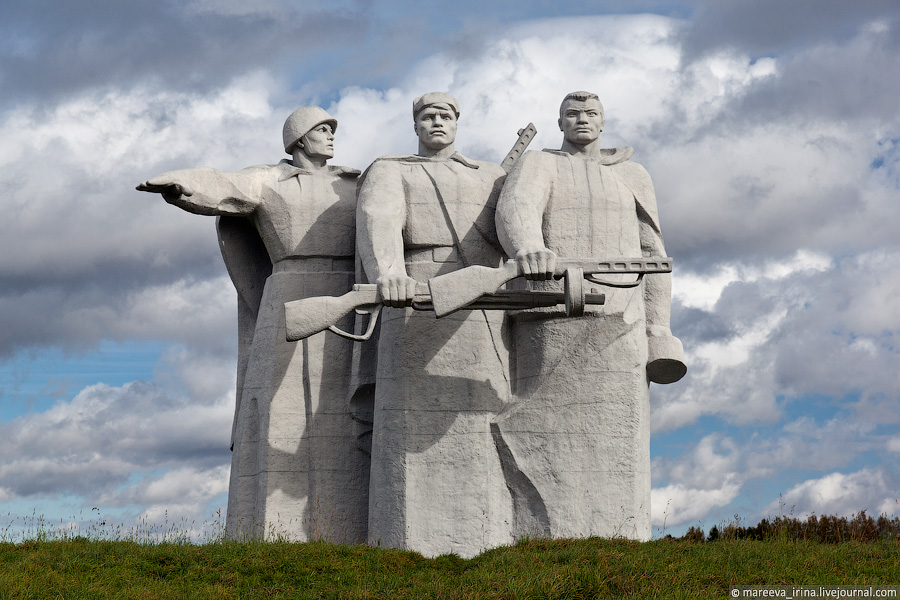
Monument to the Panfilov heroes. Source: www.byroad.ru
Continuation of the transcript of the conference Memory of the Holocaust in Contemporary Europe: What Unites and What Divides, held at International Memorial in Moscow on 25–26 September 2013. Presentation by Oleg Vitalievich Budnitsky, director of the International Center for the History and Sociology of World War II and Its Consequences, Higher School of Economics, Moscow.
Part III. Memory of the Holocaust in the USSR
Elena Zhemkova (member of the board of International Memorial, moderator): Dear friends, we are continuing our conference, and now begins a section that seems to me very important for our concluding discussion: what, in fact, happened to the memory of the Holocaust during the Soviet period? I am pleased to introduce the colleagues taking part in this discussion.
Oleg Vitalievich Budnitsky, Doctor of Historical Sciences, professor at the Higher School of Economics, director of the International Center for the History and Sociology of World War II and Its Consequences, and author of many monographs on Jewish history, including works directly related to our subject. He was the only Russian representative on the committee that, in effect, created the entire content of the Jewish Museum, which many of you visited yesterday.
I am also pleased to introduce Pavel Polian, professor and Doctor of Geographical Sciences, researcher at the University of Freiburg and author of many important studies on deportation. It is especially important that Pavel Markovich has spent many years studying the history of Soviet prisoners of war. The third participant in our section is my colleague Alexei Makarov, curator of the archive on the history of the dissident movement and, importantly, also a practicing social-studies teacher, author of many articles on the Holocaust and a winner of one of the Holocaust Foundation’s competitions.
Oleg Budnitsky (International Center for the History and Sociology of World War II and Its Consequences, Higher School of Economics, Moscow): Dear colleagues, I will speak about antisemitism during the Second World War. Two preliminary remarks.
The first concerns Soviet or post-Soviet Jews who remember the 1930s. In memory, that period has often remained a kind of golden age when there was supposedly no antisemitism and Soviet Jews had extraordinary opportunities in many fields — something that can indeed be supported statistically. I will mention only one fact: in absolute numbers there were more Jews with higher education than Ukrainians. In relative terms, on the eve of the war Jews made up more than ten percent of all students in the USSR.
When people remember the war, the dominant image is one of unity and friendship among all the peoples of the Soviet Union, and once again supposedly no antisemitism — especially at the front. If one examines interviews with Jewish veterans recorded in different countries, since Soviet Jews later scattered across the world, the dominant themes are comradeship in battle and friendship.
According to this memory, antisemitism arose after the war, partly as state policy and partly as a consequence of Nazi occupation propaganda. When wartime antisemitism is discussed, it is usually associated with Ukraine and Belarus and, to a much smaller extent, with Russian territories.
I should mention that there is another approach, based not on memory but on research. Gennady Kostyrchenko, for example, believes that a policy of state antisemitism in the USSR began in 1938. Without debating this in detail here, I will say that in my view this is completely incorrect: there was no policy of state antisemitism in the prewar USSR.
In my talk I want to challenge the stable stereotypes that have remained in people’s memory. I believe that antisemitism did not arise as a consequence of the Nazi occupation. It had never disappeared, and it manifested itself from the very first days of the war.
I want to speak specifically about the territory of the Russian Federation, which until the final days of the Soviet Union remained one of the most ethnically homogeneous republics, second in that respect only to Armenia. In the territories that were occupied or adjacent to occupied regions, Russians made up more than 90 percent of the population — for example, 96 percent in Smolensk Region. Even Moscow and Leningrad were not cosmopolitan cities: more than 80 percent of their inhabitants were ethnic Russians.
If we look at sources in which antisemitism is not even the central subject, we find that they are literally filled with evidence of strongly antisemitic manifestations from the first days of the war.
For example, Pushkin (Tsarskoye Selo). I quote from the diary of Lidia Osipova-Polyakova:
“Three new marble busts have been placed in Catherine Park. One of them is a particularly fine work, a very lifelike young Roman patrician. Today I went to see them with my neighbour Stella, who is Jewish. To our disgust, the patrician was covered with spit. Stella says it is because he has Jewish facial features. I had not noticed that before, but after she said it I really did see it. It was revolting.”
Immediately afterward she reasons that there is no antisemitism or anti-Chinese sentiment among the Russian people, only anti-communism, and that this was merely an act of hooliganism. Perhaps. But that entry is dated 15 August 1941.
Three days later antisemitic attitudes among the population nevertheless break through: among conscripts one can hear, “We are going to defend the Yids.” Again in August 1941, in Leningrad, the great Orientalist Igor Diakonov recalls his family discussing whether to leave the city. Only one member of the household, their nanny Nastya, knows what to do and says:
“Well, one can live under the Germans too. During the Revolution they slaughtered the gentry; now they will slaughter the Jews. What difference does it make to us?”
There is a view that the Jewish population supposedly did not know what the Germans were doing to Jews. Everyone knew. An entry from the same August reads:
“Everyone is in the mood that everything is collapsing. I have already heard a group of drunks shouting in the street: ‘Beat the Yids!’ — as though a quarter-century of Soviet power had never existed.”
Antisemitism was closely connected with anti-Soviet feeling, and in 1941 the idea that the Germans would arrive and finally put an end to the Bolsheviks was widespread. This was by no means confined to the Baltic states and Ukraine, as the literature often suggests. It existed in Russia itself, including in supposedly “safe” cities such as Leningrad and Moscow.
On 31 August in Leningrad, Lyubov Shapurina wrote after overhearing conversations in the street:
“I calmly await the new master, without indignation, without shuddering. They say the Germans are still better than Georgians and Yids.”
Again in August 1941, the American Mary Leder — who had come to the USSR as a teenager with her parents, who wanted to help build socialism, and who later left while Mary, as a Soviet citizen, was not allowed to leave — struck up a conversation in the street with a young Cossack woman. The woman told her in English: “The Germans will be here before long. They’ll take care of the Communists and the Jews.”
Mary then wondered whether the woman had failed to recognize that she was Jewish, or whether she felt so confident that she simply did not care — that she believed her hour had come. Mary had travelled from Moscow to Leningrad thinking it would be safer there. After this conversation she got on a train and returned to Moscow.
Naum Korzhavin, who as a teenager was evacuated from Kyiv in the summer or autumn of 1941, recalled:
“Once, amid the chaos at a railway station, I heard a colorful Cossack woman loudly cursing all the Jews who had flooded in. Her accusations were mainly about everyday matters, partly even things connected with the station, but the temperament was quite different. ‘And what are our Cossacks looking at?’ she raged. ‘They should just grab them and twist their heads off!’”
Korzhavin gives several more examples of antisemitism he encountered on the journey. At one point he fell behind his train and tried to get someone to help him board another one, but no one would help. A locomotive driver who happened to be there said: “Your daddy probably has a million hidden in his suitcase,” and immediately repeated a wandering rumor that some Jew’s suitcase had opened at a station and contained a million rubles.
That is, so to speak, the “ordinary people.” If we turn to the intelligentsia, an NKVD summary of the mood among Soviet intellectuals in Moscow dated 21 July 1941 quotes an unnamed Soviet writer as saying:
“Let the Jews be afraid of the Germans; let them fight the Germans. If the Germans enter Moscow, I will lead a German detachment and hunt down and destroy Jews.”
Then there is Mikhail Prishvin’s diary, an extraordinarily detailed and fascinating chronicle of moods in town and countryside. He condemns defeatists who expected that “the Germans will establish a government more in keeping with the spirit of the Russian people than the Bolsheviks and Jews.” Prishvin himself writes:
“For me, all the same, the Bolsheviks are somehow better. Under the victorious Bolsheviks the Orthodox God is closer to me than the old idol restored by the Germans.”
Nevertheless, in an NKVD summary dated 27 August 1941 describing the mood among intellectuals, a writer identified only as M.P. — I think this was Mikhail Prishvin — is described as believing that Soviet power faced a time of severe trials and catastrophe, and that communism throughout the world was coming to an end:
“Each of us now faces the question: what is to be done? How can we save ourselves in this catastrophe? Bolsheviks and Jews have little chance of survival. Not all Russian Party members will be destroyed; I think a change for the better may even be possible for me. For twenty-four years under Soviet power I have struggled desperately for my existence; year after year I was hounded by Jewish critics to whom my work and my philosophy were alien.”
I think this really was Prishvin, who had serious conflicts with Marshak and others.
If we move from the rear to the front and to the army, here are the words of an ordinary infantryman, Viktor Granovsky:
“If the company knew I was Jewish, then in the first battle I would get a bullet in the back from someone. I am not exaggerating.”
Fortunately for him, when he volunteered for the army at sixteen, the military commissar advised him — remarkably, this was in 1943 — to put “Belarusian” instead of “Jew” in the nationality field and “Mikhailovich” instead of “Moiseevich” as his patronymic. Thus he became Vitya, a Belarusian from Gomel, all the more plausible because he spoke Russian with a Belarusian accent.
Many other examples of antisemitism at the front could be cited, although much depended on the individual, the degree of assimilation and many other factors. Vladimir Gelfand, for example, constantly complains in his well-known diary about antisemitic manifestations, whereas Pavel Elkinson never once uses the word “Jew” in his diary. Boris Komsky likewise records no antisemitic incidents, although he meets one Jew who hides his nationality: the man had been taken to be shot during the Holocaust, miraculously survived, joined the partisans and believed it better not to advertise that he was Jewish even in the Red Army.
There are many similar examples.
How did Jews themselves explain this? Lev Kopelev, for instance, believed that the rise of antisemitism from 1942 onward was caused by “the necessity of national, and specifically great-power, patriotic propaganda — a tactical and strategic necessity.” Boris Slutsky reasoned in much the same way.
Speaking of antisemitic attitudes, I should add one more point. One of the most widespread legends is the claim that Jews were absent from the front. But there are opinions, and there are statistics. Jews were the fifth-largest ethnic group in the Red Army after Russians, Ukrainians, Belarusians and Tatars. According to my calculations based on Ministry of Defense data, 434,000 Jews served — roughly one and a half Jews per hundred servicemen. How could Jews as a group have been particularly conspicuous? That is the first point.
Second, representatives of every other nationality apart from the four just named were fewer in number than Jews. Yet no one ever asks why there were supposedly no Georgians, Armenians or Bashkirs in the army. I think there is only one explanation: the antisemitism that surfaced during the war.
Where did it come from? People often try to find a rational explanation — evacuation, for example. There were unquestionably objective causes of irritation. But there was also, I would say, an anti-Judaism existing almost at a genetic cultural level.
In this presentation I rely almost entirely on sources of personal origin, apart from some NKVD summaries. It is extremely revealing to read what people who had never actually encountered Jews said about them.
Korzhavin and his family, for example, arrived in the settlement of Sim in Chelyabinsk Region and stayed with a local resident. Korzhavin recalled:
“Alexander Yegorovich used the word ‘Yid’ constantly. While working he would mutter in annoyance: ‘May a Yid take you, look what you’ve done!’ To a mischievous child: ‘Look at the little Yid getting out of hand! I’ll pull your ears!’ Or, on the contrary: ‘Behave yourself, or the Yid will come and carry you away in his sack!’”
The remarkable thing is that the host did not even realize that the people living in his house were Jews. He had never met Jews before. When evacuated Moscow workers arrived, locals mistook them for Jews for two reasons: first, it was supposedly “known” that all Jews were fleeing to the rear; second, they spoke “not like us” — in a Moscow rather than an Ural accent.
Another story concerns Esther Fine, a Latvian Jew who by chance spent some time in the Volga-region village of Izhlei in Arzamas District of Gorky Region. No one believed she was Jewish, and one woman said:
“Jewish women are all Khaikas and Surkas, with long noses and speculators.” Esther kept insisting that she was Jewish, and they answered: “All right, enough lying.”
The most remarkable example is an entry in Boris Komsky’s diary. After being wounded and treated, he was leading a group of recovering soldiers from a hospital back to their battalion. In October 1943, near Trubchevsk in Bryansk Region, Komsky wrote:
“A strange thing: the Germans never stop talking about ‘Judeo-Bolsheviks,’ while the peasant women call the Germans ‘mute Yids.’”
In old Russian usage foreigners were called “Germans” or “mutes” because their language was incomprehensible. In the expression “mute Yids,” all the traditional popular images of evil were fused together. It is almost medieval. The sergeant did not even realize what an ethnographic discovery he had recorded.
What is the significance of all this? We know that the degree to which the Holocaust could be carried out successfully was directly connected with the attitude of the local population. In the former USSR that attitude was by no means uniformly benevolent.
A second point: if we speak of the particular difficulties of Jewish life in the USSR and of antisemitic policy, then in my view this was not simply something inspired from above. It was also a reaction by the authorities to attitudes from below.
The silencing of the Holocaust was similar. It was mentioned in Soviet newspapers — there was never complete silence — but not often. Around 1942–43, incidentally, there was an instruction that Jewish journalists should adopt pseudonyms. All of this reflected sensitivity to the mood of the masses. To talk about the suffering of the Jewish population or to defend Jews could be regarded as bad propaganda because it seemed to confirm Nazi claims.
I believe that subsequent actions by the Soviet authorities are better explained by this interaction with mass attitudes than simply by the personal antisemitism of Stalin or anyone else. Personal prejudice, in my view, is an insufficient explanation.
Finally, regarding the museum, I would like to tell one story. I was one of those who worked on its content. Many layers of material accumulated, and I wanted Yefim Dyskin to be represented in the section on the Great Patriotic War.
Marshal Zhukov regarded Dyskin’s feat as the greatest feat performed by a single soldier during the Battle of Moscow. Dyskin was part of an artillery crew and, by the end, was left alone. The crew destroyed seven German tanks. It sounds slightly Hollywood-like, but it is documented. Dyskin himself was wounded four times.
In April 1942, by decree of the Supreme Soviet, two people were posthumously awarded the title Hero of the Soviet Union for the Battle of Moscow: General Panfilov and eighteen-year-old Private Dyskin. The problem was that Dyskin had survived. He was in a hospital in Sverdlovsk, and when people came to congratulate him he kept refusing the congratulations: “It cannot be me — I am alive, while that man was killed.”
He was later sent to study medicine, which was in fact the best possible reward because he never returned to active combat. It is a remarkable life story. Yet while the museum was being created, people kept asking: “Who is Yefim Dyskin?”
And a second point. Who are the most famous heroes of the Battle of Moscow? The twenty-eight Panfilov Guardsmen. Who created that story? One Jew commissioned another Jew to create it: under orders from David Ortenberg, who signed his work as Vadimov, the story was written by Alexander — that is, Zinovy Yuryevich Krivitsky.
There is a paradox of Soviet and Soviet-Jewish history here. There was a real heroic figure, but with the “wrong” surname — Dyskin. And there was a fictional story created to inspire soldiers. The journalists who made it understood perfectly well what they were doing and why.
I do not know what profound conclusions should be drawn from this, but it certainly provides material for thought. Thank you.
Elena Zhemkova: Thank you very much for reminding us, through such vivid examples, of the realities of the wartime situation. We will now make a leap forward and move to the postwar period. I give the floor to my colleague Alexei Makarov for his presentation, “Dissident Memory of the Holocaust in the USSR.”
I would like to remind you that a similar question already arose in the previous section. Perhaps this presentation will help us reflect on whether the struggle to preserve the memory of the Holocaust became a catalyst for Jewish self-awareness.
© 2009–2015 International Memorial Society: “History Lessons. The Twentieth Century” project
© Mikhail Gefter, 2012–2015