

Новые источники по истории Второй мировой войны: дневники |
||
нояб 29 2021 |
||
|
Лектор: Олег Будницкий |
||
| |
||
 |
||
| |
||
|
Дорогие коллеги, здравствуйте! Спасибо вам за то,
что к нам сегодня
подключились. Мы начинаем новый блок нашей лаборатории. Этот блок будет
посвящён военным дневникам и, в частности, одному ранее не
публиковавшемуся
дневнику. Он хранится в архиве Еврейского музея и Центра
толерантности, и его мы
сможем почитать и обсудить на следующей нашей встрече. А сегодня мы
услышим
лекцию, посвящённую специфике жанра военного дневника и специфике
самого
способа вести дневник в 40-х годах, в советских условиях и в условиях
войны. Наш сегодняшний лектор в особом представлении не
нуждается, я думаю. Это
Олег Витальевич Будницкий, историк, профессор Высшей школы экономики и
директор
Института советской и постсоветской истории Высшей школы экономики.
Публикатор
большого количества эго-документов, в том числе и военного времени.
Олег
Витальевич, вам слово. Да, спасибо, Георгий. И у нас какой вообще формат?
На сколько у нас лекция
рассчитана? Где-то час. Слушатели там не завянут вообще? Я бы просто
хотел, чтобы тут не было
такого говорения, тем более в чёрном квадрате. Там какие-то ревью
написаны.
Иногда приятно посмотреть на лица слушателей. Я бы хотел, чтобы как-то
это у
нас проходило не в той форме, что я вещаю, а слушать, чтобы была
какая-то
обратная связь. То есть, если возникают какие-то вопросы по ходу
дела, то как-то... Я
думаю, Георгий, вы будете вести, да? Если кто-то в английском хочет
спросить,
то есть вопросы, и можно его задать устно, чтобы все слышали, или
написать в
чат, тогда вы его озвучьте. Если по ходу дела возникают какие-то
вопросы, я
думаю, что это довольно продуктивная форма, особенно когда мы в таком
онлайн-режиме. Это первое. Ну, собственно, второе – это о военных
дневниках. Кто их вёл, при каких
обстоятельствах, кем были эти люди, почему они вели дневники и так
далее. И по
большому счёту эти вопросы ничем не отличаются от тех же вопросов,
которые
задают исследователи дневников или историки, которые используют дневник
как
исторический источник, пытаются что-то извлечь. Разница лишь в том, что это война, и это в высшей
степени неудобное время
для ведения дневника. Ну, хотя бы потому, что все стреляют на войне.
Стреляют,
бомбят и много чего другое. И как вообще технически можно вести дневник?
Возникает вопрос, кто мог эти
дневники вести, и сколько вообще этих военных дневников, и можно
перечислять и
дальше-дальше эти вопросы. Сразу я хочу снять один такой вопрос, который
всегда мне задают. Ведь вести
дневники на войне было запрещено. Всегда говорят. В любой аудитории эта тема
возникает. На самом деле,
никакого специального приказа о том, что запрещено вести дневники,
никогда
издано не было. Во всяком случае, он историками до сих пор не
обнаружен. Были общие представления о секретности, общие соображения о
секретности. И, в общем-то, учитывая эти обстоятельства, вести
дневники,
конечно, было совсем нехорошим делом, если попадет в руки противника. А такие случаи, кстати, бывали. Тогда по этому
дневнику можно что-то понять о состоянии противника, в данном случае
Красной
армии. Если даже там нет конкретных сведений о месторасположении,
планах и еще
о чем-то, в дневниках обычно об этом не пишут или пишут крайне редко,
то там
будет понятно в какой-то степени, каково состояние моральное, состояние
снабжения, взаимоотношения внутри Красной армии и для противника это
уже ценная
информация. Поэтому часто тех, кто вел дневник, (просили)
дальше
не надо этого делать. Как вспоминал Зиновий Черниловский, юрист, который
во время войны был
замполитом пулеметной роты, командир, заметив, что он ведет дневник,
просто
взял его и бросил в печку в избе, растопленную, в которой они стояли, и
сказал,
что товарищ Сталин приказал расстреливать тех, кто ведет дневник. Ну,
товарищ
Сталин ничего такого не приказывал, но характерно представление
командира, что
это страшное преступление. Есть и совершенно противоположные случаи, когда
люди открыто совершенно
вели дневники, более того, иногда читали их вслух товарищам, то есть
никакого
единства здесь не было. Видимо, по большей части это не
приветствовалось, но в
то же время во многих случаях люди открыто вели дневники и никто им
худого
слова не говорил. Иногда бывали беседы у тех, кто делал какие-то
заметки с
сотрудниками особых отделов. Например, военный переводчик Ирина Дунаевская
вспоминает, что с ней
несколько раз по разным поводам беседовали разные особисты и
интересовались,
что там она записывает. Поскольку там не было ни номеров частей, ни
фамилий, в
общем, не было того, что есть военная тайна, то говорили, ну ладно,
можешь
продолжать делать записи, только смотри, чтобы ничего такого не было. Другой случай, известный или менее известный, я бы
даже сказал, скорее
менее известный, Елена Каган, переводчик специальной группы СМЕРШ,
заданием
которой было отыскать Гитлера или его останки, так она всю войну делала
записи. Елена Каган более известна под своим литературным
псевдонимом, который стал
последствием фамилии Елена Ржевская. Понятно, что она вела записи,
потому что
до начала войны она была студенткой литературного института, она хотела
быть
писателем, потом действительно и ею стала, и на войне она пыталась
делать
записи и, собственно, делала. И впоследствии, когда я познакомился с ее
этими
тетрадями фронтовыми, понятно, что очень многие ее вещи, они просто
выросли из
этих записей, и это, в общем, такие литературно обработанные дневники
военного
времени. Так вот, когда они действительно обнаружили труп
Гитлера и было произведено
вскрытие, вскрывала, кстати, женщина Анна Маранс, главный
патологоанатом,
исполняющая обязанности главного патологоанатома 1-го Белорусского
фронта,
майор медицинской службы. Останки были ужасно обгоревшие, понять, кто
это был
такой, было крайне сложно, но челюсти – зубы, оказались в
прекрасной
сохранности, ведь это стопроцентный идентификатор личности. И Елена
Каган,
лейтенант, она, в общем-то, записывала, что там происходило и так далее. Потом им сказали, что это все страшный секрет.
Одним из парадоксов
общесоветской политики было то, что об обнаружении трупа Гитлера не
было
объявлено. Это, можно говорить, полишинели. В общем, на Западе о том, что произошло с
Гитлером, хорошо знали. Эту
информацию было невозможно скрыть при определенном количестве
свидетелей, теми,
кто успел убежать из Берлина и так далее. Но, видимо, сообщили, что
Гитлер
покончил с собой, но об обнаружении трупа не сообщали. И, возможно, это была такая вот страшилка, что,
смотрите, может быть,
Гитлер скрывается, поэтому нужно быть всем начеку и так далее. Это мои
домыслы,
но я не знаю, чем еще можно это объяснить. Так вот, Елена Каган, она
тщательно
заштриховала (в дневниках) все то, что касается зубов Гитлера. Тетрадь она все-таки не уничтожила, но вот это все
было заштриховано. Она
давала подписку о неразглашении, и это, в общем, хранилось, так
сказать, ну не за
семью печатями - но
хранилось у нее
дома, и она никому не рассказывала до тех пор, пока не опубликовала
двадцать
лет спустя после этих событий, книжку под названием «Берлин,
май 45-го года.
Записки военного переводчика», где вот впервые поведала миру
обстоятельства
всего этого дела. И хотя это произведение называется
«Записками»,
это, конечно, не совсем записки, это вот такой текст, написанный на
основе
дневника. Возвращаемся к тем, кто вел дневники и почему эти
люди вели дневники. Ну,
во-первых, это люди образованные, по крайней мере, если не закончившие
среднюю
школу. Это уже был очень образованный человек в предвоенном Советском
Союзе. И, кстати, надо понимать, что идея культурной
революции и так далее — это
такой большой советский миф. В каком плане миф? В том плане, что
накануне войны
население было все-таки еще не слишком грамотное. Если мне память не
изменяет,
то на каждую тысячу взрослого населения приходилось 70, ну, там, с
долями
цифры, я называю, конечно, крылья это целого, порядка 77 человек со
средним
образованием и 6 и 7 человек - с высшим образованием. Так, их очень немного. И это, как правило, это
городские жители. Львиная
доля населения страны, что там она думала, как переживала войну, нам
это
известно крайне плохо. Львиная доля — это
крестьянство, это сельские жители. Их накануне войны еще две трети
населения по
переписи 1939 года. Так что вот те, кто ввел дневники, это
представители
меньшинства. Меньшинства незначительного образованного
городского и еще имеющего обыкновения что-то записывать. Да еще в тех
условиях,
когда во многих случаях, и, пожалуй, в большинстве записывать, в общем,
не
рекомендовалось, или запрещалось. Так, и казалось бы, что при этих условиях у нас
считалось до, я не знаю,
лет 20 тому назад, что военные дневники — это совершенно
уникальное явление,
что их крайне мало. Их действительно крайне мало, если сопоставлять
общую численность Красной армии.
Общая численность Красной армии, - вот кто скажет на вскидку, какова
численность Красной Армии за время войны? Предположим. 30 миллионов. Ну вот видите, замечательно. Так, лучше вы знаете.
Но, не совсем. Несколько больше. 34,5 миллиона. 34,5 миллиона
—
это предвоенная армия, пятимиллионная, более чем пятимиллионная, и 29,5
миллиона человек мобилизовали, призвали в армию в годы войны. Так,
значит,
конечно, это ничтожная доля. И, скажем, речь поначалу шла о десятках дневников.
Выяснилось, что их
сотни, по минимуму нам известные и опубликованные по большей части. И,
скорее
всего, тысячи. Тысячи, которые… Есть надежда, что они
где-то сохранились. Прежде всего, в
домашних архивах. Плюс к этому некоторые, возможно, не были уничтожены
сотрудниками спецслужб при аресте, потому что в ряде случаев введение
дневника
служило основанием для ареста. Если человек что-то такое записывал или кто-нибудь
на него донес. Иногда эти дневники, довольно редко, сдавались на
хранение в архивы
государственные. Но, по большей части, они обнаруживаются в домашних
архивах. Я иногда веду передачи на радио «Эхо
Москвы» в программе «Цена победы» и я
несколько раз заканчивал свои передачи призывом, обращением, что если у
кого-то
есть в домашних архивах дневники или какие-то документы военного
времени, не
позднейшие, через 50-60 лет взятые интервью или воспоминания,
записанные
кем-то, а дневники, записанные тогда, писавшиеся тогда, здесь и сейчас.
Когда
человек не знал не только то, что с ним будет завтра, но иногда и не
знал,
будет ли он жив сегодня вечером. И, к моему удивлению, люди откликались
и
присылали сканы, иногда передавали оригиналы дневников из самых разных
мест. Там, я не знаю, Новосибирск, Москвы, Штутгарт
— самых неожиданных мест. До
Нью-Йорка приходили какие-то дневники или дневниковые записи, иногда
переписанные, к сожалению, впоследствии авторами. Иногда бывали случаи,
когда
родственники переписывали и на дневниках явные следы редактуры в этом
случае. Если нет оригинала, то, конечно, к тексту нужно
относиться крайне осторожно
и проверять. Например, очень интересный дневник
«Медсестры» мне прислали. Ещё
там замечательно, и видно, что там какие-то моменты действительно
писали здесь
и сейчас, и вдруг там идёт что-то о фильме «Кубанские
казаки», который, как
известно, был снят после войны. И понятно, что в 1942 году вспоминать о счастливой
жизни по фильму
«Кубанские казаки» автор дневника никак не могла.
Но все мои попытки… Причём
переписала дневник сама автор. А её дочка упорно не хотела предоставить
оригинал. «Мама так хотела, я в таком тапе должна
быть». Вот такие бывают случаи. Это
не означает, что любой переписанный дневник на самом деле как-то
отредактирован. Бывает, что действительно, когда рассыпающиеся
листочки, тогда уже люди
переписывали, перепечатывали и так далее. Что ещё можно сказать об авторах дневников? Почему
писали, кто писал?
Писать на передовой дневники практически невозможно. Хотя случаи такие
бывали. Не частые, но бывали, когда дневники писали люди
и в том числе в ходе боевых действий. Я об одном таком дневнике
расскажу
поподробнее. Чаще всего это офицеры или командиры, как они их
называли до конца 1942
года, когда были офицерские звания, нередко это переводчики, сотрудники
-
работники штаба - штабные работники, политработники. Конечно, немало
текстов
осталось от журналистов, которым разрешалось делать записи, - военных
журналистов. И писали люди, не имевшие к литературе какого-то
отношения, но
мечтавшие стать писателями впоследствии. Это не единичный случай. Скажем, Борис Сурис,
одессит, он немножко иронично
писал, что «я хочу написать р-роман».
«Роман» писал там с тремя «р». Ну, шуточки-шуточками, но он между делом выписывал
фамилии немцев, которых
допрашивал как переводчик, для того, чтобы использовать их в будущем
романе.
Ну, роман он в итоге так и не написал. Написал замечательный дневник,
он
опубликован - оригинал дневника Бориса Суриса. Он стал художником. Его
дети,
внуки уехали в Израиль, и здесь где-то у них есть оригинал дневника.
Дневник
опубликован в Москве, замечательно интересный, но вот такое ощущение,
что
какие-то фрагменты там опущены. Олег Витальевич,
извините, пожалуйста, что перебиваю, но у некоторых не видно
демонстрации
экрана. Вы бы могли ее выключить и включить снова? Она приостановлена просто. Да, приостановлена. Она просто приостановлена, я потом ее, значит,
продолжу. Пока только
заголовок, больше ничего. Как я уже говорил, Елена Каган собиралась стать и
стала писателем. Ирина
Дунаевская вела такие дневниковые записи и говорила, «а может
быть я, вот такая
простая девчонка, когда-нибудь напишу книгу о войне?». Ну,
простая девчонка
вообще-то училась на Восточном факультете Ленинградского университета.
В общем,
хорошо или плохо, но владела немецким языком и так далее. После войны стала относительно известным
историком-востоковедом. Занималась
Древним Востоком, сектами. И там любопытные такие вещи. Она поступила,
по-моему, на русское отделение, потом она перешла на иностранное
отделение,
потом уже на востоковедение. И в одной из своих записей она досадует,
что она
читает раннего Табриана в переводе, потому что в оригинале достать
невозможно.
А она такая была, простая девчонка. Вот кто был совсем, ну, в кавычках, конечно,
простой, простых людей вообще
не бывает, и мечтал тоже стать писателем, это Владимир Гельфанд. Вот о
дневнике, которого я сейчас расскажу подробно, потому что, я смотрю,
люди уже
стосковались по картинкам, говорящая голова немножко утомляет. И
дневник,
которого ваш покорный слуга вместе с сотрудниками Татьяной Львовной
Ворониной и
Ириной Махаловой опубликовали с подробными примечаниями, иллюстрациями
и так
далее. Но история такова. История такова этого дневника,
точнее, этой публикации.
Мне, собственно, попадались в интернете такого, ну, скажем,
любительского плана
публикации этого дневника. Но это сложно было назвать публикацией, потому что
явно были соединены
вместе разного рода документы. Там дневник, какие-то заявления,
характеристики,
письма, явно есть какая-то путаница в словах и так далее. Рассказывая в одной из передач, посвященных
военным дневникам, я упомянул
об этом дневнике, потрясающем, который потрясает двумя вещами.
Во-первых, своим
объемом. Он начат летом 41-го года, а завершается осенью 46-го, когда
автор
дневника, служивший в Германии в оккупационных войсках советских,
собственно,
уже демобилизовался и едет домой, в Днепропетровск. И, во-вторых, совершенно запредельная
откровенность. После этой передачи на
радио позвонил сын автора дневника. Автора дневника уже не было в
живых, он, к
сожалению, прожил не очень долгую жизнь, в 60 лет скончался. Сын позвонил, он живет в Берлине, Виталий
Владимирович Гельфанд. Он
позвонил на радио, там дали мой телефон, он сказал, что хочет издать
его в
России. Дневник к этому времени вышел, часть его, по-немецки, и был
переведен
даже на шведский язык. Но там та часть, которая посвящена была только его
пребыванию в Германии.
Сначала в качестве завоевателя, а потом в качестве офицера
оккупационных войск.
Ну и настал момент, когда я начал говорить, что нужно еще сканы всего
этого
делать, потому что явно что-то нужно расшифровать, как-то
систематизировать и
так далее. Но в один прекрасный день я оказался в квартире
Виталия Владимировича в
Берлине. И меня еще интересовало: гигантский объем, как это все было
возможно? Там стояла такая коробка. Это коробка, в которой
были сложены записные
книжки, отдельные листы и вообще все, на чем можно было писать. Бумага
была,
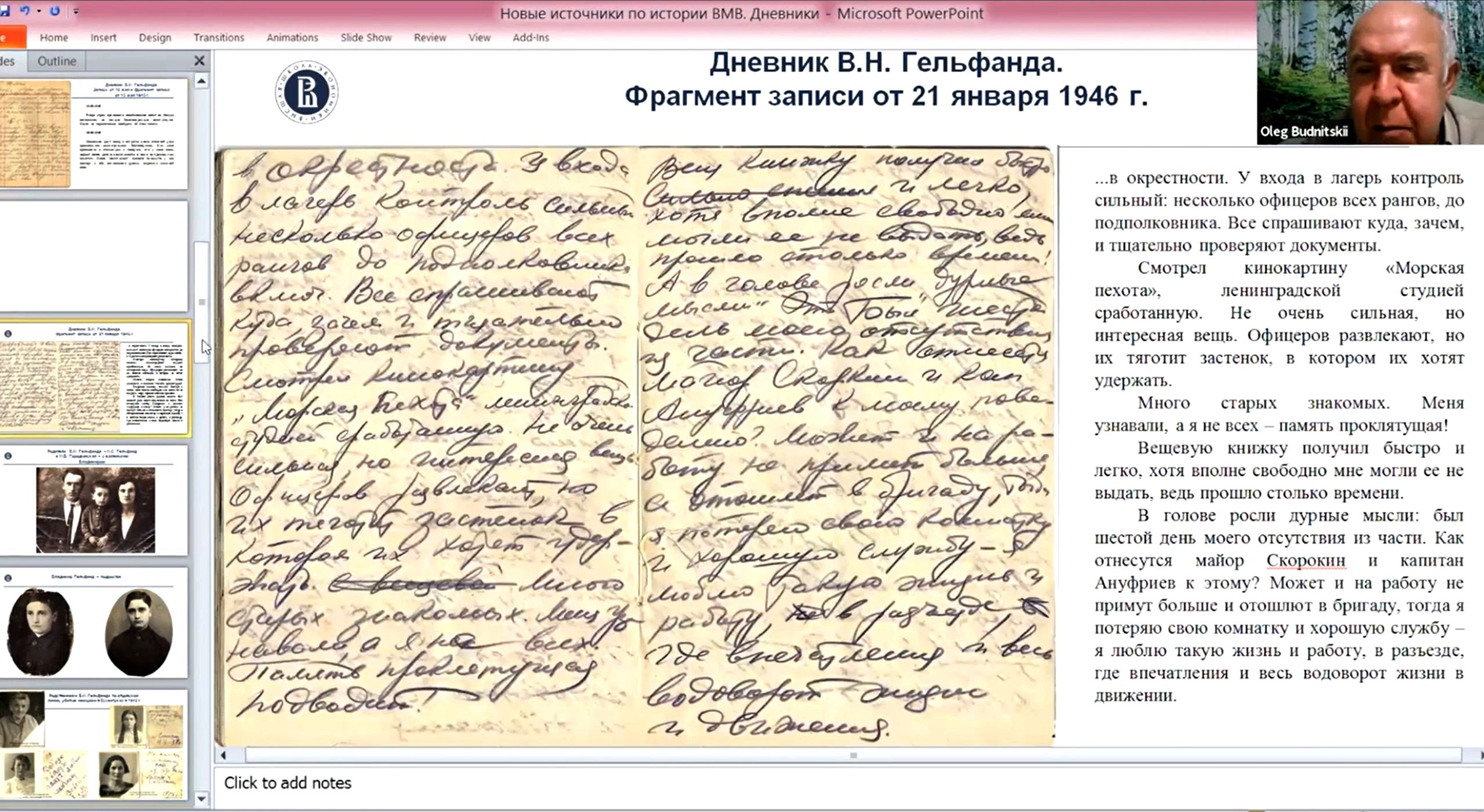
конечно, страшным дефицитом в военное время. И вот смотрите, значит,
фрагмент
дневника.
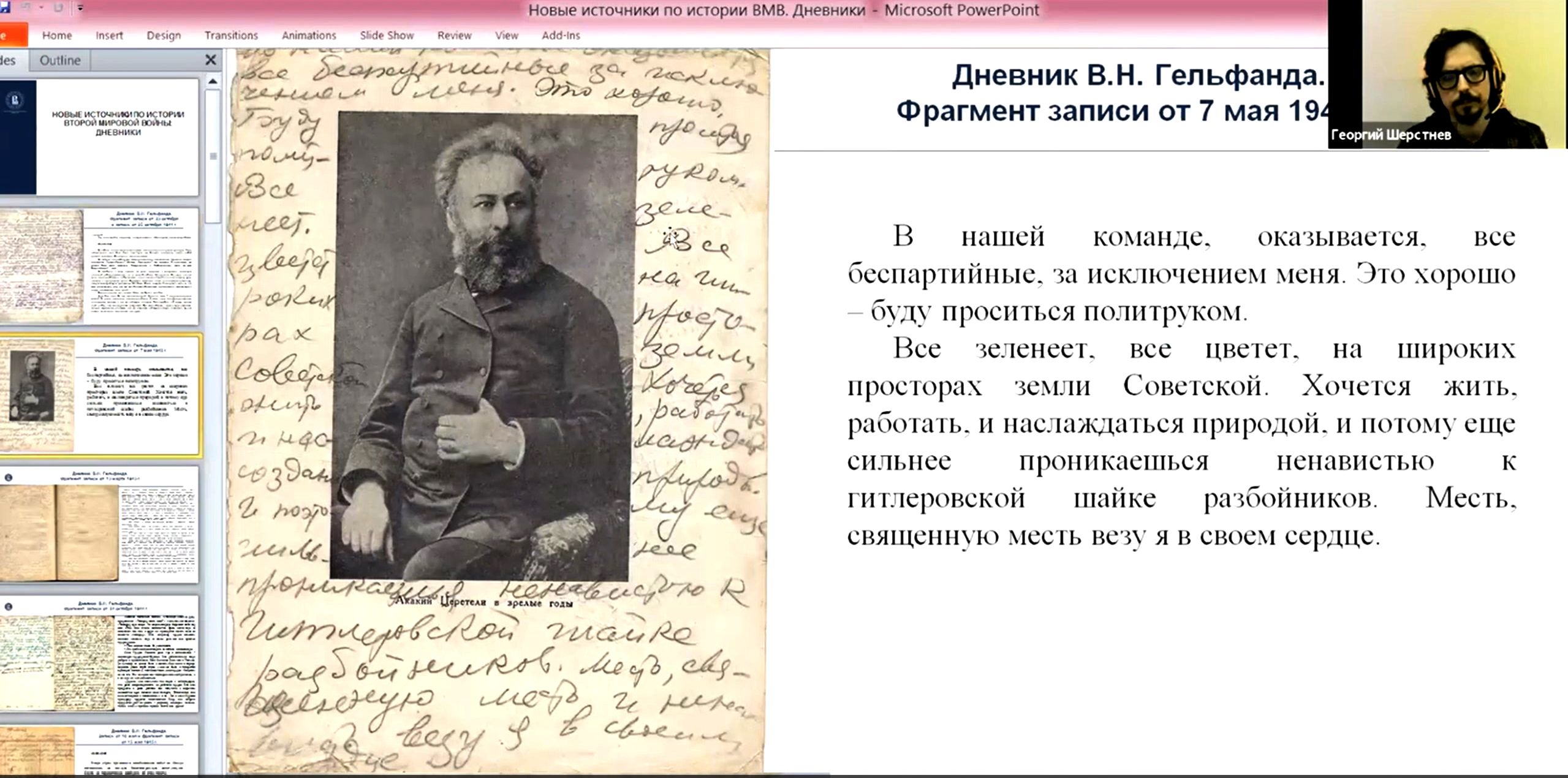
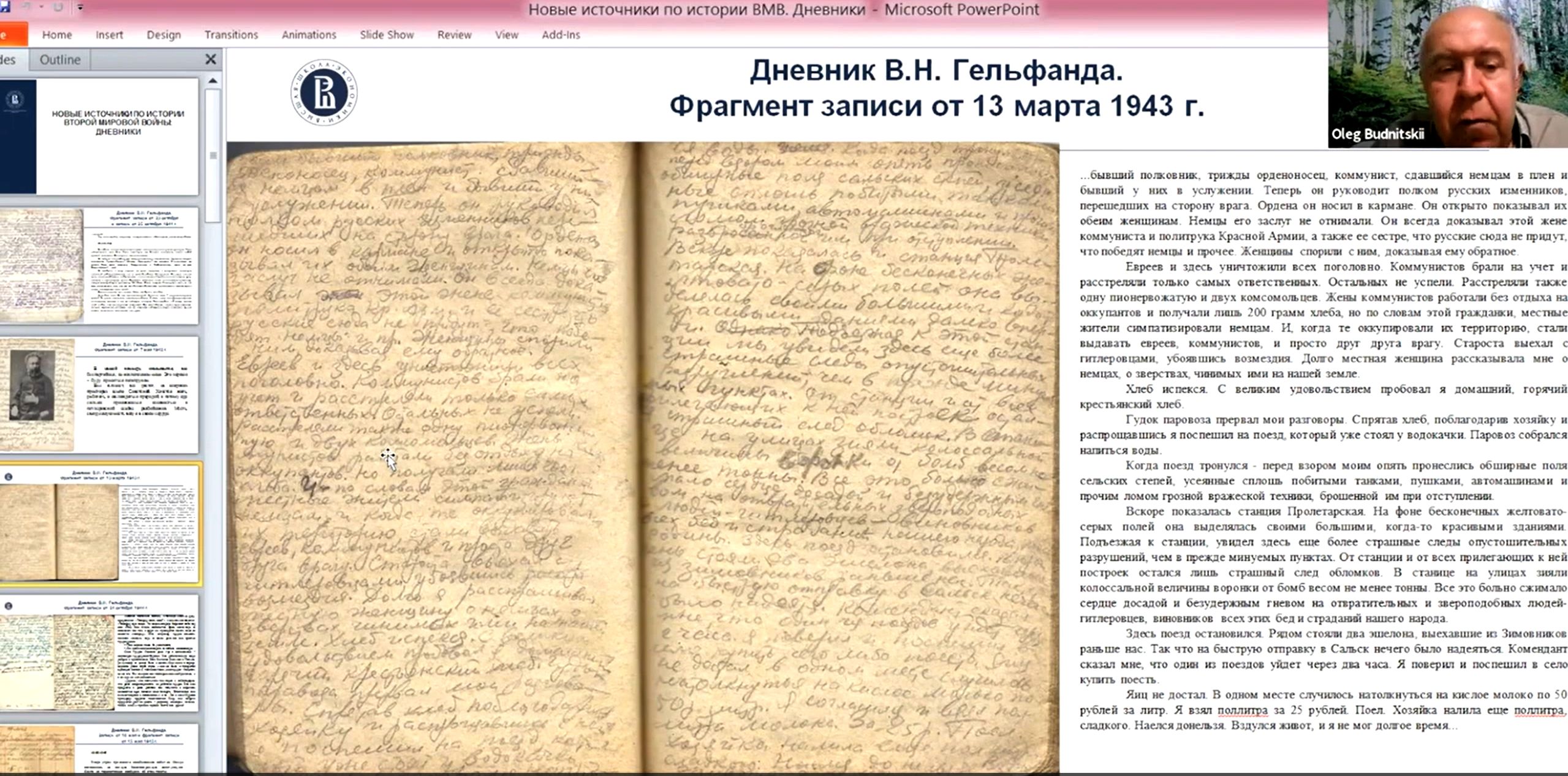
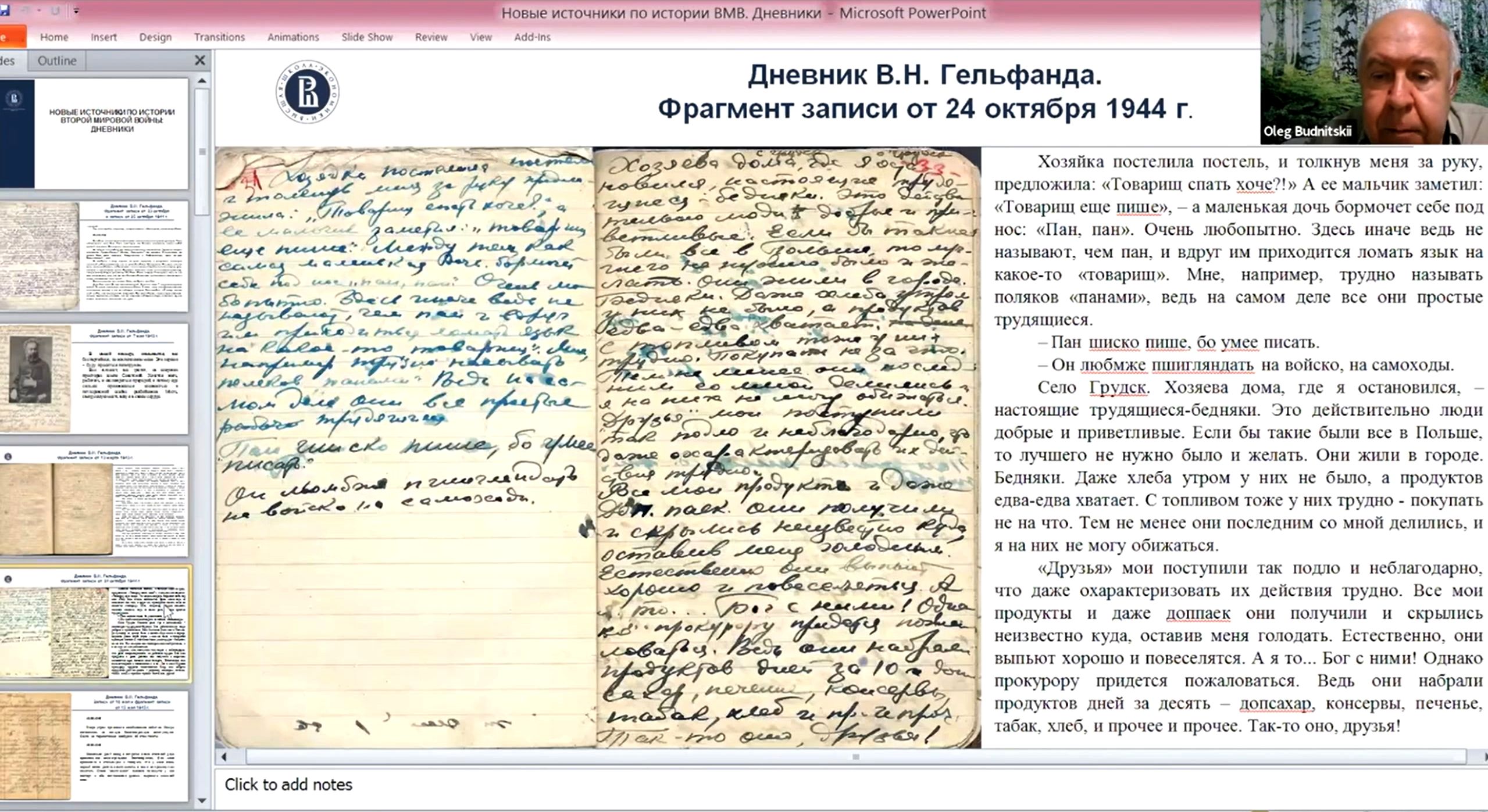
Вот так это выглядит, и это расшифровка. Это
расшифровка, которая была сделана
для этого текста. Вот еще один фрагмент.
Видите, как это записано? Вот это то, что было
записано в 1941, а это в
1942. Второе - это Церетели и вокруг запись. Видимо, это вырвана
страница из
книги с сочинениями Церетели. Есть где писать, и тут идет запись. Чем замечательный этот дневник? Несколькими
вещами. Во-первых, его автор
очень наивный. Он практически со школьной скамьи, но с небольшим
периодом, пока
ему не исполнилось 18 лет, не был призван в армию. Он служил электриком
в
Ессентуках. Он вот был таким полусформировавшимся полуподростком,
полуюношей. Вот он этот дневник ведет. Не знаю, может быть, он
вел дневниковый этап еще
раньше, но он начинается в 1941 году. И первая его реакция (на
начавшуюся войну)...
«Кстати, вот тоже началась война, но теперь придется изменить
планы на
каникулы». Действительно, планы на каникулы пришлось
изменить. И он... Дневники
всё-таки ведут обычно, имея в виду какого-то читателя будущего. Даже
если
декларируешь, что всё это для себя и так далее, но как-то человек до
последней
такой откровенности обычно не идёт. Здесь другой случай. Здесь это чрезвычайно
откровенно, просто в высшей
степени откровенно. Он пишет о себе какие-то крайне нелицеприятные
вещи,
которые, не знаю, более взрослый человек, наверное, не стал бы
записывать. В
том числе и свои какие-то неприятные поступки и так далее. Что ещё в этом дневнике поражает, кроме его
объёма, продолжительности и
откровенности? То, что это пишет человек из
реально боевых частей, он минометчик, хуже, в смысле ближе к смерти,
только
пехота, и он эти записи продолжает вести во время обстрела, во время
боев. После того, как в один конец окопа Лидного попал
снаряд,
тех, кто там находился, убило, а он опять чудом уцелел. Вообще за все
время
войны он был один раз ранен в палец, это была крайне неприятная штука,
потому
что там возникло нагноение, панариций и так далее, он попал в
госпиталь, долго
его приводили в чувство, но ему, конечно, в этом плане повезло, потому
что он
был в очень горячих боях, особенно, скажем, осенью 43-го года в боях за
Украину, довольно страшных, просто чудовищных сражениях, и он там
просто потерял
счет дням, он не знает, какое число, но продолжает записывать. Некоторые записи просто такие ужасающие: он
разговорился,
значит, с девушкой, с санинструктором, ну, явно она ему понравилась, он
отмечает, его все время обходят, обделяют наградами, он очень это
переживает,
вот девушка с медалью и так далее, они с ним поговорили, что-то у нее
было,
значит, там какое-то плохое предчувствие, но для нее все будет хорошо,
начинается обстрел, и он галантно уступает ей свой окоп, который он
отрыл
индивидуально, но он глубже, и сам там где-то тоже залег, и снаряд
попадает
именно в этот самый окоп, который он уступил девушке, и он так
описывает, что
от нее осталось, там нога, там еще какие-то части тела, в общем, как-то
это он
заставил солдат собрать, похоронить, записал на дощечке, кто это и так
далее. Что важно в данном случае, кроме вот таких
поразительных
и устрашающих вещей, показана такая реальная война, то, что это все
можно
проверить. Есть же, по счастью, электронные базы данных Министерства
обороны,
общедоступные, например, "Мемориал", и можно пойти на базу данных
"Мемориал", набрать фамилию, имя этой погибшей девушки, и убедиться,
что Гельфанд действительно это записал как раз в день ее гибели и так
далее.
Также можно прочитать о ней в связи с ее наградой в базе данных "Подвиг
народа", где собраны наградные листы всех участников войны и так далее. Что еще характерно для этого дневника, он вообще
ничего
не приукрашивал. В армию на фронт он попал рядовым, стал сержантом в
период
Харьковской катастрофы в мае 1942 года, когда Красная армия пыталась
осуществить наступление, освободить Харьков, но план был неудачен,
неверно
оценили силы противника, как раз здесь немцы готовились к наступлению,
сильнейший контрудар, Харьковское окружение, колоссальные потери, и
после этого
как раз Красная армия стала откатываться к Дону, а потом и к
Сталинграду. Вот
этот вот тяжелейший момент он описывает, и у некоторых авторов
дневников есть
такое свойство, как-то, если не приукрашивать, то, во всяком случае, не
слишком
расписывать какие-то негативные моменты. Он пишет все и без прикрас.
Но, возможно, самая интересная часть его дневника
связана
с пребыванием в Германии.
Вы знаете, что на тему Красной армии в Германии,
взаимоотношений с местным населением, скажем, не всегда джентльменским
обращением с немками, у него в дневнике написано об этом, есть там
полемика на
эту тему и так далее. У него в дневнике довольно подробно расписаны и
некоторые
эпизоды, которые он наблюдал, и его собственные взаимоотношения с
немецкими
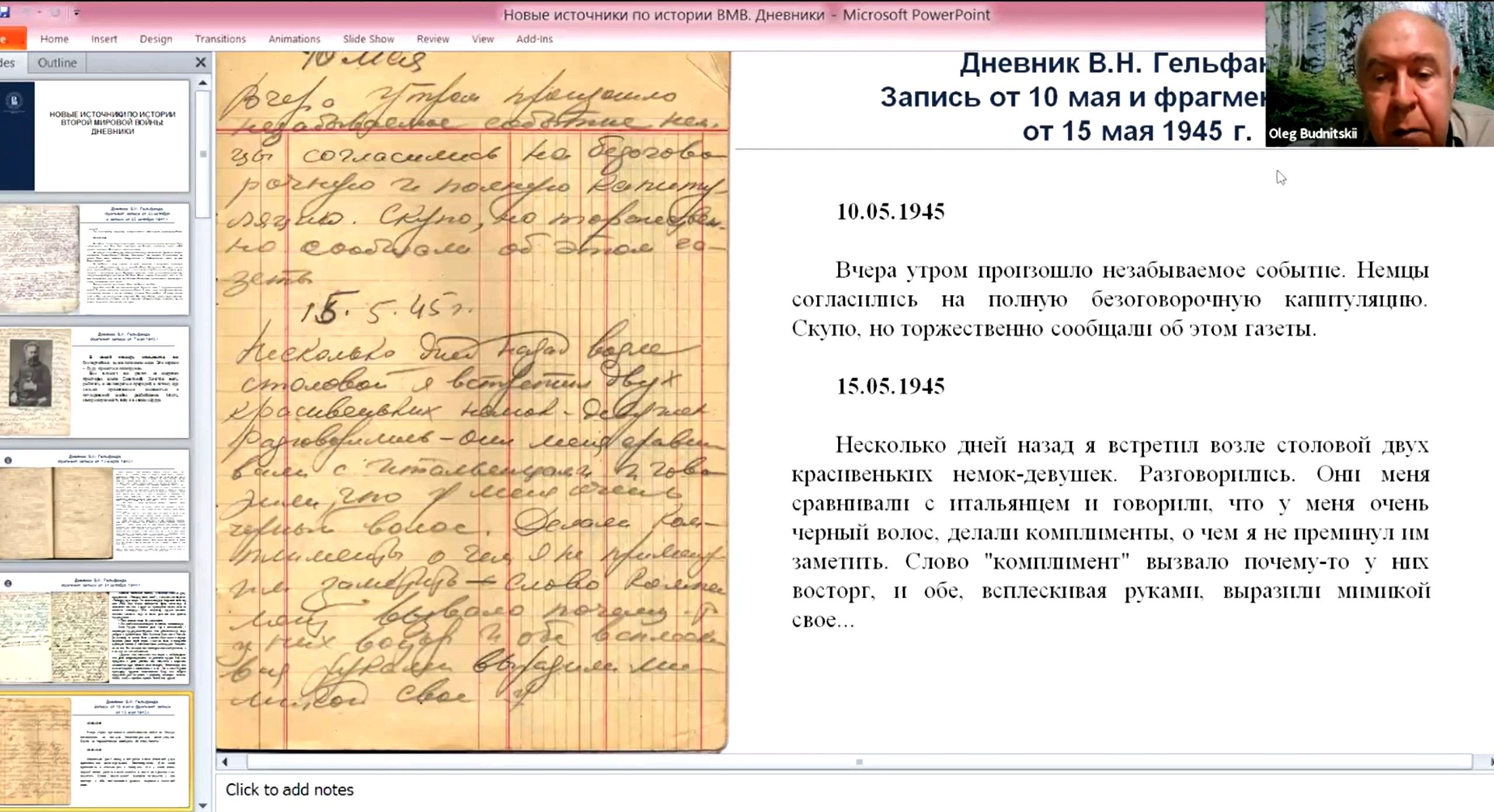
женщинами. Например, вот запись от 15 мая 1945 года.
«Несколько дней назад я встретил возле
столовой двух
красивеньких немецких девушек, разговаривали, они меня сравнивали с
итальянцем
и говорили, что у меня очень черный волос, делали комплименты, о чем я
не преминул
заметить. Слово "комплимент" вызвало почему-то у них восторг, и они
плеском руками выразили мимикой свою радость», ну и так далее. Но в чем тут интерес всей этой истории? Девушки
были не
одни, с ними была мамаша, и они хотели еды. Он им вынес каких-то
пирожков, и
они пришли в полный восторг. Мамаша явно пришла поторговать своими
дочками,
дочки, видимо, тоже были не против, но Гельфанд это, как бы, не совсем
понял. А он вообще, одна из таких центральных тем его
дневника,
девственник такой, да, и он все как-то хочет с этой девственностью
своей
расстаться, и все никак не удается. Хотя во многих случаях его просто
укладывают в постель, но он как-то отдаляется, не знает вообще, как
себя вести.
Со своей этой невинностью он расстался в Германии с немкой. Причем тоже любопытная история: что такое
начитанный мальчик.
Он разбирал одну из немецких библиотек, чтобы эти книги отправить в
Москву, в
СССР для компенсации ущерба, нанесенного немцами, и он ужасно
переживает по
этому поводу. Почему? Ведь тут же будут строить социализм, а он
убежденный
советский человек, да, тут же будут строить социализм, и как же они без
этих
важных книг, да, им будет трудно. В одной из книг он прочел - полностью медицинская
книга, -
и то, что он там понял по-немецки, он понял, что если вот сейчас с ним
этого не
случится, то все, потом, значит, ничего не получится. Он вышел на
улицу,
подозвал немку, первую попавшуюся, и предложил ей с ним переспать. Та согласилась, почему согласилась, довольно
очевидно.
Когда советский офицер говорил, иди сюда, то отказываться это было не
принято,
ведь у него, кроме всего прочего, был пистолет на боку. И он описывает
свое
грехопадение в мельчайших подробностях.
Дальше уже он пустился во все тяжкие, и наивный
уже
перестал совсем походить на наивного мальчика; стал завсегдатаем
черного рынка,
познакомился не с одной немецкой женщиной. В конце концов, это
окончилось тем,
чем нередко заканчивается, он заболел гонореей, и опять-таки,
подробнейшим
образом он описывает, как его от этого дела лечили. Лечение было
совершенно
варварское. Эти тексты надо давать молодым людям в пубертатный период,
чтобы
они понимали, чем некоторые похождения могут закончиться. В общем, все
в итоге
кончилось хорошо. Из того, что я пересказываю, думаю, уже понятно,
почему
дневники являются совершенно уникальным источником по истории войны.
Сложился
уже некий канон истории войны, и то, что говорят и пишут о войне многие
ветераны, подавляющее большинство, это то, что они считают правильным,
и очень
часто не так легко добраться до каких-то их реальных воспоминаний, у
многих они
в существенной степени перемешаны с тем, что они уже видели, слышали, и
кроме
такой понятной аберрации памяти есть еще этот переходящий момент. Когда
люди
писали дневники, они не знали, как положено, они писали так, - не все,
некоторые писали и тогда, как положено - как чувствовали. Не все писали
то, что
они видели, чувствовали, переживали. Очень часто обсуждается в обществе, особенно среди
тех,
кто интересуется историей войны, или среди историков, политических
деятелей,
что вот сейчас откроются архивы, но они в относительной степени уже
открыты, но
далеко не до конца откроются архивы, и мы все узнаем, как это все было
в
действительности. Ничего подобного, доложу я вам, мы многое узнаем,
но
далеко не все, потому что в архивах находятся документы, которые писали
люди с
определенными целями, и там очень много любопытного и действительно до
сих пор
не ставшего общепринятым достоянием. Но не нужно думать, что только
архивы
дадут нам представление о подлинной истории. Без вот этого
человеческого
взгляда, без личного опыта это бессмысленное дело, и дневники в этом
плане
совершенно уникальный, незаменимый источник. Например, письма военного времени проходили
цензуру, и
солдаты в основном знали, что они цензуруются, и, соответственно,
письма — это
источник не той степени откровенности, каковыми являлись дневники. Ну, говоря, возвращаясь к дневнику Гельфанда, что
еще
чрезвычайно любопытно, сохранился семейный архив, и он приобрел в
Германии
фотоаппарат и активнейшим образом там снимал. И у нас есть просто
уникальный
набор фотографий, часть вот из них дублирована в книге военные дневники
Гельфанда.
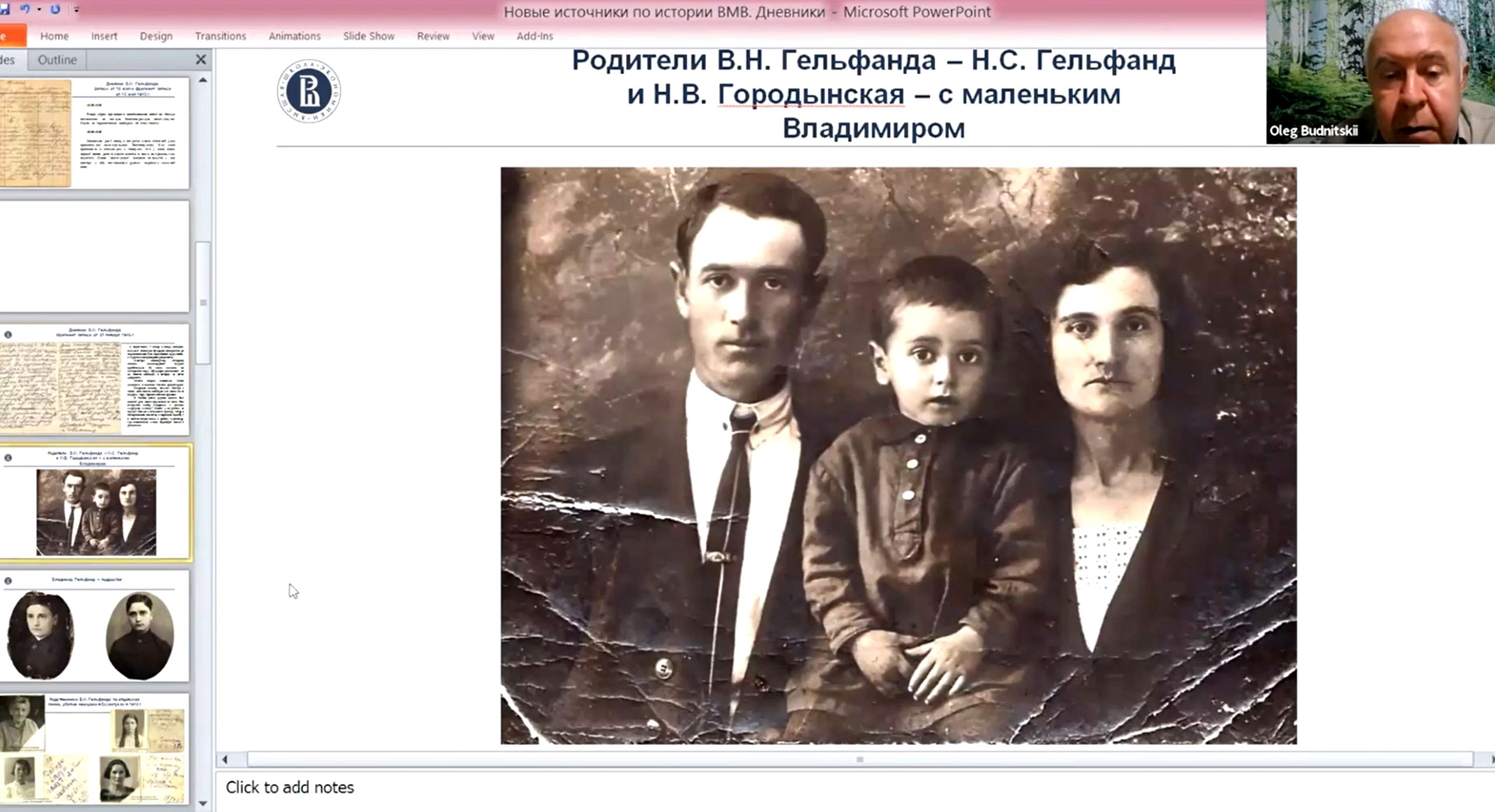
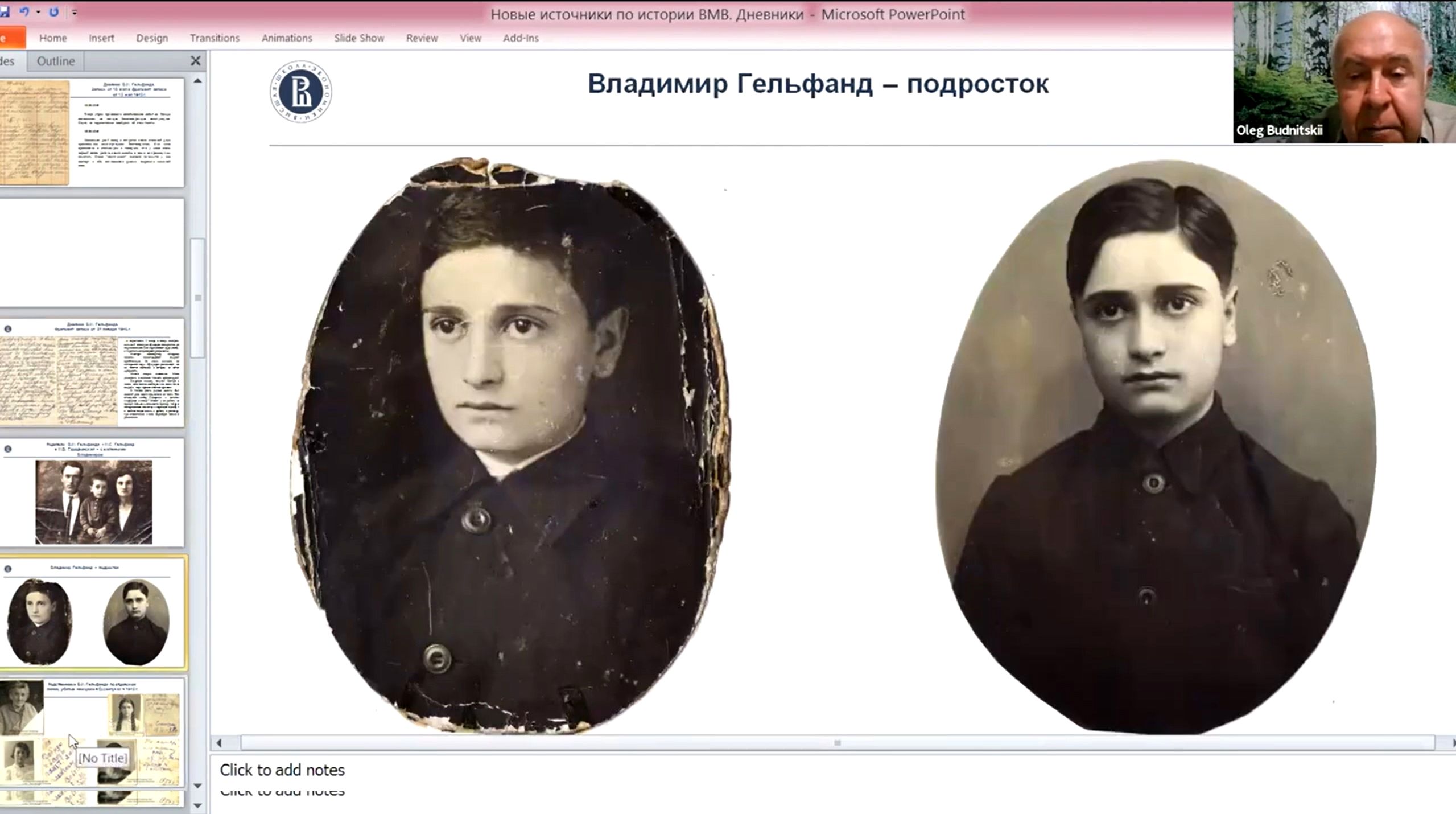
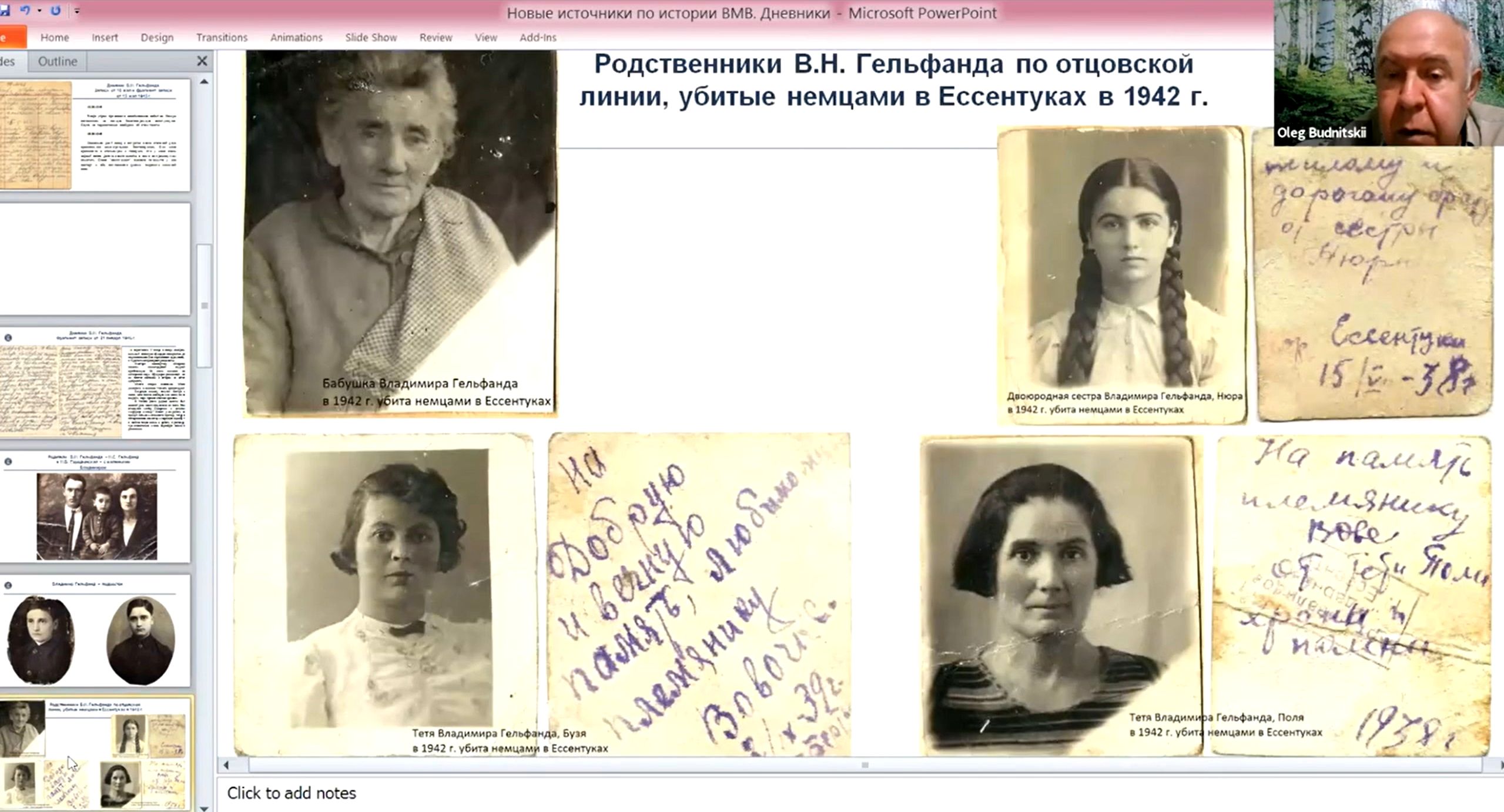
Вот это его семья, это он с мамой и папой, это
Гельфанд-подросток, это его родственники по отцовской линии, которые
были убиты
немцами в Ессентуках в 1942 году. То, что получило впоследствии
название
«Холокост», было известно ему не понаслышке и
задолго до того, как Красная армия
освободила Польшу и обнаружила нацистские лагеря уничтожения. У многих людей, особенно людей на Западе,
«Холокост» —
это прежде всего Польша, это лагеря уничтожения. Действительно, в этих
лагерях
была уничтожена значительная часть, относительно большая часть евреев,
убитых в
период Второй мировой войны. В СССР была другая стратегия у нацистов.
Евреев
расстреливали в местах, где они проживали. Недалеко от этих мест,
иногда там не
сильно скрывались. И Гельфанд об этом узнает достаточно рано и об этом
записывает.
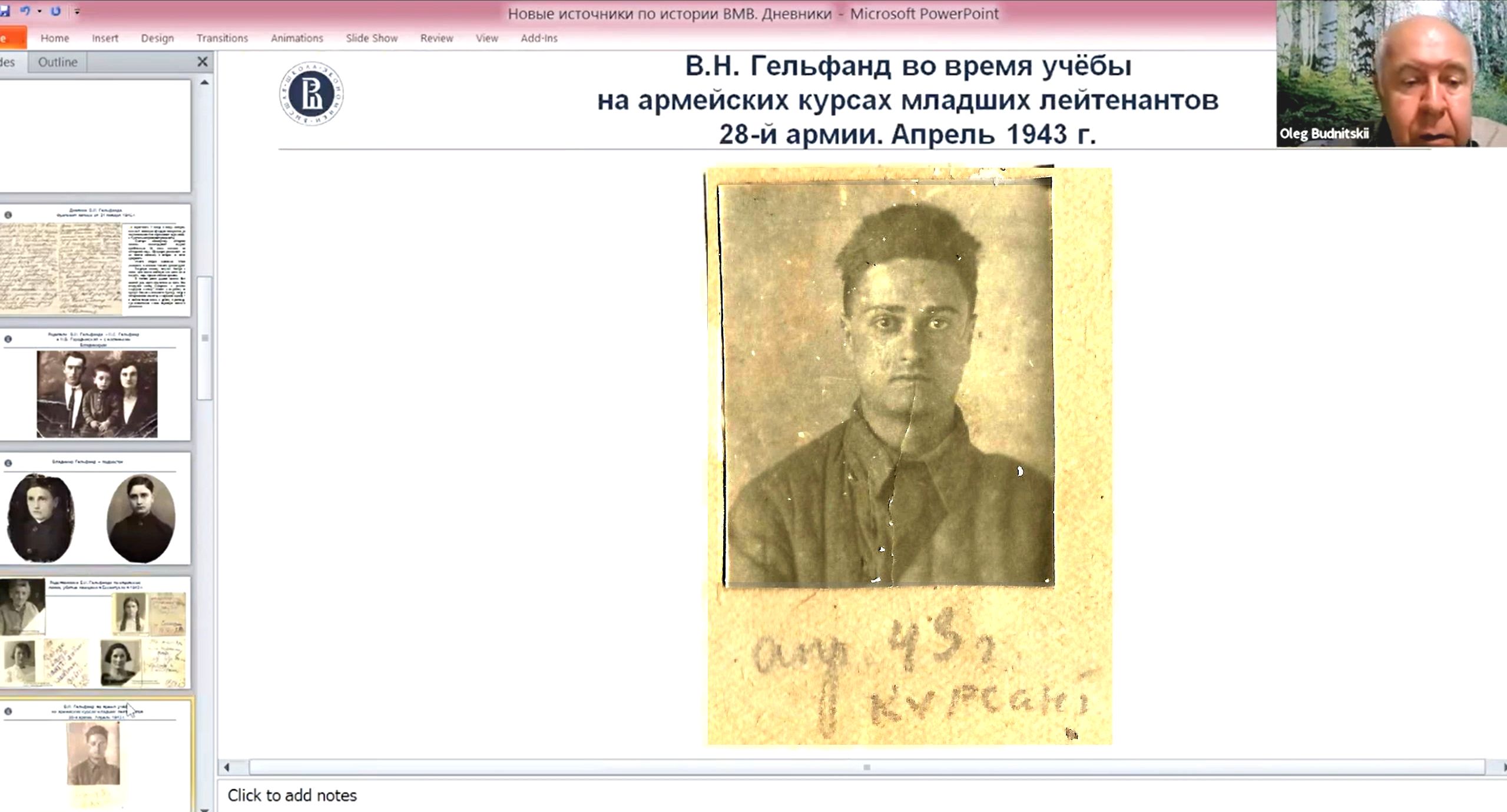
Так вот, это Владимир Гельфанд. Он закончил курсы
младших
лейтенантов в апреле 1943 года. Ну а далее целая серия...
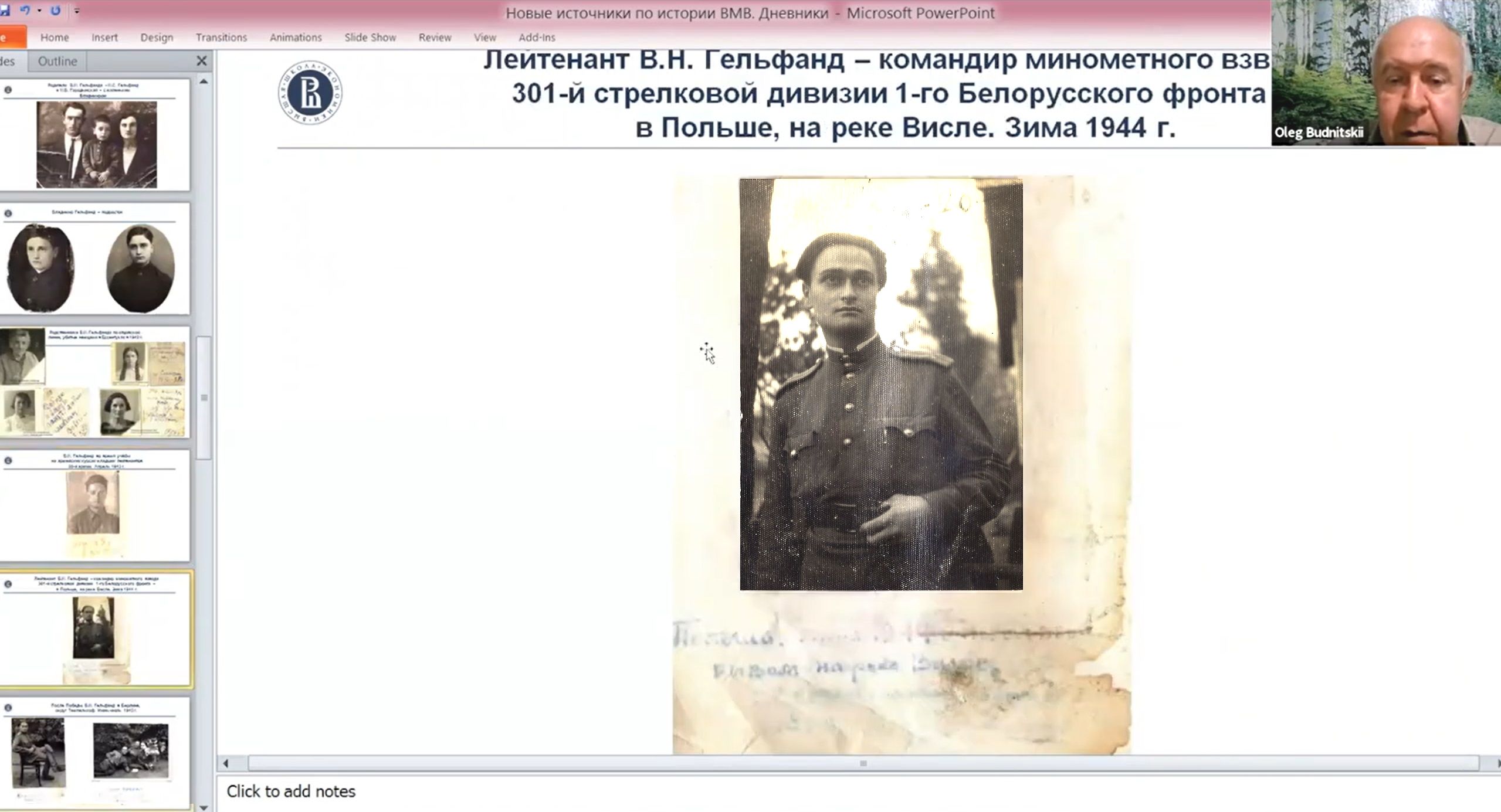
Вот это он в Польше. Вот его немецкая девушка
говорит,
что он похож на итальянца. Да, ведь он на самом деле чем-то похож на
итальянца
из фильмов.
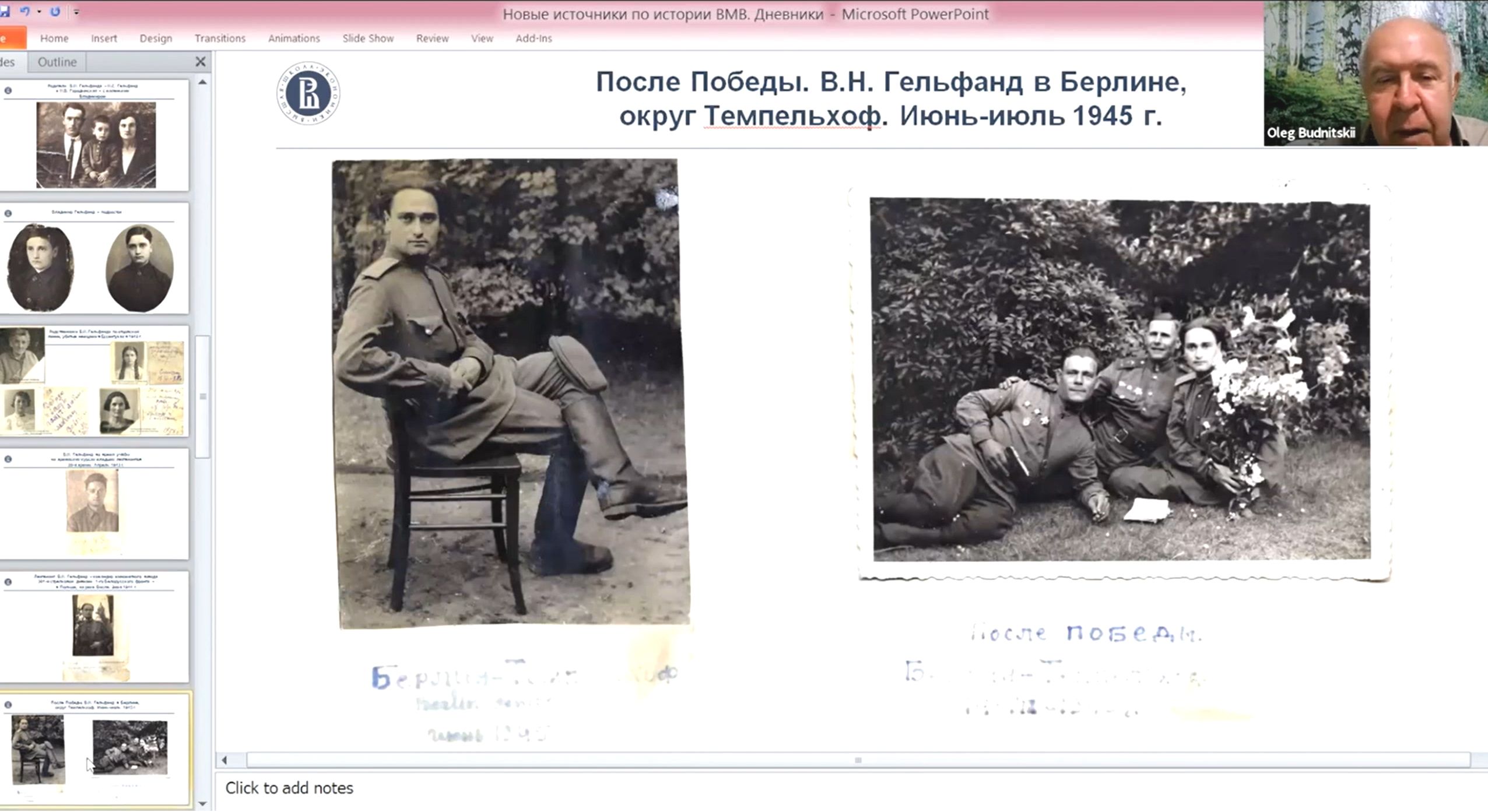
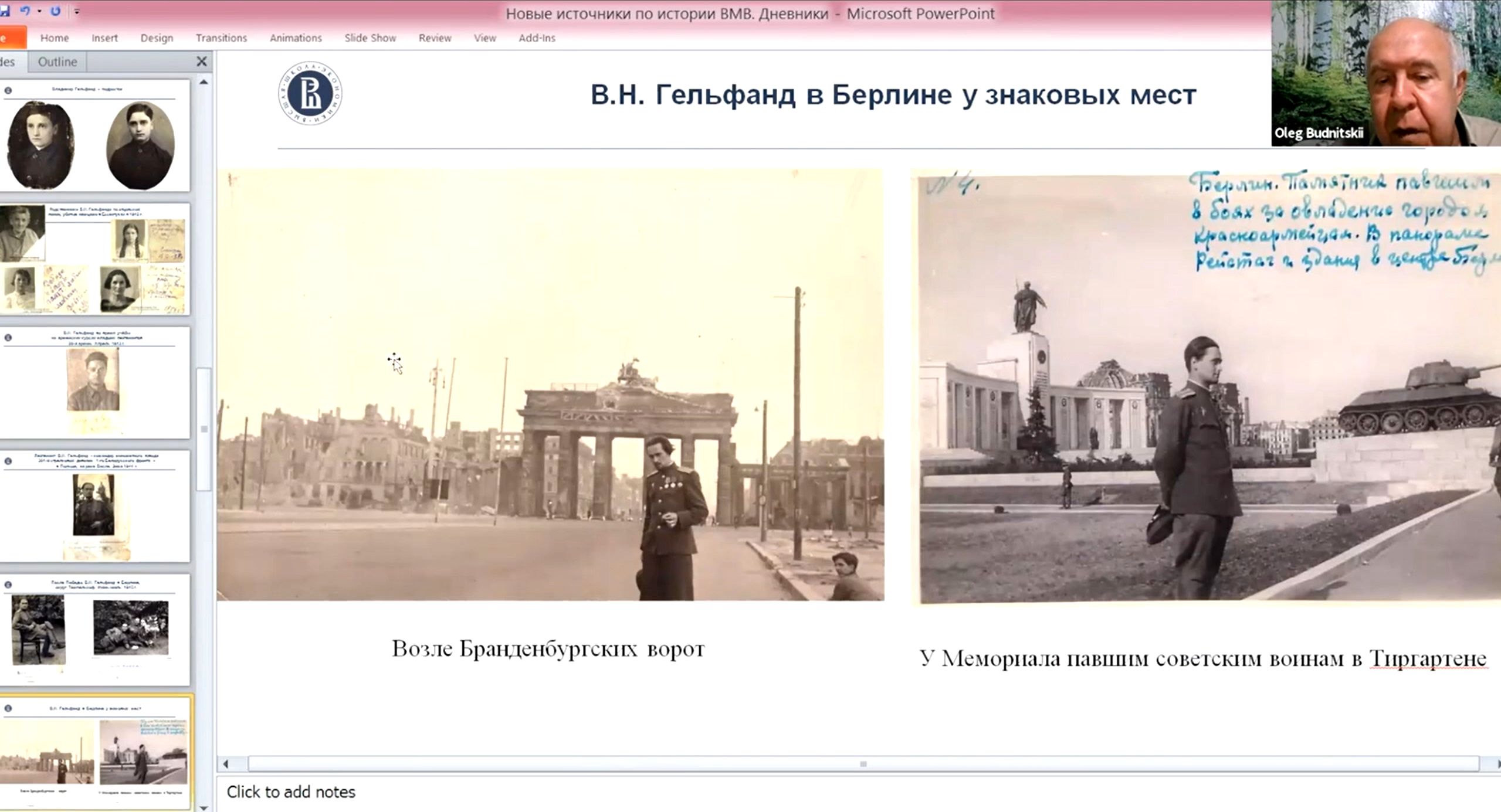
А это его серия снимков, которые делал он и его
товарищи
в Германии, в Берлине. Вот этот снимок. И далее, вот смотрите, это
легко
узнаваемые Бранденбургские ворота.
Это очень рано воздвигнутый уже тогда мемориал
Советским
воинам, павшим при штурме Берлина. И он на том же самом месте
находится. Это он
опять же со своими товарищами.
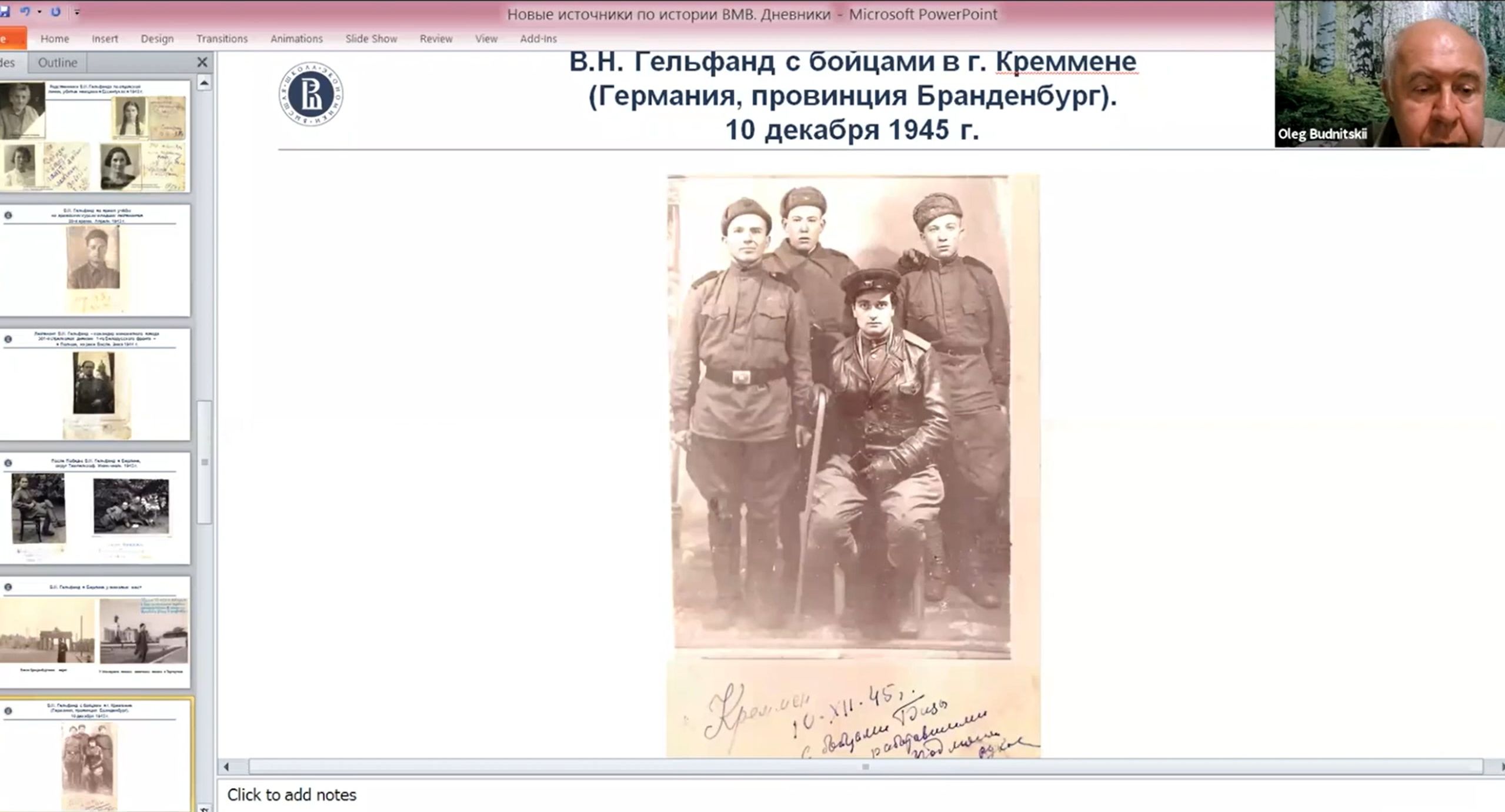
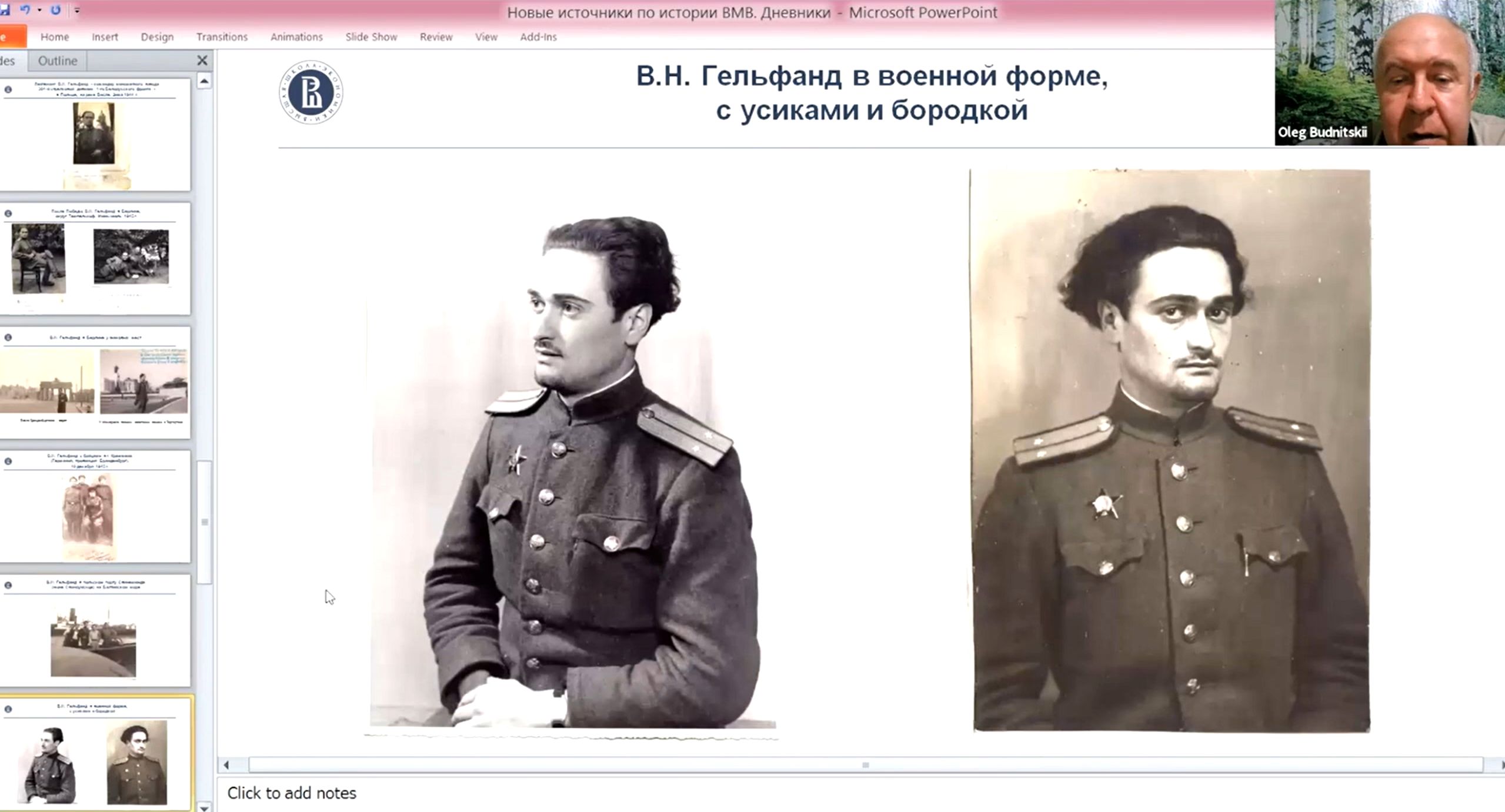
Вот смотрите, как мог выглядеть советский офицер в
то
время. Обратим внимание на прическу. Видите, наградили Гельфанда в конце войны уже за
бои 1945
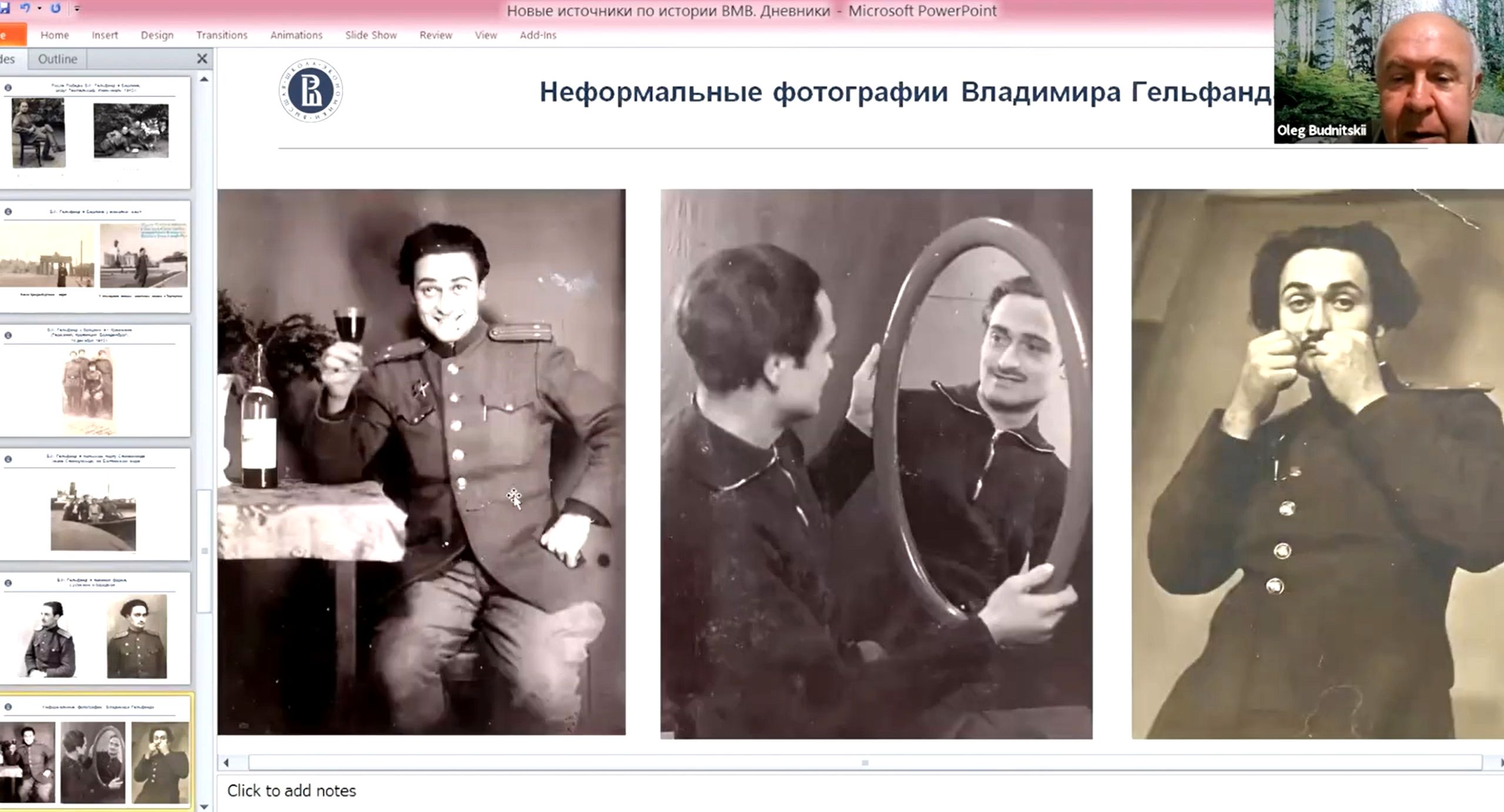
года орденом Красной звезды. А это вот он, видите, так сказать, чудит.
Что-то
такое себе там примеряет. Усы наклеивает, еще там чего-то.
В общем, молодой человек своего времени. Это его
немецкие
подруги. Какая-то из них ему даже писала после окончания войны.
Вот тоже серия этих чудачеств. Видите, вырядился в
цилиндр. И это виды послевоенного Берлина.
Щецинский вокзал. Щецин теперь Польский, этого
вокзала
уже нет. Он не существует. Разрушен.
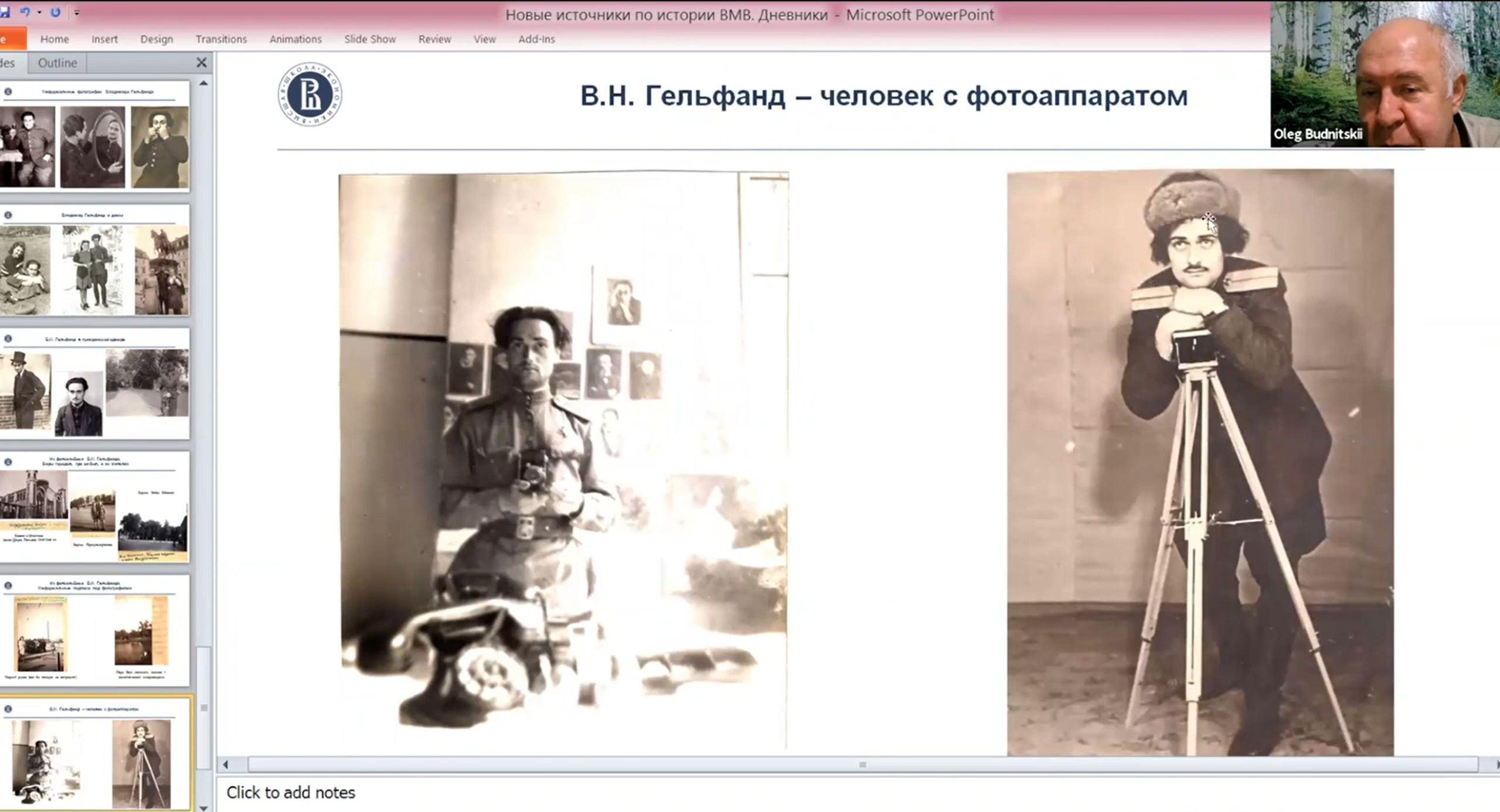
Черный рынок. Вот это Гельфанд со своим аппаратом.
Но
тоже, видите, чудит. Ну, волосы у него натуральные, но вот такой,
значит,
образ.
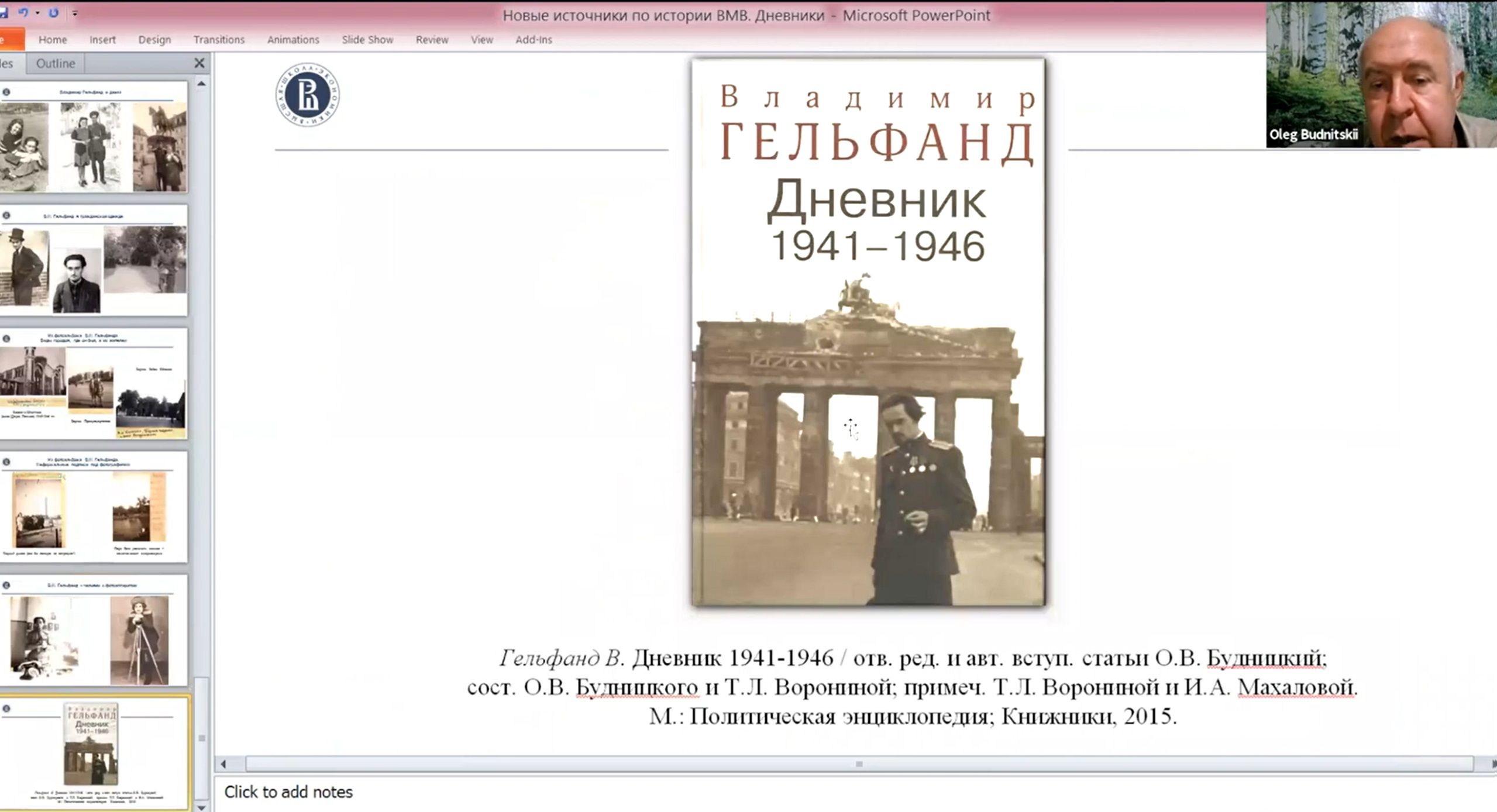
Это обложка книги Владимир Гельфанд на фоне этих
самых
Бранденбургских ворот. Тоже, видите, с такой небольшой бородкой. Вот
такая
толстенная получилась книга — 750 страниц с подробнейшими
комментариями.
Существует и немало других дневников. Я говорил о
нескольких дневниках. Есть дневнички совсем короткие, но это не значит,
что они
менее ценные. Очень впечатлил меня дневник Павла Элькинсона,
сержанта-артиллериста, прошедшего практически всю войну с 1942 года,
участвовавшего в Сталинградской битве, раненого и прочее. Он начал
вести
дневник в 1944 году. Почему? Потому что они подошли к пруту границы
Советского
Союза. И он записывает: "Вот мы идем за границу, я никогда, наверное,
больше за границей не буду, надо это все записать." И он побывал, действительно: в Румынии, Болгарии,
Югославии, Венгрии и Австрии. Вот такой, так сказать, туризм. Ну,
туризм,
конечно, в кавычках, потому что он восторженно совершенно пишет, что в
Болгарии,
Югославии так встречают, как не встречали ни в России, ни на Украине.
Там
бросают еду, все время вино, все время там пьяные, он так пишет все
очень
замечательно и так далее. А потом Болгарии же, собственно говоря,
объявили
войну, но Болгария тут же совершила переворот и объявила войну
Германии. В
Югославии встречали, конечно, освободителей. А потом в Венгрии были тяжелейшие бои при
форсировании
Дуная, штурм Будапешта. И он записывает в один день, что сегодня
погибло
четверо его товарищей. И невольно думаешь, когда же, и он записывает,
«когда же
моя очередь?». То есть вот это ощущение, что ты можешь
погибнуть в любой
момент, оно не притупляется со временем. И уже колоссальный его военный
опыт в
данном случае ничего не значит. Ну, в общем, добрались они и до Австрии. Можно привести самые неожиданные сюжеты,
встречающиеся в
дневниках: истории любви, юмор иногда, много чего любопытного. И
действительно,
почти записки туриста. Конечно, все это в кавычках. Дневник майора Сафонова, он в Питере находится, в
отделе
рукописей. Он был картографом. И его задача была нанести на карту
достоверную
военную карту территории, которую Красная армия освобождала или
оккупировала, в
зависимости от того, с кем воевала, так сказать, жертва нацистов или
сторона
нацистского блока. И он побывал тоже в ряде стран, и особенно его
поразила
Австрия, в которой он мечтал побывать. Он мечтал побывать в Вене,
мечтал
увидеть Венский лес. Понятно почему, потому что это Штраус
«Сказки Венского
леса» и прочее. И он действительно побывал в Вене, и он
побывал в Венской
опере, которая была частично разрушена. Вповалку спали, значит, там
лежали
солдаты, и он, там присел, и что-то там немножко сыграл на рояле и
думал, ну, а
не исключено, что когда-нибудь, значит, вдруг сам Штраус на этом самом
рояле
играл и так далее. И он подробно описал санки там разные и прочее,
прочее. Вот
такие бывают тексты, но чаще, конечно, это такая военная тяжелая
повседневность. Ну, могу привести последнее, что я прочел в смысле
дневников. Это дневник Николая Гензлина, политработника. Потом
политработников
сильно подсократили, и он заканчивал войну уже не в качестве
политработника, а
в качестве артиллерийского офицера. Ну, он и до этого был в артиллерии,
ну, был
там замполитом, комиссаром, потом замполитом, потом стал разведчиком в
артиллерийском дивизионе. Вот. Он описывает тяжелейшие бои на Северном фронте,
сначала в
районе Таганрога и Ростова в 1942 году, тяжелый период отступления, и
потом на
Северном Кавказе. Вот. Но он тоже дошел до Германии, да, тоже закончил
войну в
Германии, но там, правда, в Германии записи такие отрывочные уже. Так что дневников не так мало, они весьма
многообразны,
другие писавшие очень разные, но что-то их объединяет. Объединяет,
конечно, это
вот такая склонность к рефлексии, я бы сказал, да, и в какой-то степени
чувство
Истории, неосознанные сами, да, вот как-то зафиксировать то, что
происходит, и
как-то у некоторых из них это отчетливо проявляется, оставить о себе
память,
след. Опять же, люди не знают, что их ждет завтра. Иногда встречаются в дневниках сержанта Бориса
Комского,
замечательный совершенно, он хранится в архиве Балаховича в Нью-Йорке.
Он там
описывает, начал воевать на Курской дуге. Буквально накануне экзаменов
в
офицерском военном училище их просто всех погрузили, отправили, значит,
вот на
Курскую дугу, потому что были... Это Курский выступ, но вы знаете, что
битва на
Курской дуге — крупнейшее сражение в мировой истории вообще,
не только
крупнейшее сражение Второй мировой войны. Остро не хватало людей, и их, недоучившихся,
бросили туда
воевать. Он тоже минометчик был, значит, сержантом. Присвоили им
сержантов, а
не младших лейтенантов, и бросили туда. И за несколько дней буквально
его рота
сначала превратилась из минометной в пехотную, потому что были разбиты
минометы
огнем противника. А потом просто ее не стало, она была полностью
уничтожена.
Ему повезло, потому что его ранили за день. За пару дней до этого он
оказался в
госпитале, вот, а все остальные — нет. Вот такая история.
Очень интересный тоже
дневник. Комский тоже молодой парень, когда начинается
война ему
17 лет, но вот он целиком немножко другого психологического склада, чем
Владимир Гельфанд, гораздо более уверенный в себе. Закончил войну
лейтенантом в
Германии. Но, к сожалению, его... Германскую часть дневника, его жена
впоследствии уничтожила, как он рассказывал. Так, как-то не понравилось
ей то,
что он там записывал. Так что, вот такой беглый обзор дневников военного
времени. Источник беспрецедентный, я бы сказал так, и его значение для
понимания того, что мы называем иногда человеческим измерением войны,
трудно
переоценить. Так что, читайте. Это, в общем, чрезвычайно увлекательные
тексты.
И это почти всегда роман воспитания, я бы сказал так. Роман воспитания — это литературный
жанр, потому что
видно, как человек меняется. Меняется, особенно если дневник ведется
достаточно
продолжительное время, какими другими становятся авторы дневника к
концу войны
или к окончанию для них боевых действий. Иногда автор выбывает, потому
что его
ранят, и он уже не возвращается на фронт, ну и так далее. Ну, а теперь готов ответить на ваши вопросы, если
таковые
имеются. Да, еще я, значит, не сказал одну важную вещь,
учитывая,
что это все-таки семинар Еврейского музея, да, и Центра толерантности
совместный,
я понимаю, с проектом «Прожито». Как вы заметили,
почти все, о ком я говорил,
это евреи. Борис Сурис, Владимир Гельфанд, Борис Комский, Павел
Элькинсон, Гинзбург,
Ирина Дунаевская, Елена Каган. Это не случайно. Это не случайно и не потому, что
я
выбирал, например, Николай Генлин - он русский, которого я упоминал
сегодня,
или Николай Яковлев, дневник которого я прочел недавно. Это здесь... Почему так? Ну, потому что евреи были самой
образованной
советской нацией. Доля людей с высшим и средним образованием среди
евреев, она
в разы, в десятки раз превышала долю многих народов СССР, и они
практически все
были городскими жителями. Ну, почти все, подавляющее большинство было
городскими жителями, в основном жителями крупных городов. И многие были
студентами высших учебных заведений или их закончили. Это же называется precondition. Ну, чтобы вы представили себе, да, евреев с
высшим образованием в абсолютном исчислении, было больше, чем украинцев
и
в
7,5 раз больше, чем в Беларуси. В силу определённых причин, я не буду
углубляться в эту тему. Просто скажу, что шанс на то, что среди авторов
дневников будут советские евреи, был очень высок. И действительно, среди авторов много советских
евреев.
Некоторые из них вообще никак не упоминают слово
«еврей» в дневнике. Для
некоторых это очень важная тема. Некоторые страдают от антисемитизма,
как Гельфанд,
например. Он даже записывает: «Почему я еврей? Почему меня
угораздило родиться
евреем?» А Борис Сурис вообще совершенно не чувствует
никакого
такого отношения. Он пишет: «Почему-то все меня любят? У меня
хорошие
отношения, все меня любят». И действительно, судя по
дневнику, одессит с
прекрасным чувством юмора и с художественными дарованиями пользовался
популярностью. Он служил в штабе переводчиком, в той части, где он
служил. Так что все было очень по-разному, люди были очень
разные. То, что Еврейский музей избрал темой семинара дневники, я
думаю, это
очень правильное решение. Военные и невоенные дневники дают
представление об
истории советского еврейства, которое, опять-таки, оказывается не
совсем таким,
как потом принято считать и понимать. Пожалуйста, вопросы. Да, у меня есть вопрос. Возможно, вы упоминали
это, но
мне интересно, при каких обстоятельствах был найден именно этот дневник
и как
обычно находят военные дневники. То есть их передают потомки или они
как-то
случайно оказываются у вас? Дневник Гельфанда, как я уже сказал, хранился в
семье.
Его автор сохранил и он пытался опубликоваться после войны. У него были
статьи
в газетах, какие-то местные публикации, в сборнике вышли его
воспоминания. Но,
конечно, публикация дневника была там невозможна. Он не вписывался ни в
какие каноны,
хотя Гельфанд был абсолютно советским человеком. Он, например, писал о
Сталине
в конце войны: «Сталин – солнце мое!». То
есть он описывает всякие ужасы,
непотребства и так далее, с которыми он сталкивается, но никак это не
связывает
с центральной властью. Более того, он пишет в военные газеты,
дивизионные,
армейские, и он пишет тем языком, которым положено писать. В дневнике
одно, в
тексте для стенгазеты – совершенно другое. Он знает, что
писать надо именно
так. Это характерный пример двоемыслия, о котором он даже не
задумывается. Он
понимает, что так и надо. Его попытки послевоенной публикации не увенчались
успехом. Всё это осталось в семье. Владимир Гельфанд скончался в 1983
году. Он 1923
года рождения. Его сын Виталий Владимирович вывез всё это, когда они
уехали - эмигрировали
в Германию, вся семья. Там он посвятил себя расшифровке и публикации
наследия
отца. Потом об этом узнала немецкая историк Элька
Шерстяной. Это
она опубликовала немецкую часть дневника в переводе на немецкий. Это
был
бестселлер в Германии, продано около 80 тысяч экземпляров. Это
гигантская цифра
для военного дневника, тем более написанного иностранцем, а не немцем.
Уже
потом Виталий Владимирович, как я уже рассказывал, связался со мной. В
итоге он
всё это отсканировал. Оригинал дневника передан в Еврейский музей в
Москве, где
сейчас хранится, как и неопубликованная переписка военного времени. Вот
такая
история. Так получилось. Другие дневники, как я уже говорил, по моему
опыту, по большей
части хранятся в семьях. К сожалению, многие выбрасывают эти ненужные
бумажки.
Но в целом, хранятся в семьях. Да, пожалуйста. Вас не слышно. Микрофон включите. Здравствуйте. Простите. Спасибо большое за лекцию.
Очень
интересно. У меня вопрос: моя коллега имеет семейный дневник своего
деда
Попова. Часть фрагмента она уже опубликовала в книге в Тульской
области,
пыталась анализировать его. И я тоже ознакомилась с этим дневником,
вернее, с их
семьей. Мой брат и, получается, внуки расшифровали этот дневник. Он
погиб в
1945 году, к сожалению, возвращаясь и так как-то не совсем бесславно,
то есть
заболев и погибнув после войны. И практически всю войну он вёл эти
записи. Они
хранились потом в семье. И меня заинтересовал тот аспект, что он не
стеснялся
вообще вести этот дневник, и там достаточно резкие такие комментарии по
действиям непосредственно и руководства, причём самого высокого уровня,
относительно организации вот их военных действий. Скажите, пожалуйста,
насколько... Вообще, мне кажется, это не очень типичное проявление.
Такие
элементы замалчивания всё-таки встречаются. Это было опасно, как вы
правильно
рассказывали. Но вы знакомитесь с таким большим количеством этих
военных
дневников. Как распространена вот эта практика такого критиканства и
смелых
обращений относительно осуждения даже действий командования? Или это
вообще
очень редко? Ну, вы знаете, встречается нередко. Люди не
боялись,
потому что они были советские люди. И они считали, что они стремятся
устранить
эти недостатки. Понимаете? Вот такая вот... Кстати, о военных дневниках у меня подробно
написано. У
меня вышла в этом году книга. Называется «Люди на
войне». В издательстве «Новое
литературное обозрение». И я эту книжку вам рекомендую
почитать, если вы хотите
узнать, в том числе и о военных дневниках. Но там разнообразно, на
самом деле.
Там значительная часть построена именно на дневниках. И этому посвящена
специальная глава. Там анализируется дневник Ольги Бергольц, в том
числе и не
публиковавшаяся ранняя его часть. Это только что вышло.
Третья-послевоенная
часть дневника. Очень много уделено именно такого рода документам. В том числе, что мы можем прочитать в дневниках и
в
некоторых других источниках личного происхождения. Говоря простым
языком, это о
взаимоотношении мужчин и женщин на войне. Которые были очень разные.
Далеко не
всегда романтичные, романтические и прочее. Вот там у меня одна глава.
Она
называется «Мужчина и женщина в Красной армии». А то, что касается истории Елены Коган-Ржевской,
обнаружения трупа Гитлера, она его зубы носила в коробке под мышкой
некоторое
время. Это было, конечно, страшно секретно. Выяснилось, что снимок ещё
не
подвезли, эти спецгруппы. Ей вручили коробку, бордовую коробку из-под
дешёвой
бижутерии. И она её под мышкой носила, по меньшей мере, день или два.
Ей было
велено не спускать с неё глаз. Представляете, ответственность, да? Зубы
Гитлера. И она страшно досадовала. 9 мая, День Победы, все праздновали.
Она с
этой коробкой. Даже выпить невозможно тогда. Там последняя глава
называется
«Зубы Гитлера». Посвящена этой истории. Внучка Елены Ржевской, переводчик Любовь Сум,
замечательный переводчик, показывала мне эти тетради и предоставила для
публикации в книжке некоторые фотографии из семейного архива.
Чрезвычайно
интересно. В том числе там сохранилась схема зубов Гитлера, которую
нарисовал
глава этой комиссии по исследованию трупов, обнаруженных в
Рейхсканцелярии,
подполковник Шкарауской. И там же поправки. Альтернативная схема
нарисована
ассистентом зубного врача Гитлера, Кэти Хойзеровой. Это сохранилось
тоже в
личном архиве Елены Ржевской. Чрезвычайно интересно. Но много чего другого. Таким образом, это не
необычно.
Это бывает. Судьбы могли быть разные. Иногда всё было нормально, а
иногда людей
арестовывали. Например, Данил Фибих, журналист и писатель. Его кто-то
из
сослуживцев, видимо, штудировал его дневник и вычитал там такую фразу,
что
сейчас нет таких вот ораторов, как прежде, вот, Троцкий, например. Ну и
всё.
Десять лет. За то, что Троцкого. Это 43-й год. И Троцкий уже покойник.
И вообще
совершенно нейтральная фраза. Но это... Не кому-нибудь донесли, а
Мехлису,
который был членом военного совета фронта, на котором сам Фибих служил
в
армейской газете. Ну и арестован из фронта, отправлен в Лабин. Десять
лет
отсидел от звонка до звонка. Совершенно советский человек. Даже более того, там
записывают рассказы о том, как крестьяне не больно-то помогают
выбирающимся из
окружения красноармейцам. И он, в общем, дописывает, что кулачьё
проклятое. Не
добили их там во время коллективизации тогда. Так что такой убеждённый.
Я
цитирую по памяти. Не дословно, но суть такая. Когда кто-то там
обменял...
Просили хлеба, часы есть - тогда поменяем. Поменял буханку хлеба на
часы. А
часы тогда были колоссальной ценой. И так далее. То есть, если у него там есть какие-то негативные
замечания, то критические в том плане, что то, что нам нужно исправить.
Но вот
фраза о Троцком погубила. Иногда я работаю не только с дневниками, с разного
рода
источниками, в том числе с судебными материалами, например. И там
встречается
среди материалов военных трибуналов «вел контрреволюционный
дневник», «вел дневник
контрреволюционного содержания». Не часто, но встречается. Но это замечательная идея. То, что вы
рассказываете о
дневниках. А дневник она собирается публиковать полностью где-то
вообще? Да, она готовится. Она будет анализировать. То
есть, как
социолог. Я порекомендую вашу книжку ей обязательно прочесть. Я думаю,
будут
публикации. И она думает о том, чтоб передать этот дневник в
дальнейшем, пока
она хочет сама поработать с этим. Мне кажется, может, даже передаст в
дальнейшем. Ну, понятно. В общем, если нужна будет какая-то
помощь
или консультация, то... Я ей передам. Хорошо. Институт советской и постсоветской истории на
сайте
Высшей школы экономики можно найти. Ну, или меня просто найти. Дневник очень интересный. Уникальные какие-то
вещи. Я с
удовольствием прочитала. Было сложно его именно воссоздать. Почерк
такой, как
вы говорите, на чем попало писали и в каких угодно условиях. И они
несколько
лет потратили, все восстанавливая, пытаясь. И приступили к анализу. Ну, это... Расшифровать это... Это самая маленькая
проблема. Конечно, конечно. Во всяком случае для историков профессиональных,
которые
работают там. Нет, они не историки, не профессиональные, просто
в
семье, внуки. Если будет нужна какая-то консультация или помощь,
то
пожалуйста. Хорошо, я ей передам. Спасибо. Пожалуйста, есть еще какие вопросы? Вы упоминали про контрреволюционные дневники. А вы
могли
привести каких-нибудь авторов, которых можно было бы прочесть? Нет, ну секундочку. Это не я говорю про
контрреволюционные дневники. Это исследователи квалифицировали трибунал
как
контрреволюционный. Это совсем не означает, что там что-то
контрреволюционное.
Например, то, что Троцкий был прекрасным оратором, это, что называется,
каждая
собака знала в Советском Союзе и за его пределами. И сама по себе эта
запись, она…
это уж нравы сталинского времени, особенно конкретного Льва Мехлиса в
прошлом,
начальника главного политического управления, то есть главного
комиссара
Красной армии, были такие. Тот же самый дневник Гельфанда можно было
совершенно
спокойно как контрреволюционный квалифицировать. Контрреволюционный,
такая
формула, там была статья 58, 58-я статья о контрреволюционных
преступлениях,
государственных преступлениях. Там много было пунктов разного рода, в
том числе
наиболее популярных, популярных в кавычках, в том числе обсуждённых
58-10. Это
антисоветская агитация и пропаганда. И огромное большинство того, что я видел в делах
военного
времени, это людей за слова сажали. Что там за дневник?! Не то сказал.
Например, клеветал на советскую печать. Основание для ареста. Клеветал
на
сообщение Совинформбюро. Клеветал на колхозный строй. Ну, если
перевести на
русский язык, то не верили люди тому, что пишет печать, не верили
сообщениям
советским. И правильно делали, потому что там в сплошь и рядом шли
сообщения о
том, сколько уничтожено там солдат и офицеров противника, военной
техники и
прочее. При этом почему-то всё новые и новые территории сдавались.
Сдавались
противнику. И там в дневниках есть замечательный Михаил
Пришвин. Я
уже не говорю о дневнике военного времени, но для тех, кто
военнослужащие,
дневники ведь вели военнослужащие, есть замечательные дневники Михаила
Пришвина, Всеволода Иванова, писателя. И они в одном тушу, по-моему,
это у
Пришвина, что никто радио не может слушать, настолько оно действует
просто
раздражающе, угнетающе, как угодно. И прочее. Но есть подобные записи,
например, Георгий Славгородский. Я ещё поучаствовал в издании дневника
Георгия
Славгородского, посмертно изданного через много лет после его гибели,
он погиб
в 1945 году, к сожалению, прошёл всю войну и погиб на территории
Польши. Он
записывает, например, слова одного из своих сослуживцев по поводу
публикации светской
печати. «Всё брехня. Всё цэ брехня».
Вот
за эту фразу можно было 58-ю записать. И тот же самый Славгородский в
дневнике
он что-то такое записал, но тоже можно было бы его как-то
квалифицировать с
контрреволюционером. Поэтому это вопрос структуры.
Это в подавляющем большинстве, почти все, это были советские... Ну, там
есть
действительно дневники некоторые критичные к власти как таковой. Их
очень мало,
но есть такие, встречаются. Но в основном это пишут советские люди,
которые
недовольны тем, что война ведётся как-то не так по их мнению. Или Борис Комский, абсолютно
такой советский патриот, комсорг и так далее. Вот он написал, что как
ему
рассказали, как погибла его рота, остатки его роты. Что пьяный капитан
Фронель повёл
роту в лобовую атаку. Запросто могли пришить клевету на Красную армию.
А это,
конечно, вряд ли можно сомневаться, что то, что он записал, так оно и
было. Это
ему рассказал один из немногих выживших после этой вот страшной атаки,
когда
этот самый пьяный, так сказать, маленький военачальник повёл роту на
поле битвы.
Так что вот таким образом. И это как раз то, о чём я говорю,
представьте, именно и только в дневниках. Об этом не писали (в письмах)
домой.
А если кто-то находился, кто писал, следующего письма вряд ли дождались
бы его
родичи дома там и так далее. Вот, пожалуйста, если еще есть
вопросы? Олег Витальевич, да. Спасибо большое за лекцию,
спасибо
большое за книгу вышедшую. Я прошу прощения за свой экран, у меня
проблемы с
камерой. У меня на самом деле много вопросов, я постараюсь там... Я
хотел
спросить, проводились ли исследования дневников вот, собственно, Второй
мировой
войны, да, Великой Отечественной, и, соответственно, дневников,
понятно, что их
было меньше, но они тоже были, дневников Первой мировой 14-18 годов,
российские
дневники, я имею в виду, и, соответственно, были ли сравнительные
исследования
дневников советских и дневников, которые велись опять-таки, там, в
германской
армии, я не знаю, в германском обществе, или в войсках союзников. Вот, и, извините, ещё один такой вопрос, но он уже
такой
скорее общефилософский, наверное. Вы, как человек, прочитавший очень
много
дневников, мне интересно ваше мнение о военных. Вот этот момент с
рефлексией и,
собственно, рефлексией не только, понятно, над самим собой, самими
переживаниями,
но и над окружающими людьми. Вам чаще попадалось рассуждение о том, что
война
портит людей? Или же скорее, там, война, не знаю, позволяет что-то, ну,
как-то
наоборот... Выявить лучшее у человека. Да-да-да. Вот я понимаю, что там будет и такое, и
такое.
Что чаще встречается? Мне практически не встречалось в дневниках, что
война
что-то такое лучшее в человеке выявляет. И я хочу сказать, что это
мифологема.
С моей точки зрения, это абсолютный миф. Война – это страшное
дело. Так она
никого не делает лучше. Справедливая война или несправедливая, на войне
убивают. И на войне жертвуют жизни других людей. Я прошу прощения, Олег Витальевич, я, наверное,
плохо
сформулировал вопрос. Меня, наверное, немножко другое интересует.
Смотрите,
понятно, что это мифологема. Там, как бы, да, героическая сторона... То есть, есть ли об этом в дневниках? Вы это
имеете в
виду? Нет, нет. Нет, не это. Я имею в виду момент,
скажем,
когда автор дневника фиксирует некое своё удивление от того, что он
ожидал, что
люди будут вести себя одним образом, а они ведут себя другим образом.
Собственно, там дневник Гельфанда о том, что он советский патриот, и он
сталкивается, собственно, с реальностью, которая не совпадает с его
представлением о войне, об армии. И понятно, что он будет поражён, как
это там,
не знаю, в армии воруют, в армии бьют. Нету никакого интернационализма.
Понятно, что он фиксирует своё столкновение с тем, что он ждёт одного,
а
встречает более худшее поведение. Но я имею в виду, что наверняка же
были и
случаи, когда люди ожидали, уже имея военный опыт, уже имея, что война
– это
ужас, тем не менее сталкивались с какими-то неожиданными проявлениями
человечности. Насколько это часто встречается в дневниках? Наверное,
это я имею
в виду. Ну, не слишком. Там встречаются записи тех или
иных
воинских достижений того или иного военнослужащего. Но вот это
рассуждение о
том, что… встречаются записи, люди обретают друзей иногда на
войне, и очень
нежно к ним относятся. Там вообще дружба на войне – дело
такое. Так, чтобы часто
встречающаяся, во-первых, колоссальная текучка была, очень высокий
уровень
потерь и много чего другого. Там такого, что… а вот
смотрите, какие там люди
оказались человечные, ну, крайне редко. Крайне редко. Отвечая на другие ваши вопросы, можно ответить
одним
словом — нет. Значит, нет сравнительных исследований
дневников Первой и Второй
мировой войны, насколько мне известно во всяком случае. Так, кто-то
такое в
дневниках, это сравнивал письма из Сталинграда советские и немецкие.
Это Юшин
Хельберт была об этом статья. Так, дневников не припомню, честно
говоря, чтобы
были такие исследования сравнительные. Вообще таких специальных исследований о дневниках
военного времени я не припомню, чтобы... Ну, была, условно говоря,
монография
какая-то. Есть на эту тему рассуждения в тех или иных статьях,
предваряющих
нередко публикацию этих самых дневников. Но, по-моему, не припомню. Не могу вот так вот рекомендовать какую-то
конкретную
книгу или статью на эту тему, ну разве что за исключением своей
собственной,
да, главы моей самой книжки «Люди на войне». Спасибо большое. Коллеги, ещё вопросы? Олег Витальевич, если позволите, у меня есть пара
вопросов. Первый. Известны случаи, когда дневники советских
военнослужащих
попадали в руки собственно немцев и переводились на немецкий язык. Для
чего это
делалось и как они использовались потом? И известно ли было, насколько
широко
об этом было известно в советской армии и могло ли это влиять вообще на
ведение
дневника? Ну для чего это делалось, понятно. Для того, чтобы
там
какую-то информацию извлечь. Вот смотрите, ведь переводил дневник
переводчик,
да? Пользователем был соответствующий военачальник того или иного
ранга. Ему
нужно было отдать материал. Потом у немцев надо понимать, что у них работала
пропагандистская машина и довольно эффективно работала. Там была такая
«Винета»,
у них специальная служба пропагандистская и так далее. Им нужно было,
они
хотели понять, что из себя представляют советские солдаты и как, на
каком языке
с ними говорить. В этом плане дневники, конечно, - у них была масса
пленных, с которыми можно было общаться. Но дневник это тоже был такой,
вполне
себе интересный материал для составления представления о советских
военнослужащих. И иногда это использовалось в пропагандистских целях,
то есть
какие-то фрагменты публиковались. Была обратная сторона. У немцев как раз много
людей дневники
писали. Все это велось там, поощрялись, не запрещалось. И иногда эти
дневники
захватывали, как правило, на трупах убитых. И это использовалось в
процессе
пропаганды. В частности, Л. неоднократно их цитировал - дневники
немецких
солдат. Спасибо вам. И второй вопрос. Если говорить об
этом
элементе, как положено в дневниках советских солдат, существовали ли
образцы,
то есть распространены ли были в периодической печати и в литературе
тексты в
дневниковой форме в военные годы? Нет, не встречалось. Ведение дневников совсем не
поощрялось. Считалось, что их запрещено вести. Их на самом деле
запрещали вести
в подавляющем большинстве вероятных случаев. Например, Борис Комский
после
войны рассказывал, почему так вот вел дневник, хотя это запрещено:
«Я не знал.
Если бы знал, так я бы не вел». Гельфанд, он читал иногда свои эти самые записи
товарищам,
но обычно это ничего, кроме издевательств, не вызывало. Однажды вдруг, там такой был момент, вдруг вот
резко
меняется стиль. И он пишет, о том, как здорово, значит, вот у нас тут
теперь
политрук, который мне там объясняет, что надо делать, как вести
дневник. Что я
должен писать о боевых делах нашей части, о том, как политрук проводит
работу и
все такое прочее. И какой-то текст какой-то такой странный, до
нелепости.
Потом через несколько дней появляется: «наконец-то я
избавился от политрука!»,
который с ним в одной землянке жил. «Теперь я могу писать
вообще все, что хочу»
- в таком духе. Так что вот такие были наставления. Он не запрещал
ему
вести дневник, но объяснял, как и что он должен там писать. Но он, имея
под
боком этого политрука, писал. Чтобы чем-то ему, если не угодить, то, во
всяком
случае, не вызвать как-то негативную реакцию. Потом он стал писать. И
опять все
такое, что... Потом он тогда пишет, «какие глупости я писал
раньше в дневнике»,
в таком духе. Ну, потом это прошло, и он вернулся к этим самым глупостям, в кавычках, конечно, которые для нас представляют наибольший интерес. |
||
 |
 |
 |
||
© Gorskie
© Олег Будницкий
© Еврейский музей и центр толерантности
 Russian
November 29, 2021
Jewish Museum
Lecturer: Oleg Budnitsky
Dear colleagues, hello! Thank you for joining us today. We are beginning a new section of our laboratory. This section will be devoted to wartime diaries and, in particular, to one diary that has never previously been published.
It is kept in the archive of the Jewish Museum and Tolerance Center, and we will be able to read and discuss it at our next meeting. Today we will hear a lecture about the particular characteristics of the wartime diary as a genre and about the specific practice of keeping a diary in the 1940s, under Soviet conditions and in wartime.
I do not think our lecturer today needs any special introduction. This is Oleg Vitalyevich Budnitsky, historian, professor at the Higher School of Economics and director of the Institute of Soviet and Post-Soviet History at the Higher School of Economics. He has published a large number of ego-documents, including documents from the war years. Oleg Vitalyevich, the floor is yours.
Yes, thank you, Georgy. What format do we have, exactly? How long is the lecture supposed to be?
About an hour.
Won't the listeners wilt by then? I would simply like this not to be a one-way monologue, especially with me speaking into a black square. There are some reviews written there. Sometimes it is pleasant to see the listeners' faces. I would like this to take place not simply in the form of me broadcasting, but with listening and some kind of feedback.
That is, if questions arise as we go along... I think, Georgy, you will moderate, right? If someone wants to ask a question in English, they can ask it aloud so everyone can hear, or write it in the chat and then you can voice it. If questions arise in the course of the talk, I think that is a fairly productive form, especially when we are working online. That is the first point.
The second point, naturally, is wartime diaries. Who kept them, under what circumstances, who these people were, why they kept diaries, and so on. In essence, these questions are no different from the questions asked by diary researchers or by historians who use diaries as historical sources and try to extract information from them.
The only difference is that this is war, and war is an extremely inconvenient time for keeping a diary. If only because everyone is shooting. There is shooting, bombing, and a great deal else.
And technically, how can one keep a diary at all? The question arises of who could keep such diaries, how many wartime diaries there were in all, and one could continue listing such questions indefinitely.
I want immediately to dispose of one question that I am always asked. People always say that keeping a diary during the war was prohibited. This comes up in every audience. In fact, no special order specifically prohibiting people from keeping diaries was ever issued. At least, historians have not discovered one to this day. There were general rules and assumptions concerning secrecy. Given those circumstances, keeping a diary was of course an undesirable thing if it might fall into enemy hands—and such cases did occur. An enemy could learn something from a diary about the condition of the opposing side, in this case the Red Army. Even if it contained no concrete information about unit locations, plans, or similar matters—things diarists normally did not write about, or wrote about only very rarely—it could still reveal morale, the state of supplies, and relationships inside the Red Army. That was already valuable information for the enemy. Therefore people who kept diaries were often told not to continue.
Zinovy Chernilovsky, a lawyer who served during the war as the political officer of a machine-gun company, recalled that when his commander noticed that he was keeping a diary, the commander simply took it and threw it into the stove of the hut where they were quartered. He said that Comrade Stalin had ordered that people who kept diaries be shot. Comrade Stalin had ordered nothing of the kind, of course, but the commander's belief that this constituted a terrible crime is revealing.
There were also entirely opposite cases, in which people kept diaries quite openly and sometimes even read them aloud to their comrades. There was no uniform practice. For the most part it was apparently not encouraged, but at the same time in many cases people openly kept diaries and no one said a bad word to them. People who made notes were sometimes questioned by officers of the special departments.
Military interpreter Irina Dunaevskaya, for example, recalled that on several occasions different security officers spoke to her for various reasons and asked what she was writing down. Since her notes contained neither unit numbers nor surnames—in other words, nothing that constituted a military secret—they told her, all right, you may continue making notes, just make sure there is nothing secret in them.
Another case, known or perhaps rather less known, is that of Elena Kagan, an interpreter in a special SMERSH group whose task was to find Hitler or his remains. She kept notes throughout the war.
Elena Kagan is better known by the literary surname she later used, Elena Rzhevskaya. It is understandable that she kept records: before the war she had been a student at the Literary Institute, wanted to become a writer, and later did indeed become one. At the front she tried to make notes and in fact did so. Later, when I became acquainted with her wartime notebooks, it was clear that a great many of her works simply grew out of those records. They are, essentially, wartime diaries that were subsequently given literary form.
When they actually found Hitler's corpse and an autopsy was performed, incidentally, the pathologist was a woman, Anna Marants, the chief pathologist—or acting chief pathologist—of the First Belorussian Front, a major in the medical service. The remains were terribly burned, so identifying the person was extremely difficult. But the jaws and teeth were in excellent condition, and teeth are a one-hundred-percent identifier of a person. Lieutenant Elena Kagan recorded what was happening and so forth.
Then they were told that all of this was a terrible secret. One of the paradoxes of general Soviet policy was that the discovery of Hitler's body was not announced. It became something of an open secret.
In the West, people generally knew quite well what had happened to Hitler. With a certain number of witnesses, including people who had managed to escape from Berlin, the information could not really be concealed. Apparently it was announced that Hitler had committed suicide, but the discovery of the body itself was not reported.
Perhaps this served as a kind of scare story: look, Hitler might still be hiding somewhere, so everyone must remain alert, and so on. That is my speculation; I do not know how else to explain it. In any case, Elena Kagan carefully blacked out in her diaries everything concerning Hitler's teeth.
She did not destroy the notebook, but all of that material had been blacked out. She had signed a nondisclosure pledge, and so the notebooks were kept—not exactly under seven seals, but at home—and she told no one until twenty years after the events, when she published a book entitled Berlin, May 1945: Notes of a Military Interpreter. There she told the world for the first time about the circumstances of the whole affair. Although the work is called Notes, it is of course not simply a set of notes; it is a text written on the basis of a diary.
Let us return to the people who kept diaries and why they did so. First, they were educated people, at the very least people who had finished secondary school. In the prewar Soviet Union that already meant a very educated person.
And one must understand, incidentally, that the idea of the Cultural Revolution and so on is a major Soviet myth. In what sense a myth? In the sense that on the eve of the war the population was still not particularly well educated. If my memory does not fail me, for every thousand adults there were about seventy-something—I am giving approximate figures—roughly seventy-seven people with secondary education and six or seven with higher education.
There were very few of them, and as a rule they were urban residents. We know extremely little about what the overwhelming majority of the country's population thought or how it experienced the war. The overwhelming majority were peasants and rural residents. On the eve of the war they still made up two-thirds of the population according to the 1939 census. So the people who kept diaries represented a minority: a small, educated, urban minority that also happened to have the habit of writing things down. And they did so under conditions in which, in many cases and perhaps most cases, making such notes was not recommended or was forbidden.
Under those circumstances, until perhaps twenty years ago it was assumed that wartime diaries were an entirely exceptional phenomenon and that very few existed.
There are indeed very few if one compares their number with the total size of the Red Army. What was the total number of people who passed through the Red Army during the war? Who can say offhand? Suppose someone guesses.
Thirty million.
You see, excellent. You know better than I do. But not quite. A little more: 34.5 million. There was the prewar army of more than five million, and 29.5 million people were mobilized or drafted during the war. So, of course, the fraction represented by diarists is tiny.
At first we spoke of dozens of diaries. It later turned out that there are hundreds that we know about at a minimum, most of them published. And there were most likely thousands.
Thousands that... One hopes they may have survived somewhere, above all in family archives. In addition, some may not have been destroyed by security-service personnel at the time of arrest, because in a number of cases keeping a diary was itself grounds for arrest if a person wrote something considered suspicious or someone informed on him.
Sometimes, though rather rarely, such diaries were deposited in state archives. For the most part, however, they are discovered in private family archives.
I sometimes host broadcasts on Echo of Moscow radio in the program The Price of Victory, and several times I ended my broadcasts with an appeal: if anyone has diaries or wartime documents in family archives—not interviews or reminiscences recorded fifty or sixty years later, but diaries written then, here and now, when a person did not know not only what would happen tomorrow but sometimes whether he would still be alive that evening—please let us know. To my surprise, people responded and sent scans, and sometimes handed over original diaries, from all sorts of places.
They came from Novosibirsk, Moscow, Stuttgart—the most unexpected places. Diaries or diary notes even arrived from New York. Sometimes, unfortunately, they had later been recopied by the authors. There were also cases in which relatives had recopied them, and in such cases the diaries bore obvious signs of editing.
If the original does not exist, then of course one has to treat the text with extreme caution and verify it. For example, I was sent a very interesting “Nurse's Diary.” It is remarkable, and one can see that some passages really were written here and now, but suddenly it contains a reference to the film Cossacks of the Kuban, which, as everyone knows, was made after the war.
Clearly, in 1942 the diarist could not have recalled the happy life shown in Cossacks of the Kuban. Yet all my attempts... The diary was recopied by the author herself, by the way. Her daughter stubbornly refused to provide the original.
“Mother wanted it this way; this is the form it must have.” Such cases do occur. That does not mean that every recopied diary was in fact edited in some way.
Sometimes the original consisted of sheets that were literally falling apart, and people simply recopied or retyped them to preserve the text.
What else can we say about diary authors? Why did they write, and who wrote? Keeping a diary at the front line was practically impossible, although there were cases. They were not frequent, but there were people who wrote diaries even during combat operations. I will discuss one such diary in more detail.
Most often the authors were officers—or commanders, as they were called until the end of 1942, when officer ranks were restored. They were frequently interpreters, staff personnel, or political workers. Naturally, a considerable body of material survives from journalists, who were permitted to make notes—military journalists. And people who had no direct connection with literature also wrote, including people who dreamed of becoming writers afterward.
This was not an isolated phenomenon. Boris Suris from Odessa, for example, wrote somewhat ironically that “I want to write a n-n-novel.” He wrote the word “novel” with three n's in Russian for comic effect.
Jokes aside, while working as an interpreter he copied down the surnames of Germans he interrogated so that he could use them in a future novel. He never did write the novel. Instead he produced a remarkable diary. The original diary of Boris Suris has been published. He became an artist. His children and grandchildren moved to Israel, and somewhere here they have the original diary. The diary was published in Moscow; it is extraordinarily interesting, although one has the impression that certain fragments were omitted.
Oleg Vitalyevich, excuse me for interrupting, but some people cannot see the screen share. Could you turn it off and on again?
It is simply paused.
Yes, it is paused. It is simply paused; I will continue it later. For now there is only the title, nothing else.
As I said, Elena Kagan intended to become a writer and did become one. Irina Dunaevskaya kept diary notes of this kind and said, “Perhaps I, an ordinary girl like this, will someday write a book about the war?” Of course, this “ordinary girl” was studying at the Oriental Faculty of Leningrad University. For better or worse, she knew German, and so on.
After the war she became a relatively well-known historian and Orientalist. She worked on the Ancient Near East and on religious sects. There are curious details there. I think she first entered the Russian department, then moved to the foreign-language department, and later into Oriental studies. In one of her entries she complains that she has to read the early al-Tabari in translation because it is impossible to obtain the original. That was our “ordinary girl.”
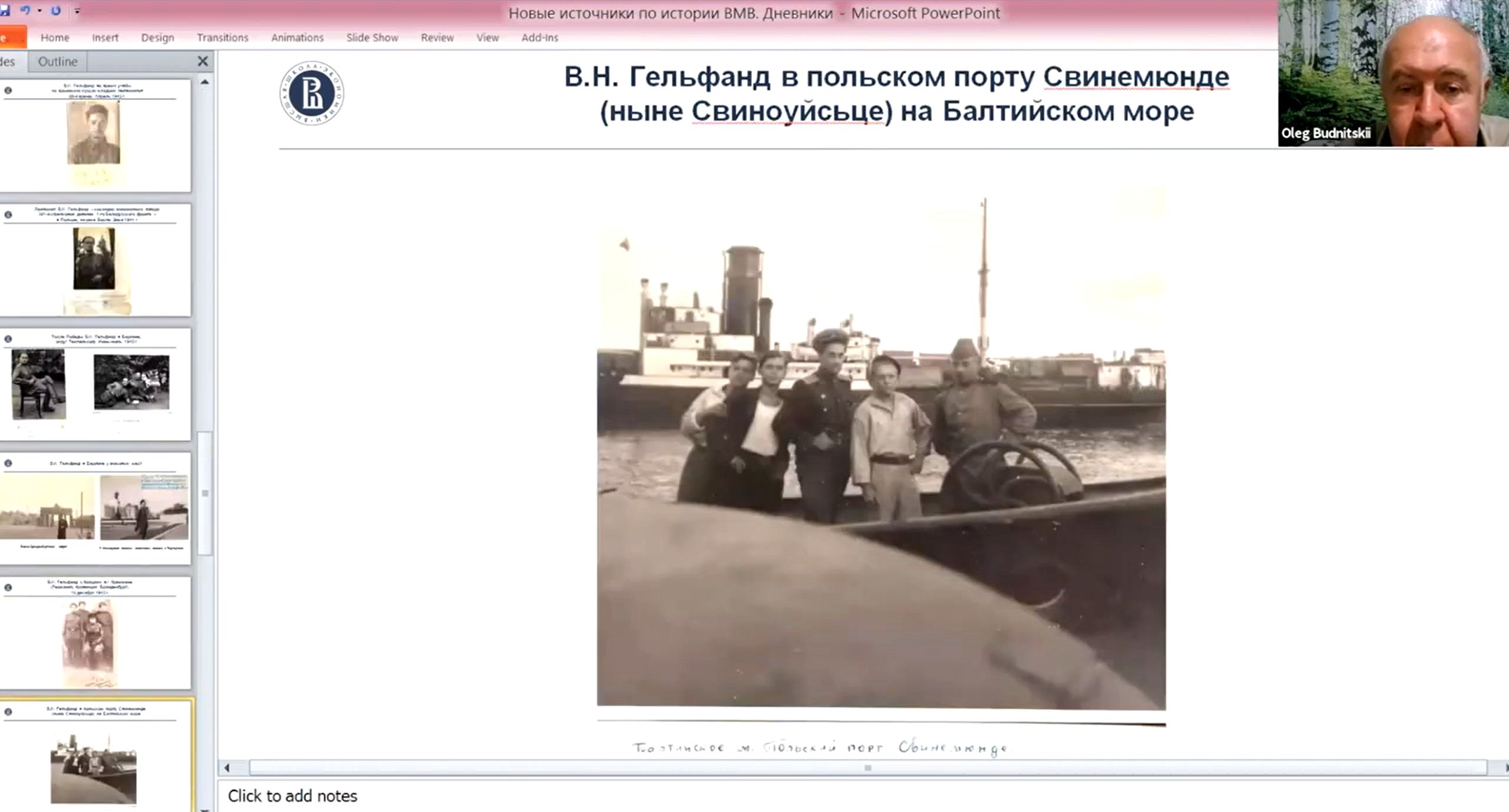
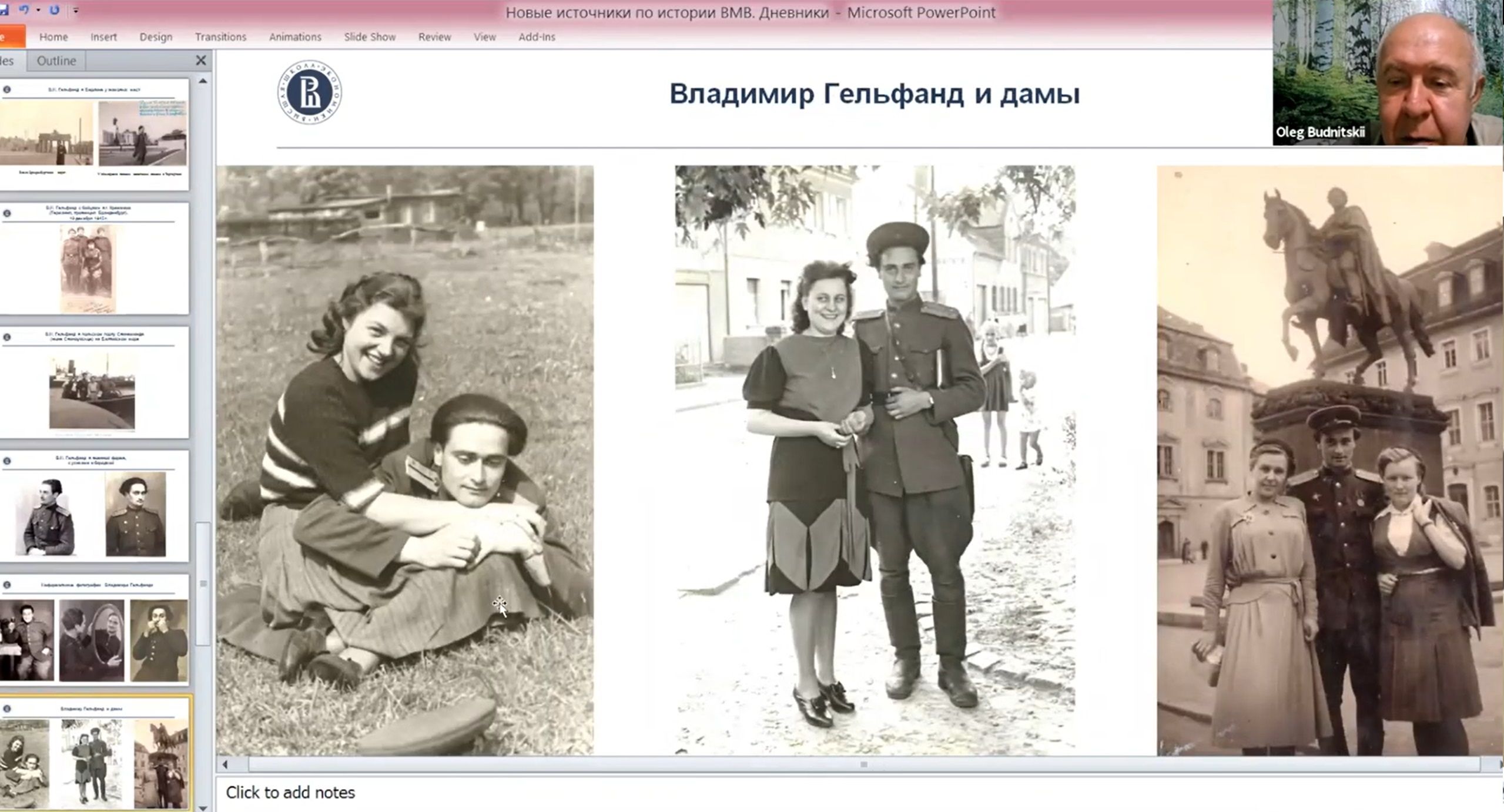
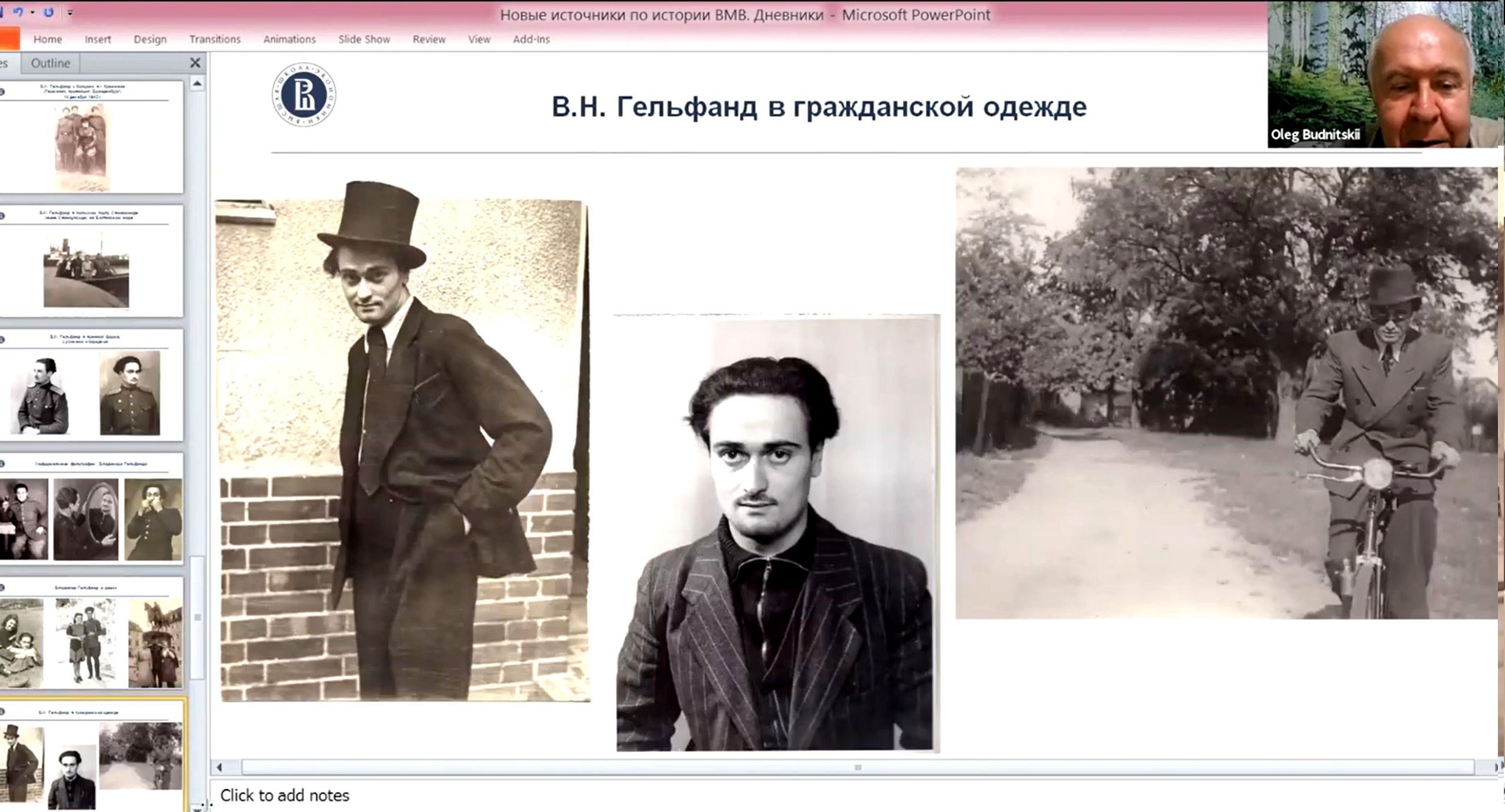
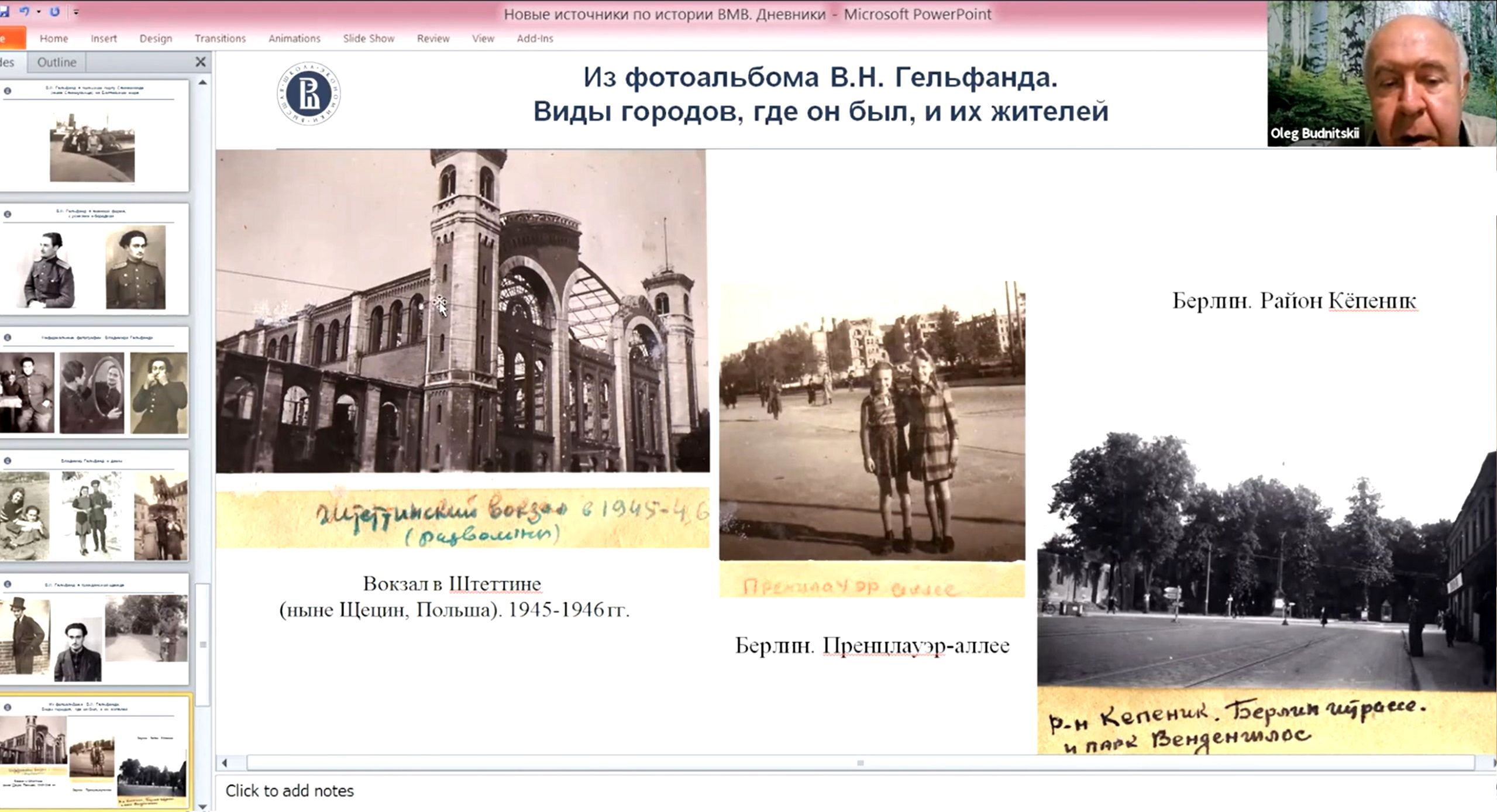
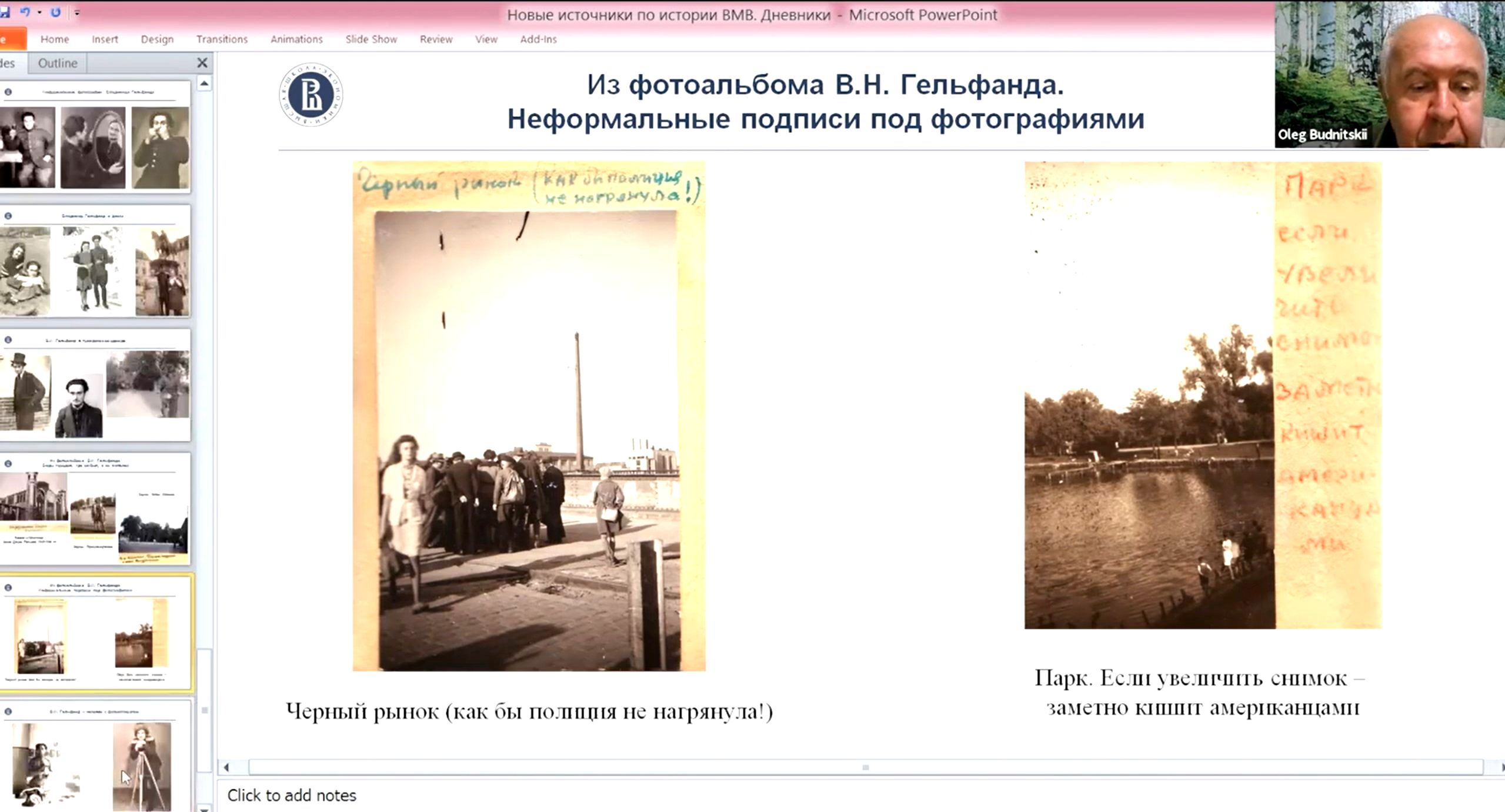
The person who really was, in quotation marks of course—because there are no truly “simple” people—and who also dreamed of becoming a writer was Vladimir Gelfand. I will now discuss his diary in detail, because I can see that people are already longing for pictures; a talking head becomes a little tiring. My colleagues Tatiana Lvovna Voronina and Irina Makhalova and I published this diary with extensive notes, illustrations, and so on.
The story is as follows—the story of this diary, or more precisely of this publication. I had come across amateur-style versions of the diary on the Internet.
But it was difficult to call them a publication, because different kinds of documents had clearly been joined together: the diary, various applications, character references, letters. There were obvious confusions in wording and so forth.
In one radio program devoted to wartime diaries I mentioned this astonishing diary, which is astonishing for two reasons. First, its sheer scale. It begins in the summer of 1941 and ends in the autumn of 1946, when the diarist, who was serving in Germany with the Soviet occupation forces, had already been demobilized and was traveling home to Dnipropetrovsk.
Second, there is its extraordinary, almost boundless candor. After that radio program the diarist's son telephoned. The author was no longer alive; unfortunately, he did not live a very long life and died at the age of sixty.
His son, Vitaly Vladimirovich Gelfand, lives in Berlin. He called the radio station, they gave him my telephone number, and he said that he wanted to publish the diary in Russia. By that time part of the diary had already appeared in German and had even been translated into Swedish.
But that edition covered only the part devoted to his time in Germany, first as a conqueror and then as an officer of the occupation forces. At some point I started saying that we needed scans of everything, because clearly some material had to be deciphered, systematized, and so on.
Then one day I found myself in Vitaly Vladimirovich's apartment in Berlin. I was also interested in one question: given the gigantic volume of the diary, how had all of this been physically possible?
There was a box standing there. It contained notebooks, separate sheets, and generally anything on which it had been possible to write. Paper, of course, was in desperately short supply during the war. And here, look, is a fragment of the diary.
This is what it looks like, and here is the transcription made for our edition. Here is another fragment.
Do you see how it is written? This part was written in 1941, and this one in 1942. The second sheet is Tsereteli, with the diary entry written around it. Apparently a page was torn out of a book containing Tsereteli's works. If there was a surface one could write on, he wrote on it.
What makes this diary remarkable? Several things. First, its author is very naïve. He had practically just left school. There was only a short interval before he turned eighteen and was drafted into the army. He had worked as an electrician in Yessentuki. He was a half-formed person, half teenager, half young man.
And he kept this diary. I do not know whether he had kept some form of diary earlier, but the surviving text begins in 1941. His first reaction to the beginning of the war was essentially: “So, the war has started; now I will have to change my vacation plans.”
Indeed, his vacation plans did have to change. Usually people keep diaries with some future reader in mind. Even if you declare that it is all only for yourself and so on, a person normally does not go all the way to complete candor.
This is a different case. It is extraordinarily frank, almost maximally frank. He writes extremely unflattering things about himself that, I do not know, a more mature person probably would not have written down, including unpleasant things that he himself did.
What else is striking about this diary besides its size, duration, and candor? It was written by someone who served in genuine combat units. He was a mortar man; only the infantry was closer to death. And he continued making entries during shelling and during battles.
After a shell hit one end of the trench near Lidnoye and killed the people who were there, he once again survived almost miraculously. During the whole war he was wounded only once, in a finger. It was a very unpleasant injury because it became infected, a whitlow developed, and he ended up in hospital and took a long time to recover. But in that respect he was of course very lucky, because he took part in very fierce fighting, especially in the autumn of 1943 during the battles for Ukraine—terrible, simply monstrous battles. At times he lost track of the days and did not know the date, yet he continued writing.
Some entries are simply horrifying. He began talking with a young woman who was a medical orderly; clearly he liked her. He notes that he was constantly passed over and deprived of decorations, which upset him greatly, while this girl already had a medal. They talked, and she apparently had some kind of bad premonition. He reassured her that everything would be all right. Shelling began, and gallantly he gave her his individual trench, which he had dug himself and which was deeper than the others, while he lay down somewhere else. A shell hit precisely the trench he had given to the girl. He describes what remained of her: a leg and other pieces of the body. He made the soldiers gather the remains and bury them and wrote on a board who she was, and so on.
What matters in this case, besides such astonishing and terrifying details, is that this is real war and that much of it can be checked. Fortunately, the Ministry of Defense has public electronic databases such as Memorial. One can search the Memorial database for the surname and first name of that dead young woman and verify that Gelfand really made the entry on the day she was killed. One can also find information about her decoration in the Podvig Naroda database, which contains award citations for participants in the war.
Another characteristic of this diary is that Gelfand embellished nothing. He entered the front-line army as a private and became a sergeant during the Kharkiv catastrophe of May 1942, when the Red Army attempted an offensive to liberate Kharkiv. The plan failed, the enemy's strength had been misjudged, and the Germans were themselves preparing an offensive. A powerful counterattack followed, then the Kharkiv encirclement and colossal losses. After that the Red Army began retreating toward the Don and later toward Stalingrad. He describes this extremely difficult period. Some diarists, even if they do not beautify events, at least avoid dwelling on negative moments. Gelfand writes everything without embellishment.
Perhaps the most interesting part of his diary, however, concerns his stay in Germany.
You know that the subject of the Red Army in Germany, relations with the local population, and, shall we say, treatment of German women that was not always gentlemanly, is much discussed. Gelfand wrote about it in his diary, and there is controversy around these passages. He records in considerable detail both episodes he witnessed and his own relations with German women. Here, for example, is an entry from May 15, 1945.
“A few days ago I met two pretty German girls near the mess hall. We talked; they compared me to an Italian and said that my hair was very black. They paid me compliments, which I did not fail to notice. For some reason the word ‘compliment’ delighted them, and they clapped their hands and expressed their joy with gestures,” and so on.
What is interesting about the story? The girls were not alone. Their mother was with them, and they wanted food. He brought out some pies, and they were delighted. The mother had clearly come to bargain with her daughters, and the daughters apparently did not object, but Gelfand did not quite understand what was going on.
One of the central themes of his diary is that he was a virgin and kept wanting to lose his virginity but never managed to. In many cases women practically put him into bed, but he somehow withdrew and did not know how to behave. He finally lost his innocence in Germany with a German woman.
This too is a curious story, a good illustration of a well-read boy. He was sorting through a German library so that the books could be sent to Moscow, to the USSR, as compensation for the damage done by Germany, and he felt terribly guilty about it. Why? Because socialism was going to be built there as well; he was a convinced Soviet person and believed socialism would soon be built in Germany, and how could people manage without these important books? It would be difficult for them.
In one of the books—a medical book—he read something in German that he understood as meaning that if “it” did not happen to him now, then later nothing would ever work. He went outside, called over the first German woman he encountered, and suggested that she sleep with him.
She agreed, and the reason she agreed is fairly obvious. When a Soviet officer said, “Come here,” refusal was not customary; among other things he had a pistol at his side. He describes his “fall from innocence” in minute detail.
After that he began to live much more freely, and the naïve boy stopped looking naïve at all. He became a regular at the black market and got to know more than one German woman. In the end it finished as such things often do: he contracted gonorrhea and again described in extraordinary detail how he was treated. The treatment was completely barbaric. These passages should be given to adolescents at puberty so that they understand how certain adventures can end. In the end, however, everything turned out well.
From what I have retold, I think it is already clear why diaries are an absolutely unique source for the history of the war. A certain canon of war history has formed. What many veterans—the overwhelming majority—say and write about the war is what they consider proper to say, and it is often not easy to reach their actual memories. For many people their memories have become substantially mixed with what they later saw and heard. In addition to the understandable distortions of memory, there is this changing norm of what one is “supposed” to say. When people wrote diaries, they did not know what they were supposed to write. They wrote as they felt—though not everyone did; some people even then wrote as they thought they ought to. Not everyone recorded exactly what they saw, felt, and experienced.
There is frequent public discussion, especially among people interested in the history of the war, historians, and politicians, to the effect that one day the archives will open. They are already open to a significant extent, although far from completely, and then, people say, we will learn everything about what really happened.
Nothing of the kind, I assure you. We will learn a great deal, but by no means everything, because archives contain documents written by people for particular purposes. They contain a great deal that is fascinating and that has still not become common knowledge. But one should not imagine that archives alone can give us a picture of genuine history. Without the human viewpoint, without personal experience, that enterprise is meaningless. In this respect diaries are a completely unique and irreplaceable source.
Wartime letters, for example, passed through censorship, and soldiers generally knew they were being censored. Accordingly, letters are not a source with the same degree of frankness as diaries.
Returning to Gelfand's diary, another extraordinarily interesting point is that the family archive survived. In Germany he acquired a camera and photographed very actively. We therefore have an absolutely unique set of photographs. Some of them are reproduced in our edition of Gelfand's wartime diaries.
Here is his family: Gelfand with his mother and father, Gelfand as a teenager, and his relatives on his father's side, who were murdered by the Germans in Yessentuki in 1942. What later came to be called the Holocaust was something he knew about firsthand, long before the Red Army liberated Poland and discovered the Nazi extermination camps.
For many people, especially in the West, the Holocaust means above all Poland and the extermination camps. Indeed, a very large proportion of the Jews murdered during the Second World War were killed in those camps. In the Soviet Union the Nazis used a different strategy. Jews were shot near the places where they lived, sometimes without any great effort to conceal what was happening. Gelfand learned about this fairly early and wrote about it.
Here, then, is Vladimir Gelfand. He completed junior-lieutenant courses in April 1943. And after that there is an entire series of photographs...
Here he is in Poland. His German girlfriend said that he looked Italian. And in fact, he does look a little like an Italian actor from the films.
And here is a series of photographs taken by him and his comrades in Germany, in Berlin. Look at this one. And then, here, you can easily recognize the Brandenburg Gate.
This is the memorial to Soviet soldiers killed in the assault on Berlin, erected very soon after the battle. It still stands in the same place. Here he is again with his comrades.
Look at how a Soviet officer could appear at that time. Notice the hairstyle.
You see, at the end of the war Gelfand was awarded the Order of the Red Star for the fighting of 1945. And here he is fooling around, trying things on, attaching a fake mustache, and so forth.
In short, a young man of his time. These are his German female friends. One of them even wrote to him after the war ended.
Here is another series of these jokes and antics. You see him dressed up in a top hat. And here are views of postwar Berlin.
The Stettin railway station. Stettin is now Polish Szczecin. The station no longer exists; it was destroyed.
The black market. Here is Gelfand with his camera. Again, as you see, he is fooling around. His hair is natural, but he created this particular look.
This is the cover of the book, with Vladimir Gelfand against the background of the Brandenburg Gate. You can see him with a small beard. The book turned out to be a very thick one—750 pages—with extremely detailed commentary.
There are many other diaries as well. I have mentioned several. Some are very short little diaries, but that does not mean they are less valuable.
I was deeply impressed by the diary of Pavel Elkinson, an artillery sergeant who fought through almost the entire war from 1942 onward, took part in the Battle of Stalingrad, was wounded, and so forth. He began keeping a diary in 1944. Why then? Because they had reached the Prut, the border of the Soviet Union. He wrote: “Now we are going abroad. I will probably never be abroad again, so I must write all of this down.”
And he really did visit Romania, Bulgaria, Yugoslavia, Hungary, and Austria. A kind of tourism, as it were. Tourism in quotation marks, of course. He writes with delight about how in Bulgaria and Yugoslavia they were welcomed as they had never been welcomed in Russia or Ukraine. People threw food to them; there was wine everywhere; everyone was constantly drunk. He describes it all with great enthusiasm, and so on. Bulgaria, of course, had been at war with the Soviet Union's allies, but it immediately underwent a coup and declared war on Germany. In Yugoslavia the Soviet troops were naturally welcomed as liberators.
Then in Hungary there was extremely heavy fighting while crossing the Danube and during the assault on Budapest. One day he writes that four of his comrades were killed that day. Involuntarily he wonders, and writes, “When will my turn come?” The feeling that you can die at any moment does not become dulled over time. His enormous combat experience meant nothing in that respect. Eventually they reached Austria as well.
One can find the most unexpected subjects in diaries: love stories, humor sometimes, and a great many other curious things. Sometimes they really read almost like a tourist's notes—again, of course, in quotation marks.
Major Safonov's diary is in St. Petersburg, in the manuscript department. He was a cartographer. His task was to put reliable military maps together for territory that the Red Army was liberating or occupying, depending on whether the country in question was a victim of Nazism or a member of the Nazi bloc. He too traveled through several countries, and Austria, which he had dreamed of visiting, made a particularly strong impression on him. He had dreamed of seeing Vienna and the Vienna Woods.
It is easy to understand why: Strauss, Tales from the Vienna Woods, and so forth. He really did reach Vienna, and he visited the Vienna Opera, which had been partly destroyed. Soldiers were sleeping there in heaps on the floor. He sat down and played something briefly on a piano and thought that perhaps, who knows, Strauss himself might once have played that very piano. He describes sleighs and various other things in detail. Texts like that exist too, although more often, of course, the diary is about the hard everyday life of war.
I can give one last example from the diaries I have read most recently. This is the diary of Nikolai Genzlin, a political worker. Later the number of political workers was sharply reduced, and he ended the war not as a political worker but as an artillery officer. He had already been in artillery before that, serving as a political deputy or commissar, and later became a reconnaissance officer in an artillery battalion.
He describes extremely heavy fighting on the southern section of the front, first around Taganrog and Rostov in 1942 during the difficult period of retreat, and later in the North Caucasus. He too reached Germany and finished the war there, although his entries from Germany are already rather fragmentary.
So there are not as few diaries as one might think, and they are very diverse. The people who wrote them were very different, yet something unites them. What unites them is a tendency toward reflection, I would say, and to some extent a sense of History, even if they themselves did not consciously formulate it that way: a desire to record what was happening. In some of them one can clearly see the wish to leave a memory, a trace of oneself. Again, these people did not know what awaited them the next day. One sometimes encounters diaries like that of Sergeant Boris Komsky, an absolutely remarkable diary kept in the Bakhmeteff Archive in New York. He began fighting at the Kursk salient. Literally on the eve of examinations at an officer-training school, all of the cadets were simply loaded up and sent to Kursk because there was an acute shortage of men. The Battle of Kursk was the largest battle not only of the Second World War but, in terms of scale, one of the largest in world history.
They were thrown into combat before completing their training. Komsky too was a mortar man and was given the rank of sergeant rather than junior lieutenant. Within a few days his mortar company first turned into an infantry company because enemy fire destroyed its mortars, and then the company simply ceased to exist: it was annihilated. He was lucky because he had been wounded a day or two earlier and was already in hospital. The others were not so lucky. That is the story. It too is a very interesting diary.
Komsky was also a young man—seventeen when the war began—but psychologically he was quite different from Vladimir Gelfand, much more self-confident. He ended the war in Germany as a lieutenant. Unfortunately, as he later said, his wife destroyed the German part of his diary. Apparently she did not like what he had written there.
So that is a rapid survey of wartime diaries. I would call them an unprecedented source, and it is difficult to overstate their importance for understanding what we sometimes call the human dimension of war. Read them. They are, in general, extraordinarily absorbing texts. And almost always, I would say, they are a Bildungsroman, a novel of formation.
A Bildungsroman is a literary genre in which we see how a person changes. This is especially clear when a diary was kept for a long time: by the end of the war, or by the end of the author's participation in combat, the diarist is a different person. Sometimes the author leaves the war because he is wounded and never returns to the front, and so on.
Now I am ready to answer your questions, if there are any.
There is one more important thing I did not mention, given that this is a joint seminar of the Jewish Museum and Tolerance Center, as I understand it, with the Prozhito project. You may have noticed that almost everyone I spoke about was Jewish: Boris Suris, Vladimir Gelfand, Boris Komsky, Pavel Elkinson, Ginzburg, Irina Dunaevskaya, Elena Kagan.
That is not accidental. It is not because I deliberately selected Jews. Nikolai Genzlin, whom I mentioned today, was Russian, for example, and so was Nikolai Yakovlev, whose diary I read recently.
Why, then, are there so many Jewish diarists? Because Jews were the most highly educated nationality in the Soviet Union. The proportion of people with higher and secondary education among Soviet Jews was several times, even tens of times, higher than among many peoples of the USSR, and they were almost all urban residents. The overwhelming majority lived in towns and especially in large cities. Many were university students or university graduates.
This is what one might call a precondition. To give you an idea: in absolute numbers there were more Jews with higher education than Ukrainians, and seven and a half times as many as in Belarus. There were specific historical reasons for this, but I will not go into them here. I will simply say that the probability of finding Soviet Jews among diary authors was very high.
And indeed, many Soviet Jews appear among the diarists. Some never use the word “Jew” in their diaries at all. For others it is a very important subject. Some suffer from antisemitism, as Gelfand did. He even wrote: “Why am I a Jew? Why did I have to be born a Jew?”
Boris Suris, by contrast, hardly felt such hostility at all. He wrote: “For some reason everybody likes me. I have good relations with people; everyone likes me.” And judging by the diary, this man from Odessa, with a splendid sense of humor and artistic gifts, really was popular. He served as an interpreter at headquarters in his unit.
So experiences differed greatly, and the people themselves were very different. I think the Jewish Museum made an excellent decision in choosing diaries as the theme of the seminar. Wartime and peacetime diaries give us a picture of the history of Soviet Jewry that, once again, turns out not to be quite the same as the version later commonly accepted or imagined.
Questions, please.
Yes, I have a question. Perhaps you mentioned this, but I am interested in the circumstances in which this particular diary was found and in how wartime diaries are usually discovered. Are they handed over by descendants, or do they somehow reach you by chance?
As I said, Gelfand's diary remained in the family. Its author preserved it and tried to publish after the war. He had articles in newspapers and some local publications, and his reminiscences appeared in a collection. But publishing the diary itself was of course impossible. It fit none of the accepted canons, even though Gelfand was an entirely Soviet person. At the end of the war, for example, he wrote about Stalin: “Stalin is my sun!” He describes all kinds of horrors, indecencies, and other things he encountered but does not connect them in any way with the central authorities. Moreover, he wrote for wartime divisional and army newspapers, and there he wrote in precisely the language one was supposed to use. The diary says one thing; the text for a wall newspaper says something entirely different. He knows that one must write in that way. It is a characteristic example of doublethink, although he himself does not reflect on it. He simply understands that this is how things are supposed to be done.
His attempts to publish after the war failed. Everything remained in the family. Vladimir Gelfand died in 1983. He was born in 1923. His son Vitaly Vladimirovich took the material with him when the family emigrated to Germany. There he devoted himself to deciphering and publishing his father's legacy.
The German historian Elke Scherstjanoi later learned about it. She published the German section of the diary in German translation. The book became a bestseller in Germany, selling about 80,000 copies—an enormous figure for a wartime diary, especially one written by a foreigner rather than a German. Later, as I have said, Vitaly Vladimirovich contacted me. In the end he scanned everything. The original diary was transferred to the Jewish Museum in Moscow, where it is now kept, along with unpublished wartime correspondence. That is how it happened.
Other diaries, as I have said, in my experience are mostly preserved in families. Unfortunately, many people throw away these “unnecessary scraps of paper.” But in general they remain in family archives.
Yes, please. We cannot hear you. Turn on your microphone.
Hello. Sorry. Thank you very much for the lecture; it was very interesting. I have a question. My colleague has a family diary kept by her grandfather, Popov. She has already published one fragment in a book in the Tula region and tried to analyze it. I too became acquainted with the diary—or rather with the family. My brother and the grandchildren deciphered the diary. Unfortunately, the grandfather died in 1945 while returning home—not exactly ingloriously, but he fell ill and died after the war. He kept notes through practically the whole war. They were then preserved in the family. What interested me was that he did not seem embarrassed or afraid to keep the diary, and it contains rather sharp comments about the actions of the leadership, including the highest-level leadership, regarding the organization of military operations. How typical is that? Such things were dangerous, as you rightly explained, and one might expect self-silencing. You have read a large number of wartime diaries. How common is this kind of criticism and bold condemnation of command decisions? Or is it very rare?
You know, it occurs fairly often. People were not afraid because they were Soviet people and believed they were trying to correct shortcomings. That was the way they saw it.
Incidentally, I have written about wartime diaries in detail. A book of mine came out this year, called People at War, published by New Literary Observer. I recommend it if you want to learn more, including about wartime diaries. It covers a range of material, but a substantial part is based precisely on diaries, and there is a special chapter devoted to them. It analyzes the diary of Olga Berggolts, including its previously unpublished early part. The third, postwar part of her diary has only just been published. A great deal of attention is devoted to precisely this kind of document.
The book also deals with what we can read in diaries and in certain other personal sources. In simple terms, this includes relations between men and women during the war, which were very varied and far from always romantic. I have a chapter called “Man and Woman in the Red Army.”
As for the story of Elena Kagan-Rzhevskaya and the discovery of Hitler's body, she carried his teeth in a box under her arm for some time. This was of course an extraordinarily secret matter. It turned out that the special group had not yet brought the necessary photographic equipment. She was handed a burgundy-colored box that had originally contained cheap costume jewelry and carried it under her arm for at least a day or two. She was ordered not to take her eyes off it. Imagine the responsibility: Hitler's teeth. She was terribly annoyed. It was May 9, Victory Day, everyone was celebrating, and she was stuck with this box. She could not even have a drink. The final chapter of my book is called “Hitler's Teeth” and is devoted to this story.
Elena Rzhevskaya's granddaughter, the excellent translator Lyubov Sum, showed me these notebooks and allowed me to publish several photographs from the family archive. They are extraordinarily interesting. The archive even preserves a diagram of Hitler's teeth drawn by Lieutenant Colonel Shkaravsky, head of the commission that examined the bodies found at the Reich Chancellery, together with corrections and an alternative diagram drawn by Käthe Heusermann, an assistant to Hitler's dentist. All this survived in Elena Rzhevskaya's personal archive. It is extraordinarily interesting.
But there are many other cases. So it was not unusual for diary keeping to occur, although the consequences varied. Sometimes everything was fine; sometimes people were arrested. Take Danil Fibikh, a journalist and writer. Apparently one of his fellow servicemen studied his diary and found a sentence to the effect that there were no speakers like in the old days—Trotsky, for example. That was enough: ten years. Simply for mentioning Trotsky. This was in 1943; Trotsky was already dead. The sentence itself was completely neutral. But the report did not go to just anyone; it went to Lev Mekhlis, who was a member of the military council of the front where Fibikh worked for an army newspaper. Fibikh was arrested at the front, sent away, and served the full ten-year sentence.
And he was an entirely Soviet person, even more than that. When he recorded stories about peasants who did not help Red Army men escaping from encirclement, he added something like: “Damned kulaks; they were not finished off during collectivization.” I am quoting from memory, not word for word, but that was the essence. Someone asked for bread, and a peasant said: you have a watch, then we can trade. A loaf of bread was exchanged for a watch, which at the time was of enormous value, and so on.
In other words, if Fibikh makes negative remarks, they are critical in the sense that “these are shortcomings we need to correct.” But the sentence about Trotsky destroyed him.
I work not only with diaries but with many kinds of sources, including judicial records. Among wartime military-tribunal documents one sometimes encounters formulations such as “kept a counterrevolutionary diary” or “kept a diary of counterrevolutionary content.” It is not common, but it occurs.
That is a wonderful project, what you are describing about the diary. Is she planning to publish the whole diary somewhere?
Yes, she is preparing it and intends to analyze it as a sociologist. I will definitely recommend your book to her. I think there will be publications. She is also considering eventually transferring the diary somewhere, although for now she wants to work with it herself.
Of course. If she needs help or consultation...
I will tell her. Thank you.
You can find the Institute of Soviet and Post-Soviet History on the Higher School of Economics website, or simply find me directly.
The diary is very interesting. It contains unique things. I read it with great interest. Reconstructing it was difficult: the handwriting is difficult, and as you said, people wrote on anything and under any conditions. The family spent several years reconstructing everything and then began the analysis.
Well, deciphering it... that is the smallest problem.
Of course, of course.
At least for professional historians who work with such materials.
No, they are not historians, not professionals—just family members, the grandchildren.
If they need any consultation or help, please contact me.
All right, I will tell her. Thank you.
Any more questions?
You mentioned “counterrevolutionary diaries.” Could you name any authors whose diaries one could read?
Wait a moment. I was not the one calling them counterrevolutionary diaries. That is how tribunals classified them. It does not mean there was anything genuinely counterrevolutionary in them. For example, the fact that Trotsky was an excellent orator was common knowledge both inside and outside the Soviet Union. The entry itself was not counterrevolutionary at all. It reflects the customs of Stalin's time and, in that particular case, the mentality of Lev Mekhlis, formerly head of the Main Political Directorate—in other words, the Red Army's chief political commissar.
Gelfand's diary itself could quite easily have been classified as counterrevolutionary. “Counterrevolutionary” was a legal formula. Article 58 dealt with counterrevolutionary and state crimes and contained many clauses, including the notorious Article 58-10—“anti-Soviet agitation and propaganda.”
The overwhelming majority of the wartime cases I have seen involved people being imprisoned for words. Forget about an entire diary: saying the wrong thing could be enough. “Slandered the Soviet press”—grounds for arrest. “Slandered a Sovinformburo communiqué.” “Slandered the collective-farm system.” Put into ordinary language, people did not believe what the newspapers printed or what Soviet official reports said. And they had good reason not to, because the reports constantly announced how many enemy soldiers and officers and how much enemy equipment had been destroyed, while somehow more and more territory kept being surrendered to the enemy.
There are splendid diaries by Mikhail Prishvin. I am no longer speaking only about diaries by servicemen; there are also excellent wartime diaries by Prishvin and by the writer Vsevolod Ivanov. In one of them—I think Prishvin's—the author says that nobody can listen to the radio because it is so irritating and depressing. And so on.
Similar entries occur in soldiers' diaries too. Georgy Slavgorodsky, for example: I also took part in publishing his diary, which appeared posthumously many years after his death. Sadly, he survived almost the entire war only to be killed in Poland in 1945. He records a fellow serviceman's reaction to an item in the Soviet press: “It's all lies. All of it is lies.” That sentence alone could have led to Article 58. Slavgorodsky himself wrote other things in his diary that could also have been labeled counterrevolutionary.
So it is a question of structure. The overwhelming majority—almost all—of these diarists were Soviet people. There are some diaries that are genuinely critical of the authorities as such. They are very few, but they do exist. Mostly, however, Soviet people wrote because they were dissatisfied with the way the war was being conducted, in their opinion.
Take Boris Komsky, an absolutely Soviet patriot, a Komsomol organizer and so forth. He recorded what he had been told about the destruction of his company, or what remained of it: a drunken Captain Fronel led the company into a frontal attack. He could easily have been accused of slandering the Red Army. Yet there is little reason to doubt that what he recorded was true. It was told to him by one of the very few men who survived that terrible attack, when this drunken minor commander led the company straight onto the battlefield.
And that is exactly what I mean: such things are preserved precisely and almost only in diaries. People did not write them home in letters. If someone did, his relatives at home would probably never have received a next letter from him.
Any more questions?
Oleg Vitalyevich, thank you very much for the lecture and for the new book. I apologize for my screen; I am having camera problems. I actually have many questions, but I will try to be concise. Have there been studies comparing diaries of the Second World War—the Great Patriotic War—with Russian diaries of the First World War, 1914–1918? And were there comparative studies of Soviet diaries and diaries kept, say, in the German army, German society, or the Allied armies?
And, if I may, another question, more philosophical perhaps. As someone who has read a great many diaries, I am interested in your opinion about war and reflection—not only reflection on oneself and one's own experiences, but on the people around one. Do you more often encounter the thought that war corrupts people? Or, conversely, that war somehow allows something else to emerge...
That it brings out the best in a person.
Yes, exactly. I understand that both kinds of observation will occur, but which is more common?
I have almost never encountered the idea in these diaries that war brings out something better in people. I want to say that this is a mythologeme. In my view it is an absolute myth. War is a terrible thing. It makes nobody better. Whether the war is just or unjust, people kill in war and sacrifice other people's lives.
I apologize, Oleg Vitalyevich. I probably formulated the question poorly. I mean something slightly different. I understand that the heroic idea is a mythologeme.
You mean: is that discussed in the diaries?
No, not exactly. I mean moments when the diarist records surprise because he expected people to behave one way but they behaved another. In Gelfand's diary, for example, he is a Soviet patriot and encounters a reality that does not match his ideas about war and the army. Naturally he is shocked that people steal in the army, beat one another, and that there is no real internationalism. He records the collision between what he expected and behavior that is worse. But surely there were also cases when people already knew from experience that war was horrible and nevertheless encountered unexpected displays of humanity. How often does that occur in the diaries? That is what I mean.
Not very often. There are entries about particular military achievements by particular servicemen. There are entries showing that people found friends in war and became very attached to them. Friendship at war, however, is a difficult matter: there was enormous turnover, very high casualty rates, and much else. Entries saying, “Look how humane these people turned out to be,” are extremely rare. Extremely rare.
As for your other questions, the answer can be given in one word: no. As far as I know, there are no comparative studies of First and Second World War diaries. Someone compared Soviet and German letters from Stalingrad—there was an article by, I believe, Helbert. But I honestly do not recall comparative studies of diaries.
In general, I do not remember any major specialized study devoted specifically to wartime diaries—a monograph, for example. There are discussions of the subject in articles that often introduce editions of particular diaries, but I cannot recall a dedicated book-length study.
I cannot recommend a specific book or article on the subject, except perhaps my own chapter in People at War.
Thank you very much.
Colleagues, any more questions?
Oleg Vitalyevich, if I may, I have two questions. First: there are known cases in which diaries of Soviet servicemen fell into German hands and were translated into German. Why was this done, how were the translations used, and was it widely known in the Soviet army that this could happen? Could that awareness have affected diary keeping?
Why they did it is clear: to extract useful information. Remember that a translator translated the diary, while the actual user was a military commander of some rank. The material had to be presented to him in a usable form.
One must also remember that the Germans had a propaganda machine and it functioned quite effectively. They had Vineta, a special propaganda service, and other structures. They wanted to understand what Soviet soldiers were like and what language should be used when speaking to them.
They had masses of prisoners with whom they could talk, of course. But diaries were also very interesting material for forming a picture of Soviet servicemen. Sometimes they were used for propaganda purposes and fragments were published.
There was also the reverse situation. Many Germans kept diaries; diary keeping was common, encouraged, and not prohibited. Soviet soldiers sometimes captured these diaries, usually from the bodies of dead soldiers, and used them in propaganda. German soldiers' diaries were repeatedly quoted for that purpose.
Thank you. And my second question: if we speak about the “proper” way of writing in Soviet soldiers' diaries, did models exist? Were diary-form texts widely published in the wartime press or literature?
No, I have not encountered that. Diary keeping was not encouraged at all. People generally believed it was prohibited. In practice it probably was prohibited in the overwhelming majority of cases. Boris Komsky, for example, explained after the war why he had kept a diary even though it was forbidden: “I didn't know. If I had known, I would not have kept it.”
Gelfand sometimes read his entries to his comrades, but usually this produced nothing except mockery.
At one point in his diary the style suddenly changes sharply. He writes enthusiastically about a political officer who is now explaining to him what he should do and how he should keep a diary: he should write about the combat achievements of their unit, about how the political officer conducts political work, and so forth.
The resulting text is strange to the point of absurdity. A few days later an entry appears: “At last I have got rid of the political officer!” The man had been living with him in the same dugout. “Now I can write whatever I want,” or words to that effect.
So those were the kinds of instructions that existed. The political officer did not forbid him to keep a diary but explained what and how he should write. With the political officer right beside him, Gelfand wrote things intended, if not to please him, at least not to provoke a negative reaction. Once the officer was gone, he went back to writing freely and later remarked: “What nonsense I wrote in my diary before,” or something of that sort.
Then that phase passed too, and he returned to those same “foolish” entries—in quotation marks, of course—which for us are the most interesting material of all.
© Gorskie
© Oleg Budnitsky
© Jewish Museum and Tolerance Center