



|
EL FINAL DEL NAZISMO |
||
la batalla de berlín durante la segunda guerra mundial |
||
Desde la seguridad de su búnker en el centro de la ciudad, Hitler no podía ver cómo Berlín era brutalmente sometida por el Ejército Rojo. En las calles por las que antes desfilaron orgullosas las topas del Tecer Reich, ahora se luchaba con desesperación para detener sin éxito el avance de los rusos. |
||
 |
||
|
Según el alto mando militar nazi, Berlín iba a ser la tumba del Ejército Rojo. Pero no fue así. Mientras Hitler se refugiaba en su búnker y perdía por completo la noción de la realidad, el Tercer Reich que debía de durar mil años carecía de los medios necesarios para hacer frente a lo que se le venía encima. El papel que jugaron las tropas soviéticas en la derrota de la Alemania nazi durante la Segunda Guerra Mundial fue para los rusos uno de los momentos más memorables de su historia. La operación, que duró poco más de dos semanas, se llevó a cabo cuando ya la capital de Alemania se hallaba reducida a escombros a causa de los bombardeos aliados. RESISTIR AL PRECIO QUE SEAPara quienes habían estado en el frente de batalla (y que ahora se encontraban inválidos o heridos), las detonaciones que se escuchaban en la periferia de la ciudad aquel 19 de abril de 1945 sonaban de manera distinta. Y tenían razón. Aquel sonido se debía a los obuses de la artillería de campaña y no a las bombas a las que los tenía acostumbrados la aviación aliada. Eso solo podía significar una cosa: Berlín ya estaba al alcance de los cañones soviéticos, lo que provocó que la población, entre asombrada y aterrorizada, se preguntara cómo habían llegado a ese punto. A pesar de la superioridad de los atacantes y de que el desánimo se había apoderado de las tropas alemanas, las órdenes de Hitler eran claras: había que resistir hasta el final. El Führer, refugiado en su búnker junto con otros jerarcas nazis, como Martin Borman, Albert Speer o Joseph Goebbels, no quería ni oír hablar de rendición. En su locura estaba dispuesto a sacrificar inútilmente a toda la población de Berlín. En aquellas dramáticas circunstancias, rendirse y alzar la bandera blanca era castigado con la muerte y quien desertaba o se escondía para evitar el combate era colgado.
Los rusos ofrecieron una breve pausa tras el empuje de las divisiones panzer sobre el río Óder. Pero la inesperada tregua no fue aprovechada para preparar concienzudamente la defensa de la ciudad. A pesar de no disponer de fuerzas suficientes para la defensa (tan sólo se contaba con algunas unidades antiaéreas de las SS y de la milicia popular volkssturm), se decidió no emprender ninguna obra de fortificación. Además se prohibió que los trenes de refugiados se detuvieran en Berlín para no dañar la moral de la población y evitar así una más que probable situación de pánico.
INEFICACES Y TRAIDORESAunque envejecido y con paso vacilante, el Führer seguía imponiendo su voluntad sobre quienes le rodeaban. Promulgó duras directrices, como las Medidas de destrucción en el territorio del Reich, conocida también como la Orden Nerón, por la que se establecía una política de tierra quemada ante el enemigo. Sumido en largas divagaciones, Hitler alternaba episodios de buen humor con explosivos estallidos de cólera contra todo y contra todos, en especial contra sus generales, a los que tachaba de ineficaces y de traidores. Desde su traslado al búnker de la Cancillería había perdido la noción del tiempo y no resultaba extraño que las reuniones con sus ayudantes fueran convocadas a horas intempestivas. Sería en una de ellas cuando, angustiado por no haber aplicado las oportunas medidas para defender Berlín, destituyó al general Guderian como Jefe del Estado Mayor y lo sustituyó por el general Hans Krebs.
El 20 de abril de 1945, fecha del 56 cumpleaños de Adolf Hitler, los aviones B-17 estadounidense y los Lancaster británicos le felicitaron bombardeando el centro urbano de Berlín y pulverizando numerosos edificios. Se forzó la evacuación de dos mil berlineses y la ciudad quedó definitivamente sin electricidad. |
||
 |
||
|
En la reunión del 22 de abril, alguien alabó ante Hitler la excelente labor del 12º Ejército comandado por el general Walther Wenck, que luchaba contra los norteamericanos en Magdeburgo. Al oír la noticia, los temblores que aquejaban al Führer desaparecieron. En uno de sus habituales cambios de humor pareció haber encontrado la solución: el general Wenck giraría sobre sí mismo y socorrería Berlín. Los soviéticos se desangrarían ante la capital y el curso de la guerra cambiaría. Pero Wenck no pudo conseguir su objetivo, ya que la empresa superaba la capacidad de sus fuerzas y nunca logró establecer un pasillo de seguridad entre la capital y el resto del Reich. Berlín estaba cercada y agonizaba. EL FIN DE HITLER Y LA CAÍDA DE BERLÍNCon el general Helmuth Weidling al mando como comandante de la defensa de Berlín, se intentó establecer una defensa operativa, pero Weidling tan sólo podía contar con tropas en descomposición, como las del general español Miguel Ezquerra. Junto a miembros del volkssturm, las Hitlerjugend y la policía, construyeron inútiles barricadas con tranvías, animados por las pintadas que hablaban de resistencia y victoria. Weidling organizó su mermada resistencia mientras los proyectiles soviéticos caían sobre el mismo centro de la capital.
Contra todo pronóstico, la ciudad resistió más allá de sus fuerzas, con la determinación del que sabe que no tiene otra opción. Pero en su defensa poco pudieron hacer el heroísmo suicida de los jóvenes nacionalsocialistas o la brutalidad de los comandos werwolff. Uno a uno, los barrios de Berlín fueron ocupados por los soviéticos, mientras la población civil se refugiaba en los túneles del metro invadidos por el humo. Como última medida se decidió volar los diques que separaban el canal de Landwehr de las líneas del suburbano para impedir que los rusos pudieran avanzar por su interior. Pero la suerte de Berlín estaba echada. |
||
 |
||
| La
tarde del 30 de abril de 1945, un disparo de revólver procedente
del dormitorio del Führer rompió el silencio del
búnker. Tras haber ingerido una cápsula de cianuro,
Hitler se acababa de pegar un tiro. Junto a él, su esposa, Eva
Braun, yacía sin vida en el sofá. Los oficiales
trasladaron los dos cuerpos hasta el jardín de la
Cancillería, una operación complicada debido a los
continuos bombardeos soviéticos. Tras arrojar los
cadáveres a una fosa previamente excavada les prendieron fuego.
Acto seguido, y mientras los restos del líder alemán se
consumían entre las llamas, en el exterior Goebbels, Bormann,
Burgdorf y Krebs realizaron el último saludo nacionalsocialista
en su honor. De esta manera, Adolf Hitler, el fundador del Tercer
Reich, desaparecía para siempre. |
||
 |
||
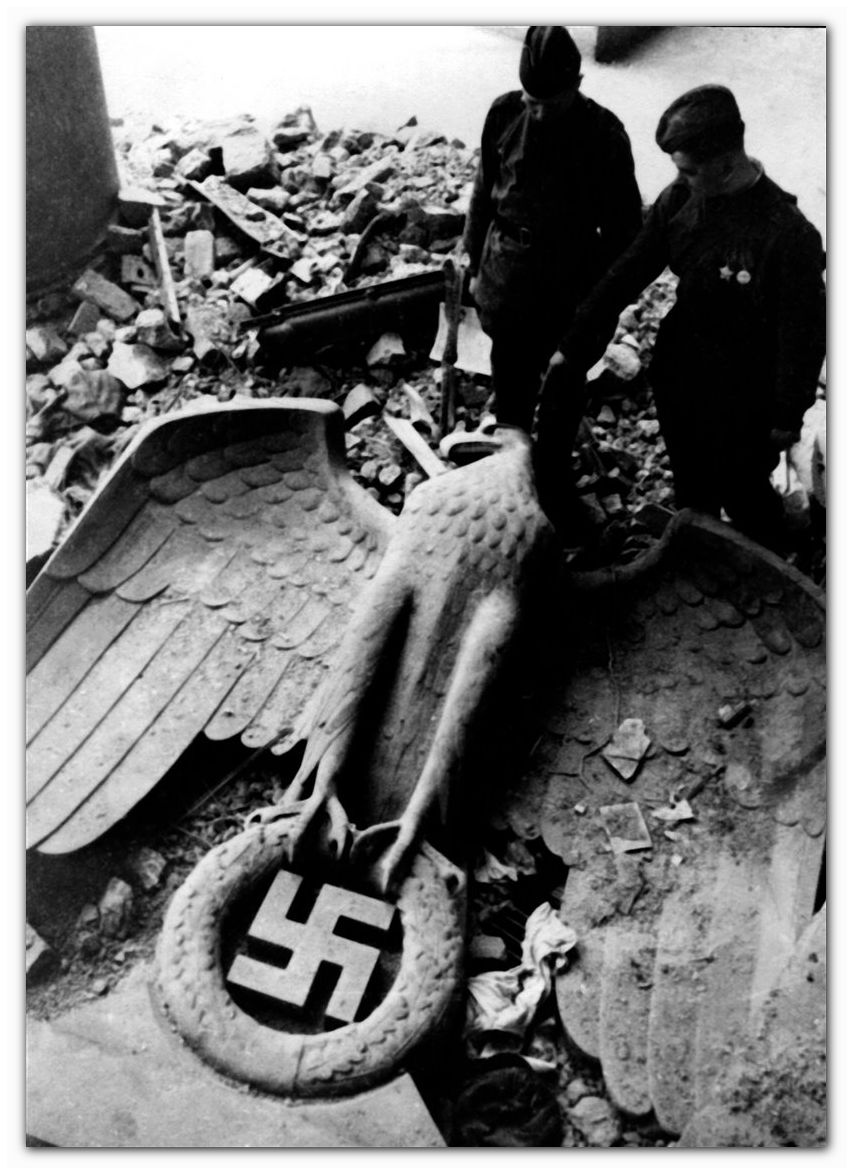
| Miembros del ejército soviético contemplan una estatua caída de un águila imperial con una esvástica tras su victoria en Berlín | ||
PILLAJE Y VIOLACIONESEl 2 de mayo, al término de la batalla, muchos seguidores del régimen, entre los que se contaban numerosos SS, prefirieron suicidarse antes que caer en poder de los soviéticos. Tras la victoria vino el pillaje. Los soldados rusos, procedentes la mayoría de las estepas y las montañas del Cáucaso, nunca habían visto nada parecido a la elegancia de Berlín. Robaban todo lo que podían: gramófonos, joyas, mecheros, ropa... Pero lo más buscado eran los relojes de pulsera, que les fascinaban. También les atraían los retretes con cisterna, las bicicletas, las bombillas... Todo lo que no robaban, lo destruían. Tras el pillaje empezaron las violaciones masivas, un tema del que se habló poco durante la Guerra Fría. Los medios rusos tradicionalmente calificaron estos hechos como "inventos" de Occidente, aunque muchas de las pruebas proceden del diario de un soldado soviético llamado Vladimir Gelfand, un joven teniente judío proveniente de la región central de Ucrania. |
||
 |
||
|
Se desconoce cuántas mujeres fueron violadas tras la caída de Berlín. Algunos historiadores hablan de unas cien mil. En cualquier caso, muchas de ellas se suicidaron o murieron a causa de la brutalidad con la que fueron tratadas. Las víctimas de las agresiones no sólo fueron jóvenes y adultas, también se ensañaron con niñas y ancianas. Las madres ocultaban a sus hijas para protegerlas y los hombres que intentaban evitar el ultraje generalmente lo pagaban con sus vidas. Las mujeres que se resistían recibían un tiro o un culatazo.
A las afueras de Berlín, a orillas del río Spree, se extiende el célebre parque Treptower, situado en la antigua Berlín Oriental, donde se alza la estatua de unos doce metros de alto de un soldado soviético con una espada en la mano y una niña alemana en la otra, pisoteando una esvástica rota. El monumento se realizó entre 1946 y 1949 como homenaje a los más de setenta mil soldados del Ejército Rojo que murieron en la batalla de Berlín. Su inscripción dice lo siguiente: "El pueblo soviético salvó a la civilización europea del fascismo". No obstante, muchos berlineses consideran hoy en día que, a causa del horror que se vivió en Berlín durante los días que siguieron a su caída, este memorial debería llamarse la "tumba del violador desconocido". |
||
 |
© Historia National Geographic
|
КОНЕЦ НАЦИЗМА |
||
Битва за Берлин во время Второй мировой войны |
||
Из безопасного укрытия своего бункера в центре Берлина Адольф Гитлер не мог видеть, как город подвергался жестокому и неумолимому наступлению Красной армии. На улицах, где когда-то с гордостью маршировали элитные части Третьего рейха, теперь его солдаты в отчаянии пытались сдержать стремительное продвижение русских — безуспешно. |
||
|
||
|
Согласно замыслам нацистского командования, Берлин должен был стать могилой для Красной армии. Но всё вышло иначе. Пока Гитлер прятался в своём бункере, окончательно утратив связь с реальностью, Третий рейх, провозглашённый «тысячелетним», уже не обладал ни силами, ни средствами, чтобы противостоять надвигающемуся краху. Роль, которую сыграли советские войска в разгроме нацистской Германии, остаётся для России одним из самых памятных и трагически героических моментов XX века. Берлинская операция, длившаяся чуть более двух недель, разворачивалась в условиях, когда столица Германии уже лежала в руинах после разрушительных бомбардировок союзников. Противостояние ценой жизниДля тех, кто находился на фронте — раненых, искалеченных, измученных, — взрывы, раздавшиеся 19 апреля 1945 года на окраинах Берлина, прозвучали иначе. Это были не авиационные бомбы, к которым уже привыкли горожане, а удары полевой артиллерии. Это означало только одно: Красная армия подошла к границам города, и её тяжёлые орудия уже били по столице. Горожане, охваченные смесью ужаса и недоумения, спрашивали себя: как всё могло дойти до этого? Несмотря на подавляющее превосходство наступающих сил и деморализацию обороняющихся, приказы Гитлера оставались однозначными: сопротивляться до конца. Фюрер, укрывшийся в бункере в окружении нацистской верхушки — Мартина Бормана, Альберта Шпеера, Йозефа Геббельса и других — категорически отказывался даже обсуждать возможность капитуляции. В своём безумии он был готов пожертвовать всем населением города. Любые попытки сдаться или поднять белый флаг карались смертью. Дезертиры и те, кто пытался уклониться от боя, подвергались публичным повешениям.
После того как танковые дивизии Красной армии форсировали Одер, русские предложили краткую передышку. Однако это неожиданное перемирие не было использовано для организации полноценной обороны города. Несмотря на явный недостаток сил — в Берлине оставались лишь отдельные зенитные части СС и отряды народного ополчения «Фольксштурм», — от фортификационных работ отказались. Более того, поездам с беженцами было запрещено останавливаться в Берлине, чтобы не подорвать моральный дух жителей и избежать предсказуемой волны паники.
НЕОФИЦИАЛЬНЫЕ И ПРЕДАТЕЛИСтареющий и всё более неуверенный в себе, фюрер продолжал навязывать свою волю окружению. Он издавал всё более жестокие директивы, такие как так называемые меры по уничтожению на территории Рейха, известные также как «приказ Нерона», предусматривающие политику выжженной земли перед наступающим врагом. Погружённый в бесконечные разговоры, Гитлер чередовал приступы эйфории с бурными вспышками ярости, направленной на всех и вся — особенно на собственных генералов, которых он обвинял в некомпетентности и предательстве. С момента переезда в бункер Рейхсканцелярии он окончательно потерял ощущение времени, и встречи с его ближайшими помощниками нередко назначались на самые неожиданные и неурочные часы. Именно на одной из таких встреч, будучи особенно раздражённым отсутствием решительных мер по защите Берлина, он уволил с поста начальника Генерального штаба генерала Гейнца Гудериана, заменив его на генерала Ханса Кребса. 20 апреля 1945 года, в день 56-летия Адольфа Гитлера, американские бомбардировщики B-17 и британские Lancasters «поздравили» его очередной массированной атакой на центр Берлина. В результате налёта были разрушены многочисленные здания, около 2000 жителей вынужденно эвакуированы, а город вновь остался без электричества. |
||
|
||
|
На совещании 22 апреля один из офицеров упомянул об успешных действиях 12-й армии под командованием генерала Вальтера Венка, сражавшейся с американцами в районе Магдебурга. Услышав эту новость, Гитлер, до этого охваченный внутренней дрожью и отчаянием, внезапно приободрился. В одном из своих типичных эмоциональных перепадов он внезапно решил: Венк развернёт армию и придёт на помощь Берлину. Пока советские войска теряют людей в ожесточённых боях за столицу, — размышлял фюрер, — наступит перелом, и ход войны изменится. Однако Венк не смог реализовать этот план. Его армия была истощена, не имела достаточных ресурсов и так и не смогла пробить коридор между Берлином и остальной частью Рейха. Город оказался полностью окружён. Берлин умирал. Конец Гитлера и падение столицыПод командованием генерала Хельмута Вейдлинга, назначенного руководить обороной города, предпринимались отчаянные попытки организовать хоть какую-то линию сопротивления. Но в его распоряжении были лишь обессиленные, деморализованные части, включая иностранных добровольцев — таких, как бойцы под командованием испанского генерала Мигеля Эскерры. Вместе с подразделениями Фольксштурма, членами Гитлерюгенда и полицией они возводили баррикады из трамваев, которые больше походили на символы обречённости, чем на реальные укрепления. На стенах появлялись граффити, призывающие к сопротивлению и победе. Вейдлинг продолжал организовывать остатки обороны, в то время как советские снаряды уже падали в самом сердце столицы.
Несмотря ни на что, город продолжал сопротивляться из последних сил — с решимостью тех, кто осознаёт: иного выбора у них нет. Но даже отчаянное мужество молодых национал-социалистов, готовых к самоубийственному героизму, и жестокость диверсантов из «Вервольфа» уже не могли изменить ход событий. Один за другим районы Берлина переходили под контроль советских войск, в то время как жители укрывались в туннелях метро, наполненных дымом и страхом. В отчаянной попытке остановить наступление, было принято решение взорвать дамбы, отделяющие канал Ландвер от внешних линий города, чтобы не допустить продвижения Красной армии. Но исход битвы был уже предрешён — Берлин был обречён. |
||
|
||
|
Днём 30 апреля 1945 года тишину фюрербункера нарушил выстрел из револьвера. Приняв капсулу с цианидом, Адольф Гитлер застрелился в своей спальне. Рядом на диване лежало тело его жены, Евы Браун, с которой он обвенчался накануне. Офицеры перенесли оба тела в сад Рейхсканцелярии — задача была крайне опасной из-за непрекращающегося советского артобстрела. Тела сбросили в заранее вырытую воронку, облили бензином и подожгли. Сразу после того, как пламя охватило останки Гитлера, Йозеф Геббельс, Мартин Борман, Вильгельм Бургдорф и Ханс Кребс отдали в отдалении последний национал-социалистический салют. Так исчез навсегда Адольф Гитлер — основатель и диктатор Третьего рейха. |
||
|
||
| Солдаты Советской армии смотрят на упавшую статую имперского орла со свастикой после их победы в Берлине | ||
Мародёрство и насилие2 мая, в последние часы битвы за Берлин, многие приверженцы нацистского режима — в том числе многочисленные эсэсовцы — предпочли покончить с собой, лишь бы не попасть в руки наступающей Красной армии. За победой последовала волна мародёрства. Советские солдаты, пришедшие с просторов Сибири, степей и гор Кавказа, впервые оказались в элегантном, разрушенном Берлине — городе, которого они не могли себе даже представить. Они уносили всё, что только можно было унести: граммофоны, украшения, зажигалки, шёлковое бельё, одежду. Но самой желанной добычей для многих стали наручные часы — предмет, вызывавший у солдат настоящий восторг. Их так же привлекали унитазы с бачками, велосипеды, электрические лампочки... Всё, что невозможно было украсть — разрушали. Когда мародёрство угасло, началась новая, ещё более тёмная глава — массовые изнасилования. Об этом в советское время и в эпоху холодной войны практически не говорили. Российские СМИ по традиции называли подобные рассказы «западными выдумками», хотя значительная часть доказательств исходит из дневника советского офицера — лейтенанта Владимира Гельфанда, молодого еврея из центральной Украины. Его записи, наполненные личными переживаниями, наблюдениями и признаниями, с годами стали важным свидетельством как героизма, так и трагедий, которыми сопровождалась победа. |
||
|
||
|
Сколько женщин было изнасиловано после падения Берлина — до сих пор точно неизвестно. Некоторые историки называют цифру в сто тысяч. Как бы то ни было, многие из них впоследствии покончили с собой или умерли от той жестокости, с которой к ним отнеслись. Жертвами насилия становились не только молодые женщины, но и пожилые — возраст не имел значения. Советские солдаты бесчинствовали одинаково жестоко. Матери пытались спрятать своих дочерей, чтобы уберечь их, а мужчины, осмелившиеся вмешаться или просто оказавшиеся рядом, чаще всего расплачивались за это собственной жизнью. Женщины, которые сопротивлялись, получали пулю — или удар прикладом.
На окраине Берлина, на берегу реки Шпрее, расположен знаменитый Трептов-парк — один из крупнейших мемориальных комплексов в бывшем Восточном Берлине. Здесь возвышается двенадцатиметровая статуя советского солдата с мечом в одной руке и спасённой немецкой девочкой — в другой. Его нога попирает разбитую свастику — символ окончательной победы над нацизмом. Памятник был возведён в 1946–1949 годах как дань памяти более чем семидесяти тысячам красноармейцев, павших в боях за Берлин. На постаменте высечена надпись: «Советские люди спасли европейскую цивилизацию от фашизма». Однако в сегодняшнем Берлине этот мемориал вызывает у многих противоречивые чувства. Из-за страха, насилия и страданий, обрушившихся на город в дни после капитуляции, некоторые берлинцы называют его не иначе как «могилой неизвестного насильника».
|
||
|
 Spanish
From the safety of his bunker in the center of Berlin, Adolf Hitler could not see how the city was being brutally and relentlessly crushed by the Red Army. In streets where the elite formations of the Third Reich had once marched proudly, German troops now fought desperately—and unsuccessfully—to stop the rapid Russian advance.
Josep Gavaldà
23 April 2020 · 17:47
Reading time: 7 minutes
Second World War · Nazism
According to the plans of the Nazi high command, Berlin was supposed to become the grave of the Red Army. It did not. While Hitler hid in his bunker and lost all connection with reality, the Third Reich, proclaimed to last a thousand years, no longer possessed the men or resources needed to resist the collapse closing in around it. The role played by Soviet troops in the defeat of Nazi Germany remains one of the most memorable and tragically heroic moments of the twentieth century for Russia. The Berlin operation lasted a little more than two weeks and unfolded when the German capital had already been reduced to ruins by Allied bombing.
For those who had been at the front—wounded, maimed, and exhausted—the explosions heard on the outskirts of Berlin on 19 April 1945 sounded different. These were not aircraft bombs, to which the population had already become accustomed, but shells from field artillery. That could mean only one thing: the Red Army had reached the approaches to the city and its heavy guns could already strike the capital. Astonished and terrified Berliners asked themselves how events had reached this point.
Despite the overwhelming superiority of the attacking forces and the demoralization of the German defenders, Hitler’s orders were unambiguous: resist to the end. The Führer, sheltering in the bunker together with leading Nazis such as Martin Bormann, Albert Speer, and Joseph Goebbels, refused even to contemplate surrender. In his delusion he was prepared to sacrifice the entire population of Berlin. Surrender or the raising of a white flag was punishable by death. Deserters and those who tried to hide in order to avoid combat were publicly hanged.
Surrendering or raising a white flag was punishable by death; anyone who deserted or hid from battle risked ending up on the gallows.
After Red Army tank divisions crossed the Oder, the Russians offered a short pause. The unexpected respite was not used to organize a thorough defense of the city. Although the defenders clearly lacked forces—only some SS anti-aircraft units and small Volkssturm formations remained—serious fortification work was not undertaken. Refugee trains were even prohibited from stopping in Berlin so as not to undermine civilian morale or trigger a predictable wave of panic.
Only a handful of SS anti-aircraft formations and small Volkssturm militia units were available for the defense of the city.
Aging and increasingly insecure, Hitler continued to impose his will on those around him. He issued ever harsher directives, including so-called destruction measures for the territory of the Reich, better known as the “Nero Decree,” which called for a scorched-earth policy in the face of the advancing enemy.
Immersed in endless discussions, Hitler alternated between bouts of euphoria and violent rages directed at everyone around him, particularly his own generals, whom he accused of incompetence and treason. Since moving into the Reich Chancellery bunker he had lost his sense of time; meetings with his closest aides were often scheduled at bizarre hours. At one such meeting, particularly angered by the failure to take decisive steps to defend Berlin, he dismissed Chief of the General Staff General Heinz Guderian and replaced him with General Hans Krebs.
Disappointed by the lack of adequate defensive preparations, Hitler removed Guderian and appointed Hans Krebs as his successor.
On 20 April 1945, Adolf Hitler’s fifty-sixth birthday, American B-17 bombers and British Lancasters “congratulated” him with another heavy attack on central Berlin. Numerous buildings were destroyed, about 2,000 residents were forced to evacuate, and the city again lost its electricity supply.
At a meeting on 22 April, an officer mentioned the supposed successes of the Twelfth Army under General Walther Wenck, then fighting the Americans near Magdeburg. Hitler, who had been trembling and despairing, suddenly brightened. In one of his characteristic swings of mood, he decided that Wenck would turn his army around and come to Berlin’s rescue. While Soviet troops lost men in bitter fighting for the capital, Hitler imagined, a turning point would occur and the course of the war would change.
Wenck could not carry out the plan. His army was exhausted, lacked sufficient resources, and never succeeded in opening a corridor between Berlin and the rest of the Reich. The city was completely encircled. Berlin was dying.
Under General Helmuth Weidling, appointed commander of the city’s defense, desperate attempts were made to create some kind of defensive line. He had only exhausted, demoralized formations at his disposal, including foreign volunteers such as men associated with the Spanish officer Miguel Ezquerra. Along with Volkssturm units, Hitler Youth members, and police, they constructed barricades from tramcars. These looked more like symbols of doom than useful fortifications. Graffiti calling for resistance and victory appeared on walls.
Weidling continued organizing the remnants of the defense while Soviet shells were already falling in the heart of the capital. Volkssturm fighters, Hitler Youth members, and police built ineffective tram barricades beneath slogans promising resistance and eventual victory.
Despite everything, the city continued to fight with the last of its strength and with the determination of people who believed there was no alternative. Yet neither the desperate courage of young National Socialists prepared for suicidal heroism nor the brutality of Werwolf saboteurs could alter the course of events. District after district passed under Soviet control while civilians hid in smoke-filled, fear-filled underground tunnels.
In a desperate effort to halt the advance, a decision was made to blow up dams separating the Landwehr Canal from outer parts of the city so as to obstruct the Red Army. But the outcome had already been decided. Berlin was doomed.
On the afternoon of 30 April 1945, a revolver shot broke the silence of the Führerbunker. After taking cyanide, Adolf Hitler shot himself in his bedroom. His wife Eva Braun, whom he had married the previous day, lay dead beside him on a sofa.
Officers carried both bodies into the garden of the Reich Chancellery, a dangerous task under continuing Soviet artillery fire. The corpses were placed in a shell crater, doused with gasoline, and burned.
As flames consumed Hitler’s remains, Joseph Goebbels, Martin Bormann, Wilhelm Burgdorf, and Hans Krebs gave a final National Socialist salute from a distance. Thus Adolf Hitler, founder and dictator of the Third Reich, disappeared forever.
Soviet Army soldiers look at a fallen statue of the imperial eagle and swastika after their victory in Berlin.
On 2 May, during the final hours of the Battle of Berlin, many adherents of the Nazi regime, including numerous SS men, chose suicide rather than falling into the hands of the advancing Red Army. Victory was followed by a wave of looting.
Soviet soldiers who had come from the vast spaces of Siberia, the steppes, and the Caucasus mountains suddenly found themselves in an elegant but ruined Berlin, a city unlike anything many of them had ever imagined. They carried away whatever they could: gramophones, jewelry, cigarette lighters, silk underwear, and clothing. Wristwatches became an especially coveted prize and fascinated many soldiers. They were also intrigued by flush toilets, bicycles, and electric light bulbs. Things that could not be taken away were sometimes simply destroyed.
When the looting subsided, another and darker chapter began: mass rape. The subject was scarcely discussed during the Soviet era or the Cold War. Russian media traditionally dismissed such accounts as “Western inventions,” although an important body of evidence comes from the diary of a Soviet officer, Lieutenant Vladimir Gelfand, a young Jewish man from central Ukraine. Over time his records, filled with personal experiences, observations, and confessions, became an important testimony to both the heroism and the tragedies that accompanied victory.
The exact number of women raped after the fall of Berlin remains unknown. Some historians have suggested a figure of one hundred thousand. Whatever the exact number, many victims later died by suicide or from the brutality of the assaults they had endured.
The victims were not only young women. Elderly women were assaulted as well; age offered little protection. Soviet soldiers could act with equal brutality toward all. Mothers tried to hide their daughters, while men who dared to intervene—or who simply happened to be nearby—often paid with their lives. Women who resisted risked being shot or struck with a rifle butt.
How many women were raped after Berlin fell is still not known precisely; some historians estimate around 100,000.
On the outskirts of Berlin, beside the River Spree, lies the famous Treptower Park, one of the largest memorial complexes in the former East Berlin. A twelve-meter statue depicts a Soviet soldier holding a sword in one hand and a rescued German girl in the other. His foot crushes a broken swastika, symbolizing the final victory over Nazism.
The memorial was built between 1946 and 1949 in memory of more than seventy thousand Red Army soldiers who died in the battles for Berlin. An inscription on the pedestal reads: “The Soviet people saved European civilization from fascism.”
Yet in present-day Berlin the memorial evokes conflicting feelings for many people. Because of the fear, violence, and suffering that descended on the city in the days after capitulation, some Berliners have bitterly referred to it as the “tomb of the unknown rapist.”
FOR FURTHER READING — More than 20,000 people killed
“The Bombing of Dresden in the Second World War.”
Remembered as one of the darkest episodes at the end of the Second
World War, the bombing of Dresden—the city known as the
“Florence of the Elbe”—was carried out on 13 and 14
February 1945 by Allied British and American aircraft and caused an
estimated 20,000 to 45,000 deaths. Several thousand bombers flew over
Dresden, destroying to its foundations a city that until then had not
been considered especially important strategically. “Read
article.”
FOR FURTHER READING — Stolen childhoods
“The Nazi ‘Werewolves.’” With the war lost and
the Russians at the gates of Berlin, Hitler played his last card by
recruiting children to form part of his special Werwolf units.
“Read article.”
FOR FURTHER READING — The Nazi leader’s lover
“Eva Braun, the Woman in Hitler’s Shadow.” The young
German woman, fascinated by Adolf Hitler’s image and personality,
became his lover and, shortly before the end of the war, his wife. Yet
the relationship was far from idyllic. Eva attempted suicide several
times, depressed by the Führer’s lack of attention, and
finally, after marrying him in the Berlin bunker, died by suicide with
him before the Russians arrived. “Read article.”
FOR FURTHER READING — Historian and occultist
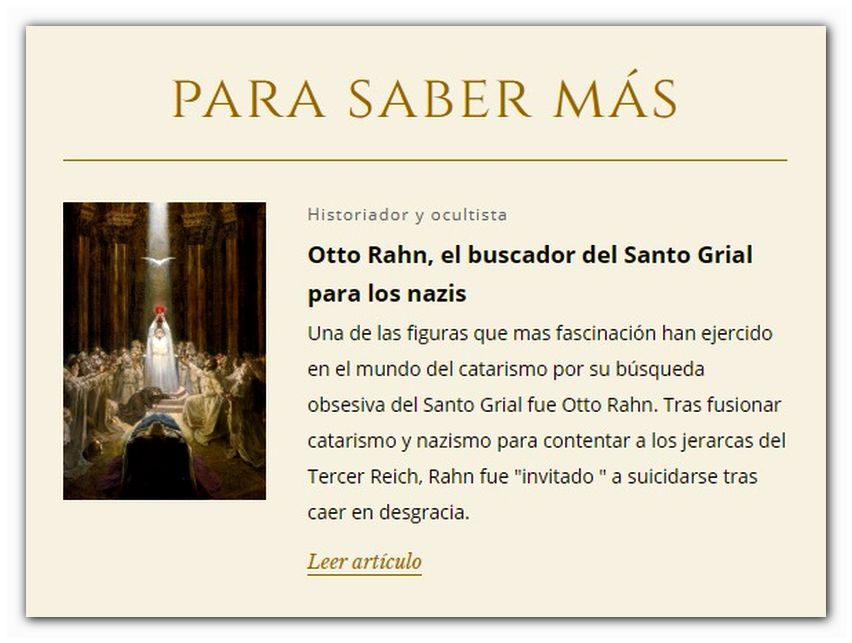
“Otto Rahn, the Nazis’ Seeker of the Holy Grail.” One
of the figures who has most fascinated students of Catharism because of
his obsessive search for the Holy Grail was Otto Rahn. After trying to
combine Catharism and Nazism in order to please the leaders of the
Third Reich, Rahn was effectively “invited” to take his own
life after falling into disgrace. “Read article.”