Graf Orlov 33 — “DIARY OF V. GELFAND, Soviet Red Army Officer”
DIARY OF V. GELFAND
Soviet Red Army officer
graf_orlov33 — August 18, 2020
Many Russian media outlets regularly dismiss
accounts of rapes committed by Soviet soldiers during the war as a myth
concocted in the West. Yet one of the many sources confirming that such
crimes did take place is the diary of a Soviet officer, V. Gelfand.
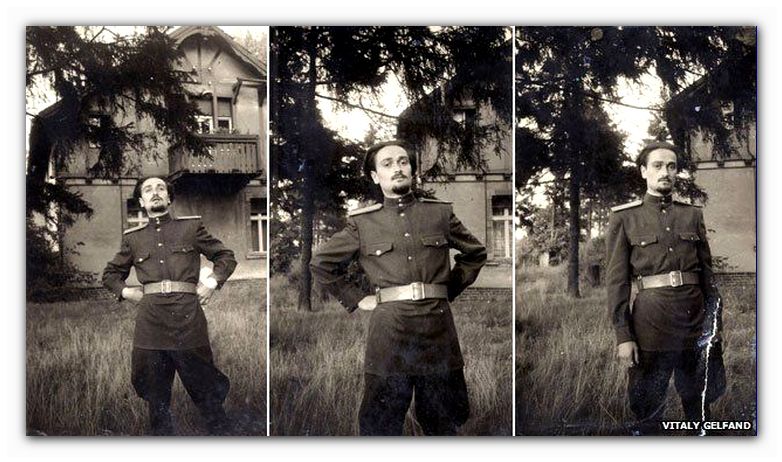
Soviet lieutenant Vladimir Gelfand, a native of
Ukraine, kept his notes from 1941 until the end of the war with
extraordinary candour, despite the ban that then existed on keeping
diaries in the Soviet Army.
The diary describes the lack of order and
discipline in regular units: meagre rations, lice and endless theft. As
he tells it, soldiers stole from one another, even taking their
comrades' boots.
In February 1945 Gelfand's military unit was
stationed near the Oder River, preparing for the advance on Berlin. He
recalls how his comrades surrounded and captured a German women's
battalion.
“The day before yesterday a women's
battalion was operating on the left flank. It was completely smashed;
the captured German women declared themselves avengers for husbands
killed at the front. I do not know what was done with them, but the
scoundrels should have been executed without mercy,” Vladimir
Gelfand wrote.
One of Gelfand's most revealing accounts dates
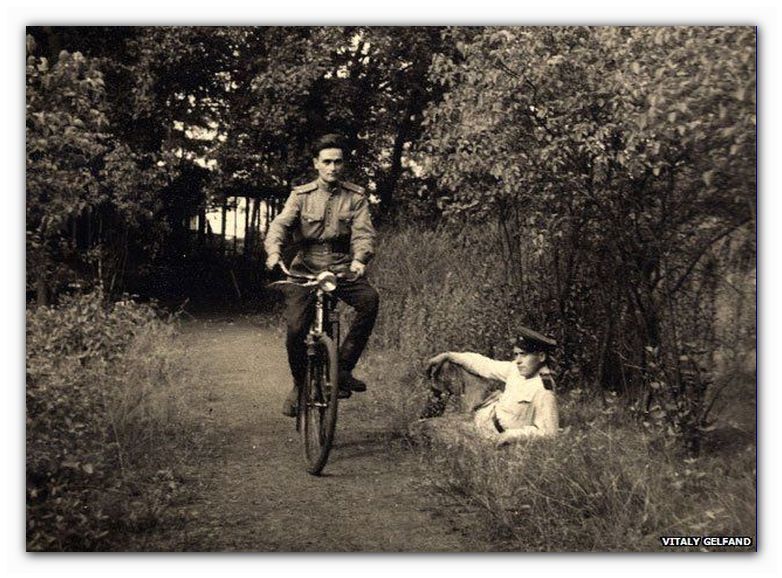
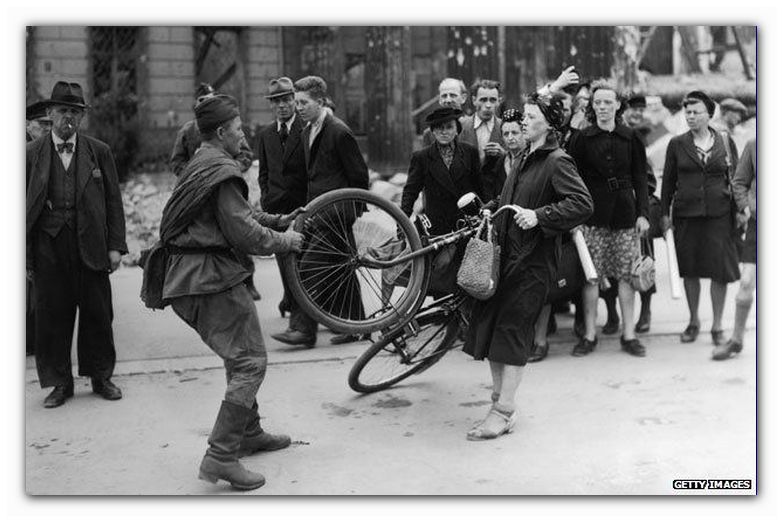
from April 25, when he was already in Berlin. There Gelfand rode a
bicycle for the first time in his life. Riding along the bank of the
Spree, he saw a group of women dragging their suitcases and bundles
somewhere.
“I asked the German women where they
lived, in broken German, and asked why they had left their homes, and
in horror they told me about what they had had to endure on the first
night after the Red Army arrived here,” the diarist writes.
“They raped me,” a beautiful
German woman explained. “All night, and there were so many of
them. Before them I was a virgin,” she sighed, crying.
“They ruined my youth. Among them were old men, pimply men, and
they all climbed on me … There were no fewer than twenty, yes,
yes …”
“They raped my daughter in front of
me,” the poor mother added. “They may come again, and if
they want they will start raping my girl again.” This horrified
everyone once more, and bitter sobbing swept from one corner of the
cellar to the other, where the owners had brought me.
“Stay here,” the girl suddenly
rushed toward me. “You will sleep with me. You can do anything
you want with me, but only you alone!” Gelfand writes in his
diary.
“The hour of revenge has struck!”
According to Nazi ideology, the Wehrmacht was
supposed to be a well-organized force of Aryans who would not lower
themselves to sexual contact with “Untermenschen”
(“subhumans”).
The German command was so concerned about the
spread of venereal disease among the troops that it organized a network
of military brothels in the occupied territories.
Direct evidence of how German soldiers treated
Russian women is difficult to find. But at the German-Russian Museum in
Berlin, its director Jörg Morré showed me a photograph from
a German soldier's private album, taken in Crimea.
The photograph shows the body of a woman sprawled on the ground.
“It looks as though she was killed
during or after a rape. Her skirt is pulled up and her hands cover her
face,” says the museum director.
“It is a shocking photograph. We debated
at the museum whether such pictures should be exhibited. This is war;
this is sexual violence in the Soviet Union under the Germans. We show
the war. We do not merely talk about the war — we show it,”
says Jörg Morré.
When the Red Army entered the “lair of the
fascist beast,” as the Soviet press then called Berlin, posters
and slogans encouraged the fury of Soviet soldiers: “Soldier, you
are on German soil. The hour of revenge has struck!”
The political department of the 19th Army, which
advanced on Berlin along the Baltic coast, declared that a true Soviet
soldier was so full of hatred that the very thought of sexual contact
with German women would disgust him. But life showed that the
ideologists were wrong.
Historian Antony Beevor, while researching his
2002 book Berlin: The Downfall, found reports in the Russian state
archives about an epidemic of sexual violence in Germany. At the end of
1944 NKVD officials had sent these reports to Lavrentiy Beria.
“They were passed on to Stalin,”
Beevor says. “From the markings you can see whether they were
read. They report mass rapes in East Prussia and describe how German
women tried to kill themselves and their children to avoid that
fate.”
“The cellar dwellers”
Another wartime diary, kept by the fiancée
of a German soldier, describes how some women adapted to this
horrifying situation of lawlessness and rape in an effort to survive.
From April 20, 1945, the unnamed woman set down
observations that were ruthless in their honesty, perceptive and at
times seasoned with gallows humour. The diarist describes herself as
“a pale blonde, always dressed in the same winter coat.”
She paints vivid pictures of life among her neighbours in the air-raid
shelter beneath their apartment building.
Among her neighbours were “a young man in
grey trousers and thick-rimmed glasses who, on closer inspection, turns
out to be a woman,” as well as three elderly sisters who, she
writes, were “all three seamstresses, huddled together into one
big black pudding.”
Waiting for the approaching Red Army units, the
women joked: “Better a Russian on top of me than a Yankee
overhead,” meaning that it was better to be raped than to die in
an American carpet-bombing raid.
But when soldiers entered their cellar and tried
to pull women out, they began begging the diarist to use her knowledge
of Russian to complain to the Soviet command.
On the ruined streets she manages to find a Soviet
officer. He shrugs. Despite a Stalin decree — issued two weeks
after the violence began — prohibiting violence against
civilians, he says, “it happens anyway.”
Nevertheless, the officer goes down into the
cellar with her and reprimands the soldiers. But one of them is beside
himself with anger. “What are you talking about? Look what the
Germans did to our women!” he shouts. “They took my sister
and …” The officer calms him down and leads the soldiers
outside.
But when the diarist goes out into the corridor to
check whether they have left, other soldiers who had been waiting seize
her and brutally rape her, nearly strangling her. Terrified neighbours
— the “cellar dwellers,” as she calls them —
hide in the cellar and bolt the door behind them.
“At last the two iron bolts opened.
Everyone stared at me,” she writes. “My stockings are down,
my hands are holding the remains of my belt. I begin to scream:
‘You pigs! I have just been raped twice in a row here, and you
leave me lying here like a piece of dirt!’”
Eventually the diarist concludes that she needs to
find one “wolf” to protect her from further gang rapes by
the “male beasts.”
She finds an officer from Leningrad with whom she
shares a bed. Gradually the relationship between aggressor and victim
becomes less violent, more reciprocal and more ambiguous. The German
woman and the Soviet officer even discuss literature and the meaning of
life.
“It cannot in any way be said that the
major is raping me,” she writes. “Why am I doing this? For
bacon, sugar, candles, canned meat? To some extent I am sure that is
true. But I also like the major, and the less he wants from me as a
man, the more I like him as a person.”
Many of her neighbours made similar arrangements with the victors of defeated Berlin.
When the diary was published in Germany in 1959
under the title A Woman in Berlin, its frank account prompted a wave of
accusations that it had dishonoured German women. It is therefore
unsurprising that the author, anticipating this reaction, demanded that
the diary not be published again until after her death.
Eisenhower: shoot them on the spot
Rape was not a problem confined to the Red Army.
Bob Lilly, a historian at Northern Kentucky University, managed to gain access to the archives of U.S. military courts.
His book, Taken by Force, provoked so much
controversy that at first no American publisher was willing to publish
it; the first edition appeared in France.
According to Lilly's rough estimate, about 14,000
rapes were committed by American soldiers in England, France and
Germany between 1942 and 1945.
“There were very few rapes in England,
but as soon as American soldiers crossed the English Channel, the
number rose sharply,” Lilly says.
According to him, rape became a problem not only
for the army's image but also for military discipline.
“Eisenhower said soldiers were to be shot at the scene of the
crime and the executions reported in military newspapers such as Stars
and Stripes. Germany was the peak of the phenomenon,” he says.
— Were soldiers executed for rape?
— Oh yes!
— But not in Germany?
— No. Not a single soldier was executed for the rape or murder of German civilians, Lilly acknowledges.
Today historians continue to investigate sexual crimes committed by Allied troops in Germany.
For many years the subject of sexual violence by
Allied troops — American, British, French and Soviet soldiers
— on German territory was officially suppressed. Few people
reported it, and even fewer wanted to listen.
Silence
Such matters are generally difficult to discuss in
society. In addition, in East Germany it was regarded as almost
blasphemous to criticize the Soviet heroes who had defeated fascism.
In West Germany, meanwhile, the guilt Germans felt
over Nazi crimes overshadowed the subject of the German population's
own suffering.
But in 2008 the film A Woman in Berlin, based on
the Berlin woman's diary and starring actress Nina Hoss, was released
in Germany.
The film was a revelation for Germans and
encouraged many women to tell what had happened to them. One of those
women was Ingeborg Bullert.
Now 90 years old, Ingeborg lives in Hamburg in an
apartment full of photographs of cats and books about theatre. In 1945
she was 20. She dreamed of becoming an actress and lived with her
mother on a fairly fashionable street in Berlin's Charlottenburg
district.
“I thought they were going to kill me,” Ingeborg Bullert says.
When the Soviet assault on the city began, she hid in the basement of her building, just like the author of A Woman in Berlin.
“Suddenly tanks appeared on our street;
the bodies of Russian and German soldiers were lying everywhere,”
she recalls. “I remember the terrifying drawn-out sound of
falling Russian rockets. We called them Stalinorgels (‘Stalin
organs’).”
One day, during a pause in the bombardment,
Ingeborg came out of the cellar and ran upstairs for a piece of rope
she had adapted as a lamp wick.
“Suddenly I saw two Russians pointing
pistols at me,” she says. “One of them forced me to undress
and raped me. Then they changed places and the other raped me. I
thought I was going to die, that they would kill me.”
At the time Ingeborg told no one what had happened
to her. She remained silent for several decades because speaking about
it would have been too painful. “My mother liked to boast that
her daughter had not been touched,” she recalls.
A wave of abortions
Many women in Berlin were raped. Ingeborg recalls
that immediately after the war women between the ages of 15 and 55 were
ordered to undergo tests for venereal diseases.
“To receive ration cards you needed a
medical certificate, and I remember that the waiting rooms of all the
doctors who issued them were full of women,” she recalls.
What was the real scale of the rapes? The figures
most often cited are 100,000 women in Berlin and two million throughout
Germany. These hotly disputed numbers were extrapolated from the sparse
medical records that have survived.
The 1945 medical records survived almost
miraculously. In just one Berlin district, 995 requests for abortions
were approved within six months.
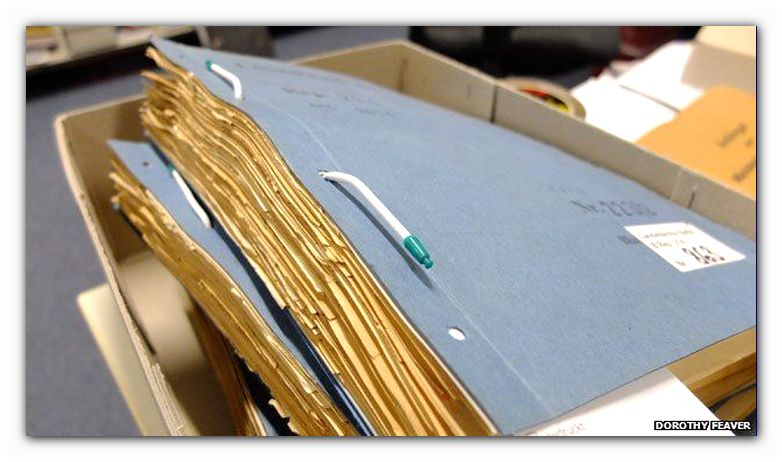
At a former military factory now used to house the
state archive, an employee, Martin Luchterhand, shows me a bundle of
blue cardboard folders. The files contain more than a thousand pages of
different colours and sizes.
They contain data on abortions from June to
October 1945 in Neukölln, one of Berlin's 24 districts. The fact
that they survived intact is a small miracle.
At that time abortion was prohibited in Germany
under Article 218 of the Criminal Code. But Luchterhand says that after
the war there was a short period during which women were permitted to
terminate pregnancies. The exceptional situation was connected with the
mass rapes of 1945.
PS
We will probably never know the true scale of the
rapes. The records of Soviet military tribunals and many other
documents remain closed. Recently the State Duma approved a law
“on encroachment upon historical memory,” under which
anyone who belittles the USSR's contribution to the victory over
fascism may receive a fine and up to five years in prison.
Vera Dubina, a young historian at the University
for the Humanities in Moscow, says that she knew nothing about these
rapes until she received a scholarship to study in Berlin. After
studying in Germany she wrote a paper on the subject but was unable to
publish it. “The Russian media reacted very aggressively,”
she says. “People want to know only about our glorious victory in
the Great Patriotic War, and it is becoming increasingly difficult to
conduct serious research.”
We know very well that history is often rewritten
to suit the political climate. That is precisely why eyewitness
testimony is so important: the testimony of those who have dared to
speak about the subject now, in old age, and the accounts of people who
were still young at the time and recorded what they witnessed during
the war.
Vitaly, the son of the author of the army diary,
Vladimir Gelfand, says that many Soviet soldiers displayed great
heroism during the Second World War. But that is far from the whole
story, he believes. “If people do not want to know the truth,
want to remain mistaken and want to say that everything was beautiful
and noble, that is foolish, it is self-deception,” he reminds us.
“The whole world understands this, and Russia understands it.
Even those behind these laws about distorting the past understand it
too. We cannot move into the future until we come to terms with the
past.”
Lieutenant Vladimir Gelfand's diary was available
online, but is now being published in Russia in book form for the first
time. Two abridged editions of the diary had previously appeared in
Germany and Sweden.
© https://graf-orlov33.livejournal.com
Text visible on the photographed diary/document page
Photograph 5 — handwritten German
statement, Berlin, July 27, 1945. Heading: “Report to the Health
Office, Neukölln administrative district.” Text: “I
declare under oath that on May 16 of this year I was raped under threat
to my life. [A short phrase describing the circumstances is not
reliably legible in this reproduction.] I was taken from Post Office 29
together with several female colleagues to the women’s barracks
and was raped there twice by two Russians. After the examinations I
received at the Urban Hospital, which were negative, I went to Dr.
Rehkopf, Hasenheide 119, who established that I was two to three months
pregnant. I hereby ask for permission to terminate the pregnancy,
because I am engaged and intend to marry after my fiancé
returns.” The signature and the final address are handwritten;
the surname appears to read “Hellmann,” and the address
line includes “Lichtenrader Str. 28,” but the remaining
characters are not clear enough to reproduce safely.




 Russian