


 |
 |
  |
|
||
 |
Zwischen Krieg und und Frieden: Waldlager der Roten Armee 1945 |
||
| Nach
dem gleichnamigen Begleitheft zur Wanderausstellung seit 2016 liegt nun
eine erste wissenschaftliche Auswertung der archäologischen
Befunde und Funde vor. Dazu gehören ein Fundkatalog und
Gastbeiträge aus historischer Sicht. Das Heft ist ein mit
eigenem
Umschlag versehener Sonderdruck aus Band 48 der Reihe
„Veröffentlichungen zur brandenburgischen
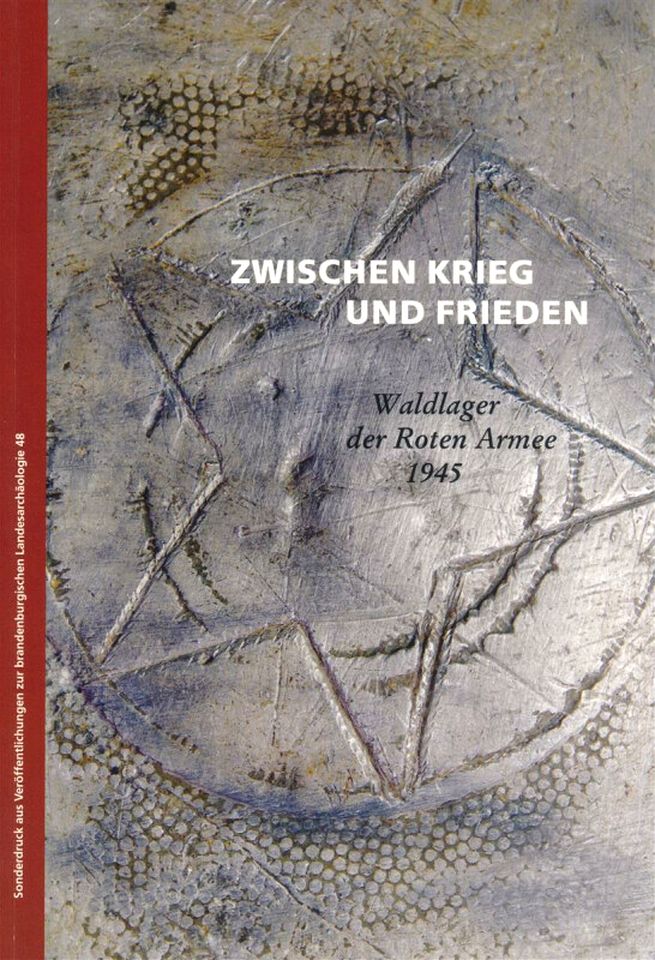
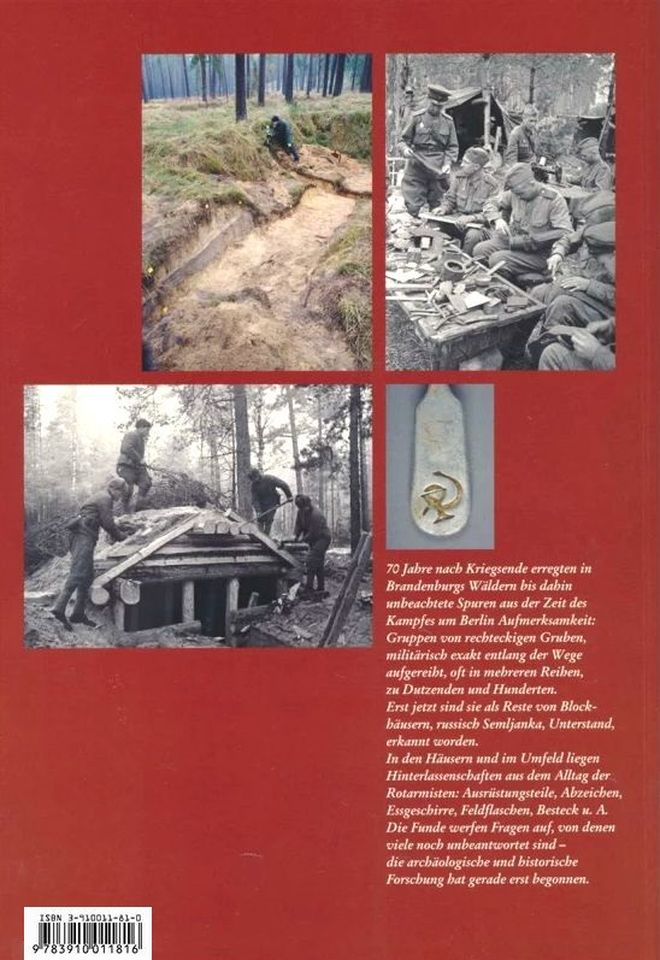
Landesarchäologie“. 70 Jahre nach Kriegsende erregten in Brandenburgs Wäldern bis dahin unbeachtete Spuren aus der Zeit des Kampfes um Berlin Aufmerksamkeit: Gruppen von rechteckigen Gruben, militärisch exakt entlang der Wege aufgereiht, oft in mehreren Reihen, zu Dutzenden und Hunderten. Erst jetzt sind sie als Reste von Blockhäusern, russisch Semljanka, Unterstand, erkannt worden. Die Lager dienten der geordneten Auflösung großer Truppenteile und der beginnenden Rückführung Hunderttausender Soldatinnen und Soldaten sowie ehemaliger Kriegsgefangener und Zwangsarbeiter. In den Häusern und im Umfeld liegen Hinterlassenschaften aus dem Alltag der Rotarmisten: Ausrüstungsteile, Abzeichen, Essgeschirre, Feldflaschen, Besteck u. A. Einige Gegenstände tragen kyrillische Aufschriften. Eingeritzte Sowjetsterne, etwa auf Wehrmachts-Koppelschlössern über dem ausgelöschtem Hakenkreuz, spiegeln das ausgeprägte Bedürfnis wider, sich mit dem Sieges-Symbol zu schmücken. Ziviles Material – Schmuck, Uhren, Feuerzeuge, Rasierer und sogar Wasserhähne und Fahrradteile – bestätigt die Narrative dieser Zeit. Die Funde werfen Fragen auf, von denen viele noch unbeantwortet sind – die archäologische und historische Forschung hat gerade erst begonnen. Seventy years after the end of the Second World War, hitherto unnoticed structures in Brandenburg’s forests from the time of the Battle of Berlin have begun to attract attention: groups of rectangular pits lined up with military precision alongside roads, dozens and sometimes hundreds of them often many rows deep. Only recently have these features been recognised as the remnants of Russian zemlyankas, or wood-lined dugout shelters. The camps once served the organised demobilisation of large troop units and the initial repatriation of hundreds of thousands of soldiers, as well as former POWs and forced labourers. In and around the houses, remnants of daily life in the Red Army can be found: among other items, pieces of equipment, badges, plates and cups, canteens and cutlery. Some items bear Cyrillic inscriptions. Soviet stars engraved on Wehrmacht belt buckles over erased swastikas, for example, reflect a desire of adornment with the symbol of victory. Civilian artefacts such as jewellery, watches, lighters, razors and even taps and bicycle parts confirm the narrative of the time. The finds raise questions, many of which are still unanswered―the archaeological and historical research has just begun. |
||
| |
||
| Thomas
Kersting,
Wünsdorf, Christoph Unglaub, Berlin, Joachim Wacker,
Wünsdorf, und Sieghard Wolter, Brandenburg a. d. H. Mit Beiträgen von Melanie Herz, Andreas Köpp, Martin Petzel, Elke Scherstjanoi, Klaus Stieger, Florian Wilke |
||
| |
||
| Thomas Kersting Archäologe mit Schwerpunkt auf der Archäologie des Mittelalters und des 20. Jahrhunderts. Seit 1993 tätig im Brandenburgischen Landesamt für Denkmalpflege und Archäologie (BLDAM). Erforschung von Zwangsarbeitslagern und weiteren Denkmälern des Zweiten Weltkriegs. Christoph Unglaub Archäologe, tätig im Archäologischen Landesamt Schleswig-Holstein. Beschäftigt sich mit eisenzeitlichen Siedlungen und hat an der Entwicklung archäologischer Thesen mitgewirkt. Joachim Wacker Leiter der Abteilung für Großprojekte und Stadtarchäologie im BLDAM. Forschungsschwerpunkte sind städtische Archäologie und die Archäologie der Kohleindustrie in Brandenburg. Sieghard Wolter Hobbyarchäologe aus Brandenburg, bekannt für zahlreiche bedeutende Funde, darunter Münzschätze. Ausgezeichnet für sein Engagement im Denkmalschutz. Melanie Herz Hobbyarchäologin aus Rangsdorf, engagiert in der Dokumentation und Auswertung von Funden aus Zwangsarbeitslagern. Andreas Köpp Archäologe und Mitglied historischer Vereine. Beschäftigt sich mit regionaler Geschichte und der Erhaltung kulturellen Erbes. Martin Petzel Archäologe im BLDAM mit Schwerpunkt auf der Archäologie des 20. Jahrhunderts, insbesondere Zwangsarbeitslager. Elke Scherstjanoi Dr. phil., Spezialistin für Zeitgeschichte, tätig am Institut für Zeitgeschichte München-Berlin. Forschungsschwerpunkte: Zwangsarbeitslager und osteuropäische Geschichte des 20. Jahrhunderts. |
  |
 |
 |
|
| |
|||
 |
 немецкий
Между войной и миром: лесной лагерь Красной армии 1945 |
||
| Вслед
за одноименным буклетом, сопровождавшим передвижную выставку с 2016
года, теперь доступна первоначальная научная оценка археологических
объектов и находок. Она включает в себя каталог открытий и материалы
гостей с исторической точки зрения. Буклет представляет собой
специальное издание с собственной обложкой из 48-го тома серии
"Veröffentlichungen zur Brandenburgischen
Landesarchäologie". Спустя 70 лет после окончания Второй мировой войны в лесах Бранденбурга начали привлекать внимание ранее незамеченные сооружения времен битвы за Берлин: группы прямоугольных ям, выстроенных с военной точностью вдоль дорог, десятки, а иногда и сотни, часто в несколько рядов глубиной. Только сейчас в них признали остатки срубов - русских землянок, или деревянных блиндажей. Когда-то эти лагеря служили для организованной демобилизации крупных воинских частей и первоначальной репатриации сотен тысяч солдат, а также бывших военнопленных и подневольных рабочих. В домах и вокруг них можно найти остатки повседневной жизни красноармейцев: предметы снаряжения, значки, тарелки и чашки, фляги, столовые приборы. На некоторых предметах есть кириллические надписи. Например, советские звезды, выгравированные на пряжках ремней вермахта поверх стертой свастики, отражают стремление к украшению символами победы. Гражданские артефакты, такие как ювелирные изделия, часы, зажигалки, бритвы и даже краны, детали велосипедов, подтверждают нарратив того времени. Находки вызывают вопросы, на многие из которых пока нет ответов - археологические и исторические исследования ведутся уже давно. |
||
| |
||
| Авторы:
Thomas Kersting, Вюнсдорф, Christoph Unglaub, Берлин, Joachim Wacker,
Вюнсдорф, und Sieghard Wolter, Бранденбург При участии Melanie Herz, Andreas Köpp, Martin Petzel, Elke Scherstjanoi, Klaus Stieger, Florian Wilke |
||
| |
||
| Томас Керстинг Археолог, специализирующийся на археологии Средневековья и XX века. С 1993 года работает в Бранденбургском земельном управлении по охране памятников и археологии (BLDAM). Исследует лагеря принудительного труда и другие памятники Второй мировой войны. Кристоф Унглауб Археолог, работавший в Археологическом земельном управлении Шлезвиг-Гольштейн. Занимается изучением железнодорожных поселений и участвовал в разработке археологических концепций. Йоахим Вакер Руководитель отдела крупных проектов и городской археологии в BLDAM. Занимается городскими археологическими исследованиями и археологией угольной промышленности в Бранденбурге. Зигхард Вольтер Любитель-археолог из Бранденбурга, известный своими значительными находками, включая монетные сокровища. Награждён за вклад в охрану памятников. Мелани Херц Любительница-археолог из Рангсдорфа, участвовала в документировании находок из нацистских лагерей принудительного труда. Андреас Кёпп Археолог и член историко-родовых обществ. Занимается исследованиями региональной истории и сохранением культурного наследия. Мартин Петцель Археолог BLDAM, специализируется на археологии XX века, в частности на лагерях принудительного труда. Эльке Шерстяной Кандидат философских наук, специалист по современной истории, работает в Институте современной истории Мюнхена-Берлина. Исследует лагеря принудительного труда и историю Восточной Европы XX века. |
German© Veröffentlichungen zur brandenburgischen Landesarchäologie German / English
© Thomas Kersting
© Christoph Unglaub
© Martin Petzel
© Joachim Wacker
© Sieghard Wolter
Following the booklet of the same name
that accompanied a traveling exhibition from 2016 onward, an initial
scholarly assessment of the archaeological features and finds is now
available. It includes a catalogue of discoveries and contributions by
invited authors from a historical perspective. The booklet is a special
edition with its own cover taken from volume 48 of the series
Veröffentlichungen zur Brandenburgischen Landesarchäologie.
Seventy years after the end of the Second World War, previously
unnoticed structures dating from the Battle of Berlin began to attract
attention in the forests of Brandenburg: groups of rectangular pits
laid out with military precision along roads, in their dozens and
sometimes hundreds, often several rows deep. Only now were they
recognized as the remains of log structures — Russian zemlyankas,
or timber dugouts. These camps once served for the organized
demobilization of large military units and the initial repatriation of
hundreds of thousands of soldiers, as well as former prisoners of war
and forced laborers. In and around the structures one can find remnants
of the everyday life of Red Army soldiers: items of equipment, badges,
plates and cups, flasks, and cutlery. Some objects bear Cyrillic
inscriptions. Soviet stars engraved on Wehrmacht belt buckles over
erased swastikas, for example, reflect a desire to decorate objects
with symbols of victory. Civilian artifacts such as jewelry, watches,
lighters, razors, and even taps and bicycle parts confirm the
historical narrative of the period. The finds raise questions, many of
which still have no answers — archaeological and historical
research has been under way for some time.
Authors: Thomas Kersting, Wünsdorf;
Christoph Unglaub, Berlin; Joachim Wacker, Wünsdorf; and Sieghard
Wolter, Brandenburg.
With contributions by Melanie Herz, Andreas Köpp, Martin Petzel, Elke Scherstjanoi, Klaus Stieger, and Florian Wilke.
Thomas Kersting
Archaeologist specializing in medieval and twentieth-century
archaeology. Since 1993 he has worked at the Brandenburg State Office
for the Preservation of Monuments and Archaeology (BLDAM). He
researches forced-labor camps and other monuments of the Second World
War.
Christoph Unglaub
An archaeologist who worked at the Schleswig-Holstein State
Archaeological Office. He studies railway settlements and participated
in the development of archaeological concepts.
Joachim Wacker
Head of the major projects and urban archaeology department at BLDAM.
He works on urban archaeological research and the archaeology of the
coal industry in Brandenburg.
Sieghard Wolter
An amateur archaeologist from Brandenburg known for important
discoveries, including hoards of coins. He has received an award for
his contribution to monument preservation.
Melanie Herz
An amateur archaeologist from Rangsdorf who participated in documenting finds from Nazi forced-labor camps.
Andreas Köpp
An archaeologist and member of historical and genealogical societies.
He researches regional history and the preservation of cultural
heritage.
Martin Petzel
An archaeologist at BLDAM specializing in twentieth-century archaeology, particularly forced-labor camps.
Elke Scherstjanoi
PhD, specialist in contemporary history, working at the Institute of
Contemporary History Munich–Berlin. She researches forced-labor
camps and the history of Eastern Europe in the twentieth century.