 |
 |
 |
 |
 |
|
|
|
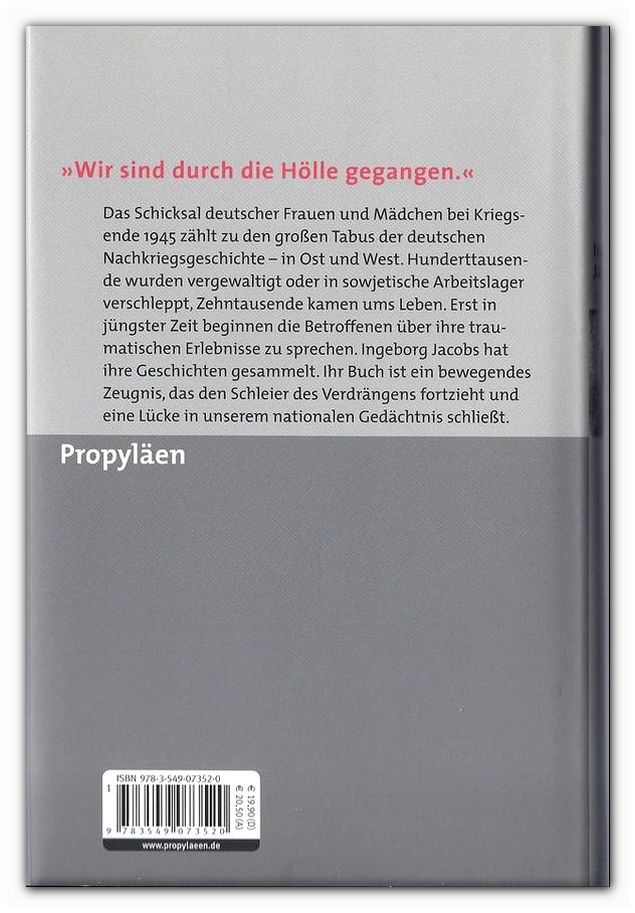
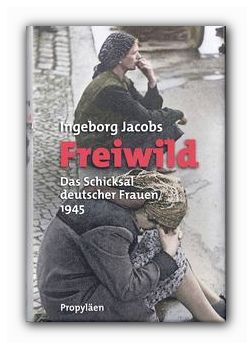
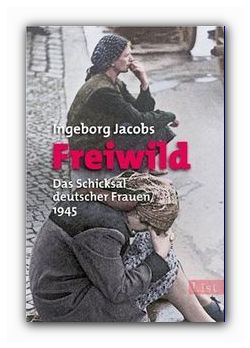
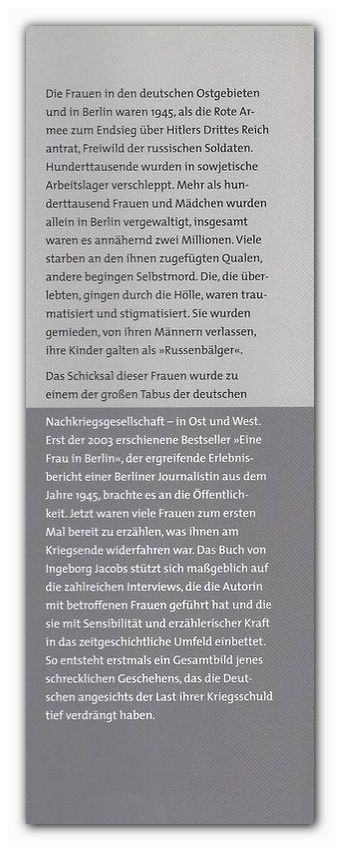
В 1945 году, когда Красная армия одержала окончательную победу над Третьим рейхом Гитлера, женщины в восточных областях Германии и в Берлине оказались беззащитными перед насилием со стороны советских солдат. Сотни тысяч людей были депортированы в советские трудовые лагеря. Только в Берлине были изнасилованы более 100 тысяч женщин и девушек; по всей Германии общее число жертв оценивается примерно в два миллиона. Многие женщины умерли от полученных травм, другие покончили с собой. Выжившие прошли через ад, получили тяжёлые психологические травмы и подвергались общественному осуждению. Их сторонились, мужья нередко оставляли их, а детей клеймили унизительным словом «Russenbälger». Судьба этих женщин долго оставалась одним из главных табу послевоенной Германии. И на Востоке, и на Западе широкое общественное внимание к этой теме возникло лишь в 2003 году после выхода бестселлера «Женщина в Берлине» — беспощадного рассказа берлинской журналистки о пережитом в 1945 году. Когда книгу экранизировали с Ниной Хосс в главной роли, тележурналист Ингеборг Якобс подготовила для ZDF документальный фильм на эту тему. В сопроводительной книге представлены результаты её обширных исследований. Она основана прежде всего на многочисленных интервью автора с женщинами и с большой деликатностью помещает их личный опыт в исторический контекст. Впервые немецкому читателю была представлена целостная картина этого страшного события, которое десятилетиями вытеснялось из памяти на фоне ответственности Германии за войну. |
 |
«Сенсационный документальный труд». HÖRZU / 02.10.08 «Взгляд на травму, которая до сих пор не преодолена». Die Welt / 18.10.08 / Arielle Fridson «Тягостно и впечатляюще». Hannoversche Allgemeine Zeitung / 14.10.08 / Ekkehard Böhm «Впечатляет, словно пугающий групповой портрет». Leipziger Volkszeitung / 23.10.08 «Благодаря этим свидетельствам автору удаётся приблизить читателя к травме, которая по-прежнему не преодолена». Morgenpost / 24.10.08 / Arielle Fridson «Ингеборг Якобс выпустила книгу, которая позволяет заглянуть в запретную тему, затронувшую, по осторожным оценкам, более двух миллионов женщин. Особенно впечатляет то, как книга анализирует события, повторение которых в Боснии или Конго вызывает наше возмущение, и напоминает, что когда-то они коснулись наших собственных матерей и бабушек». Deutschlandradio Kultur / 14.12.2008 / Bernd Wagner «Ингеборг Якобс умеет показывать конкретное, не впадая в истерику. Она принимает сторону жертв, не разжигая ненависти к преступникам». NZZ / 18.06.2009 |
 |
 |
 |
© Propyläen
Verlag
© List-Taschenbuch
Verlag
 German
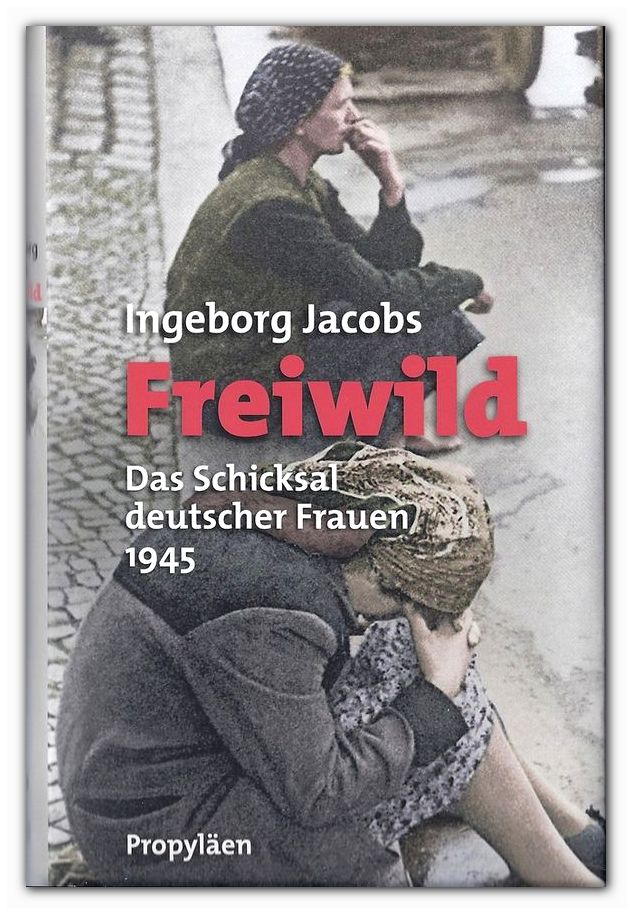
Ingeborg Jacobs: “Fair Game: The Fate of German Women in 1945”
In 1945, when the Red Army achieved its final victory over Hitler’s Third Reich, women in Germany’s eastern territories and in Berlin became fair game for Russian soldiers. Hundreds of thousands of people were deported to Soviet labor camps. More than 100,000 women and girls were raped in Berlin alone; across Germany, the total number was around two million.
Many women died from the injuries inflicted on them; others took their own lives. Those who survived had been through hell, were traumatized, and were stigmatized. They were shunned; husbands abandoned them; their children were branded “Russenbälger.” The fate of these women remained one of the great taboos of postwar Germany.
In East and West, broader public attention came only in 2003 with the bestseller “A Woman in Berlin,” the stark account of a Berlin journalist’s experiences in 1945. When the book was adapted for film, with Nina Hoss in the leading role, television journalist Ingeborg Jacobs prepared a documentary on the subject for ZDF. The accompanying book presents the results of her extensive research. It is based above all on numerous interviews conducted by the author with women and places their experiences, with sensitivity and narrative force, in the context of contemporary history. For the first time, Germans are given an overall view of this terrible event—an experience that had long been deeply repressed under the burden of responsibility for the war.
Press reviews
“A sensational documentary.” — HÖRZU, 2 October 2008
“A glimpse into a trauma that has still not been resolved.” — Die Welt, 18 October 2008, Arielle Fridson
“Disturbing and impressive.” — Hannoversche Allgemeine Zeitung, 14 October 2008, Ekkehard Böhm
“Impressive, like a frightening group portrait.” — Leipziger Volkszeitung, 23 October 2008
“With these accounts, the author succeeds in bringing her readers close to a trauma that remains unresolved.” — Morgenpost, 24 October 2008, Arielle Fridson
“Ingeborg Jacobs has now published a book that uses the present moment to let us look into a taboo subject in which, according to conservative estimates, more than two million women were affected. … What is most impressive is the way the book analyzes events whose recurrence in Bosnia or the Congo would outrage us, and reminds us that our own mothers and grandmothers were once affected.” — Deutschlandradio Kultur, 14 December 2008, Bernd Wagner
“Ingeborg Jacobs masters the art of making the concrete visible without becoming shrill. She adopts the victims’ point of view without stirring up hatred against the perpetrators.” — NZZ, 18 June 2009
About the author
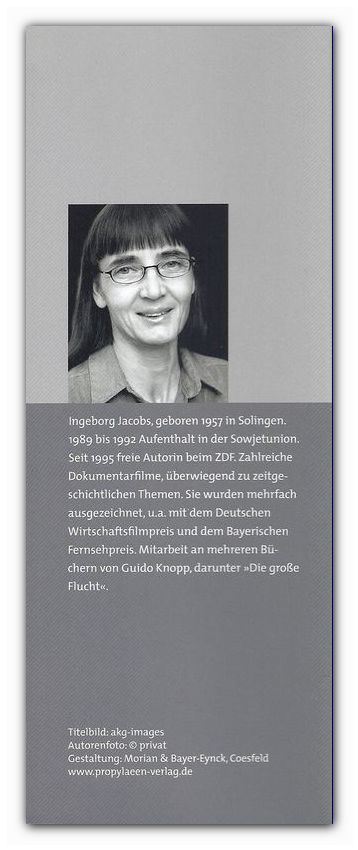
Ingeborg Jacobs was born in Solingen in 1957. From 1989 to 1992 she lived in the Soviet Union. Since 1995 she has worked as a freelance author for ZDF. She is the author of numerous documentaries, mainly on contemporary history. Her work has received several awards, including the German Business Film Prize and the Bavarian Television Prize. She has also contributed to several books by Guido Knopp, including “The Great Escape.”