



 |
 |
 |
| |
|||
Produktinformation
Über die Autorin
|
Produktinformation
|
||

|
|
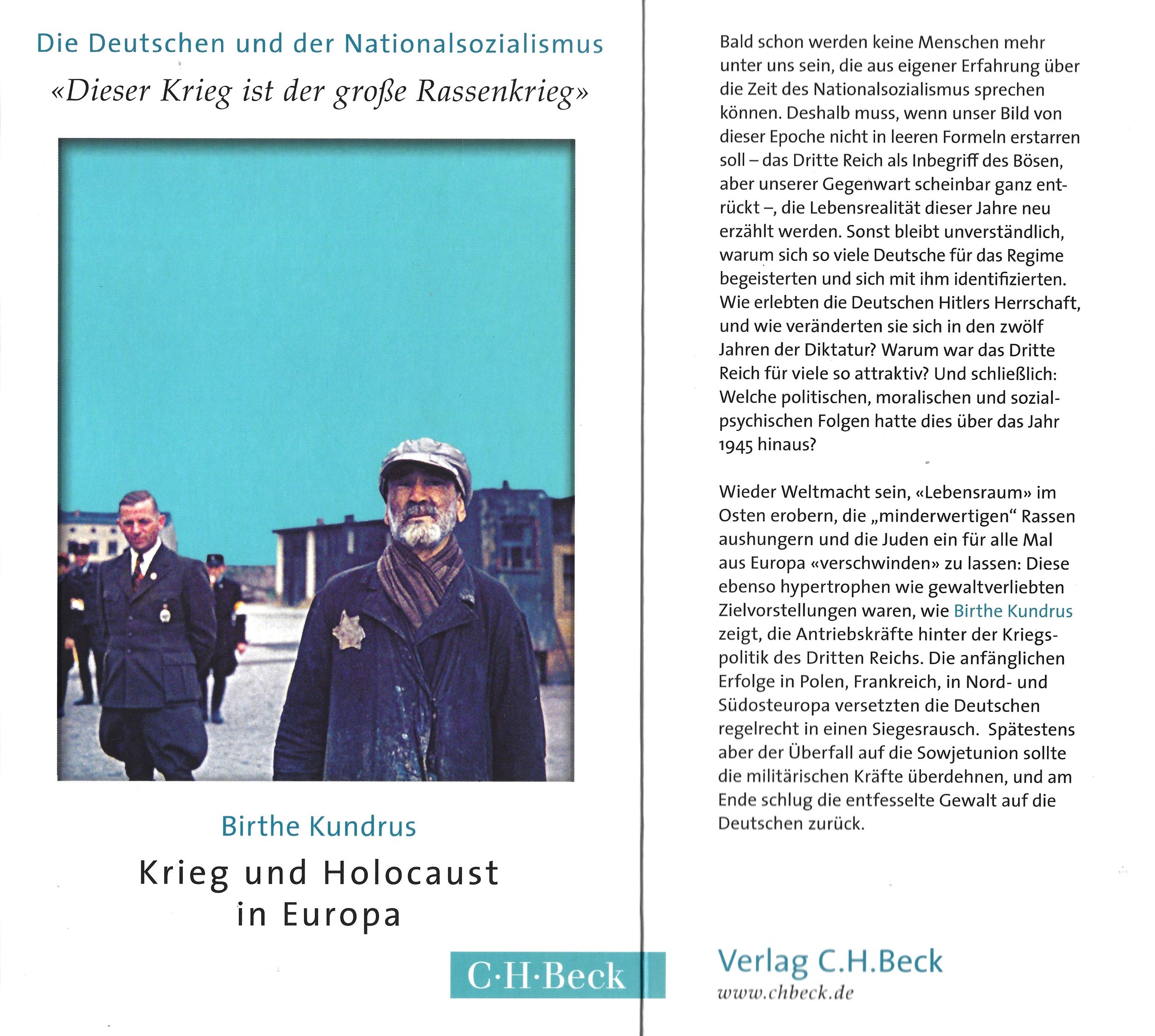
| „Dieser Krieg ist der große Rassenkrieg“ – in Hermann Görings martialischen Worten aus dem Oktober 1942 spiegelte sich der Wille des NS-Regimes, die Vernichtung der europäischen Juden gnadenlos voranzutreiben – notfalls bis zum eigenen Untergang. Radikaler Antisemitismus und Rassenhass, so zeigt dieser beeindruckende Überblick, waren die ideologischen Antriebskräfte hinter der Kriegspolitik des Dritten Reichs und führten zu einer beispiellosen Eskalation der Gewalt. Ausgehend von Hitlers Bekenntnissen in „Mein Kampf“ veranschaulicht Birthe Kundrus die verheerenden Auswirkungen des nationalsozialistischen Expansionsstrebens und zeichnet nach, wie das Regime im Verlauf des Zweiten Weltkriegs alle Maßstäbe der Humanität aufgab. |
20.
Jahrhundert Adolf
Hitler Antisemitismus Deutschland Europa Expansion Geschichte Holocaust Krieg Militär Monographie Politik
| Rezensionsnotiz
in Süddeutsche Zeitung, 06.08.2018
René Schlott liest das Holocaust-Buch der Historikerin Birthe Kundrus mit großem Interesse. Das Konzept, das sich an der Wechselwirkung von Kriegsverlauf und Radikalisierung des Judenmords orientiert, eine integrative Geschichte des Holocaust anstrebt und nicht auf überwältigende Emotionen setzt, geht für Schlott auf. Das Einstreuen von Zeitzeugenberichten von Tätern, Opfern und Zuschauern, mit dem Ziel, menschliche Verhaltensweisen im Holocaust sichtbar zu machen, scheint Schlott hingegen methodisch fragwürdig, wenn es aus der Ereignisgeschichte eine Erfahrungsgeschichte machen soll. Der laut Schlott vergleichsweise schlanke, lesefreundliche Band besticht jedenfalls durch eine "bewundernswerte Syntheseleistung". |
||
| |
||
Die sieben Bände der von Norbert Frei herausgegebenen Reihe bieten eine Erfahrungsgeschichte der deutschen Gesellschaft im Dritten Reich. Sie erzählen die Geschichte dieser Jahre neu: nah an den Menschen und in einer Sprache, die die Lebensrealität unter dem Hakenkreuz begreiflich macht – für die Zeit nach der Zeitgenossenschaft. Bald schon werden keine Menschen mehr unter uns sein, die aus eigener Erfahrung über die Zeit des Nationalsozialismus sprechen können. Deshalb muss, wenn unser Bild von dieser Epoche nicht in leeren Formeln erstarren soll – das Dritte Reich als Inbegriff des Bösen, aber unserer Gegenwart scheinbar ganz entrückt –, die Lebensrealität dieser Jahre neu erzählt werden. Sonst bleibt unverständlich, warum sich so viele Deutsche für das Regime begeisterten und sich mit ihm identifizierten. Wie erlebten die Deutschen Hitlers Herrschaft, und wie veränderten sie sich in den zwölf Jahren der Diktatur? Warum war das Dritte Reich für viele so attraktiv? Und schließlich: Welche politischen, moralischen und sozial- psychischen Folgen hatte dies über das Jahr 1945 hinaus? |
||
| ________________________
|
||
| Verteidigungen Die Euphorie im deutschen Hauptquartier hielt nicht lang. Über die Weihnachtstage war das Wetter besser geworden, im verschneiten Ostbelgien hatte die alliierte Luftwaffe eingegriffen und die deutschen Nachschublinien zerstört. Der Wehrmacht ging der Kraftstoff aus, sie konnte nicht mehr vorrücken und blieb stecken. Erbittert wurde gekämpft, ein Horrorszenario entfaltete sich, mit Massakern auf der einen und dem Niedermähen von Gefangenen auf der anderen Seite. Die deutschen Streitkräfte verloren 90.000 Soldaten, das militärische Ziel wurde verfehlt: Man schwächte die Westmächte nicht wirklich, sondern hielt sie lediglich auf. Kriegsentscheidend war, wie sich immer deutlicher zeigte, der zwar stockende, aber nicht enden wollende Nachschub an Menschen und Material auf Seiten der Alliierten. Hitler aber setzte den einmal eingeschlagenen Weg fort. Am 1. Januar 1945 erwähnte er in seiner Neujahrsansprache die Offensive mit keinem Wort mehr. Stattdessen drohte er: «Die Welt muß wissen, daß daher dieser Staat niemals kapitulieren wird, daß das heutige Deutsche Reich, wie alle großen Staaten der Vergangenheit auf seinem Weg Rückschlägen ausgesetzt sein mag, daß es aber nie diesen Weg verlassen wird. Man muß wissen, daß die heutige Staatsführung die Sorgen und Leiden mit ihrem Volke teilt, aber niemals vor Sorgen oder Leid kapitulieren wird.»[58] Die Folgen seiner ruchlosen Kriegführung für die deutsche Gesellschaft waren dem Regime, das hatte schon im April 1943 der Schweizer Generalkonsul Zurlinden erkannt, «gleichgültig»[59]. Und in Thaya wusste der Pfarrer, wenn die Nazis abtreten müssten, dann «soll nichts mehr da sein!»[60] Die alliierte Übermacht und die selbstzerstörerische deutsche Kriegführung zeigten sich in besonderem Maße an der Ostfront. Am 12. Januar startete die Rote Armee ihre Winteroffensive. 6,7 Millionen Soldaten und Tausende von Panzern, Flugzeugen und Geschützen standen entlang einer Linie von der Ostsee bis zur Adria. Stalin hatte abgewartet, bis die Wehrmacht alle verfügbaren Kräfte nach Westen verlagert hatte. Dort, so hatte er gehofft, würden die Amerikaner möglichst lange unter deutschem Feuer liegen, derweil er zügig das Reich eroberte. Hitler hatte seinerseits trotz aller Warnungen aus Kreisen der Generalität den Aufmarsch mit einem etwas merkwürdigen Vergleich als «größten Bluff seit Dschingis Khan»[61] abgetan. Aber: «Warschau, Krakau, Lodz, Czenstochau sind genommen, die oberschlesische Grenze ist erreicht»,[62] staunte Klemperer am 20. Januar. Oberschlesien als Industrierevier wollte die Rote Armee – wie die Amerikaner das Pendant im Westen, das Ruhrgebiet – möglichst schnell erreichen. Hans Frank war schon am 17. Januar aus der Wawelsburg geflohen, nicht ohne vorher gestohlene Gemälde und andere Preziosen in sein neues Zuhause nach Bayern verfrachtet zu haben. Nach drei Tagen heftiger Kämpfe war das Generalgouvernement Geschichte. Lindgren freute sich, die sowjetischen Streitkräfte schritten «im Sturmschritt voran»[63]. Und so ging es weiter. Der 21-jährige Rotarmist Wladimir Gelfand notierte am 26. Januar in sein Tagebuch: «Heute werden wir in Deutschland sein.»[64] Was den einen mit Stolz erfüllte, war für die anderen der blanke Horror. Die Ankunft der Truppen Stalins im Altreich verursachte eine Massenflucht der Zivilbevölkerung. Sie verschmolz mit der Fluchtbewegung der Volksdeutschen in Osteuropa sowie Hunderttausenden von Sowjetbürgerinnen und -bürgern, die im Gefolge der Wehrmacht freiwillig oder unfreiwillig ihre Heimat verlassen hatten. Alles lieber, als der Roten Armee in die Hände zu fallen, war die Devise. Riesige, immer weiter anschwellende Flüchtlingstrecks, sechs Millionen sollten es zwischen 1944 und Frühjahr 1945 werden, bahnten sich bei eisigen Wintertemperaturen auf völlig verstopften Straßen ihren Weg nach Westen. Viele hatten die Haustürschlüssel in der Tasche – auf eine baldige Rückkehr hoffend. Gemäß der Maßgabe, die Stellungen zu halten, befahlen örtliche NSDAP-Leiter und militärische Führungsstellen die Räumung der Ortschaften viel zu spät. Als es darauf angekommen wäre, ließen viele Parteifunktionäre sich mit den Worten Martin Bormanns, des Leiters der Partei-Kanzlei, «vom Russenschreck beeinflussen»[65]. Sie liefen als Erste zu ihren vollgepackten Autos und fuhren davon. So setzte sich in Posen Chefgermanisierer Greiser am 20. Januar ab – sowjetische Einheiten waren immerhin noch 130 km entfernt. Offiziell hatte er die Parole ausgegeben, die Stadt bis zum letzten Blutstropfen zu halten. Goebbels kommentierte: «schauderhaftes Versagen».[66] |
||
| |
||
| 58
Domarus, Hitler, Bd. 4, T. 2,
S. 2182. 59 Zit n. Bajohr/Strupp, Fremde Blicke, S. 572, 22.4.1943. 60 Schweitzer, 50 Jahre danach, S. 89, 11.9.1944. 61 Zit. n. Hildebrand, Reich, S. 811. 62 Klemperer, Zeugnis, Bd. 2, S. 643. 63 Lindgren, Menschheit, S. 437, 21.1.1945. 64 Wladimir Gelfand: Deutschland-Tagebuch. Aufzeichnungen eines Rotarmisten, ausgew. und komm. von Elke Scherstjanoi, Berlin 2005. S. 27. 65 Zit. n. Elisabeth Kohlhaas: 1945 – Krieg nach innen. NS-Verbrechen in Aschaffenburg und an Aschaffenburgern, Aschaffenburg 2005, S. 37, Anordnung vom 6.3.1945. 66 Goebbels, Tagebücher, T. II, Bd. 15, S. 214, 25.1.1945. 67 Kardorff, Aufzeichnungen 1942–1945, S. 285, 30.1.1945. 68 Gelfand, Deutschland-Tagebuch, S. 28, 28.1.1945. 69 Gelfand, Deutschland-Tagebuch, S. 29, 30.1.1945. 70 Gelfand, Deutschland-Tagebuch 71 Zit. n. Nikolaus Wachsmann: KL. Die Geschichte der nationalsozialistischen Konzentrationslager, München 2016, S. 639. 72 Klemperer, Zeugnis, Bd. 2, S. 649, 29.1.1945. 73 Zit. n. Heinrich Schwendeman: Der deutsche Zusammenbruch im Osten 1944/45, in: Bernd-A. Rusinek (Hrsg.): Kriegsende 1945. Verbrechen, Katastrophen, Göttingen 2004, S. 137. 74 Zit. n. Hürter, Notizen, S. 235, 31.1.1945. 75 Zit. n. Ian Kershaw: Das Ende. Kampf bis in den Untergang, NS-Deutschland 1944/45, München 2011, S. 230, 4.2.1945. 76 Zit. n. ebd., S. 230, 6.1.1945. 77 Lindgren, Menschheit, S. 430 f. 78 Zit. n. Helmut Heiber (Hrsg.): Hitlers Lagebesprechungen. Die Protokollfragmente seiner militärischen Konferenzen 1942–1945, Stuttgart 1962. S. 721, 12.12.1944. 79 Andreas-Friedrich, Schattenmann, S. 200, 19.2.1945. 80 Klemperer, Zeugnis, Bd. 2, S. 661, 22.–24.2.1945. 81 Ebd., S. 667, 22.–24.2.1945. 82 FZH, 11/S13 Solmitz Tagebücher, S. 992. 83 Zit. n. Das Deutsche Reich und der Zweite Weltkrieg, Bd. 10, Erster Halbbd., hrsg. vom Militärgeschichtlichen Forschungsamt von Rolf-Dieter Müller, München 2008, S. 316. 84 Goebbels, Tagebücher, T. II, Bd. 15, S. 504, 14.3.1945. 85 Mann, Hörer, S. 142, 4.3.1945. 86 Ebd., S. 143, 20.3.1945. 87 Zit. n. Kershaw, Ende, S. 366 f., 9.3.1945. 88 Zit. n. Echternkamp, Kriegsschauplatz, S. 196, 28.3.1945. 89 Zit. n. Joachim Szodrzynski: Die «Heimatfront» zwischen Stalingrad und Kriegsende, in: Hamburg im «Dritten Reich», hrsg. von der Forschungsstelle für Zeitgeschichte, Göttingen 2005, S. 675. 90 Klemperer, Zeugnis, Bd. 2, S. 706. 91 Kalshoven, Ich denk so viel an Euch, S. 439, 4.1.1945. 92 Goebbels, Tagebücher, T. II, Bd. 14, S. 314, 2.12.1944. 93 Kalshoven, Ich denk so viel an Euch, S. 444. 94 Lindgren, Menschheit, S. 439. 95 Melvin Lasky: Und alles war still. Deutsches Tagebuch 1945, hrsg. und mit einem Nachwort versehen von Wolfgang Schuller, Berlin 2014, S. 141, 9.4.1945. 96 Ebd., S. 146, 11.4.1945. 97 Zit. n. Klemperer, Zeugnis, Bd. 2, S. 657, 12.2.1945. 98 Mann, Hörer, S. 147, 5.4.1945. 99 Lasky, Und alles war still, S. 106, 25./26.3.1945. 100 Böll, Briefe, Bd. 2, S. 1126 f. 101 Briefwechsel Stalins mit Churchill, Attlee, Roosevelt und Truman 1941–1945, hrsg. vom Ministerium für Auswärtige Angelegenheiten der UdSSR, Berlin 1961, S. 704. 102 Zit. n. Echternkamp, Kriegsschauplatz, S. 167. 103 Gelfand, Deutschland-Tagebuch, S. 31.6./7.2.1945. |
||

© Birthe
Kundrus
© Verlag C.H.Beck oHG
Информация о книге
О авторе
|
Информация о книге
|
||
|
|
|
| «Эта война - великая расовая война» - военные слова Германа Геринга в октябре 1942 года отражали стремление нацистского режима безжалостно добиваться уничтожения европейских евреев - если потребуется, до собственной гибели. Радикальный антисемитизм и расовая ненависть, как показывает этот впечатляющий обзор, были идеологической движущей силой военной политики Третьего рейха и привели к беспрецедентной эскалации насилия. Основываясь на признаниях Гитлера в «Майн кампф», Бирте Кундрус иллюстрирует разрушительные последствия стремления национал-социалистов к экспансии и прослеживает как режим отказался от всех стандартов человечности в ходе Второй мировой войны. | ||
| |
||
| Скоро среди нас не останется людей, которые могли бы рассказать об эпохе национал-социализма, исходя из собственного опыта | ||
| |
||
| Чтобы наше представление об истории не увязло в стереотипах и клише - Третий рейх как воплощение зла, которое, кажется, больше не имеет ничего общего с нашим настоящим, - необходимо рассказать о реальной жизни того времени. Иначе остается непонятным, почему этот режим казался привлекательным столь многим немцам и почему так много людей отождествляли себя с ним. В этом смысле новая серия призвана предложить историю опыта национал-социализма. В центре внимания - то, как население переживало диктатуру, как оно менялось в течение двенадцати лет и какие моральные и социально-психологические последствия это имело после 1945 года. В целом книга представляет собой современную социальную историю национал-социализма и рассказывает о годах Третьего рейха в новом и необычном ключе. |
20
век Adolf
Hitler Aнтисемитизм Германия Европa Expansion История Холокост Война Военные Монография Политика
| Рецензия
в Süddeutsche Zeitung, 06.08.2018
Рене Шлотт с большим интересом читает книгу историка Бирте Кундрус о Холокосте. Концепция, основанная на взаимодействии между ходом войны и радикализацией убийства евреев, стремящаяся к интегративной истории Холокоста и не опирающаяся на переполняющие эмоции, работает на Шлотта. С другой стороны, перемежение рассказов очевидцев - преступников, жертв и случайных свидетелей - с целью сделать поведение людей в Холокосте видимым, кажется Шлотту методологически сомнительным, если оно призвано превратить историю событий в историю опыта. По мнению Шлотта, сравнительно небольшой, удобный для чтения том в любом случае характеризуется «восхитительным достижением в области синтеза». |
||
| |
||
| Семь
томов серии под редакцией Норберта Фрея представляют собой историю
переживаний немецкого общества во времена Третьего рейха. Они
рассказывают историю этих лет заново: близко к людям и на языке,
который делает реальность жизни под свастикой понятной - для времени
после нашей современности. Скоро среди нас не останется людей, которые
могли бы рассказать об эпохе национал-социализма на основе собственного
опыта. Поэтому, чтобы наше представление об этой эпохе не застыло в
пустых формулах - Третий рейх как воплощение зла, но, казалось бы,
совершенно далекое от нашего настоящего, - необходимо рассказать о
реальности жизни в те годы. Иначе остается непонятным, почему так много
немцев с энтузиазмом относились к режиму и отождествляли себя с ним.
Как немцы переживали правление Гитлера и как они изменились за
двенадцать лет диктатуры? Почему Третий рейх был так привлекателен для
многих? И наконец, какие политические, моральные и
социально-психологические последствия это имело после 1945 года? |
||
| ________________________
|
||
| Оборона Эйфория в немецком штабе длилась недолго. За рождественские праздники погода улучшилась, а авиация союзников вторглась в заснеженную Восточную Бельгию и разрушила немецкие линии снабжения. У вермахта закончилось топливо, он больше не мог продвигаться вперед и увяз в болоте. Бои были ожесточенными, и разворачивались они по ужасному сценарию: с одной стороны - массовые убийства, с другой - уничтожение пленных. Германские вооруженные силы потеряли 90 000 солдат, военная цель не была достигнута: западные державы не были ослаблены, а лишь сдерживались. Решающим фактором в войне, как становилось все более очевидным, было неустойчивое, но не прекращающееся снабжение союзников людьми и материалами. Гитлер, однако, продолжал идти по уже проторенному пути. 1 января 1945 года в своем новогоднем обращении он больше не упоминал о наступлении. Вместо этого он пригрозил: «Мир должен знать, что это государство никогда не капитулирует, что сегодняшний германский рейх, как и все великие государства прошлого может быть подвержен неудачам на этом пути, но что он никогда с него не свернет. Нужно знать, что сегодняшнее руководство государства разделяет со своим народом заботы и страдания, но никогда не капитулирует перед заботами и страданиями"[58] Последствия его гнусной войны для немецкого общества были „безразличны“[59] режиму, как уже в апреле 1943 года признал швейцарский генеральный консул Цурлинден. А в Тае пастор знал, что если нацистам придется уйти, то «не должно остаться ничего!»[60]. Превосходство союзников и саморазрушительная война Германии были особенно очевидны на Восточном фронте. 12 января Красная Армия начала свое зимнее наступление. 6,7 миллиона солдат и тысячи танков, самолетов и орудий встали вдоль линии от Балтийского моря до Адриатики. Сталин ждал, пока вермахт перебросит все имеющиеся силы на запад. Он надеялся, что там американцы будут лежать под немецким огнем как можно дольше, пока он быстро завоюет Рейх. Гитлер, со своей стороны, назвал это развертывание «величайшим блефом со времен Чингисхана»[61], причем сравнение было несколько странным, несмотря на все предупреждения из генеральских кругов. Но: «Варшава, Краков, Лодзь, Ченстохау взяты, граница Верхней Силезии достигнута»,[62] - удивлялся Клемперер 20 января. Как промышленно развитый регион, Красная армия хотела как можно быстрее достичь Верхней Силезии - точно так же, как американцы хотели достичь своего западного аналога, Рурской области. Ганс Франк уже бежал из замка Вавельсбург 17 января, предварительно переправив украденные картины и другие ценности в свой новый дом в Баварии. После трех дней ожесточенных боев генерал-губернаторство стало историей. Линдгрен был в восторге от того, что советские войска «продвигались штурмом»[63]. И так продолжалось. 21-летний красноармеец Владимир Гельфанд записал в своем дневнике 26 января: «Сегодня мы будем в Германии».[64] То, что вызывало гордость у одних, вызывало ужас у других. Приход сталинских войск в старый рейх вызвал массовое бегство гражданского населения. Оно слилось с бегством этнических немцев в Восточной Европе и сотен тысяч советских граждан, вольно или невольно покинувших родину вслед за вермахтом. Лозунгом стало «что угодно», лишь бы не попасть в руки Красной армии. Огромные, постоянно растущие потоки беженцев, шесть миллионов из которых с 1944 по весну 1945 года пробирались на запад по совершенно перегруженным дорогам в условиях ледяной зимы. Многие держали ключи от входных дверей в карманах, надеясь на скорое возвращение. В соответствии с требованием удерживать свои позиции, местные руководители НСДАП и военные командные пункты слишком поздно отдали приказ об эвакуации деревень. Когда дело дошло до дела, многие партийные функционеры, по словам Мартина Бормана, главы партийной канцелярии, оказались «под влиянием русского испуга»[65]. Они первыми побежали к своим набитым машинам и уехали. Главный германист Грейзер покинул Позен 20 января - советские части все еще находились в 130 км от него. Официально он выступил с лозунгом удерживать город до последней капли крови. Геббельс прокомментировал это так: «Ужасающий провал»[66]. |
||
| |
||
| 58
Домарус, Гитлер, т. 4, вып. 2, стр. 2182. 59 Цитируется по. Bajohr/Strupp, Fremde Blicke, стр. 572, 22 апреля 1943 г. 60 Schweitzer, 50 Jahre danach, стр. 89, 11 сентября 1944 г. 61 Цитируется в Hildebrand, Reich, p. 811. 62 Клемперер, Свидетельства, т. 2, стр. 643. 63 Lindgren, Menschheit, стр. 437, 21 января 1945 г. 64 Владимир Гельфанд: Deutschland-Tagebuch. Aufzeichnungen eines Rotarmisten, избранное и отредактированное Эльке Шерстяной, Берлин 2005. стр. 27. 65 Цитируется по Elisabeth Kohlhaas: 1945 - Krieg nach innen. NS-Verbrechen in Aschaffenburg und an Aschaffenburgern, Aschaffenburg 2005, стр. 37, приказ от 6 марта 1945 г. 66 Геббельс, Дневники, Т. II, т. 15, стр. 214, 25 января 1945 г. 67 Kardorff, Records 1942-1945, стр. 285, 30 января 1945 г. 68 Гельфанд, Deutschland-Tagebuch, стр. 28, 28 января 1945 г. 69 Гельфанд, Deutschland-Tagebuch, стр. 29, 30 января 1945 г. 70 Гельфанд, Deutschland-Tagebuch. 71 Цитируется по Nikolaus Wachsmann: KL. Die Geschichte der nationalsozialistischen Konzentrationslager, Munich 2016, стр. 639. 72 Клемперер, Свидетельства, т. 2, стр. 649, 29 января 1945 г. 73 Цитируется в Heinrich Schwendeman: Der deutsche Zusammenbruch im Osten 1944/45, in: Bernd-A. Rusinek (ed.): End of the War 1945: Crimes, Catastrophes, Геттинген 2004, стр. 137. 74 Цитируется в Hürter, Notizen, стр. 235, 31 января 1945 г. 75 Цитируется в книге Иэна Кершоу: Конец. Kampf bis in den Untergang, Nazi Germany 1944/45, Munich 2011, стр. 230, 4 февраля 1945 г. 76 Цитируется там же, стр. 230, 6 января 1945 г. 77 Lindgren, Humanity, стр. 430 f. 78 Цитируется по Helmut Heiber (ed.): Брифинги Гитлера. Фрагменты протоколов его военных совещаний 1942-1945, Stuttgart 1962. стр. 721, 12 декабря 1944 г. 79 Андреас-Фридрих, Шаттенманн, стр. 200, 19 февраля 1945 г. 80 Клемперер, Свидетельства, т. 2, стр. 661, 22-24 февраля 1945 г. 81 Там же, стр. 667, 22-24 февраля 1945 г. 82 FZH, 11/S13 Solmitz diaries, стр. 992. 83 Цитируется в Немецкий рейх и Вторая мировая война, vol. 10, Erster Halbbd., ed. by Rolf-Dieter Müller, Militärgeschichtliches Forschungsamt, Munich 2008, стр. 316. 84 Геббельс, Дневники, Т. II, т. 15, стр. 504, 14 марта 1945 г. 85 Mann, Hörer, стр. 142, 4 марта 1945 г. 86 Там же, стp. 143, 20 марта 1945 г. 87 Цитируется в Kershaw, Ende, стp. 366 f., 9 марта 1945 г. 88 Цитируется в Echternkamp, Kriegsschauplatz, стp. 196, 28 марта 1945 г. 89 Цитируется в Joachim Szodrzynski: Внутренний фронт между Сталинградом и концом войны, в: Hamburg im «Dritten Reich», Геттинген 2005, стp. 675. 90 Klemperer, Testimony, vol. 2, стp. 706. 91 Kalshoven, Я так часто думаю о тебе, стp. 439, 4 января 1945 г. 92 Геббельс, Дневники, Т. II, т. 14, стр. 314, 2 декабря 1944 г. 93 Kalshoven, Я так часто думаю о тебе, стp. 444. 94 Lindgren, Humanity, стp. 439. 95 Мелвин Ласки: И все было тихо. Deutsches Tagebuch 1945, изд. и с послесловием Вольфганга Шуллера, Берлин 2014, стp. 141, 9 апреля 1945 г. 96 Там же, стр. 146, 11 апреля 1945 г. 97 Цитируется в Клемперер, Свидетельства, т. 2, стр. 657, 12 февраля 1945 г. 98 Mann, Hörer, стp. 147, 5 апреля 1945 г. 99 Lasky, И все было тихо, стр. 106, 25/26 марта 1945 г. 100 Böll, Письма, vol. 2, стр. 1126 f. 101 Переписка Сталина с Черчиллем, Эттли, Рузвельтом и Трумэном 1941-1945, опубликованная Министерством иностранных дел СССР, Берлин 1961, стр. 704. 102 Цитируется в Echternkamp, Kriegsschauplatz, стр. 167. 103 Гельфанд, Deutschland-Tagebuch, стр. 31.6./7.2.1945. |
||
 German
Publisher: C.H.Beck; 1st edition (May 17, 2018)
Language: German
Paperback: 336 pages
ISBN-10: 3406675212
ISBN-13: 978-3406675218
Dimensions: 12.8 × 2 × 20.5 cm
Price: €18.00
Birthe Kundrus, born in 1963, is Professor of Social and Economic History at the University of Hamburg. Her publications include “Modern Imperialists: The German Empire in the Mirror of Its Colonies” (2003) and “Realms of Imagination: Toward a Cultural History of German Colonialism” (2003).
ASIN: B0B8PG8CTT
Publisher: C.H.Beck; 1st edition (May 17, 2018)
Language: German
File size: 5390 KB
Text-to-Speech: Enabled
Screen reader: Supported
Enhanced typesetting: Enabled
X-Ray: Not enabled
Word Wise: Not enabled
Kindle price: €12.99
eBook ISBN: 978 3 406 67522 5
“This war is the great racial war” — Hermann Göring’s martial words of October 1942 reflected the Nazi regime’s determination to drive the annihilation of Europe’s Jews forward without mercy, if necessary even to the point of its own destruction. Radical antisemitism and racial hatred, this striking overview shows, were the ideological driving forces behind the Third Reich’s war policy and led to an unprecedented escalation of violence. Beginning with Hitler’s declarations in “Mein Kampf,” Birthe Kundrus illustrates the devastating consequences of National Socialist expansionism and traces how, in the course of the Second World War, the regime abandoned every standard of humanity.
Subjects: 20th century · Adolf Hitler · antisemitism · Germany · Europe · expansion · history · Holocaust · war · military · monograph · politics · racism · Shoah · Soviet Union · war of annihilation · Second World War
René Schlott reads historian Birthe Kundrus’s book on the Holocaust with great interest. For Schlott, its concept works: it is organized around the interaction between the course of the war and the radicalization of the murder of the Jews, seeks an integrated history of the Holocaust, and does not rely on overwhelming emotion. By contrast, Schlott finds the insertion of eyewitness reports from perpetrators, victims, and observers methodologically questionable when the intention is to turn an event-history into a history of experience. In any case, the comparatively slender and readable volume, he writes, impresses through an “admirable achievement of synthesis.”
The seven volumes of the series edited by Norbert Frei offer a history of the experiences of German society under the Third Reich. They retell the history of those years close to the people and in a language that makes life under the swastika comprehensible for the era after the generation of eyewitnesses. Soon there will no longer be anyone among us who can speak from personal experience about the period of National Socialism. Therefore, if our image of that era is not to harden into empty formulas — the Third Reich as the embodiment of evil, yet seemingly wholly remote from our present — the lived reality of those years must be told anew. Otherwise it remains incomprehensible why so many Germans were enthusiastic about the regime and identified with it. How did Germans experience Hitler’s rule, and how did they change during twelve years of dictatorship? Why was the Third Reich so attractive to so many? And finally, what political, moral, social, and psychological consequences persisted beyond 1945?
The euphoria at German headquarters did not last long. Over Christmas the weather improved; Allied aircraft intervened over snow-covered eastern Belgium and destroyed German supply lines. The Wehrmacht ran out of fuel, could no longer advance, and became bogged down. The fighting was bitter and a horrific pattern unfolded, with massacres on one side and prisoners being mown down on the other. German forces lost 90,000 soldiers. The military objective had failed: the Western powers had not really been weakened, merely delayed. What increasingly proved decisive was the Allies’ halting but seemingly inexhaustible flow of men and materiel. Hitler nevertheless continued along the path he had chosen.
In his New Year’s address on January 1, 1945, he no longer mentioned the offensive at all. Instead he threatened: “The world must know that this state will therefore never capitulate; that today’s German Reich, like all great states of the past, may suffer setbacks on its path, but that it will never leave that path. One must know that the present leadership of the state shares the cares and suffering of its people, but will never capitulate before cares or suffering.”[58] The regime was indifferent to the consequences of its ruthless conduct of the war for German society, as the Swiss consul general Zurlinden had already recognized in April 1943.[59] And in Thaya the priest knew that if the Nazis had to leave, then “nothing should be left!”[60]
Allied superiority and Germany’s self-destructive conduct of the war were particularly evident on the Eastern Front. On January 12 the Red Army opened its winter offensive. Some 6.7 million soldiers and thousands of tanks, aircraft, and guns stood along a line stretching from the Baltic to the Adriatic. Stalin had waited until the Wehrmacht had shifted every available force westward. He hoped the Americans would remain under German fire there as long as possible while he rapidly conquered the Reich. Hitler, despite every warning from senior officers, dismissed the concentration of forces with the rather strange comparison that it was the “greatest bluff since Genghis Khan.”[61] But on January 20 Klemperer marveled: “Warsaw, Kraków, Łódź, Częstochowa have been taken; the Upper Silesian border has been reached.”[62] The Red Army wanted to reach the industrial region of Upper Silesia as quickly as the Americans wanted to reach its western counterpart, the Ruhr.
Hans Frank had fled Wawel Castle on January 17, though not before transporting stolen paintings and other valuables to his new home in Bavaria. After three days of fierce fighting, the General Government was history. Lindgren was pleased that Soviet forces were advancing “at a storming pace.”[63]
And so it continued. On January 26, the twenty-one-year-old Red Army soldier Wladimir Gelfand wrote in his diary: “Today we will be in Germany.”[64] What filled one side with pride was sheer horror for the other. The arrival of Stalin’s troops in the old Reich triggered a mass flight by civilians. It merged with the flight of ethnic Germans in Eastern Europe and with hundreds of thousands of Soviet citizens who had left their homeland voluntarily or involuntarily in the wake of the Wehrmacht. Anything was preferable to falling into the hands of the Red Army. Huge refugee columns, constantly swelling — six million people between 1944 and the spring of 1945 — made their way westward in freezing winter temperatures along completely clogged roads. Many carried their house keys, hoping for an early return.
In accordance with the order to hold positions, local Nazi Party leaders and military commands ordered towns and villages evacuated far too late. When it mattered, many party officials allowed themselves, in Martin Bormann’s words, to be “influenced by fear of the Russians.”[65] They were the first to run to their packed cars and drive away. Thus the chief Germanizer of Poznań, Arthur Greiser, fled on January 20 even though Soviet units were still 130 kilometers away. Officially he had proclaimed that the city must be held to the last drop of blood. Goebbels commented: “horrible failure.”[66]
In Berlin at the end of January 1945, journalist Ursula von Kardorff did not know whether to believe the reports coming in: “Willy Beer’s wife has not returned from Silesia. Every day dreadful reports about atrocities against the population left behind lie on his desk: children beaten to death, women raped, farms set on fire, farmers shot. Goebbels’s propaganda brain is evidently working feverishly again. Or could all this actually be true? I believe nothing anymore until I have seen it myself.”[67] Yet the reports were largely accurate. What they omitted was that, once the flight was under way, Wehrmacht vehicles ruthlessly pushed refugees off the roads in order to move ahead themselves. Hundreds of thousands were therefore overtaken by Soviet forces and genuinely faced rape, deportation, or death.
Several tens of thousands of Germans would die in the course of the Soviet advance. Red Army soldier Gelfand wrote in his diary that they deserved it: “Death for death, blood for blood. I feel no pity for these haters of mankind, these beasts.”[68] The Ukrainian was also disturbed by the Germans’ comfortable lives, their well-kept houses and beautiful furnishings: “The wealth and refinement of these things are overwhelming. Our Slavs will stare!”[69] For a long time Stalin did not stop the unrestrained violence. On the one hand, he calculated that this brutality would drive the entire German population out of Eastern Europe. On the other, he knew that looting and rape compensated soldiers for the extreme violence they had experienced not only in combat with the enemy but also within their own army. Gelfand, at any rate, noted: “Nobody forbids us to take from the Germans and destroy what they previously looted from us. I am extremely satisfied.”[70]
Panic also spread among the SS at Auschwitz,[71] as prisoners scribbled on a note. The camp was evacuated in haste. The decision to deport prisoners amid the chaotic conditions of retreat produced indescribable odysseys. While the camp staff, increased to almost 4,500 men, feverishly destroyed files and other evidence of mass murder — a prisoner had only just been transferred from Mauthausen — Himmler had 58,000 prisoners from the main camp, Birkenau, Monowitz, and the Upper Silesian satellite camps marched to camps farther west. Anyone who could no longer keep up, fell, tried to rest, or attempted to escape was shot by the escort units: the overriding aim was to keep moving west, away from Red Army vengeance. Other victims froze or starved on the way; probably 15,000 prisoners died on these death marches. The abandoned Auschwitz complex was liberated by the 60th Army of the First Ukrainian Front on the afternoon of January 27, 1945. The soldiers found 8,200 prisoners, including 650 children and adolescents whom the departing camp SS had left behind as too weak — the last survivors among 1.1 million murdered people, including 900,000 Jews, 140,000 non-Jewish Poles, and 21,000 Sinti and Roma. The same day Soviet troops took Katowice, placing the economic center of Upper Silesia in Stalin’s hands.
Some 170 kilometers farther west in Lower Silesia, Breslau had been under attack since January 23. Gauleiter Karl Hanke, who had declared the city a fortress, cared nothing for its inhabitants. What mattered was only that “the Russians” should not get the easternmost major city of the German Reich. While the battle for Breslau raged, Soviet formations also advanced farther north. The first issue of the U.S.-Army-licensed Aachener Nachrichten headlined on January 24, 1945: “Bydgoszcz captured. East Prussia overrun, 270 km from Berlin.” The now landless “brown tsar” of Ukraine and still Gauleiter of East Prussia, Erich Koch, was also responsible for this failure. He forced civilians to remain while his wife left for Bavaria and he himself sat in a bunker at Pillau, directly on the Vistula Lagoon, with an aircraft ready for his foreseeable escape.
At the end of January Soviet formations sealed off East Prussia. About two million people, trapped and panicking, tried to escape through Baltic ports that were still open. Klemperer repeated rumors: “The fisherman sells places for jewelry (not money), three and four times over; whoever arrives first is taken, the others are cheated.”[72] Many died in Soviet submarine attacks and air strikes. On January 24, 1945 Friedrich Hoßbach, now commander of the 4th Army in East Prussia, coldly told his generals that the civilian population “must remain behind.” It “sounds cruel, but cannot be changed”;[73] the military forces had to be brought home first. Naval authorities ignored these orders. Alongside 350,000 wounded soldiers, they managed to rescue some 900,000 people on merchant and naval vessels.
By early February, in just three weeks, the Red Army had conquered the General Government, the annexed Polish territories, and large parts of eastern Germany. Its soldiers stood on the Oder, seventy kilometers from Berlin, formed up for a frontal assault and establishing bridgeheads on the western bank. Heinrici wrote to his family, astonished and dismayed, that none of them had believed matters could “assume such proportions.”[74]
Defeats in the East and West, like the air raids, produced disillusionment among soldiers. “Why should I fight?” asked a Wehrmacht soldier from Hamburg. It was, he continued, “only about the existence of the Nazis. Our enemy’s superiority is so great that it is pointless to fight against it.”
If the men no longer wanted to continue, only two options remained: go over to the enemy or desert. Increasing numbers of Wehrmacht soldiers tried to fall into captivity during the next phase of the war. Yet even surrender to the Western Allies was not without danger, as the fighting in the Ardennes had just shown. Hardly anyone wanted to go over to the brutally operating Red Army, even though it treated German prisoners better than the Germans treated Soviet prisoners and German death rates in captivity had fallen during the final two years. Desertion was no attractive escape either if one wanted to stay alive. Desertion carried the death penalty, and military judges used it extensively, not least in newly created flying courts-martial and before the eyes of the public. During the First World War only 150 men had been sentenced to death and 48 executed; now military courts issued about 22,000 death sentences, of which 15,000 were carried out. German soldiers therefore continued fighting, desperate and fatalistic. “If only this idiotic war would end,”[75] the Hamburg soldier put their reluctance into words.
A minority of soldiers nevertheless continued to see themselves as executors of an ideology. These men indulged in bloody fantasies of revenge against Russians and also Americans. American bombing and the Morgenthau Plan — briefly discussed in the United States and spread by Goebbels’s propaganda apparatus as a plan to reduce Germany to an agrarian country — intensified resentment. “The snow must turn red with American blood,” one lieutenant wrote of the “arrogant, big-mouthed apes from the New World.”[76] Those who did not desert but no longer fought for Hitler or for Germany’s continued existence fought for themselves, for survival, and for the chance to return to their families. Lindgren quoted in her diary a letter, intercepted by censorship, from a German soldier on the Eastern Front to his pregnant Swedish wife: “The days come and go, and we suffer from heat and sleeplessness. Every day the same deafening noise of battle. […] Will I ever be allowed to see my child? […] All day long I have not been able to leave my trench for a single moment. But one says to oneself again and again: You have to make it!”[77] He did not make it.
Hitler himself withdrew into the bunker beneath the Reich Chancellery house and garden after American bombers destroyed his living quarters during the air raid on Berlin on February 3. He sent orders to every division to hold out. Nothing other than fighting to the last and “never, never”[78] capitulating — as he had already drilled into his generals during the Ardennes battle — would be heard from the “Führer” in the weeks to come. He refused to redirect into the Reich the more than one million soldiers stationed outside Germany in Norway, Hungary, and Italy or holding the encircled Courland pocket. Unlike his military commanders, who were thinking about defending the Reich, Hitler would believe only in the offensive — or in realizing total but heroic destruction. The “Führer” remained fixated on salvation through annihilation, and, in defeat, on the heroic self-destruction of his warring Reich.
The next Allied summit in early February 1945 dealt with Hitler’s downfall and with everything that was to follow. Roosevelt had just been elected president for a fourth term. At Stalin’s request they met at Yalta. The Crimean city was symbolically charged: only a year earlier it had still been in German hands. The conference indeed became a home game for Uncle Joe. The Western Allies had opened their second front too late; the Red Army stood deep in eastern Germany, controlled large parts of Central and Southeastern Europe, had installed governments favorable to Moscow there, and had begun expulsions. The right of all peoples to choose the form of government under which they wished to live, proclaimed in the 1941 Atlantic Charter, had become waste paper. The dictator was establishing his security cordon around the Soviet Union. The gravely ill Roosevelt could not stop Stalin, and in any case it was too late for a change of course.
Yet the delegations of the Big Three still had matters to settle concerning Germany’s future. Their common objective after unconditional surrender was to break the power of the German Reich. They agreed on the “four Ds”: demilitarization, denazification, decartelization, and dismantling of German industry. Occupation zones, one of which would go to France, would replace territorial unity, and Berlin likewise would be divided into four sectors. Economically, however, British experts in particular objected that such fragmentation made little sense. How was a dismembered Germany to meet Stalin’s demand for high reparations? Churchill’s officials also doubted whether German power would really be neutralized by political fragmentation or whether the Germans would truly remain quiet. Essential questions therefore remained open.
While the conference was still in session, the Western Allies launched their attack on the old Reich on February 8, 1945. The setbacks at Arnhem and the German winter offensive led them to increase the intensity of air attacks once again, in the belief that Germany had to be bombed into surrender. Churchill in particular also wanted the massive raids to demonstrate Western air power to his unloved partner in Moscow. Between January and May 1945, a thousand people a day would die. The German Reich recorded about 420,000 deaths from the air war in total, including soldiers, forced laborers, and prisoners of war; more than half died in the final year alone. Area bombing played into the hands of Nazi propaganda.
This was especially true of the great incendiary attack on Dresden, crowded with refugees and until then largely spared, between February 13 and 15. The Foreign Office instructed its missions abroad to speak of as many as 200,000 dead; it simply added a zero to the original SS report. In fact, about 23,000 people died. The message was clear: the Allies supposedly had no military aims but wanted to annihilate the Germans. The regime thus projected its own policy of annihilation onto its wartime enemies.
Yet the regime had long since been driving its own citizens to fulfill their duty to the bitter end not only with propaganda but with terror. Hitler’s decision in response to defend Berlin “with claws and teeth”[79] and to mobilize four SS divisions made Ruth Andreas-Friedrich shudder in the capital. The bombing of Dresden, by contrast, brought salvation for Klemperer. As a “bearer of bad news,”[80] he had just had to deliver deportation notices to people of mixed ancestry and spouses in mixed marriages. Desperate that they themselves would soon appear on the lists, the couple used the chaos of the burning city to disappear. With “a tiny pocketknife,”[81] Eva Klemperer cut the accursed star from her husband’s coat. Victor Klemperer became an “Aryan” refugee — like millions of others.
The number of people moving through the ever smaller “Fortress Germany,” increasingly transformed into a battlefield, was further swollen by foreign forced laborers. Air raids had separated these men and women from their guards or left them homeless amid the general chaos, and they were now seeking shelter and food. Earlier fears of “foreign-worker disorder” and assertive forced laborers were repeatedly fed when newspapers reported “Eastern-worker gangs” that stole or killed their former bosses.
Across Europe underground movements increased the pressure on the remaining German occupiers. On February 22 Luise Solmitz read in the newspaper that in Norway there had been “serious bombing attacks, murders, attacks on railways, garages, filling stations, factories, businesses, members of the Norwegian police,” and that more than thirty “terrorists”[82] had been executed.
Then, on March 7, the Western forces of the anti-Hitler coalition made the decisive leap. American units captured the only remaining bridge across the Rhine at Remagen. German attempts to demolish the bridge had failed; the direct route into the Reich was open. Hitler once again dismissed the recently reinstated Commander-in-Chief West, Field Marshal Gerd von Rundstedt, into retirement. His successor Albert Kesselring called Remagen a “disgrace”;[83] the major held responsible was sentenced to death, which Goebbels interpreted as a “signal”: “Only with such measures can we still save the Reich.”[84]
Now the enemy actually stood in Germany. Beyond all propaganda, the myth of a defensive war — whether people had previously believed it or not — had acquired real substance. Every Allied bomb and every Soviet assault reinforced the rhetoric of defending the homeland. Against the brown-shirted “bankrupts” threatening “downfall” and against many Germans’ fear that their country would be erased, Thomas Mann declared over the BBC: “That is nonsense!” Germany was not dying but was “in the process of assuming a new form.”[85] Precisely because of this refusal to accept a future, continuing the war was “a crime — committed against the German people by their leaders.”[86]
Senior Sergeant Peter B., however, would not accept that judgment. In early March he once again wrote himself into complete confidence in Hitler: “The Führer is no scoundrel and not so bad as to lie to an entire people and drive it to death. Until today the Führer has always given us his love, promised us freedom, and made all his plans come true. […] Only our faith makes us strong, and I build on the Führer’s words that German victory will stand at the end of all struggle.”[87] A mother in Kaarßen near Lüneburg hoped for the same, ending a letter to her son: “With all my heart, Heil Hitler, Mama.”[88]
In Hamburg, by contrast, mood reports registered a widespread longing for the war to end. Statements such as “No matter what comes, just put an end to it” showed that defeat was being accepted and confidence in the regime had fallen almost to zero. At the same time fear of a British occupation, considered the most likely outcome in the Hanseatic city, was slight. In bunkers, pubs, and trams people said: “Now Tommy should come and put an end to it, so that we can live a sensible and orderly life again.”[89]
That “sensible life,” however, was still a long way off. On March 22 Klemperer wrote that the Anglo-Americans and Russians were advancing step by step, “but it is going nerve-rackingly slowly, and the real final offensive, against the Ruhr and Berlin, still lies ahead.”[90] Meanwhile Hitler ignored quiet appeals from within his own ranks to acknowledge defeat and responded to Remagen with another escalation. On March 19, 1945, he issued the order on “destruction measures in Reich territory.” Even within Germany, and without regard for civilians, nothing but scorched earth was now to be left to the enemy.
Meanwhile the Western Allies had divided their directions of advance. Canadian-British units moved into the Netherlands. The population there was increasingly caught between the fronts — “strafing by English aircraft”[91] on the one hand and German “man-hunting”[92] for men to dig defenses on the other. Attacks by the resistance also multiplied. In March underground fighters attacked Higher SS and Police Leader Hanns Albin Rauter. In retaliation the German occupiers once again executed 263 political prisoners. In Amersfoort, Eberhard Gebensleben’s fifteen-year-old niece Hedda Kalshoven recorded in her diary on April 23 the tension hanging over all Europe and cursed: “That we are still not liberated, damn it.”[93]
While British troops turned north, American formations marched east and south and French forces toward the southwest. After the constant air raids, Germans inside the Reich now experienced ground war as well. Tanks rolled through the streets, artillery fire and low-flying aircraft dominated the scene, and the air smelled of charred bodies. “Germany is on the way to being leveled to the ground,”[94] Astrid Lindgren concluded from her daily reading of the press on March 23.
Melvin Lasky, twenty-five years old and attached to the U.S. Army as a military historian, was horrified on April 9 by the ruins of Darmstadt: there was “not a single intact house! All the buildings bombed out, whole blocks leveled to the ground. We drove for many kilometers and could not believe our eyes. An entire city had disappeared.”[95] In Frankfurt two days later he heard no sound; the “silence was overwhelming.” He saw “the charred, shrunken corpse of a great city.”[96] Only while traveling through German landscapes of rubble did Lasky recognize the scale of the catastrophe the war had brought to Germany. The devastation of the Eastern European theater, by contrast, remained unseen, and reports about it in the West were relatively rare.
In Britain a debate developed over whether bombing the Reich on this scale remained ethically defensible. Churchill yielded to criticism and on March 28 largely halted the air war over Germany. He did not forget to add, however, that otherwise the Allies would merely take control of a devastated country.
By this time about 250,000 Jews had been confined in concentration camps and other camps inside the Reich. As the fronts approached from East and West, these camps were dissolved with increasing haste. Together with roughly 500,000 non-Jewish prisoners, they were sent on death marches toward locations in the shrinking interior of the Reich. Because of widespread improvisation — roads were impassable and clogged by refugees and army vehicles — routes could change quickly. The rule still held that no prisoner should fall alive into enemy hands. Those considered capable of work, Himmler intended, were still to build supposedly impregnable fortresses or lay the foundations of a future SS economic empire. He also revived the idea of using Jews as political hostages to force the Western powers into a separate peace.
For the guards accompanying the transports, the most important thing was to reach their destination as quickly as possible; they feared Allied reprisals. Losses among the prisoners did not matter. Better a dead prisoner than an escaped one was the principle. Probably 80,000 Jews and 170,000 non-Jews died. German civilians watched the passing columns of weakened figures suspiciously. A few helped; many behaved with hostility toward the emaciated “criminals” and returning Jews. To some, the prisoners appeared as an omen of defeat and of their own complicity. Like the SS guards, local Nazi officials, Volkssturm men, police officers, mayors, and self-appointed guardians of order feverishly tried to get rid of them — which generally meant murder.
In the West Allied forces were now taking German cities every day. Reich defense collapsed, and the expected partisan war failed to materialize. Where they made the decision and were not prevented by flying courts-martial or suddenly appearing SS units, mayors and local notables raised white flags, fearing above all that their towns would be senselessly shot to pieces. Courageous people removed anti-tank barriers — and burned their party uniforms. Others removed portraits of Hitler from their homes; one visiting woman, as Klemperer recorded, put it this way: “I cremated him.”[97]
Himmler tried to halt these acts of supposed high treason with the familiar instrument of violence. In early April 1945, as commander of the Replacement Army, he ordered that every male resident of a house displaying a white flag be shot. He was supported by his “Nazi freedom movement,”[98] as Thomas Mann ironically called the Werewolf paramilitaries organized by Himmler, and once again by self-appointed avengers of the national community. As state order dissolved, killings of Germans by Germans became an everyday phenomenon.
But all the violence, threats, and slogans urging people to hold out achieved nothing: the Third Reich was defeated. Not only most civilians but Wehrmacht formations too were exhausted. By late March Lasky had already recognized: “Since the positions at the West Wall, the Germans have had nothing more to offer. They surrender by the hundreds and march practically unguarded to the collection points.”[99]
Böll’s last letter was dated April 3, 1945, written in Oberauel, a small place on the Rhine. Watching the Americans on the opposite bank, he briefly allowed himself the thought that “we” Germans could “really finish off” the Americans “with ease,” since they moved around “quite inexperienced and naive,” “if we had more and better weapons.” But then the patriot and opponent of Hitler managed not merely to look toward the end but to approve defeat as well: “it really cannot go on any longer. There is a limit to all human madness, and that limit has been reached.”[100]
The situation on the Eastern Front was different. There German soldiers fought Soviet troops “like mad”[101] over an insignificant railway station, as Stalin complained to Roosevelt in a letter of April 7, 1945, having grown suspicious of the unequal situation in West and East. His observation was essentially correct. Wehrmacht soldiers fought the Red Army desperately; fear for themselves and their families and the sense of having no alternative were much stronger than in the West. A staff corporal trapped in Courland warned his wife in Württemberg at the end of March not to flee. Unlike the “Ivan,” he said, he was “not afraid” of the American. He also indirectly suggested that he regarded the war as lost. Flight was pointless, he added, because “one day the enemy will come to you anyway.”[102]
Red Army soldier Gelfand, for his part, described these battles with the Wehrmacht as an indescribable “nightmare.” At least half the men in his sector of the front, seventy kilometers from Berlin, had fallen into the “clutches of death”[103] or had been wounded.
At the beginning of April the last Wehrmacht units had to withdraw from Hungary, and the country was completely occupied by the Soviet Union. On April 3 Stalin’s troops took Vienna. Here, as elsewhere, what had already occurred throughout their advance through villages and cities was repeated — on a scale that had no equivalent in the West: soldiery burned, looted, raped, and killed. Vienna was followed by Berlin.
58. Domarus, Hitler, vol. 4, part 2, p. 2182.
59. Quoted in Bajohr/Strupp, Fremde Blicke, p. 572, April 22, 1943.
60. Schweitzer, 50 Jahre danach, p. 89, September 11, 1944.
61. Quoted in Hildebrand, Reich, p. 811.
62. Klemperer, Zeugnis, vol. 2, p. 643.
63. Lindgren, Menschheit, p. 437, January 21, 1945.
64. Wladimir Gelfand: Deutschland-Tagebuch.
Aufzeichnungen eines Rotarmisten, selected and annotated by Elke
Scherstjanoi, Berlin 2005, p. 27.
65. Quoted in Elisabeth Kohlhaas: 1945 – Krieg
nach innen. NS-Verbrechen in Aschaffenburg und an Aschaffenburgern,
Aschaffenburg 2005, p. 37, order of March 6, 1945.
66. Goebbels, Tagebücher, part II, vol. 15, p. 214, January 25, 1945.
67. Kardorff, Aufzeichnungen 1942–1945, p. 285, January 30, 1945.
68. Gelfand, Deutschland-Tagebuch, p. 28, January 28, 1945.
69. Gelfand, Deutschland-Tagebuch, p. 29, January 30, 1945.
70. Gelfand, Deutschland-Tagebuch.
71. Quoted in Nikolaus Wachsmann: KL. Die Geschichte der nationalsozialistischen Konzentrationslager, Munich 2016, p. 639.
72. Klemperer, Zeugnis, vol. 2, p. 649, January 29, 1945.
73. Quoted in Heinrich Schwendeman: Der deutsche
Zusammenbruch im Osten 1944/45, in Bernd-A. Rusinek (ed.): Kriegsende
1945. Verbrechen, Katastrophen, Göttingen 2004, p. 137.
74. Quoted in Hürter, Notizen, p. 235, January 31, 1945.
75. Quoted in Ian Kershaw: Das Ende. Kampf bis in den Untergang, NS-Deutschland 1944/45, Munich 2011, p. 230, February 4, 1945.
76. Quoted ibid., p. 230, January 6, 1945.
77. Lindgren, Menschheit, pp. 430–431.
78. Quoted in Helmut Heiber (ed.): Hitlers
Lagebesprechungen. Die Protokollfragmente seiner militärischen
Konferenzen 1942–1945, Stuttgart 1962, p. 721, December 12, 1944.
79. Andreas-Friedrich, Schattenmann, p. 200, February 19, 1945.
80. Klemperer, Zeugnis, vol. 2, p. 661, February 22–24, 1945.
81. Ibid., p. 667, February 22–24, 1945.
82. FZH, 11/S13 Solmitz Tagebücher, p. 992.
83. Quoted in Das Deutsche Reich und der Zweite
Weltkrieg, vol. 10, first half-volume, ed. by the
Militärgeschichtliches Forschungsamt, Rolf-Dieter Müller,
Munich 2008, p. 316.
84. Goebbels, Tagebücher, part II, vol. 15, p. 504, March 14, 1945.
85. Mann, Hörer, p. 142, March 4, 1945.
86. Ibid., p. 143, March 20, 1945.
87. Quoted in Kershaw, Ende, pp. 366–367, March 9, 1945.
88. Quoted in Echternkamp, Kriegsschauplatz, p. 196, March 28, 1945.
89. Quoted in Joachim Szodrzynski: Die
“Heimatfront” zwischen Stalingrad und Kriegsende, in
Hamburg im “Dritten Reich”, ed. Forschungsstelle für
Zeitgeschichte, Göttingen 2005, p. 675.
90. Klemperer, Zeugnis, vol. 2, p. 706.
91. Kalshoven, Ich denk so viel an Euch, p. 439, January 4, 1945.
92. Goebbels, Tagebücher, part II, vol. 14, p. 314, December 2, 1944.
93. Kalshoven, Ich denk so viel an Euch, p. 444.
94. Lindgren, Menschheit, p. 439.
95. Melvin Lasky: Und alles war still. Deutsches
Tagebuch 1945, ed. and with an afterword by Wolfgang Schuller, Berlin
2014, p. 141, April 9, 1945.
96. Ibid., p. 146, April 11, 1945.
97. Quoted in Klemperer, Zeugnis, vol. 2, p. 657, February 12, 1945.
98. Mann, Hörer, p. 147, April 5, 1945.
99. Lasky, Und alles war still, p. 106, March 25/26, 1945.
100. Böll, Briefe, vol. 2, pp. 1126–1127.
101. Briefwechsel Stalins mit Churchill, Attlee,
Roosevelt und Truman 1941–1945, ed. Ministry of Foreign Affairs
of the USSR, Berlin 1961, p. 704.
102. Quoted in Echternkamp, Kriegsschauplatz, p. 167.
103. Gelfand, Deutschland-Tagebuch, p. 31, February 6/7, 1945.
© Birthe Kundrus
© Verlag C.H.Beck oHG