A Forgotten WWII Tragedy: Mass Rapes in the Fall of Berlin
But
there is another story — how Soviet soldiers, in the final days
of the war, raped German women on a mass scale. The BBC recalls the
horrific crimes committed by Soviet soldiers.
The Treptower Park Memorial
It
is dusk in Treptower Park on the outskirts of Berlin, and I am looking
at a statue that stands out sharply against the lilac sky. The
twelve-meter sculpture depicts a Soviet soldier holding a sword in one
hand and a little German girl in the other, while trampling a swastika
underfoot.
Photo: Kraft_Stoff / shutterstock.com
Between 5,000 and 80,000
Soviet soldiers killed in the Battle of Berlin between April 16 and May
2, 1945, are buried here. The size of the monument reflects the number
of casualties. An inscription declaring that “the Soviet people saved European civilization from fascism” draws particular attention.
However, part of the public calls this monument the Tomb of the Unknown Rapist.
Stalin’s
troops, while trying to seize the capital of Hitler’s Germany,
raped many women, although after the war this was rarely discussed in
either West or East Germany. In Russia it remains a taboo subject to
this day.
The Diary of Lieutenant Vladimir Gelfand
Russian
media regularly dismiss claims of rape in Germany during the Second
World War as a "Western myth." Yet one of several sources exposing
crimes committed by the Soviet army against German women is the diary
of a young Soviet officer.
Photo: Soviet soldiers celebrate the capture of Berlin. May 1945. (German Federal Archives / Wikipedia)
Soviet Army Lieutenant Vladimir Gelfand
wrote very openly about what he saw in the war from 1941 until its end,
even though keeping diaries was prohibited in the Soviet Army because
of the "security threat."
The soldier’s notes reveal the chaotic daily life in Red Army battalions:
Gelfand
was at the Oder dam in February 1945, preparing for the decisive
advance on Berlin. He describes how his comrades surrounded and
defeated a battalion of German women fighters:
“The captured German cats declared that they were avenging their husbands killed at the front,” he writes in his diary. “They
must be destroyed without mercy. Our soldiers suggest piercing their
genitals, but I would simply execute them.”
Encounter at the River Spree (April 25, 1945)
Gelfand
was riding a bicycle along the River Spree for the first time in his
life when he met a group of German women carrying suitcases and
bundles. In broken German, he asked where they were going and why they
had left their homes:
-
“They raped me all night,” a beautiful German woman explained to Gelfand, lifting her skirt, “all
night! They were old, some had pimples, and they all climbed on top of
me and ‘worked’ — no fewer than twenty men,” the German woman burst into tears.
-
“They raped my daughter before my eyes,” the mother added, “and they may come back and rape her again.”
The thought horrified everyone. “Stay here,” the girl suddenly threw herself at Gelfand. “Sleep with me! You can do anything you want with me, but only you!”
Historical Context & Motivation
The
BBC explains that by then German soldiers in the Soviet Union had
already been regarded for almost four years as guilty of sexual
violence and other crimes on Soviet territory. Gelfand understood this
as he went into battle for Berlin — he had passed through many
villages where the Nazis killed everyone, including small children, and
saw signs of rape there.
The Wehrmacht was said to be a "well-organized" Aryan force that would never have thought of having sex with Untermenschen ("subhumans" in German). But according to Oleg Budnitsky,
a historian at Moscow’s Higher School of Economics, the
prohibition was ignored, and Nazi commanders even opened a network of
military brothels in occupied territories.
Jörg Morré,
director of the German-Russian Museum in Berlin, shows a photograph
from a German soldier’s private wartime album taken in Crimea,
showing the body of a woman lying on the ground:
“It
looks as though she was killed during or after a rape. Her skirt is
raised and her hands are clenched in front of her face,” the museum director says. “It
is a shocking photograph. At the museum we debated whether these
photographs should be shown — this is war, this is sexual
violence as part of Germany’s policy in the Soviet Union.”
As the Red Army approached Germany, posters urged soldiers to release their anger: “Soldiers, you now stand on German soil. The hour of revenge has come!”
Documents of the NKVD
While writing his 2002 book Berlin: The Downfall, historian Antony Beevor
found documents concerning sexual violence in the State Archives of the
Russian Federation. At the end of 1944, they had been sent by the NKVD
to Lavrentiy Beria and passed on to Stalin. They reported mass rapes in East Prussia and how German women tried to kill their children and commit suicide to avoid such a fate.
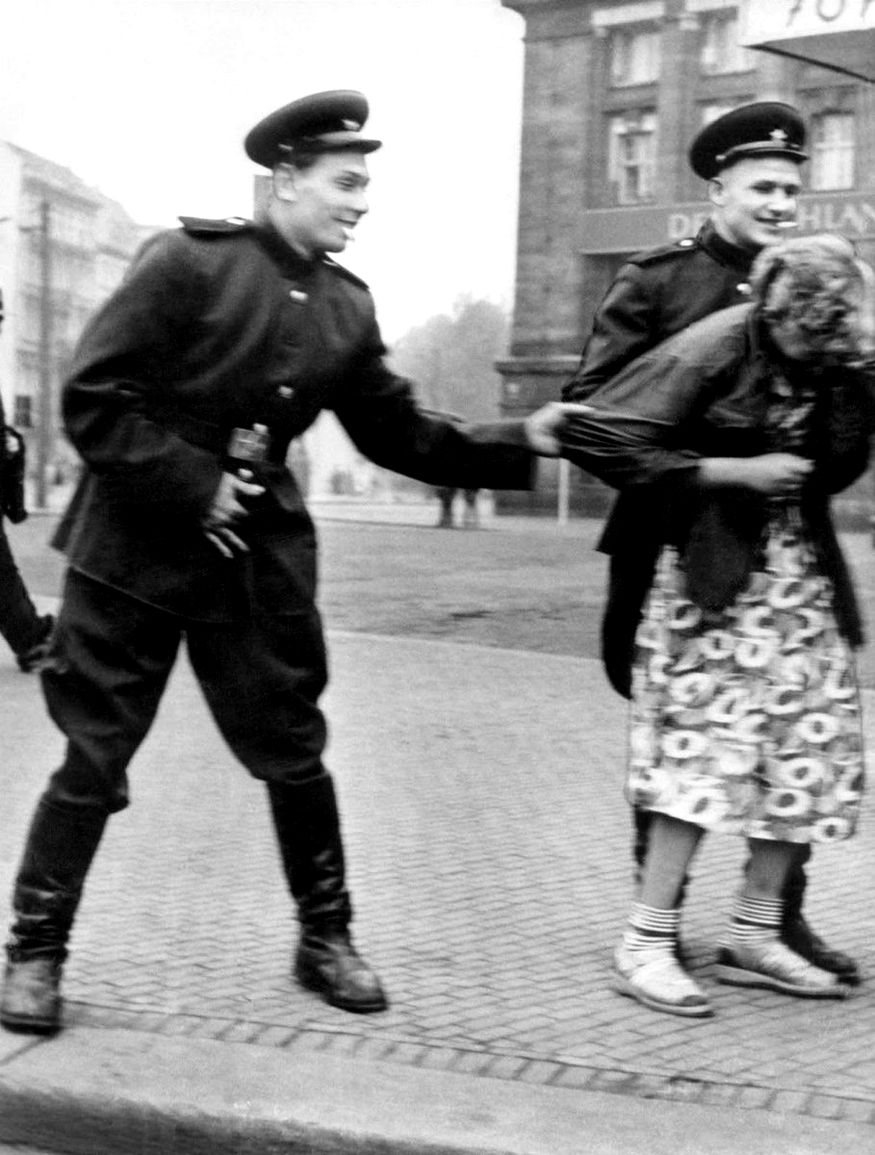
Photo: Red Army soldiers harass German women (1945). (Reddit / imgur.com)
"A Woman in Berlin": An Anonymous Account
Another
wartime diary, written by the fiancée of an absent German
soldier starting April 20, 1945 (ten days before Hitler’s
suicide), shows how women adapted to horrific conditions to survive.
Waiting for the arrival of the Red Army in an air-raid shelter, the neighbors joked: “Better the Russians upstairs than the Yanks overhead”
— better rape than bombing. But when Russian soldiers tried to
drag women out of the cellar, the author used her Russian to complain
to an officer, who simply shrugged: “Things like that happen anyway.”
One soldier blurted out: “You have no idea! What did the Germans do to our women! They took my sister and…”
After
being brutally raped by multiple men, the author realized she needed to
find one "wolf" to avoid being raped by an entire pack of beasts. Her
bed partner became a Soviet officer from Leningrad, with whom she
discussed literature:
“You cannot say that the major is raping me,” the German woman wrote. “Am
I doing it for bacon, butter, sugar, candles, canned meat? To some
extent I am sure that is why. Besides, I like the major. The less he
wants me as a man, the more I like him as a person.”
When published in 1959 under the title A Woman in Berlin,
the author was criticized for her openness as a "defiler of the honor"
of German women. In 2008, the book reached cinemas under the title Anonyma (starring Nina Hoss), encouraging many survivors to share their stories.
First-Hand Testimonies & Scale of the Atrocities
Photo: Illustrative image. (Yupa Watchanakit / shutterstock.com)
Ingeborg Bullert (20 years old in 1945, living in Berlin's Charlottenburg district):
In May 1945, two Soviet soldiers pointed weapons at her, forced her to undress, and raped her. She remained silent for decades: “My mother liked to boast that her daughter had remained untouched.”
Women
between 15 and 55 were required to undergo testing for sexually
transmitted diseases (STDs) to receive food ration cards. Doctors'
waiting rooms were filled with women.
What was the true scale?
-
The most frequently cited figure is 100,000 women in Berlin and 2 million across Germany.
-
Archives from Neukölln (one of Berlin’s districts) show that between June 1945 and June 1946, 995 applications for abortions were approved under exceptional circumstances, despite abortion being illegal under Section 218 of the German Criminal Code.
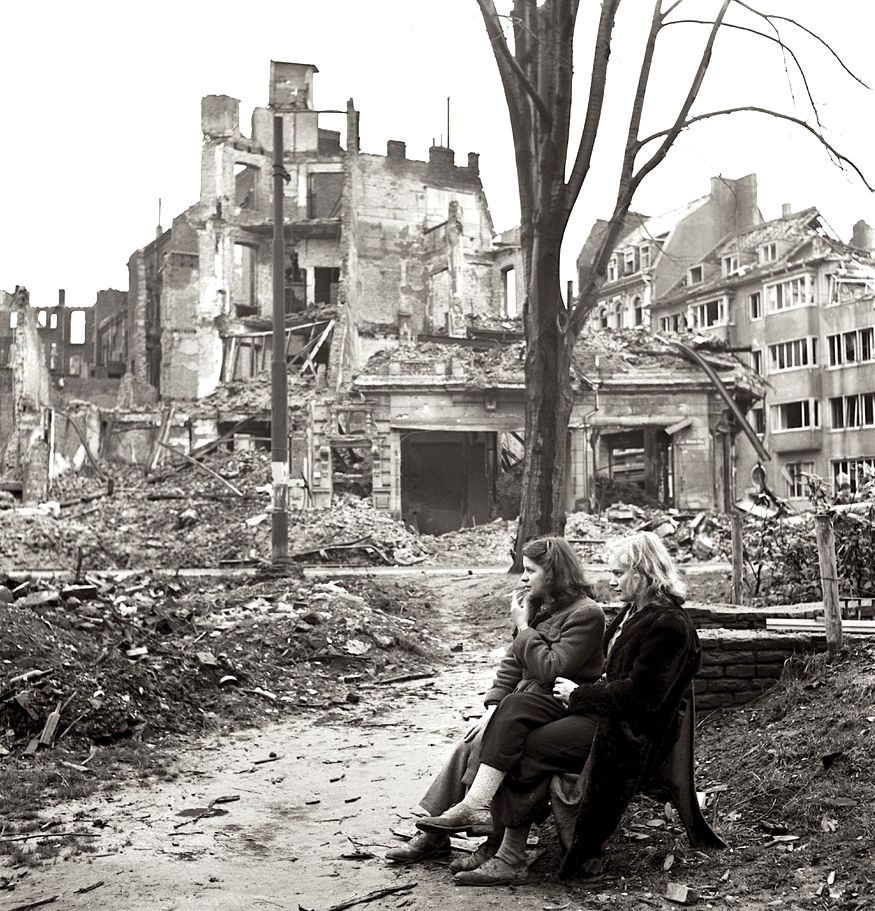
Photo: Two
German women sit on a park bench surrounded by ruined buildings in
Cologne, Germany, 1945. Photograph by Lee Miller (1907–1977).
Historical Suppression & Today
We
may never know the true scale of these crimes as Soviet military
tribunal documents remain classified. Russia has enacted laws punishing
anyone who "denigrates Russia’s achievements" in WWII with fines
or up to five years in prison.
Historian Vera Dubina (Moscow University for the Humanities) notes: “The
Russian media reacted very aggressively. People only want to hear about
our glorious victory in the Great Patriotic War.”
Vitaly Gelfand (son of diary author Vladimir Gelfand, living in Berlin):
“If
people do not want to know the truth, they are deceiving themselves. We
will not be able to move forward until we look back.”
History Repeating in Ukraine
Seventy-seven
years later, history is repeating itself. On February 24, 2022, Russia
invaded Ukraine. In the following months, numerous cases of torture and
sexual violence against Ukrainian civilians were recorded in liberated
territories such as Irpin and Bucha.
The
true scale of sexual crimes committed by the Russian army remains
unknown, both during the invasion of Ukraine and seventy-seven years
ago when Berlin fell.