


 |
| Ежемесячный
литературно-публицистический журнал |
 |
||
| ЛЕХАИМ МАЙ 2010 ИЯР 5770 – 5(217) | ||
| Содержание Архив |
 |
 |
|
 |
 |
|
 |
 |
|
 |
 |
|
 Russian
The title of this article seems to refer to a well-known (or rather, little-known) journal of the same name that appeared for a short time at the beginning of the First World War. The journal told of the exploits of Jews serving as soldiers in the Russian army. At that time there could be no Jewish officers by definition. The Jewish public was concerned that Jewish military valor was underestimated, or even remained completely unknown to the wider public. A quarter of a century passed. During the Second World War roughly the same number of Jews fought in the Red Army as had served in the army of Imperial Russia — more than 400,000 people. Now there were thousands of officers among them, and nearly three hundred generals and admirals. Once again the Jewish public — now the Soviet Jewish public — was concerned that the exploits of Jews on the fronts of the Great Patriotic War remained unknown or little known. Ilya Ehrenburg spoke about this at a plenary meeting of the Jewish Anti-Fascist Committee in March 1943:
For Jewish fighters and commanders to be able to continue calmly doing their duty, we must tell how Jews are fighting at the front. Not for bragging, but in the interests of our common cause — the quickest possible destruction of fascism. To this end we must create a book and in it give a convincing account of Jewish participation in the war. Statistics alone are not enough. We need living stories, living portraits. We need a collection about Jewish heroes, participants in the Great Patriotic War. We must tell the truth, the pure truth. And that will be quite sufficient.1
Let us not argue about what “pure truth” means, especially when war is concerned. We shall merely note that the lion’s share of books and articles devoted to Jewish participation in the war tells of heroes and heroic deeds. The greater part of the publications on the participation of other peoples of the USSR in the war is likewise devoted to heroes and exploits. This is, of course, a necessary and noble undertaking.
War, however, is not only a place where heroic deeds are performed. More than that, war is not only a place where people kill and die. At war people play cards, drink, sing, envy, love, steal. In short, they live. Of course, when speaking about war we cannot avoid thinking about death. Yet let us try to speak about something else — about life at war. For all the enormous literature on the war, this subject — life at war, and especially the life of the “ordinary Ivan” (or Abram) — has received the least attention.2 Only recently have the first studies of the individual at war appeared; there is even now a special field, historical anthropology of war.3 But this is only the beginning.
The crucial question is: where can we obtain information about the life of the “ordinary Abram” (our hypothetical Abram could, of course, have been a sergeant or junior officer) at the front — about his everyday life, moods and feelings? The answer seems obvious: we should turn to personal sources — diaries, letters and memoirs. And that is where the problem begins. Keeping diaries during the war was forbidden; letters were censored. Later, the memory of the war was carefully standardized. A huge number of memoirs — remember the famous “Military Memoirs” series? — were published by military commanders of various ranks. The texts, naturally, were carefully edited and approved, and as a rule were not even written by the generals and marshals themselves but by literary ghostwriters, most of them utterly talentless.
“Military memoirs became something like notes from beyond the grave, composed by general-Chateaubriands,” wrote Zinovy Chernilovsky, a former machine-gun company commander, “while soldiers such as Nekrasov or Bykov concentrated on the artistic vision of war. Where, one wonders, is the company commander who would dare to show this greatest of wars as one of its participants saw it: simply and ordinarily, not as a ‘man with a gun,’ but much more simply and prosaically, in the spirit of the famous French saying: at war as at war...”4
The situation began to change during perestroika, and in post-Soviet Russia a genuine “source revolution” took place. The number of texts about the war began to grow geometrically, and so did their degree of candor. Dozens, if not hundreds, of memoir books appeared. Military-history enthusiasts recorded thousands of veterans’ stories. It turned out that some ordinary soldiers of the great war had kept diaries despite all prohibitions. They had also written memoirs about their wartime experience without expecting publication — for their children, grandchildren, or simply “for the desk,” for history. Sometimes the impulse to write came from the official lies about the war and from the complicity in those lies of officially appointed “veterans.”
“No country has such wonderful veterans as our native and beloved USSR,” wrote Vasil Bykov. They “not only do not help reveal the truth and justice of the war; on the contrary, they are now more concerned than anyone else with hiding the truth, replacing it with propaganda mythology in which they are heroes and nothing more. They have grown into this inflated image and will not allow it to be destroyed.”5
It is characteristic that Bykov’s letter to N. N. Nikulin, author of the remarkable Memoirs of the War, written in the mid-1970s and published in 2008, was dated 1996. For Bykov, the USSR — at least as far as attitudes toward the war were concerned — continued to exist.
Of course, memoirs written forty or even fifty years after the events they describe, just like oral history (interviews), must be treated with great caution. The problem is not merely the weakness of human memory. The people who write and speak later are different people, no longer quite the same as they were during the war. Life experience, the surrounding environment, books read and films seen, decades of propaganda — all this cannot fail to affect what they write or say. Sometimes veterans, without noticing it themselves, insert into their stories episodes from films they have seen; sometimes they argue with what they have read or watched. Without going into the details of source criticism, we may note that these “new memoirs” can certainly be used, but cannot simply be believed at face value.
There are many Jews among the authors of these “new memoirs.” Memoirs of Jewish veterans have appeared not only in the former USSR. Books by individual authors or collections of reminiscences were printed in Vancouver, Tel Aviv, Netanya, Detroit, Palo Alto and other places where veterans who emigrated from the former USSR happened to settle. Hundreds of interviews with Jewish veterans have been recorded. The Blavatnik Archive Foundation in New York specializes in interviewing Jewish veterans living in different countries. By the time this article was written, the archive’s staff had already recorded more than 800 interviews. Many stories by Jewish veterans can also be found on the website I Remember (www.iremember.ru).
Yet the most valuable — and rarest — personal sources about the war remain diaries. A surprisingly large number of the authors of the few surviving diaries are Jews. Statistically, this is quite understandable. According to various estimates, between 430,000 and 450,000 Jews served in the Red Army and Navy during the war. Of these, 142,500 were killed.6 According to the 1939 census, Jews made up 1.78 percent of the population of the USSR. At the same time they constituted 15.5 percent of all Soviet citizens with higher education (in absolute numbers, 171,000; they were second only to Russians, 620,209, and ahead of Ukrainians, 147,645). Another 26.5 percent of Jews had secondary education.7 These categories formed a large part of the Jewish contingent in the Red Army. It is understandable that diaries are usually kept by educated people.
Let us repeat once again: keeping diaries at the front was forbidden. When the commissar of the company commanded by Chernilovsky saw his notebook, he took it away and threw it into the stove: “Remember, company commander, Comrade Stalin ordered that everyone who keeps a diary be shot.” “I do not know whether such an order actually existed, but I never kept a diary again. Like everyone else,” Chernilovsky wrote more than half a century later.8
Yet there were no orders in the USSR that were not violated — in this case, fortunately for historians. Mark Shumelishsky wrote on separate sheets, sometimes without dates. He understood that recording his impressions, and especially his opinions, was dangerous. “A great deal of what one would like to write down and later think through using specific examples cannot be recorded... one cannot write everything down. A note that falls into the hands of a bastard may cause harm.” It was not denunciation that Shumelishsky feared. He worried that the enemy might use his critical notes for its own purposes. Criticism, he believed, was for the future. “This is, so to speak, potential criticism.”9
By contrast, Sergeant, later Lieutenant, Vladimir Gelfand kept a diary quite openly and sometimes read passages from it to his comrades. His immediate superior even advised him to use an ordinary pencil rather than a copying pencil so that the writing would be preserved better.10 On another occasion Gelfand received instructions from the political officer:
The political officer told me how to keep a diary. After that incident when he happened to see various stupid things in my diary, I now write the way the political officer suggested. He says that in the diary one should write only about the work of the company, the course of the fighting, the skillful leadership of the company command, the political officer’s talks with the soldiers, the soldiers’ comments on his talks, and so on. That is exactly how I shall write from now on.11
Two days later an even more remarkable entry appeared:
The political officer slept at my place last night. Today in the daytime too. I have now moved out of my trench onto the mortar platform. This may even be more convenient for me. I am delighted! After all, if it were not for the political officer, who would direct my actions?12
One might think that something had happened to Gelfand’s mind, but the reason for the abrupt change in the content and tone of the diary becomes clear from an entry he made two weeks later:
For the first time here I have written openly, because I have got rid of the political officer who once told me how to keep a diary and what to write in it!13
Needless to say, Gelfand once again began writing down “stupid things” (sometimes without quotation marks), and these are in fact what give this extensive text its greatest value.
Why did Red Army soldiers keep diaries? Most of these “writers” were not without literary ambitions and may have intended to use their diaries when preparing future books. High-school graduates Vladimir Gelfand and Boris Komsky wrote poetry and dreamed of literary careers. “I will not stop my literary work and study under any circumstances; it is my life,” Gelfand wrote on 6 June 1942. Private David Kaufman was a student at the Moscow Institute of Philosophy, Literature and History (IFLI), was preparing to become a professional writer and had already published his first poem in a major literary journal. Kaufman would later write one of the best-known poems about the war, “The Forties, the Fatal Forties...” I do not think I need remind the reader of the literary pseudonym under which the author of those lines became famous.
Engineer Mark Shumelishsky asked himself “again and again”: “Why the hell do I keep trying to make these notes? I am constantly haunted by the idea of gathering material and, in time, writing a good and truthful book that would show the real moods of certain groups of people in the rear during this great time. The book, of course, can be written many years later, when everything has been lived through, thought over and evaluated. But now it is necessary to record many small details.”14
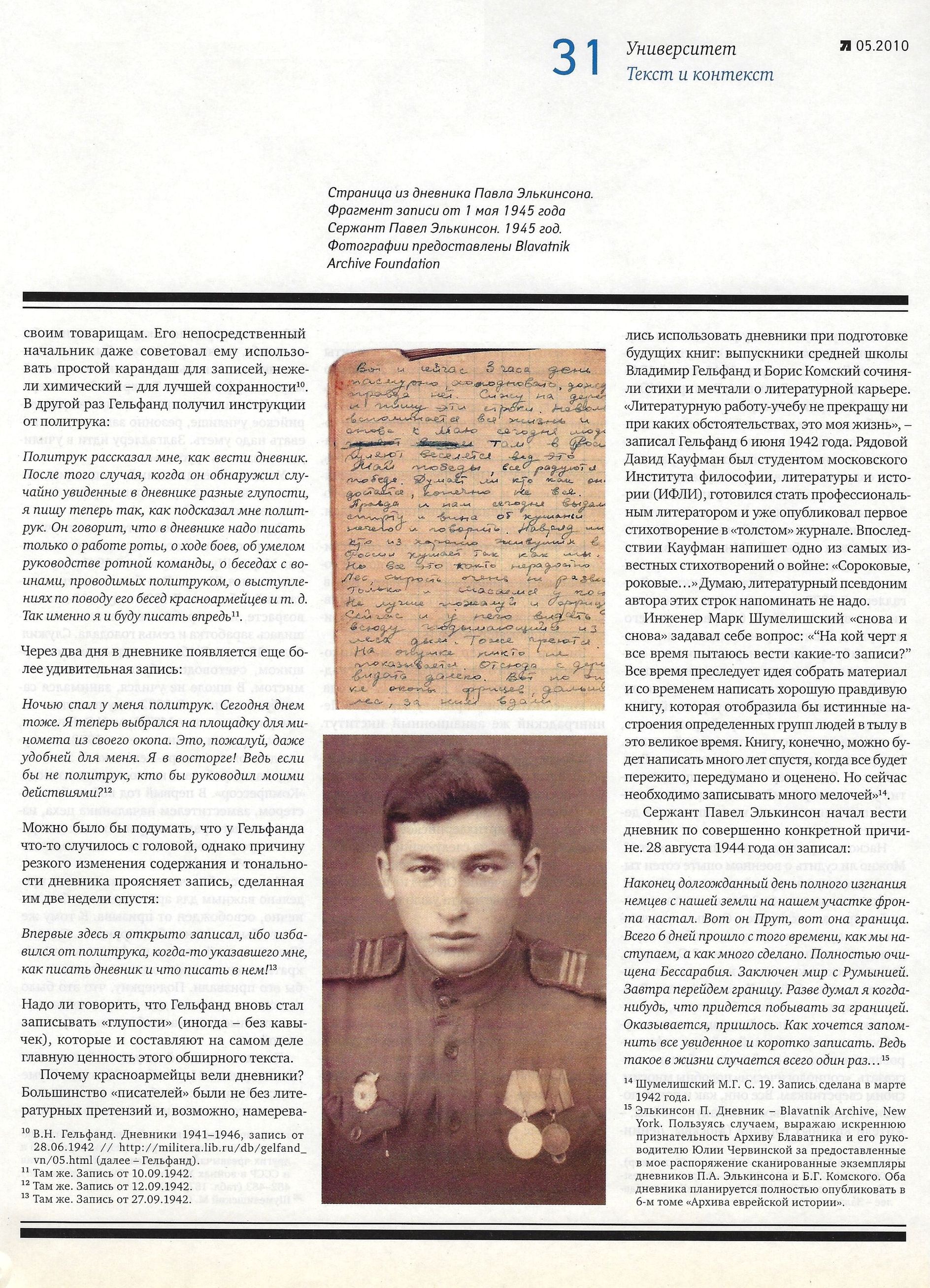
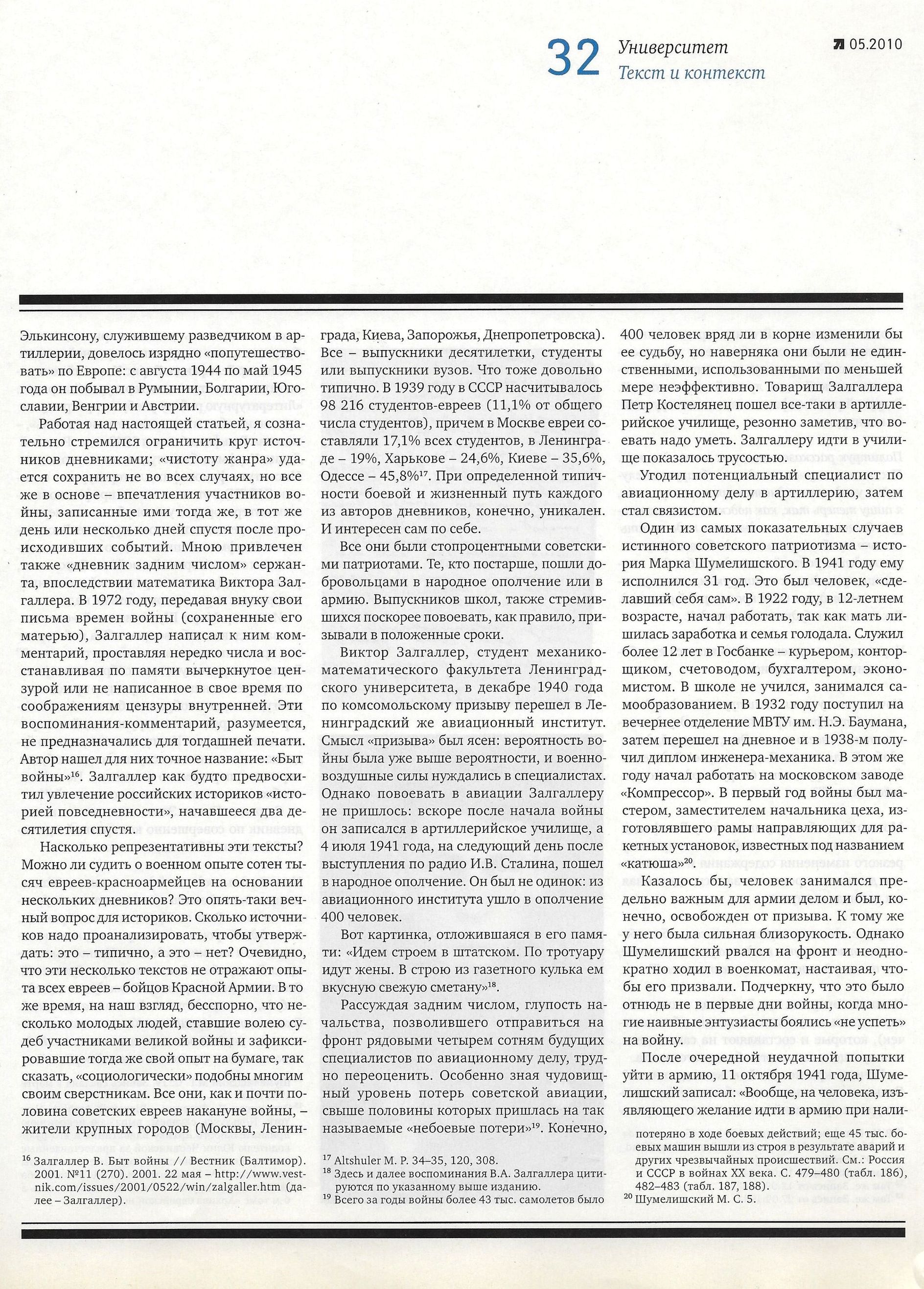
Sergeant Pavel Elkinson began keeping a diary for a very specific reason. On 28 August 1944 he wrote:
At last the long-awaited day of the complete expulsion of the Germans from our land on our sector of the front has come. Here is the Prut, here is the border. Only six days have passed since we began advancing, and how much has been accomplished. Bessarabia has been completely cleared. Peace has been concluded with Romania. Tomorrow we shall cross the border. Did I ever think I would have to go abroad? It turns out I did. How I want to remember everything I have seen and write it down briefly. Such a thing happens only once in a lifetime...15
Elkinson, who served as a reconnaissance man in the artillery, had quite an opportunity to “travel” around Europe: from August 1944 to May 1945 he passed through Romania, Bulgaria, Yugoslavia, Hungary and Austria.
In writing this article I consciously tried to limit my sources to diaries. The “purity of the genre” cannot be maintained in every case, but the basis remains the impressions of participants in the war recorded at the time — on the same day, or several days after the events. I have also used the “retrospective diary” of Sergeant Viktor Zalgaller, who later became a mathematician. In 1972, when he gave his grandson his wartime letters (preserved by his mother), Zalgaller wrote a commentary on them, often adding dates and reconstructing from memory what censorship had crossed out or what he had not written at the time because of self-censorship. These recollections and comments were, of course, not intended for publication in the Soviet press. The author gave them an exact title: The Everyday Life of War.16 Zalgaller seems to have anticipated the fascination of Russian historians with the “history of everyday life” that began two decades later.
How representative are these texts? Can the wartime experience of hundreds of thousands of Jewish Red Army soldiers be judged on the basis of a few diaries? This is once again the historian’s perennial question. How many sources must be analyzed before one can say: this is typical, and this is not? Clearly these few texts do not reflect the experience of all Jews who fought in the Red Army. At the same time, it seems indisputable to us that several young people who, by the will of fate, became participants in the great war and recorded their experience on paper at the time were, so to speak, sociologically similar to many of their peers. Like almost half of Soviet Jews on the eve of the war, all of them were residents of large cities — Moscow, Leningrad, Kiev, Zaporozhye and Dnepropetrovsk. All had completed ten-year secondary school, were university students, or university graduates. That too was fairly typical. In 1939 the USSR had 98,216 Jewish university students (11.1 percent of all students); in Moscow Jews made up 17.1 percent of all students, in Leningrad 19 percent, Kharkov 24.6 percent, Kiev 35.6 percent and Odessa 45.8 percent.17 Despite these typical features, the military and personal path of each diary author was, of course, unique and interesting in its own right.
They were all one-hundred-percent Soviet patriots. Those who were older volunteered for the people’s militia or the army. School graduates who also wanted to get into the fighting as quickly as possible were generally drafted at the proper time.
Viktor Zalgaller, a student in the Faculty of Mechanics and Mathematics at Leningrad University, transferred in December 1940, under a Komsomol recruitment drive, to the Leningrad Aviation Institute. The purpose of the “recruitment” was obvious: war was becoming increasingly likely, and the air force needed specialists. Yet Zalgaller never got to fight in aviation. Soon after the war began he enrolled in an artillery school, and on 4 July 1941, the day after Stalin’s radio address, he joined the people’s militia. He was not alone: 400 people from the Aviation Institute joined the militia.
One image remained fixed in his memory: “We march in formation in civilian clothes. Our wives walk along the sidewalk. In the ranks I eat delicious fresh sour cream from a paper cone made of newspaper.”18
Looking back, it is hard to overstate the stupidity of commanders who allowed four hundred future aviation specialists to go to the front as ordinary soldiers — especially knowing the catastrophic level of Soviet aviation losses, more than half of which were so-called “non-combat losses.”19 Four hundred men would hardly have changed the fate of Soviet aviation fundamentally, of course, but they were surely not the only specialists used, to put it mildly, inefficiently. Zalgaller’s comrade Pyotr Kostelyanets did enter an artillery school, sensibly observing that one had to know how to fight. Zalgaller thought that going to school would be cowardice.
Thus a potential aviation specialist ended up in the artillery and later became a signals soldier.
One of the most revealing examples of genuine Soviet patriotism is the story of Mark Shumelishsky. In 1941 he was thirty-one. He was a self-made man. In 1922, at the age of twelve, he began working because his mother had lost her income and the family was starving. He spent more than twelve years in the State Bank, working as a courier, clerk, bookkeeper, accountant and economist. He did not attend school and educated himself. In 1932 he entered the evening division of the Bauman Moscow Higher Technical School, later transferred to the full-time program and graduated in 1938 as a mechanical engineer. That same year he began work at Moscow’s Compressor Plant. During the first year of the war he was a foreman and deputy shop chief in a workshop producing guide frames for the rocket launchers known as Katyushas.20
One would think that a man doing work of the utmost importance to the army would naturally be exempt from military service. He was also severely nearsighted. Yet Shumelishsky longed to go to the front and repeatedly went to the draft office, insisting that he be called up. I emphasize that this was by no means during the first days of the war, when many naive enthusiasts were afraid they might “miss” it.
After another unsuccessful attempt to enter the army, on 11 October 1941 Shumelishsky wrote: “In general, a person who expresses a desire to join the army when he has the possibility of avoiding it is regarded as an idiot, even at the draft office.”21 In May 1942 Shumelishsky finally got his way and volunteered for the army.
So how did “Abram’s war” differ from “Ivan’s war”? In the main, not at all. Death did not distinguish Greek from Jew — unless, of course, the Jew happened to be taken prisoner.
Having promised to speak about life, I shall begin with death, because life at war always took place under its sign. Death in war came in different forms: rarely heroic, more often ordinary, sometimes stupid — and always repulsive. It possessed none of the “aesthetics” that can so often be seen in modern war films.
“Our first positions,” Viktor Zalgaller recalled of 14 July 1941. “Nearby there is a foul smell. Flies circle. The nose and lips of a badly buried corpse stick out of the earth. Both nose and lips are black. It is hot. Shelling. Something flew in and is swinging on a branch — a piece of human intestine.”
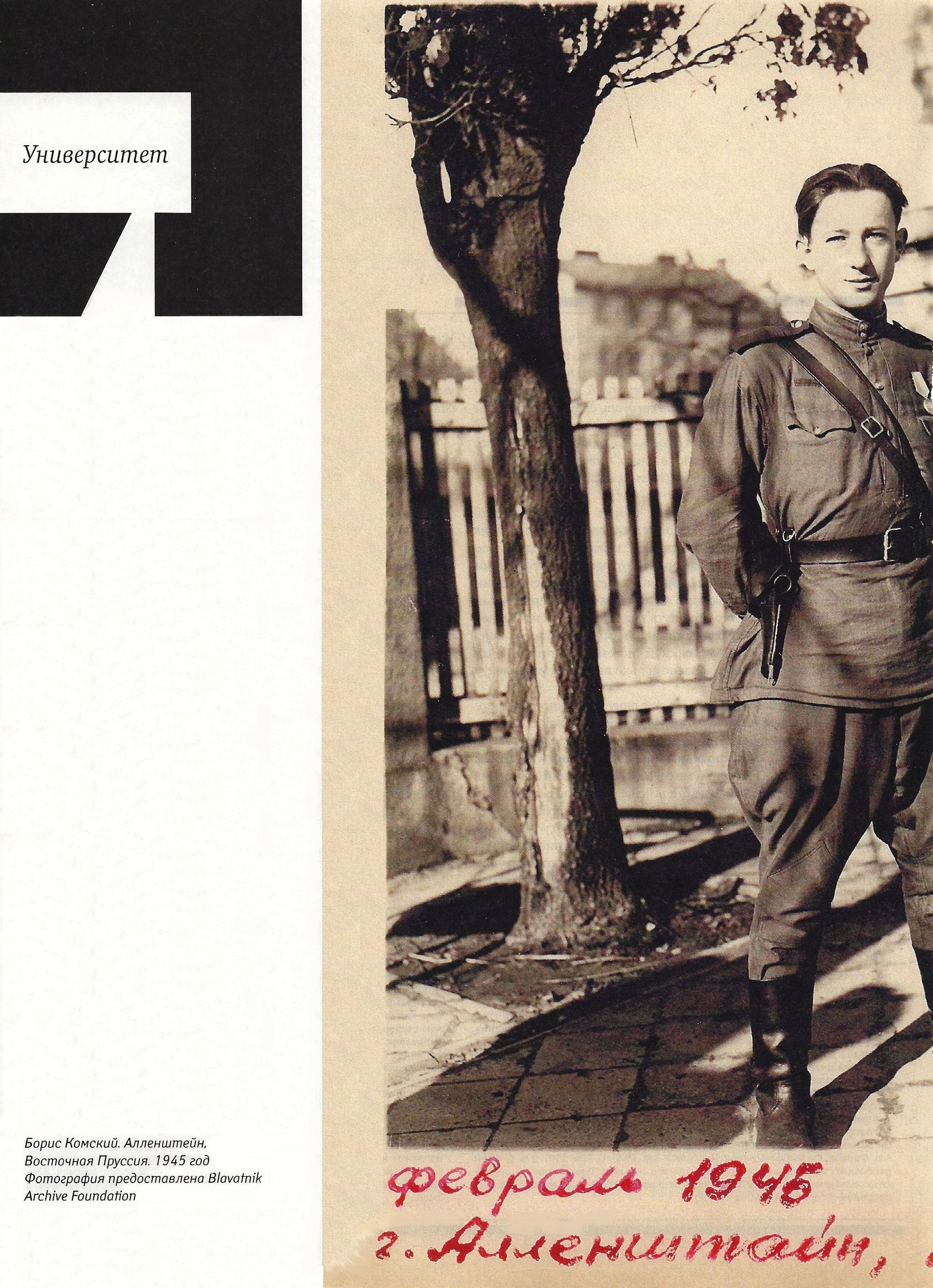
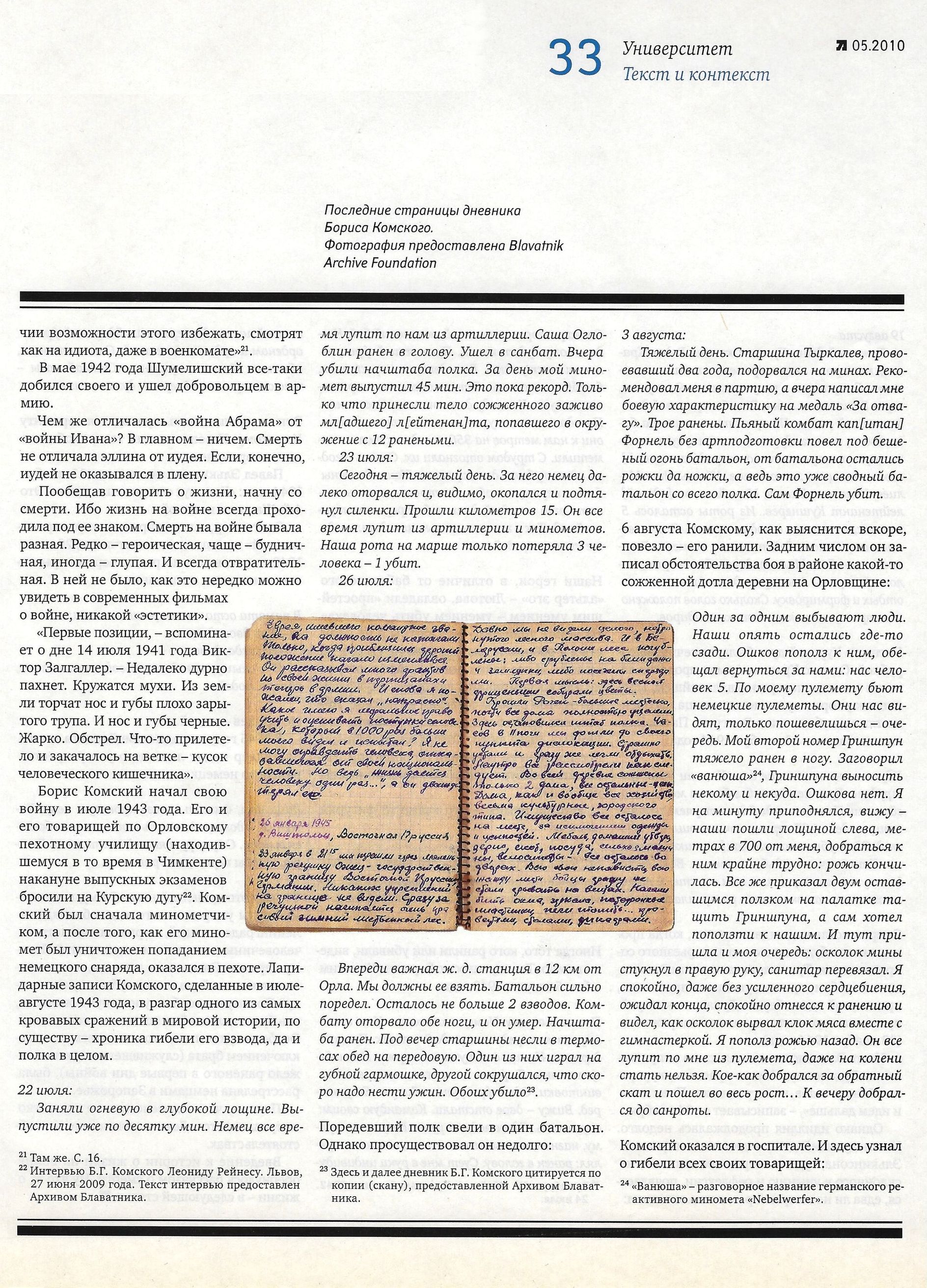
Boris Komsky began his war in July 1943. On the eve of their final examinations, he and his fellow cadets from the Oryol Infantry School (which at the time was located in Chimkent) were thrown into the Battle of Kursk.22 Komsky began as a mortar man; after his mortar was destroyed by a direct hit from a German shell, he ended up in the infantry. Komsky’s laconic entries, written in July and August 1943 in the midst of one of the bloodiest battles in world history, are essentially a chronicle of the destruction of his platoon — and, indeed, of the regiment as a whole.
We took a firing position in a deep hollow. We have already fired about ten mortar rounds each. The German keeps pounding us with artillery. Sasha Ogloblin was wounded in the head. He went to the medical battalion. Yesterday the regiment chief of staff was killed. During the day my mortar fired 45 rounds. That is the record so far. They have just brought in the body of a junior lieutenant who was burned alive after being surrounded together with twelve wounded men.
Today was a hard day. The German has pulled far away, apparently dug in and brought up reinforcements. We covered about fifteen kilometers. He keeps pounding us with artillery and mortars. Our company lost three men just on the march — one killed.
Ahead is an important railway station twelve kilometers from Oryol. We have to take it. The battalion has thinned badly. No more than two platoons remain. The battalion commander had both legs torn off and died. The chief of staff was wounded. Toward evening the company sergeants were carrying dinner to the front line in thermos containers. One of them was playing a harmonica, while the other complained that soon they would have to carry supper. Both were killed.23
The depleted regiment was consolidated into a single battalion. It did not last long.
A hard day. Sergeant Major Tyrkalev, who had fought for two years, was blown up on mines. He had recommended me for Party membership, and yesterday wrote my combat citation for the Medal “For Courage.” Three men wounded. The drunken battalion commander, Captain Fornel, led the battalion under murderous fire without artillery preparation. Almost nothing was left of the battalion, and this was already a composite battalion formed from the entire regiment. Fornel himself was killed.
On 6 August Komsky, as it soon turned out, was lucky: he was wounded. Later he reconstructed the circumstances of the battle near some village in the Oryol region that had been burned to the ground:
Men are dropping out one after another. Our troops are again somewhere behind. Oshkov crawled toward them and promised to return for us; there are about five of us. German machine guns are firing at my machine gun. They can see us: the slightest movement and there is a burst. My number two, Grinshpun, is badly wounded in the leg. “Vanyusha”24 has started talking; there is no one to carry Grinshpun out and nowhere to take him. Oshkov is gone. I raise myself for a moment and see our men moving along a hollow on the left, about 700 meters away. It is extremely difficult to reach them: the rye field has ended. Still, I order the two men who remain to drag Grinshpun on a shelter-half, crawling, while I intend to crawl toward our troops. And then my turn comes: a fragment of a mortar bomb hits my right arm; the medic bandages it. Calmly, without even an increased heartbeat, I wait for the end. I take the wound calmly and see how the fragment tore away a piece of flesh together with my tunic. I crawl backward through the rye. He keeps firing at me with the machine gun; I cannot even get onto my knees. Somehow I reach the reverse slope and then walk upright... By evening I reach the medical company.
Komsky found himself in hospital. There he learned that all his comrades had been killed.
A hard day. Godik Kravets came to see me; he too has been brought to our hospital. He was wounded in the leg by a fragment on 9 August, three days after me. That was a fatal day for our company. On the whim of the battalion chief of staff, a complete fool, they began to “improve” the positions and ran into German mortar barrage fire. Yasha Maliev, Islamov, Oshkov, Mikhailov and Junior Lieutenant Kushnerev were killed. Five men are left from the company; from our platoon — no one. The news had a terrible effect on me. Most of all Yasha Maliev, a dear comrade, a golden fellow. In the evening the divisions were withdrawn for rest and reorganization. How many lives have been thrown away because of the rigidity of commanders.
The Battle of Kursk was, of course, a meat grinder. But the Red Army continued to suffer heavy losses afterward. The enemy fought stubbornly to the end. The fighting was especially hard in Hungary. Pavel Elkinson wrote on 11 November 1944:
Very fierce fighting is going on. Every day it gets harder. The enemy does not give up a single meter of his land without a fight. Almost every day we lose our best men. On 4 November we were the first to enter the town of Cegléd at night. Our chief of reconnaissance was killed there. What a person’s fate means! Only one minute before, I had been standing together with him. I had barely stepped away when a mortar bomb exploded beside him.
Death could also be waiting when the enemy seemed to be offering no serious resistance. Three men from Elkinson’s unit were killed when they touched a wire stretched along the bank of the Danube through which the enemy had sent high-voltage current (23 November 1944).
Elkinson’s unit moved toward Budapest. “A beautiful resort area. Many gardens and vineyards. We drink wine and move on,” he wrote on 24 November. The idyll did not last long. The next day, in the diary of Sergeant Elkinson — who, judging by his terse entries, was not given to despondency or introspection — a note of despair appears, perhaps for the first time:
Again a heavy, savage battle has broken out. When will this end? The damned Fritz does not want to retreat. Aircraft bomb us all day without stopping. It is not a very pleasant business. Toward evening tanks came at us. The weather was bad and foggy, so they got to within about 350 meters before we even noticed them. With difficulty we drove them off. Again today one man was killed and two wounded. What kind of nerves must one have to see and experience this every day, without interruption, for the third year? One thought keeps going through my head involuntarily: when will it be your turn?
Our protagonists, unlike Lyutov, Babel’s alter ego, mastered “the simplest skill — the ability to kill a man.” In war, killing is somehow not murder but work. Besides, if you do not kill him, he will kill you. And yet... sometimes, when reading diaries or memoirs, one senses that the soldiers were uneasy about this work. More precisely, that they could not entirely forget that Germans were people too, although both wartime experience and propagandists told them otherwise. Recall Ehrenburg’s phrase, “We understood: the Germans are not people.”25
Sometimes Germans were merely little figures in the distance:
Two Germans appeared brazenly on the hill with a small mortar and are trying to fire at us. But we shoot them down with a volley from our carbines.
(Zalgaller, 4 September 1941.)
At other times a soldier saw the face of the man he wounded or killed. This happened to Boris Komsky in the battle of 5 August 1943:
We went on the attack. The Germans ran. Our platoon broke ahead — eight men in the platoon. We passed through the village. The Germans retreat through the rye. Our men run after them. I dropped to one knee and fired my rifle. One Fritz fell. I rejoice. I run forward. I see two have lagged behind. I command my men: surround them. One raises his hands. I run to the second and catch him. It turns out to be the one I shot; he is wounded in the head. He pushes his individual dressing packet into my hands. I did not bandage him. A big healthy Fritz with a decoration and ribbon. I took his submachine gun and searched him. Someone shouts, “Take his watch — what are you staring at?” Right, I think; I took it.
That watch would later prove very useful to Sergeant Komsky — and not for telling the time.
Pavel Elkinson wrote on 11 November 1944: “Got another one today. That makes four. No pity at all.”
Zalgaller, who had calmly “shot down” German mortar men, on 20 July 1942 heard the radio communications of Soviet tank crews — and their breathing.
The terrible words remained in my memory:
— Two of them are surrendering here.
— No time. Run them over.
And I hear the tank driver breathing as he kills people.
Not Germans — people.
In 1945, in a suburb of Danzig, the same Zalgaller saw a wounded German soldier lying at a crossroads:
There is no face; he breathes through bloody foam. It seems there are people in the house nearby, but they are afraid to come out. I knock with the grip of my pistol. I tell them to bandage the wounded man.
What was that wounded German to him — to a man who had seen the corpses of people who died of hunger in besieged Leningrad, and people frying cutlets made of human flesh without even hiding it? Why did Sergeant Elkinson record that he felt no pity for the German he had killed? Why did he mention pity at all, as though he should nevertheless have felt it? Especially given that his entire family, except for his brother (who served in the army and was badly wounded in the first days of the war), had been shot by the Germans in Zaporozhye.
It seems that humanity is not so easily eradicated — even in inhuman circumstances.
This introduction to a history of life at war has turned into a story about death. So be it. We shall speak about life in the next article.
Notes
1 Eynikayt, 15 March 1943. Quoted in F. D. Sverdlov, Encyclopedia of Jewish Heroism, Moscow, 2002, p. 10.
2 One of the few substantial books on this subject was written by the British historian Catherine Merridale: Ivan’s War: Life and Death in the Red Army, 1939-1945. New York, 2006.
3 See Military-Historical Anthropology. Yearbook 2002: Subject, Tasks and Prospects for Development. Moscow, 2002.
4 Z. M. Chernilovsky, Notes of a Company Commander. Moscow, 2002, p. 83.
5 Vasil Bykov to N. N. Nikulin, 25 March 1996, in N. N. Nikulin, Memoirs of the War. St. Petersburg, 2008, p. 236.
6 Russia and the USSR in the Wars of the Twentieth Century: Losses of the Armed Forces, ed. G. F. Krivosheev. Moscow, 2001, table 121; F. D. Sverdlov, pp. 11-12. Total Jewish population losses (including those living in territories annexed to the USSR in 1939-1940) amounted to 2.733 million people, or 55 percent of the entire Jewish population of the USSR in June 1941. This was more than 10 percent of all human losses of the USSR during the Great Patriotic War. See M. Kupovetsky, “Human Losses of the Jewish Population within the Postwar Borders of the USSR,” Bulletin of the Jewish University in Moscow, 1995, no. 2 (9), p. 152, table 9.
7 M. Altshuler, Soviet Jewry on the Eve of the Holocaust: A Social and Demographic Profile. Jerusalem, 1998, p. 125; Y. Slezkine, The Jewish Century. Moscow, 2005, p. 288.
8 Chernilovsky, p. 16.
9 M. G. Shumelishsky, A Soldier’s Diary. Moscow, 2000, p. 37.
10 V. N. Gelfand, Diaries 1941-1946, entry of 28 June 1942, http://militera.lib.ru/db/gelfand_vn/05.html (hereafter Gelfand).
11 Gelfand, entry of 10 September 1942.
12 Ibid., entry of 12 September 1942.
13 Ibid., entry of 27 September 1942.
14 Shumelishsky, p. 19. Entry made in March 1942.
15 P. Elkinson, diary, Blavatnik Archive, New York. I take this opportunity to express my sincere gratitude to the Blavatnik Archive and its director, Yulia Chervinskaya, for making available to me scanned copies of the diaries of P. A. Elkinson and B. G. Komsky. Both diaries were planned for full publication in volume 6 of the Archive of Jewish History.
16 V. Zalgaller, “The Everyday Life of War,” Vestnik (Baltimore), 2001, no. 11 (270), 22 May 2001, http://www.vestnik.com/issues/2001/0522/win/zalgaller.htm (hereafter Zalgaller).
17 Altshuler, pp. 34-35, 120, 308.
18 Here and below V. A. Zalgaller’s recollections are quoted from the publication cited above.
19 During the war more than 43,000 aircraft were lost in combat operations; another 45,000 combat aircraft were lost through accidents and other emergencies. See Russia and the USSR in the Wars of the Twentieth Century, pp. 479-480 (table 186), 482-483 (tables 187, 188).
20 Shumelishsky, p. 5.
21 Ibid., p. 16.
22 Interview with B. G. Komsky by Leonid Reynes, Lviv, 27 June 2009. Interview text supplied by the Blavatnik Archive.
23 Here and below B. G. Komsky’s diary is quoted from a copy (scan) supplied by the Blavatnik Archive.
24 “Vanyusha” was the colloquial Soviet name for the German Nebelwerfer rocket mortar.
25 Ilya Ehrenburg, “Kill,” Krasnaya Zvezda, 24 July 1942.
© 2010 Лехаим

