


 |
 |
 |
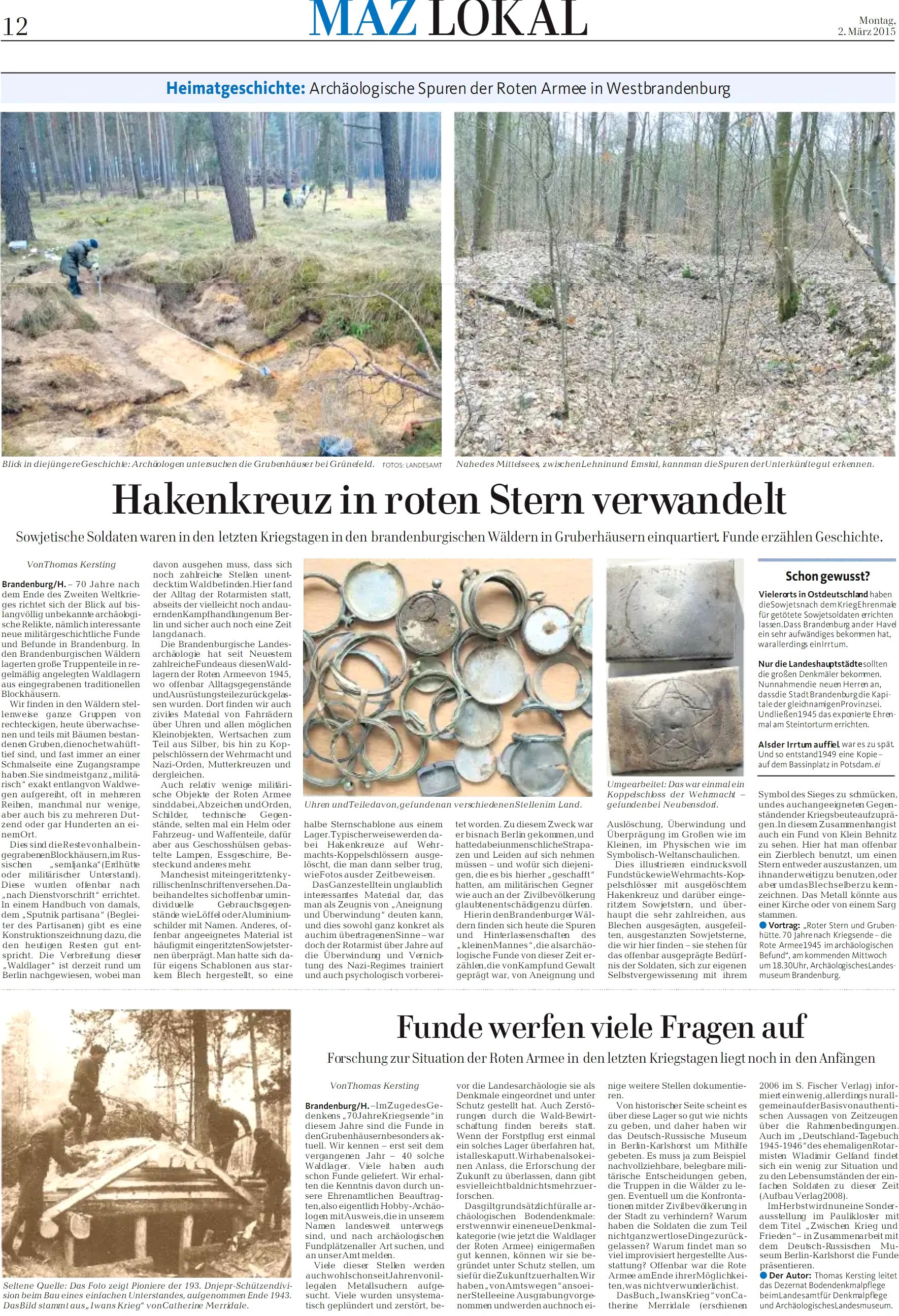
In
den Brandenburgischen Wäldern lagerten große
Truppenteile in
regelmäßig angelegten Waldlagern aus eingegrabenen
traditionellen Blockhäusern.
Wir finden in den Wäldern stellenweise ganze Gruppen von
rechteckigen, heute überwachsenen und z.T. mit Bäumen
bestandenen Gruben, die noch etwa hüfttief sind, und fast
immer an
einer Schmalseite eine Zugangsrampe haben. Sie sind meist ganz
„militärisch“ exakt entlang von Waldwegen
aufgereiht,
oft in mehreren Reihen, manchmal nur wenige, aber auch bis zu mehreren
Dutzend oder gar Hunderten an einem Ort.
Dabei ist ein möglicherweise zu vermutender Zusammenhang
dieser
Eingrabungen mit (älteren und jüngeren)
Truppenübungsplätzen – an denen Brandenburg
ja reich
ist – auszuschließen; sie liegen alle
außerhalb der
bekannten Orte, und das umgebende Waldgebiet ist in allen
Fällen
völlig ungestört und unberührt.
Diese Eingrabungen sind die Reste von halb eingegrabenen
Blockhäusern, im Russischen sog.
"semljanka"(Erdhütte, oder
allgemein milit. Unterstand). Diese wurden offenbar nach "nach
Dienstvorschrift" errichtet; in einem militärischen Handbuch
von
damals, dem "Sputnik partisana" („Begleiter des
Partisanen“) gibt es eine Konstruktionszeichnung dazu, die
den
heutigen Resten gut entspricht. Die Verbreitung dieser
„Waldlager“ ist derzeit fast überall rund
um Berlin
nachgewiesen, wobei man davon ausgehen muss, dass sich noch zahlreiche
Stellen unentdeckt im Wald befinden. Hier in den Brandenburger
Wäldern finden sich heute die Spuren und Hinterlassenschaften
des
„kleinen Mannes“, die als archäologische
Funde von
dieser Zeit erzählen, die von Kampf und Gewalt
geprägt war,
von Aneignung und Auslöschung, Überwindung und
Überprägung im Großen wie im Kleinen, im
physischen wie
im symbolisch-weltanschaulichen.
Dies illustrieren eindrucksvoll Fundstücke wie
Wehrmachts-Koppelschlösser mit ausgelöschtem
Hakenkreuz und
darüber eingeritztem Sowjetstern, und überhaupt die
sehr
zahlreichen, aus Blechen ausgesägten, ausgefeilten,
ausgestanzten
Sowjetsterne, die wir hier finden – sie stehen für
das
offenbar ausgeprägte Bedürfnis der Soldaten, sich zur
eigenen
Selbstvergewisserung mit ihrem Symbol des Sieges zu schmücken,
und
es auch angeeigneten Gegenständen der Kriegsbeute
aufzuprägen.
Im Herbst 2015 wird nun eine Sonderausstellung im Arch. Landesmuseum im
Paulikloster mit dem Titel "Zwischen Krieg und Frieden" - in
Zusammenarbeit mit dem Deutsch-Russischen Museum Berlin-Karlshorst die
Funde präsentieren.
Brandenburg/H.
– Im Zuge des Gedenkens „70 Jahre
Kriegsende“
in diesem Jahre sind die Funde in den Grubenhäusern besonders
aktuell. Wir
kennen – erst seit dem vergangenen Jahr – 40 solche
Waldlager. Viele haben auch
schon Funde geliefert. Wir erhalten die Kenntnis davon durch unsere
Ehrenamtlichen Beauftragten, also eigentlich Hobby-Archäologen
mit Ausweis, die
in unserem Namen landesweit unterwegs sind, und nach
archäologischen Fundplätzen
aller Art suchen, und an unser Amt melden.
Viele dieser Stellen werden auch wohl schon seit Jahren von illegalen Metallsuchern aufgesucht. Viele wurden unsystematisch geplündert und zerstört, be- vor die Landesarchäologie sie als Denkmale eingeordnet und unter Schutz gestellt hat. Auch Zerstörungen durch die Wald-Bewirtschaftung finden bereits statt. Wenn der Forstpflug erst einmal ein solches Lager überfahren hat, ist alles kaputt. Wir haben also keinen Anlass, die Erforschung der Zukunft zu überlassen, dann gibt es vielleicht bald nichts mehr zu erforschen.
Das gilt grundsätzlich für alle archäologischen Bodendenkmale: erst wenn wir eine neue Denkmalkategorie (wie jetzt die Waldlager der Roten Armee) einigermaßen gut kennen, können wir sie begründet unter Schutz stellen, um sie für die Zukunft zu erhalten. Wir haben „von Amts wegen“ an so einer Stelle eine Ausgrabung vorgenommen und werden auch noch ei- nige weitere Stellen dokumentieren.
Von historischer Seite scheint es über diese Lager so gut wie nichts zu geben, und daher haben wir das Deutsch-Russische Museum in Berlin-Karlshorst um Mithilfe gebeten. Es muss ja zum Beispiel nachvollziehbare, belegbare militärische Entscheidungen geben, die Truppen in die Wälder zu legen. Eventuell um die Konfrontationen mit der Zivilbevölkerung in der Stadt zu verhindern? Warum haben die Soldaten die zum Teil nicht ganz wertlose Dinge zurückgelassen? Warum findet man so viel improvisiert hergestellte Ausstattung? Offenbar war die Rote Armee am Ende ihrer Möglichkeiten, was nicht verwunderlich ist.
Das Buch „Iwans Krieg“ von Catherine Merridale (erschienen 2006 im S. Fischer Verlag) informiert ein wenig, allerdings nur allgemein auf der Basis von authentischen Aussagen von Zeitzeugen über die Rahmenbedingungen. Auch im „Deutschland-Tagebuch 1945-1946“ des ehemaligen Rotarmisten Wladimir Gelfand findet sich ein wenig zur Situation und zu den Lebensumständen der einfachen Soldaten zu dieser Zeit (Aufbau Verlag 2008).
Im Herbst wird nun eine Sonderausstellung im Paulikloster mit dem Titel „Zwischen Krieg und Frieden“ – in Zusammenarbeit mit dem Deutsch-Russischen Museum Berlin-Karlshorst die Funde präsentieren.
 |
Archäologisches Landesmuseum Brandenburg "Zwischen Krieg und Frieden - Waldlager der Roten Armee in Brandenburg 1945" Sonderausstellung 22. April – 24. Juli 2016 |
Academia © 2016
В лесах Бранденбурга в годы войны располагались крупные войсковые подразделения, широко применявшие укоренённые лагеря с бревенчатыми домами. Сегодня в этих лесах можно найти следы — целые группы прямоугольных, ныне заросших и частично засаженных деревьями ям. Эти ямы, глубиной примерно до пояса взрослого человека, почти всегда имеют аппарель (наклонный вход) с одной из узких сторон. Расположены они, как правило, в строгом порядке вдоль лесных дорожек — часто в несколько рядов, иногда насчитываются лишь немногие, но бывают места, где таких ям десятки, а то и сотни.
При этом можно исключить связь с известными полигонами и районами тренировок — все эти следы расположены вне известных полигонных зон, а окружающие леса остались нетронутыми.
Эти ямы — остатки полуземлянных деревянных построек, которые в России назывались "землянками" (semlyanka) или вообще военными укрытиями. Судя по всему, их строили для размещения связных служб. В военных руководствах того времени, например в пособии "Спутник партизана", приводились чертежи таких сооружений — и они полностью соответствуют тому, что мы находим сегодня.
Распространение подобных "лесных лагерей" сегодня почти повсеместно фиксируется в окрестностях Берлина. Можно предположить, что в лесах до сих пор осталось множество незамеченных подобных мест.
В этих лесах Бранденбурга можно найти следы "маленького человека", своего рода археологические находки военного времени, которое было отмечено борьбой и насилием, присвоением и разрушением, преодолением и принудительным навязыванием — как в физическом, так и в символическом и идеологическом смысле.
Это особенно ярко видно по находкам вроде пряжек от ремней вермахта, на которых затёрта свастика и вырезана советская звезда. Также находят множество звёзд, вырезанных вручную из листового металла, отполированных и пробитых. Эти находки говорят о сильном желании самих солдат увековечить свою победу, украсить свой быт символами новой власти и одновременно придать захваченным трофеям новый смысл.
Осенью 2015 года в монастыре Паули в Ландесмузее в рамках специальной выставки "Между войной и миром" были впервые широко представлены находки этих лесных лагерей. Выставка была организована в сотрудничестве с Германо-российским музеем Берлин-Карлсхорст.
В рамках празднования "70 лет окончания войны" в этом году находки советских землянок в лесах Бранденбурга оказались особенно своевременными. Только за последний год было зафиксировано около сорока таких лагерей. Их открытие стало возможным благодаря работе добровольных помощников археологической службы — любителей-археологов с официальными удостоверениями, которые исследуют территорию, находят археологические памятники и сообщают о них.
Многие из этих мест уже давно стали объектами внимания нелегальных искателей металла. Разграбление и уничтожение памятников происходило ещё до того, как они были официально признаны археологическим наследием и взяты под охрану. Дополнительный урон наносят работы в лесном хозяйстве: если лесной плуг проходит через такие участки, всё оказывается разрушено. Поэтому задача изучения этих памятников сегодня особенно срочна — вскоре может просто не остаться ничего для будущих исследований.
Эта проблема касается всех археологических объектов. Только тогда, когда новая категория памятников будет достаточно изучена, их можно будет поставить под официальную охрану для будущих поколений. Уже сейчас были проведены раскопки на одном из таких мест и задокументированы ещё несколько лагерей.
С исторической точки зрения информации о существовании этих лесных лагерей почти нет. Поэтому за консультацией обратились в Немецко-российский музей в Берлине-Карлсхорсте. Однако даже там не удалось найти подтверждённых данных о приказах Красной армии размещать войска в лесах. Возможно, такие меры были предприняты, чтобы избежать контактов с немецким гражданским населением. Но остаются вопросы: почему солдаты покидали лагерь, оставляя вполне пригодные вещи? Почему находят так много самодельного снаряжения? Очевидно, Красная армия находилась тогда на пределе своих возможностей — что вполне объяснимо условиями последних месяцев войны.
Небольшие упоминания о жизни советских солдат можно найти в книге "Иван. Солдатская война" Екатерины Мерридейл (Fischer Verlag, 2006), а также в «Дневнике Германии 1945–1946» Владимира Гельфанда (Aufbau Verlag, 2008). Эти источники помогают хотя бы частично восстановить картину быта и настроений советских военнослужащих в те месяцы.
Осенью в монастыре Святого Павла будет открыта специальная выставка «Между войной и миром», подготовленная в сотрудничестве с Немецко-российским музеем Берлин-Карлсхорст. На ней будут представлены находки из лесных лагерей, ставшие молчаливыми свидетелями последней фазы войны в Бранденбурге.
|
Archäologisches Landesmuseum Brandenburg "Zwischen Krieg und Frieden - Waldlager der Roten Armee in Brandenburg 1945" Sonderausstellung 22. April – 24. Juli 2016 |
 German
“Archaeological Traces of the Red Army in Brandenburg”
2 March 2015
Abstract
In the forests of Brandenburg, large troop formations were quartered in regularly laid-out woodland camps consisting of traditional log huts dug into the ground.
In places we find whole groups of rectangular pits in the woods, now overgrown and partly covered with trees. They are still roughly waist-deep and almost always have an access ramp at one of the narrow ends. They are usually laid out with almost “military” precision along forest tracks, often in several rows—sometimes only a few, but in other places several dozen or even hundreds at a single site.
A possible connection between these dugouts and older or newer military training grounds—of which Brandenburg has many—can be ruled out. They all lie outside the known training areas, and the surrounding forest is in every case entirely undisturbed.
These depressions are the remains of semi-subterranean log huts, known in Russian as a zemlyanka (an earth hut, or more generally a military dugout). They were apparently built according to service regulations. A military manual of the period, the Sputnik partizana (“The Partisan’s Companion”), contains a construction drawing that corresponds closely to the remains found today. Such “forest camps” have now been documented almost everywhere around Berlin, and it must be assumed that numerous sites remain undiscovered in the woods.
Here in the Brandenburg forests we can still find the traces and belongings of the “ordinary man.” As archaeological finds they tell of a period marked by fighting and violence, appropriation and erasure, overcoming and superimposition—on both a large and a small scale, physically as well as symbolically and ideologically.
This is vividly illustrated by finds such as Wehrmacht belt buckles on which the swastika was erased and a Soviet star scratched over it, and by the very large number of Soviet stars sawn, filed or punched out of sheet metal. They point to the soldiers’ pronounced need to reassure themselves of their identity by wearing their symbol of victory and by imprinting that symbol on objects appropriated as spoils of war.
In autumn 2015, a special exhibition at the Archaeological State Museum in the Paulikloster, entitled “Between War and Peace,” was to present the finds in cooperation with the German-Russian Museum Berlin-Karlshorst.
Thomas Kersting
Finds Raise Many Questions
Research into the situation of the Red Army in the final days of the war is still in its infancy.
By Thomas Kersting
Brandenburg an der Havel. As part of this year’s commemoration of “70 Years Since the End of the War,” the finds from the pit houses are particularly topical. Only since last year have we known of forty such forest camps. Many of them have already yielded finds. We learn about them through our volunteer representatives—essentially licensed amateur archaeologists who travel throughout the state on our behalf, looking for archaeological sites of every kind and reporting them to our office.
Many of these places have apparently been visited for years by illegal metal detectorists. A number were unsystematically looted and destroyed before the state archaeological service could classify them as monuments and place them under protection. Damage is also already being caused by forestry. Once a forestry plough has driven across such a camp, everything is destroyed. We therefore have no reason to leave research to the future: there may soon be nothing left to investigate.
This applies in principle to all archaeological ground monuments. Only when we know a new category of monument reasonably well—as is now the case with the Red Army forest camps—can we justify placing it under protection and preserve it for the future. Acting in our official capacity, we have excavated one such site and will document several others.
From the historical side, there appears to be virtually nothing about these camps, so we asked the German-Russian Museum in Berlin-Karlshorst for assistance. There must, for example, have been traceable and documentable military decisions to quarter troops in the forests. Was this perhaps intended to prevent confrontations with the civilian population in the towns? Why did the soldiers leave behind objects, some of them not entirely without value? Why do we find so much improvised equipment? Apparently the Red Army had reached the limits of what it could supply, which is hardly surprising.
Catherine Merridale’s book Ivan’s War (published by S. Fischer in 2006) provides some information, although only in general terms, drawing on authentic testimony about the conditions at the time. The former Red Army soldier Vladimir Gelfand’s Germany Diary 1945–1946 (Aufbau Verlag, 2008) also contains some information about the situation and living conditions of ordinary soldiers in this period.
In autumn, a special exhibition in the Paulikloster entitled “Between War and Peace,” organized together with the German-Russian Museum Berlin-Karlshorst, was to present the finds.
© Brandenburg State Office
for Monument Preservation and Archaeological State Museum
Wünsdorfer Platz 4–5, D-15806 Zossen (Wünsdorf district)
Dr. Thomas Kersting — thomas.kersting@bldam-brandenburg.de www.denkmalpflege.brandenburg.de
© Verlagsgesellschaft Madsack GmbH & Co. KG
Academia © 2016
Brandenburg an der Havel. Seventy years after the end of the Second World War, attention is turning to archaeological remains that until now were completely unknown: interesting new military-historical finds and features in Brandenburg. In the Brandenburg forests, large troop formations stayed in regularly arranged woodland camps made up of traditional log huts dug into the ground.
In some places we find entire groups of rectangular pits, now overgrown and partly covered with trees, still about waist-deep and almost always provided with an access ramp at one narrow end. They are generally arranged with precise “military” regularity along forest roads, often in several rows—sometimes only a few huts, but elsewhere several dozen or even hundreds in one place.
These are the remains of semi-subterranean log huts, called zemlyanka in Russian—earth huts or military dugouts. They were evidently built “according to service regulations.” A handbook of the time, the Sputnik partizana (“Partisan’s Companion”), contains a construction drawing that corresponds well with the remains visible today. These “forest camps” are now known around Berlin, and we must assume that numerous sites remain undiscovered in the woods. Everyday life for Red Army soldiers took place here, away from the fighting around Berlin that may still have been continuing, and certainly for some time afterward.
Brandenburg state archaeology has recently recovered numerous finds from these Red Army forest camps of 1945, where everyday objects and pieces of equipment were apparently left behind. The material includes civilian items ranging from bicycles and watches to all kinds of small objects and valuables, some made of silver, as well as Wehrmacht belt buckles, Nazi decorations, Mother’s Crosses and similar objects.
There are comparatively few military objects belonging to the Red Army itself: badges and medals, signs, technical objects, occasionally a helmet or vehicle and weapon parts. On the other hand, there are lamps made from shell casings, mess kits, cutlery and other improvised objects.
Some objects bear scratched Cyrillic inscriptions. These appear to be personal everyday objects, such as spoons or aluminium name plates. Other material, evidently appropriated from elsewhere, was frequently marked with scratched Soviet stars. Soldiers even made templates out of strong sheet metal for this purpose; one half-star stencil was found in a camp. Swastikas on Wehrmacht belt buckles were typically erased and the soldiers then wore the altered buckles themselves, as period photographs demonstrate.
The whole assemblage is extraordinarily interesting evidence of “appropriation and overcoming,” both literally and metaphorically. For years the Red Army soldier had been trained and psychologically prepared to overcome and destroy the Nazi regime. To achieve this he had come all the way to Berlin and endured inhuman exertion and suffering—and some of those who had “made it” this far believed they were entitled to compensate themselves at the expense of both the military enemy and the civilian population.
Here in the Brandenburg forests, the traces and belongings of the “ordinary man” survive. As archaeological finds they tell of a period shaped by fighting and violence, appropriation and erasure, overcoming and symbolic reworking, in the large and the small, in the physical and in the ideological realm.
This is strikingly illustrated by Wehrmacht belt buckles with their swastikas erased and Soviet stars scratched over them, and above all by the many Soviet stars sawn, filed and punched out of sheet metal that have been found here. They show the soldiers’ evidently strong desire to adorn themselves with the symbol of their victory as a means of self-affirmation, and to place that symbol on objects appropriated as spoils of war.
One find from Klein Behnitz is particularly relevant in this context. A decorative sheet of metal was apparently used either to punch out a star for use elsewhere or to mark the sheet itself. The metal may have come from a church or from a coffin.
Did you know?
In many places in eastern Germany, the Soviets had memorials erected after the war for Soviet soldiers who had been killed. The fact that Brandenburg an der Havel received an especially elaborate memorial, however, was the result of a mistake.
Only the state capitals were supposed to receive the large monuments. The new rulers apparently assumed that the city of Brandenburg was the capital of the province of the same name, and in 1945 had the conspicuous memorial erected at the Steintorturm.
By the time the mistake was discovered it was too late. In 1949 a copy was therefore erected on Bassinplatz in Potsdam.
Object captions: “Watches and parts of watches, found at various sites in the state.” “Reworked: this was once a Wehrmacht belt buckle—found near Neubensdorf.”
Lecture notice: “Red Star and Pit Hut. Seventy Years After the End of the War — the Red Army in the Archaeological Record of 1945,” Wednesday at 6:30 p.m., Archaeological State Museum Brandenburg.
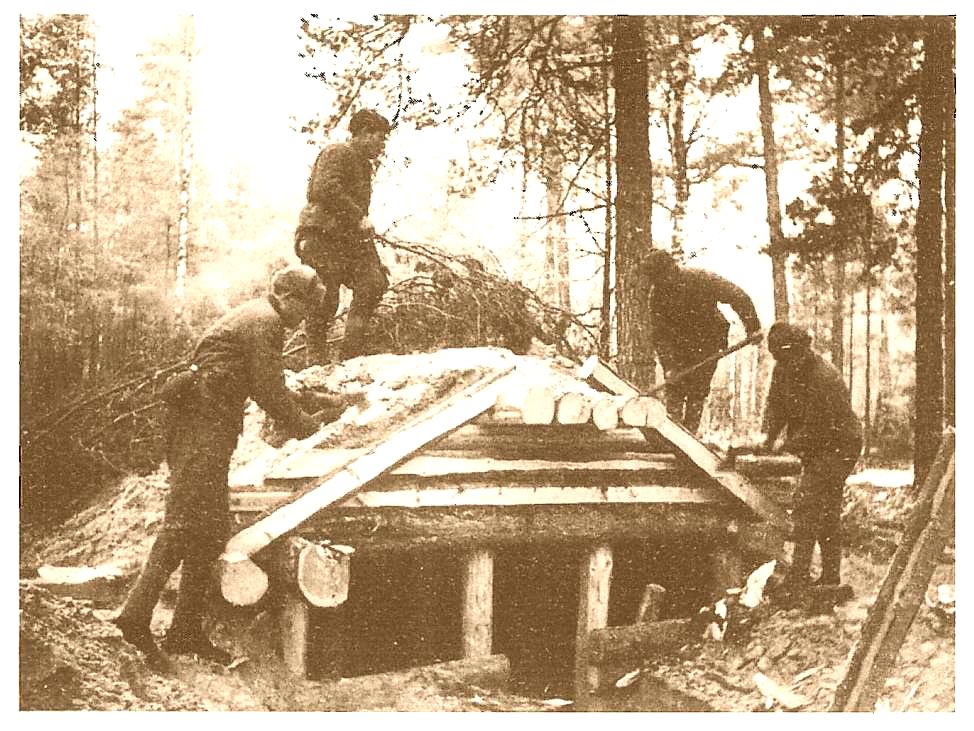
Rare source: The photograph shows engineers of the 193rd Dnieper Rifle Division building a simple shelter at the end of 1943. The photograph comes from Catherine Merridale’s Ivan’s War.
The lower article on the scanned page, “Finds Raise Many Questions”, is reproduced in the webpage text and is translated in full above.