




| Seite 10-11 | |
 |
|
 |
|
 |
|
|
jüdisches
berlin © Jüdisches Berlin |
With the diary of the Jewish lieutenant Wladimir Natanowitsch Gelfand, we are given for the first time an authentic insight into the world of thought of a Red Army soldier in Germany at the end of the war — beyond historical-political whitewashing and deliberate dramatization.
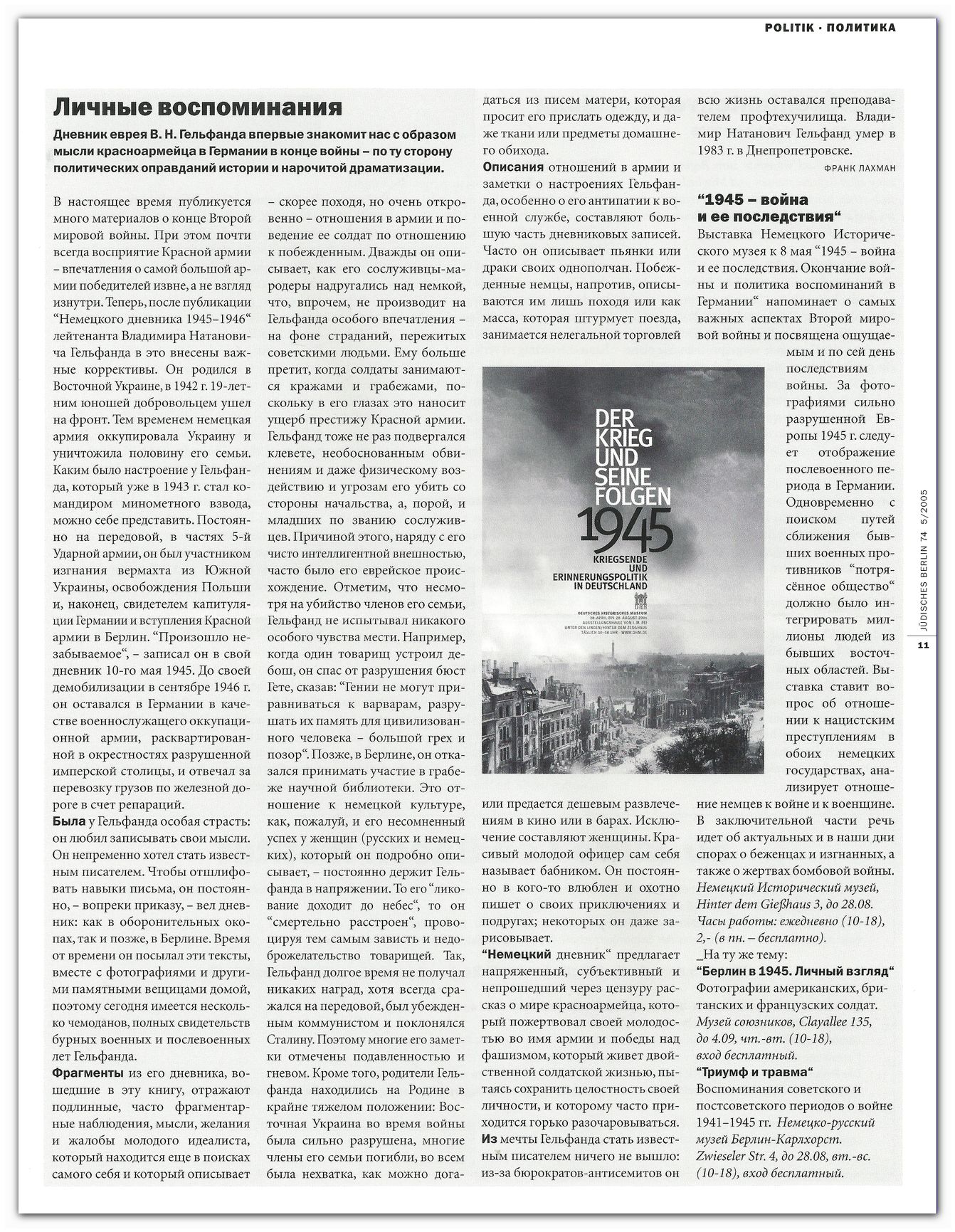
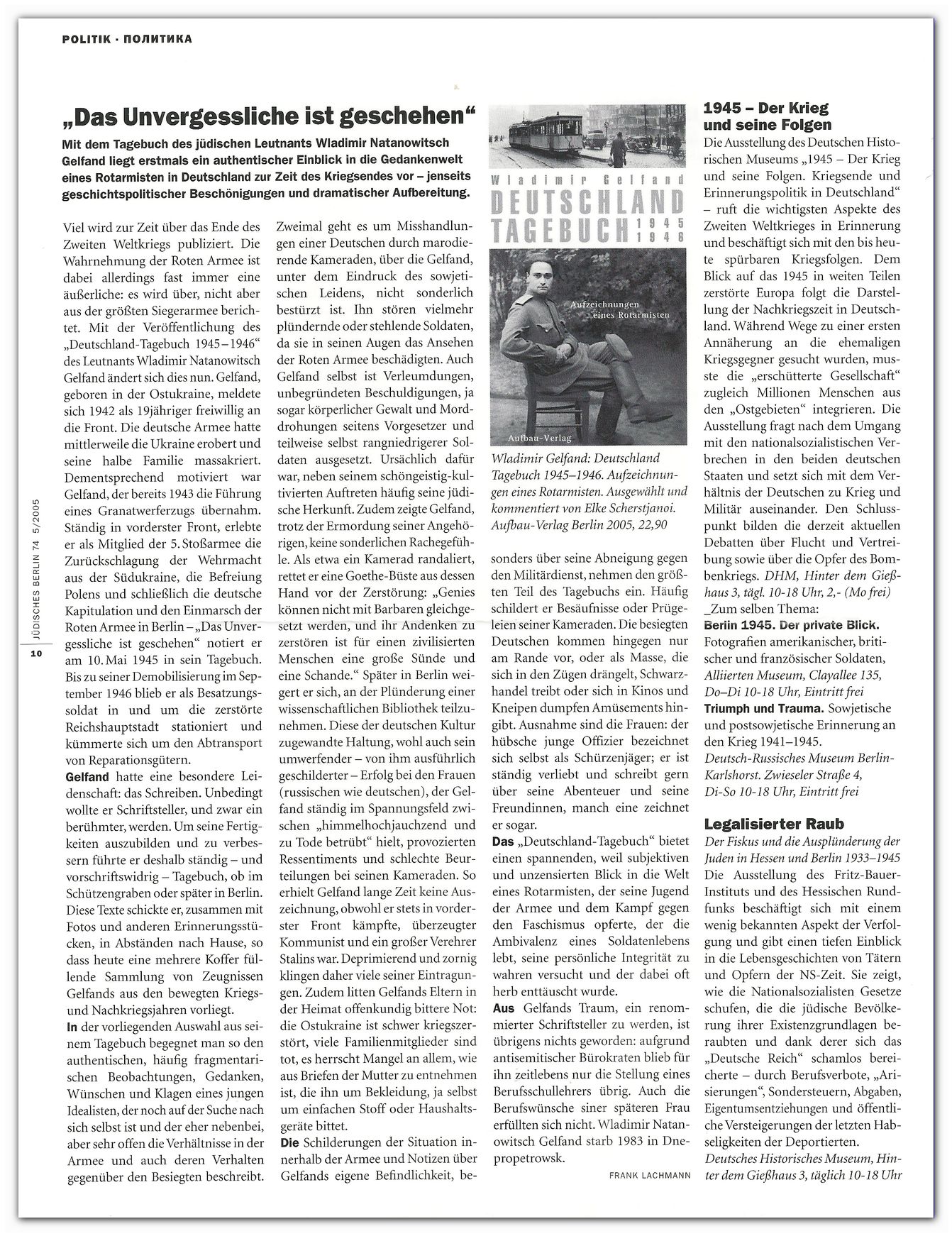
Much is currently being published about the end of the Second World War. Yet the Red Army is almost always perceived from the outside: people write about, but not from within, the largest of the victorious armies. The publication of Lieutenant Wladimir Natanowitsch Gelfand’s Germany Diary 1945–1946 changes that. Gelfand, born in eastern Ukraine, volunteered for the front in 1942 at the age of nineteen. By then the German army had occupied Ukraine and murdered half of his family. Accordingly motivated, Gelfand was already commanding a mortar platoon in 1943. Constantly at the front, as a member of the 5th Shock Army he experienced the Wehrmacht’s expulsion from southern Ukraine, the liberation of Poland, and finally Germany’s capitulation and the Red Army’s entry into Berlin. “The unforgettable has happened,” he wrote in his diary on 10 May 1945. Until his demobilization in September 1946 he remained stationed as an occupation soldier in and around the destroyed capital of the Reich and was involved in transporting reparations goods by rail.
Gelfand had one particular passion: writing. He was determined to become a writer — and a famous one. To train and improve his skills, he therefore kept a diary continuously, contrary to regulations, whether in a trench or later in Berlin. At intervals he sent these texts home together with photographs and other keepsakes. As a result, several suitcases full of Gelfand’s documents from the turbulent war and postwar years survive today.
The selection from his diary presents the authentic, often fragmentary observations, thoughts, wishes and complaints of a young idealist who is still searching for himself and who, almost in passing but with great openness, describes conditions within the army and its behavior toward the defeated.
Twice he writes about German women being abused by marauding comrades; under the impact of Soviet suffering, Gelfand is not especially shocked by this. What bothers him more are soldiers who loot or steal, because in his eyes they damage the reputation of the Red Army. Gelfand himself is subjected to slander, unfounded accusations, physical violence and even death threats from superiors and, at times, lower-ranking soldiers. One reason, alongside his cultivated, literary manner, was often his Jewish background. Despite the murder of his relatives, he showed no particular desire for revenge. When a comrade goes on a rampage, for example, Gelfand rescues a bust of Goethe from destruction: “Geniuses cannot be equated with barbarians, and destroying their memory is a great sin and a disgrace for a civilized person.” Later in Berlin he refuses to take part in looting a scientific library.
His sympathetic attitude toward German culture — and probably also his striking success with women, Russian as well as German, which he describes at length and which kept him constantly oscillating between elation and despair — provoked resentment and poor evaluations from his comrades. For a long time Gelfand received no decoration, although he repeatedly fought at the front, was a convinced Communist and a great admirer of Stalin. Many diary entries therefore sound depressed and angry. His parents at home were also clearly suffering severe hardship: eastern Ukraine had been devastated by the war, many family members were dead, and everything was scarce. His mother’s letters ask him for clothing, even simple fabric and household utensils.
Descriptions of conditions inside the army and notes about Gelfand’s own state of mind — especially his dislike of military service — occupy most of the diary. He frequently describes his comrades’ drinking bouts and fights. The defeated Germans appear mostly at the margins, or as a crowd pressing into trains, trading on the black market or seeking dull entertainment in cinemas and pubs. The exception is women. The handsome young officer calls himself a womanizer; he is constantly in love, likes to write about his adventures and girlfriends, and even draws some of them.
Germany Diary offers a compelling, highly subjective and uncensored view into the world of a Red Army soldier who sacrificed his youth to the army and to the fight against fascism, lived the contradictions of a soldier’s life, tried to preserve his personal integrity, and was often bitterly disappointed.
Gelfand’s dream of becoming a renowned writer never came true. Because of antisemitic bureaucrats, he spent his working life as a vocational-school teacher. The professional ambitions of his later wife were likewise frustrated. Wladimir Natanowitsch Gelfand died in Dnepropetrovsk in 1983.
Frank Lachmann
1945 — The War and Its Consequences. The German Historical Museum exhibition “1945 — The War and Its Consequences: The End of the War and the Politics of Memory in Germany” recalls the principal aspects of the Second World War and examines consequences that are still perceptible today. A view of a Europe widely devastated in 1945 is followed by the postwar period in Germany. While ways toward an initial rapprochement with former wartime enemies were being sought, the “shattered society” also had to integrate millions of people from the former eastern territories. The exhibition examines how the two German states dealt with National Socialist crimes and explores Germans’ relationship to war and the military. It concludes with contemporary debates about flight and expulsion and about the victims of the bombing war.
Legalized Plunder. The exhibition by the Fritz Bauer Institute and Hessischer Rundfunk examines a little-known aspect of persecution: how the National Socialists created laws that deprived the Jewish population of the foundations of its existence and enabled the German Reich to enrich itself through employment bans, “Aryanization,” special taxes and levies, confiscation of property, and public auctions of deportees’ last possessions.