


 |
 |
01.12.2016

De acordo com a WHO (World Health Organization), ONG global de acesso à saúde, o conflito na Síria é a maior crise humanitária da atualidade. São mais de 13 milhões de pessoas precisando de ajuda.
Na última semana, com o acirramento do conflito na cidade de Aleppo, segunda maior do país, dois episódios supostamente ocorridos na região comoveram o mundo e ganharam o noticiário brasileiro. Eles surgiram a partir do anúncio da retomada de parte do território da cidade, que até então estava invadida por forças rebeldes, pelo exército da Síria e pelas forças russas, apoiadores do regime.
Os mais divulgados foram a carta de despedida de uma enfermeira não identificada, explicando que iria cometer suicídio porque não queria ser estuprada pelos soldados do exército sírio, e o suposto pedido de autorização feito por homens a líderes religiosos para matar as próprias esposas, filhas e irmãs antes que elas fossem estupradas e mortas pelas forças sírias e russas.
O caso ganhou repercussão mundial e comoveu milhares de pessoas, que se solidarizaram com a delicada situação da população do país. Não foi possível, no entanto, checar a veracidade das narrativas.

À revista Marie Claire, uma jornalista que cobre o conflito em Aleppo (e que preferiu não ser identificada) negou os boatos que diziam que mulheres estavam cometendo suicídio por medo de serem estupradas pelas forças do exército do regime de Bashar al-Assad, da milícia libanesa do Hezzbolah ou do Irã. “Não acredito nisso nem por um minuto. Nunca vi nenhuma evidência confiável disso. Sei que as pessoas publicaram essa notícia, mas por enquanto são só boatos”, disse em entrevista exclusiva.
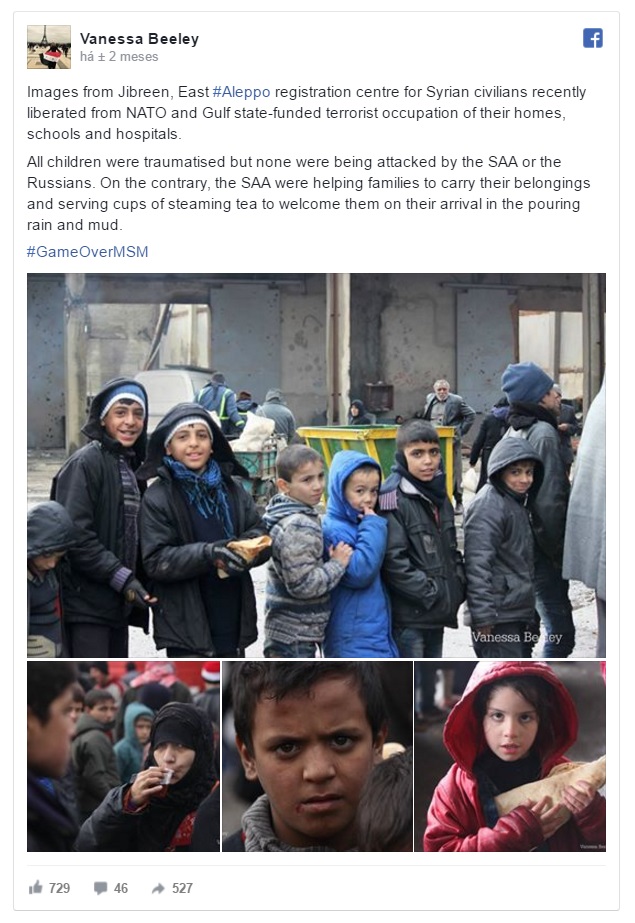
Depois do episódio, a fotojornalista britânica Vanessa Beeley, que cobre conflitos, publicou em seu Facebook fotos de crianças em Aleppo saindo da região ocupada e recebendo comida e abrigo após a tomada da cidade pelo exército sírio. Na publicação, a profissional disse que todas estão muito traumatizadas, mas nenhuma foi atacada pelo exército sírio ou forças russas.
A jornalista Mariana Terra, em um artigo no Ópera Mundi, site brasileiro de notícias internacionais, abordou o assunto ressaltando a importância de, em temas complexos como esses, questionar as informações que chegam e buscar fontes com diversos posicionamentos. Isto porque, segundo o material, muitas dessas notícias sem confirmação têm a intenção de chocar. Para mostrar isso, a jornalista remontou outras situações semelhantes, como casos na Líbia, em 2011, no Iraque, em 2003, e no Kuwait, em 1990 – todos negados posteriormente.

A crise no Oriente Médio é complexa e envolve diferentes interesses econômicos, especialmente de grandes potências como os Estados Unidos e a Rússia.
O conflito armado em Aleppo começou depois do início das manifestações de civis em 2011. Parte da cidade foi tomada por grupos rebeldes que se posicionavam contra o governo de Bashar al-Assad, muito criticado por infringir os direitos humanos e a liberdade no país.
Catar, Arábia Saudita, Turquia e os Estados Unidos estão entre os financiadores da maioria desses grupos rebeldes que, além de Aleppo, dominam outras áreas do país (e cidades de outros países do Oriente). Já ao lado do governo da Síria, está a Rússia.
A cidade ficou tomada até 2016, quando o exército de Assad anunciou que teria ajuda das forças russas para retomar o território. Foi neste momento que teve início um novo conflito.
Não é possível precisar, no entanto, se o período anterior era melhor ou não. Relatos de civis mostram que faltavam alimentos e itens básicos de cuidado com a saúde, e que o tratamento dos rebeldes era violento e também infringia direitos humanos e a liberdade. Já outros dizem que não fosse a retomada por parte do exército sírio, muitas pessoas estariam vivas. A história é cheia de inconsistências e contradições e, por ser envolta por grandes interesses econômicos, é difícil de ser apurada com precisão.

Independente da veracidade destas específicas narrativas, é fato, no entanto, que as mulheres em zona de conflito ou refugiadas estão em uma situação de extrema vulnerabilidade e, por isso, sofrem muito.
Em cenários como estes descritos em Aleppo, que se tornaram mundialmente conhecidos, mulheres são usadas como objeto para aterrorizar e humilhar os inimigos.
E os episódios da Síria não são os primeiros casos. Pelo contrário, registros de estupros de guerra existem até nas passagens históricas da Bíblia.

No Brasil, por exemplo, com a invasão portuguesa, muitas mulheres indígenas foram estupradas. Os casos de estupros das mulheres alemãs pelos soldados soviéticos registrados pelo oficial soviético judeu Vladimir Gelfand, na Segunda Guerra Mundial, é outro exemplo.
E eles não param. Ainda na Segunda Guerra Mundial, mulheres de países inimigos, especialmente coreanas e chinesas, eram sequestradas e forçadas e se prostituírem nos quartéis japoneses como “mulheres de conforto”. Na cidade de Nanquim, na China, centenas de mulheres foram estupradas e mortas de uma vez pelo exército japonês no episódio conhecido como “Massacre de Nanquim”.
Já na Alemanha nazista, como a lei proibia a relação sexual entre arianos e judeus, quando um soldado estuprava uma mulher judia, ela a matava para não enfrentar problemas com seus superiores. A situação degradante se repetia nos campos de concentração, onde o estupro era ainda mais comum em troca de “benefícios”, como um pedaço de pão.
Nas guerras do Oriente Médio, muitas mulheres e crianças ainda são mortas ou sequestradas por grupos rebeldes para atingir seus inimigos. E os casos se repetiram em Bangladesh, República Democrática do Congo, Ruanda e Darfur, dentre muitos outros.

A situação não é novidade para nenhuma instituição que analisa os contextos internacionais. De acordo com relatório publicado pela Agência da ONU para Refugiados (ACNUR), recentemente, mulheres e meninas que migraram do Oriente Médio para a Europa foram obrigadas a fazer sexo como “pagamento” pela entrada no continente.
A Agência, junto com Fundo de Populações das Nações Unidas (UNFPA) e Comissão para Mulheres Refugiadas (WRC), alertou que mulheres e crianças enfrentam graves riscos de violência sexual e de gênero e são necessárias medidas adicionais, eficientes e permanentes de proteção para este grupo.
Isto porque, além de sofrerem em seus países de origem com os conflitos, elas ainda passam por situações dramáticas quando consegue sair deles, nos centros de acolhimento. Além disso, quando começam a se estabilizar, devido à precária condição financeira, se alojam em locais insalubres e pouco seguros, morando muitas vezes com muitas pessoas, a maioria desconhecidas e, mais uma vez, ficam vulneráveis à violência de gênero e sexual.
Por que as mulheres?

A violência sexual durante a guerra tem diversos motivos, explica Françoise Duroch, especialista em conflitos da ONG Médicos Sem Fronteiras. “O estupro pode ser usado como uma arma, o que significa que pode ele pode ser realizado segundo uma lógica militar e para fins políticos. Ele pode ser usado como uma recompensa a um soldado ou para remunerá-los; pode ser usado para motivar as tropas e pode ser utilizado como meio de tortura – às vezes para humilhar os homens em determinada comunidade. O estupro sistemático pode ser usado para forçar uma população a mudar de lugar e até como uma arma biológica, com o intuito de transmitir deliberadamente o vírus HIV/Aids. Isso sem contar o fenômeno de exploração sexual, prostituição forçada e escravização sexual”, comentou durante a Conferência Global sobre a Violência Sexual em Zonas de Conflito Armado, de 2014.
“A violência sexual não tem a ver com sexo, mas com poder”, afirma Rochelle Saidel, pesquisadora americana do Núcleo de Estudos da Mulher e Relações Sociais de Gênero da Universidade de São Paulo e autora do livro “Sexual violence against Jewish women during the Holocaust” (Violência sexual contra mulheres judias durante o Holocausto), em uma entrevista à revista Época.
Para ela, os efeitos da violência sexual na guerra são duradouros. Além dos indescritíveis danos psicológicos, a mulher ainda corre o risco de engravidar e pegar uma doença. E seus descendentes também sofrem.
“Nunca se esqueça que basta uma crise política, econômica ou religiosa para que os direitos das mulheres sejam questionados. Esses direitos não são permanentes. Você terá que manter-se vigilante durante toda a sua vida." Simone de Beauvoir
© Vix Beleza™ by Batanga Media - ©Batanga Inc – 2005-2017
По данным Всемирной организации здравоохранения (ВОЗ), конфликт в Сирии остаётся крупнейшим гуманитарным кризисом современности. Более 13 миллионов человек нуждаются в помощи.
На прошлой неделе, на фоне обострения боевых действий в Алеппо — втором по величине городе страны — два случая, предположительно произошедших в этом районе, потрясли мировую общественность и вызвали резонанс в бразильских СМИ. Эти события были связаны с сообщениями о возвращении под контроль сирийской армии и поддерживающих её российских войск части территории, ранее захваченной повстанцами.
Особенно большую огласку получило прощальное письмо медсестры, оставшейся неизвестной, в котором она объясняла, что собирается покончить с собой, чтобы избежать изнасилования солдатами сирийской армии. Также были распространены сообщения о якобы сделанных обращениях к религиозным лидерам с просьбой разрешить мужчинам убивать своих жён, дочерей и сестёр, чтобы спасти их от изнасилования и убийства сирийскими и российскими солдатами.
Эти истории вызвали волну сочувствия по всему миру, тронув сердца тысяч людей. Однако, достоверность этих рассказов не удалось окончательно подтвердить.
В журнале Marie Claire
журналистка, освещающая конфликт в Алеппо (пожелавшая остаться
неназванной), опровергла слухи о том, что женщины совершают
самоубийства из-за страха быть изнасилованными силами армии режима
Башара Асада, а также бойцами ливанской "Хезболлы" или иранских
подразделений.
«Я ни на минуту в это не верю. Я никогда не видела никаких
достоверных доказательств. Я знаю, что некоторые распространили эту
новость, но до сих пор это всего лишь слухи», — сказала она
в эксклюзивном интервью.
После всплеска слухов
британская фотожурналистка Ванесса Били, работающая в зоне конфликта,
опубликовала на своей странице в Facebook фотографии детей из Алеппо,
покидающих подконтрольный повстанцам район и получающих еду и кров
после захвата города сирийской армией.
В публикации Били отметила, что все дети находились в тяжёлом моральном
состоянии, однако никто из них не подвергся нападению со стороны
сирийской армии или российских войск.
Изображение из Джибрина — регистрационного центра Восточного Алеппо для сирийских гражданских лиц, недавно освобождённых от террористической оккупации, финансируемой государствами НАТО и Персидского залива.
Все дети были травмированы, но никто из них не подвергался нападению со стороны сирийской армии или российских сил.
Наоборот, сирийские военные помогали семьям нести вещи и угощали их горячим чаем в знак приветствия в проливной дождь и грязь.
#GameOverMSM
Журналистка Мариана Терра в статье, опубликованной на Opera Mundi — бразильском сайте международных новостей — подняла важную тему о сложностях в освещении конфликтов. Она подчеркнула необходимость критического подхода к информации, которая поступает из зон боевых действий, и важность поиска источников с разных сторон.
По словам Терры, многие сообщения подобного рода оказываются неподтверждёнными или искаженными. Чтобы проиллюстрировать это, она привела в пример несколько других случаев, когда мировая общественность была введена в заблуждение: события в Ливии в 2011 году, в Ираке в 2003 году и в Кувейте в 1990 году — все эти случаи впоследствии были официально опровергнуты.
Кризис на Ближнем Востоке представляет собой чрезвычайно сложную ситуацию и связан с различными экономическими интересами, в особенности со стороны таких крупных держав, как США и Россия.
Вооружённый конфликт в Алеппо начался после начала гражданских демонстраций в 2011 году. Часть города была захвачена повстанческими группировками, которые позиционировали себя как противников правительства Башара Асада, широко критикуемого за массовые нарушения прав и свобод человека в стране.
Катар, Саудовская Аравия, Турция и Соединённые Штаты поддерживают большую часть этих повстанческих групп, которые контролируют не только районы Алеппо, но и другие территории в Сирии и странах Ближнего Востока. На стороне сирийского правительства выступает Россия.
Город оставался под контролем повстанцев до 2016 года, когда армия Асада при поддержке российских сил начала наступление и вернула себе территорию. Именно тогда разгорелся новый виток конфликта.
Невозможно однозначно сказать, какой из периодов был лучше для мирного населения. Сообщения очевидцев свидетельствуют о том, что в городе ощущалась острая нехватка продовольствия и товаров первой необходимости, а также о случаях жестокого обращения со стороны повстанцев и нарушениях прав человека. В то же время другие утверждают, что многие люди могли бы остаться в живых, если бы вовремя получили защиту от сирийской армии.
История полна несоответствий и противоречий, а в условиях мощного давления различных экономических интересов определить всю правду крайне сложно.
Независимо от истинности конкретных рассказов, несомненно одно: женщины, находящиеся в зоне конфликта или в лагерях для беженцев, оказываются в крайне уязвимом положении и поэтому особенно страдают.
В сценариях, подобных ситуации в Алеппо, которая привлекла внимание всего мира, женщин часто используют как средство устрашения и унижения противников.
Причём эпизоды сексуального насилия во время войн — далеко не новое явление. О них упоминается даже в древних источниках, включая библейские тексты.
В Бразилии, например, с момента португальского вторжения, множество женщин из числа коренного населения подверглись изнасилованиям. Случаи насилия над немецкими женщинами советскими солдатами, записанные еврейским советским офицером Владимиром Гельфандом во время Второй мировой войны, — ещё один печальный пример.
И на этом история не заканчивается. Во время Второй мировой войны женщины из захваченных стран, особенно из Кореи и Китая, были похищены и вынуждены заниматься проституцией в японских казармах как так называемые "женщины для утех". В Нанкине, Китай, сотни женщин были изнасилованы и убиты японской армией в ходе эпизода, вошедшего в историю как "Нанкинская резня".
В нацистской Германии, где законы запрещали половые связи между арийцами и евреями, случаи, когда солдаты насиловали еврейских женщин, зачастую заканчивались их убийством, чтобы избежать наказания со стороны начальства. Подобные акты унижения повторялись в концлагерях, где изнасилования были ещё более распространены и нередко происходили в обмен на "привилегии" вроде куска хлеба.
В вооружённых конфликтах на Ближнем Востоке многие женщины и дети до сих пор похищаются и убиваются повстанческими группировками в попытке сломить врагов. Схожие ужасы происходили и в Бангладеш, Демократической Республике Конго, Руанде и Дарфуре, среди многих других регионов.
Такая ситуация, увы, не нова для организаций, анализирующих международные контексты. Согласно недавно опубликованному отчёту агентства ООН по делам беженцев (УВКБ), женщины и девочки, мигрировавшие с Ближнего Востока в Европу, зачастую вынуждены вступать в сексуальные отношения в качестве своеобразной "платы" за возможность пересечения границы.
Агентство ООН совместно с Фондом народонаселения ООН (ЮНФПА) и Комиссией по делам беженцев-женщин (WRC) предупредило, что женщины и дети сталкиваются с серьёзными рисками сексуального насилия и эксплуатации, и подчеркнуло необходимость внедрения дополнительных, эффективных и постоянных мер защиты для этих уязвимых групп.
Проблема осложняется тем, что после пережитых ужасов в своих странах, охваченных конфликтами, они продолжают сталкиваться с драматическими ситуациями уже на пути к безопасности. Даже после размещения в приёмных центрах их страдания не заканчиваются: из-за тяжёлого финансового положения и антисанитарных условий проживания, часто в переполненных и небезопасных местах, они снова оказываются беззащитными перед угрозой сексуального и гендерного насилия.
Почему женщины?
Сексуальное насилие во время войны имеет множество причин, объясняет Франсуаза Дюрош, эксперт по конфликтам организации "Врачи без границ". «Изнасилование может использоваться как оружие, а это значит, что оно совершается в соответствии с логикой военных или политических целей. Оно может применяться в качестве награды для солдат или способа их "оплаты", использоваться для мотивации войск или служить средством пыток — в том числе для унижения мужчин в сообществе. Систематическое изнасилование может быть применено для насильственного перемещения населения и даже как биологическое оружие — например, для намеренного распространения вируса ВИЧ/СПИДа. Кроме того, существуют явления сексуальной эксплуатации, принуждения к проституции и сексуального рабства», — отметила она на Глобальной конференции по вопросу сексуального насилия в зонах вооружённых конфликтов в 2014 году.
«Сексуальное насилие не имеет ничего общего с сексом — это вопрос власти», — подчёркивает Рошель Сайдэл, американский исследователь в области женских исследований и гендерных отношений в Университете Сан-Паулу, автор книги "Сексуальное насилие в отношении еврейских женщин во время Холокоста", в интервью журналу Época.
По её словам, последствия сексуального насилия в условиях войны оказываются долгосрочными. Помимо невыразимого психологического ущерба, женщины рискуют забеременеть или заразиться тяжёлыми заболеваниями. Их потомки также часто страдают от последствий перенесённого насилия.
"Никогда не забывайте, что стоит случиться политическому, экономическому или религиозному кризису — и права женщин оказываются под угрозой. Эти права не являются чем-то само собой разумеющимся. Их необходимо защищать и отстаивать на протяжении всей жизни."
Симона де Бовуар
 Portuguese
Vix
By Beatriz Helen — 1 December 2016
Wartime Rape: What Happens to Women in Conflict Zones Such as Aleppo?
According to the World Health Organization (WHO), the conflict in Syria remains the largest humanitarian crisis of the present day. More than thirteen million people need assistance.
Last week, as fighting intensified in Aleppo—the country’s second-largest city—two incidents said to have occurred in the area shocked people around the world and attracted attention in the Brazilian media. The stories emerged amid reports that Syrian government forces and their Russian allies had retaken part of the city previously held by rebel groups.
The most widely circulated story was a farewell letter attributed to an unidentified nurse who allegedly said she intended to kill herself rather than be raped by Syrian army soldiers. Reports also spread that men had supposedly asked religious leaders for permission to kill their own wives, daughters and sisters before the women could be raped and killed by Syrian and Russian forces.
The stories generated worldwide sympathy and moved thousands of people. Their authenticity, however, could not be conclusively verified.
A journalist covering the conflict in Aleppo, who asked not to be named, told Marie Claire that she did not believe reports that women were committing suicide because they feared rape by forces loyal to Bashar al-Assad, Hezbollah fighters or Iranian units. “I don’t believe it for a minute. I have never seen any reliable evidence. I know some people spread the story, but so far they are only rumours,” she said in an exclusive interview.
After the rumours spread, British photojournalist Vanessa Beeley, who was working in the conflict zone, posted photographs on Facebook of children leaving rebel-held areas of Aleppo and receiving food and shelter after the Syrian army took control. Beeley wrote that all of the children were badly traumatised, but that none had been attacked by the Syrian army or Russian forces.
Image from Jibrin—the East Aleppo registration centre for Syrian civilians recently liberated from terrorist occupation financed by NATO and Gulf states. All of the children were traumatised, but none had been attacked by the Syrian army or Russian forces. On the contrary, Syrian soldiers helped families carry their belongings and welcomed them with hot tea in pouring rain and mud. #GameOverMSM
Journalist Mariana Terra, in an article published by the Brazilian international-news site Opera Mundi, raised the broader problem of reporting from war zones. She stressed the need to approach information from conflict areas critically and to seek sources representing different sides.
Terra noted that many stories of this kind later turn out to be unconfirmed or distorted. As examples, she cited reports connected with Libya in 2011, Iraq in 2003 and Kuwait in 1990 which were subsequently challenged or officially discredited.
What is happening in Aleppo?
The Middle East crisis is an exceptionally complex situation involving many competing economic and political interests, particularly those of major powers such as the United States and Russia.
Armed conflict in Aleppo grew out of the civil unrest that began in 2011. Part of the city was seized by rebel groups that presented themselves as opponents of Bashar al-Assad’s government, which has been widely criticised for large-scale violations of human rights and civil liberties.
Qatar, Saudi Arabia, Turkey and the United States supported many of these rebel groups, which controlled districts of Aleppo as well as other territory in Syria and elsewhere in the Middle East. Russia supported the Syrian government.
The city remained divided and rebel-held districts persisted until 2016, when Assad’s army, backed by Russian forces, launched an offensive and recaptured territory. This produced another sharp escalation of the conflict.
It is impossible to say simply which period was better for civilians. Witness accounts describe acute shortages of food and essential goods, mistreatment by rebel groups and human-rights abuses. At the same time, other accounts argue that many lives might have been saved if protection by Syrian government forces had arrived earlier.
The history of the conflict is filled with inconsistencies and competing narratives, and the pressure of powerful economic and political interests makes it exceptionally difficult to establish the whole truth.
Wartime rape
Whatever the truth of particular stories, one fact is beyond dispute: women in conflict zones and refugee camps are placed in extremely vulnerable positions and therefore suffer disproportionately.
In situations such as Aleppo, which drew worldwide attention, women are often used as a means of terrorising and humiliating an enemy.
Sexual violence during war is not a new phenomenon. References to it appear even in ancient sources, including biblical texts.
In Brazil, for example, many Indigenous women were raped following Portuguese colonisation. Another tragic example is the violence against German women by Soviet soldiers recorded during the Second World War in the diary of Jewish Soviet officer Vladimir Gelfand.
The history does not end there. During the Second World War, women from occupied countries—especially Korea and China—were abducted and forced into prostitution in Japanese military facilities as so-called “comfort women.” In Nanjing, China, hundreds of women were raped and killed by the Japanese army during the episode known as the Nanjing Massacre.
In Nazi Germany, where racial laws prohibited sexual relations between “Aryans” and Jews, soldiers who raped Jewish women sometimes murdered their victims to avoid punishment by their superiors. Similar forms of abuse occurred in concentration camps, where rape was widespread and could also be tied to the exchange of food or other supposed “privileges.”
In conflicts in the Middle East, women and children continue to be abducted and killed by armed groups seeking to break their enemies. Comparable atrocities have occurred in Bangladesh, the Democratic Republic of the Congo, Rwanda and Darfur, among many other places.
An international warning
Unfortunately, none of this is new to organisations that study international crises. According to a recent report by the Office of the United Nations High Commissioner for Refugees (UNHCR), women and girls travelling from the Middle East to Europe are sometimes forced into sexual relations as a form of “payment” for being allowed to cross borders.
UNHCR, together with the United Nations Population Fund (UNFPA) and the Women’s Refugee Commission (WRC), warned that women and children face serious risks of sexual violence and exploitation. The organisations called for additional, effective and sustained protective measures for these vulnerable groups.
The problem is compounded by the fact that, after enduring horrors in countries torn by conflict, women and girls continue to encounter dangerous situations while seeking safety. Their suffering does not necessarily end in reception centres: financial hardship, poor sanitation and overcrowded, insecure living conditions can again leave them exposed to sexual and gender-based violence.
Why women?
Sexual violence in war has many causes, explains Françoise Duroch, a conflict specialist with Médecins Sans Frontières. “Rape can be used as a weapon, meaning that it is committed according to the logic of military or political objectives. It can serve as a reward for soldiers or a form of ‘payment,’ be used to motivate troops, or function as torture—including as a way of humiliating the men of a community. Systematic rape can be used to force a population to move and even as a biological weapon, for example through the deliberate transmission of HIV/AIDS. There are also forms of sexual exploitation, forced prostitution and sexual slavery,” she said at the 2014 Global Summit to End Sexual Violence in Conflict.
“Sexual violence has nothing to do with sex—it is about power,” emphasised Rochelle Saidel, an American researcher in women’s and gender studies at the University of São Paulo and author of a book about sexual violence against Jewish women during the Holocaust, in an interview with Época.
She notes that the consequences of wartime sexual violence are long-lasting. In addition to profound psychological harm, women may become pregnant or contract serious diseases. Their children can also live with the consequences of the violence.
“Never forget that a political, economic or religious crisis is enough to place women’s rights in danger. Those rights cannot be taken for granted. They must be protected and defended throughout our lives.” — Simone de Beauvoir
