


 |
 |
 |
Когда писателя-фронтовика Виктора Астафьева попросили дать оценку очередному блокбастеру про Великую Отечественную, он ответил, что не может этого сделать, потому что был на какой-то другой войне. Дескать, нет смысла обсуждать преувеличения, нестыковки или долю художественного вымысла, сравнивая фильм «Звёздные войны» с галльским походом Юлия Цезаря – это вообще разные вещи. Но почему так вышло? Ведь общественный интерес к правде о войне колоссален – достаточно вспомнить о миллионах россиян, которые 9 Мая выходят на «Бессмертный полк» с портретами предков. Ежегодно растёт число военно-патриотических и поисковых отрядов. При общем падении книжного рынка воспоминания о войне по-прежнему издаются солидными тиражами. Появились качественные интернет-проекты, в том числе библиотека фронтовых дневников. Вроде бы власть первой должна раздувать угольки патриотического настроя сограждан – какое-никакое отвлечение от падающего уровня жизни. Но ничего подобного! В архивах вводят плату за фотографирование документов на собственный телефон. Засекречены пласты важнейших источников военного периода. Дошло до посмертной травли авторов «окопной правды»: не то видели, не о том писали. Казалось бы, какой смысл нынешним чиновникам-патриотам отмазывать сталинскую номенклатуру? Победил-то народ – его и надо превозносить. Но резоны всё-таки есть – и очень серьёзные.
Рама без героя
После войны писатель и фронтовой корреспондент Константин Симонов предложил создать хранилище солдатских мемуаров и дневников при Центральном архиве Министерства обороны (ЦАМО). Идею обсудили на уровне политбюро и от воплощения отказались: против выступили Генштаб и Главное политическое управление Советской армии. Мол, взгляд на Победу и «руководящую роль» должен быть един. Как это понималось, можно посмотреть на примере «Воспоминаний» маршала Г.К. Жукова или других полководцев – кастрированных, вылизанных до неправдоподобности и, скорее всего, написанных «литературными неграми».
При Н.С. Хрущёве издали «Историю Великой Отечественной войны Советского Союза» в 6 томах, из которой невозможно понять, например, какие части Красной армии где дислоцировались в июне 1941 года. Если просеять все 6 томов, можно выудить лишь названия военных округов и номера собранных под их знамёнами армий. Сколько в них было воинов, чем они были вооружены? Типичный фрагмент: «В конце 1940 г. численный состав авиадесантных бригад возрос в два раза. С начала 1941 г. было развёрнуто формирование нескольких авиадесантных корпусов, завершённых в основном к 1 июня 1941 г.». Что значит, «в основном» завершено и «нескольких» корпусов? Это мешки с картошкой, что ли? Десантников в бригадах стало больше в два раза от какого количества?
При Л.И. Брежневе история войны вышла уже в 12 томах, где умышленное запутывание читателя продолжилось. Почему умышленное? Судите сами: перечень рецензентов занимал теперь целую страницу – маршалы, генералы, академики, члены ЦК КПСС. Многие из них воевали, а на войне всё предельно конкретно: подкрепление – 8 танков, 3 «студебеккера», рота солдат. А тут: «Части и соединения ВВС флота состояли на 45, 3% из истребительной авиации, на 14% – из бомбардировочной, на 9, 7% – из торпедоносной, на 25% – из разведывательной». Как нетрудно догадаться, общее число самолётов ВВС флота многотомник не сообщает. И две сотни рецензентов это устраивает.
Но в художественной прозе одними мемуарами начальства грандиозную тему войны не закроешь. Пришлось ослабить гайки. Глотком правды стала «лейтенантская проза», представленная Василем Быковым, Константином Воробьёвым, Виктором Курочкиным, Юрием Бондаревым, Виктором Некрасовым.Нельзя сказать, что они не пытались вписаться в формат: у Некрасова, например, отступающие красноармейцы, словно снопы сена, палят немецкие танки, которых, как мы теперь знаем, в 1941 г. на весь вермахт было меньше 4 тысяч. Но у «лейтенантов» была и беспримесная правда, по которой миллионы ветеранов безо- шибочно опознали своих. Это сейчас нам кажется непонятным, за что в 1963 г. промывали Воробьёва, автора книг «Убиты под Москвой» и «Крик». У него вроде бы вполне патриотичные повести с яркими русскими характерами, однако герои позволяют себе подвергать сомнению единую «руководящую роль». Боец Васюков кричит, что «махал» особистов и раздражён отправкой его в бессмысленную самоубийственную разведку: «Я вот чего не пойму. Скажи, а куда ж делись наши танки? А самолёты? А? Или их не было? Понимаешь, ить с одними ПТР да с поллитрами…»
К сценариям для советского кино о войне подобные вопросы не подпустили бы на пушечный выстрел. Поэтому народу так полюбились лиричные «А зори здесь тихие», где тему «руководящей роли» хитро обошли. И «Летят журавли», среди героев которого нет ни одного полководца, склонившегося над картой. Вроде бы для нынешних кинематографистов дневники фронтовиков – кладезь интереснейшей информации. Тем более что эти свидетельства пробивались к своему исследователю, как цветы сквозь асфальт: ведение дневников на фронте не поощрялось, хотя высочайшего запрета тоже не было. Однако мы не видим, чтобы окопная правда вдохновляла получателей грантов Минкульта и фонда кино. Скорее наоборот: они превращают войну в здоровенную скрепу, маскируя правду, словно в советских многотомниках, и штампуя что-то вроде «Звёздных войн».
Лишь в 1993 г. рассекречена статистика потерь по отдельным сражениям. Однако, по словам директора Международного центра истории и социологии Второй мировой войны и её последствий НИУ ВШЭ Олега Будницкого, фонд Главного политического управления, которое занималось морально-психологическим состоянием армии, до сих пор закрыт для исследователей. Недоступны и фонды военной прокуратуры, таящие информацию о том, как советские люди горели «яростью благородной» (только по официальной статистике, более 994 тыс. военнослужащих за время войны были осуждены военными трибуналами). Закрыт в значительной своей части Военно-медицинский архив, и мы многого не знаем о чисто физическом состоянии бойцов Красной армии. А ведь даже в 1941 г. отсев призывников по медицинским показателям достигал 20%, и многое мог бы сказать о состоянии страны и её вооружённых сил.
Kочка зрения
Известный специалист по архивам пожаловался в СМИ, что «вообще невозможно описать адекватно ни одного сражения Красной армии, если практически все обмены шифрованными телеграммами между И.В. Сталиным, командующими фронтами и армиями и представителями Ставки засекречены». Мы не знаем, какова логика этого запрета. Но можем предполагать. Вот что пишет на эту тему в своих мемуарах фронтовик Николай Никулин: «Однажды ночью я замещал телефониста у аппарата. Тогдашняя связь была примитивна, и разговоры по всем линиям слышались во всех точках, я узнал, как разговаривает наш командующий И.И. Федюнинский с командирами дивизий: «Вашу мать! Вперёд!!! Не продвинешься – расстреляю! Вашу мать! Вперёд! Вашу мать!» Два года назад престарелый Иван Иванович, добрый дедушка, рассказывал по телевизору октябрятам о войне совсем в других тонах».
«Воспоминания о войне» гвардии сержанта Никулина, закончившего войну в Германии с двумя медалями «За отвагу» и орденом Красной Звезды, выросли из фронтовых заметок. Сегодня его часто критикуют за незнание темы безусые блогеры, хотя большего гимна храбрости и упорству русского солдата ещё поискать.
Никулин рассказывает про длившийся два года штурм небольшой железнодорожной станции Погостье под Ленинградом. Немцы хорошо организовали оборону: пристреляли пулемёты, возвели дзоты. Советская дивизия численностью 6–7 тысяч имела потери 12 тысяч за счёт постоянных пополнений. Автор пишет: «Пополнения идут беспрерывно, в людях дефицита нет. Но среди них опухшие дистрофики из Ленинграда, которым только что врачи прописали постельный режим и усиленное питание на три недели. Среди них младенцы 1926 года рождения, то есть шестнадцатилетние, не подлежащие призыву в армию… «Вперррёд!!!», и всё. Наконец какой-то солдат или лейтенант, командир взвода, или капитан, командир роты (что реже), видя это вопиющее безобразие, восклицает: «Нельзя же гробить людей! Там же, на высоте, бетонный дот! А у нас лишь 76-миллиметровая пушчонка! Она его не пробьёт!»… Сразу же подключаются политрук, Смерш и трибунал. Один из стукачей, которых полно в каждом подразделении, свидетельствует: «Да, в присутствии солдат усомнился в нашей победе». Тотчас же заполняют уже готовый бланк, куда надо только вписать фамилию, и готово: «Расстрелять перед строем!» или «Отправить в штрафную роту!», что то же самое. Так гибли самые честные, чувствовавшие свою ответственность перед обществом люди. А остальные – «Вперррёд, в атаку!»
Но кончилось всё известно чем – Погостье взяли. Никулин рассказывает: «Пришла дивизия вятских мужичков, низкорослых, кривоногих, жилистых, скуластых. «Эх, мать твою! Была не была» – полезли они на немецкие дзоты, выкурили фрицев, всё повзрывали и продвинулись метров на пятьсот. По их телам в прорыв бросили стрелковый корпус, и пошло, и пошло дело». Кто ещё на такое способен? Американские фермеры? Безусые блогеры? После войны немецкий ветеран рассказывал Никулину о том, что среди пулемётчиков их полка были случаи помешательства: не так просто убивать людей ряд за рядом – а они всё идут и идут, и нет им конца.
Однако нельзя сказать, что Красная армия умела воевать только массой. История войны знает блестяще проведённую операцию «Багратион», в результате которой немцы оставили Белоруссию, понеся потери большие, чем наступающие войска маршала Константина Рокоссовского. Кто-то скажет, что в начале войны мы воевать не умели, а потом научились. Это неправда – всё зависело от мотивов командования. В апреле 1945 г. маршал Георгий Жуков решил штурмовать Берлин в лоб – и напрасно, как считают многие специалисты, положил 200 тысяч солдат, которым до возвращения домой оставался последний шаг. Есть версия: Жуков люто враждовал с маршалом Иваном Коневым и не мог допустить коневские войска к Рейхстагу вперёд себя. Плюс хотел успеть к 1 Мая.
Танкист Василий Субботин пишет: «Теперь мы знаем, что до войны командный состав нашей армии подвергся страшным репрессиям. От лейтенантов до маршалов. Значит, обстановка среди командного состава была такая, что люди были деморализованы. Они боялись не немцев, а собственного начальства. Боялись отдать какой-нибудь приказ самостоятельно, без приказа сверху. Никто не осмелился взять на себя ответственность и организовать на каком-нибудь рубеже оборону. Просто отступали». Кто-то снова предположит, что так было лишь в начале войны. Но Субботин закончил войну в Берлине, и из его записок не заметно, чтобы система управления войсками изменилась. Самое страшное в ней, что генералов и полковников не слишком журили за большие потери, ноза невыполненную в срок задачу могли отдать под трибунал. И не важно, об обороне речь или о наступлении, о 1941-м или 1945‑м.
Виктор Астафьев рассказывает о форсировании Днепра в конце 1943 г., когда воевать, по официальной версии, научились: «Днепровские плацдармы! Я был южнее Киева, на тех самых Букринских плацдармах (на двух из трёх). Ранен был там и утверждаю, до смерти буду утверждать, что так могли нас заставить переправляться и воевать только те, кому совершенно наплевать на чужую человеческую жизнь. Те, кто оставался на левом берегу и, «не щадя жизни», восславлял наши «подвиги». А мы на другой стороне Днепра, на клочке земли, голодные, холодные, без табаку, патроны со счёта, гранат нету, лопат нету, подыхали, съедаемые вшами, крысами, откуда-то массой хлынувшими в окопы… Я пробовал написать роман о Днепровском плацдарме – не могу: страшно, даже сейчас страшно, и сердце останавливается, и головные боли мучают».
Астафьев вспоминает, что их, фронтовиков, «солдатами-то стали называть только после войны. А так – штык, боец, в общем – неодушевлённый предмет». А их рассказы о войне насмешливо прозвали «кочкой зрения». Ему вторит Субботин: «Пионеры и генералы рассказывают нам, как мы воевали…» Но, может быть, по-другому на войне нельзя? Ведь не одни же критики системы вели фронтовые дневники.
Блоги на крови
В записках Константина Симонова 1960‑х годов читаем: «Находясь в действующей армии первые месяцы войны, я стремился найти прежде всего такие факты, которые бы показывали стойкость людей среди обрушившегося на них ужаса, их героизм, их веру в то, что не всё пропало, их постепенно возникающее воинское умение». Симонов полагал, что увидеть на войне неразбериху, панику и трупы вдоль дорог проще простого, куда сложнее найти полк или роту, которая не отступает и дерётся. Для этого нужно было лезть на передний край, и многие коллеги Симонова на этом сложили головы. Тем не менее даже ему – классику, орденоносцу и лауреату – так и не удалось напечатать свои сокровенные воспоминания при жизни: «100 суток войны» издали только в 1992 году. Почему бы?
Похоже, когда Симонов решился написать правду о войне, а не роман «Живые и мёртвые», его герои тут же стали для власти неформатом. Ведь война – это ненормальная жизненная ситуация, где добрые приличные обыватели ведут себя ненормально. И на плакаты всё равно не годятся. «Всю правду знает только народ», – говорит один из симоновских героев.
В дневнике Николая Иноземцева читаем: «На следующий после наступления день заметил окопные работы в расположении немцев. Привели строем человек 40, одетых в шинели, и они под наблюдением 4–5 автоматчиков начали рыть траншеи. Пошёл на батарейный НП, стал наблюдать в стереотрубу, уточнил, что это наши пленные. Запросили штаб полка. Ответ: «Немедленно открыть огонь!» Сыпанули сотни мин. Хороший наглядный урок для тех, кто думал последовать дурному примеру». Фронтовик, немало прошедший к тому времени, считал попадание в плен «дурным примером», достойным смерти.
Или вот Герой Советского Союза Георгий Славгородский переправлял матери в Ростовскую область свои записки с фронта. Летом 1944 г. он пишет из Западной Украины: «На ходу приходится пополнять своё хозяйство, добавили трёх лошадей, а с одной вчера вышел скандал: хозяйка опознала, с одной удалось обмануть хозяина. Единоличники, черти, держатся за каждую клячу, не зная того, что придётся в колхоз сдавать… Ничего, обработаем». Или ещё: «Делал обыск в квартире, где стоял наш хозвзвод: наговорили, что там много трофейного сахару. Виноградов смастерил мне ложное удостоверение, я надел комбатову шинель, комиссарову шапку и боялся, чтобы меня не узнала хозяйка. Роль сыграл хорошо, но ничего не обнаружили».
Славгородский, как и миномётчик лейтенант Владимир Гельфанд, – убеждённые сталинисты. Дневник Гельфанда – это, по сути, «роман воспитания», в начале которого (2 июля 1941 г.) вчерашний школьник пишет: «Война изменила все мои планы относительно проведения летних каникул». Но от армии он косить не собирается: «Испугался слёз матери, поддался её просьбам и решил уйти от воинской службы. Что броня? Не лучше ли весёлая окопная жизнь на благо Родине моей? Жаркая воинская служба, сопряжённая с опасностью, наполненная кровавыми боевыми эпизодами». Казалось бы, Гельфанд – настоящая находка для радетелей за «единый взгляд» на войну. Но к 1945 г. юноша малость изменился: он красочно описывает бесчинства на освобождённых территориях, как перепуганные немки мечтают ему отдаться. Чтобы только ему, а не ещё 20 «иванам».
Фронтовые дневники невольно напоминают, что советский народ победил в самой кровопролитной в истории войне, несмотря на то что его забыли не только научить воевать, но и накормить и даже нормально обмундировать. Ветераны пишут, что многие из них ходили в гимнастёрках и нательном белье со швом на животе – одежду срезали с убитых, а потом зашивали. Кое-кто получил нормальную форму только в декабре 1943 года. Вместо пищи до передовой доходили подсоленная водица, замешанная на горсти муки, и замёрзший хлеб, который приходилось рубить топором. «Жрать и спать» – вот что пишут о своих главных желаниях фронтовики. Но они же гнали лучшую армию мира до самого Берлина. Разве это не повод для гордости потомков?
Так не воевали ни немцы, ни англичане
Миф о том, что без Сталина и Жукова нам совсем кранты, как бы нивелирует мужество и стойкость простых солдат и офицеров, которые вставали в атаку, повинуясь подчас диким бессмысленным приказам. В мемуарах американского генерала Дуайта Эйзенхауэра всплыла история о том, как поддатый Жуков в побеждённом Берлине хвастался тактической находкой: мол, самый быстрый способ разминировать минное поле – отправить впереди танков роту солдат. Эйзенхауэр был в шоке: так не воевали ни немцы, ни англичане, ни даже зулусы. И Русская императорская армия так не воевала.
– Советская историография, рассказывая о первом годе войны, часто использует слово «зато», – говорит историк Виктор Правдюк. – Да, попали в «котёл» полмиллиона красноармейцев, зато они отвлекли на себя большие силы противника и затормозили его продвижение к Москве. Но так можно дойти до абсурда: в плен к декабрю 1941 г. попали 3, 8 миллиона красноармейцев, зато на их охрану немцам пришлось выделить 28 дивизий. Если бы не истеричные приказы Ставки атаковать «прорвавшихся бандитов», если бы не сверхплотная концентрация наших войск у западных границ, может, и не нужно было бы этих «зато»? Может, немцы не стояли бы к осени под стенами Москвы и Ленинграда при нормальной организации обороныи подавляющем превосходстве Союза в танках и самолётах? И нам не пришлось бы спорить, какую цену народ заплатил за Победу: один к пяти или один к десяти?
Версия о том, что Советский Союз победил Германию не благодаря, а вопреки Сталину с Жуковым, как минимум, имеет право на существование. Но она не нравится нынешней власти. Она помешала бы россиянам уверовать, что чинуши, из года в год проваливающие отопительный сезон, способны привести нас к победе в вероятной войне с Западом, о которой они так смело рассуждают по ТВ. Что у них только заморозки и паводки происходят неожиданно, а к ядерному удару по Москве они всегда готовы. А координация усилий и оповещение населения у них не сработали только при наводнении в Крымске и взрыве в питерском метро.
Однако не верится, что самарский губернатор, который подарил телевизор слепому ветерану, будет кормить вшей в окопе. Куда проще представить его на яхте в Мировом океане, кричащем по спутниковой связи: «Вперёд! Вашу мать! Вперёд!» И вряд ли челябинский «папа», считающий, что газ добывают изо льда, будет эффективным управленцем военного времени. А патриарх Кузбасса А.Г. Тулеев, которого сгоревшие в «Зимней вишне» дети так подставили перед начальством, будет беречь в бою солдат. Российские генералы, совсем недавно бросившие тысячи мальчишек-срочников на неподготовленный штурм Грозного, – настоящие наследники Жукова. В академии Генштаба они усвоили главный полководческий секрет: чтобы лучше горело, надо заложить печку дровами под самую завязку.
Кто-то скажет, что великий Сталин – не чета нынешним коррупционерам. На эту тему проливает свет свидетельство замначальника Разведуправления НКВД Павла Судоплатова, которому в первые дни войны Лаврентий Берия поручил по заданию правительства «неофициальным путём выяснить, на каких условиях Германия согласится прекратить войну против СССР… Устроит ли немцев передача Германии таких советских земель, как Прибалтика, Украина, Бессарабия, Буковина, Карельский перешеек. Если нет, то на какие территории Германия дополнительно претендует». Вероятно, отсюда и длительное молчание вождя, только 3 июля разразившегося: «Братья и сёстры…». И веря, что решающий вклад в величие России внёс склонившийся над картой Сталин, мы не должны спрашивать, где тот «русский миллиард», который должен был народиться к концу XX века по прогнозам дореволюционных демографов.
Потерянное без вести поколение
В последние годы наибольший интерес россиян вызывает именно «социальная история» войны, которая изучается на основе «эго-документов»: дневников, воспоминаний, личных архивов. По словам Михаила Мельниченко, создателя и руководителя интернет-проекта «Прожито», занимающегося публикацией личных дневников в Сети, 1942 год уверенно держит первое место среди датировок поступающих к ним записей.
МЕЛЬНИЧЕНКО говорит, что не склонен на 100% доверять авторам дневников. Во-первых, над человеком довлеют различные идеологические установки. Во-вторых, люди даже в дневниках склонны концептуализировать собственную жизнь, подавая себя в определённом виде. Поэтому «Прожито» не комментирует и не оценивает дневники. Документы должны говорить сами за себя. Даже когда военнослужащий Николай Иванов рассуждает: «Каковы успехи в смысле состояния моего благополучия, в смысле удовлетворения моих чисто индивидуальных, эгоистических стремлений? Во-первых, 24 января вечером, часов около 12 ночи, у себя на койке я окончательно заставил отдаться мне Марию М. Как видно, она не первой свежести, несмотря на свои 19 лет». Когда читатель интересуется войной не только в контексте характеристик танков и стрелочек на картах, он размышляет шире. И имеет шанс больше понять.
 Russian
No. 17–18 (610–611), 7–16 May 2018
Denis Terentyev, Argumenty Nedeli
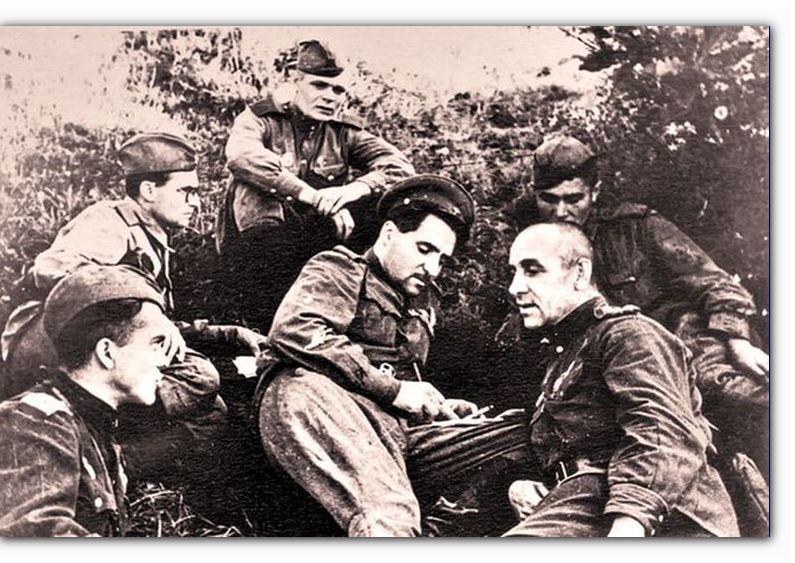
Konstantin Simonov (center) at the front.
When the front-line writer Viktor Astafyev was asked to assess yet another blockbuster about the Great Patriotic War, he replied that he could not do so because he had apparently fought in some other war. There was no point, he said, in discussing exaggerations, inconsistencies or the proportion of artistic invention by comparing Star Wars with Julius Caesar’s Gallic campaign: they were simply different things.
But why did this happen? Public interest in the truth about the war is enormous. One need only recall the millions of Russians who come out on 9 May for the “Immortal Regiment” carrying portraits of their ancestors. The number of military-patriotic and search groups grows every year. Even amid the general decline of the book market, war memoirs are still published in substantial print runs. High-quality Internet projects have appeared, including a library of front-line diaries.
One might think that the authorities would be the first to fan the embers of their citizens’ patriotic feeling—it would at least distract them from falling living standards. Yet nothing of the sort happens. Archives introduce fees for photographing documents with one’s own phone. Entire bodies of crucial wartime sources remain classified. Things have gone as far as posthumous attacks on the authors of “trench truth”: they supposedly saw the wrong things and wrote about the wrong things. Why should today’s patriotic officials feel any need to defend Stalin’s nomenklatura? It was the people who won, so surely the people should be praised. Yet there are reasons—and very serious ones.
After the war, writer and front-line correspondent Konstantin Simonov proposed creating a repository of soldiers’ memoirs and diaries at the Central Archive of the Ministry of Defense. The idea was discussed at Politburo level but abandoned after objections from the General Staff and the Main Political Directorate of the Soviet Army. The view of Victory and of the Party’s “leading role,” they argued, had to be uniform.
What that meant can be seen in Marshal G. K. Zhukov’s Memoirs and those of other commanders: emasculated, polished to the point of implausibility and, in all likelihood, written by ghostwriters.
Under Nikita Khrushchev, the six-volume History of the Great Patriotic War of the Soviet Union was published. From it one cannot determine, for example, exactly which Red Army units were stationed where in June 1941. Sifting through all six volumes yields little more than the names of military districts and the numbers of the armies assembled under their banners. How many soldiers did they contain? How were they armed?
A typical passage reads: “At the end of 1940 the personnel strength of airborne brigades doubled. From the beginning of 1941 the formation of several airborne corps was undertaken and was largely completed by 1 June 1941.” What does “largely completed” mean? How many is “several”? Are these sacks of potatoes? The number of paratroopers in the brigades doubled—from what original number?
Under Leonid Brezhnev, the history of the war expanded to twelve volumes, but the deliberate confusing of the reader continued. Why call it deliberate? Judge for yourself: the list of reviewers now filled an entire page—marshals, generals, academicians and members of the CPSU Central Committee. Many had fought in the war, where everything is extremely concrete: reinforcement means eight tanks, three Studebakers and a company of soldiers. Yet the history says: “Fleet Air Force units and formations consisted of 45.3% fighter aviation, 14% bomber aviation, 9.7% torpedo aviation and 25% reconnaissance aviation.” As one might guess, the multivolume work never states the total number of Fleet Air Force aircraft. And two hundred reviewers were apparently satisfied with that.
But the vast subject of the war could not be covered in fiction using only the memoirs of commanders. The screws had to be loosened. The so-called “lieutenant prose” of Vasil Bykov, Konstantin Vorobyov, Viktor Kurochkin, Yuri Bondarev and Viktor Nekrasov became a breath of truth.
It cannot be said that these writers made no effort to fit the prescribed format. In Nekrasov, for example, retreating Red Army men burn German tanks like sheaves of hay, even though we now know that the entire Wehrmacht possessed fewer than four thousand tanks in 1941. But the “lieutenants” also offered unalloyed truth in which millions of veterans instantly recognized their own experience.
Today it is hard to understand why Konstantin Vorobyov, author of Killed near Moscow and The Scream, was subjected to ideological pressure in 1963. His stories seem thoroughly patriotic and contain vivid Russian characters, yet his heroes allow themselves to question the single “leading role.” Soldier Vasyukov curses the security officers and is furious at being sent on a pointless, suicidal reconnaissance mission: “Here is what I don’t understand. Tell me, where have our tanks gone? And the planes? Eh? Or did we never have them? You see, with nothing but antitank rifles and half-liter bottles…”
Questions like these would never have been allowed anywhere near a Soviet war-film script. That is why audiences came to love the lyrical The Dawns Here Are Quiet, which cleverly avoided the subject of the “leading role,” and The Cranes Are Flying, whose cast contains not a single commander bending over a map.
One would think that front-line diaries should be a treasure trove for today’s filmmakers. Their testimony reached researchers like flowers pushing through asphalt: keeping diaries at the front was discouraged, even if there was no absolute prohibition from the highest level. Yet “trench truth” does not seem to inspire recipients of grants from the Ministry of Culture or the Cinema Fund. Rather, they turn the war into an enormous ideological “binding force,” masking the truth as Soviet multivolume histories did and producing something closer to Star Wars.
Statistics on losses in individual battles were declassified only in 1993. Yet according to Oleg Budnitsky, director of the HSE International Center for the History and Sociology of World War II and Its Consequences, the archive of the Main Political Directorate—which dealt with the army’s moral and psychological condition—remains closed to researchers. The military prosecutor’s archives, which contain information about how Soviet people burned with “noble rage,” are also unavailable. According to official statistics alone, more than 994,000 servicemen were convicted by military tribunals during the war.
Much of the Military Medical Archive is closed as well, so we know little about the purely physical condition of Red Army soldiers. Even in 1941 as many as 20 percent of conscripts were rejected on medical grounds, a figure that could tell us much about the state of the country and its armed forces.
A well-known archival specialist complained in the press that “it is generally impossible to describe any Red Army battle adequately when practically all exchanges of encrypted telegrams between Stalin, front and army commanders and Stavka representatives remain classified.” We do not know the logic of this ban, but we can speculate.
Front-line soldier Nikolai Nikulin wrote in his memoirs:
“One night I was substituting for the telephone operator at the set. Communications were primitive in those days, and conversations on every line could be heard at every point. I learned how our commander, I. I. Fedyuninsky, spoke to division commanders: ‘For fuck’s sake! Forward!!! If you don’t advance, I’ll have you shot! For fuck’s sake! Forward! For fuck’s sake!’ Two years ago the elderly Ivan Ivanovich, a kindly grandfather, was telling Young Pioneers about the war on television in an entirely different tone.”
Nikulin’s Memories of the War, written by a Guards sergeant who ended the war in Germany with two Medals “For Courage” and the Order of the Red Star, grew out of his front-line notes. Today he is often criticized by beardless bloggers for supposedly not understanding the subject, although it would be hard to find a greater hymn to the courage and persistence of the Russian soldier.
Nikulin describes the two-year assault on the small railway station of Pogostye near Leningrad. The Germans organized an effective defense, registered their machine-gun fire and built bunkers. A Soviet division numbering six or seven thousand suffered twelve thousand casualties because it was constantly replenished.
Nikulin wrote:
“Replacements arrive without interruption; there is no shortage of men. But among them are swollen dystrophic patients from Leningrad whom doctors have only just prescribed three weeks of bed rest and extra food. Among them are babies born in 1926—that is, sixteen-year-olds not subject to conscription… ‘Forwarrrd!!!’ and that is all.
“Eventually some soldier or lieutenant, a platoon commander, or more rarely a captain commanding a company, seeing this outrageous state of affairs, exclaims: ‘You cannot just destroy people! There is a concrete pillbox on that height! And all we have is a little 76-mm gun! It won’t penetrate it!’…
“Immediately the political officer, SMERSH and the tribunal become involved. One of the informers who infest every unit testifies: ‘Yes, in the presence of soldiers he expressed doubt about our victory.’ A ready-made form is filled out with only the surname to be inserted, and that is that: ‘Shoot him in front of the formation!’ or ‘Send him to a penal company!’—which amounts to the same thing. Thus the most honest people, those who felt responsibility before society, perished. The rest—‘Forwarrrd, attack!’”
But everyone knows how it ended: Pogostye was taken. Nikulin continued:
“A division of little Vyatka peasants arrived—short, bow-legged, wiry, high-cheekboned. ‘Ah, to hell with it! Whatever happens!’ They climbed onto the German pillboxes, smoked the Fritz out, blew everything up and advanced about five hundred meters. Over their bodies a rifle corps was thrown into the breakthrough, and then things began to move.”
Who else was capable of that? American farmers? Beardless bloggers? After the war a German veteran told Nikulin that some machine gunners in their regiment had gone insane: it is not easy to kill people row after row when they keep coming and coming without end.
Yet it would be wrong to say that the Red Army knew how to fight only by mass. The war includes the brilliantly conducted Operation Bagration, which drove the Germans out of Belarus with losses greater than those suffered by Marshal Konstantin Rokossovsky’s attacking forces.
Some will say that at the beginning of the war the Red Army did not know how to fight and later learned. The article argues that this is not true: much depended on the motives of the command. In April 1945 Marshal Georgy Zhukov decided to storm Berlin head-on and, according to many specialists, needlessly lost around 200,000 soldiers when they were only one step from returning home. One explanation offered is Zhukov’s bitter rivalry with Marshal Ivan Konev and his determination not to let Konev’s troops reach the Reichstag first, combined with a desire to finish by 1 May.
Tank soldier Vasily Subbotin wrote:
“Now we know that before the war the commanding personnel of our army were subjected to terrible repression, from lieutenants to marshals. That meant that the atmosphere among commanders was such that people were demoralized. They feared not the Germans but their own superiors.
“They were afraid to issue any order independently, without an order from above. No one dared take responsibility and organize a defense on some line. They simply retreated.”
Some may again suppose this was true only at the beginning of the war. But Subbotin ended the war in Berlin, and his notes do not suggest that the troop-control system changed. The most frightening thing about it was that generals and colonels were not severely rebuked for enormous losses, while failure to accomplish an assigned task on time could bring them before a tribunal. It did not matter whether the question was defense or attack, 1941 or 1945.
Viktor Astafyev described crossing the Dnieper at the end of 1943, by which time the army was supposedly already skilled at fighting:
“The Dnieper bridgeheads! I was south of Kyiv, on those very Bukrin bridgeheads—on two of the three. I was wounded there and I maintain, and will maintain until I die, that only people who did not care at all about another human life could have forced us to cross and fight like that. Those who stayed on the left bank and, ‘sparing not their lives,’ glorified our ‘feats.’ And we, on the other side of the Dnieper, on a patch of ground, hungry, cold, without tobacco, ammunition counted out, no grenades, no shovels, were dying, eaten by lice and by rats that for some reason flooded into the trenches in masses… I tried to write a novel about the Dnieper bridgehead—I cannot. It is frightening; even now it is frightening, my heart stops and headaches torment me.”
Astafyev recalled that they, the front-line men, “were only called soldiers after the war. Before that we were a bayonet, a fighter—in general, an inanimate object.” Their war stories were mockingly dubbed a “mound of view,” a pun on “point of view.” Subbotin echoed him: “Young Pioneers and generals tell us how we fought…” But perhaps war cannot be fought differently? After all, front-line diaries were not kept only by critics of the system.
In Konstantin Simonov’s notes from the 1960s we read:
“While I was with the active army in the first months of the war, I tried above all to find facts showing people’s steadfastness amid the horror that had fallen upon them, their heroism, their faith that not everything was lost, and the military skill that gradually emerged.”
Simonov believed that seeing confusion, panic and corpses along the roads was easy; the hard thing was to find a regiment or company that did not retreat and that fought. To do that one had to go to the forward edge, and many of Simonov’s colleagues died there. Yet even he—a classic, a decorated writer and prizewinner—was unable to publish his most intimate recollections in his lifetime. One Hundred Days of War appeared only in 1992. Why?
It seems that once Simonov decided to write the truth about the war rather than another The Living and the Dead, his heroes immediately ceased to fit the official format. War is an abnormal condition of life in which kind, decent ordinary people behave abnormally. They are unsuitable for posters in any case. “Only the people know the whole truth,” says one of Simonov’s characters.
In Nikolai Inozemtsev’s diary we read:
“On the day after the offensive I noticed trench work in the German positions. About forty men in greatcoats were brought in formation and, under the supervision of four or five submachine gunners, began digging trenches. I went to the battery observation post, watched through the stereoscopic telescope and established that they were our prisoners. We asked regimental headquarters. The answer: ‘Open fire immediately!’ Hundreds of mortar bombs were poured on them. A good object lesson for those who thought of following a bad example.”
A front-line soldier who had already been through a great deal regarded capture as a “bad example” deserving death.
Hero of the Soviet Union Georgy Slavgorodsky sent his notes from the front to his mother in Rostov Region. In the summer of 1944 he wrote from Western Ukraine:
“We have to replenish our establishment on the move. We added three horses, and yesterday there was a scandal about one: the owner recognized it. With another we managed to deceive the owner. Individual farmers, the devils, cling to every nag, not knowing that they will have to surrender them to the collective farm anyway… Never mind, we’ll work on them.”
And again:
“I carried out a search in the apartment where our supply platoon had been quartered. They said there was a lot of captured sugar there. Vinogradov made me a false identity card, I put on the battalion commander’s greatcoat and the commissar’s cap and was afraid the landlady might recognize me. I played the role well, but we found nothing.”
Slavgorodsky, like mortar lieutenant Vladimir Gelfand, was a convinced Stalinist. Gelfand’s diary is essentially a Bildungsroman. At its beginning, on 2 July 1941, the recent schoolboy writes: “The war changed all my plans for spending the summer holidays.” Yet he had no intention of evading the army:
“I was frightened by my mother’s tears, yielded to her pleas and decided to avoid military service. What is a reserved occupation? Isn’t cheerful trench life for the good of my Motherland better? Ardent military service connected with danger, filled with bloody combat episodes.”
One might think Gelfand would be a perfect find for advocates of a “single view” of the war. But by 1945 the young man had changed somewhat: he vividly describes abuses in liberated territories and terrified German women who dream of giving themselves to him—if only to him, rather than to another twenty “Ivans.”
Front-line diaries involuntarily remind us that the Soviet people won the bloodiest war in history even though they had often been neither properly taught to fight nor adequately fed or clothed. Veterans write that many wore tunics and underwear with seams down the stomach because the clothes had been cut from the dead and sewn up again. Some received proper uniforms only in December 1943. Instead of food, salted water mixed with a handful of flour and frozen bread that had to be chopped with an axe reached the front line.
“Eat and sleep”—that is what front-line soldiers most often wrote about as their main desires. Yet those same soldiers drove what was considered the best army in the world all the way to Berlin. Is that not a reason for descendants to be proud?
The myth that without Stalin and Zhukov the country would have been doomed tends to diminish the courage and endurance of ordinary soldiers and officers who rose to attack, sometimes in obedience to wild and senseless orders.
In the memoirs of American General Dwight Eisenhower there appears a story about Zhukov, somewhat drunk in defeated Berlin, boasting about a tactical discovery: the fastest way to clear a minefield, he supposedly said, was to send a company of soldiers in front of the tanks. Eisenhower was shocked; Germans, British, even Zulus, the article says, did not fight that way. Nor had the Imperial Russian Army.
Historian Viktor Pravdyuk says that Soviet historiography, when telling the story of the first year of the war, often uses the word “but”: half a million Red Army men were surrounded, but they tied down large enemy forces and slowed the advance on Moscow. Taken far enough, this logic becomes absurd: by December 1941, 3.8 million Red Army men had been taken prisoner, but the Germans had to assign twenty-eight divisions to guard them.
If Stavka had not issued hysterical orders to attack “bandits who had broken through,” and if Soviet forces had not been concentrated with extreme density along the western borders, perhaps there would have been less need for these “buts.” Perhaps, with normal organization of defense and the Soviet Union’s overwhelming superiority in tanks and aircraft, German forces would not have stood before Moscow and Leningrad by autumn. And perhaps people would not have to argue over whether the price paid for Victory was one to five or one to ten.
The version according to which the Soviet Union defeated Germany not thanks to Stalin and Zhukov but in spite of them has, at the very least, a right to exist, the article argues. Yet it does not suit the present authorities. It would make it harder to persuade Russians that officials who fail year after year to cope with the heating season are capable of leading the country to victory in a possible war with the West—the sort of war they discuss so boldly on television. Frosts and floods may always take them by surprise, but they would supposedly always be ready for a nuclear strike on Moscow. Coordination and public warning failed only during the Krymsk flood and the explosion in the St. Petersburg metro.
The author says it is difficult to imagine a provincial governor who gives a television set to a blind veteran feeding lice in a trench; it is easier to imagine him on a yacht in the open ocean shouting by satellite telephone, “Forward! For fuck’s sake! Forward!” Nor is a regional “father” who thinks gas is extracted from ice likely to be an effective wartime administrator. And would a long-serving regional boss whose leadership was disgraced by children dying in a shopping-center fire truly protect soldiers in battle?
Russian generals who only recently sent thousands of poorly prepared conscripts into the assault on Grozny are described as genuine heirs of Zhukov. At the General Staff Academy, the article says, they learned the main commander’s secret: if you want a stove to burn better, fill it to the brim with firewood.
Someone may reply that the great Stalin cannot be compared with today’s corrupt officials. The article cites testimony by Pavel Sudoplatov, deputy head of an NKVD intelligence directorate. According to him, in the first days of the war Lavrenty Beria, acting on government instructions, ordered him “unofficially to find out on what conditions Germany would agree to end the war against the USSR… whether Germany would be satisfied with the transfer of Soviet territories such as the Baltic states, Ukraine, Bessarabia, Bukovina and the Karelian Isthmus. If not, what additional territories Germany claims.”
The author suggests that this may help explain the leader’s long silence before his radio address of 3 July beginning “Brothers and sisters…” And, believing that the decisive contribution to Russia’s greatness came from Stalin bending over a map, people are not supposed to ask what became of the “Russian billion” that pre-revolutionary demographers had predicted for the end of the twentieth century.
In recent years Russians have shown the greatest interest precisely in the “social history” of the war, studied through “ego-documents”: diaries, memoirs and personal archives.
According to Mikhail Melnichenko, founder and director of the Internet project Prozhito, which publishes personal diaries online, the year 1942 confidently holds first place among the dates of incoming records.
Melnichenko says he is not inclined to trust diary authors one hundred percent. First, people live under various ideological assumptions. Second, even in diaries people tend to conceptualize their own lives and present themselves in a particular way. Prozhito therefore neither comments on nor evaluates diaries. Documents should speak for themselves.
This applies even when serviceman Nikolai Ivanov reflects:
“What successes have I had in terms of my well-being, in satisfying my purely individual, selfish aspirations? First, on the evening of 24 January, at about twelve at night, on my cot, I finally compelled Maria M. to give herself to me. Evidently she is not exactly fresh, despite being nineteen years old.”
When a reader is interested in war not only through tank specifications and arrows on maps, the reader thinks more broadly—and has a chance to understand more.
© Argumenty Nedeli
© NDN.INFO
© MOZGOKRATIYA
The image logos identify the publications Argumenty Nedeli, NDN.INFO and MOZGOKRATIYA (“Think Together”). The historical photograph is captioned in the article as “Konstantin Simonov (center) at the front.”