




 |
 |
 |
 |
 |
 |
Презентація книги Олени Проскури "Запізніла сповідь" |

© Olena Proskura 2016
 Ukrainian
A Belated Confession
Title: A Belated Confession
Publisher: Interservice, Kyiv
Year: 2016
Author: Olena Proskura
Language: Ukrainian
Format: 20.8 × 15.2 × 3.2 cm
Pages: 506, illustrated
Weight: 700 g
ISBN-10: 6176964768
ISBN-13: 978-6176964766
Price: €29.95
Olena Vasylivna Proskura is a world-renowned Ukrainian specialist in child psychology, a student of H. S. Kostiuk and O. V. Zaporozhets. This unique publication, prepared in the genre of “private history,” contains memories of the terrible war and post-war years, the orphanage, growing up, study at a teacher-training college and pedagogical institute. A substantial part of the book tells about her postgraduate years and later work at the Institute of Psychology, about friends and colleagues, many of whom are no longer with us, and about repression against the Ukrainian elite in the 1960s and 1970s. The book also contains Olena Vasylivna’s recent scholarly work—research in the history of pedagogy devoted to Sofia Rusova, Janusz Korczak, Vasyl Sukhomlynsky and Yakiv Reznik. The presentation was attended by academicians of the National Academy of Educational Sciences of Ukraine: psychologists Serhii Dmytrovych Maksymenko and Natalia Vasylivna Chepelieva; educators Oleksandra Yakivna Savchenko, Olha Vasylivna Sukhomlynska and Nadiia Mykhailivna Bibik; many employees of the Institute of Psychology; former postgraduate students of Olena Vasylivna; and colleagues and friends of her husband, the well-known Ukrainian physicist Oleksandr Ivanovych Proskura.
Oleksandra Savchenko:
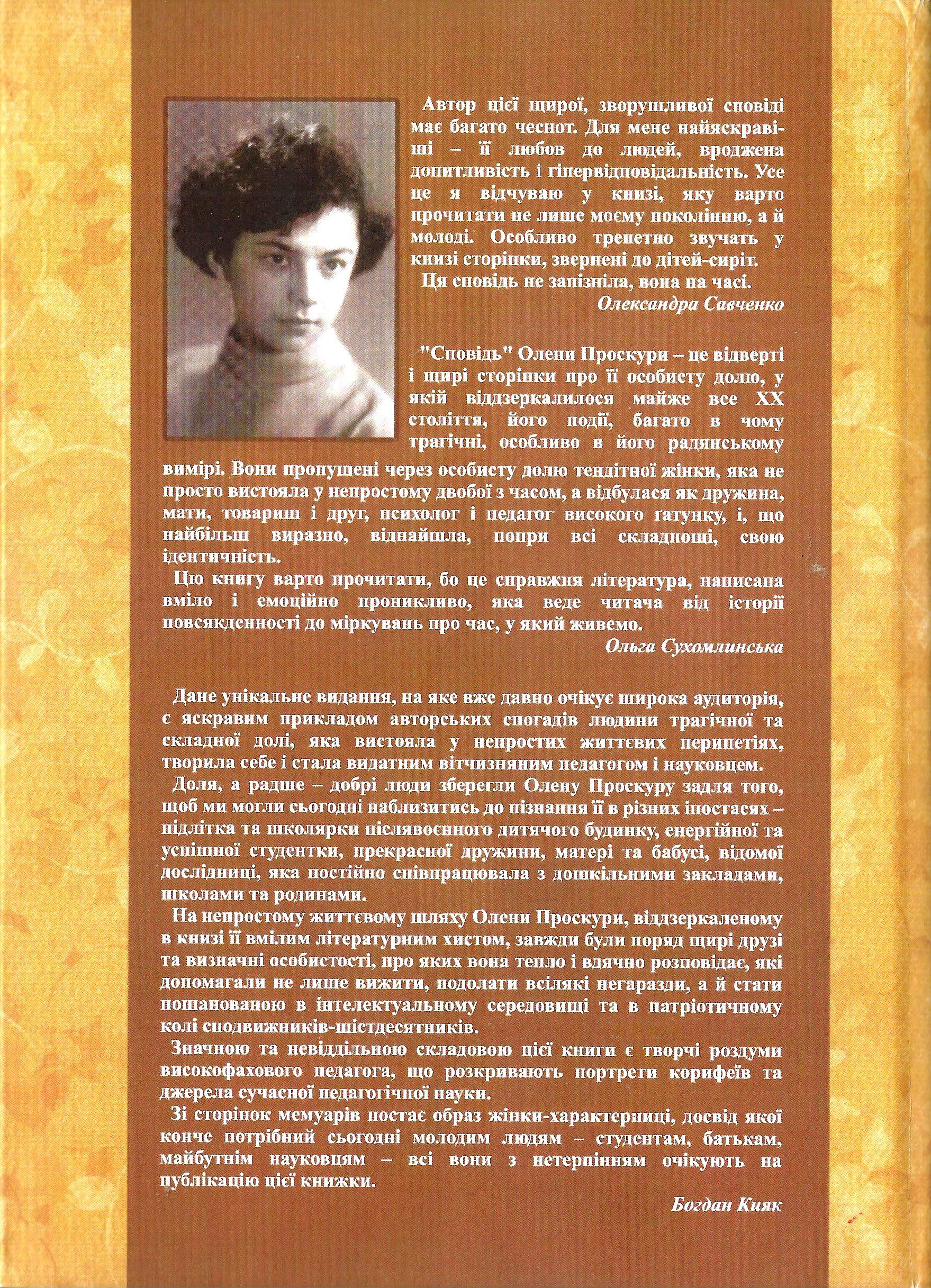
The author of this sincere and moving confession has many virtues. To me the most striking are her love of people, innate curiosity and extraordinary sense of responsibility. I feel all of this in a book that deserves to be read not only by my own generation but by young people as well. This confession is not belated; it has appeared at exactly the right time.
Olha Sukhomlynska:
Olena Proskura’s Confession consists of frank and sincere pages about her personal fate, in which almost the whole twentieth century and its events—many of them tragic, especially in their Soviet dimension—are reflected. They are refracted through the fate of a fragile woman who not only withstood a difficult duel with her age, but fulfilled herself as a wife, mother, companion and friend, and as a psychologist and educator of the highest calibre. Most distinctly of all, despite every difficulty, she found her own identity. This book is worth reading because it is genuine literature, written skilfully and with emotional insight, leading the reader from the history of everyday life toward reflection on the age in which we live.
Bohdan Kyiak:
This unique publication, long awaited by a broad readership, is a vivid example of an author’s memoirs by a person with a tragic and complicated fate who endured difficult turns of life, shaped herself and became an outstanding Ukrainian educator and scholar.
Fate—or rather, kind people—preserved Olena Proskura so that today we can come closer to knowing her in her different roles: a teenager and pupil in a post-war orphanage, an energetic and successful student, a wonderful wife, mother and grandmother, and a well-known researcher who constantly worked with preschools, schools and families.
Along Olena Proskura’s difficult life path, which her literary talent reflects in this book, there were always sincere friends and major personalities. She writes warmly about them in the manuscript. They helped her not merely survive and overcome every kind of hardship, but also become respected in intellectual circles and among the patriotic community of the Sixtiers.
A substantial and inseparable component of the book is the creative reflection of a highly qualified educator, revealing portraits of major figures and the sources of modern educational science. From the memoirs emerges the image of a strong-willed woman whose experience is urgently needed today by young people—students, parents and future scholars—all of whom have been eagerly awaiting publication of this book.
Semen Gluzman, physician and former political prisoner:
That is how we lived. Methodically, happily, despicably—as a Soviet person was supposed to live, depending on specific circumstances and opportunities, looking over one’s shoulder every day at the danger emanating from the totalitarian state-supervisor. It was the ordinary life of the Soviet intelligentsia, firmly and confidently described by the authorities as a “stratum.”
This book is not a commentary on the past or on a life already lived. It contains no unambiguous judgments or political-science reflections. It is an ordinary narrative, a record of names, deeds, encounters and partings—partings caused by death and partings caused by arrest. Everything is as it was in that country. The happiness of conceiving and giving birth to a child... and a whispered message from a colleague about something heard on Radio Liberty or the Voice of America.
Resistance is only one aspect of life. Yes, there were the French maquis and Soviet dissidents, but there was also ordinary life, with love and joy, the defence of a dissertation, the reading of an intelligent book, and the habitual obligation to attend meaningless meetings and political-information sessions. Here, in this book, is truth—the ordinary truth of names, deeds, encounters and partings. Decades from now, our descendants will want to understand us better: our lives, our fears, our longing and our happiness. It will also be very important for them to understand why, after unexpectedly receiving the luxury of freedom and democracy by the will of fate, we learned to use it with such difficulty and pain. They will not find the answer in Levko Lukianenko’s memoirs, nor in my own prison memoirs, because it is not there.
The answer is in Mrs. Proskura’s calm, measured and very honest book. That is exactly how we lived. And unfortunately, that is still how we live today, at the beginning of the twenty-first century.
V. S. Manzhara, Academic Secretary of the Institute of Physics of the National Academy of Sciences of Ukraine, Candidate of Physical and Mathematical Sciences:
Olena Vasylivna Proskura is a scholar, educator and psychologist well known in Ukraine, the author of educational, popular-science and methodological works devoted to children’s development, teaching and upbringing; the formation of personality and individuality; and the creation of conditions for developing children’s abilities. Her works, the result of many years of research and observation, take account of the experience of outstanding philosophers and educators who studied thinking and the human understanding of the world—from Aristotle, Hegel, Spinoza, Jean-Jacques Rousseau and Pestalozzi to V. O. Sukhomlynsky. Olena Vasylivna knew their ideas well and used them creatively under modern conditions. Her speeches and written recommendations to educators and parents on the content and methods of teaching were therefore received with great respect and remain relevant to contemporary educational problems.
While conducting joint semiconductor research with the noted specialist in physics and the history of physics Oleksandr Ivanovych Proskura, I knew that his wife, Olena Vasylivna, was a talented scholar in pedagogy and psychology. When she allowed me, as her husband’s colleague and an educator by training, to read the manuscript of her memoirs, I was very grateful for the trust and, despite my own heavy workload, read them attentively from first page to last.
Analysing every step of her conscious life, Olena Vasylivna concluded that the chief impulse for beginning these memoirs was her awareness of guilt over a childhood opportunity she had missed to help Mrs. Iryna, who during the war had hidden her under a table in her home, saved her life and became a saintly woman in her memory. Olena Vasylivna has carried the memory of this probably imagined guilt like a heavy stone throughout her life. It is one of the things that demonstrates her extraordinary responsibility, honesty and sense of justice. The entire work, like all her activity, is filled with respect for people, goodwill and profound gratitude to every unforgettable caregiver, teacher, family member, pupil, student, colleague, and old and new friend. This is felt on every page and encourages the reader to turn to the next page of the memoirs of this exceptional person.
The war took away the beginning of Olena Vasylivna’s life, deprived her of a mother’s and father’s love, the care of grandparents and the family warmth necessary for a happy childhood, and made her a complete orphan in a children’s home, with the constant feeling of hunger in which frozen potatoes found in a field in late autumn or scraps discovered in a spring field were regarded as happiness. Most caregivers and teachers treated the children compassionately, supported them and strengthened their faith in themselves and in the future.
Olena Vasylivna describes the post-war hardships without embellishment and with extraordinary realism. Life was not sweet for the people as a whole, but the difficulties most strongly affected orphans. Even then she tried to live decently and lawfully and became one of the few children from orphanages who managed to hold on in life and stand on her own feet. Her memory is filled mainly with recollections of kind classmates and compassionate teachers. But she could never forget what she had experienced. Her sympathy for children living in orphanages did not fade, and she focused her professional activity on improving the fate of orphans.
The description of this instructive path—from a child in an orphanage to a university lecturer and the author of curricula and textbooks for educators and parents—deserves wider dissemination, for example in the form of a feature film.
Modern technology makes it inexpensive to produce and place online a video interview with Olena Vasylivna. Such a film would be exceptionally useful both as moral support for children in orphanages—whose numbers, according to Olena Vasylivna, have unfortunately not declined very much since the post-war period—and for their caregivers and parents. It could teach adults to treat children calmly, lovingly and gently and help strengthen family relations and traditions, something especially important in the present period of social development. After all, the chief defect of education today is one shared by all spheres of life in the country—agriculture, industry, artists’ unions—the division into bosses and executors, whose interaction is still most often governed by mistrust and even fear. Saying that the school is a model of society, Olena Vasylivna writes: “The General Secretary governs the entire country, a factory director thousands of workers and engineers, the head of a collective farm an entire village, a teacher whole classes of pupils and often their parents. He is their leader, their boss. Whoever commands is always right. Yet we strive for democracy and humanism—that is, humanity—not authoritarianism.”
Speaking of the well-known openness of our compatriots in discussion, Olena Vasylivna notes first of all a readiness to argue, oppose and deny rather than agree with another person’s opinion. She says life cannot be considered complete if a person does not know how to take joy in it, cannot find reasons for joy or notice and create them, and has not learned to be friendly and pleasant to others, to notice positive qualities in them and value them. She recalls the beginning of attempts to introduce the humanistic ideas of V. O. Sukhomlynsky, who regarded restoring joy to children, creating conditions for it and encouraging the ability to rejoice in life as the chief task of society and the school. Unfortunately, the intentions to reform education remained only intentions.
Describing in detail the stages of her creative growth and the life problems of her family, colleagues and friends, Olena Vasylivna reflects on the meaning and problems of human life and development, the country and society; on patriotism and interethnic relations at official and everyday levels; on the problems and fate of mixed Ukrainian-Jewish families; and on the role of family celebrations and traditions in a child’s upbringing. Particularly interesting are her reflections on the slogan “criticism is the engine of progress.” Criticism, however, often produces mutual offence and an opponent rather than new ideas.
Olena Vasylivna regards a special style of communication and relationships, which she was fortunate to encounter in life, as one of the guarantees of successful cooperation within a group and between a leader and a collective. Important qualities include readiness not to expect gratitude but always to be grateful oneself, to speak without harsh or overly categorical judgments, and to choose suitable terms.
A substantial part of her memoirs is devoted to the ideas and work of well-known public figures—the Sixtiers, scholars and historical personalities whose works she came to know. Among them are the classics Jean-Jacques Rousseau, Maria Montessori and Sofia Rusova, and the more recent Janusz Korczak with his book How to Love a Child, a pedagogical encyclopedia describing different circumstances in which a child comes into the world, the course of development, abilities and most important needs; V. O. Sukhomlynsky with his idea of a school of joy; and Ya. B. Reznik, a prominent Ukrainian educator and psychologist and the first Doctor of Pedagogical Sciences in Soviet Ukraine, born on 22 April 1892 in picturesque Chernobyl, today known throughout the world. Published separately, this portion of the Confession would make an excellent pedagogical textbook.
Olena Vasylivna recalls that after her presentation at a republican conference on the upbringing of orphaned children, the first secretary of the Poltava regional party committee, Fedir Morhun, addressed the audience: “Let us applaud Olena Vasylivna once again for her excellent presentation. What a pity I did not hear something like this when my own children were growing up.” Today we should once again thank Olena Vasylivna for an excellent book and inform preschool educators, primary-school teachers and the public about it widely, so as to prevent mistakes made in educational institutions and families unfamiliar with the advice of outstanding educators, including Olena Vasylivna herself.
Presentation of Olena Proskura’s book A Belated Confession
© Olena Proskura 2016
Text visible in the book images and scans
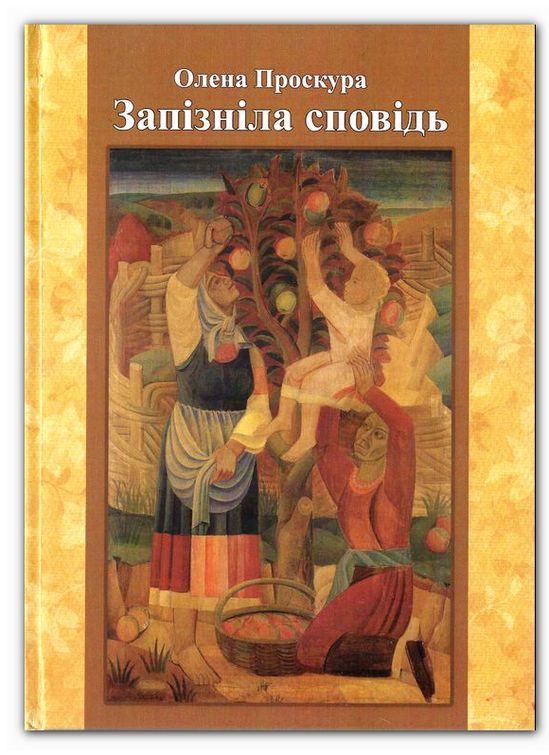
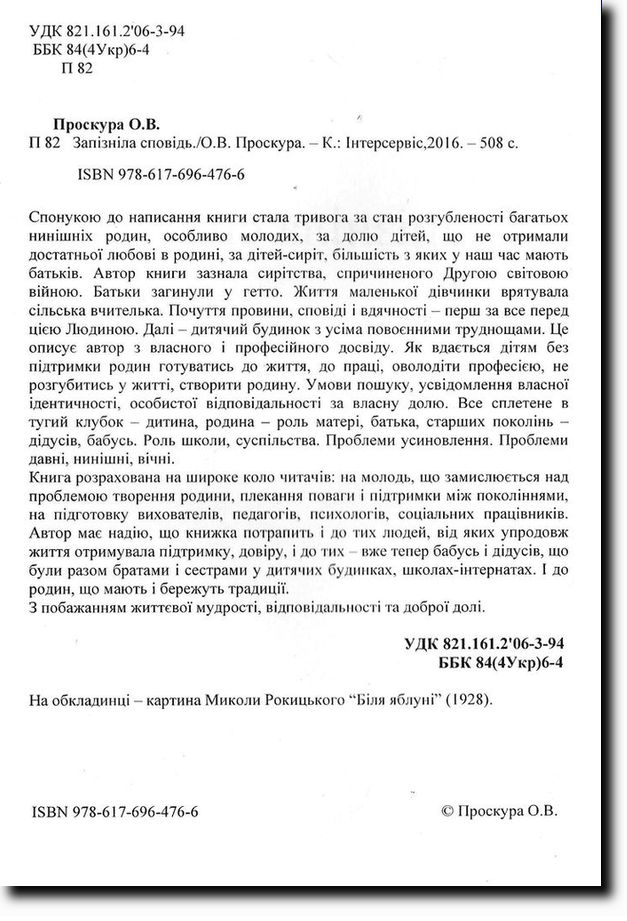
Bibliographic/back-cover page (4.jpg): The book was prompted by concern about the disorientation of many contemporary families, especially young ones, and about children who do not receive enough love in the family. Most children today have both parents. The author’s own book began with her orphanhood, caused by the Second World War. Her parents died in a ghetto. The little girl’s life was saved by several ordinary people. Then came a children’s home with all its post-war hardships. This is the story of an educator and professional teacher who, without family support, prepared herself for life and work, mastered a profession, did not lose herself in life, and created a family. The book is intended for a wide readership: young people thinking about creating a family and nurturing respect and support between generations; educators, teachers, psychologists and social workers. It is meant to inspire respect for people of different ages who have arranged their lives differently, and to encourage mutual care and the preservation of family traditions. The cover reproduces Mykola Rokytsky’s painting By the Apple Tree (1928).
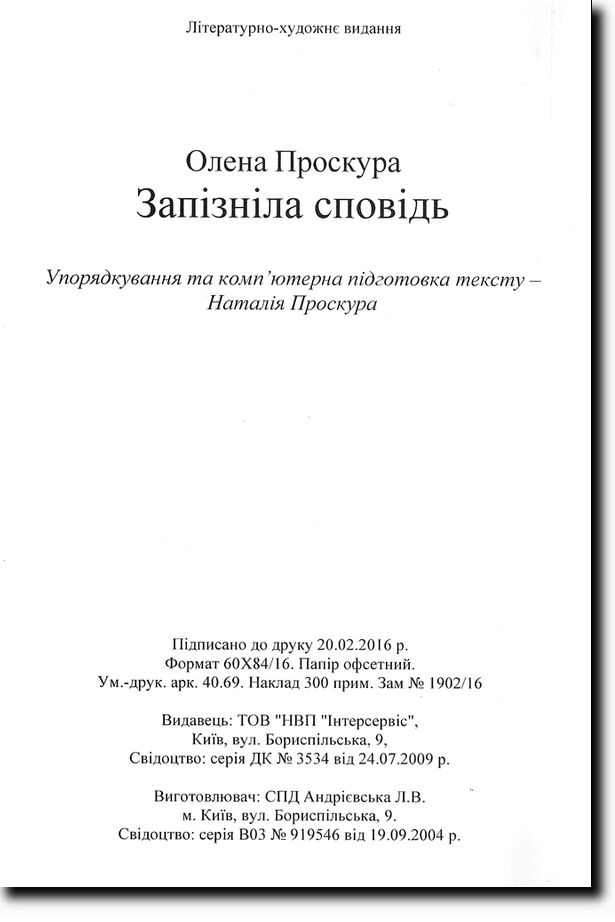
Title/publication page (5.jpg): “Literary-artistic publication. Olena Proskura. A Belated Confession. Editing and computer preparation of the text: Natalia Proskura.” Signed for printing on 20 February 2016; offset paper; print run 300 copies; publisher Interservice, Kyiv.
Dedication page (10.jpg): “To Mrs. Iryna Romanovska and her family I bow deeply and give thanks for preserving my life. To the children of orphanages—my sisters and brothers—with the wish that they hold on in life and never lose faith in goodness. To Oleksandr Proskura and his mother, Olha Andriivna Rokytska, with gratitude for giving me the feeling of having a family. To my daughter Natalia Proskura and my grandson Mykola-Mykhailyk Proskura.” The handwritten dedication reads approximately: “Dear Bella and your kind family, with respect, Olena Proskura, 11 June 2016.”
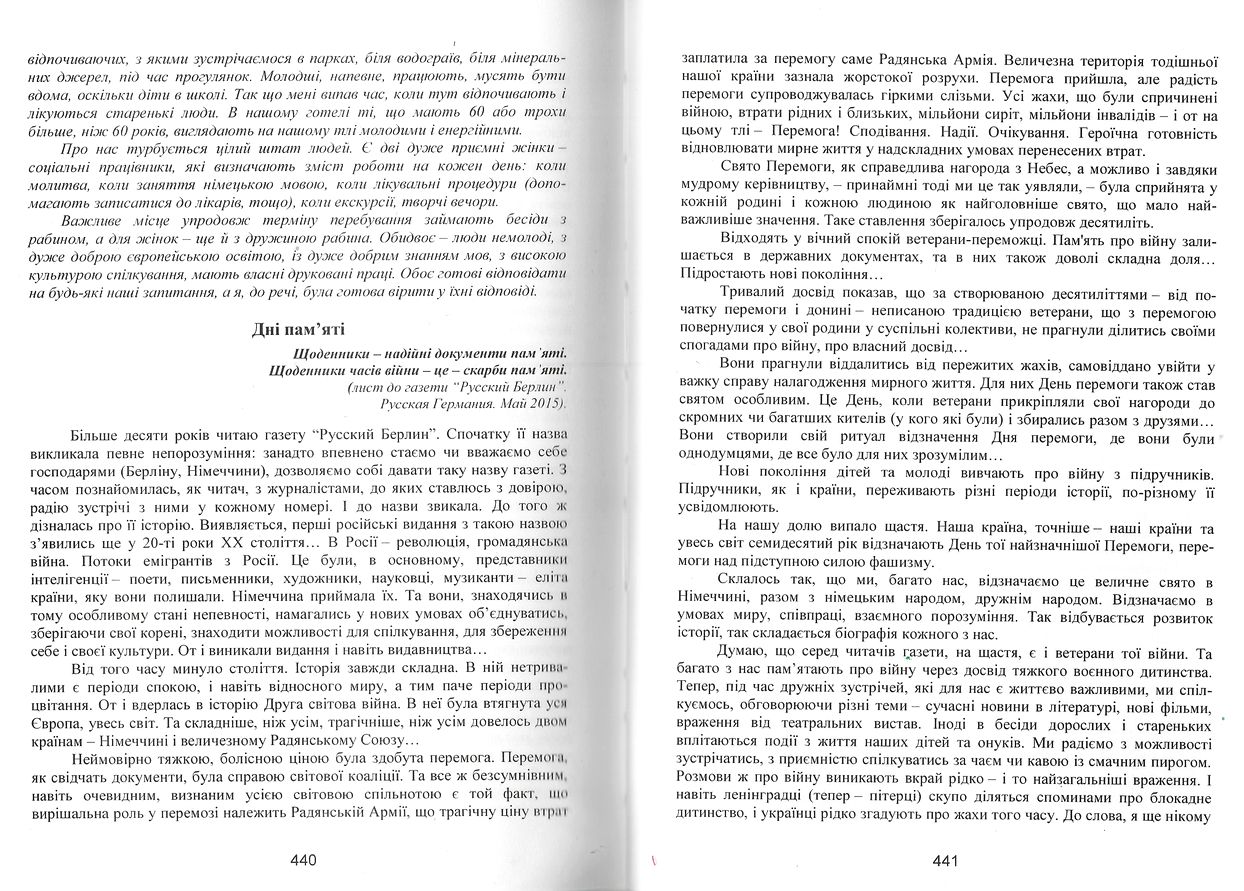
Book pages 440–447 (6.jpg–9.jpg): “Days of Remembrance”
The preceding passage ends with the author describing older holidaymakers whom she meets in parks, by fountains and mineral springs. Younger people are apparently working or at home while their children are in school, so she is there at a time when elderly people are resting and receiving treatment. A whole staff looks after them. Two pleasant social workers organize each day: prayer, German lessons, medical procedures, excursions and creative evenings. Conversations with the rabbi—and, for women, also with the rabbi’s wife—occupy an important place. Both are older, highly educated Europeans with excellent language skills and a refined culture of communication; they have published works of their own and are ready to answer any question.
Days of Remembrance
Diaries are reliable documents of memory.
Diaries from wartime are treasures of memory.
(letter to the newspaper “Russkiy Berlin,” Russkaya Germaniya, May 2015)
I have been reading the newspaper Russkiy Berlin for more than ten years. At first its name caused some confusion: were we becoming, or imagining ourselves to be, the masters of Berlin and Germany so confidently that we allowed ourselves to give a newspaper such a name? Over time, as a reader, I came to know the journalists, whom I trust and am glad to encounter in every issue, and I became accustomed to the name. I also learned its history. It turns out that the first Russian publications with such a name appeared as early as the 1920s. Russia had undergone revolution and civil war, and streams of emigrants left the country. They were chiefly representatives of the intelligentsia—poets, writers, artists, scholars and musicians—the elite of the country they had left. Germany received them. In their special state of uncertainty, they tried under new conditions to unite, preserve their roots, find opportunities to communicate, and preserve themselves and their culture. Publications and even publishing houses therefore arose.
A century has passed since then. History is always complicated. Periods of calm and even relative peace are short, and periods of prosperity still shorter. Then the Second World War burst into history. All Europe and the whole world were drawn into it. But two countries had a more difficult and more tragic fate than all others: Germany and the enormous Soviet Union.
Victory was won at an unimaginably heavy and painful price. Documents show that victory was the work of a global coalition. Yet it is unquestionable—indeed obvious and recognized by the world community—that the decisive role in victory belonged to the Soviet Army, which paid a tragic price for that victory. The huge territory of our country at that time suffered brutal destruction. Victory came, but the joy of victory was accompanied by bitter tears. All the horrors caused by the war, the loss of relatives and loved ones, millions of orphans and millions of disabled people—and against this background, Victory! Hopes. Expectations. Heroic readiness to restore peaceful life amid the extremely difficult conditions created by these losses.
Victory Day was received in every family and by every person as a just reward from Heaven—and perhaps, as we imagined then, also thanks to wise leadership—as the greatest and most important holiday. That attitude persisted for decades.
The victorious veterans are passing into eternal rest. The memory of the war remains in official documents, although those documents too have had a complicated fate. New generations are growing up.
Long experience has shown that an unwritten tradition, created through the decades from the moment of victory to the present, meant that veterans who returned with victory to their families and social communities did not seek to share their memories of the war or to explain their own fate. They wanted to distance themselves from the horrors they had experienced and selflessly enter the difficult work of building peaceful life. Victory Day became a special holiday for them too: a day when they pinned decorations to whatever tunics they had, modest or richer, and gathered with friends. They created their own ritual of commemoration, among people who understood one another without explanation.
New generations of children and young people learn about the war from textbooks. Textbooks, like countries, pass through different periods of history and understand it differently.
We were fortunate. Our country—or more precisely, our countries and the entire world—are marking the seventieth anniversary of that most important Victory, the victory over the treacherous power of fascism.
It so happens that many of us are celebrating this great holiday in Germany, together with the German people, a friendly people. We celebrate it under conditions of peace, cooperation and mutual understanding. That is how history develops; that is how each of our biographies is formed.
I think that, fortunately, there are veterans of that war among the newspaper’s readers. Many of us also remember the war through the experience of a difficult wartime childhood. Now, during friendly meetings that are vitally important to us, we talk about many things—new books, new films, impressions of theatre performances. Sometimes the events of our children’s and grandchildren’s lives enter the conversations of adults and elderly people. We are happy to meet and enjoy talking over tea or coffee with a good cake. Talk of the war arises extremely rarely and then only in the most general impressions. Even people from Leningrad—now St. Petersburg—share little about their childhood during the blockade, and Ukrainians rarely recall the horrors of that time.
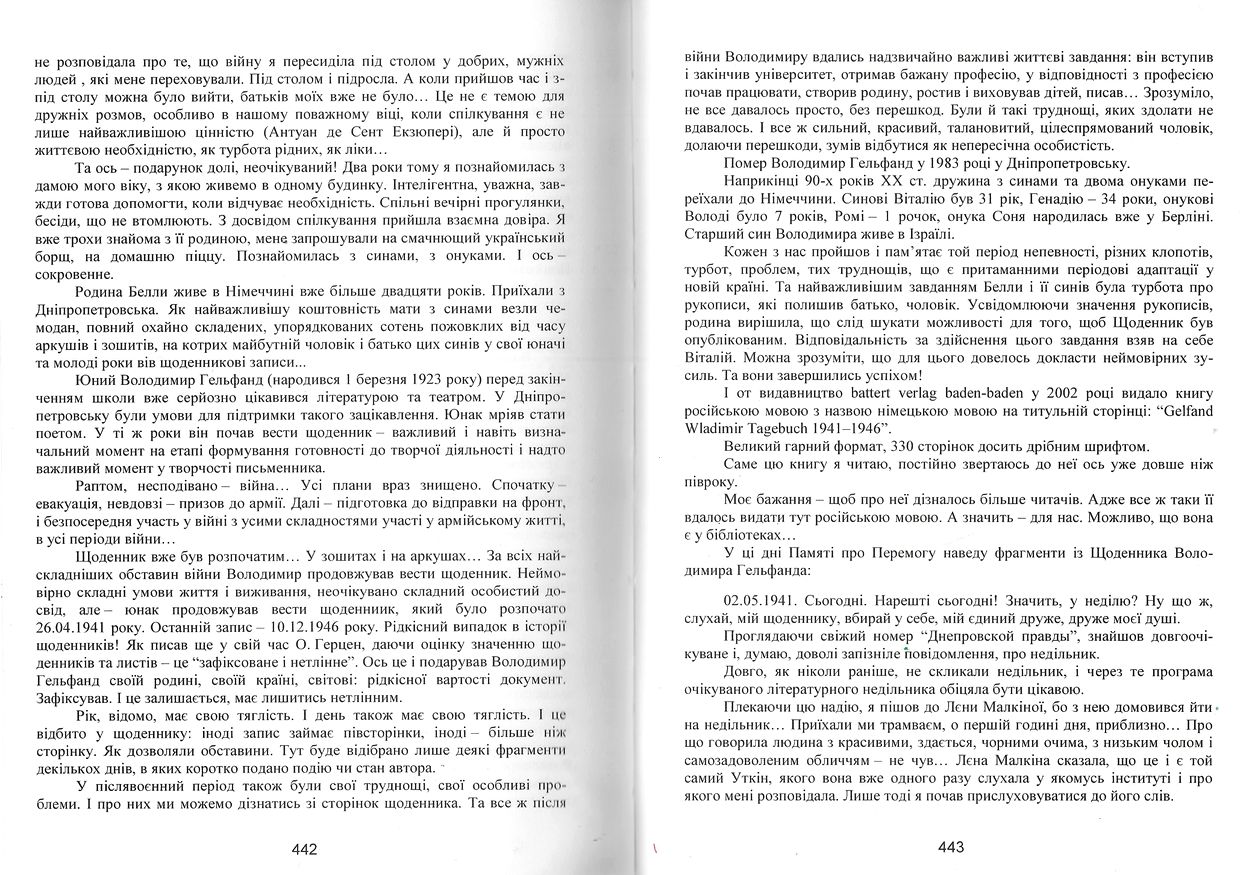
For my part, I had never told anyone that I survived the war under the table of kind men who hid me. Under that table I grew up. And when visitors came and one could see their feet beneath the table, my parents were already gone. This is not a subject for friendly conversation, especially in our respected age, when communication is not only the most important value—Antoine de Saint-Exupéry—but a simple necessity of life that must be shared, as bread is shared.
Then came an unexpected gift of fate. Two years ago I met the family in whose home I live, with whom I keep in close contact. An intelligent, attentive family, always ready to help when needed. We take evening walks together, talk, and sometimes I even trust them with my thoughts. I am already closely acquainted with the family, have been invited to delicious Ukrainian borscht and homemade pizza, and have met the sons and grandchildren. In short, the connection is complete.
The Bella family has lived in Germany for more than twenty years. They came from Dnipropetrovsk. Of greatest interest to me is the mother’s account of her son—modest, filled with carefully arranged memories of the bygone times, of people and events, and on whose shelves are books by writers familiar from my youth together with diary entries.
Yurii Volodymyrovych Gelfand, born on 1 March 1923, was seriously interested in literature and theatre before leaving school. In Dnipropetrovsk there were conditions that supported such an interest. The young man dreamed of becoming a poet. In those years he began keeping a diary—an important stage in developing readiness for creative work and a very important moment in the formation of a writer.
Then suddenly came war. Every plan was destroyed. First evacuation, hardship and conscription into the army. Then preparation to be sent to the front, direct participation in the war with all the difficulties of army life, and all the trials of war.
The diary had already begun—in notebooks and on loose sheets. Throughout the most difficult circumstances of the war Vladimir continued to keep it. With extraordinary care and commitment he recorded events reliably and impartially, but he continued writing a diary that had begun on 26 April 1941. The last entry is dated 10 December 1946. The years recorded in the diary were important in history. As I. Ehrenburg once wrote in assessing the importance of diaries and letters, they are “recorded and imperishable.” That is the gift Vladimir Gelfand made to his family, his country and the world: a document of rare value. It was preserved—and remains immutable.
A year has its own burden; a single day also has its burden. That is why the diary contains different kinds of entries—sometimes terse and only a little more extensive than a line in a school diary. Only a few fragments from several days are selected here, briefly recording an event or the author’s condition.
In the post-war period Vladimir successfully accomplished exceptionally important life tasks: he entered and graduated from university, acquired the profession he wanted, worked in that profession, created a family, raised and educated children, and wrote stories and poems. Not everything was easy; there were obstacles that sometimes seemed impossible to overcome. Yet he, strong, handsome, talented and purposeful, overcame difficulties and could fight with malice and dishonesty.
Vladimir Gelfand died in Dnipropetrovsk in 1983.
At the end of the 1990s his family moved to Germany with their sons and grandchildren. His sons Vitalii and Hennadii were then thirty-one and thirty-four; his grandsons Volodia and Roma were seven and one, while granddaughter Sonia was born in Berlin. Vladimir’s eldest son lives in Israel.
Each of us had his or her share of uncertainty, troubles and problems in that period of adaptation to a new country. Bella and her sons’ most important task was to care for the manuscripts left by a father and husband. Aware of the importance of the manuscript, the family decided to seek a way to publish the diary. Vitalii had a task that seemed hopeless. One can imagine the immense effort it required. Yet they completed it successfully.
In 2002 the publishing house Battert Verlag in Baden-Baden published the book in Russian with the title in German: Gelfand Wladimir Tagebuch 1941–1946. It was a large, attractive format, 330 pages in dense type.
I have the book and read it, constantly returning to it for more than two years.
My wish is for more readers to learn about it. After all, it was published here in Russian as well, which means it can reach us too. Perhaps it will have more editions.
During these days of remembrance of Victory, I will quote fragments from Vladimir Gelfand’s diary:
2 May 1941. Today. At last, today! So, on Sunday? Well then, listen, my diary, take into yourself, my only friend, the friend of my soul. The programme is fresh and includes No. 4 of Dneprovskaya Pravda, an overdue and, I think, rather late announcement about Sunday. I had never planned Sunday so early, and because of that programme I had expected interesting Sunday communication. Filled with hope, I went to Lena Malkina, because I had arranged with her to go on Sunday... I arrived by tram, entered the building, approached the door and came nearer. A man with handsome, apparently black eyes, a low forehead and a self-satisfied face was speaking with her—it was Utkin himself, whom she had listened to once at some institute and later told me about. Only then did I begin to listen to his words.
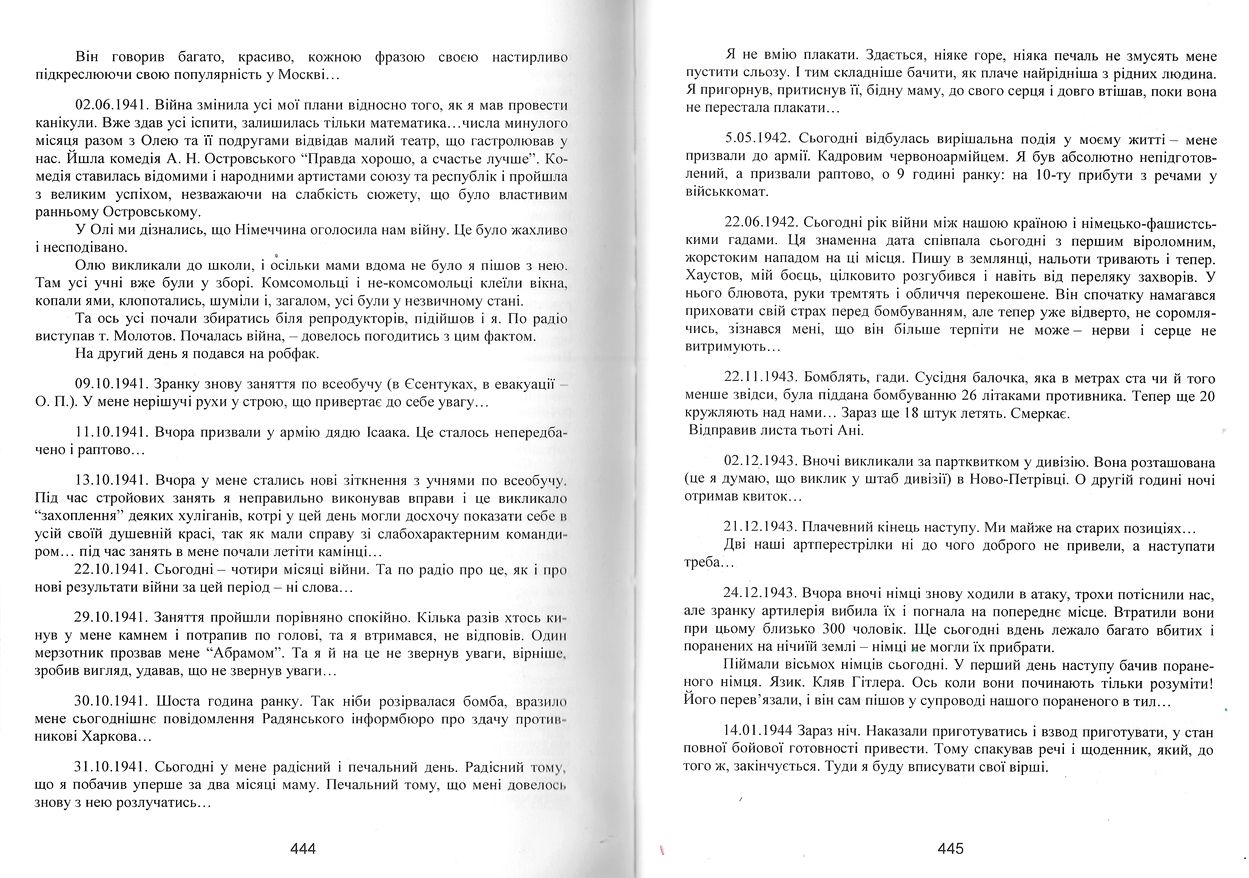
He spoke a lot and beautifully, constantly emphasizing with every phrase his popularity in Moscow...
2 June 1941. The war changed all my plans for how I expected to spend the holidays. I was already eating, staying busy, practicing mathematics... After last month Olya, her girlfriends and I visited the small theatre touring here. A comedy by A. N. Ostrovsky, Truth Is Good, but Happiness Is Better, was performed. The comedy was staged by actors from the republic’s capital and was a great success despite the weak plot characteristic of early Ostrovsky.
At Olya’s we learned that Germany had declared war on us. It was terrible and unexpected.
Olya was called to school and, because Mother had not been home for a long time, I went with her. Everyone there was already assembled. Komsomol members and non-Komsomol members were digging trenches, making noise and moving about; everyone was in an unusual state.
Then everyone began gathering around the loudspeakers, and I did too. Molotov spoke. First came war—one had to accept that fact.
The next day I went to work.
9 October 1941. In the morning I was again occupied with general military training (in Essentuki, during evacuation—O. P.). I do not feel any improvement yet, which is surprising even after three months...
11 October 1941. Yesterday Uncle Isaac was called into the army. It happened unexpectedly and suddenly...
13 October 1941. Yesterday I had new clashes with pupils over general military training. During the drill there was again an unfairly imposed exercise and shouts of “enthusiasm” from several hooligans who on that day might have shown themselves fully in their spiritual backwardness; meanwhile stones began flying at me during the lesson...
22 October 1941. Today marks the fourth month of the war. Yet on the radio there is not a word about how things have gone during that period—no word at all.
29 October 1941. Lessons passed relatively calmly. Several times someone threw stones at me and hit me on the head, while I held back and did not respond. One scoundrel called me “Abram.” I ignored that too—or rather pretended not to notice...
30 October 1941. The post office exploded from the strike, as if a bomb had burst there; today’s report from the Soviet Information Bureau about the surrender of Kharkiv by our forces hit me hard...
31 October 1941. Today I have a joyful and sad day. Joyful because for more than two months I have had Mother with me. Sad because I will again have to part with her...
I do not know how to cry. It seems that no grief and no sorrow can force a tear from me. And it is all the harder to see a person dearest to me crying. I comfort and encourage her, poor Mama, to whom my heart and duty belong, until she stops crying...
5 May 1942. Today a decisive event occurred in my life: I was called into the army. I had long been called up and released, but this time I was called suddenly, at nine in the morning, and by ten I had already arrived with my things at the recruiting office.
22 June 1942. Today marks one year since the war between our country and the German-Fascist gangs began. This famous date coincided today with the first enemy shelling of our location. I am writing in an earth shelter; raids continue even now. A corporal, my fighter, has just jumped up and even seized his weapon. From nervous chatter his hands tremble and his face is distorted. At first he tried to conceal his fear of an aerial bombardment, but now that he has been frank he admitted to me that he can endure no more—his nerves and heart will not withstand it...
22 November 1943. They are bombing us, the swine. The neighbouring ravine, a hundred metres or less from here, was bombed by twenty-six enemy aircraft. Another twenty are now circling above us. Eighteen are flying there. Twilight. I sent a letter to Aunt Ania.
2 December 1943. During the night I was summoned to division headquarters for my party membership card (but I think it was a summons to divisional headquarters) in Novo-Petrivka. At two in the morning I received the card...
21 December 1943. A tearful end to the offensive. We are almost back at our old positions... Our two artillery batteries achieved nothing good, yet we must advance...
24 December 1943. Last night the Germans attacked again and pushed us back a little, but in the morning our artillery drove them out and chased them back to their former position. They lost around three hundred men. Even today there are many dead Germans and wounded lying on no-man’s-land—the Germans could not remove them. I saw eight Germans today. On the first day of the offensive I saw a wounded German. Tongue. Hitler’s oath. Only when they begin to understand! His father was killed and he himself went to break his skull, but now he is already openly cursing that fool...
14 January 1944. Now it is night. We were ordered to prepare, and the platoon was brought to full combat readiness. So I have packed my belongings and the diary, which is ending anyway. I will write my poems here.
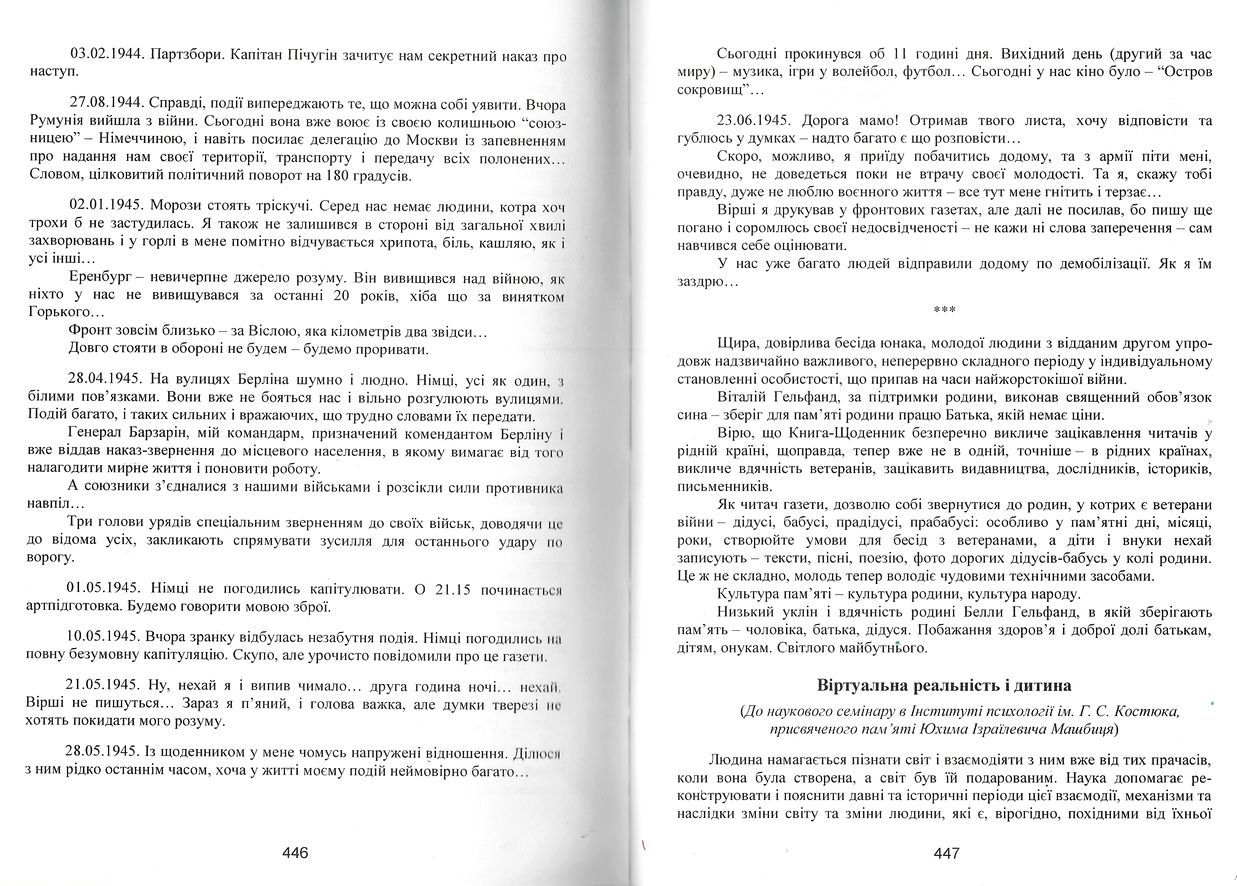
3 February 1944. Party meeting. Captain Pichugin reads us the secret order for the offensive.
27 August 1944. Events are moving faster than one can imagine. Yesterday Romania withdrew from the war. Today it has effectively declared its full “alliance” with Germany and even sent a delegation to Moscow assuring us of its absolute readiness to provide territory and transport and to hand over all prisoners. In short, a complete political turn of 180 degrees.
2 January 1945. The frosts are cracking. There is no one among us who has not caught at least a slight cold. Nor have I remained aside from the general wave of illness, and I have a sore throat now that I never suffered before. Everyone speaks only about one thing—Berlin, Berlin, Berlin, as do all the others. Ehrenburg is an inexhaustible source of wit. He has risen above the war as no one among us has risen during the last twenty years, with the possible exception of Gorky. The front is very close—beyond the Vistula, a few kilometres from here... It has been standing close by for a long time—we are going to break through it.
28 April 1945. The streets of Berlin are noisy and crowded. The Germans, every one of them, wear white armbands. They are already afraid of us and freely walk through the streets. There are many striking events that are difficult to describe and convey. General Berzarin, my commander, was appointed commandant of Berlin and has already issued an order-address to the local population demanding that peaceful life be established and that work resume. The Allies have joined our forces and split the enemy’s strength in two... The heads of the three governments, in a special appeal to their armies, report this to the whole world and call for efforts to be directed toward the final blow against the enemy.
1 May 1945. The Germans have not agreed to capitulate. At 21:15 the artillery preparation begins. We shall speak to them in the language of weapons.
10 May 1945. Yesterday morning an unforgettable event occurred. The Germans agreed to complete, unconditional surrender. It is strange, but the solemn reports on this matter are sad.
21 May 1945. Well, let me drink quite a lot... it is two in the morning... let me. Believe it or not... Now I am drunk and my head is heavy, but sober thoughts do not want to leave my mind.
28 May 1945. For some reason I have a strained relationship with the diary. Recently I have rarely shared things with it, although there are incredibly many events in my life...
Today I woke at eleven in the morning. It was a day off—the second in peacetime—with music, volleyball and football. Today we also had a film, Treasure Island...
23 June 1945. Dear Mama! I received your letter and want to answer it, but I have become lost in thought—there is too much I want to sort out... Perhaps I will come home soon, but clearly I will not leave the army until I have lost my youth. I will tell you the truth: I very much dislike military life—everyone here is threatening me and shaking me... I grew up and matured under front-line newspapers, but later things did not go well, and I am ashamed of my inexperience—do not say a word in objection—I am beginning to evaluate myself... Many people have already been sent home through demobilization. How I envy them...
***
The sincere, trusting conversation of a young man with his devoted friend throughout an extraordinarily important and continually difficult period in the formation of the individual is accepted as part of the most important period of the war.
Vitalii Gelfand, with the support of his family, fulfilled a son’s sacred duty: he preserved for our memory the true word of a father that is beyond price.
I believe that Gelfand’s diary will ensure greater interest among readers in his native country, though readers now live not in one but in different countries and, if fortune allows, will take part in editions, research and writers’ work.
As a newspaper reader, I allow myself to address families that have war veterans—grandfathers, grandmothers, great-grandfathers and great-grandmothers. Especially on commemorative days and in these months, create the conditions for conversations with veterans, and let their grandchildren write down the memories—texts, songs, poetry, photographs of dear grandparents in the family circle. It is not difficult today; young people now possess remarkable technical means.
The culture of memory is a family culture, a culture of the people.
A deep bow and gratitude to the Gelfand family, who preserve memory—of a person, a father and a grandfather. I wish health and a good destiny to parents, children and grandchildren. A bright future.
The next page begins a new, unrelated section: “Virtual Reality and the Child.”