



| ПРОБЛЕМЫ РЕАДАПТАЦИИ СТУДЕНТОВ-ФРОНТОВИКОВ К УЧЕБНОМУ ПРОЦЕССУ ПОСЛЕ ВЕЛИКОЙ ОТЕЧЕСТВЕННОЙ ВОЙНЫ |
ЛАРИОНОВ
АЛЕКСЕЙ ЭДИСЛАВОВИЧ 1 1 1 ФГБОУ ВПО «Российский государственный университет туризма и сервиса» |

| Тип: статья в журнале - научная статья Язык: русский |
| Номер: 1 Год: 2013 Страницы: 72-81 |
| УДК: 94(47)"1941/45" ИСТОРИЯ ОБРАЗОВАНИЯ |
| ЖУРНАЛ: | |
|
Издательство: Российский государственный университет туризма и сервиса (Черкизово) ISSN: 1999-5644 |
|
| АННОТАЦИЯ: | |
|
Статья посвящена проблеме возвратной адаптации студентов-фронтовиков к учебному процессу. На фактическом материале и на основе источников реконструируются особенности мен- тальности переходного периода от войны к миру. Реадаптация рассматривается как часть социокультурной проблемы всего общества. Этот обратный переход от войны к миру был не менее труден, чем прежде милитаризация общества. Успешность была предопределена совокупностью адаптационных механизмов, основанных на высокой мотивированности участников и корпоративной солидарности.
The article considers the problem of returning adaptation of veteran students to academic activity. The article points peculiarities of from-war-to-peace transition period mentality based on actual materials and sources. Readaptation is seen as a part of society's social and cultural problem. This returning transition from war to peace was no less difficult than earlier militarization of the society. The success was predestined by the complex of adaptation mechanisms based on high motivation of the participants and corporate solidarity. |
|

© Научный журнал "ВЕСТНИК АССОЦИАЦИИ ВУЗОВ ТУРИЗМА И СЕРВИСА"
© 2000-2017 ООО НАУЧНАЯ ЭЛЕКТРОННАЯ БИБЛИОТЕКА Russian
Alexey Edislavovich Larionov, Candidate of Historical Sciences, Associate Professor, Department of History and Political Science, Russian State University of Tourism and Service, Moscow, Russian Federation
Journal: Bulletin of the Association of Universities of Tourism and Service, 2013, No. 1 (23), pp. 72–81
UDC: 94(47) “1941/45” — History of Education
The article examines the readaptation of veteran students to academic activity after the Great Patriotic War. Using factual evidence and documentary sources, it reconstructs features of the mentality of the transition from war to peace. Readaptation is treated as part of a broader sociocultural problem affecting society as a whole. The reverse transition from war to peace proved no less difficult than the earlier militarization of society. Its relative success was determined by a combination of adaptive mechanisms founded on strong personal motivation and corporate solidarity.
Keywords: Great Patriotic War, everyday life, higher education, adaptation, students
High dynamism and the permanent character of modernization changes, many of them fundamental, are often named among the basic features of contemporary sociocultural development. Changeability and variability have become constants of social existence and extend into the various subsystems of public life, including education.
This tendency, however, has another side. No social transformation, however constructive, well considered or necessary, occurs without social costs. In practice, this means a shorter or longer period of discomfort for individuals and entire social groups as roles and statuses change, often independently of the wishes of those affected. Hence the problem of adapting to new and often sharply changing conditions. This is a challenge posed to people by their environment, but also to the social system and its institutions of power, which take and implement consequential decisions. The degree to which society and government can reduce social costs and soften the transition to a new condition for particular people is one measure of how much the system cares for them.
Russian education today cannot be called static, and Russian society likewise cannot be described as highly stable. The problem of adaptation to rapidly changing conditions is therefore especially relevant for many students. It is useful to turn to historical experience in which a large group of people moved almost at once, by historical standards, from one qualitative state to another. In Russian educational history such a period was 1945–1946, when millions of servicemen were demobilized and returned to peaceful life. Among them were thousands who had left university classrooms for the front. They had passed through the furnace of war, matured early, endured the deaths of comrades, the bitterness of defeat and the joy of victory. After the war they had to grow back into civilian life, recover half-forgotten knowledge, open textbooks again and take their places in lecture halls so that they could eventually become qualified specialists and make up the years they had given to their country at the front.
How difficult was this transition for yesterday’s victors over Germany and liberators of Europe? How did they themselves perceive it, and how did those around them respond? The article addresses these and related questions.
On June 22, 1941, the Soviet Union’s 817 higher-education institutions enrolled 811,000 students. In the 1941/42 academic year the number fell to 313,000, and in 1942/43 to 227,000. Only from 1943 did enrollment begin to rise: 400,000 in 1943/44, 585,000 in 1944/45, and 730,000 in the first postwar academic year, approaching the prewar level. Admission during the first year of war was reduced to 94,600 people. The author therefore estimates that nearly 600,000 students left for the front in the first year and that, as the student population shrank further by 1942, roughly another 100,000 may have gone from classrooms into the active army. The number of postgraduate students fell from 13,169 in June 1941 to only 800 in February 1942 [9, pp. 38, 41, 42]. The Soviet government later took deliberate measures to expand the training of future specialists, tightening student exemptions and even returning some students and postgraduates from the army to higher education, but most of those who had gone to the front remained in active service. Many did not live to see Victory.
After hostilities ended and mass demobilization began in summer 1945, many former students hurried back to lecture halls. To understand that return, one must first imagine the moral and psychological state of Soviet soldiers at the time Germany surrendered in April–May 1945. Around 200,000 former students were among them. Some had served since 1941; others had joined later after accelerated military schools and courses, received the rank of lieutenant or junior lieutenant, and replaced fallen officers in command of infantry and reconnaissance platoons, mortar and artillery crews, tank crews and signals units.
Far to the east lay their native Russian land, with ruined cities and burned villages. Some were awaited by mothers, sisters and fiancées; others had lost loved ones during the war. These unrealized teachers and engineers, physicists, mathematicians and biologists had been forced for years to reshape their consciousness radically, pushing into the background everything not directly connected with destroying the enemy, obeying orders and surviving.
Soldiers and officers slept for weeks and months in trenches under the open sky, made exhausting marches of many kilometers in any weather, lived constantly under threat of death, stormed German towns and estates, lived off whatever food could be found when field kitchens lagged behind, buried fallen comrades and waited for letters from home. The situation can be described as permanently extreme, leaving almost no room for ordinary feelings, emotions or interests. A person who must constantly survive adapts by cultivating traits that aid survival and suppressing qualities that do not. This could conflict sharply with earlier values, beliefs and standards of behavior. In the everyday world of war, yesterday’s intellectuals entered an altered state of consciousness that may be called an adaptive transformation of personality.
Young people of romantic and idealistic outlook—many from educated families and accustomed to an intellectually demanding environment—were genuinely shocked by the cruelty and extreme hardship of war and trench life. Student veterans, because of their education and emotional needs, were often especially inclined to reflection. Even when diaries were officially prohibited, many kept diaries and frontline notes, and these sources now allow a fairly reliable reconstruction of their state of mind at the end of the war and during the reverse transition from war to peace.
Former students acutely felt the brutality of war, the deaths of people, separation from loved ones, the lack of intellectual conversation and the inability to pursue favorite interests or read the books they wanted. A recurring motif was simple exhaustion with war.
Vladimir Stezhensky, before the war a student at the Institute of Philosophy, Literature and History and later a military interpreter in the 8th Guards Army of the 1st Belorussian Front, wrote on his birthday: “I am already 23. Every year I write these ever larger numbers with horror. Time passes so uselessly. Three years can already be crossed out. Damn it, when will this war end! Will it really last another year, another two? Enough! I want to go home. It is not bad here now, but home is still better. Soon we are to be moved somewhere. Where?” [10, p. 167].
The fact that twenty-three seemed such an advanced age is revealing. The constant threat of death changed the individual experience of time. Edmund Husserl, in Internal Time-Consciousness, wrote that experiences are not ordered by us in some independent reality; in relation to time, what matters is how temporal data are posited within experience [3, p. 12]. At the front, diary writers testify, a day, an hour or even a minute could be experienced almost as a year depending on the density and significance of events. This intensified awareness of years spent at war and the burning desire to return to the ordinary flow of life.
Another aspect of the military mentality of students who became soldiers and officers was a deep, almost subconscious understanding of war itself as pathological and inherently hostile to human life and civilization. Numerous compensating mechanisms restrained extreme negativism and held people together inside military society: patriotism, intensified during the Great Patriotic War; the desire for revenge for the invaded country and dead relatives; the oath and comradeship; and finally the knowledge that the road back to civilian life lay through war and victory.
The cultivation of military qualities often collided with the values of people whose original motivations had nothing to do with killing an enemy and surviving. Stezhensky lamented in his diary that army life had coarsened him and that he had forgotten much of what he once knew: “I remember Moscow, peaceful life, the institute, the Moscow Art Theatre… This is already my third wartime spring. For three years I have received no new knowledge and am gradually forgetting what I knew before. How far I have fallen behind everything, behind my friends who during these years could study and add to their knowledge… We are here so that the old peaceful spring may return to Moscow, so that we can again walk through our park and along the embankment, work in the Lenin Library, see The Cherry Orchard again at the Art Theatre. In any case my conscience is clear: in these difficult years for all of us I have done my duty” [10, pp. 165–166].
The quotation combines nostalgia for prewar life and regret at intellectual stagnation with pride in belonging to the army and fulfilling a duty of primary importance. Yet the lack of study was not always experienced as an absolute or fatal loss. People strongly motivated to obtain knowledge searched persistently for ways to overcome intellectual hunger even at the front, and surprisingly often found them.
Books discovered in houses ruined by war, letters from home describing news, or rare meetings with representatives of the creative intelligentsia could temporarily compensate for the deprivation. Former tank soldier Iona Degen remembered for the rest of his life a visit by Ilya Ehrenburg, whose articles were immensely popular among soldiers. Degen regretted not approaching the writer because he had drunk heavily after a battle [4, p. 399]. Even such fleeting contact with a writer, journalist or performer could assume a significance it would never have had in ordinary civilian life.
War taught people to value communication and seize any opportunity for direct experience and discussion of enduring human values. At the same time, many educated students found the roughness of barracks life, rigid discipline, crude humor and profanity extremely difficult. Lieutenant Vladimir Gelfand repeatedly described his discomfort with swearing in his diary. He had begun his wartime service as an ordinary rifleman and later became an officer. His lack of practical toughness, emotional sensitivity and concern for his personal belongings often provoked ridicule from more thick-skinned soldiers and commanders and placed the former student in awkward situations. That such discomfort persisted until the end of the war also demonstrates the resilience of a person’s original values even when suppressed by circumstances.
Not every student or postgraduate reflected so acutely on maladaptation, but almost all veterans from a student background who left diaries or memoirs dreamed of peaceful life and a return to study, science, books and their familiar intellectual environment.
Then the long-awaited Victory Day arrived. The dominant feeling was overwhelming joy—joy at victory itself, at participation in an epic achievement and, no less important, at simply being alive. Young lieutenants felt this especially strongly. Many had reached the front, quickly shed their illusions and almost counted themselves among the doomed. Their relatively high educational level encouraged reflection and the narrative expression of emotions, which is why diaries and memoirs preserve vivid descriptions of survival through the final battles.
The future artist Igor Nikolaev, then an unfinished student, recalled that he and Lieutenant Alekseyev “drank away” their Victory in May 1945 with extraordinary energy, drawing comrades and even German civilians into the celebration. Command eventually forced the intoxicated servicemen into the medical unit to sober up, and the two principal culprits were removed from award lists. Nikolaev was twenty and Alekseyev twenty-two; they already had two orders each and did not care much about another decoration. The essential fact was that the war was over and they were alive. In his recollection two Moscow boys—a mechanic and an artist, lieutenants Ivan Alekseyev and Igor Nikolaev—had the right to celebrate that survival [7].
Military interpreter Irina Mikhailovna Dunaevskaya, a philology student who served on the Leningrad Front from 1942 through 1945, wrote in her diary on May 8–9, 1945: at 2:10 in the morning came the announcement of Germany’s capitulation; although everyone had waited for it all the previous day, it still seemed unbelievable, and tears of joy, happiness and bliss came to her eyes. She wrote that May 9 would henceforth become “THE MAIN HOLIDAY OF OUR GENERATION!!!” [5, pp. 397–398].
Signal lieutenant Leonid Rabichev, before the war a law student, met Victory with his men in Czechoslovakia. He remembered a covered wagon blocking the highway, civilians and boys with radiant faces shouting “War kaput! Fritz kaput!”, handing out hot pastries and pouring wine from jugs, while Soviet troops drove for kilometers through celebrating crowds [8, pp. 175–176]. Such quotations could be multiplied indefinitely: all are united by a joy that can be fully understood only by someone who lived through it. The author also notes that the diaries and memoirs of student veterans often possess a notably high literary quality.
Once the victory salutes and celebrations had passed, everyday life in the victorious army began to assume a peacetime character. Demobilization started almost at once, in stages but on a large scale. The country shifted from an extreme mobilization regime to peace, and Soviet society changed with it. Almost every veteran faced the question: what next? Most were not career soldiers and wanted to demobilize quickly. Student veterans were no exception. Beyond the universal wish to return to family, loved ones and children, they had the additional need to resume interrupted education and finally pursue the profession they had originally chosen.
Several features of student-veteran mentality thus became especially important in 1945. First was the cumulative character of status identity: they were both veterans and people who still understood themselves as students or future professionals, giving them unusually strong motivation during the transition to peace. Second was a predominantly positive, major-key mood shared with most veterans who had survived to Victory. Third was a high level of social reflection, expressed in vivid descriptions of personal experience and an awareness of the enormity of what had happened. In time these features became a powerful motivational base that eased the return to the half-forgotten but still desired status of student or postgraduate.
The journey home passed through several European countries whose borders the same soldiers had crossed westward with the active army. Their return eastward was not entirely trouble-free. When millions of demobilized people move over thousands of kilometers and across several state borders, problems are inevitable. Trains traveled amid songs, accordions, dancing and drink. Some men fought; others began romances with Polish or Romanian women and missed their trains; still others became involved in crime. Because of their generally higher level of education and culture, student veterans may have been less involved in the ugliest incidents and sometimes acted as a restraining force. The author cites a student who prevented a fellow traveler from committing robbery and murder against wealthy Romanians. Instead of reporting him to the commandant or SMERSH, the young lieutenant neutralized the would-be robber with a large quantity of homemade alcohol and then hurriedly put him on a train [8, p. 189].
Such episodes suggest that demobilized student veterans could serve as stabilizing elements while the army shifted to a peacetime establishment. Yet difficulties did not end at the Soviet border. Some returning veterans had trophies confiscated, even relatively modest items such as leather or silk, watches or table silver, and filed indignant complaints [1, fols. 97–98]. This looked especially unfair against reports that certain high-ranking officers managed to send entire railway cars of captured property home from Germany.
Memoirs suggest that most student veterans considered aggressive trophy hunting beneath their dignity. Their souvenirs were usually practical things acquired at the front or small mementos. The prewar student generation was marked by a certain disinterest in possessions. As Nikolaev’s recollection showed, the greatest trophy was simply to have lived to see Victory.
Once home, student veterans did not generally want to waste time in passive rest. They sought to enter intense peacetime life immediately: helping relatives, taking jobs, returning to study, or doing all three at once. Returning to education was an especially urgent need. Intellectual interests that had seemed dormant during the war revived with new force, and many veterans went to their former institute or university almost immediately after arriving home.
The typical veteran student still wore field uniform—a tunic, greatcoat and boots. In the postwar shortage of consumer goods and amid low incomes, military clothing often remained a student’s only outfit for a long time. Wearing it to lectures was not embarrassing; it was more likely a source of respect. During the war many students had worried about losing their former knowledge. Now they could recover what had been forgotten and complete the education interrupted by war. At least 100,000 demobilized Red Army veterans rejoined the student body during the 1945/46 academic year, and the flow continued during the next two years.
The process of readaptation to study was both similar and different from person to person. The common element was an intense desire to return to university, resume postgraduate work, or realize a dream of higher education for those who had finished school in 1941 but had never had the chance to enroll. Postwar living conditions meant that veterans often had to solve several problems at once.
Vladimir Stezhensky returned to his interrupted philological education. Since he had served as a military interpreter, his professional knowledge had not disappeared completely. At the same time he had to rebuild his personal life and eventually succeeded in finding his beloved Nina, whom during the war he had sometimes believed lost forever. His memoirs do not describe major academic difficulties, which may mean that his return to study was relatively smooth. It may also mean that, after mortal danger and years of war, ordinary peacetime problems seemed too small to dwell on—an attitude voiced by many veterans.
Not everyone’s return was so straightforward. Partial loss of knowledge was only one obstacle; war also changed people’s view of life and sometimes their field of interest. Leonid Rabichev, a law student before the war, chose after the war to become a professional writer and artist. The decision had matured during military service and was strengthened by his poetic talent and conversations with people knowledgeable about literature. Jurisprudence thereby lost what might have been an ordinary conscientious employee, while Russian culture gained an unusual poet and original artist. The article quotes a poem in which ordinary domestic details—celery, dill, milk and potatoes—stand beside thoughts of God, the world, an ark, flood and the need to dig a trench behind the house. The worldview is that of a veteran who has returned to peace but whose consciousness still remains very close to war [8, p. 249].
War could therefore help a person understand his vocation and choose a life path. It did not merely create resilience and adaptability; it could force young people who survived it to decide what made life meaningful.
Many future cultural figures returned to universities after demobilization. One was Fyodor Abramov. Seriously wounded in 1942, he was classified as fit only for limited service and worked in SMERSH military counterintelligence before being finally demobilized and reinstated at the philology faculty of Leningrad State University in autumn 1945. Abramov left only brief diary notes and a few systematic memories of his postwar adaptation, but classmates also wrote about him.
M. Kagan recalled Abramov’s unwavering determination to demobilize and return to university despite the attractive career in counterintelligence open to him. Returning meant two years of difficult student life with an uncertain future; the profession of writer was still only a dream. Abramov was briefly tempted to exchange literary studies for art history and, persuaded by a friend, transferred to the art-history section of the history faculty. He performed successfully there, helped considerably by classmates who assisted him in preparing for lessons and exams. Nevertheless he ultimately chose to return to philology and graduated in 1949 [2, pp. 182–183].
Behind these apparent changes of direction lay a consistent postwar trajectory: rejection of a materially secure and prestigious career in the security organs, a strong drive toward self-development, determination to continue along a consciously chosen path, and mutual help among comrades. These were social values that served both as a direction for life and as an adaptation mechanism. Abramov himself did not complain about postwar poverty or the difficulty of resuming study. His posthumously published diaries and notes instead express anger at the bureaucracy’s heartlessness and injustice toward people who had defended the country at the cost of their lives, youth and health. He almost never speaks about his own problems; his concern is for comrades and other people. The author sees this altruistic intensity and readiness to sacrifice oneself for others as another typical quality that veterans carried from frontline relations into postwar adaptation.
There were as many variants of adaptation as there were individual lives. Some students and postgraduates not only retained their professional skills during the war but significantly increased them because of the nature of their military specialty. Boris Vladimirovich Zylev graduated from the Moscow Institute of Railway Transport in 1941 and entered postgraduate study as a bridge engineer. After war began he volunteered for Moscow’s 6th People’s Militia Division and later, with the 36th Railway Troops Brigade, restored bridges in the operational zones of several fronts. Extreme working conditions gave him unique experience. After the war Zylev returned to postgraduate study and defended his candidate dissertation in 1948 [6, pp. 123–128]. He studied and wrote his dissertation on the same terms as everyone else, without special concessions for his frontline bridge-building experience. No concessions were requested and none were given.
Alexander Urazov’s memoirs provide another pattern. He had graduated with honors from a technical school before the war and wanted to continue his education afterward, but an opportunity did not arise until 1952. At the entrance examinations to the Higher Engineering Courses of the USSR Ministry of the Coal Industry, he later recalled, he could answer only in general terms, remembered no formulas and tried to display the Orders of Glory and Red Star and his Medal for Courage on his chest. A professor asked how he expected to study in an accelerated program with such weak preparation. Urazov answered: “Just let me in, and I’ll get excellent marks.” The director supported him by noting that he had graduated from technical school with honors [11, p. 349].
Urazov then had to support a family while living and studying on a scholarship of 1,100 rubles. Teachers did not reduce academic requirements because students had served at the front. Urazov said he “sat over textbooks for days on end in order to remember everything forgotten during the war and hungry postwar years.” The result was graduation with honors and a successful engineering career.
The same recurring features are visible: powerful motivation that enabled people to overcome hardship; a benevolent but objective environment that did not lower standards; enormous personal effort; and, afterward, successful careers in the chosen field. Many more postwar biographies of veteran students could be given, but these examples are sufficient for several general conclusions.
© Scientific Journal “Bulletin of the Association of Universities of Tourism and Service”; © 2000–2017 Scientific Electronic Library.
Cover: Bulletin — Scientific Journal of the Association of Universities of Tourism and Service. No. 1 (23), 2013. Russian State University of Tourism and Service. ISSN 1999-5644.
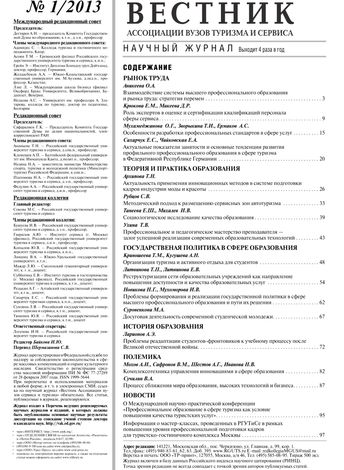
Contents page: The reproduced page lists the journal sections “Labour Market,” “Theory and Practice of Education,” “Government Policy in Education,” “History of Education,” “Controversy,” and “News.” The present article by A. E. Larionov, “Problems of Veteran Students’ Readaptation to Academic Activity after the Great Patriotic War,” begins on page 72. The journal’s own English contents page in the accompanying PDF gives the same English title and section headings.