Jornal de Psicanálise
Print ISSN 0103-5835 · J. psicanal. vol. 56 no. 105, São Paulo, July/December 2023 · ePub August 26, 2024
Paulo Cesar Endo2
Psychoanalyst, researcher, and associate professor at the Institute of
Psychology. Coordinator of the Human Rights, Democracy and Memory
Research Group at the Institute of Advanced Studies of the University
of São Paulo (IEA-USP), São Paulo.
Honored men usurp the bodies of raped women, and war has no woman’s face: only bodies
Abstract
This article examines contradictions present in politics of memory
in order to approach what also occurs in the field of knowledge and
theory. The reflection is guided by my visit and field research in
Treptower Park in Berlin, more specifically by the monument to the
Russian soldier located there. I seek to discuss certain hypotheses or
presuppositions of psychoanalytic theory so as to evoke the doubt and
work in which we are immersed today, unlike in Freud’s time. My
concern is with the inscription and determination of secular political
hegemonies that authorize and/or disauthorize the ideals,
self-representations, and psychic memory of some at the expense of
others. Their influence on unconscious movements is undeniable and they
are therefore often instrumentally guided by public and mass policies.
Ah, another book about war... What for? Thousands of wars
have already happened — small and large, famous and unknown. And
what has been written about them is even more numerous. But... it was
written by men and about men; that became clear immediately. Everything
we know about war we know through a “male voice.” We are
all prisoners of “male” representations and sensations of
war... of “male” words. (Aleksievitch, 2016, p. 12)
Brief report on a field-research trip (Berlin, May 2022)
In May 2015 I was in Berlin carrying out part of the research on memorials that I have pursued for many years.3
On that occasion, during a visit to the Topography of Terror, I viewed
the permanent exhibition of photographs displayed throughout the
exhibition room. Amid the extraordinary richness of that unique site of
memory in Germany, the final photograph on display caught my attention.
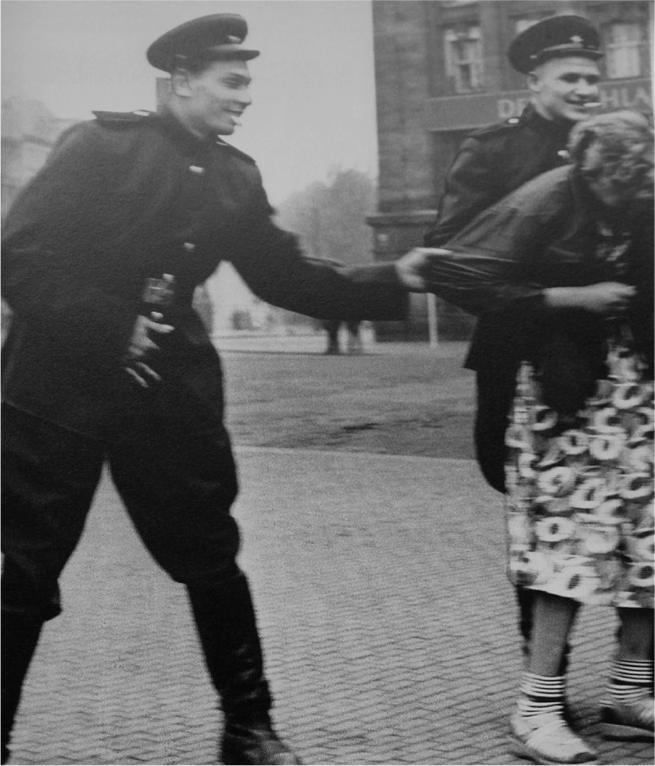
It showed two Russian Red Army soldiers harassing a German woman
after the Russian occupation at the end of the Second World War, when
Nazi Germany had already been virtually defeated by the Allied troops.
The photograph was terrifying: two armed, uniformed men harassing a
lone woman who was frightened and constrained. One pulled at her
clothes as if he could tear them off in the middle of the street; the
other, his accomplice, wore a mocking smile that showed that what was
terrible for the woman was, for both men, another moment of lascivious
amusement. They were in the middle of the city, publicly exposed.
Around them there was emptiness and solitude in the face of harassment
committed by the newly installed highest authorities in Berlin: the
victorious Soviet Red Army.
While the two soldiers pressed themselves without restraint upon the
woman, they simultaneously mocked the absolute vulnerability and
visible fear of the likely victim before what might happen moments
later, or might already have happened: the rape of yet another German
woman.
With mocking smiles and the certainty that they had permission to do
anything without restraint, law, shame, guilt, or any castration in the
newly occupied country, these soldiers seemed to choose as their reward
the continuation of atrocities already committed by the Nazis and seen
and lived through in the bloody war that was about to end. They decided
to celebrate victory not as men but as animals. Their chosen stage was
the bodies of women who, in the following weeks and months, would
repeatedly be invaded by beasts.
The woman in the photograph, her face hidden by pain, terror, and
shame, and whose name we will never know, shrank into herself as though
she wished to disappear into her own crumpled clothes and vanish,
perhaps escaping the inevitable. That photograph marked me forever.
In the years that followed, the image persisted in memory and
thought. I believe that finding it again was one of my clearest wishes
when I eventually returned to Berlin. For me it was a clue left on the
ground that I picked up and kept. Everything it showed and concealed
pointed to a larger temporal devastation whose existence I did not yet
know, but which had long been fully represented somewhere in Berlin
itself as a monument of counter-memory, as I discovered years later.
Those who decided to be victors and animals were granted, as a
prize, impunity to perpetuate atrocities, and they did not take long to
use that prize. Rapes in Berlin began within hours of the Russian
Army’s entry into the city. When they had the opportunity, the
great victors did not hesitate to become simply Nazis themselves.
Robert Fisk once wrote: “Like it or not, that is how most wars
end. It is as if the sins were erased” (2007, p. 635). All the
resignation contained in Fisk’s sentence clearly comes from his
own experience as one of the best-known war reporters. Yet it also
implies an almost religious expectation that something greater than
wars might arise to call to account the sins committed in their name.
He knew that nothing exists to prevent forgotten victims from being
erased so that sins can be erased.
This single, decisive photograph displays with astonishing precision
the explicit, bloody, misogynistic, criminal, and cruel violations to
which German women were subjected by the then victors of the war, who
had supposedly just “freed” humanity from Nazi atrocities
only to commit atrocities of their own. Its disturbing character
— perhaps the same thing that impressed me during my first visit
— was highlighted in a book published by the Topography of Terror
in 2014 (Steur, 2014), where the photograph is reproduced full-page as
one of the book’s important images.
This is not a unique or isolated example.4 Countries
occupied by other armies experienced similar problems during the Second
World War and, possibly, during every war. Permission and impunity for
abuse do not make the atrocity less atrocious. The “valor”
of victors often has a guaranteed prize: the bodies and spirits of
millions of women in different countries. What makes the matter even
more nauseating, however, are the justifications. Perpetrators
frequently have disavowing justifications: “We are only
collecting what the Germans did in Russia”; “It was a
consequence of the loneliness, fear, and deprivation to which soldiers
in combat were subjected”; or “It was all part of a
necessary strategy of war.” With minor variations, such
explanations abound in the words of authorities and perpetrators
themselves.
Men’s claimed right to vengeance, male self-pity, and the
supposedly inexorable fatality of war belong to the same complex that
authorizes — or fails to disauthorize — violence, sustains
impunity, and invariably shelters perpetrators under a consolidated
hegemony: in this case, men who make a compact among themselves,
indifferent to and consequently against women’s bodies and
spirits. Nothing may stand above male honor, pain, and thought.
Masculinity must remain intact within the same system of asymmetries.
Outside that system, segregation, violence, and cruelty are authorized,
encouraged, and perpetuated regardless of against whom or where.
Asymmetry is a symptom for victors — or defeated men — that
assumes collective, communal, and institutional forms and tends to
perpetuate itself as the primary strategy for installing hegemonies.
Binarism, therefore, has always been unarism. There are two in order
to legitimize the one through the negation of one of the poles
supported by dichotomous thought and discourse. Only in this way can we
understand how the nullification of women, transformed into violable
bodies, becomes a male prerogative for hating, segregating, using,
celebrating, and destroying.
Here I quote Butler:
The feminine, to use a catachresis, is domesticated and
made unintelligible within a phallogocentrism that presumes itself to
be self-constituting. Rejected, it survives as the space of inscription
of that phallogocentrism, the specular surface that receives the marks
of a masculine signifying act only to return a (false) reflection and
guarantee phallogocentric self-sufficiency without making any
contribution of its own. (2023, p. 77)
Although Butler is reflecting here on the epistemic domain, from
which other domains derive, she simultaneously helps show that
phallogocentrism, unary binarism, or masculine centrality interacts
with what lies outside it through domestication and congenital
hegemony. The feminine may — and at times must — exist as
the place of inscription of something that subjugates it and defines it
as part of the context in which phallocentric centrality affirms itself.
Moreover, female body and psyche must expose or offer themselves as
the receptacle that confirms an order in which the negative mirror
image of the feminine can be nothing other than defective, fragile,
insufficient, and superficial. The narcissistic enclave in which
masculine identities outweigh others perpetuates violence treated as
eternal, banal, or inevitable. The place where man is raised above
others is the same place where every other person is generically
subordinated, without exception. There is no middle ground in an
abusive binarity that contaminates everything long before denunciation,
demand, or indignant opposition can arise.
Just as wars are treated as inevitable, their consequences,
permissions, and opportunities are treated in the same way within a
male spectacle of annihilation, destruction, and assertion of no one
quite knows what, in an endless game of stupidity and blood. Those
annihilated have always had their singularity stripped away before
disappearing under cruel — and “just” —
violence that has no end.
Lucy Ash’s report on events in Berlin after the Russian occupation quotes the diary of Vladimir Gelfand:5
One of the most revealing passages in Gelfand’s diary
is dated April 25, when he reached Berlin. Gelfand was riding a bicycle
along the banks of the Spree — the first time he had ridden a
bicycle — when he came upon a group of German women carrying
suitcases and bundles. In poor German he asked where they were going
and why they had left their homes. “With horror on their faces,
they told me what had happened on the first night of the Red
Army’s arrival,” he writes. “They poked here,”
the beautiful German girl explained, lifting her skirt, “all
night long. They were old, some were covered in pimples, and all of
them climbed on me and poked — no fewer than twenty men,”
she burst into tears. “They raped my daughter in front of
me,” added her poor mother, “and they can come back and
rape her again.” The thought horrified them all. “Stay
here,” the girl suddenly threw herself at me, “sleep with
me! You can do whatever you want with me, but only you!” (Ash,
2015)
Would a young woman who had already been violated by twenty soldiers
in a context of complete permission for abuse have the strength to be
indignant and affirm how absurd this supposedly banal situation was?
Could she and her mother continue living in a country occupied by
rapists? Could they leave? And where could they go in an occupied
country? How can one imagine them continuing to live as women with the
certainty that they would successively be run over by the carcasses of
tanks and men?6
Imagination seems to founder before the extremes of cruel action,
which in turn creates contexts confirming the absence of limits to
which masculinities reduced to rubble may go when, in order to rise
from the ground, they support themselves on those whom they violate.
In 2022 I returned to Berlin, thanks to support from FAPESP, to
continue my research on memory, memorials, and dream archives. One of
my intentions, however, was to follow the traces of that photograph
and, in the little time I had, to deepen my understanding of the Berlin
context in which what the author calls the largest rape of white women
by white men in history took place. It has been estimated that around
two million women were raped during the Red Army’s occupation of
Germany, in Berlin and in other German cities.7
At that time I drew up a small research diagram that included
conversations with German researchers, visits to well-known museums,
and a return to the Topography of Terror seven years after my first
visit.
The discoveries that occur when we are physically present at sites
of investigation and research are immodest. Everything depends on
details, luck, and some perceptiveness, and sometimes on the solitary
consideration and attention of someone walking along abysses, noticing
jolts in one’s own psyche as it clouds and clears while
discovering the boundlessness of the terrible.
My first contact while finalizing the research context was Martin Dammann.8
Although he was traveling to France that same week, Martin kindly gave
me many suggestions and regretted that he was not in Berlin to
accompany me to Treptower Park, one of the principal reasons for my
investigation. He suggested that I return to the Topography of Terror
and visit the German Historical Museum’s collection, beginning
with its permanent exhibition.
I followed his suggestions. I contacted the director of the German
Historical Museum, who informed me that the permanent exhibition was
undergoing renovation, which I confirmed when I went there. At that
time, however, no other path through the museum’s holdings was
suggested that could help me approach this specific subject. Days later
Martin gave me the contact of a staff member willing to help, but by
then I was already in Warsaw.
During those few days in Berlin I also met a German researcher from
Humboldt University. Our conversation seemed unable to reach the
subject I was pursuing even though I had been very explicit about what
I wanted to discuss, knowing her trajectory as a German and feminist
researcher. At one point in our strange conversation she merely said:
it is possible that my grandmother was raped, but she never spoke about
it. A certain silence covered our conversation after that, and we could
not advance significantly.
Between 1945 and 2023 almost eighty years passed, but materials on
these events are not abundant (Gerbhardt, 2017), and testimony is
certainly approaching extinction because many victims and survivors
either decided never to speak about the experience or have already
died. The few elements that exist today are rarities.
For me, displaying these half-erased, opaque, ostentatious, and
imposing traces is always precious material for a wandering
psychoanalyst. In a country exemplary for its memorials and museums of
the Shoah, I found a path that was anything but straight toward
information about events known worldwide yet still filled, generation
after generation, with disavowals, silences, concealments, and frauds.
I knew I would not be able to go much further in the limited
research time I had and, in any case, my broader subject was not
exactly the mass rape that occurred in Berlin at the end of the Second
World War. I myself was making a detour from my principal topic, which
would be completed days later in Warsaw.
Still in Berlin, I therefore prepared to visit what, in my opinion,
is one of the principal sites of counter-memory in the world: the
monument to the Russian soldier in Treptower Park.
My fantasies about this monument were modest compared with what I
found. I imagined a large bronze monument framed by gardens somewhere
in the immense park, a monument I had already seen in photographs on
the Internet.
What I found, however, was an unmistakable, terrible, gigantic,
authoritarian tribute, without restraint, to what the author describes
as one of the largest groups of rapists in the world, today maintained
with German public money through the municipality of Berlin.
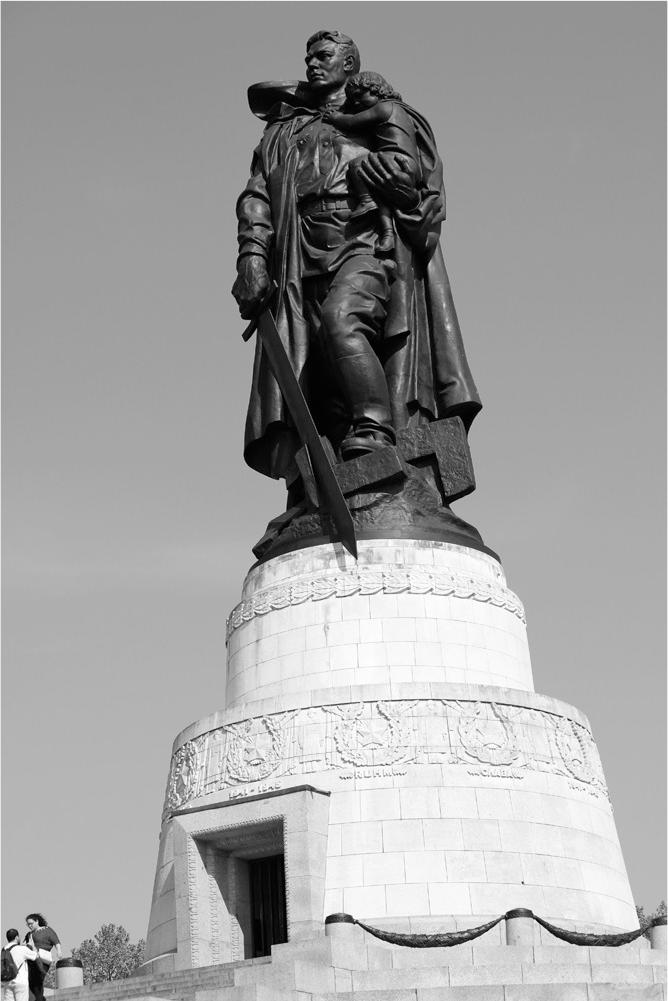
The experience moves through layers. This is not a distracted
tribute dropped somewhere in a park. It is thousands of insistent
square meters forming an abusive iconography of the Russian soldier,
who in the central monument carries a child in his left arm and a
lowered sword in his right. The victorious, generous, and raping
warrior saves Germany from Nazi anti-civilizational devastation.
The image becomes even more abusive when we remember that among
those violated in Berlin were elderly women and children like the child
the soldier carries as if saving her, lifting her almost above himself.
But who would save her from the soldier carrying her? Not without
reason, according to Ash, the monument is called by some the
“monument to the unknown rapist” (Ash, 2015).
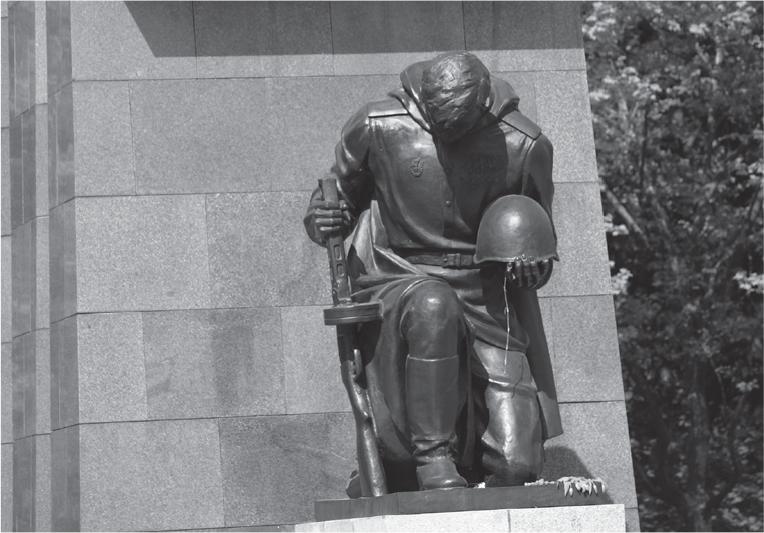
Before reaching the principal monument, one passes sixteen
sarcophagi where 5,000 Russian soldiers who died fighting the Nazi Army
are buried. Before them, two enormous bronze statues receive the
visitor, both kneeling at the entrance to the sarcophagus area. They
are Russian soldiers honoring compatriots killed in combat and
receiving the visitor humbly and deferentially.
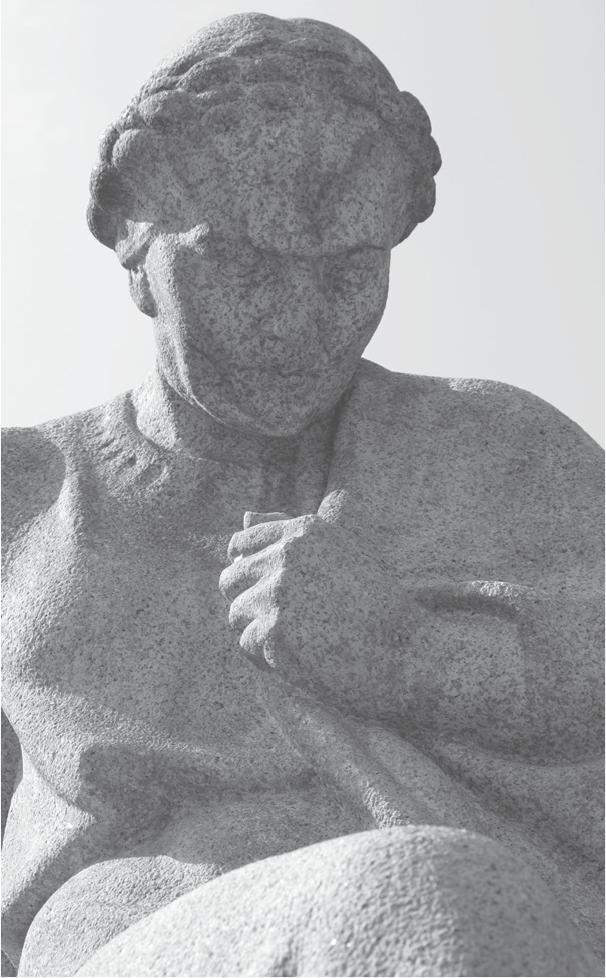
A statue of a woman points the way toward the grandiose tribute to
men. She is kneeling, head bowed, submissive, and weeping. She
represents the mother of all soldiers in mourning and pays tribute to
them: the Motherland. She thanks the Red Army combatants — her
sons — for their feat and mourns them. But to what feat does this
female statue, conceived by men, refer? Why does she mourn? To what
does she defer or submit?
A nightmare is staged in this space. It confuses and assaults the
difficult work of memory. Everything was planned and staged from 1947
onward and preserved decade after decade by the components that forge
international politics between countries and between men. In a country
that, not without contradictions, excels in the quality of information
and documentation concerning the Holocaust, nowhere in the park is
there information about the millions of German women and children
brutally violated in Germany, whose lives were devastated during and
after the Russian occupation (Ash, 2015).
In 2022, in the middle of Berlin, there is an explicit invitation to
the submission of thought, history, and the impossible testimony of
women who could not and did not wish to speak: an invitation to
unmemory.
The dead soldiers were made to cover over the mortified women, and
the violated and silenced women were made to legitimize the just
tribute to combatants and their glorious narratives, narratives that
abounded and predominated after the Second World War.
The capture of speech displays itself as an iconography of death and
mortification, also acting to legitimize unpunished crimes and elevate
male warriors above the atrocities they commit. Women figure there as
subservient to men’s version and to men’s desire to violate
them. Women are an immense nothing, forever undifferentiated and
unknown.
There is an entire layout that displays not only the reasons for war
that result in the affirmation of degrading masculinity but also its
corollaries, which condemn women to silence and perpetual resignation
so as not to stain the glories that occurred despite them, against
them, and upon them, and that persist in endless versions of the Second
World War. If the instruction given by this monument can itself be
understood as abusive, that compels us to think about the role of the
negative in activating mechanisms by which entire societies of abusers
perpetuate themselves.
The public display of this contradiction is undoubtedly disavowing,
but the truth is that few will see there more than a huge, beautifully
landscaped park of monuments indicating that the worst is over. Yet
only the deliberately ignorant lack information about violating
practices by Russian forces in invaded countries. What is happening
today in Ukraine, for example, produces a predictable but striking
contemporary repetition:
Ukraine’s prosecutor general Iryna Venediktova said
on Tuesday that her office had collected reports of sexual violence by
Russian troops against men and women of all ages, from children to
elderly people. (Graham-Harrison, 2022; Al Jazeera, 2022)9
But there in Berlin the Russian soldier continues to be honored
unharmed. Iconographic and unconscious traces of women’s fate can
be seen in the many images of women on the memorial slabs and in the
grandiose image of the kneeling, submissive, devastated Motherland:
mothers and land devastated.
Women are there, but as grateful, frightened, and resigned figures,
while in the end Stalin is the one who narrates the story, in words
readable on all sixteen immense memorial slabs adorned with his
sentences. Whom else would women choose to represent them, if not Josef
Stalin?
The (non-)place for women’s memory
In testimony to Opera Mundi, Amelinha Teles once again recounts
details of the sexual nature of torture during her political
imprisonment by OBAN. Sexual violation was an authorized, regular
practice and a policy of the state against imprisoned women under the
civil-military government that began in Brazil in 1964. The acts
described by Amelinha were not isolated incidents or behavioral
deviations by this or that soldier or police officer. Her accounts
reveal the sexual targeting of torture practices in Brazil: they
accompanied and defined torture itself, together with the impunity that
benefits torturers to this day, and they clearly indicate social and
political tolerance for the continuation of violations, crimes, and
abuses that remain unpunished in Brazil.
Unlike the grandiose monument to the Soviet soldier in Berlin, the
tribute in Brazil is adorned with impunity and silence surrounding
crimes of the past, a silence that also defines and fuels continuing
violence against Brazilian women today.10
And it is women who must endlessly repeat what they suffered, the
consequences of that suffering, and the risks they face in a society
and an entire country that explicitly refuse to hear them, when they
are not actively silencing them. The denial says that there were no
torturers, no dictatorship, no rapes committed by state agents in a
Brazil then ruled by the military. It is women, displaying their
bodies, wounded spirits, and testimony, who keep the memory of
atrocities alive and sustain the task of preventing the erasure of acts
of torture and destruction committed by men who chose violence against
women because they were women. Brazil’s civil-military
dictatorship shamelessly practiced feminicidal torture and femicide.11
No male torturers are punished in Brazil. This creates opportunities
and incentives for monstrosities to build entire political campaigns
denying the military coup, its crimes, atrocities, and cowardice and to
reach power by vote while defending illegal and arbitrary practices.
From this standpoint, the mass arrests that began after January 8,
2023 displayed, in the author’s formulation, how Brazil’s
far right had become another name for hordes of habitual violators of
human and civil rights, preachers of hatred against minorities, and
deliberate practitioners of racism, sexism, and misogyny.
All of this had long been known, but arrests and proceedings
following the attempted coup of January 8, 2023 also staged a spectacle
against the mass impunity that had flourished in Brazil outside and
against the principles of the 1988 Federal Constitution.
For four years, from 2019 to 2022, we lived in an atmosphere in
which everything was permitted and dissenting voices seemed hoarse,
inaudible, and erased by the government’s ability to silence them
or remain indifferent to them. The microphones of infamy and stupidity
sounded very loudly, far louder than had been supposed. The assault on
thought, argument, and the exercise of speaking and listening won
enormous adherence, became transmissible discourse, and instructed
actions and affects everywhere among hordes that we now know number in
the millions.
These avowed violators of the 1988 Constitution recognized and
organized themselves around the campaign preaching of the former
president defeated at the polls in 2022 and, in the text, accused of
theft, misappropriation, and improper appropriation of national
property. He incited and persuaded millions to take advantage of
everything, above all because they would be protected. The effective
but fragmented message, the author writes, was always: “buy your
guns and loot whomever and whatever you can,” while the former
president and his family carried out their own pillage against the
state. False promises charmed serpents now bred and released across the
country.
What made all this implicitly horrifying was that it extended to an
incitement to turn into property the bodies of the vulnerable,
dissenters, non-white people, and non-men. The language converts bodies
into objects purged of subjects, animalizes them, and preaches violence
and degradation against them:
“What do you weigh? More than seven arrobas,
right?” (Brasil 247, 2022), the former president under
investigation said to a Black man. On the deaths of Dom Phillips and
Bruno Araújo: “Everything indicates that if they killed
the two of them — I hope not — they are in the water. In
the water, little will be left. Fish eat. I don’t know whether
there are piranhas there in the Javari” (Brasil, 2022). On rape,
addressing then federal deputy Maria do Rosário: “I would
never rape you, because you don’t deserve it”
(IstoÉ, 2014). And on the search for political prisoners killed
and disappeared under the dictatorship produced by the 1964 coup:
“Who goes looking for bones is a dog” (Locomotiva, 2020).
Mockery was always his discursive strategy for gathering followers,
calling forth the massification of desires for the death, degradation,
and destruction of millions of people who were to be segregated,
violated, and killed because they displeased someone who happened to be
in power. We lived through what the author calls the resurgence of
tyranny in Brazil.12
Brazilian women and men who had until then been restrained became
open and combative supporters of the previous government and today
constitute a mass capable of acting, voting, and defending illegal,
criminal, and violent practices in satisfaction of desires and
fantasies of devastation that had previously been unspeakable.
In the language proper to this group, a single sentence is enough to
turn Black people into animals; activists into fish food; women into
candidates who supposedly deserve violence and mockery; and the
politically disappeared into dog food. This metamorphosis of stupidity
spread through Brazil with striking consistency and speed, and few
doubt, the author says, that they would devastate the country had the
result of the 2022 presidential election been different.
During this recent period, mockery as a political weapon became a
tool for dismantling common discursive starting points resistant to
violence. Explicit contempt toward groups and individuals silenced or
obscured discourse in defense of diversity, rights, and struggles for
equality, which were ridiculed daily in public appearances by the
former president.
It is the same mockery visible on the faces of the Red Army soldiers
harassing a woman in Berlin in 1945, in the image where their laughter
suggests that it would be impossible to persuade them not to violate
the lone woman, publicly exposed, vulnerable, and harassed. Armed
soldiers and cowards in a city occupied by vulnerable and defeated
people will always see opportunity in this. To mock is to radically
dissuade any appeal to speech, argument, or reason, while claiming
authorization for future abuses. These, in the author’s reading,
were the concealed desires that another coup in Brazil would fulfill:
soldiers and militias loose everywhere, without regulation, control, or
shame.
The language of “deserving” then reveals the sordid
details of sick psyches. Soldiers deserve to rape because they are
victors. Women deserve — or do not deserve — to be raped
because, after all, becoming a mere male object is supposed always to
be an ambition, privilege, and... something to deserve.
Here the prerogative of cowardice and the supposition of a desire
for degradation come together. Supposing and imposing a woman’s
desire to be degraded softens, disguises, and veils the cowardice of
cowards while preserving intact the injunction that a woman’s
desire must always trail behind male desire.
This is the autofiction of self-proclaimed “victors” who
feed on their own liver in order finally to assert themselves as men
above humans. They are dangerous in coexistence with people who are
different and put people at risk in many ways. Preventing such
non-humans from reaching power is, in the author’s view, among
the greatest priorities and urgencies of political struggles on the
planet.
In this massacre of women’s bodies, faces, and souls,
convictions about ways of living through killing are consecrated, but
the very notion that engenders traumatic vicissitude is also brought
into relief. Territories of the traumatic are those in which some
subject resists before another’s wish to annihilate them. They
persist as trauma, fragment, and/or nightmare, yet painfully refute the
conviction of those who wish to make impossible the events their lives
represent.
We can therefore say here explicitly and without restraint that the
assumption and production of contexts of traumatic experience is a
strategy of power used by governments, parties, and groups, and that it
lies in the abusive elevation of phallic centrality as both principle
and end.
For psychoanalysis, critically examining the powerful diagram of the
Oedipus complex and its vicissitudes from this perspective becomes an
urgent task. Refusing to do so, or remaining indifferent in the name of
yet another operation to save psychoanalysis, may bring psychoanalysts
and their institutions close to becoming accomplices and suspects in
what today is called the elimination of bodies and epistemes
(Malfrán, Geni & Lago, 2021).13
Identity masks of power and violence as serious problems for psychoanalytic theory and clinical practice
The constitution of the psychoanalytic subject, or the subject in
psychoanalysis, is an important and costly matter. In this debate Freud
opened a fissure concerning the indeterminacy of the subject in the
very process of becoming a subject. The case of Little Hans reveals
many of the oscillations in Freud’s careful, attentive
investigation of the sexuality of a five-year-old child and his terror
of horses.
Hans’s oscillations between feeling himself to be a girl, a
boy, both, or neither appear as traces of a struggle taking place in
the field of sexuality and in the child’s sexual body: a battle
over gender. It does not end there, as becomes clear in the description
of the case by Hans’s father and by Freud himself. Freud observes
of Hans: “Mama, he believes, has a widdler ‘like a
horse’” (1909/2015, p. 241). The mother’s (im)potence
is explained by the penis she does not have, because what she does have
has for centuries been denied, degraded, devalued, and transformed into
a mere receptacle for those who do have one. Why can the vagina not be
phallic?
Hans was surrounded by a parental heteronormative environment that
of course included Freud himself. Hans’s polygamy, homosexuality,
and bigamy appear in different ways and are emphasized by the two men
accompanying him, yet the study does not conceive of the possibility of
a trans sexuality in Little Hans’s explorations. More than a
hundred years later, however, what was very difficult for Freud is not
so for us.
We have the privilege today of thinking what could not be thought in
the past, restoring what founded psychoanalysis itself as a practice
and mode of thought at the margins of itself, its institutions, and its
eventual points of certainty. To doubt what is said about oneself is
what Freud left to clinical work and metapsychology, even where he
failed. Working for an attentive, engaged, and creative psychoanalysis
is no longer Freud’s task; it is ours.
With Hans, everything can happen in the complex field of tensions in
which the aim of the drive is defined, yet indecidability, ambiguity,
and the in-between would determine neurotic suffering and psychic
difficulties for the child.
That is true when we hear the case and Freud’s analysis. There
seems to be no place for lack of definition, although any definition
could potentially be possible. If Freud explicitly opens a space for
these tensions to appear, it is also true that the counter-force
exerted by the adults around Hans — adults with undeniable
asymmetric power over him — is never considered as psychic
inscription and overdetermination in what will produce Hans’s
horse phobia.
The phobia of castration, the phobia of the father, the phobia of
having to be something he does not wish to be and does not yet know,
the phobia of the horse’s enormous penis. Hans’s fear is
not only fear of losing the organ he already experiences as an emblem
of power, strength, and obligation, but of being punished for failing
to represent what imposes on him an unpayable debt through mimicry of
parental narcissism: being a boy. The child makes every effort to seek
this psychic sameness, which persists as a promise and is never wholly
abandoned either by his parents or by Hans. At times, reading the case,
one has the impression of seeing a polymorphous island surrounded on
every side by heteronormativity — Freud and his disciple,
Hans’s father.
It is not simple to introduce the complex dynamics of power
operating in interactions between adults and children, and perhaps
Ferenczi (1992) was the first to mention this explicitly. Parental
narcissistic overdeterminations play a role in psychic genesis and
condemnation; to recognize them interpretively is therefore to open a
fissure for another kind of thought within the tracing function of
those very overdeterminations.
We know that this otherness of thought, which also pervades the
psyche, is a condition for analysis to happen and be possible. Yet
analysis must take care with its own installation of other heteronomies
to which the psyche adheres in the transference situation. Such
adherence is often due to defects of form — which we might think
of as defects of the body, inherited defects in representations of the
body — whose obstacles impose forms of knowledge and duty that
induce captive psychic experience.
“We are all prisoners of ‘male’
representations and sensations of war... of ‘male’
words.” (Aleksievitch, 2016, p. 12)
The unconscious image of the body (Dolto, 1992) overdetermines
sexual experience as gendered experience. But the colonizing
impositions on body and psyche are innumerable, and the process of
appropriating the condition of being a body is costly, as we know. A
quotation from Dolto may help us continue:
The dynamic image (of the body) corresponds to the
“desire to be” and to persevere in a becoming. This desire,
fundamentally shaken by lack, is always opened by the unknown. The
dynamic image therefore has no representation of its own; it is the
tension of intention. Its representation would be the word
“desire,” conjugated with an active verb, participating and
present in the subject, insofar as it embodies the verb to go in the
sense of going-desiring... The dynamic image expresses in each of us
Being calling toward Becoming: the subject in the right to desire, I
would like to say “in desiringness.” (Dolto, 1992, pp.
44–45)
Many consequences can follow from this statement. What matters here
is to indicate that the unconscious image/representation of one’s
own body has the effect of movement — it is dynamic — and
is disturbed by stagnation. It suffers when immobilized and deprived of
the dynamism proper to desire as becoming. We hardly need indicate how
much the psychic bodies of women and of the LGBTQIAP+ community suffer
from the immobility imposed and demanded of them. “Trans”
can also be read as moving on and, certainly, as desiringness. Yet
openness and the unknown are possibilities made possible by non-male
bodies that continually run up against the toxic impossibility of men
stupefied by their own paradigms.
In the final convulsions of everything done to keep certain bodies
and psyches captive, one always finds evidence of an economy of
enjoyment that extends so far as to capitalize on what would be another
person’s suffering, converting it into forms of one’s own
enjoyment and thereby defining the paths of socially accepted,
captured, and standardized sexual desire. In the immense “outside
all this” lie struggles, resistances, new ways of thinking,
saying, doing, and performing, and the institution of the new, which
always presupposes the decline of forms of acting and thinking that
today, in many places and situations, are in agony at the edge of their
own self-affirming, positivized, binary, heteronormative cruelty. We
are revising these traces in thought itself and in psychoanalytic
clinical practice, which depends, always and greatly, on dialogue with
this vaginal “outside.”
Against this agony, perpetrators institute and prepare more wars in
which men may again be stripped of humanity so that they may continue
to be only inhuman. By this route they intend to bring everything down,
and somehow, because of this, everything is always only beginning.
Notes
1. I intend to emphasize the juxtaposition between
bodies and corpses, one as the consequence of the other. To be only a
body is potentially to be a corpse; playing with these two words
through parentheses makes it possible to highlight that simultaneity.
2. Author affiliation as given above.
3. This is research on memory, memorials, and the
future of democracies, supported since 2016 by FAPESP and CNPq through
different forms of assistance and by Poland’s Ministry of Science
and Technology. The research included nine countries — Brazil,
Germany, Colombia, Argentina, Chile, Poland, South Africa, Angola, and
Japan — and twelve cities in those countries.
4. In almost schematic form, E. J. Wood’s
article (2018) seeks to organize the different forms of permission for
rape in situations of conflict and in armed groups officially or
unofficially linked to state security forces. Wood argues that
permission for rape appears in differing contexts of authorization,
semi-authorization, or disauthorization, and that the organization of
such groups or implicit permissions can make non-rapists into
occasional rapists or enable them to discover, with pleasure, the
hidden rapist within themselves. For example, according to a study of
demobilized combatants in eastern Democratic Republic of the Congo, 44
percent agreed “somewhat” or strongly that harming others
can be satisfying, 40 percent found it difficult to stop once they had
begun beating someone, and 8 percent said that attacking others was
sexually exciting. Participation can therefore endogenously change
preferences so that combatants come to prefer violence they previously
abhorred (Wood, 2018, p. 7). Iris Chang’s book (2011), however,
seems to demonstrate the lack of limits to men’s capacity to
dehumanize themselves. Reading it, trying to look at the photographs
reproduced in it, and trying to reproduce passages and examples
produces a certainty of the irreparable and a stark portrait of the
extremes that heteronormative culture, exercised absolutely and without
limit, can reach during wars, particularly during the Japanese
occupation of Nanking beginning in 1937. It is impossible to know the
price Chang paid for leaving this book, which will remain unique for a
long time. At times I abandoned the idea of quoting passages here,
exhausted by what I had just read and without the psychic support to
remain with it at length. More than a wish to forget, it was a wish
that nobody had ever lived through it, as though in reading I were
trying to wake from a nightmare.
5. Vladimir Gelfand was a Red Army soldier during
the Russian occupation of Germany. He kept a diary despite the
prohibition on soldiers keeping diaries at the time. His notes were
published in Russian and then heavily criticized for supposedly
staining the honor of the glorious Red Army. The Russian diary and
excerpts in English can be found at Gelfand, 2023.
6. I am aware of the risks of contributing to a
partial view of rapes committed during the Second World War and wars in
general, as if they were exclusive to the Russian Army. That is
obviously not the intention here. But in the name of impartiality, and
supposed protection of a particular group of men, one cannot abandon an
in-depth examination of certain aspects inherent in blatant abuses of
memory committed in the name of male honor, regardless of who commits
or authorizes them. The point is to highlight one example among many
— the object of my specific research — rather than to
assert any typology of the kind common to war narratives organized
around friend/enemy, good/bad, heroes/villains binaries. I believe
that, without exception, none of the authors in the bibliography
consulted during the writing of this article is naive on this point.
7. This number is uncertain. Different studies give
different figures. Gerbhardt (2017), for example, estimates at least
860,000 victims — women and young girls, but also men and boys
— of Allied forces and occupation troops. She includes Russians,
Americans, French, Belgians, British, Czechs, and Serbs among the
perpetrators. There has nevertheless been great interest in singling
out Russian soldiers as wartime rapists in order to conceal all the
others. “Russian soldiers rape, Americans hand out candy”
was the propaganda that flourished.
8. Martin was recommended to me by my friend
Márcio Seligmann-Silva, whom I thank once again. Martin Dammann
is a German artist and researcher. He has conducted extensive research
with images of Wehrmacht soldiers and on the monument to the Soviet
soldier in Treptower Park in Berlin (Dammann, 2010).
9. “Ukraine’s prosecutor general Iryna
Venediktova said on Tuesday that her office had collected reports of
sexual violence by Russian troops against men and women of all ages,
from children to elderly people.” Author’s free translation
in the Portuguese article.
10. In 2022 Brazil reached a record in the
historical series, with one woman killed simply for being a woman every
six hours in the country. On the latest femicide figures in Brazil, see
Velasco, Grandin, Pinhoni & Faria, 2023. Brazil currently ranks
fifth among the countries with the most femicides in the world.
11. On the conceptual distinction between femicide and feminicide, the author recommends Pasinato & Ávila, 2023.
12. On this point the author refers the reader to
his article “The Resurgence of Tyranny as an Original Element of
Politics” (Endo, 2011), where he develops this political fact at
length through a rereading of Sigmund Freud’s Totem and Taboo and
Giorgio Agamben’s Homo Sacer: Sovereign Power and Bare Life I.
13. This is a long subject for another occasion.
References
Aleksievitch, S. (2016). A guerra não tem rosto de mulher. Companhia das Letras.
Al Jazeera (2022). “UN finds Russian ‘pattern of
rape’ and other abuses in Ukraine.” Al Jazeera, October 19.
https://www.aljazeera.com
Ash, L. (2015). “The rape of Berlin.” BBC News, May 1, 2015.
https://www.bbc.com
Brasil, F. M. (2022). Sob Bolsonaro, “bandido bom é
bandido morto” ganha nova versão. Notícias UOL,
June 15.
https://noticias.uol.com
Brasil 247 (2022). Relembre outras vezes que Bolsonaro fez falas racistas. Brasil 247, May 12.
https://www.brasil247.com
Butler, J. (2023). Corpos que importam: os limites discursivos do sexo
(V. Daminelli & D. Françoli, trans.). n-1/Crocodilo.
Chang, I. (2011). The Rape of Nanking: The Forgotten Holocaust of WWII. Basic Books.
Dammann, M. (2010). Soldier Studies: Cross-Dressing in der Wehrmacht. Hatje Cantz.
Dolto, F. (1992). A imagem inconsciente do corpo. Perspectiva.
Endo, P. C. (2011). “A ressurgência da tirania como
elemento originário da política: diálogos entre
Sigmund Freud e Giorgio Agamben.” In G. M. Ramos & N. V. A.
Leite (eds.), Entreato: o poético e o analítico, vol. 1,
pp. 491–501. Mercado de Letras.
Ferenczi, S. (1992). “Confusão de línguas entre os
adultos e a criança.” In S. Ferenczi, Obras completas.
Sandor Ferenczi – Psicanálise IV (Á. Cabral,
trans.). WMF Martins Fontes.
Fisk, R. (2007). A grande guerra pela civilização: a
conquista do Oriente Médio (S. Dolinsky, trans.). Planeta do
Brasil.
Freud, S. (2015). “Análise da fobia de um garoto de 5 anos
[o pequeno Hans].” In S. Freud, Obras completas (P. C. de Souza,
trans., vol. 8). Companhia das Letras. Original work published 1909.
Freud, S. (2023). O pequeno Hans: análise da fobia de um menino
de 5 anos (R. Zwick, trans.; P. Endo & E. Sousa, bibliographical
essay). L&PM. Original work published 1909.
Gerbhardt, M. (2017). The Rape of German Women at the End of the Second World War (N. Somers, trans.). Polity Press.
Gelfand, V. (2023). Vladimir Gelfand. Diary, letters 1946–1983.
http://gelfand.de/en/
Graham-Harrison, E. (2022). “Men and boys among alleged rape
victims of Russian soldiers in Ukraine.” The Guardian, May 3.
https://www.theguardian.com
IstoÉ (2014). “‘Não estupro porque você
não merece’, diz Bolsonaro a Maria do
Rosário.” Revista IstoÉ, YouTube, December 9. Event
occurred in 2003.
https://www.youtube.com
Locomotiva da História (2020). “Bolsonaro e sua fala
asquerosa: ‘Quem procura osso é cachorro’.”
YouTube, November 26.
https://www.youtube.com
Malfrán, Y. I. M.; Geni, N. & Lago, M. C. S. (2021).
“Epistemicídio e necropolíticas trans:
considerações decoloniais sobre cenas
cinematográficas latino-americanas.” Epistemologias do
Sul, 5(2), 92–113.
Pasinato, W. & Ávila, T. P. (2023). “Criminalization
of femicide in Latin America: challenges of legal
conceptualization.” Current Sociology, 71(1), 60–77.
Steur, C. (ed.) (2014). Topographie de terreurs: Germany 1945: the last months of the war. Conradcitydruck.
Teles, A. (2014). “Amelinha Teles relata as torturas praticadas
pelos homens do coronel Ustra, ‘herói’ de
Bolsonaro.” Opera Mundi, YouTube, December.
https://www.youtube.com
Velasco, C.; Grandin, F.; Pinhoni, M. & Faria, V. (2023).
“Brasil bate recorde de feminicídios em 2022, com uma
mulher morta a cada 6 horas.” G1, March 8.
https://g1.globo.com
Wood, E. J. (2018). “Rape as a practice of war: toward a typology
of political violence.” Politics and Society, 00(0), 1–25.
Received: September 4, 2023;
Accepted: September 5, 2023
Av. Dr. Cardoso de Melo, 1450 – 9th floor – Vila
Olímpia, 04548-005 São Paulo – SP – Brazil
Publication
Institute of Psychoanalysis of the Brazilian Society of Psychoanalysis of São Paulo · Print ISSN 0103-5835
Mission
Jornal de Psicanálise aims to publish works that can
contribute to the training of psychoanalysts. It conceives training
broadly, dealing not only with the specific knowledge of psychoanalysis
but also with the different cultural productions that help sustain
reflection on human beings in the contemporary world. Its editorial
line therefore seeks to accommodate different theoretical and technical
conceptions of contemporary psychoanalysis and to highlight the
articulation of psychoanalysis with other fields of the humanities.
© Jornal de Psicanálise






 Бразилия / португальский