


 |
| Ежемесячный
литературно-публицистический журнал |
 |
|
| ЛЕХАИМ СЕНТЯБРЬ 2010 ЭЛУЛ 5770 – 9(221) | |
| Содержание Архив |
 |
 |
 |
 |
 |
 |
 Russian
JEWS AT WAR:
FROM SOVIET TO JEWISH?
Oleg Budnitskii
The authors of the letters, diaries, and memoirs that served as the sources for our article1 were Soviet intellectuals of a new formation: if they were not born under Soviet rule, they had grown up under it. They were typical — and at the same time not entirely typical — products of social engineering. They were Soviet Jews who had been given the chance to join the new internationalist majority. And they took that chance without much hesitation.
Fifteen-year-old David Kaufman recalled that when he was very young his father told him various stories from the Bible and tried to instill in him “the spirit of nationalism.” He did not succeed: “I did not turn out to be much of a nationalist, although I am not devoid of a certain sense of national pride and self-respect.”2
“In essence, I have no people,” the slightly older Kaufman reflected. “The spirit of Jewishness is alien, incomprehensible, and distant to me. By conviction I am an internationalist, and in spirit… the same. And yet something brings me closer to this people. And I am sure that if some new misfortunes were to befall it, I would not abandon it and would boldly accept any suffering together with my brothers… And still this people is far from me. A broad Volga song touches my heart more than the melancholy, anguished song of my people. The language of my people is not my language, its spirit is not my spirit, but its heart is my heart.”3
Unlike his father, who “did not pass judgment on the nation but simply belonged to it,” Kaufman does pass judgment on the “Jewish nation.” He judges it, as it were, from the outside — from the standpoint of “Russian Jews,” who are more Russian than Jewish; people who no longer go to the synagogue but do not yet go to church. Later, however, many of them would go to church.4 Reflecting many years afterward on Jewishness and on his ancestors, Kaufman wrote: “I will speak of his (italics mine — O. B.) nation.”5
Lev Kopelev “never practiced the Jewish religion, did not know the Jewish language, and did not think or feel of himself as a Jew.” He identified himself as “a Russian of Jewish origin”; he was a Jew “according to Tuwim’s formula”: his kinship with Jews was defined not by the blood flowing in the veins, but by the blood flowing out of them. What compelled Kopelev to declare his Jewishness was the “mass, brutal antisemitism” in the USSR. Kopelev said this in the late 1970s.6 In 1945, and later as well, Major Kopelev professed internationalism. He explained the antisemitism that had been growing since 1942 as a natural sharpening during wartime of class and national contradictions, complicated by “the need for national — specifically great-power — patriotic propaganda, a necessity both tactical and strategic.” Even in the camp he firmly believed in “the coming communism and eternal Russia.”7 In 1948, his friends from the sharashka, Dmitry Panin and Aleksandr Solzhenitsyn, reproached Kopelev for refusing to recognize himself as “first and foremost a Jew” and rejected his self-definition as “a Russian intellectual of Jewish origin.”8
Soviet Jews — those who had grown up under Soviet rule — were perhaps the most Soviet of Soviet people. They clearly understood how different they were from the “former,” other Jews. All the more so because they had to encounter those “former,” non-Soviet, Western Jews who had become Soviet citizens in 1939.
Boris Tartakovsky wrote in Stalingrad on October 31, 1941, struck by the crowds of evacuees: “But who among this entire mass filling the streets, crowding around shops, jostling in lines for soda water, is a real, native Stalingrader? So one comes across women in once-fashionable coats with broad shoulders, in colored dirty caps or kerchiefs, in brown ski boots. Where have I seen them?”9
Tartakovsky had seen them at the beginning of that same year, 1941, in Lviv, where he had been sent on university business:
February of this year. A sharp, cold wind is blowing. It hurls dry grains of snow into your face; little snakes of snow run along the narrow streets of this strange city, unlike anything I had ever seen before. A small snow whirlwind spins by the Mickiewicz monument. The marble medieval splendor of the churches. Gothic architecture, fifteenth century. Narrow four-story houses, three windows wide. Blackened figures of saints, cramped stone courtyards. Suddenly, around a corner, there spreads an enormous gray building with a dome and statues. The Galician Diet — “Lviv State University.” And Jews of biblical appearance with sidelocks and gray beards, and women in fashionable coats with broad shoulders, bright colored kerchiefs, brown ski boots with straps… Alien and exhausted, they wander with bags through the market of a huge Volga city. How far, to what distance from their native places have they come? Again and again one hears the sharp sound of Jewish speech. Inevitably one remembers that same Khurenito10 — his judgments on the fate of the Jewish tribe. Indeed, the very fate of this unfortunate, talented people pushes it toward mysticism, toward Zionism. Yet its future lies in assimilation. Without a territory of one’s own, one cannot try to preserve all one’s national habits and prejudices. That is reactionary and utopian.11
Mark Shumelishsky also encountered “Western” Jews in a settlement somewhere in the Volga region. He calls them “Jews from Lviv.” Perhaps they really were, although Lviv was more likely a symbol of something Western. The “Jews from Lviv” worked as lumberjacks. Several families lived in a barracks-like room. “In the past they were probably small traders or owners of small commercial or handicraft enterprises,” Shumelishsky writes. “These are typical Polish Jews who have not yet been touched by the assimilating influence of Soviet culture. They keep together, but apparently do not live especially amicably. Everyone wants to snatch the better piece. They resell things. That is the main source of income. The lumberjack work seems to be only to obtain rights — out of necessity. This whole house, swarming with a lively and noisy population, makes an extremely unpleasant impression. These people have not yet understood that Jews, too, can and should be lumberjacks.”12
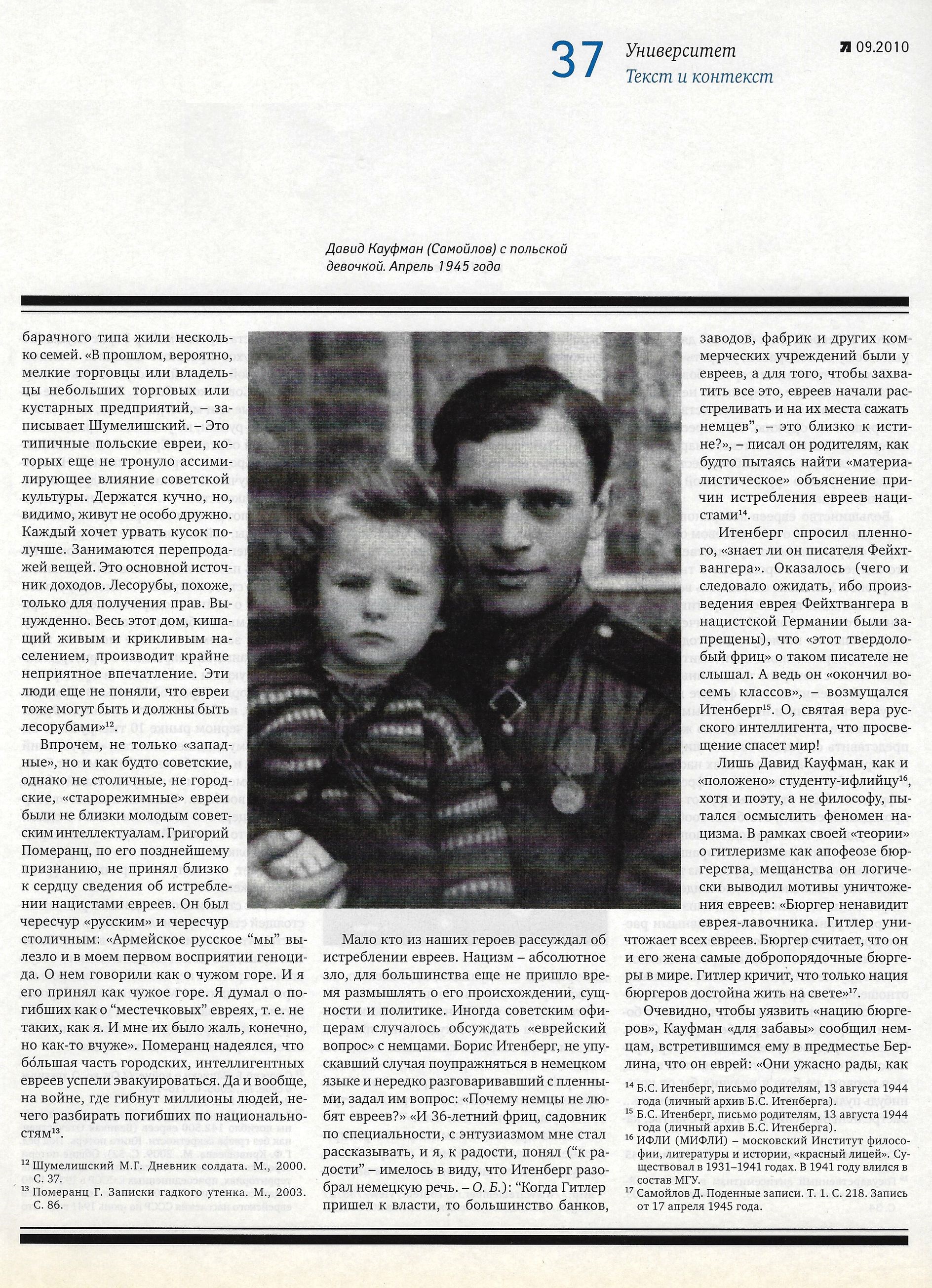
David Kaufman with a Polish girl. April 1945.
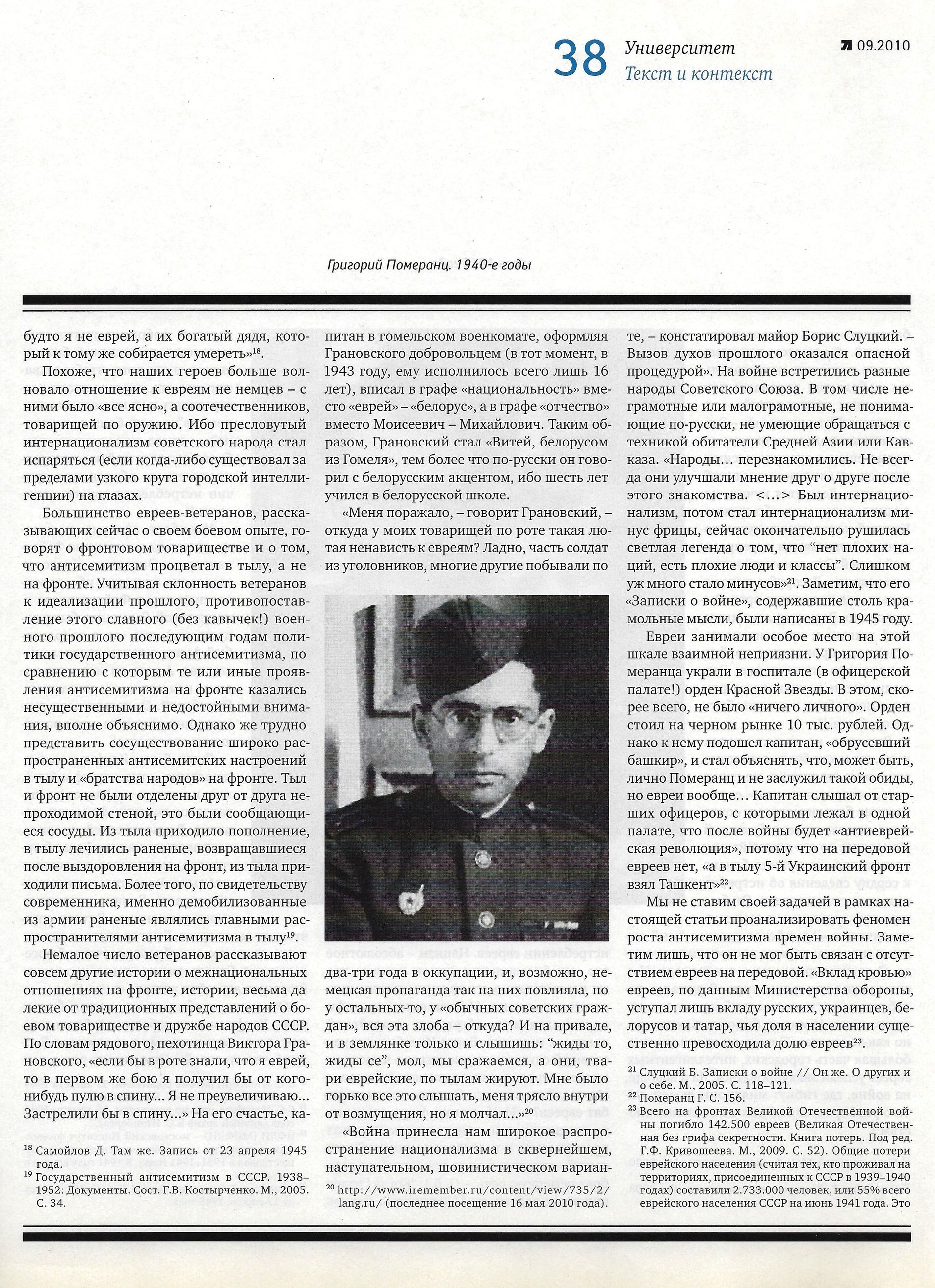
Still, it was not only “Western” Jews but also Jews who were seemingly Soviet, yet not metropolitan, not urban — “old-regime” Jews — who felt distant to young Soviet intellectuals. Grigory Pomerants later admitted that the news of the Nazi extermination of the Jews did not strike him deeply. He was too “Russian” and too metropolitan: “The army’s Russian ‘we’ came out in my first perception of the genocide as well. It was spoken of as someone else’s grief. And I accepted it as someone else’s grief. I thought of those who had died as ‘shtetl’ Jews — that is, not people like me. And I pitied them, of course, but somehow from the outside.” Pomerants hoped that most urban, educated Jews had managed to evacuate. And, generally speaking, in a war in which millions of people were dying, he felt there was no point sorting the dead by nationality.13
Few of our protagonists reflected on the extermination of the Jews. Nazism was absolute evil; for most of them the time had not yet come to ponder its origins, essence, and politics. Soviet officers sometimes happened to discuss the “Jewish question” with Germans. Boris Itenberg, who never missed a chance to practice his German and often talked to prisoners, asked them: “Why don’t the Germans like Jews?” “And a 36-year-old Fritz, a gardener by profession, began explaining it to me enthusiastically, and to my delight I understood him (‘to my delight’ meant that Itenberg could make out the German speech — O. B.): ‘When Hitler came to power, most banks, plants, factories, and other commercial institutions were in Jewish hands, and in order to seize all of it they began shooting Jews and putting Germans in their places’ — is that close to the truth?” he wrote to his parents, as if trying to find a “materialist” explanation for the reasons behind the Nazi extermination of the Jews.14
Itenberg asked the prisoner “whether he knew the writer Feuchtwanger.” It turned out — as one might have expected, since the works of the Jewish writer Feuchtwanger were banned in Nazi Germany — that “this thick-headed Fritz” had never heard of such a writer. And yet he had “finished eight grades of school,” Itenberg protested indignantly.15 Oh, the sacred faith of the Russian intellectual that enlightenment will save the world!
Only David Kaufman, as was “proper” for a student of IFLI,16 though a poet rather than a philosopher, tried to comprehend the phenomenon of Nazism. Within his own “theory” of Hitlerism as the apotheosis of the bourgeois, philistine spirit, he logically derived the motives for the destruction of the Jews: “The burgher hates the Jewish shopkeeper. Hitler destroys all Jews. The burgher considers himself and his wife the most respectable burghers in the world. Hitler shouts that only a nation of burghers deserves to live on earth.”17
Evidently, in order to sting the “nation of burghers,” Kaufman “for amusement” told Germans he met on the outskirts of Berlin that he was a Jew: “They are terribly delighted, as though I were not a Jew but their rich uncle who also happened to be about to die.”18
Grigory Pomerants. 1940s.
It appears that our protagonists were more concerned not with the Germans’ attitude toward Jews — with the Germans “everything was clear” — but with the attitude of their own countrymen and comrades-in-arms. For the much-vaunted internationalism of the Soviet people was evaporating before their eyes (if it had ever existed outside the narrow circle of the urban intelligentsia).
Most Jewish veterans who now speak about their combat experience talk about frontline comradeship and say that antisemitism flourished in the rear, not at the front. Given veterans’ tendency to idealize the past, and to contrast that glorious — without quotation marks — wartime past with the later years of state antisemitism, compared with which individual manifestations of antisemitism at the front seemed insignificant and unworthy of notice, this is understandable. Yet it is difficult to imagine widespread antisemitic attitudes in the rear coexisting with a “brotherhood of peoples” at the front. The rear and the front were not separated by an impassable wall; they were communicating vessels. Reinforcements came from the rear; the wounded were treated there and, after recovery, returned to the front; letters came from the rear. Moreover, according to a contemporary, wounded men discharged from the army were among the principal spreaders of antisemitism in the rear.19
A considerable number of veterans tell quite different stories about interethnic relations at the front — stories very far from traditional notions of combat comradeship and the friendship of the peoples of the USSR. According to Private Viktor Granovsky, an infantryman, “if the company had known that I was a Jew, in the very first battle someone would have put a bullet in my back… I am not exaggerating… They would have shot me in the back…” Fortunately for him, the captain at the Gomel military registration office, while registering Granovsky as a volunteer (in 1943 he was only sixteen), wrote “Belarusian” instead of “Jew” in the nationality field, and changed his patronymic from Moiseyevich to Mikhailovich. Thus Granovsky became “Vitya, a Belarusian from Gomel,” all the more convincingly because he spoke Russian with a Belarusian accent, having attended a Belarusian school for six years.
“What amazed me,” Granovsky says, “was where my comrades in the company got such savage hatred of Jews. All right, some of the soldiers were former criminals, many others had spent two or three years under occupation, and perhaps German propaganda had affected them — but what about the rest, the ‘ordinary Soviet citizens’? Where did all that malice come from? At a rest stop or in the dugout, all you ever heard was: ‘the Yids this, the Yids that’; supposedly we are fighting while those Jewish bastards are fattening themselves in the rear. It was bitter for me to hear all that; inside I shook with indignation, but I kept silent…”20
“The war brought us a broad spread of nationalism in its worst, aggressive, chauvinist form,” Major Boris Slutsky stated. “Summoning the spirits of the past turned out to be a dangerous procedure.” Different peoples of the Soviet Union met one another in the war. Among them were illiterate or barely literate inhabitants of Central Asia or the Caucasus who did not understand Russian and did not know how to handle machinery. “The peoples… got to know one another. Their opinions of one another did not always improve after that acquaintance. <…> There had been internationalism, then there was internationalism minus the Fritzes; now the bright legend that ‘there are no bad nations, only bad people and classes’ was finally collapsing. There had become far too many exceptions.”21 It should be noted that his “Notes on the War,” containing such seditious thoughts, were written in 1945.
Jews occupied a special place on this scale of mutual hostility. Grigory Pomerants had his Order of the Red Star stolen in a hospital — in an officers’ ward! Most likely there was “nothing personal” in this: the decoration was worth 10,000 rubles on the black market. But a captain, a “Russified Bashkir,” came up to him and began explaining that perhaps Pomerants personally did not deserve such an insult, but Jews in general… The captain had heard from senior officers sharing his ward that after the war there would be an “anti-Jewish revolution,” because there were no Jews on the front line, while “in the rear the Fifth Ukrainian Front has taken Tashkent.”22
It is not our purpose within the limits of this article to analyze the phenomenon of the wartime growth of antisemitism. We will only note that it could not have been connected with an absence of Jews from the front line. According to Ministry of Defense data, the Jewish “contribution in blood” was exceeded only by that of Russians, Ukrainians, Belarusians, and Tatars, whose shares of the population were substantially larger than that of the Jews.23
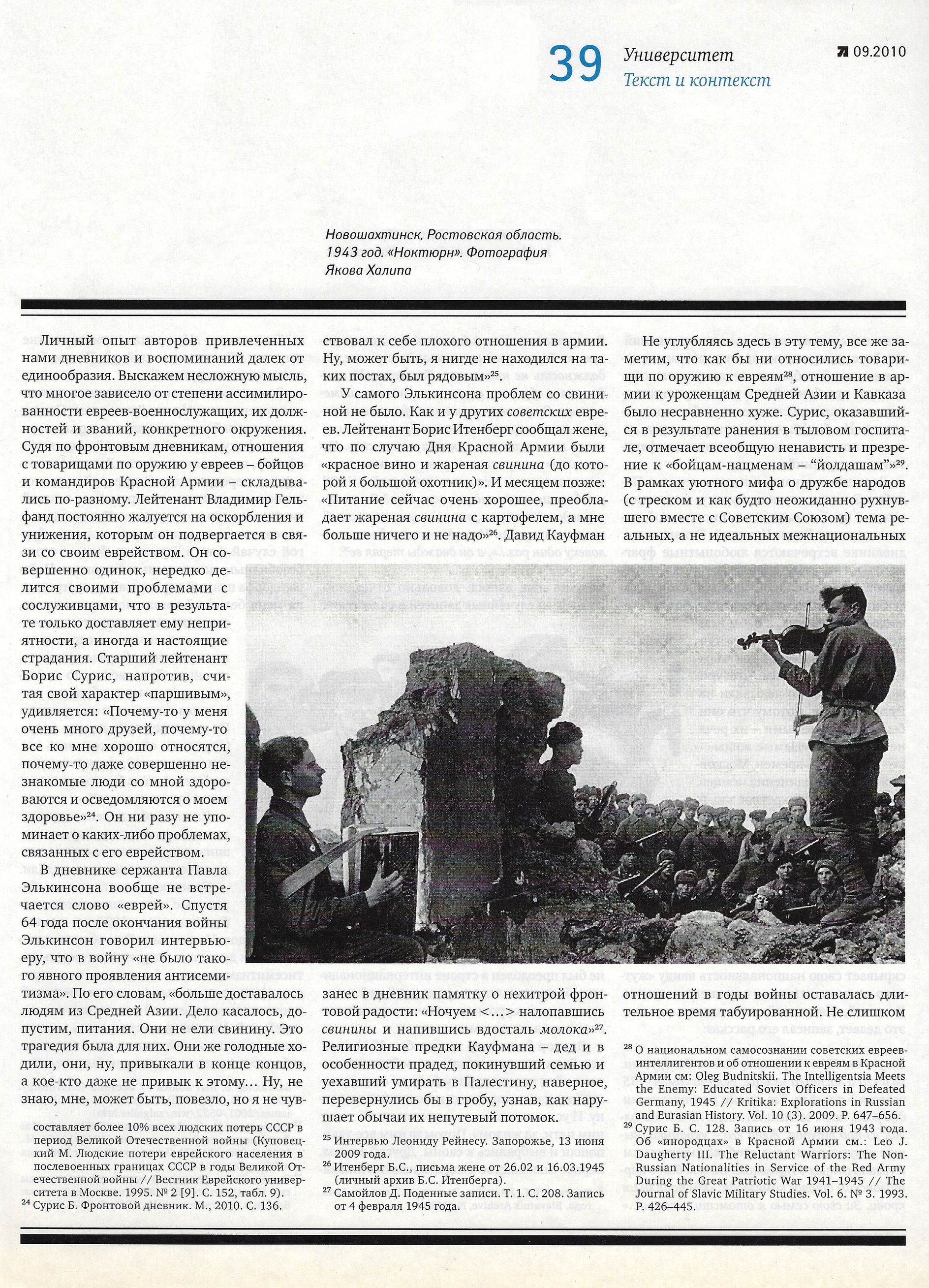
Nocturne. Yakov Khalip. Novoshakhtinsk, Rostov Region. 1943.
The personal experiences of the authors of the diaries and memoirs we have used were far from uniform. The simple point is that much depended on the degree of assimilation of Jewish servicemen, their positions and ranks, and their particular surroundings. Judging by frontline diaries, relations between Jewish Red Army soldiers and commanders and their comrades-in-arms developed in different ways. Lieutenant Vladimir Gelfand constantly complains of insults and humiliations he suffers because he is Jewish. He is completely alone and often shares his problems with fellow servicemen, which as a result only brings him trouble and, at times, genuine suffering. Senior Lieutenant Boris Suris, by contrast, while describing his own character as “lousy,” wonders: “For some reason I have a great many friends; for some reason everyone treats me well; for some reason even complete strangers greet me and ask after my health.”24 He never once mentions any problems connected with being Jewish.
The word “Jew” does not occur at all in Sergeant Pavel Elkinson’s diary. Sixty-four years after the end of the war, Elkinson told an interviewer that during the war “there was no such overt manifestation of antisemitism.” According to him, “people from Central Asia had it worse. Take food, for instance. They did not eat pork. That was a tragedy for them. They went around hungry; well, they got used to it eventually, though some never did… Well, I don’t know, maybe I was lucky, but I did not feel any bad attitude toward me in the army. Maybe I never held positions like that; I was a private.”25
Elkinson himself had no problem with pork — nor did other Soviet Jews. Lieutenant Boris Itenberg informed his wife that on the occasion of Red Army Day there had been “red wine and roast pork (of which I am very fond).” A month later: “The food is very good now; roast pork with potatoes predominates, and I need nothing more.”26 David Kaufman entered in his diary a note about a simple frontline pleasure: “We are spending the night <…> having stuffed ourselves with pork and drunk our fill of milk.”27 Kaufman’s religious ancestors — his grandfather, and especially his great-grandfather, who left his family and went to Palestine to die — would probably have turned in their graves had they learned how their wayward descendant was violating their customs.
Without going deeply into this subject, we should nevertheless note that, whatever the attitude of comrades-in-arms toward Jews,28 the army’s treatment of natives of Central Asia and the Caucasus was incomparably worse. Suris, who after being wounded found himself in a rear hospital, notes the universal hatred and contempt for “national-minority soldiers — ‘yoldashes.’”29 Within the cozy myth of the friendship of peoples — which collapsed with a crash, and seemingly unexpectedly, together with the Soviet Union — the subject of real, rather than ideal, interethnic relations during the war remained taboo for a long time.
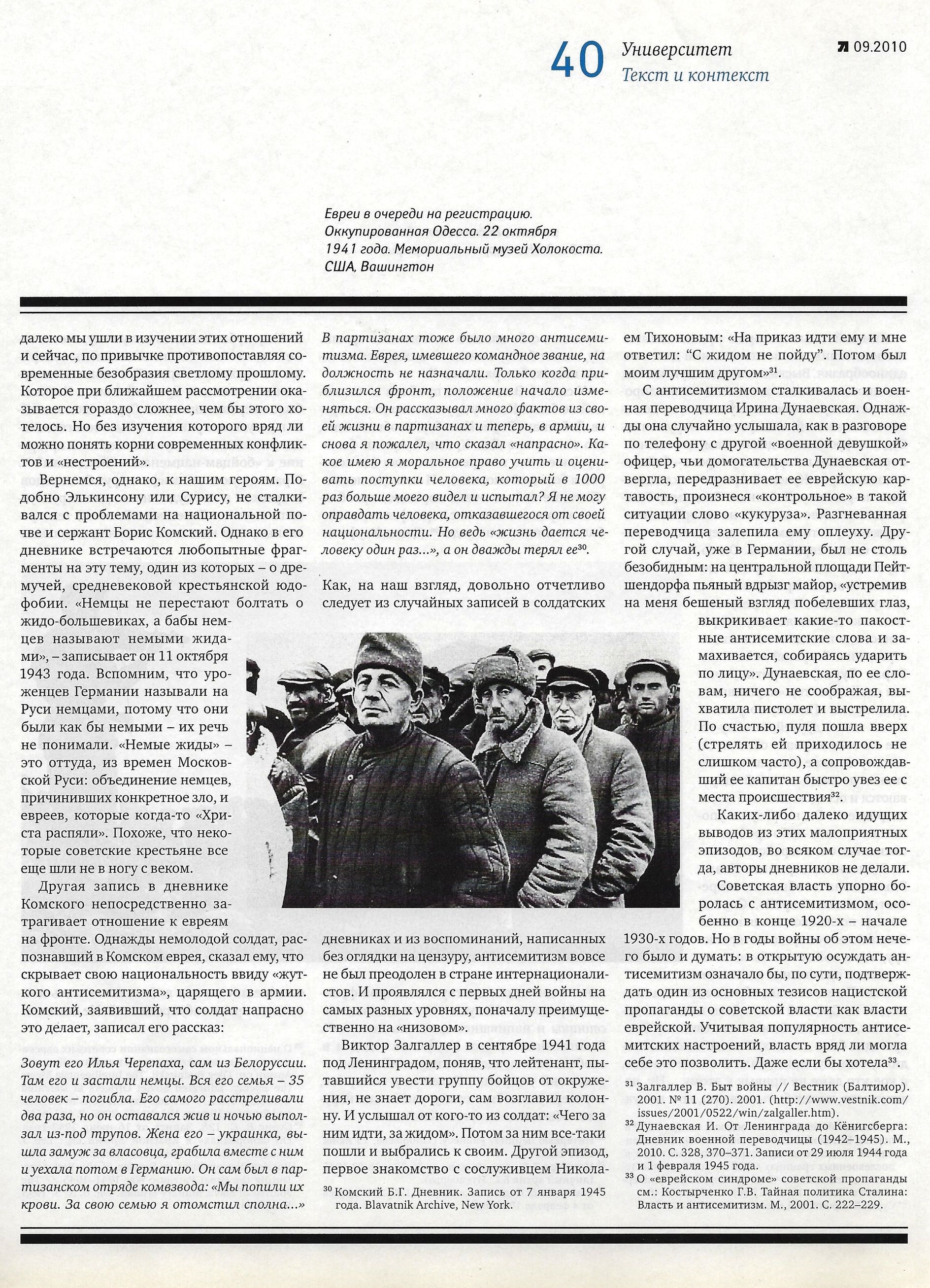
Jews queueing for registration. Occupied Odessa, October 22, 1941. United States Holocaust Memorial Museum, Washington.
Even today we have not advanced very far in studying these relations, habitually contrasting the ugliness of the present with a bright past. On closer examination, that past proves far more complicated than one would like. Yet without studying it, it is hardly possible to understand the roots of present-day conflicts and discord.
Let us return, however, to our protagonists. Like Elkinson or Suris, Sergeant Boris Komsky did not encounter problems on ethnic grounds. Yet his diary contains some curious passages on the subject, one of them concerning a deep, medieval peasant Judeophobia. “The Germans keep babbling about Judeo-Bolsheviks, while the peasant women call the Germans mute Yids,” he wrote on October 11, 1943. Let us recall that in old Russia natives of Germany were called nemtsy, “Germans,” from the idea that they were mute, as though unable to speak, because their speech could not be understood. “Mute Yids” comes from the same world, from the age of Muscovite Rus’: it fuses the Germans, who had inflicted a concrete evil, with the Jews, who had once “crucified Christ.” It seems that some Soviet peasants were still out of step with their century.
Another entry in Komsky’s diary directly concerns attitudes toward Jews at the front. One day an older soldier, recognizing Komsky as a Jew, told him that he concealed his nationality because of the “terrible antisemitism” prevailing in the army. Komsky, who told the soldier that he was wrong to do so, recorded his story:
His name is Ilya Cherepakha; he is from Belarus. The Germans caught him there. His entire family — thirty-five people — was killed. He himself was shot twice, but remained alive and at night crawled out from under the corpses. His wife, a Ukrainian, married a Vlasov man, looted together with him, and later left for Germany. He himself was a platoon commander in a partisan detachment: “We drank plenty of their blood. I avenged my family in full…” There was also much antisemitism among the partisans. A Jew who held command rank would not be appointed to a command post. Only when the front drew near did the situation begin to change. He told many facts from his life with the partisans and now in the army, and once again I regretted having said “wrong.” What moral right do I have to instruct and judge the actions of a man who has seen and endured a thousand times more than I have? I cannot justify a man who has renounced his nationality. But “a man has only one life…” and he had lost his twice.30
As, in our view, follows quite clearly from chance entries in soldiers’ diaries and from memoirs written without regard to censorship, antisemitism had by no means been overcome in the country of internationalists. It manifested itself from the first days of the war at very different levels, at first mainly at the grassroots level.
In September 1941, near Leningrad, Viktor Zalgaller realized that the lieutenant trying to lead a group of soldiers out of encirclement did not know the way, and he himself took command of the column. He heard one of the soldiers say: “Why follow him, a Yid?” In the end they did follow him and reached their own lines. Another episode was his first encounter with a fellow serviceman, Nikolai Tikhonov. When ordered to go with Zalgaller, Tikhonov replied: “I won’t go with a Yid.” Later he became Zalgaller’s best friend.31
Military interpreter Irina Dunaevskaya also encountered antisemitism. Once she accidentally overheard an officer whose advances she had rejected talking on the telephone with another “military girl” and mimicking Dunaevskaya’s Jewish uvular pronunciation, deliberately using the test word kukuruza (“corn”). The enraged interpreter slapped him across the face. Another episode, already in Germany, was less harmless: on the central square of Peitschendorf, a major who was dead drunk “fixed me with the furious stare of his whitened eyes, shouted some vile antisemitic words, and raised his arm to strike me in the face.” Dunaevskaya, by her own account, acted without thinking, pulled out her pistol, and fired. Fortunately the bullet went upward — she did not have much occasion to shoot — and the captain accompanying her quickly drove her away from the scene.32
The diary writers did not, at least at the time, draw any far-reaching conclusions from these unpleasant episodes. The Soviet government had fought antisemitism persistently, especially in the late 1920s and early 1930s. But during the war there could be no question of doing so openly: publicly condemning antisemitism would in effect have confirmed one of the main claims of Nazi propaganda, that Soviet power was Jewish power. Given the popularity of antisemitic attitudes, the government could hardly afford that — even if it had wanted to.33
How did the war affect Soviet soldiers’ and officers’ relationship to their own Jewishness? In different ways. We cannot operate here with any figures or give an unequivocal answer. For some, Jewishness remained a peculiarity inherited at birth and, if not an obstacle, then an unnecessary appendage to normal existence.
In the winter of 1945 in Poland, Viktor Zalgaller’s platoon was forced to sleep in the forest on spruce branches in twenty-five-degree frost. Zalgaller went down to the river, where he found several dugouts belonging to a neighboring unit — there was no room in them — and a little bathhouse. An elderly Jewish man was heating it. “He asks me,” Zalgaller recalled, “‘Jew?’ — ‘Yes.’ He starts muttering in Yiddish. I don’t understand. ‘Never mind,’ he says, ‘you sleep, and I will sing over you.’ And I am already asleep on the damp bunks <…> For the first time in my life my absurd (italics mine — O. B.) national affiliation helped me.”34
Others, while remaining internationalists, perhaps for the first time felt their belonging to the Jewish people. Boris Tartakovsky recorded on May 10, 1944, his impressions of the preceding days. The troops in which he served were liberating Ukraine. In Kamianets-Podilskyi the Old Town had become a city of death:
Once these districts had been inhabited to a considerable extent by Jews. The Germans first turned the Old Town into a real ghetto and then destroyed both all its inhabitants and the town itself. Footsteps echo hollowly across grass-grown squares; the broken windows of the houses stare silently; scraps of wallpaper are still visible on the remnants of ruined walls. Only rarely does a person pass, or a stray dog run by. Silence.35
The Jews gathered in the ghetto of Zhmerinka, which was part of Romanian Transnistria, were fortunate: the Germans who replaced the Romanians did not manage to shoot them. On the morning Tartakovsky arrived in Zhmerinka, “the town was full of people who had returned to life. For the first time in two and a half years they were able to walk down the street with their heads held high, freely and independently, without the humiliating yellow star on their chest. The stakes with barbed wire had been swept completely away; the terrible boundary no longer existed. It was a moving sight. <…> And for the first time in my life I regretted that I did not know the Jewish language,” wrote Tartakovsky, the “assimilationist.”36
Grigory Pomerants was “struck to the core” on the way back from Germany, at Majdanek, “beside a mass of children’s shoes stuck together”: he “felt the dead as his own children and for the first time fully experienced Ivan Karamazov’s words about the little children who are guilty of nothing.”37 This is very characteristic of the Russian-Jewish intellectual: the tragedy of the Jewish people allows him “fully” to grasp the thought of a Russian writer — a thought (and image) that undoubtedly belongs among the most humanistic in Russian literature, though it was voiced by a character in Dostoevsky’s most antisemitic novel.
All the authors quoted in this article survived the war and had relatively successful careers. I think the poets Boris Slutsky and David Samoilov (Kaufman) need no special introduction. Boris Komsky became a military journalist and, after retirement, settled in Lviv. Until recently he edited the local Jewish newspaper. He still regrets the “misfortune” of the collapse of the Soviet Union. Pavel Elkinson became an engineer and the head of a shop at a large factory in his native Zaporizhzhia. He lived for several years in Israel, then returned to Zaporizhzhia — with age, the Israeli climate became too difficult for him. Viktor Zalgaller became a scholar, a doctor of physical and mathematical sciences. In the 1990s his “absurd” nationality brought him to Israel. Boris Itenberg became a doctor of historical sciences and the author of numerous works on the history of revolutionary populism and Russian liberalism. He lives in Moscow. Irina Dunaevskaya earned a candidate degree in Hittitology and worked at the Leningrad branch of the Institute of Oriental Studies of the Academy of Sciences. She lives in St. Petersburg. Boris Suris graduated from the Academy of Arts in Leningrad and became an art historian. Sadly, his frontline diary was published almost twenty years after his death. Boris Tartakovsky served in the holy of holies — the Institute of Marxism-Leninism under the CPSU Central Committee. His wartime diaries were likewise published posthumously. Grigory Pomerants made precisely the opposite kind of “career”: he spent three years in a camp during the late Stalin period and became a well-known cultural scholar and dissident. Lev Kopelev became an even more famous dissident — or, I would say, was “made” into one — after stubbornly trying to improve Soviet society and ultimately being deprived of Soviet citizenship. Vladimir Gelfand had no particular career: he taught history and social studies at a vocational school in Dnipropetrovsk, where he died. His extensive diary was published by his son, who had moved permanently to Germany. By an irony of fate, the diary appeared in book form only in German and Swedish.
On the whole, our protagonists remained Soviet Jews (with the exception of the “anti-Soviets” Kopelev and Pomerants): more Soviet than Jewish.
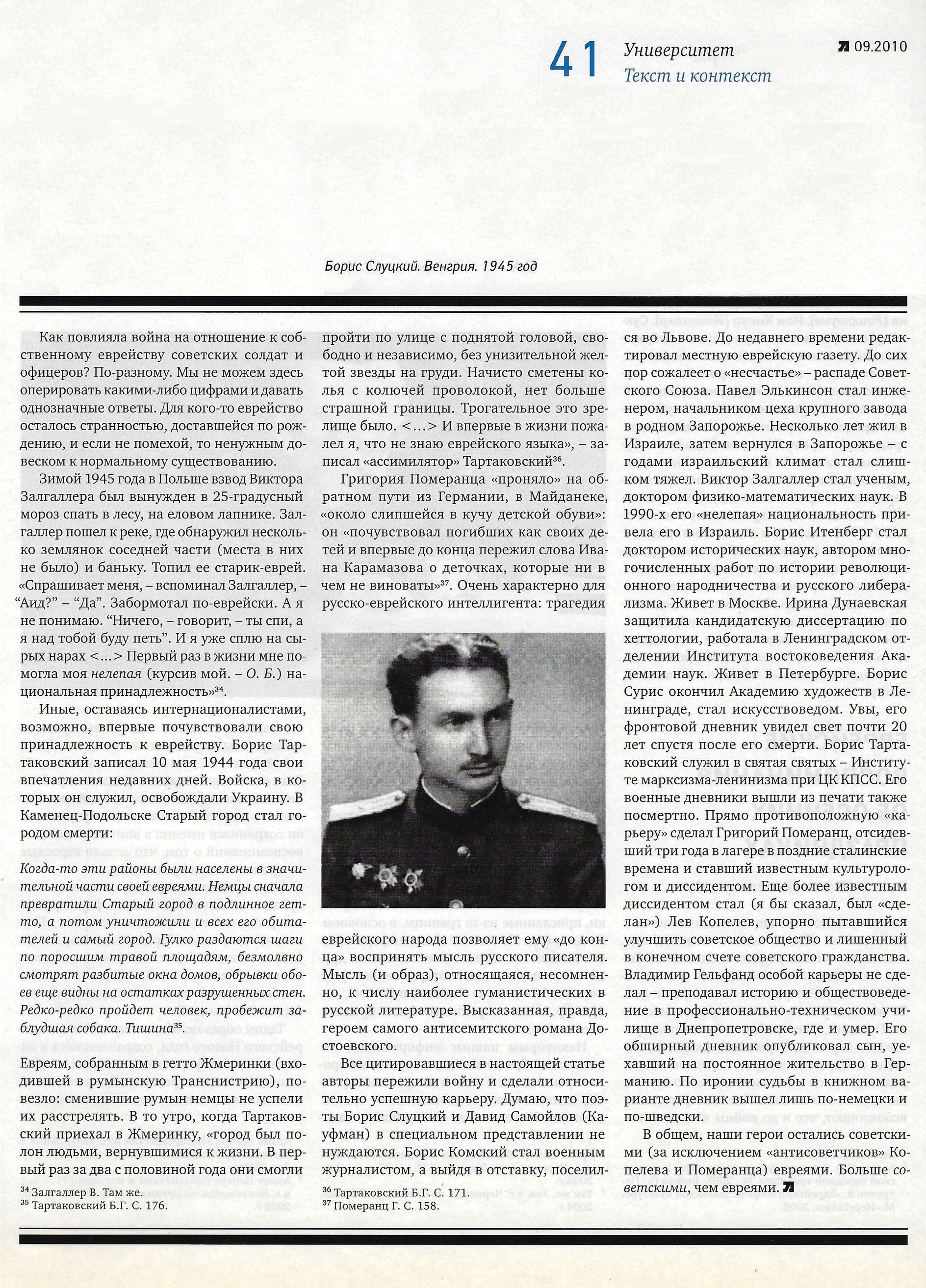
Boris Slutsky. Baja, Hungary. 1945.
Notes
ISSN 0869-5792
http://www.lechaim.ru/
ЛЕХАИМ
- ежемесячный
литературно-публицистический
журнал и издательство
