


Существует устойчивый миф, что ни одна из немецких женщин нацисткой Германии не служила ни в Вермахте, ни в войсках СС. А часто показываемые в советских фильмах немки в военных мундирах – это не более чем плод больного воображения не слишком сведущих в военной истории сценаристов и режиссеров.

 Russian
“Women in the Service of the Third Reich”
There is a persistent myth that not a single German woman in Nazi Germany served either in the Wehrmacht or in the SS. The German women in military uniforms so often shown in Soviet films are therefore said to be no more than the product of the unhealthy imagination of screenwriters and directors who knew little about military history.
That is both true and untrue at the same time.
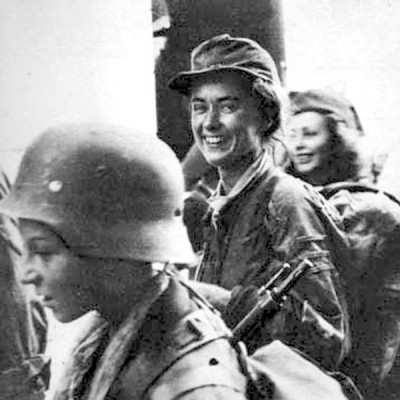
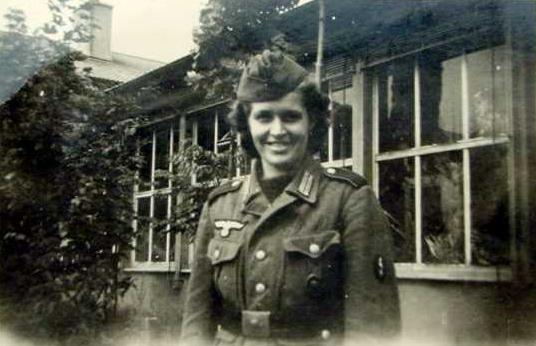
In photographs from that war, German women almost always grin into the camera. In 1945 they would no longer feel like laughing.
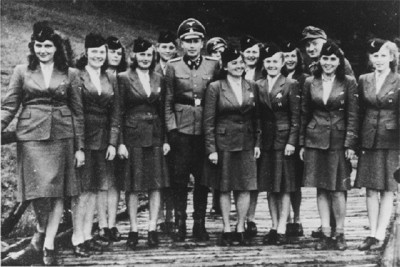
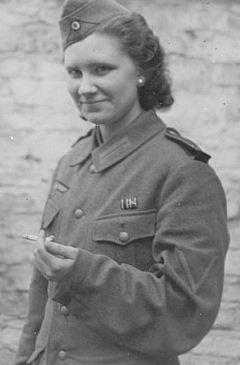
After the Germans had conquered half of Europe, it became obvious that the armed forces needed additional personnel in the form of women's auxiliary units. Wehrmacht Order No. 1085 of 1 October 1940 created the Women's Auxiliary Signals Service (Nachrichtenhelferinnen), which became the forerunner of a whole series of similar women's services, including women employed as horse riders and handlers (Bereiterinnen).
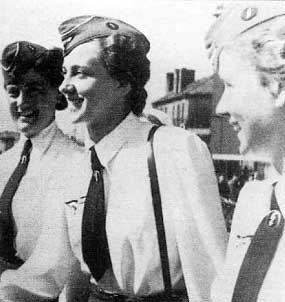
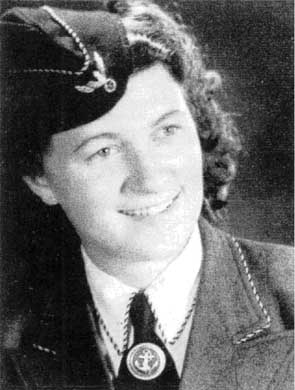
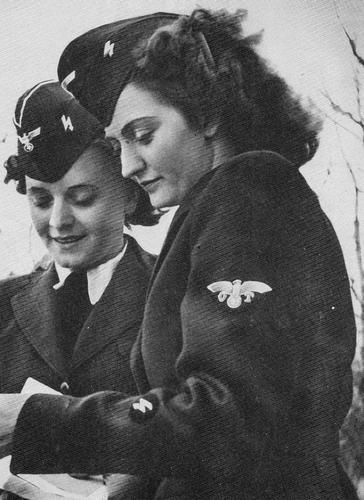
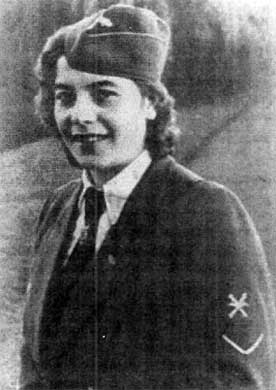
Women serving in auxiliary military units wore army-style uniforms, with distinctions depending on the branch of service. Women serving in occupied territories were permitted to use only a minimum of cosmetics and were forbidden to wear civilian clothes or jewelry.
The emblem of the Women's Auxiliary Signals Service, for example, was a lightning bolt. They were trained at the signals school in Giessen under the supervision of army communications specialists. After training they became military radio operators, telephone operators, and telegraphists.
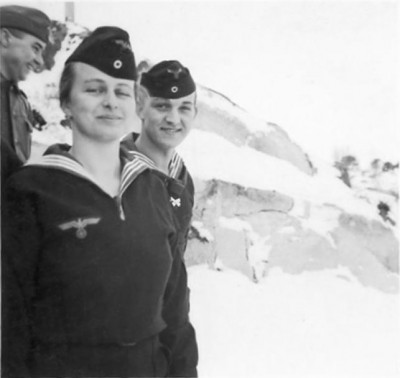
The first large-scale use of female personnel for strictly military purposes in the navy began on 10 April 1941 with the creation of the Naval Air Reporting Auxiliary Service (Flugmeldehelferinnen der Kriegsmarine).
In mid-1942 the naval auxiliary services (Marinehelferinnen) were formed, and in 1943 the navy created its own women's anti-aircraft auxiliary service (Marine-Flakhelferinnen).
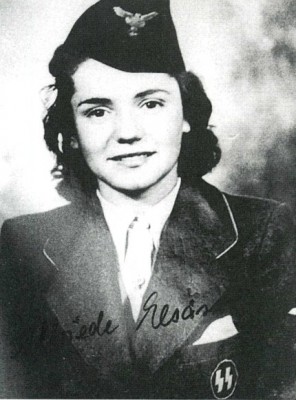
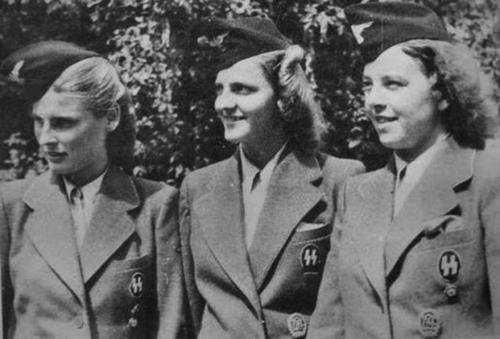
Women for SS auxiliary units were recruited between the ages of 17 and 30. Their duties included guarding women's concentration camps. Many of these women were no less brutal than the men and after the war were convicted of war crimes; some were executed.
Each women's military service had its own complicated rank system, indicated by ring-shaped insignia on sleeves, collars and headgear, or by shoulder straps. This continued until an order of 29 November 1944 united the women's auxiliary units of the various services into a single Women's Auxiliary Service (Wehrmachthelferinnen) with a unified rank system.
Before that, by an order of 28 August 1944, women serving with the armed forces received official military status. Until then they had been regarded as “civilian employees attached to the army.” For Nazi Germany this was a symbolic step in the concept of “total war”: the Germans no longer considered it shameful to send their women into combat.
In the Red Army it was forbidden to keep diaries during the war, and only a few ignored the ban. Read the wartime diaries of one of those bold men, the 22-year-old lieutenant from Dnepropetrovsk, Vladimir Gelfand. They describe the war without embellishment. Here is one example:
“February–March 1945, Oder Front.
...The day before yesterday a women's battalion was operating on the left flank. They were completely defeated, and the captured German women declared themselves avengers of husbands who had died at the front. I do not know what was done with them, but the scoundrels ought to have been executed without mercy. Our soldiers suggest, for example, stabbing them through the sexual organs and other things, but I would simply have destroyed them...
...The women advanced in orderly lines: the first, the second, the third, firing submachine guns. The fourth and final lines consisted entirely of men. Our men kept silent. The women grew brazen; as they approached, they fired point-blank at our infantry...
...The prisoners were divided into three groups.
1. Russians. There turned out to be two of them.
2. Married women and those whose husbands and relatives served in the
same unit as they did (some identified themselves: ‘My husband is
an officer!’).
3. Girls.
Only the third group of prisoners was kept.
The Russians, who were no more than 19 years old, were shot first after questioning.
From the third group they began taking ‘trophies’ away to houses and beds...”
The Führer always said that war was men's business and that women's tasks should be limited to the household and caring for husband and children (Kinder, Küche, Kirche — children, kitchen, church). And I agree with Hitler's view of the role of German women in the army: after what their fathers and husbands did in that war, German women would have been better off staying at home.
© Online publication “St. Petersburg Gazette”
© Oadam