




© Sächsische Zeitung
Франк
Грубич
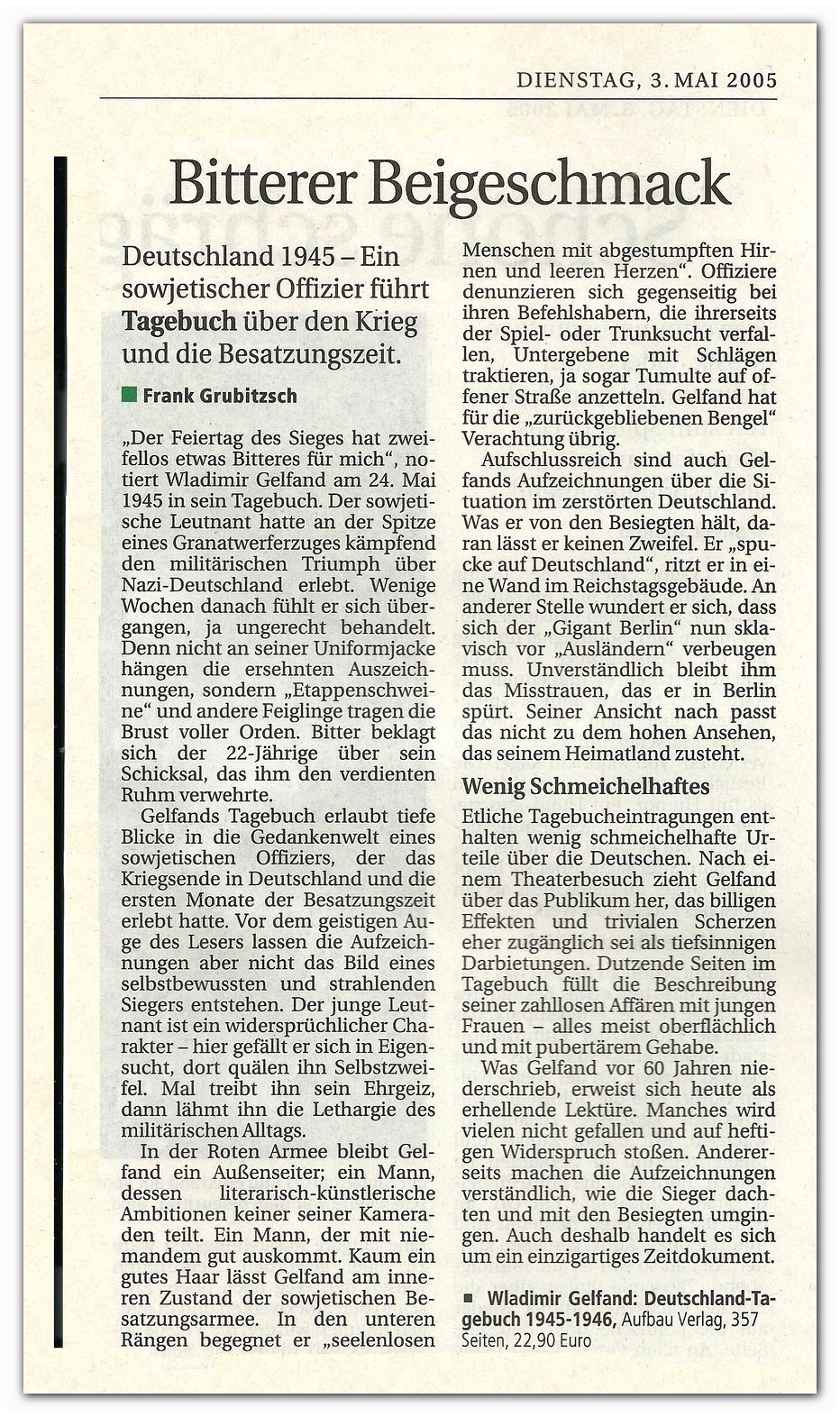
"Праздник победы имеет, без сомнения, кое-что горькое для меня," — записывает Владимир Гельфанд в своем дневнике 24 мая 1945 года.
Советский лейтенант, прошедший войну, испытал многое, возглавляя минометный взвод в боях за триумф над нацистской Германией. Но теперь, спустя несколько недель после окончания войны, он ощущает себя несправедливо обойденным наградами. Вместо боевых отличий на его кителе — пустота, а "герои тыла" и те, кого он считает трусами, ходят с грудью, увешанной орденами.
Двадцатидвухлетний Владимир с горечью жалуется на судьбу, которая лишила его заслуженного признания. Дневник Гельфанда дает редкую возможность заглянуть в мысли и переживания советского офицера, встретившего конец войны в Германии и проведшего первые месяцы в оккупации. Однако его записи не рисуют образ уверенного и сияющего победителя. Он предстает перед читателем противоречивым человеком — то корит себя за эгоизм, то мучается сомнениями. Его раздирает честолюбие, а затем накрывает апатия военной повседневности.
В Красной армии Гельфанд остается аутсайдером. Ни командиры, ни сослуживцы не разделяют его литературные и художественные амбиции. Никто не проявляет к нему особой теплоты. В своих записях он не щадит ни себя, ни окружающих. О рядовых он говорит как о "бездушных людях с притупленными потребностями и пустыми сердцами". Офицеры, по его наблюдениям, плетут интриги, заискивают перед начальством, а те, в свою очередь, предаются азартным играм и пьянству. Подчиненные решают споры кулаками, на улицах вспыхивают беспорядки.
Он презирает "отсталых сопляков", но в то же время испытывает стыд.
Записи Гельфанда о ситуации в разрушенной Германии также весьма показательны. Он не скрывает своего превосходства над побежденными.
"Я плюю на Германию," — царапает он на стене Рейхстага.
В другом месте он удивляется, почему "гигант Берлин" не склоняется рабски перед иностранцами. Но при этом его озадачивает недоверие, с которым к нему относятся в городе. Ему кажется, что немцы не осознают, какое уважение должно быть оказано его Родине.
Некоторые записи дневника наполнены колкими комментариями. После посещения театра он пренебрежительно отзывается о немецкой публике, замечая, что "дешевые эффекты и тривиальные шутки кажутся ей ближе, чем глубокие и меланхоличные образы". Его дневник содержит десятки страниц, посвященных его многочисленным романам — мимолетным, поверхностным, поданным с юношеским кокетством.
То, что Гельфанд записал 60 лет назад, сегодня читается как документ эпохи — живой, противоречивый, местами спорный. Некоторые его слова вызовут неприятие и протест, но в этом и заключается ценность его дневника. Он позволяет понять, что думали победители и как они обращались с побежденными. Именно поэтому этот дневник остается уникальным историческим свидетельством.
Владимир Гельфанд: немецкий
дневник 1945-1946,
Aufbau,
357 стр., 22,90 евро
 German
Sächsische Zeitung
A Bitter Aftertaste
Frank Grubitzsch
“The celebration of victory undoubtedly has something bitter about it for me,” Vladimir Gelfand wrote in his diary on 24 May 1945.
The Soviet lieutenant had been through much in the war, commanding a mortar platoon during the struggle that ended in victory over Nazi Germany. Yet a few weeks after the end of the fighting he felt that he had been unfairly passed over for decorations. His tunic remained bare while “rear-area heroes” and men he regarded as cowards walked around with chests covered in medals.
The twenty-two-year-old Vladimir complained bitterly about a fate that, in his eyes, had deprived him of deserved recognition. Gelfand’s diary offers a rare opportunity to look into the thoughts and emotions of a Soviet officer who experienced the end of the war in Germany and spent the first months of the occupation there. His notes do not portray a confident, radiant victor. Instead he appears as a contradictory human being, at one moment reproaching himself for selfishness and at another tormented by doubt. Ambition pulls him in one direction; the apathy of military routine drags him in another.
Within the Red Army, Gelfand remained an outsider. Neither his commanders nor his fellow soldiers shared his literary and artistic ambitions. Few showed him much warmth. In his notes he spared neither himself nor those around him. He described ordinary soldiers as “soulless people with dulled needs and empty hearts.” Officers, in his account, schemed and ingratiated themselves with superiors, while their commanders in turn gave themselves over to gambling and drinking. Subordinates settled disputes with their fists and disturbances broke out in the streets.
He despised “straggling hooligans,” yet at the same time he felt ashamed.
Gelfand’s observations on conditions in devastated Germany are equally revealing. He did not hide his sense of superiority over the defeated.
“I spit on Germany,” he scratched on a wall of the Reichstag.
Elsewhere he wondered why “giant Berlin” did not bow slavishly before foreigners. Yet he was also puzzled by the mistrust with which people in the city treated him. It seemed to him that Germans did not understand the respect that ought to be shown to his homeland.
Unflattering Judgments
Some diary entries are filled with sharp comments. After a visit to the theater he wrote disparagingly about the German audience, observing that “cheap effects and trivial jokes seem closer to them than profound and melancholy images.” Dozens of pages are devoted to his numerous romances — fleeting and superficial, narrated with youthful vanity.
What Gelfand wrote sixty years ago can now be read as a document of its time: vivid, contradictory and at points contentious. Some of his words will provoke rejection and protest, but that is also part of the diary’s value. It helps us understand what some of the victors thought and how they related to the defeated. That is why the diary remains a unique historical testimony.
Vladimir Gelfand: Germany Diary 1945–1946, Aufbau, 357 pages, €22.90