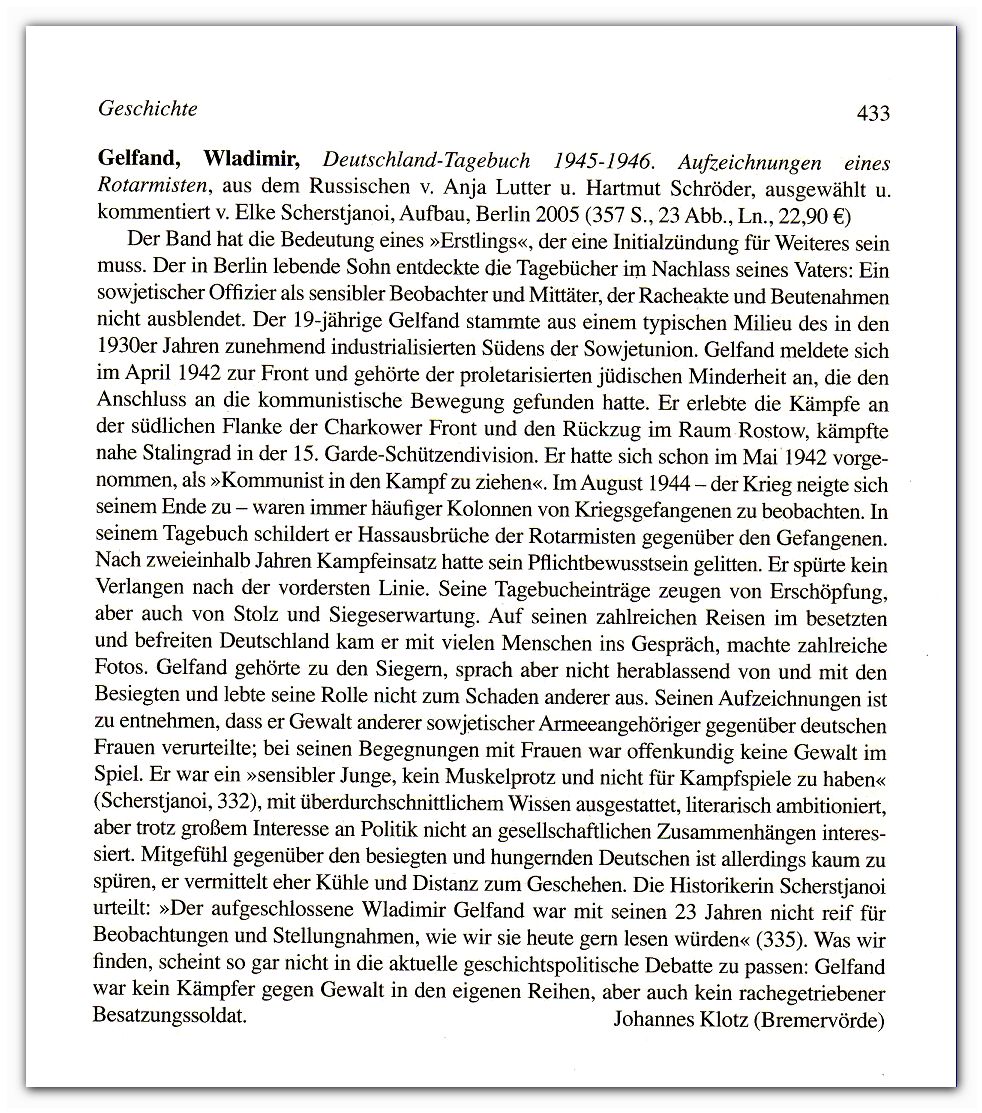
Gelfand,
Wladimir. Deutschland-Tagebuch 1945-1946.
Aufzeichnungen eines Rotarmisten,
aus dem Russischen v. Anja Lutter u. Hartmut Schröder,
ausgewählt und kommentiert
v. Elke Scherstjanoi, Aufbau Verlag, Berlin 2005 (357 S., 23 Abb., Ln.,
22,90 €)

Сын Владимира Гельфанда, проживающий в Берлине, обнаружил дневники своего отца – советского офицера, который предстает в записях не как безжалостный завоеватель, движимый местью и жаждой добычи, а как чувствительный наблюдатель и участник событий.
19-летний Гельфанд вырос в типичной среде рабочего класса в южных регионах Советского Союза, которые в 1930-х годах переживали индустриальный подъем. Весной 1942 года он ушел на фронт и оказался в рядах пролетарского еврейского меньшинства, чьи судьбы переплелись с коммунистическим движением. Он стал свидетелем тяжелых боев на южном фланге фронта в районе Харькова и отступления Красной армии под Ростовом. Позже он воевал под Сталинградом в 15-й гвардейской стрелковой дивизии, проявляя себя как убежденный коммунист, «идущий в бой как партийный боец».
К августу 1944 года, когда война приближалась к концу, он все чаще сталкивался с колоннами немецких военнопленных. В своем дневнике он описывает ярость красноармейцев по отношению к пленным. После двух с половиной лет на передовой его чувство долга притупляется. Записи свидетельствуют об истощении, но также о гордости и предвкушении победы.
В многочисленных поездках по оккупированной Германии он встречает людей, делает снимки, фиксируя на пленке и в дневнике повседневность поверженной страны. Несмотря на то, что он оказался в числе победителей, он не возвышает себя над побежденными и не злоупотребляет своей ролью. В его записях видно, что он осуждает насилие, совершенное его соратниками против немецких женщин. В его собственных встречах с женщинами нет даже намека на насилие.
«Он был чувствительным юношей, а не воином, не человеком силы», – пишет историк Эльке Шерстяной (стр. 332). Гельфанд обладал высоким уровнем образования, литературными амбициями, но при этом его интерес к социальной справедливости не распространялся на поверженных немцев. Он с холодным равнодушием наблюдает за страданиями голодающих жителей Германии, сохраняет дистанцию от их бедствий. Эльке Шерстяной заключает: «23-летний Владимир Гельфанд не был непредвзятым наблюдателем, каким нам хотелось бы его видеть сегодня» (стр. 335). Именно эта неоднозначность делает его записи особенно ценными – они не вписываются в привычные историко-политические нарративы. Гельфанд не был борцом с насилием внутри Красной армии, но и не стал оккупантом, движимым жаждой мести.
Иоханнес Клотц (Bremervörde) German
Das Argument - Journal of Philosophy and Social Sciences
Vladimir Gelfand. German Diary 1945-1946. Notes of a Red Army Soldier, translated into German by Anja Lutter and Hartmut Schroeder, selected and annotated by Elke Scherstjanoi, Aufbau Verlag, Berlin 2005 (357 pp., 23 illustrations, cloth, EUR 22.90)
Vladimir Gelfand's son, who lives in Berlin, discovered the diaries of his father, a Soviet officer who emerges from the pages not as a ruthless conqueror driven by revenge and the desire for booty, but as a sensitive observer and participant in events.
Nineteen-year-old Gelfand grew up in a typical working-class environment in the southern regions of the Soviet Union, which were undergoing rapid industrialization during the 1930s. In the spring of 1942 he went to the front and belonged to the proletarian Jewish minority whose lives were intertwined with the communist movement. He witnessed heavy fighting on the southern flank near Kharkov and the Red Army's retreat toward Rostov. Later he fought at Stalingrad in the 15th Guards Rifle Division, presenting himself as a convinced communist, "going into battle as a Party fighter."
By August 1944, as the war moved toward its end, he increasingly encountered columns of German prisoners of war. In his diary he describes the fury of Red Army soldiers toward the prisoners. After two and a half years at the front, his sense of duty has begun to dull. The entries show exhaustion, but also pride and anticipation of victory.
During numerous journeys through occupied Germany he meets people and takes photographs, recording everyday life in the defeated country both on film and in his diary. Although he belongs to the victors, he does not elevate himself above the defeated or abuse his role. His notes show that he condemns violence by his comrades against German women. In his own encounters with women there is not even a hint of violence.
"He was a sensitive young man, not a warrior, not a man of force," historian Elke Scherstjanoi writes (p. 332). Gelfand was well educated and had literary ambitions, yet his concern for social justice did not extend to the defeated Germans. He watches the suffering of Germany's starving population with cool detachment and keeps his distance from their misery. Scherstjanoi concludes: "The twenty-three-year-old Vladimir Gelfand was not the unbiased observer we might wish him to be today" (p. 335). It is precisely this ambiguity that makes his notes so valuable: they do not fit familiar historical and political narratives. Gelfand was not a fighter against violence within the Red Army, but neither did he become an occupier driven by a thirst for revenge.
Johannes Klotz
(Bremervoerde)