




Лилия Валеева "Новости культуры"
Русско-немецкий солдатский разговорник
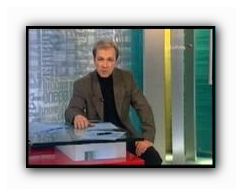 |
 |
 |
 |
 |
От статистики и мировой
истории к
индивидуальной драме и насущной
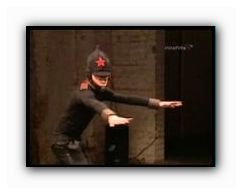
необходимости найти общий язык. Тема спектакля Аглаи Романовской и
Елены Харламовой «Русско-немецкий солдатский
разговорник» актуальна в любое время и в любом национальном
контексте. Диалог залпов и взаимной ненависти сменяется диалогом
человеческих существ. Премьера совместного русско-немецкого проекта
состоялась в Берлине. Минувшим вечером спектакль был впервые показан в
России на сцене театра «Около дома Станиславского».
Рассказывают «Новости
культуры».
Два разговорника и два дневника – бесценный материал для спектакля. Дневник молодой женщины жившей во время Второй мировой войны в Берлине, попал в руки режиссера совершенно случайно. Потом начались поиски дневника мужского. Его автор – Владимир Гельфанд. Он родился в 1923-м году на Украине и в дневнике описал события своей жизни с 1941-го по 1946-й год. Дневник, кстати, размещен в Интернете и, более того, переведен на немецкий.
По разные стороны баррикад находятся обычные люди, которые страдают и любят. Не бывает только плохих или хороших – все похожи, но в тоже время все разные. Почти так же, как разговорники. Русско-немецкий для советских солдат был издан в 1943-м году. В нем уже были готовые фразы и вопросы. Немецко-русский появился двумя годами раньше. В инструкции немецким солдатам рекомендовано не обращать внимания на правила и составлять фразы, используя набор слов.
В мечтах режиссера – создать «Русско-немецкий разговорник» для какого-нибудь московского театра, а пока этот спектакль будет гастролировать по разным театральным площадкам.
© Общероссийский государственный телеканал «Культура»
The Russian-German Soldier's Phrasebook
13 March 2007
Lilia Valeeva, Culture News
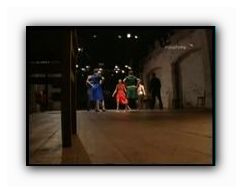
From statistics and world history to individual drama and the urgent need to find a common language. The theme of Aglaja Romanovskaya and Elena Kharlamova's production The Russian-German Soldier's Phrasebook is relevant in any era and in any national context. The dialogue of gunfire and mutual hatred is replaced by a dialogue between human beings. The joint Russian-German project premiered in Berlin. Last night the production was shown in Russia for the first time, on the stage of the theatre "Near the Stanislavsky House." Culture News reports.
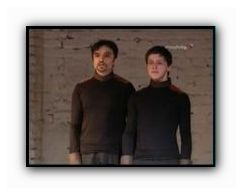
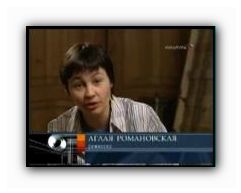
At least half an hour before the performance is devoted to training. Director Aglaja Romanovskaya and her actors tune themselves for the production. Performers from Moscow, Berlin and Vienna take part. The small company consists of six people. Almost all speak German and Russian fluently; only two need phrase books.
Two phrase books and two diaries provide invaluable material for the production. The diary of a young woman who lived in Berlin during the Second World War came into the director's hands entirely by chance. Then the search began for a man's diary. Its author was Vladimir Gelfand. He was born in Ukraine in 1923 and in his diary described events of his life from 1941 to 1946. The diary, incidentally, is available on the Internet and has also been translated into German.
On opposite sides of the barricades are ordinary people who suffer and love. There are no people who are only bad or only good: everyone is alike and at the same time everyone is different. The phrase books are much the same. The Russian-German one for Soviet soldiers was published in 1943 and contained ready-made phrases and questions. The German-Russian phrase book appeared two years earlier. German soldiers were instructed not to worry about grammar but simply to construct sentences from the available words.
The director dreams of creating a Russian-German Phrasebook for a Moscow theatre. For the moment, however, this production will tour various theatrical venues.
- Телеканал РТР "Культура": "Русско-немецкий солдатский разговорник"
- Lothar Gall & Barbara Blessing: "Historische Zeitschrift Register zu Band 276 (2003) bis 285 (2007)"
- Michael Jones: "El trasfondo humano de la guerra: con el ejército soviético de Stalingrado a Berlín"
- Германо-российский музей Берлин-Карлсхорст. Каталог постоянной экспозиции / Katalog zur Dauerausstellung
- Das Buch von Nicholas Stargardt "Der deutsche Krieg: 1939 - 1945" / Николас Старгардт "Мобилизованная нация. Германия 1939–1945"
- BBC Русская служба "Изнасилование Берлина: неизвестная история войны" / BBC Україна "Зґвалтування Берліна: невідома історія війни"
- O Sentinela "Dois Milhões de Alemãs: O Maior Estupro em Massa da História foi um Crime Aliado-Soviético"
- Znaj.UA "Жорстокі знущання та масові вбивства: злочини Другої світової показали в моторошних кадрах"
- Dioxland "NEMŠKIM VOJAKOM JE BILO ŽAL RUSKIH ŽENSK. VSE KNJIGE SO O: "VOJAŠKIH SPOMINIH NEMŠKEGA..."
- Леонід Мацієвський "9 травня – День перемоги над здоровим глуздом. Про згвалтовану Європу та Берлін"
- Русская семёрка "Владимир Гельфанд: что не так в дневниках автора мифа об «изнасилованной» Германии"