


 |
 |
 |

 |
 |
 |
 |
 |
 |
|
 |
 |
 |
 |
 |
|
ТОЙ ВЕСНОЙ
Двор. С чердака и пятого этажа бьют вражеские снайперы. Двор перед ними — как на ладони. Укрыться негде. А нам идти вперед. Но вот вскочил и побежал первый. Через несколько метров упал. Второй стремительно мчит зигзагами: пули взбивают столбики пыли у самых его ног. Засекаем, откуда выстрелы. Подоспевшая батарея «сорокапяток» дает залп. Верх здания застилают пыль и дым. Стрельба из окон прекратилась, и второй добегает до цели. Как по команде, срываемся все мы. Бежим врассыпную к зданию. Но пули снова взвякают о камни двора, хотя наша артиллерия не прекращает огня. Видно, какая-то вражина уцелела, оправилась от первого испуга и опять дает о себе знать. Добегаем. Прочесываем автоматными очередями этаж за этажом. Дом пуст, будто вымер весь. Лишь в одной из комнат пятого этажа находим труп снайпера, уткнувшегося лицом в ствол винтовки. Но вот выше, в других комнатах — россыпь гильз. Взбегаем на чердак. У дымохода несколько человек в штатском. Клянутся, что не стреляли. Заглядываем в дымоход — там оружие! — Эх, попался бы ты мне со своим карабином! — негодуя, говорит один боец. — Да нельзя! Пленные... — добавляет другой. Отправляем «штатских» под конвоем в наш штаб. Последний резерв. Трептов-парк. На нас шли танки и бронетранспортеры с эсэсовскими головорезами. Затем бросились в атаку пьяные уголовники, выпущенные из тюрем. За ними опять танки. А после некоторой передышки последовала и эта, «психическая». |
|
 Russian
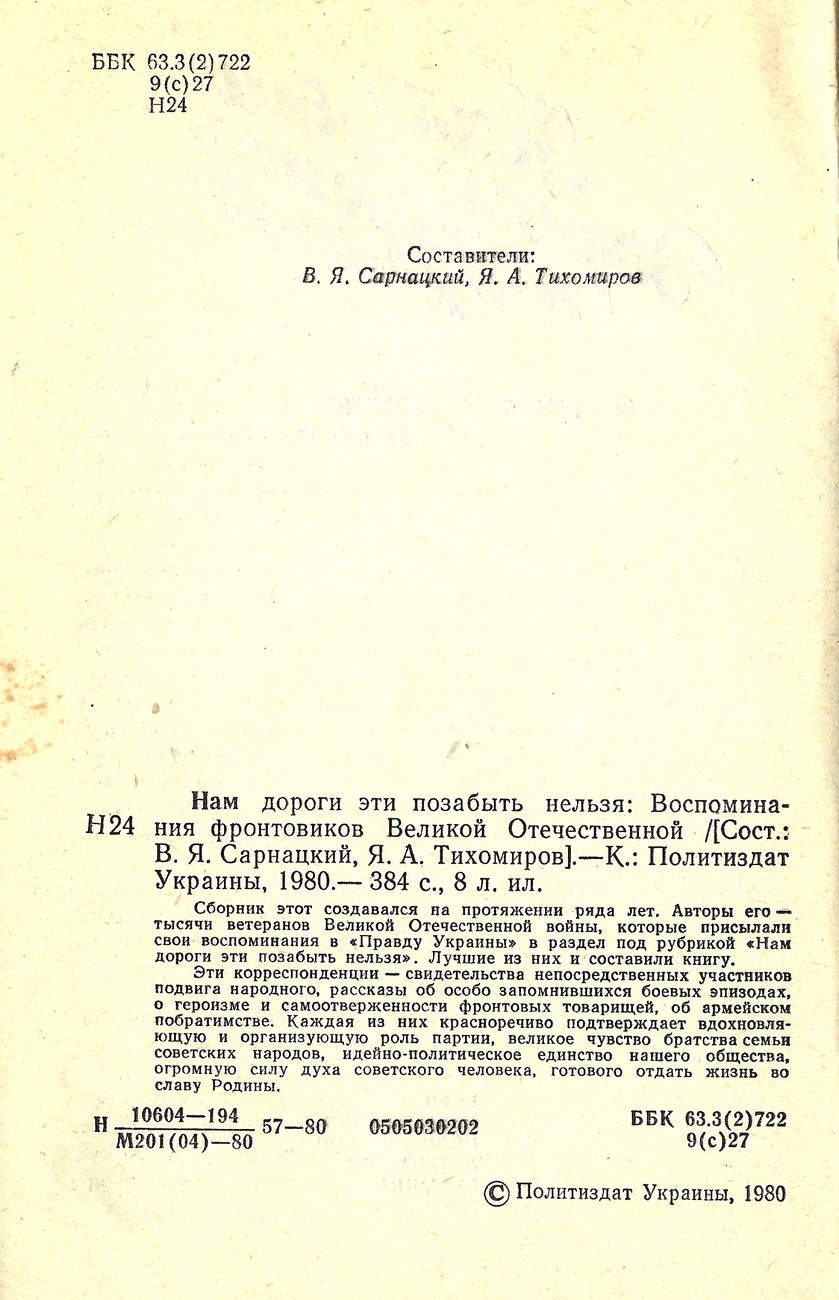
This collection was assembled over a number of years. Its authors were thousands of veterans of the Great Patriotic War who sent their reminiscences to Pravda Ukrainy for the section entitled “We Must Never Forget These Roads.” The best of those recollections were included in the book.
These contributions are testimonies by direct participants in the people’s wartime struggle: accounts of especially memorable combat episodes, of the heroism and selflessness of comrades at the front, and of the bonds of army brotherhood. Each text reflects the official Soviet language of its time, stressing the organising role of the Party, the fraternity of the Soviet peoples, the ideological unity of society and the willingness of Soviet citizens to give their lives for their homeland.
A courtyard. Enemy snipers are firing from the attic and the fifth floor. The courtyard lies fully exposed before them. There is nowhere to take cover, yet we have to move forward.
The first man jumps up and runs. A few metres later he falls. The second rushes forward in a zigzag; bullets kick up little fountains of dust right at his feet.
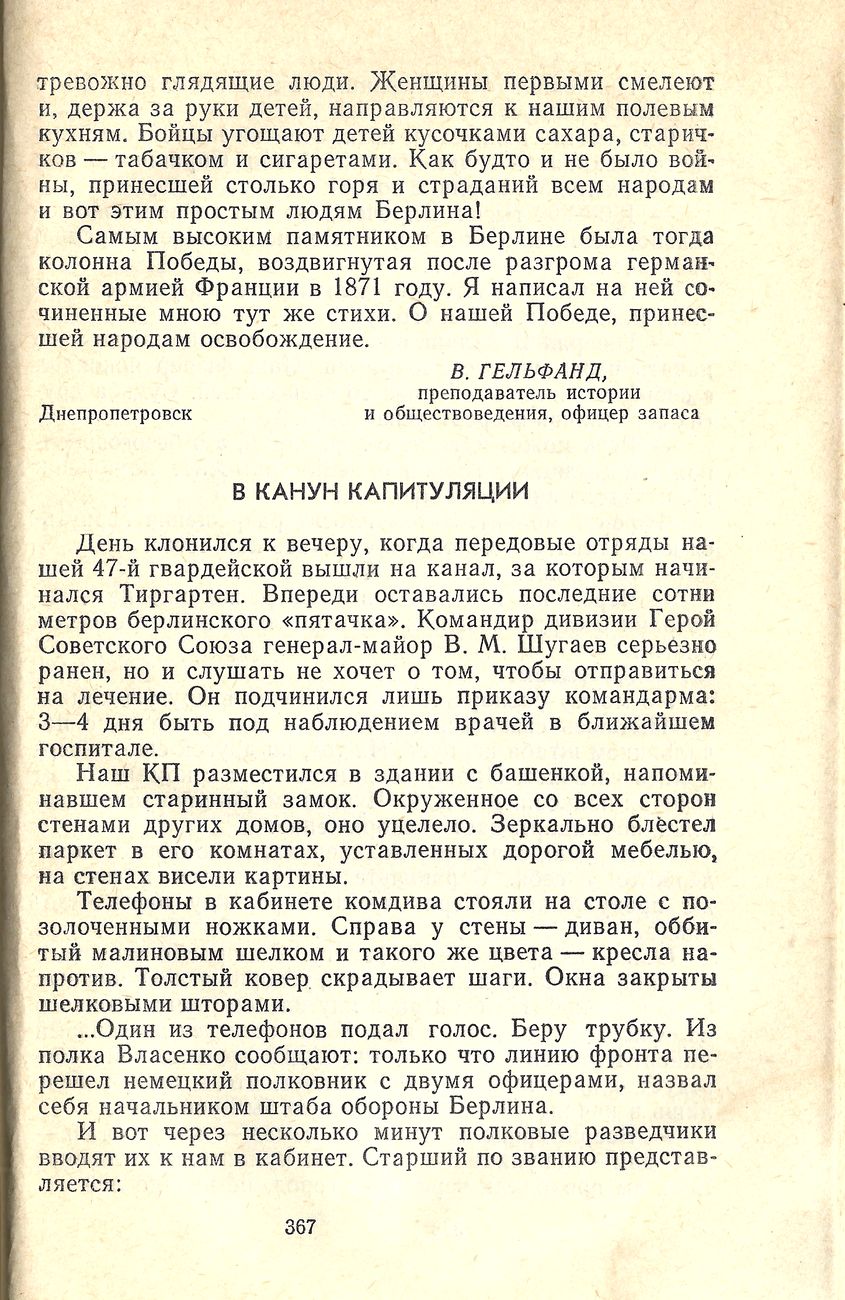
We determine where the shots are coming from. A battery of 45-mm guns that has just arrived fires a salvo. Dust and smoke cover the top of the building. The firing from the windows stops, and the second man reaches his destination.
As if on command, all of us break into a run. We scatter toward the building. But bullets once again ring off the stones of the courtyard, even though our artillery has not stopped firing. Apparently one of the enemy has survived, recovered from the first shock, and is making himself felt again.
We reach the building. We sweep floor after floor with bursts from our submachine guns. The house is empty, as though everyone in it had died. Only in one room on the fifth floor do we find the body of a sniper, his face collapsed against the barrel of his rifle. Higher up, in other rooms, spent cartridges are scattered everywhere.
We race up to the attic. Several men in civilian clothes are standing by the chimney. They swear they did not fire. We look into the chimney — there are weapons inside.
“If only I had caught you with your carbine!” one soldier says angrily.
“You can’t. They’re prisoners…” another adds.
We send the “civilians” under guard to our headquarters.
Treptow Park. Tanks and armoured personnel carriers filled with SS men came at us. Then drunken criminals released from prisons were thrown into the attack. Tanks followed again. After a short pause came this “psychological” assault.
To the beat of a drum, marching in step with submachine guns and fixed bayonets, a women’s battalion approached: girls of about sixteen to eighteen years old — “avengers,” apparently one of the enemy’s last reserves.
Two or three hundred metres behind them stood a group of officers with light machine guns aimed at their backs, as a kind of “insurance.”
Our soldiers, who had just held firm against an attack by “Tigers,” watched anxiously and in disbelief. We had never seen anything like it. Where were these deluded girls going? They were advancing on us with weapons and were about to use them. A Soviet soldier does not wage war on women, and for that reason this “psychological” attack caused a moment of hesitation among us. That, apparently, was what the enemy expected: more “Tigers” were likely to follow behind the “avengers.”
Our command immediately called artillery and Katyusha fire onto the officers. One accurate salvo — and the entire group was swept away.
Weeping, their eyes frozen with terror, the “avengers” lay down on the ground. Their battalion escaped destruction and was taken prisoner.
Sergeant Nikolai Kiyan and privates Ivan Sergeyev and Andrei Savostin did something that people soon spoke about not only in the company but throughout the division.
The company was storming a strongly fortified building. The fighting was hard. Fascists entrenched on every floor resisted desperately.
Kiyan and his two friends tied bundles of grenades to their belts, slung submachine guns over their shoulders and climbed the drainpipes to the top, fifth floor. They threw grenades, shot down or drove off those who were there, and then began working their way downward. Kiyan, who had a thunderous voice, shouted:
“Battalion, follow me!”
All three tried to make as much noise as possible, throwing grenades and firing their submachine guns at the same time.
Believing that strong detachments were attacking them from both below and above, the Hitlerites threw down their weapons. How bitterly disappointed they were when they discovered that they had been captured by only a small group of daring soldiers.
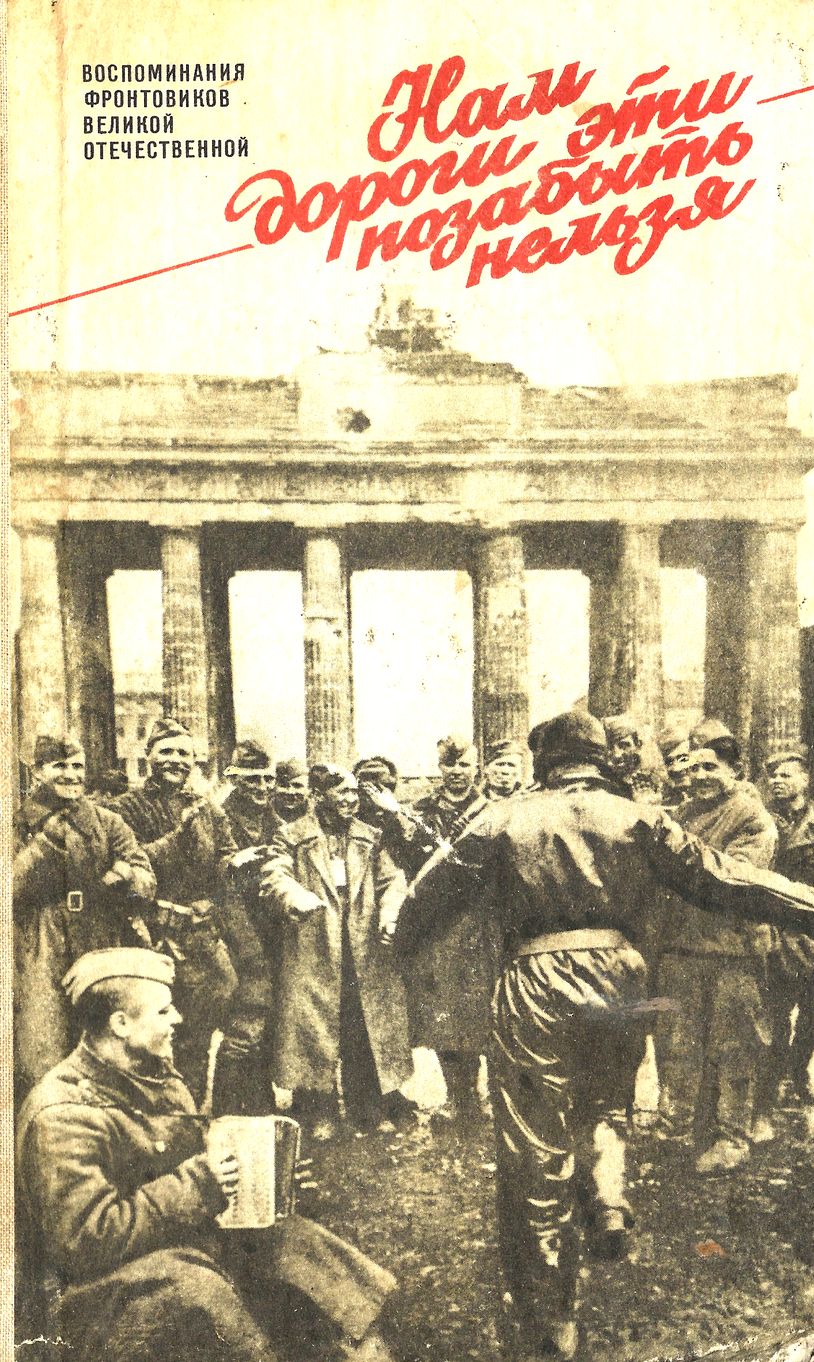
2 May 1945, 3 p.m. Silence. For a front-line soldier it is almost unimaginable. We still cannot come to our senses.
Groups of soldiers emerge from shelters and hiding places and surrender to us. Anxious civilians come out of the cellars.
The women are the first to regain their courage. Holding their children by the hand, they make their way toward our field kitchens. Our soldiers give the children pieces of sugar and offer the old men tobacco and cigarettes. It is almost as if there had been no war — a war that brought so much grief and suffering to every people, including these ordinary people of Berlin.
At that time the tallest monument in Berlin was the Victory Column, erected after the German army defeated France in 1871. On it I wrote verses I had composed there and then — verses about our Victory, which brought liberation to the peoples.
V. Gelfand
Teacher of history and social studies; reserve officer
Dnipropetrovsk
© Political Literature Publishing House of Ukraine