

 |
| OPUS 45 80 Jahre Kriegsende ● „Dass ein gutes Deutschland blühe …“ Leben nach Kriegsende 1945 bis 1949
|
||
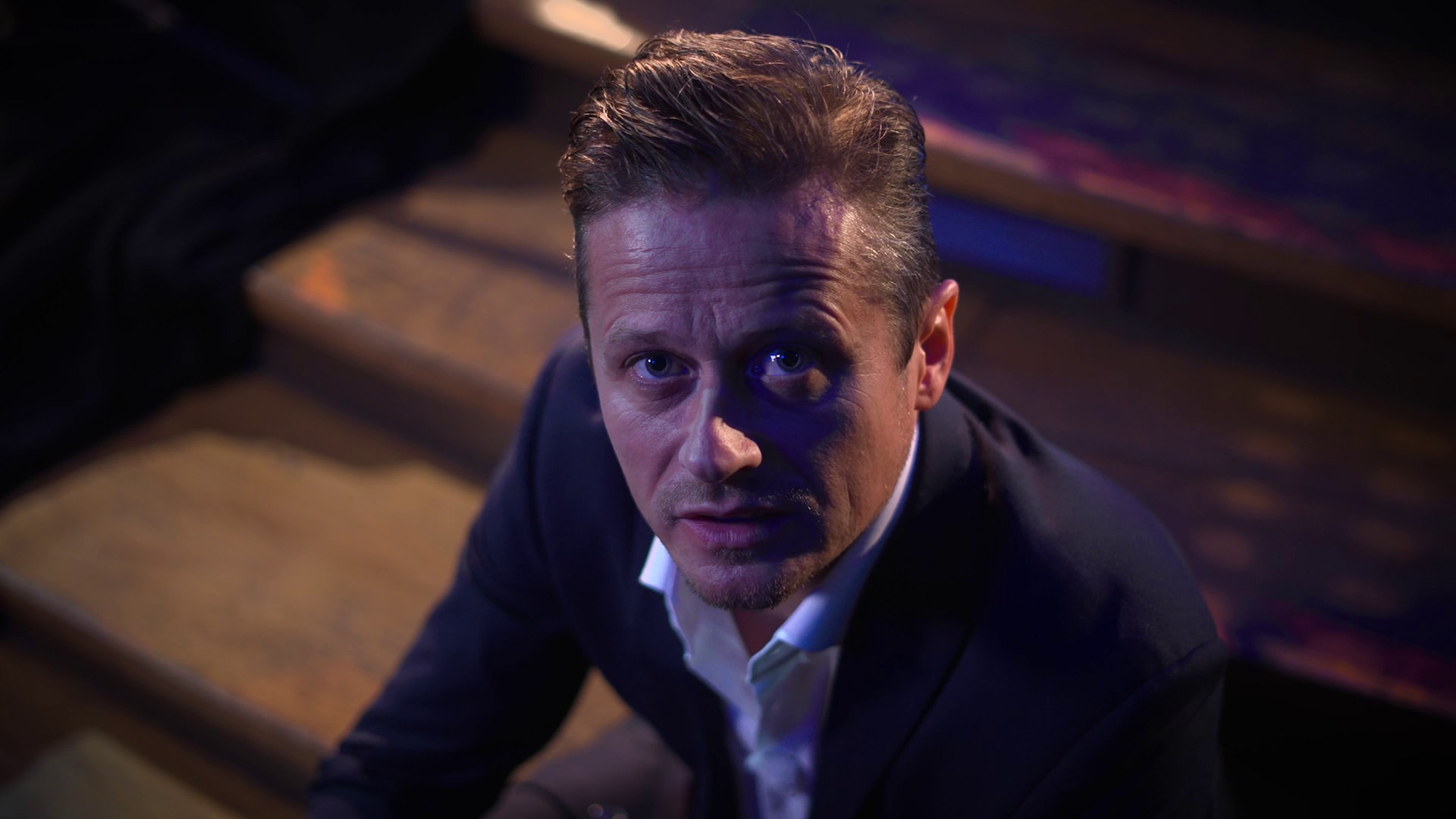
| Texte u.a. von Bertolt Brecht, Wolfgang Borchert, Margaret Bourke-White, Ruth Andreas-Friedrich, Stig Dagerman und Nelly Sachs Musik u.a. von Ludwig van Beethoven, Hanns Eisler, Jean Françaix, Karl Amadeus Hartmann, Charles Koechlin, György Ligeti, Dmitri Schostakowitsch und Richard Strauss Rezitation: Roman Knižka Dramaturgie: Kathrin Liebhäuser Dauer des Konzerts: ca. 90 Minuten (mit Pause ca. 110 Minuten) |
||
 |
||
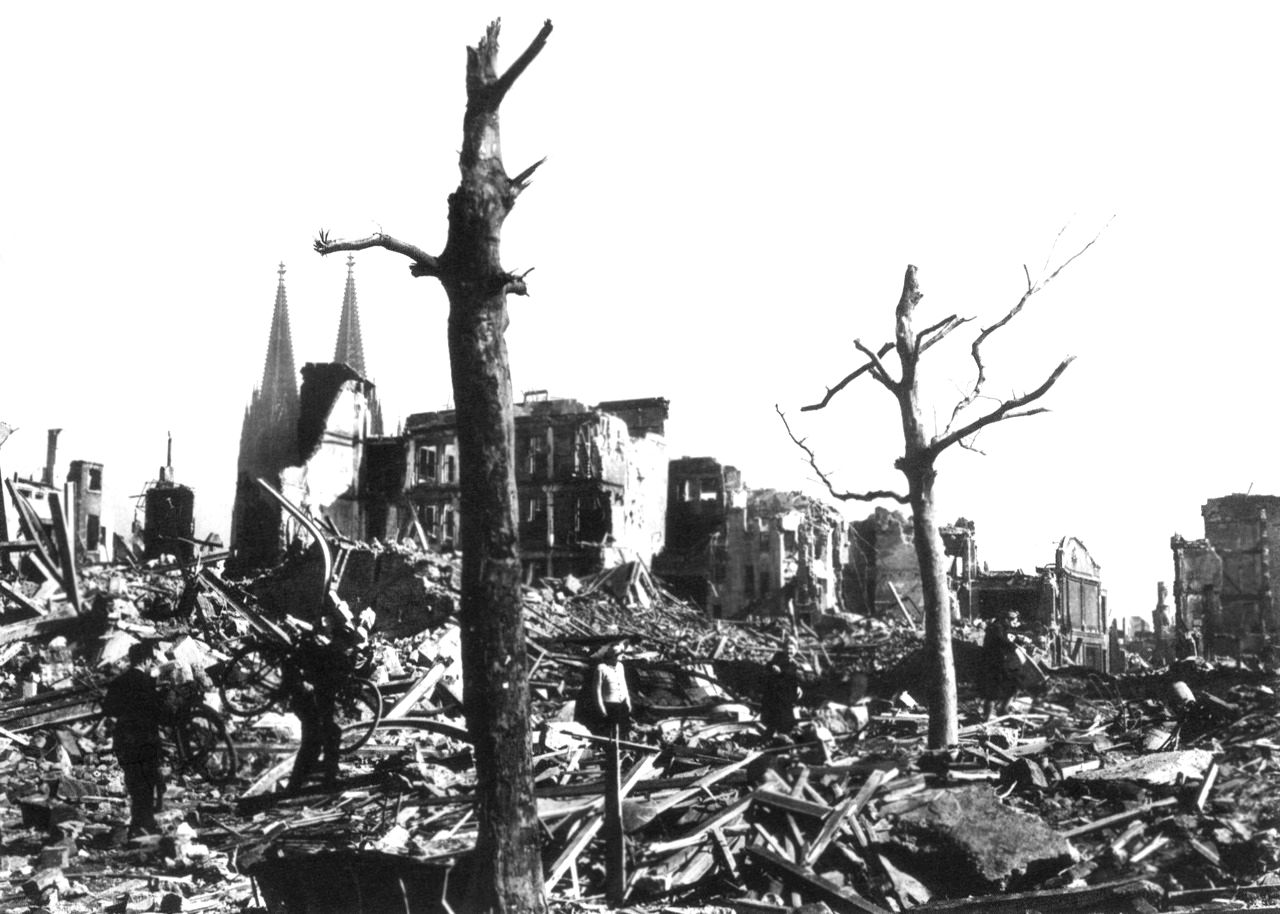
| Köln
nach dem Luftangriff der Alliierten, April 1945, fotografiert von
Kriegsberichterstatterin Margaret Bourke-White, die Teil des Programms
ist. Quelle: The LIFE Picture Collection |
||
|
8. Mai 2025: Das Ende des von Hitler-Deutschland begonnenen Zweiten Weltkriegs und die Befreiung Deutschlands vom Nationalsozialismus jähren sich zum achtzigsten Mal. Aus diesem Anlass versetzen sich Roman Knižka und das Bläserquintett OPUS 45 in ihrem neuen Programm zurück in die frühe Nachkriegszeit der Jahre 1945 bis 1949. 8. Mai 1945: Mit der bedingungslosen Kapitulation der deutschen Wehrmacht war Hitler-Deutschland offiziell besiegt. Fast sechs Jahre hatte der Zweite Weltkrieg gedauert und unvorstellbare 60 Millionen Opfer gekostet. In Deutschland lagen die Großstädte in Schutt und Asche. Unzählige Menschen waren obdachlos, auf der Flucht oder in Kriegsgefangenschaft. Das Sagen im Land hatten nun die Siegermächte. „Dass ein gutes Deutschland blühe …“ erzählt in literarischen Texten, Reportagen und Zeitzeugnissen von einem Land zwischen Apokalypse und Aufbruch, von der Ankunft der Sieger, von der Konfrontation der Deutschen mit den Gräueltaten des NS-Regimes, dem Schicksal jüdischer KZ-Überlebender, die nach ihrer Befreiung als „Displaced persons“ durch das Land der Täter irrten, von Hungerwintern, Vertriebenen und Kriegsheimkehrern. Politische Zäsuren wie die Potsdamer Konferenz, die Nürnberger Prozesse, die Währungsreform oder die Berlin-Blockade werden ebenso thematisiert wie die im Alltag häufig fragwürdige Praxis der Entnazifizierungsverfahren. Literatur und Musik nach 1945: Doch auch von kulturellen Aufbrüchen und Neuanfängen handelt das Programm. Ob oder wie man nach den Verbrechen der NS-Diktatur und der Katastrophe des Zweiten Weltkriegs noch schreiben sollte, wurde von Schriftsteller:innen der Zeit heftig diskutiert. Roman Knižka rezitiert aus Werken der Nachkriegsliteratur von Wolfgang Borchert, Bertolt Brecht und Nelly Sachs. Bereits kurz nach Kriegsende entstanden in völlig zerbombten Städten wie Darmstadt und München Foren für Neue Musik. OPUS 45 interpretiert Werke der Nachkriegsavantgardisten György Ligeti und Karl Amadeus Hartmann sowie weitere Kompositionen am Puls der Zeit von Dmitri Schostakowitsch und Hanns Eisler. Außerdem erklingt Musik von Ludwig van Beethoven, Richard Strauss, Charles Koechlin und Jean Françaix. Wie sich besonders in der jungen Nachkriegsgeneration ein oft kaum zu stillendes Verlangen nach Unterhaltung und Tanz bahnbrach, vermitteln Swing und zeitgenössische Schlager, die das musikalische Porträt der Epoche abrunden. 8. Mai 1945? Das offizielle Kriegsende war für viele Deutsche ein unspektakulärer Tag im anhaltenden Chaos. Das Ende des Zweiten Weltkrieges erlebten die Menschen im Land oft zu unterschiedlichen Zeiten und auf unterschiedliche Weise. Wie es sich konkret am jeweiligen Veranstaltungsort abspielte, berichtet Roman Knižka im ersten Teil des Programms. „Dass ein gutes Deutschland blühe …“ – Leben nach Kriegsende 1945-1949 erinnert an die verheerenden Folgen des Zweiten Weltkriegs und der NS-Diktatur. Ausgehend von der epochalen Zäsur des Jahres 1945 beleuchten Roman Knižka und OPUS 45 eine ambivalente und spannungsreiche Übergangszeit zwischen Zerstörung und Neubeginn. Diese endete mit der Gründung zweier deutscher Staaten und damit der Teilung Deutschlands, deren Folgen bis heute spürbar sind. Programmablauf inkl. Quellen und Musikauswahl zum Download (PDF) In eigener Sache: Für den individuellen Einschub, die Ereignisse am jeweiligen Konzertort im Jahr 1945 betreffend, nehmen wir rechtzeitig Kontakt zu Stadtarchiven und Geschichtsvereinen auf bzw. recherchieren geeignete Quellen. Auch über Hinweise freuen wir uns sehr. Bitte per Mail an kontakt@opus45.de Für Veranstalter: Das im Programm „Dass ein gutes Deutschland blühe …“ integrierte Video zum Download (eine Datei): Link |
||
 |
||
|
Lesung ● Musik ● Performance anlässlich 80 Jahre Kriegsende „Dass ein gutes Deutschland blühe …“ Leben nach Kriegsende (1945-1949) Sprecher/Rezitation: Roman Knižka Musik gespielt vom Bläserquintett OPUS 45 (www.opus-45.de) Dramaturgie / Musikauswahl: Kathrin Liebhäuser (OPUS 45) Idee / Musikauswahl: Benjamin Comparot (OPUS 45) Musikalische Arrangements: Matthias Pflaum & Ulf-Guido Schäfer Copyright: Aufführung ausschließlich durch Roman Knižka und Bläserquintett OPUS 45 Texte, Quellen und Musikauswahl in der Programmabfolge:
„Als die Amerikaner kamen“ Ernest Gold d.i. Ernst Siegmund Goldner (1921-1999): „Hänschen klein“ Titelmusik zum Film „Steiner – Das Eiserne Kreuz“ (arr. Matthias Pflaum) „Die Brücke“ Ludwig van Beethoven (1770-1827): „Allegretto“ (2. Satz) aus der 7. Sinfonie in A-Dur op. 92 (arr. Matthias Pflaum) „Lieber Michail“ – Feldbrief des russischen Offiziers Evgenij Nilovic an einen Freund „Die Leute hier, die Deutschen, fürchten den Zorn von uns Russen“ „Jeder deutsche Zivilist ist ein getarnter Soldat des Hasses“ „Wir haben von nichts gewusst!“ „Wir kannten die Buchenwald-Häftlinge“ György Ligeti (1923-2006): „Allegro con spirito” (1. Satz) aus “Sechs Bagatellen für Bläserquintett” (1953) Bedingungslose Kapitulation Das Kriegsende am jeweiligen Veranstaltungsort des Konzerts Karl Amadeus Hartmann (1905-1963): „Tränen des Vaterlands, anno 1636“ Zwischenspiel aus dem 1. Akt der Oper „Simplicius Simplicissimus“ (UA 1948) arr. Matthias Pflaum „Als die Deutschen im Sommer 1945 begannen, sich über ihre Lage klarzuwerden, mussten sie eine dreifache Niederlage erkennen.“ „Ganz Berlin lebt in einem Rausch der Erwartung!“ Felix Mendelssohn Bartholdy (1809-1847): „Tanz der Rüpel“ aus der Schauspiel-musik zu Shakespeares „Ein Sommernachtstraum“ (arr. Ulf-Guido Schäfer) „In der Stadt herrscht Panik, Bestürzung und Entsetzen.“ „Kriemhild! Dieses Mädchen verdient wahrhaftig Liebe und Achtung.“ Dmitri Schostakowitsch (1906-1975): Largo – Allegretto aus der Neunten Sinfonie Es-Dur op. 70 (1944 / 1945) arr. Matthias Pflaum „Eine derartige Zerstörung habe ich nie wieder gesehen.“ „17. Juli 1945: Beginn der Potsdamer Konferenz“ Die Ausführungen zur Potsdamer Konferenz basieren auf Wolfgang Benz: „Potsdam 1945 - Besatzungsherrschaft und Neuaufbau im Vier-Zonen-Deutschland“ München, 2005 Richard Strauss (1864-1949): „Andante“ (2. Satz) aus dem Konzert für Oboe und kleines Orchester D-Dur (1945) arr. Matthias Pflaum (Pause) Charles Koechlin (1867-1950): „Choral“ (1. Satz) aus „Trio d’anches“ op. 206 (1945) „Nürnberg: Schwurgerichtssaal 600 im zweiten Stock des Justizpalastes.“ „Hoher Gerichtshof!“ GyörgyLigeti (1923-2006): „Presto ruvido“ (4. Satz) aus “Sechs Bagatellen für Bläserquintett” (1953) Displaced Persons – Jakob Biber im DP-Lager Föhrenwald Chor der Geretteten Jerry Bock (1928-2010): „Far from the home I love“ Lied aus dem Musical „Anatevka“ (Fiddler on the Roof) arr. Matthias Pflaum „Ein US-Sergeant fragte mich, was ich mit den Deutschen tun würde …“ „Heute war der glücklichste Tag. Ich bin nicht mehr Nazi!“ Artur Beul (1915-2010): „Nach Regen scheint Sonne“(1945) arr. Matthias Pflaum Im Nachkriegsdeutschland herrscht kein Mangel an Vergnügungen. Glenn Miller (1904-1944): „Moonlight Serenade“ (1939) arr. Matthias Pflaum „Herrgott im Himmel, sieh unsere Not, wir Bauern haben kein Fett und kein „Kein Bauer in Nindorf will diese ausgehungerten ‚Pollacken‘ freiwillig aufnehmen.“ Erinnerungen von Rolf Klodt, der mit seiner Mutter und vier Geschwistern aus dem ostpreußischen Insterburg nach Schleswig-Holstein flüchtete in: Katja Iken, Uwe Klußmann, Eva-Maria Schnurr (Hg.): „Als Deutschland sich neu erfand. Die Nachkriegszeit 1945-1949“ München, 2019 „Kein Strom, kein Wasser, keine Kohlen.“ GyörgyLigeti (1923-2006): „Rubato lamentoso“ (2. Satz) aus “Sechs Bagatellen für Bläserquintett” (1953) „Ein Mann kommt nach Deutschland.“ „Im Herbst 1948 wurde meine Mutter benachrichtigt ...“ Sholom Secunda (1894-1974) / Jacob Jacobs (1890-1977): „Bei mir bist du schön” (1932 / Schlager des Jahres 1948) arr. Matthias Pflaum „Top secret – Operation Bird Dog von Februar bis April 1948“ „Motorengeräusche, die die Berliner erfreuen!“ „Uns kann man nicht eintauschen … Ihr Völker der Welt, schaut auf diese Stadt“ Günter Neumann (1913-1972): „Insulanerlied“ (1948) arr. Matthias Pflaum Weihnachten 1948 – das Lied der Stunde: Am 25. 12. 1948, inmitten der Berlin-Blockade, präsentierte Günter Neumann im RIAS erstmals ein Kabarettprogramm unter dem Titel „Der Club der Insulaner“, das von der Situation West-Berlins im Kalten Krieg handelte. Das Erkennungslied der Radiosendung, das „Insulanerlied“, avancierte über Nacht zu einer Art geheimen Berlin-Hymne. Schon bald erfreute sich das Programm sowohl in Ost als auch in West großer Beliebtheit. „Wir spielen bis zur Wiedervereinigung“, versprachen die Insulaner, die im Kalten Krieg von der SED als „Kriegshetzer“ diffamiert wurden. Abgesetzt wurde das Ensemble dann aber doch schon 1968 – nach 133 Sendungen. „Schlussstrich drunter, Schluss mit Entnazifizierung!“ Bertolt Brecht (1898-1956) / Hanns Eisler (1898-1962): Kinderhymne „Anmut sparet nicht noch Mühe“ (1950) arr. Matthias Pflaum „Der Trinkbecher meines Vaters“ Jean Françaix (1912-1997): „Tempo alla marcia francese” (4. Satz) aus dem Bläserquintett Nr. 1 (1948) (Zugabe)
|
||
| |
||
|
||
 |
||
| „Daß ein gutes Deutschland blühe - Wie ein andres gutes Land“ | ||
 |
||
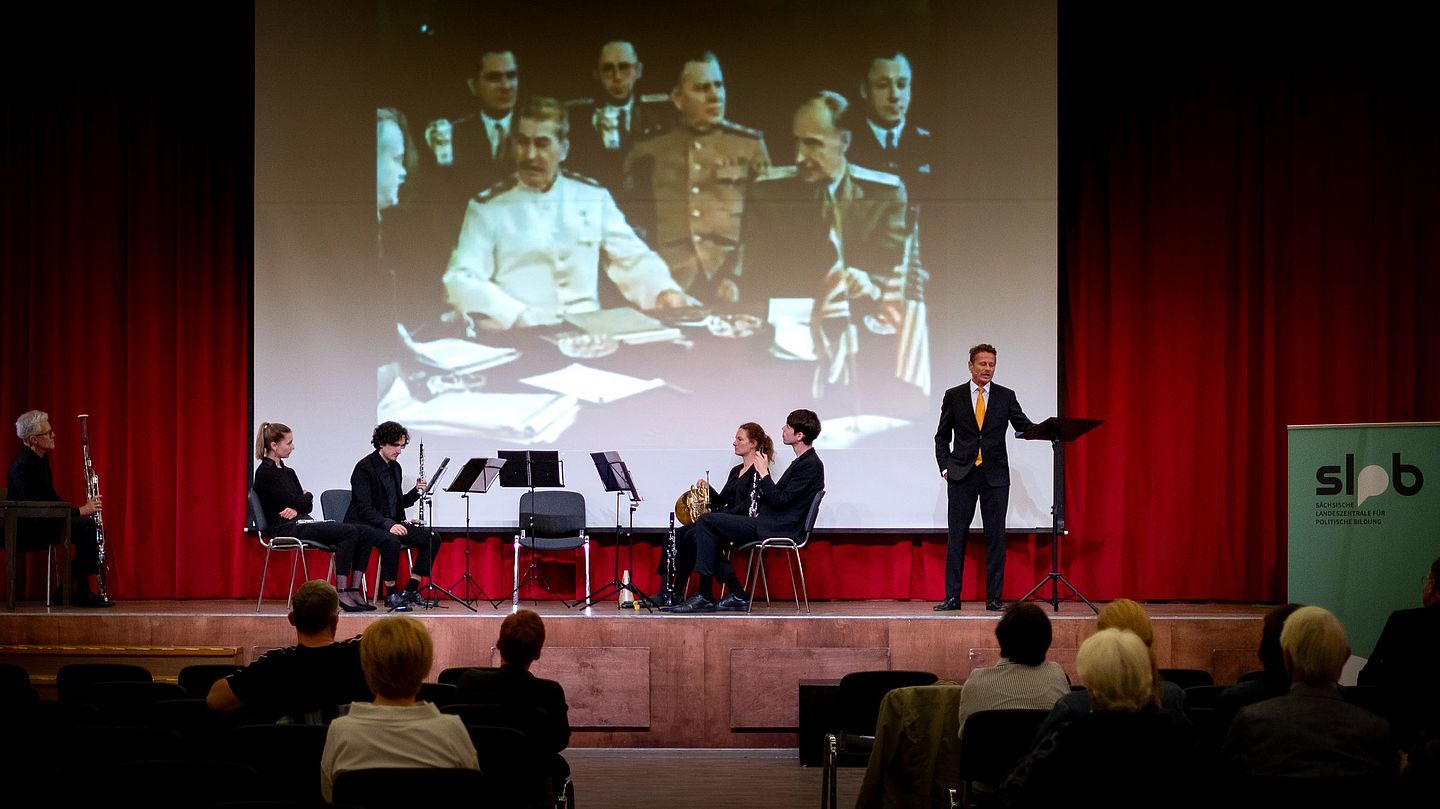
| © Corinna Mehl, 2025 Zeitzeugenberichte, journalistische Texte und historische Dokumente machen die Konfrontation mit dem Grauen unmittelbar spürbar |
||
|
||
 |
||
| "Dass ein gutes Deutschland blühe..." Leben in der Nachkriegszeit 1945 bis 1949 | ||
| Musikalische Lesung mit Roman Knižka und dem Bläserquintett OPUS 45 |
||
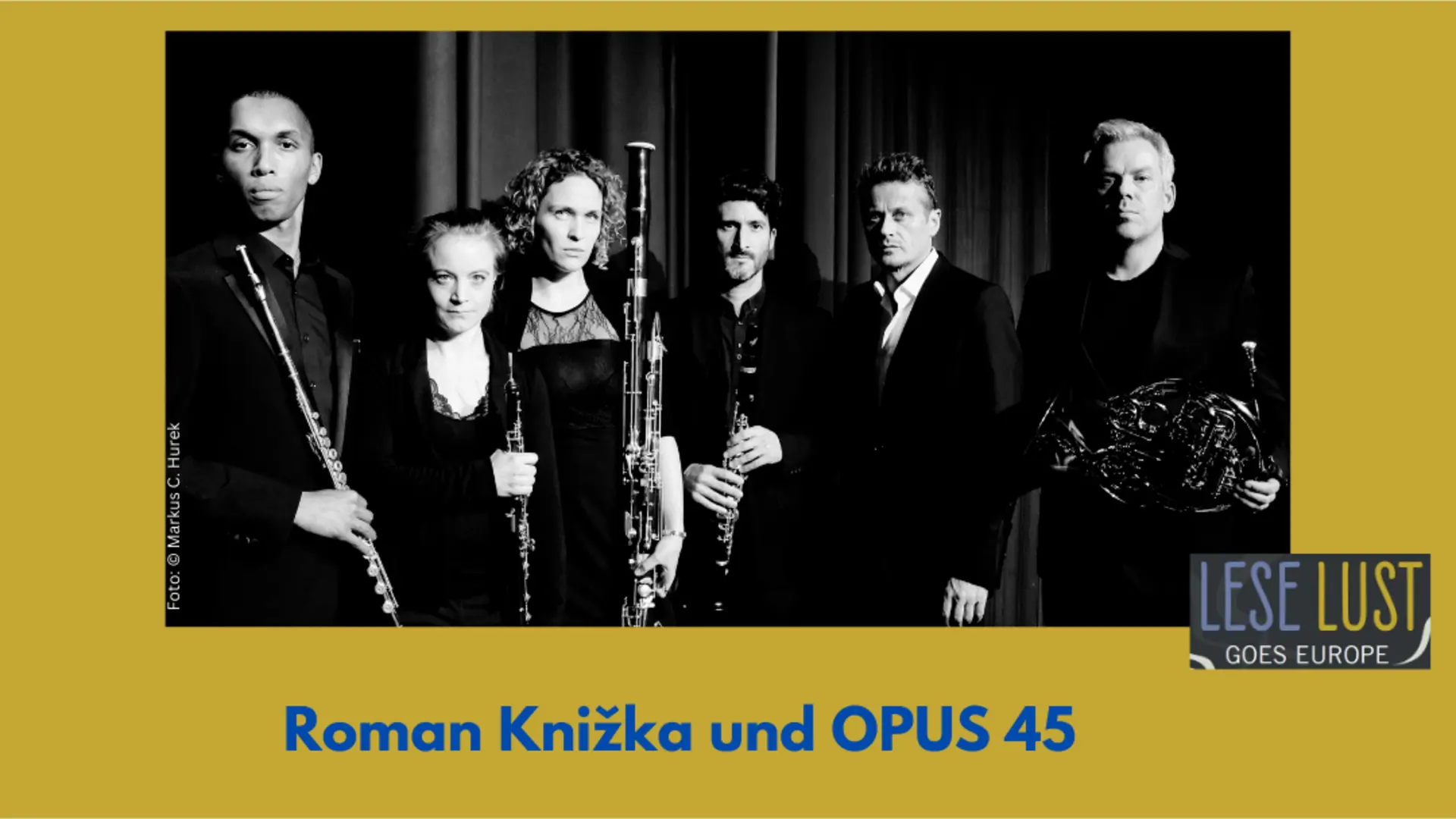 |
||
| |
||
 |
||
80 Jahre Kriegsende „Jeder rannte um sein eigenes Leben“
|
||
 |
||
| © Christian Endt Bei einer Feier zum 80. Jahrestag des Kriegsendes in einer Poinger Dreifachturnhalle erlebt das Publikum ein szenisches Konzert des Ensembles "Opus 45", bestehend aus Schauspieler Roman Knižka und Bläserquintett. |
||
|
Eindrückliche
Geschichtsstunde: Das Ensemble „Opus 45“ zeichnet in Poing
mit Zitaten und Musik ein bewegendes Bild von einem Land zwischen Angst
und Hoffnung. Am Ende steht der ganze Saal.
Von Ulrich Pfaffenberger, Poing |
||
|
„Eine derartige Zerstörung habe ich nie wieder gesehen.“ Ein kurzer Satz aus den Memoiren des US-Präsidenten Harry S. Truman, notiert in Erinnerung an seine Fahrt durchs zerbombte Berlin am 16. Juli 1945, einen Tag vor Beginn der Potsdamer Konferenz. Bei der dieser Mann aus dem ländlichen Missouri dann nachdrücklich dazu beitrug, den bezwungenen Feindstaat nicht zwanghaft in Agrarland zu verwandeln, sondern Aufbaukräfte zu stärken und eine Rückkehr in die Völkergemeinschaft zu ermöglichen. Doch keine würdige Rede zum Jahrestag des Kriegsendes 1945, keine Unterrichtseinheit war es am Samstag in Poing, die diesen Moment der Weltgeschichte erkennbar und begreifbar machte. Sondern eine „Geschichtsstunde“ von ebenso ungewöhnlichem wie eindringlichem Format, zu der die Aktionsgruppe Respekt@Poing und die Kulturtage Poing eingeladen hatten. Trumans Erinnerungen waren Teil eines vielgestaltigen Mosaiks aus Notizen, Berichten, Kommentaren und Erinnerungen aus der Zeit zwischen Kriegsende und staatlicher Souveränität, das vom Ensemble Opus 45 zusammengefügt wird, je nach Auftrittsort ergänzt um Zeitzeugnisse von dort. Rezitierte und gestaltete Textpassagen, vorgetragen von Schauspieler Roman Knižka, wechseln sich dabei ab mit illustrierenden Musikzitaten von Zeitgenossen, Nachgeborenen und Klassikern, gespielt von einem Bläserquintett. |
||
 |
||
| © Christian Endt Ein Bläserquintett liefert illustrierende Musikzitate von Zeitgenossen, Nachgeborenen und Klassikern |
||
| Was sich streng und
nüchtern anhört, ist in der erlebten Aufführung ein
höchst lebendiges, bewegendes Gefüge von Impressionen von
beispielloser Qualität und höchstem künstlerischen
Niveau. Im Publikum kommt diese Mischung aus Worten und Musik nicht als
Abfolge von Signalen an, sondern verflicht sich mit unwiderstehlicher
Kraft: Die Botschaft der Instrumente schiebt die Gedanken an, die das
soeben Gehörte ausgelöst hat – und bereitet zugleich
den Weg für das Nächste, was zu hören sein wird. Die Zitate aus verschiedensten Quellen, aus Tagebüchern, Dienstanweisungen, Schauspielen, Gedichten, Zeitungsberichten, Reden, sind hier bei aller Knappheit prägnante Zeugnisse des Geschehens und in überzeugender Wechselwirkung aufeinander abgestimmt. Der Autor Wolfgang Borchert kommt zu Wort, der Rotarmist Wladimir Gelfand, Chefankläger Robert H. Jackson, die Dichterin Nelly Sachs und viele Bekannte und Unbekannte mehr, allesamt wahrnehmbar als Gleiche unter Gleichen dieser Zeit. Eines ergibt sich aus dem anderen, Selbsterklärendes mündet in Überraschendes, auf Antworten folgen neue Fragen. Die Dramaturgie zieht das Publikum aus dem passiven Erleben hinein ins aktive Beteiligtsein Es ist Dramaturgie auf Spitzenniveau, die Kathrin Liebhäuser hier mit ihrem Team geschaffen hat und sich entwickeln lässt – und die das Publikum aus dem passiven Erleben hineinzieht ins aktive Beteiligtsein. Als vorteilhaft für diese Absicht erweist sich da die Strategie, keine Programmzettel zu verteilen, in denen Inhalte oder Musiktitel aufgeführt sind: So erhält sich die Neugier von der ersten bis zur letzten Minute. Die Musiktitel, arrangiert von Ulf-Guido Schäfer und Matthias Pflaum, begleiten den Fortgang des Geschehens zuverlässig, bei aller Stilvielfalt von einer Kontinuität getragen, die sie aus dem Genre „Filmmusik“ als perfekt gelungene Nicht-Vertreterin derselben herausragen lässt. Ludwig van Beethoven und Mendelssohn Bartholdy findet sich da in bester Gesellschaft mit Glenn Miller und Sholom Secunda, das „Insulaner-Lied“ kontrastiert mit „Anatevka“ und eine ganze Reihe von weniger bekannten Komponisten wie Karl Amadeus Hartmann oder Charles Koechlin erweisen sich als großartige Entdeckungen. Allen voran mehrere Stück von György Ligeti setzen so farbige, markante Akzente, dass es weder Bühnenbild noch Lichtspektakel braucht, um eine überzeugende Szenerie zu gestalten. |
||
|
Kein Zufall ist es also, dass das Programm den Titel trägt „Dass ein gutes Deutschland blühe …“, der ersten Zeile von Bert Brechts „Kinderhymne“, entstanden 1950 als Gegenentwurf zu Deutschlandlied und DDR-Hymne, mühelos singbar auf die jeweilige Melodie. Je länger der Abend fortschreitet, desto häufiger ergeben sich diese „Was wäre gewesen, wenn…“-Situationen, in denen blitzartig die Erkenntnis einschlägt über potenzielle Weltläufte, die nicht nur das Leben von Völkern und Nationen grundlegend geändert, sondern sich bis in unsere Gegenwart fortgesetzt hätten. Der Wunsch nach einer Blüte hätte auch im Nichts verpuffen, das „gute“ Deutschland sich auch in eines wandeln können, in dem sich niemand wohlfühlt. Allein die Szene zum Todeszug aus dem KZ Mühldorf, der am 27. April 1945 Poing passierte, um bis Tutzing zu gelangen, wo die Gefangen von ihren Bewachern zunächst freigelassen, dann von einem anderen Kommando niedergeschossen wurden, verdeutlicht in kaum erträglich nüchternen Sätzen, wie nah Wohl und Wehe beieinander liegen, Hoffnung und Verzweiflung. Die Erinnerungen des Poinger Zeitzeugen Laszlo „Leslie“ Schwartz sind hier mehr als ein lokaler Bezug, sie sind ein hell leuchtender Wegweiser, wie leicht es – noch – ist, an echtes Wissen zu gelangen, unmittelbar erlebt, erfahren, erlitten. „Jeder rannte um sein eigenes Leben.“ |
||
Im Anschluss ergeben sich angeregte Gespräche mit Menschen, die man zwei Stunden vorher noch nicht gekannt hat |
||
|
Es liegt vor allem an der Sprachkunst von Roman Knižka, Brücken zu schlagen zwischen den anekdotisch aufgereihten Texten und aus den Verläufen von 1945 bis 1949 einen erkennbaren Ablauf zu zeichnen. Manchmal sind es nur Mikro-Variationen seiner Stimme, die aus Worten Bilder machen, etwa der einige Sätze nur andauernde typische Tonfall eines „Wochenschau“-Reporters vom Beginn der Nürnberger Kriegsverbrecher-Prozesse oder einige Silben sächsischen Untertons zur Ernennung von Wilhelm Pieck als Staatschef der DDR. Verzögern und Beschleunigen, Verharren oder behutsames Entlanggleiten: Knižka spielt nicht, er dient kompromisslos und uneitel seiner Aufgabe, Botschaften der Vergangenheit ins Heute zu dolmetschen. Als sich Quintett und Schauspieler zum Schlussapplaus verneigen, belohnt sie das Publikum mit einem Applaus, in dessen Obertonreihe nicht nur die Anerkennung für die Leistung mitschwingt, sondern der Respekt für die Anschaulichkeit und Glaubwürdigkeit ihrer Darbietung – und die Dankbarkeit, dass aus der Zerstörung neues entstehen durfte, das jeden von uns geprägt hat. Zunächst erheben sich nur einige zum stehenden Beifall, dann reißt es den ganzen, gut gefüllten Saal mit. Im Anschluss dann ergibt sich das Beste, was aus einem solchen Anlass entspringen kann: Angeregte Gespräche mit Menschen, die man zwei Stunden vorher noch nicht gekannt hat. Kurzum: lebendige Geschichte in Reinform und in überzeugender Gestalt, die auch jenseits von Gedenktagen ihren Platz in unserer Gesellschaft beanspruchen darf.
|
||
 |
||
| Ensemble OPUS45, Konzerte: 21. Jan. - 6. Dez. 2025 ↘ | ||
 |
||
| Fotos: © Daniel Haeker Photography Download der hochaufgelösten Fotos: LINK LINK |
||
|
|
||
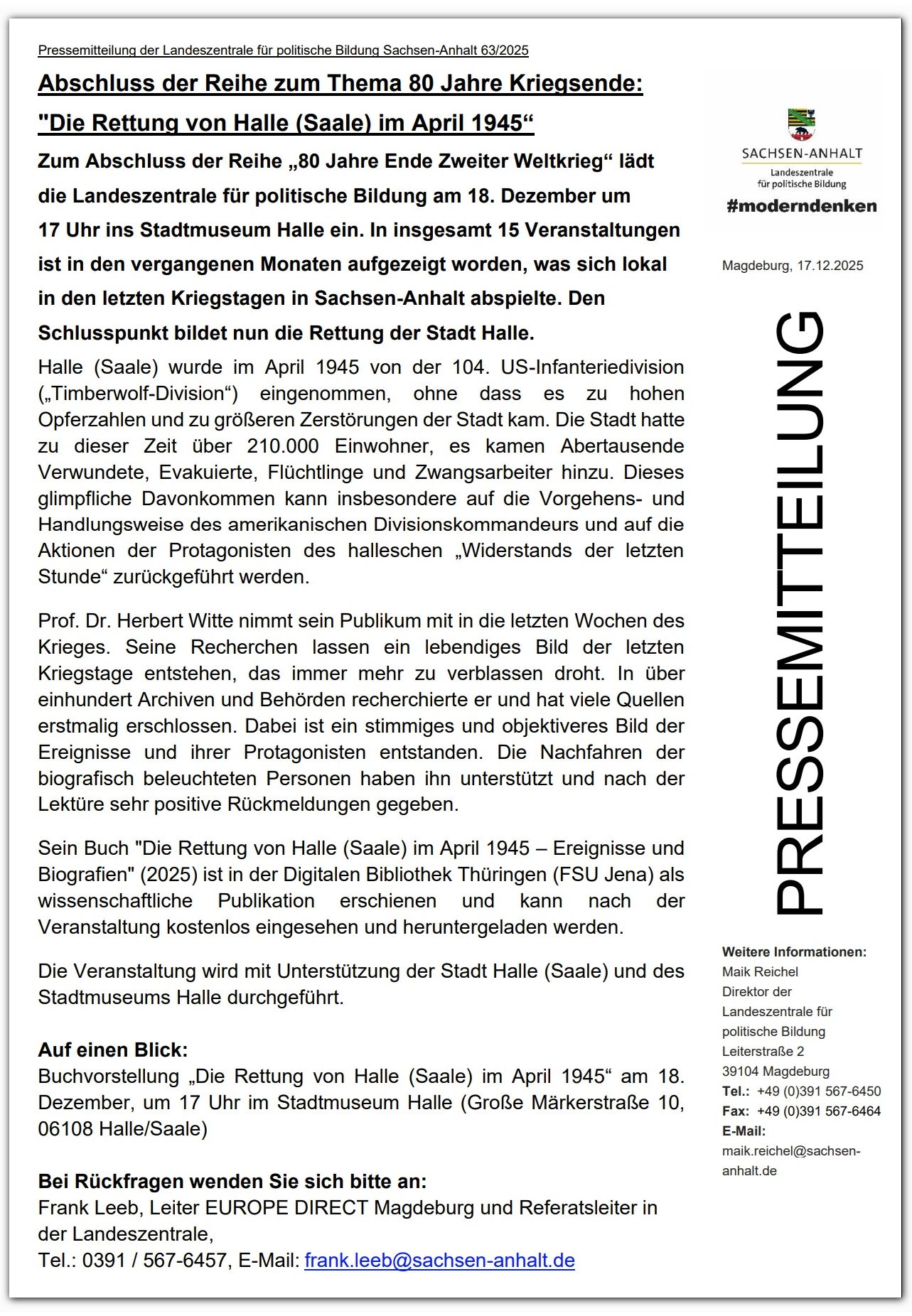
| Abschluss der Reihe zum Thema 80 Jahre Kriegsende: "Die Rettung von Halle (Saale) im April 1945“ | ||
 |
||
 |
||
| |
||
|
Das Bläserquintett OPUS 45 gründete sich bei einem Berliner Orchesterprojekt: Johannes Brahms’ „Ein deutsches Requiem“ (opus 45) stand auf dem Programm und ist seither namensgebend. Das Bläserquintett, bestehend u. a. aus Musikerinnen und Musikern der Hamburgischen Staatsoper, des Beethoven Orchesters Bonn, der NDR Radiophilharmonie Hannover und der Dresdner Philharmonie, beschreitet seit einiger Zeit gemeinsam mit dem Schauspieler Roman Knižka neue, disziplinübergreifende Wege. So entstanden literarische Kammermusikabende, die in der deutschsprachigen Konzertlandschaft einmalig sind, etwa das Programm zum NS-Widerstand („Den Nazis eine schallende Ohrfeige versetzen!“) oder die szenische Lesung zu Geschichte und Gegenwart rechter Gewalt in Deutschland, die das Ensemble mit dem Primo-Levi-Zitat „Es ist geschehen, und folglich kann es wieder geschehen …“ betitelte. Im Programm „Ich hatte einst ein schönes Vaterland …“ blicken Roman Knižka und die fünf Musikerinnen und Musiker auf 1700 Jahre jüdisches Leben in Deutschland zurück. Sie veranschaulichen die faszinierende Vielfalt jüdischen Lebens auf deutschem Boden, berichten von der Entrechtung, Vertreibung und Vernichtung deutscher Jüdinnen und Juden im nationalsozialistischen Regime und gewähren Einblicke, wie sich jüdisches Leben in Deutschland heute, 80 Jahre nach Kriegsende, gestaltet. Das Ensemble tourt mit allen Programmen bundesweit. Im Juni 2022 erschien die erste DVD von OPUS 45, nämlich das o. g. Programm zum NS-Widerstand „Den Nazis eine schallende Ohrfeige versetzen!“ in Kooperation mit diversen Landeszentralen und der Bundeszentrale für politische Bildung (bpb). Film und pädagogisches Begleitmaterial wurden aufwändig digital aufbereitet und können als Referenz hier eingesehen werden: www.opus45-derfilm.de ↘ |
||
© OPUS 45 ● Roman Knižka und jeweilige Urheber
© Süddeutsche Zeitung
© Landeszentrale für politische Bildung Sachsen-Anhalt
© Sächsische Landeszentrale für politische Bildung
© hamburg.de
© Corinna Mehl
© Christian Endt
© Daniel Haecker
 German
| OPUS 45 80 Years Since the End of the War ● “May a Good Germany Flourish …” Life After the War, 1945–1949
|
||
| Texts by Bertolt Brecht, Wolfgang Borchert, Margaret Bourke-White, Ruth Andreas-Friedrich, Stig Dagerman, Nelly Sachs and others Music by Ludwig van Beethoven, Hanns Eisler, Jean Françaix, Karl Amadeus Hartmann, Charles Koechlin, György Ligeti, Dmitri Shostakovich, Richard Strauss and others Recitation: Roman Knižka Dramaturgy: Kathrin Liebhäuser Concert duration: approx. 90 minutes (approx. 110 minutes including the interval) |
||
|
||
| Cologne after the Allied air raid, April 1945, photographed by war correspondent Margaret Bourke-White, whose work is part of the programme. Source: The LIFE Picture Collection |
||
|
8 May 2025: Eighty years have passed since the end of the Second World War, which was started by Hitler's Germany, and Germany's liberation from National Socialism. To mark the anniversary, Roman Knižka and the OPUS 45 wind quintet transport their audience back to the early post-war years, from 1945 to 1949, in their new programme. 8 May 1945: With the unconditional surrender of the German armed forces, Hitler's Germany was officially defeated. The Second World War had lasted almost six years and claimed an unimaginable 60 million lives. Germany's major cities lay in ruins. Countless people were homeless, fleeing or being held as prisoners of war. The victorious powers now governed the country. “May a Good Germany Flourish …” tells the story, through literary texts, reportage and eyewitness accounts, of a country between apocalypse and renewal: the arrival of the victors; the confrontation of Germans with the atrocities of the Nazi regime; the fate of Jewish concentration-camp survivors who wandered through the perpetrators' homeland as “displaced persons” after their liberation; the hunger winters, expellees and returning soldiers. Political turning points, including the Potsdam Conference, Nuremberg Trials, currency reform and Berlin Blockade, are explored alongside the often questionable practice of denazification in everyday life. Literature and music after 1945: But the programme also tells of cultural renewal and fresh beginnings. Writers of the period fiercely debated whether, or how, literature should be written after the crimes of the Nazi dictatorship and the catastrophe of the Second World War. Roman Knižka recites works of post-war literature by Wolfgang Borchert, Bertolt Brecht and Nelly Sachs. Soon after the war, forums for new music emerged in cities such as Darmstadt and Munich, even though they had been devastated by bombing. OPUS 45 performs works by the post-war avant-garde composers György Ligeti and Karl Amadeus Hartmann, as well as other compositions capturing the spirit of the age by Dmitri Shostakovich and Hanns Eisler. Music by Ludwig van Beethoven, Richard Strauss, Charles Koechlin and Jean Françaix is also featured. Swing and contemporary popular songs complete the musical portrait of the period, conveying the younger generation's often insatiable desire for entertainment and dancing. 8 May 1945? For many Germans, the official end of the war was an unremarkable day amid continuing chaos. People across the country experienced the end of the Second World War at different times and in different ways. In the first part of the programme, Roman Knižka recounts exactly what happened in the city or town hosting the concert. “May a Good Germany Flourish …” – Life After the War, 1945–1949 commemorates the devastating consequences of the Second World War and the Nazi dictatorship. Beginning with the epochal turning point of 1945, Roman Knižka and OPUS 45 explore the complex, tension-filled transition between destruction and a new beginning. It ended with the founding of two German states and the division of Germany, the effects of which are still felt today. Download the programme sequence, including sources and the selection of music (PDF) A note from the organisers: For the individually tailored section about events in 1945 at each concert location, we contact local archives and historical societies in good time and research suitable sources. We also welcome suggestions. Please email kontakt@opus45.de For event organisers: Download the video included in the programme “May a Good Germany Flourish …” (one file): Link |
||
| |
||
|
Reading ● Music ● Performance marking 80 years since the end of the war “May a Good Germany Flourish …” Life After the War (1945–1949) Speaker/recitation: Roman Knižka Music performed by the OPUS 45 wind quintet (www.opus-45.de) Dramaturgy / musical selection: Kathrin Liebhäuser (OPUS 45) Concept / musical selection: Benjamin Comparot (OPUS 45) Musical arrangements: Matthias Pflaum & Ulf-Guido Schäfer Copyright: Performance exclusively by Roman Knižka and the OPUS 45 wind quintet Texts, sources and selection of music in programme order:
“When the Americans Came” Ernest Gold, born Ernst Siegmund Goldner (1921–1999): “Hänschen klein”, title music from the film “Steiner – The Iron Cross” (arr. Matthias Pflaum) “The Bridge” Ludwig van Beethoven (1770–1827): “Allegretto” (second movement) from Symphony No. 7 in Amajor, Op. 92 (arr. Matthias Pflaum) “Dear Mikhail” – a letter from the front by Russian officer Evgenij Nilovic to a friend “The people here, the Germans, fear the anger of us Russians” “Every German civilian is a soldier of hatred in disguise” “We knew nothing about it!” “We Knew the Buchenwald Prisoners” György Ligeti (1923–2006): “Allegro con spirito” (first movement) from “Six Bagatelles for Wind Quintet” (1953) Unconditional surrender The end of the war at the concert location Karl Amadeus Hartmann (1905–1963): “Tears of the Fatherland, Anno 1636”, interlude from Act I of the opera “Simplicius Simplicissimus” (premiered 1948), arr. Matthias Pflaum “When the Germans began to grasp their situation in the summer of 1945, they had to recognise a threefold defeat.” “All Berlin is in a frenzy of expectation!” Felix Mendelssohn Bartholdy (1809–1847): “Dance of the Clowns” from the incidentalmusic to Shakespeare's “A Midsummer Night's Dream” (arr. Ulf-Guido Schäfer) “Panic, consternation and horror reign in the city.” “Kriemhild! This girl truly deserves love and respect.” Dmitri Shostakovich (1906–1975): Largo – Allegretto from Symphony No. 9 in E-flat major, Op. 70 (1944/1945), arr. Matthias Pflaum “I have never seen destruction on such a scale again.” “17 July 1945: The Potsdam Conference Begins” The account of the Potsdam Conference is based on Wolfgang Benz, “Potsdam 1945: Occupation Rule and Reconstruction in the Four-Zone Germany”, Munich, 2005 Richard Strauss (1864–1949): “Andante” (second movement) from the Concerto for Oboe and Small Orchestra in D major (1945), arr. Matthias Pflaum (Interval) Charles Koechlin (1867–1950): “Choral” (first movement) from “Trio d’anches”, Op. 206 (1945) “Nuremberg: Courtroom 600 on the second floor of the Palace of Justice.” “May it please the Tribunal!” GyörgyLigeti (1923–2006): “Presto ruvido” (fourth movement) from “Six Bagatelles for Wind Quintet” (1953) Displaced Persons – Jakob Biber at Föhrenwald DP Camp “Chorus of the Saved” Jerry Bock (1928–2010): “Far from the Home I Love” Song from the musical “Fiddler on the Roof” (Anatevka), arr. Matthias Pflaum “An American sergeant asked me what I would do with the Germans …” “Today was the happiest day. I am no longer a Nazi!” Artur Beul (1915–2010): “After Rain Comes Sunshine”(1945), arr. Matthias Pflaum There is no shortage of entertainment in post-war Germany. Glenn Miller (1904–1944): “Moonlight Serenade” (1939), arr. Matthias Pflaum “Dear God in heaven, behold our plight: we farmers have neither fat nor “No farmer in Nindorf wants to take in these starving ‘Poles’voluntarily.” Recollections of Rolf Klodt, who fled from Insterburg in East Prussia to Schleswig-Holstein with his mother and four siblings, in Katja Iken, Uwe Klußmann and Eva-Maria Schnurr (eds.), “When Germany Reinvented Itself: The Post-war Period 1945–1949”, Munich, 2019 “No electricity, no water, no coal.” GyörgyLigeti (1923–2006): “Rubato lamentoso” (second movement) from “Six Bagatelles for Wind Quintet” (1953) “A Man Comes to Germany.” “In the autumn of 1948 my mother was notified ...” Sholom Secunda (1894–1974) / Jacob Jacobs (1890–1977): “Bei mir bist du schön” (1932 / hit song of 1948), arr. Matthias Pflaum “Top Secret – Operation Bird Dog, February to April 1948” “Engine sounds that delight Berliners!” “We cannot be traded away … Peoples of the world, look upon this city!” Günter Neumann (1913–1972): “Insulanerlied” [Song of the Islanders] (1948), arr. Matthias Pflaum Christmas 1948 – the song of the moment: On 25 December 1948, in the midst of the Berlin Blockade, Günter Neumann first presented a cabaret programme on RIAS entitled “The Islanders' Club”, about West Berlin's situation in the Cold War. The radio programme's signature song, “Insulanerlied”, became a kind of unofficial Berlin anthem overnight. The programme soon became popular in both East and West. “We will perform until reunification,” promised the Islanders, whom the SED denounced as “warmongers” during the Cold War. The ensemble was nevertheless discontinued in 1968, after 133 broadcasts. “Draw a line under it – an end to denazification!” Bertolt Brecht (1898–1956) / Hanns Eisler (1898–1962): “Children's Hymn”, “Spare Neither Grace nor Effort” (1950), arr. Matthias Pflaum “My Father's Drinking Cup” Jean Françaix (1912–1997): “Tempo alla marcia francese” (fourth movement) from Wind Quintet No. 1 (1948) (Encore)
|
||
|
||
|
||
| “May a Good Germany Flourish — Like Another Good Country” | ||
|
||
| © Corinna Mehl, 2025 Eyewitness accounts, journalistic reports and historical documents make the confrontation with the horrors of the past deeply tangible |
||
|
||
|
||
“May a Good Germany Flourish …” Life in the Post-war Years, 1945–1949 |
||
| A musical reading with Roman Knižka and the OPUS 45 wind quintet | ||
|
|
||
| |
||
|
||
80 Years Since the End of the War “Everyone Ran for Their Own Life”
|
||
|
||
| © Christian Endt At an event marking 80 years since the end of the war, an audience in a triple sports hall in Poing experiences a staged concert by the ensemble OPUS 45, comprising actor Roman Knižka and a wind quintet. |
||
|
A powerful history lesson: In Poing, the ensemble OPUS 45 uses quotations and music to paint a moving picture of a country caught between fear and hope. By the end, the entire hall is on its feet.
By Ulrich Pfaffenberger, Poing |
||
|
“I have never seen destruction on such a scale again.” This short sentence from the memoirs of US President Harry S. Truman recalls his journey through bombed-out Berlin on 16 July 1945, the day before the Potsdam Conference began. At the conference, this man from rural Missouri played a decisive role in ensuring that the defeated enemy state was not forcibly turned into an agricultural country, but that the forces of reconstruction were strengthened and a return to the community of nations was made possible. Yet what made this moment of world history vivid and comprehensible on Saturday was not an anniversary speech about the end of the war in 1945, nor a classroom lesson. It happened in Poing, through a “history lesson” of an unusual and deeply affecting kind, organised by the Respekt@Poing action group and the Poing Cultural Days. Truman's recollections formed part of a many-sided mosaic of notes, reports, commentary and memories from the period between the war's end and the recovery of state sovereignty. The ensemble OPUS 45 assembles this mosaic and, depending on the venue, adds local eyewitness accounts. Recited and dramatised passages delivered by actor Roman Knižka alternate with evocative musical excerpts by composers of the period, later generations and the classical canon, performed by a wind quintet. |
||
|
||
| © Christian Endt A wind quintet supplies evocative musical excerpts by contemporaries, later composers and the classics |
||
| What sounds austere and sober on paper becomes, in performance, an extraordinarily vivid and moving fabric of impressions, of exceptional quality and the highest artistic standard. For the audience, the mixture of words and music is not received as a sequence of signals but interweaves with irresistible force: the instruments give fresh impetus to the thoughts sparked by what has just been heard and, at the same time, prepare the way for what comes next. The quotations come from a wide variety of sources – diaries, official instructions, plays, poems, newspaper reports and speeches. Brief as they are, they form compelling testimony to events and interact convincingly with one another. We hear from writer Wolfgang Borchert, Red Army soldier Wladimir Gelfand, chief prosecutor Robert H. Jackson, poet Nelly Sachs and many other familiar and unfamiliar figures, all perceived as equals among the people of their time. One thing follows from another; the self-explanatory gives way to the unexpected, and answers lead to new questions. The dramaturgy draws the audience out of passive observation and into active involvement Kathrin Liebhäuser and her team have devised dramaturgy of the highest order and allowed it to unfold, drawing the audience away from passive experience into active involvement. The decision not to distribute programmes listing the content or musical works proves effective: curiosity is sustained from the first minute to the last. The music, arranged by Ulf-Guido Schäfer and Matthias Pflaum, accompanies the unfolding events reliably. Despite the diversity of styles, the works are bound by a continuity that makes them something like an exceptionally successful film score – although they are not one. Ludwig van Beethoven and Mendelssohn Bartholdy find themselves in excellent company with Glenn Miller and Sholom Secunda. The “Song of the Islanders” contrasts with “Fiddler on the Roof”, while lesser-known composers such as Karl Amadeus Hartmann and Charles Koechlin prove to be wonderful discoveries. Above all, several pieces by György Ligeti add such vivid and striking colour that neither scenery nor spectacular lighting is needed to conjure a convincing setting. |
||
|
It is no coincidence that the programme takes its title, “May a Good Germany Flourish …”, from the first line of Bertolt Brecht's “Children's Hymn”, written in 1950 as an alternative to both the Deutschlandlied and the GDR anthem; it can readily be sung to either melody. As the evening goes on, more and more “What if …?” moments arise, bringing sudden realisation of the possible courses history might have taken – courses that would not only have fundamentally changed the lives of peoples and nations but continued to shape our present. The hope of flourishing might have come to nothing, and a “good” Germany might have become a country in which no one felt at home. The scene about the death train from Mühldorf concentration camp is especially powerful. The train passed through Poing on 27 April 1945 on its way to Tutzing, where the prisoners were first released by their guards and then shot by another unit. In almost unbearably sober sentences, the scene shows how close good fortune and catastrophe, hope and despair, can be. The memories of Poing eyewitness Laszlo “Leslie” Schwartz are more than a local reference: they are a shining signpost to how it is still possible to gain authentic knowledge, directly lived, witnessed and suffered. “Everyone ran for their own life.” |
||
Afterwards, lively conversations develop with people who were strangers only two hours earlier |
||
|
Above all, it is Roman Knižka's mastery of speech that bridges the sequence of anecdotal texts and gives the events of 1945 to 1949 a recognisable narrative arc. Sometimes the smallest variation in his voice turns words into images – a few sentences in the characteristic tone of a newsreel reporter at the opening of the Nuremberg war-crimes trials, or a few syllables with a Saxon accent on the appointment of Wilhelm Pieck as head of state of the GDR. Slowing down and speeding up, pausing or gliding gently forward: Knižka does not merely act. Without compromise or vanity, he dedicates himself to translating the messages of the past into the present. When the quintet and actor bow for their final applause, the audience rewards them not only with recognition of their achievement but also with respect for the clarity and credibility of the performance – and gratitude that something new was able to emerge from destruction and shape each of us. At first only a few people rise, then the entire well-filled hall joins in a standing ovation. Afterwards comes the best possible outcome of such an event: lively conversations among people who were strangers only two hours earlier. In short, this is living history at its purest, in a compelling form that deserves a place in our society beyond commemorative dates.
|
||
|
||
| Ensemble OPUS 45, concerts: 21 Jan. – 6 Dec. 2025 ↘ | ||
|
||
| Photos: © Daniel Haeker Photography Download high-resolution photos: LINK LINK |
||
|
|
||
| Closing event of the series marking 80 years since the war's end: “The Rescue of Halle (Saale) in April 1945” | ||
|
||
| |
||
| |
||
|
The OPUS 45 wind quintet was founded during an orchestral project in Berlin. Johannes Brahms's “A German Requiem” (Opus 45) was on the programme and gave the ensemble its name. The wind quintet, whose members include musicians from the Hamburg State Opera, Beethoven Orchestra Bonn, NDR Radio Philharmonic Hanover and Dresden Philharmonic, has for some time been exploring new interdisciplinary paths with actor Roman Knižka. This has resulted in unique literary chamber-music evenings in German-speaking concert life, including a programme about resistance to the Nazis (“Give the Nazis a Resounding Slap in the Face!”) and a staged reading about the history and present-day reality of right-wing violence in Germany, which the ensemble titled with a quotation from Primo Levi: “It happened, therefore it can happen again …” . In the programme “I Once Had a Beautiful Homeland …” Roman Knižka and the five musicians look back at 1,700 years of Jewish life in Germany. They illuminate its fascinating diversity, recount the disenfranchisement, expulsion and murder of German Jews under National Socialism, and offer insights into Jewish life in Germany today, 80 years after the end of the war. The ensemble tours with all its programmes throughout Germany. In June 2022 OPUS 45 released its first DVD, featuring the above-mentioned programme about resistance to the Nazis, “Give the Nazis a Resounding Slap in the Face!”, in cooperation with several regional centres and the Federal Agency for Civic Education (bpb). The film and educational materials have been prepared in digital form and can be viewed here as a reference: www.opus45-derfilm.de ↘ |
||