




1
Autorin
2
Sprecher
3
Overvoice Vitaly
4
Zitatsprecher Tagebuch

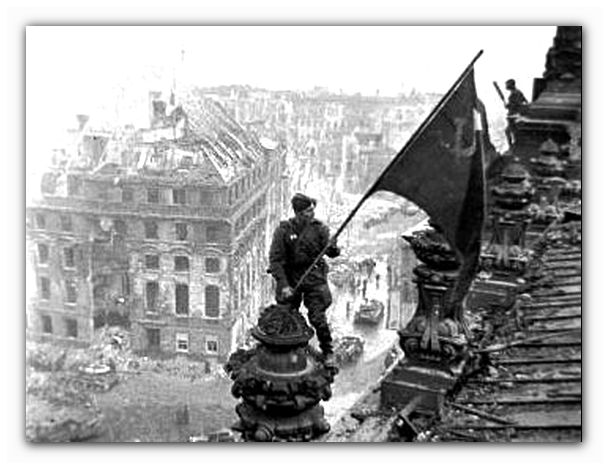
Die Rote
Fahne weht auf dem Reichstag 1945 in Berlin (Bild: AP)
Als
junger Leutnant marschierte
Wladimir Gelfand 1945 mit der Roten Armee in das zerstörte
Berlin ein. Seine
Erlebnisse vertraute er einem Tagebuch an und wurde so zum Chronisten
der
"Stunde null". Damals hätte er sich nicht vorstellen
können, dass
genau fünfzig Jahre später seine Familie die Ukraine
verlassen und nach Berlin
ziehen würde.
Und
dass
ausgerechnet hier sein
"Deutschland-Tagebuch" erscheinen würde. Gelfand selbst hat
all das
nicht mehr erlebt, er starb mit sechzig Jahren in der Ukraine an den
Spätfolgen
einer Kriegsverletzung. Sohn Vitaly und Wladimir Gelfands Witwe Bella
können
davon erzählen, wie staatliche Willkür und
fortdauernder Antisemitismus in der
Ukraine die ohnehin bedrängten Lebensverhältnisse der
Familie verschärften. Man
entschloss sich zur Ausreise. Der Sohn sagt heute: "Heimat ist dort, wo
man sich sicher und als Mensch fühlen kann. Wo man durch das
Gesetz geschützt
ist und wo kein Hass ist."
Urheberrechtlicher Hinweis

________________________________________________________________________
– Unkorrigiertes Exemplar –
O-Ton russisch:
Sohn
Vitaly (Overvoice)
Ja, ich bin Berliner. Hier bin ich zu Hause.
Heimat ist
dort, wo kein Hass ist.
Autorin:
Sie kamen aus
Dnjepropetrowsk, dieser großen
ukrainischen Industriestadt
Ihr erster Sohn Gennadij Wladimirowitsch, 50 Jahre
alt, mit Ehefrau Anna
O-Ton: Enkel Wowa
Wir hatten wirklich gar
kein Geld. Und das erste Neue
Jahr... was wir
und so was. Ja.
Autorin:
Seit die Gelfands in
Deutschland sind, hat sich viel
in ihrem Leben
Vitaly kann wegen seines kaputten Rückens nicht
körperlich arbeiten und
Vitaly selbst könnte für Institutionen arbeiten, die
sich mit Russland
Seine beiden Söhne Wladimir, 22, und Roman, 15, wohnen
manchmal bei
O-Ton: Enkel Wowa
Das war schon deutlich in
der Grundschule, dass ich zu
den Außenseitern
war wirklich sehr verklemmt. Und dann bin ich unter
diesen Zwang
Autorin:
Die vier Gelfand-Familien
wohnen in Berlin Tiergarten
und Charlottenburg
Auch Bella, die Mutter und Großmutter, ist noch immer
aktiv. Die
(Musik)
Autorin:
Warum ist die Familie
Gelfand eigentlich nach Berlin
ausgewandert?
Sprecher:
Oktober 1945.
Dienstliche Beurteilung des Granatwerferzugführers
Leutnant Wladimir Natanowitsch Gelfand hat sich in der
Zeit seines
O-Ton: Mutter Bella ( spricht ihr eigenes Deutsch,
eventuell Overvoice)
Wladimir war immer krank, er hat Schmerzen gehabt im
Herzen und im
O-Ton: Enkel Wowa
Von dem, was ich
weiß, wie Großvater gestorben ist...
ist, dass er während
O-Ton:Mutter Bella (eventuell Overvoice)
Er kam ins Krankenhaus und der Arzt sagte, ich soll in
einem anderen
O-Ton russisch:
Sohn Vitaly (Overvoice)
Vater ist gestorben als ich in der Armee war. Ich
wurde nicht zu seiner
Der Vater wollte zu meinem Bruder am anderen Ende der
Stadt fahren, um
Nachts bemerkte ihn eine Tramfahrerin im Zentrum der
Stadt. Er saß auf
(Musik:
Efim Jourist „Russisches
Roulette“ Nr 2 ‚Wenn du mich liebst’
Von Anfang bis
0.38 min., dann weiter unter dem Text)
O-Ton: Enkel Wowa
Mein Großvater
war sechzig Jahre, als er gestorben
ist... das war im Jahr
Autorin:
Wladimir Natanowitsch
Gelfand war ein ungewöhnlicher
Mann. Er war
gerecht und liebevoll.
O-Ton: Enkel Wowa
Als er so alt war wie ich
jetzt bin, 22, war er hier,
in Berlin. Das war 1945.
Er schrieb offen über die besiegten Deutschen und
über
die Zustände in der
(Musik bei 1.40
ausblenden, vor dem schnellen
Teil)
Dass wir heute lesen
können, was er damals
aufgeschrieben hat, verdanken
(Montage verschiedener
Tagebuchaufzeichnungen; darunter feierndes
Tagebuch:
(Zitatsprecher)
Frühjahr
1945
(Militärs ausblenden)
26.Oktober 1945
Zu Ehren der Beendigung des Krieges beschloss ich, ein
Gedicht zu
14. November 1945
Im Zug fragt mich ein Deutscher ganz unvermittelt und
ernsthaft: “Wird
(Langsames Anschwellen von
geschäftigem Murmeln,
Marktsituation)
O-Ton: Enkel Wowa
Nach dem Krieg wollte mein
Großvater das Leben nur
noch genießen. Er
(Marktgeräusche
ausblenden)
Autorin:
Wladimir Gelfand fand auch
immer wieder Zeit für sein
Tagebuch.
Tagebuch: (Zitatsprecher)
Brief an Vater vom
1. April 1946
Sei gegrüßt, mein lieber Papa! Dein langerwarteter
Brief mit dem
Du sprichst von den Kränkungen und Leiden, die wir
unverschuldet
O-Ton: Enkel Wowa
In Jessentuki lebte die
Familie meines Urgroßvaters.
Das liegt in der
(Sirrender
Geigenton: „String perspectives“ von Anthony Pleeth)
Tagebuch: (Zitatsprecher)
Berlin, 10. Juni
1946
Es begann, nachdem ich eine Zigarette geraucht hatte.
Als hätte ich
(Sirrenden Ton ausblenden)
O-Ton: Enkel Wowa
Mein Großvater
wusste damals noch nicht, dass diese
Schmerzen von
(Musik: Efim
Jourist „Russian
Rhapsody“ Nr3. ‘Die Lerche’
Autorin:
Im Herbst 1946 wurde ein
Teil der Roten Armee
demobilisiert und
O-Ton: Enkel Wowa
Mein Großvater,
Wladimir Gelfand, studierte Russische
Sprache und
Tagebuch: (Zitatsprecher)
5. Februar 1953
Es gibt noch Perewalow in der Gruppe 7. In jedem
Unterricht schreit er
Das Verschwinden eines Porträts von Karl Marx wurde
vor ein paar Tagen
Und anderes.
Und ich habe versucht zu erklären, was eigentlich
Juden sind. Dass alle
An der Wand hängt nur noch ein Porträt von Lenin, das
stört die
(Musik: Efrim
Jourist „Russian
Rhapsody“ Nr. 4 ‘Rote Sarafan’, von
13. Januar1958
In der letzten
Zeit habe ich Glück. Es gibt Liebe von
überall, angefangen
O-Ton: Enkel Wowa
Jetzt kommt meine
Großmutter: Bella Jefimowna
Schulman. Sie hatte in
(Musik ausblenden)
O-Ton: Mutter Bella (eventuell Overvoice)
Und ich war mal am Samstag und Sonntag bei den Eltern.
Sie hatten ein
Tagebuch:
(Zitatsprecher)
Dnjepropetrowsk:
den 13. Januar 1958
Alles hängt von ‚ihr’ ab. Wird sie lieb zu
mir sein,
wird sie einen Schritt auf
„Guten Tag, Bella,
Und als ich keine Antwort bekam, hat mein
Selbstbewusstsein gelitten. Jetzt
logischen Gedanken leben. Das Herz ist genauso wie das
Leben unlogisch
O-Ton: Mutter Bella (eventuell Overvoice)
Und er schreibt mir, dass er mich treffen möchte und
dass ich ihm sehr
O-Ton: Mutter Bella (eventuell Overvoice)
Dann waren Schul-Ferien. Und ich sitze im
Lehrerzimmer, ein großer
(Musik: „Russian
Rhapsodie“ wieder Nr. 4
O-Ton: Enkel Wowa
Meine Großmutter
Bella Jefimowna Schulman und mein
Großvater
O-Ton: Mutter Bella (eventuell Overvoice)
Bei Wladimir gab es ein Zimmer, wie meine Küche hier.
Und Vater,
Wir bekamen keine Arbeit, weil wir Juden waren. Meine
Familie hieß
Ich bin böse auf die Ukraine, denn in der Ukraine gab
es für mich kein
Neben dem Haus war ein kleines Stückchen Erde. Alle
haben geholfen,
(Klaviermusik einblenden:
Sergej
Prokofiev „Gavotte“)
Wladimir hatte ein bisschen Geld
verdient und ich
sagte, was sollen wir
Und das erste Möbel, was wir gekauft haben... kein
Stuhl, kein Anzug
(Klaviermusik
ausblenden)
Wladimir war ein guter Vater, er
hat die Kinder sehr
geliebt. Aber er hatte
Und die Mutter sagte, du darfst sie nicht tragen. Er
antwortete dann, das ist
O-Ton russisch:
Sohn Vitaly (Overvoice)
An alles, was mit Vater verbunden ist, an alles kann
ich mich erinnern. Es
O-Ton: Mutter Bella (eventuell Overvoice)
Wladimir arbeitete dann an einer Berufs-Schule. Sie
bauten Häuser und ich
Und da sagte ich, nun, dann gehe ich. Ich ging zu
seinem Chef und habe
O-Ton russisch:
Sohn Vitaly (Overvoice)
Ich war damals sechs. Gena - mein Bruder - vier Jahre
älter – er schleppte
(Klaviermusik
einblenden: Dimitry Shostakovich „Sonata Nr. 2“)
O-Ton: Mutter
Bella (eventuell
Overvoice)
Dann haben wir das Piano dort aufgestellt und hatten
auch ein paar Möbel.
O-Ton russisch:
SohnVitaly (Overvoice)
Mutter bereitete Teigtaschen mit Kartoffeln zu - schon
immer, solange ich
(Piano-Musik ausblenden)
O-Ton: Mutter Bella (eventuell Overvoice)
Wladimir hat viel gearbeitet. Er ging früh und kam
sehr spät, sieben, acht
Die Kinder in der Schule haben ihn sehr geliebt, weil
er nicht streng war,
O-Ton russisch:
Sohn Vitaly (Overvoice)
(Lärm in einer Schulklasse)
Vater hat mich oft in die Berufsschule mitgenommen. Er
ließ mich in der
ansah.
(Schulklasse ausblenden)
O-Ton: Mutter Bella (eventuell Overvoice)
Er saß immer und hat geschrieben, geschrieben,
geschrieben. Ich sagte, geh
O-Ton russisch:
Sohn Vitaly (Overvoice)
Vater hat Bücher sehr geliebt und sie gesammelt. Wenn
er jemandem eins
für den Vater.
Autorin:
Wladimir Gelfand war ein
leidenschaftlicher Verehrer
von Ilja Ehrenburg.
O-Ton russisch:
Sohn Vitaly (Overvoice)
Was dann kam – ich erinnere mich nur ungern daran.
Reden, Reden,
Vieles ist passiert, aber er hat uns niemals
angeschrien oder geschlagen. Er
Er hat uns Pünktlichkeit und Pflichtbewusstsein
beigebracht.
Wir spielten manchmal Schach mit Vater. Schach hat mir
Großmutter - die
Er hat mir auch gezeigt, wie man Fotos entwickelt. Im
Badezimmer: rote
(Musik einblenden:
Efim Jourist
„Russisches Roulette“ Nr.2
O-Ton russisch:
Sohn Vitaly (Overvoice)
Nach seinem Tod hinterließ Vater nicht weniger als 10
Koffer mit
Ich glaube, das alles begann 1985.
Ich beschloss: ein Buch herauszugeben. Ich hatte nicht
die geringsten
(Schreibmaschine ausblenden)
O-Ton: Enkel Wowa
Doch dann kamen
Gorbatschow, die Perestroika und die
ganzen politischen
(Langsam einsetzendes
Zuggerattern)
O-Ton russisch:
Sohn Vitaly (Overvoice)
Ich und Mutter gingen zu verschiedenen jüdischen
Veranstaltungen. Und
Wir hatten Pläne mit Israel. Dann, vier Jahre vor uns,
sind unsere
O-Ton: Enkel Wowa
Als mein Vater
zurück kam, haben wir die Datscha, die
Wohnung und
(Zugrattern ausblenden)
O-Ton: Mutter Bella (eventuell Overvoice)
Denn das Leben in der Ukraine war sehr schwer,
unmöglich. Das Geld
Juden, das ist schlecht, du bist schlecht. Es gab
keine Arbeit. Die sahen am
Wir waren Menschen wie alle anderen. Nicht schlecht,
was konnten wir
O-Ton russisch:
Sohn Vitaly (Overvoice)
Wir fuhren weg und die Heimat flüsterte uns nach: die
Juden fahren weg.
Jetzt bin ich hier zu Hause. Jetzt bin ich Berliner.
O-Ton: Enkel Wowa
Am Anfang kamen wir in ein
Heim in Potsdam. Dort waren
die ganzen
Als wir nach Deutschland fuhren, hatte ich große
Angst, dass uns der Zoll
Wenn man in Panik gerät, den Blick abwendet oder
irgendetwas brummelt,
Wir kamen 1995. 1997 kaufte ich mir irgendwo einen
Computer und
eine Arbeit von rund 15 Jahren.
O-Ton: Enkel Wowa
Mein Vater, Vitaly Gelfand,
hat endlich sein Ziel
erreicht: das
Autorin:
Das war ein Erfolg, den
kaum jemand für möglich
gehalten hatte. Der
O-Ton russisch:
Sohn
Vitaly (Overvoice)
Der Redakteur hat zu mir gesagt: Du verstehst doch,
wir haben heute
Sie brauchen die wirkliche Geschichte nicht. Alles ist
verdreht und von
Der Name Putin wurde in die Lehrbücher geschrieben und
er wird dort als
(Musik bis Ende unterlegen: Efim
Jourist „Russian
Rhapsody“‚Russische Rhapsodie’)
O-Ton: Enkel Wowa
Wir leben jetzt schon 15
Jahre in Berlin, aber der
Kontakt zu den
O-Ton: Mutter Bella (eventuell Overvoice)
Ich habe Kontakt mit Deutschen, ich gehe und spreche
schlecht, aber es
O-Ton russisch:
Sohn Vitaly (Overvoice)
Deutsche Freunde haben wir nicht. Ich würde gern mit
Deutschen
O-Ton: Enkel Wowa
Ich habe zwar Kontakt zu
Deutschen, aber die meisten
meiner Freunde sind
Autorin:
Der
größere Teil der Familie Gelfand besitzt bereits
einen deutschen Pass.
O-Ton russisch:
Sohn Vitaly (Overvoice)
Heimat ist dort, wo es gut ist. Heimat ist dort, wo
man sich sicher und als
keine Unordnung herrscht. Wo kein Hass ist.
Hier ist mein Vater gewesen, hier bin ich und hier
habe ich das Buch

 German
HOME IS WHERE THERE IS NO HATREDA Ukrainian-Jewish family in BerlinBy Doris Netenjakob
As a young lieutenant, Vladimir Gelfand entered ruined Berlin with the Red Army in 1945. He entrusted his experiences to a diary and thus became a chronicler of the “zero hour.” At the time, he could not have imagined that exactly fifty years later his family would leave Ukraine and move to Berlin—and that it would be here, of all places, that his “Germany Diary” would be published. Gelfand himself did not live to see any of this. He died in Ukraine at the age of sixty from the long-term effects of a wartime injury. His son Vitaly and Vladimir Gelfand’s widow Bella can tell how state arbitrariness and continuing antisemitism in Ukraine made the family’s already difficult living conditions even worse. They decided to emigrate. Today the son says: “Home is where you can feel safe and feel like a human being. Where you are protected by the law and where there is no hatred.”
– Uncorrected copy –
Original sound, Russian: son Vitaly (overvoice) Yes, I am a Berliner. This is my home. When I drive, I let elderly people and children cross the street and give others the right of way. I do not make noise at home from 1 to 3 p.m. or after 7 p.m. I do not give bribes to anyone, anywhere, for anything. I am not ashamed of my broken German. I am not afraid of police officers in the street. I do not steal in shops. I do not put on a suit when I go to a restaurant. I know the city as if it were my own. I always drive a little faster than allowed, I often do not buy a parking ticket, and I honestly pay my fine.
Home is where there is no hatred.
Author: They came from Dnipropetrovsk, the large Ukrainian industrial city on the Dnieper. They came in 1995: Bella, Yakov, Gennady, Anna, Natalia, Vitaly, Elena, Vladimir, and Roman.
Bella Yefimovna is the seventy-seven-year-old mother of the Gelfand family. Her elder son, Gennady Vladimirovich, fifty years old, with his wife Anna and daughter Natalia, is just as much at home in Berlin as her younger son, forty-six-year-old Vitaly Vladimirovich, with his wife Elena and his two sons Vladimir and Roman.
Bella’s grandson Vladimir was seven years old when they arrived in Germany.
Original sound: grandson Vova We really had no money at all. And the first New Year… what we got as a present… was one mark each. And we were unbelievably happy. Really, it was… The second New Year’s Eve we got two marks; that was an even greater joy. That was a lot of money for us. We took some catalogs and cut out the jewelry with scissors and said that when we had our own apartment, we would hang it everywhere and things like that. Yes.
Author: Since the Gelfands have been in Germany, a great deal has changed in their lives, most of it for the better. Some expectations were disappointed as well. The brothers and fathers Gennady and Vitaly Gelfand, both trained as engineers in Ukraine, could not find corresponding work in Berlin. The elder is now the manager of a small hotel. His wife and daughter work there too.
Vitaly cannot do physical work because of his damaged back and receives unemployment assistance. His marriage broke down, and he married Olga, with whom he has a four-year-old daughter, Sophia. Olga brought her son Vladislav into the marriage and works part-time as a saleswoman.
Vitaly himself could work for institutions dealing with Russia. He is extremely well informed about problems there, participates in important discussions on the Internet, and expresses his critical views of Putin’s policies in forums.
His two sons, Vladimir, twenty-two, and Roman, fifteen, sometimes live with him and sometimes with their mother.
Vladimir, usually called Vova in the family, is currently teaching four-year-old Sophia to play chess. He also plays guitar and likes the rapper Eminem.
Original sound: grandson Vova It was already very clear in primary school that I was one of the outsiders because I didn’t wear Nike or Adidas. But then when I went to grammar school, it was right next to Moabit and there really were a lot of foreigners. We had only five or six Germans out of thirty in our class. The foreigners were the majority, and they all wore brand-name clothes and somehow spoke in their own way. And they were somehow freer. I was inhibited, really very inhibited. Then I came under this pressure that I too had to wear those brand-name clothes, and of course I wanted to belong to the cool kids and not the outsiders.
Then somehow I got off track. I stopped studying because the cool kids didn’t study anymore. The cool kids were outside doing something all the time. We laughed at the teachers and at the clever pupils and things like that. They also got together with the pretty girls… and I wanted to belong.
Then I stopped studying, got into trouble with the school administration, and in the end I was expelled from school.
Author: The four Gelfand households live very close to one another in Berlin-Tiergarten and Charlottenburg. As is so often the case with emigrant families, they mainly keep in contact with one another. They need the closeness, the certainty that one will be there for another when help is needed: in illness, when dealing with authorities, or with professional problems. They wallpaper together, lay tiles together, and repair electrical appliances together.
Bella, the mother and grandmother, is still active. The former teacher tutors Russian pupils—and she cooks. Sometimes she provides food for the whole family. She lives only five hundred meters from Vitaly and comes almost every day with her walker, bringing pirozhki, soup, pelmeni, or cake.
They speak Russian, read Russian, celebrate in Russian, and sing in Russian. Only the young people also speak German among themselves.
(Music)
Author: Why did the Gelfand family actually emigrate to Berlin? Why not to America or Israel?
The answer probably goes back sixty-five years and has to do with the grandfather.
Announcer: October 1945. Service evaluation of mortar-platoon commander Lieutenant Vladimir Natanovich Gelfand. Born in 1923, Jewish, civilian occupation, member of the Communist Party of the Soviet Union, completed general secondary education, participant in the Patriotic War. Awarded the Order of the Red Star; one light wound.
During his period of service, Lieutenant Vladimir Natanovich Gelfand has shown himself to be a disciplined and consistent officer and politically developed. He strives to broaden his knowledge, enjoys the respect of the officers, is physically healthy, morally steadfast, and loyally devoted to the cause of the Party of Lenin and Stalin and to the socialist Motherland.
Original sound: mother Bella (speaks her own German; possibly overvoice) Vladimir was always ill. He had pain in his heart and in his head. And always huuuu… always a sound in his head. In the last years he became more and more forgetful. We went to the doctor and he looked into his eyes and said he had a serious problem with his head. His head was ill.
Original sound: grandson Vova From what I know about how Grandfather died… during the war, when a bomb exploded near him, he suffered a concussion to the brain, and from then on he had these headaches and his memory was impaired.
Original sound: mother Bella (possibly overvoice) He was taken to hospital, and the doctor told me to wait in another room. I sat there and then went in and looked. He was lying there and not saying a word. And I said, what is wrong… by then he had already died.
Original sound, Russian: son Vitaly (overvoice) Father died while I was in the army. I was not allowed to go to his funeral.
We had a captain, Potapov, an antisemite. If there had been more Jews in the battalion, perhaps it would have been easier. But I was the only one, and all his antisemitic hatred was concentrated on me alone. He gave me the telegram about my father’s death only after I came out of the guardhouse. His comment was something like: “Here, Jew, a telegram…” By then the funeral was already over.
Father had wanted to go to my brother at the other end of the city to bring him some books, and he disappeared. We searched for him for three days. We reported it to the police, telephoned everywhere, and put photographs up all over the city. He had got lost and could no longer find his way home.
At night a tram driver noticed him in the city center. He was sitting on a bench on a main street. She stopped and called the police. The police took him to hospital. He died there three days later.
(Music: Efim Jourist, “Russian Roulette,” No. 2, “If You Love Me,” from the beginning to 0:38, then continue under the text.)
Original sound: grandson Vova My grandfather was sixty when he died. That was in 1983. I never got to know him; I was born four years later, in 1987. My grandmother insisted that I be given his name, Vladimir.
Author: Vladimir Natanovich Gelfand was an unusual man. He had broad interests, was active politically and artistically, spoke German, and was fair and loving.
Original sound: grandson Vova When he was as old as I am now, twenty-two, he was here in Berlin. That was in 1945. Grandfather was a lieutenant in the Red Army then and liberated Berlin from the Nazis. He then lived in Berlin for about a year as an occupation officer.
Everything he saw and experienced at the time he wrote in his diary. He wrote openly about the defeated Germans and about conditions in the Red Army. He was courageous and was not afraid of his superiors. Again and again he wrote everything down. Perhaps that had something to do with his dream of becoming a writer.
(Music fades at 1:40, before the fast section.)
That we can read today what he wrote then is thanks to my father, Vitaly Gelfand, because he saved the diaries.
(Montage of various diary entries; underneath, celebrating Russian military personnel, laughter, etc.)
Diary (quotation voice) Spring 1945. Theft and fraud have become a tradition in the company. They shrink from no baseness, break suitcases, force locks… Karpienko seems to get himself drunk senseless every day as usual. Yesterday Rybkin smashed a bust of Schiller and would probably have destroyed Goethe too if I had not torn it out of the fool’s hands.
(Military sounds fade.)
26 October 1945 In honor of the end of the war I decided to write a poem. When it was almost finished, a lieutenant snatched it and ridiculed it. In substance, he said I should give up writing. I began to doubt myself and was in a very depressed mood…
14 November 1945 On the train a German suddenly and seriously asks me: “Will Germany become great and strong again?” I will spare myself the conclusions.
(Slowly increasing busy murmur, market atmosphere.)
Original sound: grandson Vova After the war my grandfather wanted only to enjoy life. He was young and did not care about prohibitions or regulations. He went out and also went to the black market and bought all sorts of things: a suit, a hat, sunglasses, gloves. He even bought himself a bicycle. Then he had himself photographed with all those things and sent the photos home.
(Market sounds fade.)
Author: Vladimir Gelfand also always found time for his diary. His talent for writing was so conspicuous that he was even called upon to write the unit’s war diary.
He regularly sent letters to his mother and father, who lived separately. He reported that in Berlin he was working in the transport department, where German industrial equipment was being dismantled and transported to the USSR. He wrote about his acquaintances with girls and about how, as an occupation officer, he was well supplied and received enough food.
Diary (quotation voice) Letter to his father, 1 April 1946 Greetings, my dear Papa! Your long-awaited letter with the photograph has arrived—thank you very much!
You speak about the insults and suffering we have to endure through no fault of our own simply because we are Jews, and in that I agree with you. How many hardships I had to endure throughout the war, how much mockery and ridicule, how much rudeness, solely because I am a Jew. It hurt; it made the war ten times harder and life more difficult. When I learned of the deaths of our relatives in Yessentuki, I surrendered completely to the feeling of revenge, and from then on I spared neither strength nor means for victory.
Original sound: grandson Vova My great-grandfather’s family lived in Yessentuki, near the Caucasus. When the place was occupied in 1942, the Nazis murdered the entire family. Only my great-grandfather survived because he was not there.
(High, vibrating violin tone: “String Perspectives” by Anthony Pleeth.)
Diary (quotation voice) Berlin, 10 June 1946 It began after I smoked a cigarette. It is as though I have a thousand stones in my head and all thoughts have gone. I feel so dull and miserable. What is this mysterious, inexplicable illness…
(Vibrating tone fades.)
Original sound: grandson Vova My grandfather did not yet know at the time that these pains came from his war injury and would accompany him for the rest of his life.
(Music: Efim Jourist, “Russian Rhapsody,” No. 3, “The Lark,” from 2:05.)
Author: In the autumn of 1946 part of the Red Army was demobilized and Vladimir Gelfand was able to go home to Ukraine. Before that, however, he held a big celebration with his company. For around 1,000 marks he obtained plenty of food, vodka, lard, and onions. Then he managed to buy an elegant typewriter. With eight suitcases, two coats, a radio receiver, and a bicycle he traveled to his mother in Dnipropetrovsk.
(Music fades.)
Original sound: grandson Vova My grandfather, Vladimir Gelfand, studied Russian language and literature in Dnipropetrovsk. He married a school friend, but the marriage went wrong and they separated. Then he lived with his mother again.
In Dnipropetrovsk he became a vocational-school teacher of history, literature, and Russian. He continued to keep his diary after the war. He wrote a lot about how difficult life was for Jews in the Soviet Union.
Diary (quotation voice) 5 February 1953 There is also Perevalov in Group 7. In every lesson he shouts “Jew” at me, and every day he suddenly comes out brazenly with the line: “Why didn’t Hitler kill all the Jews?”
The disappearance of a portrait of Karl Marx was commented on a few days ago during my lesson: “These Jews must be killed. They are the reason there are wars. They live well while we live badly.” And other things.
I tried to explain what Jews actually are: that all nationalities are equal and that among every people there are heroes and failures, intelligent people and fools, friends and enemies. At the same time I named a few well-known Jews: Marx, Sverdlov, Heine, Spinoza, and others. The next day the school director comes in and asks, “Who took the picture of Marx down from the wall? Marx has disappeared! Only a portrait of Lenin is left on the wall, and that upsets the symmetry.” The portrait of Marx had already been missing for several days. That is how alive the pogrom-like atmosphere is in Ukraine.
(Music: Efim Jourist, “Russian Rhapsody,” No. 4, “Red Sarafan,” from the beginning.)
13 January 1958 Lately I have been lucky. There is love from everywhere, from female pupils to divorced women. But the one I desire most is not here.
Original sound: grandson Vova Now my grandmother enters the story: Bella Yefimovna Schulman. She had completed her teacher training in the 1950s and was already teaching the upper grades. When they met, she was ten years younger than Grandfather.
(Music fades.)
Original sound: mother Bella (possibly overvoice) One Saturday and Sunday I was visiting my parents. They had a small house—one room and a kitchen, but it was a house. It was 1958, hard times; everyone lived very poorly. Mother said a visitor was coming, and I did not know that it was Vladimir Gelfand. Well, we sat at the big table, drank tea and ate sweets, and he sat among our acquaintances. We talked. He was a very educated man, very educated. He had seen a lot because he had been a soldier and then studied Russian language and literature at university.
We talked the whole evening. I looked at the young man; he had a very handsome face, and I was twenty-two, and we talked, talked, talked. The next day he went back to Dnipropetrovsk to his mother.
Diary (quotation voice) Dnipropetrovsk, 13 January 1958 Everything depends on “her.” Will she be kind to me, will she take a step toward me? Or… But now I want to write Bella a letter, my most desired one, who is very far away in Crimea.
“Hello, Bella. You have given me a lesson in ethics; I accept it without taking offense. I deserved it. Of course I should not have invited you here in the very first letter. But I remembered your vacation and immediately thought of the possibility that, if you were traveling to Moscow or Kyiv, you might come through Dnipropetrovsk. Would you be offended if I were able to meet you on such an occasion?
“And when I received no answer, my self-confidence suffered. Now I tell you honestly—your letter gave me wings. I want as quickly as possible to find the key to a good, friendly conversation with you. As you can see, I am impatient.
“I have opened my feelings toward you. People generally say that is fatal to a good relationship. But I do not want to follow these conventions. I do not want to live my whole life according to logical thoughts. The heart is just as illogical as life, and I do not want to hide my feelings.
“Stay healthy and happy. Vova. Please answer quickly.”
Original sound: mother Bella (possibly overvoice) And he writes to me that he wants to meet me and that he likes me very much. And every day I receive a letter from him, every day. He writes and writes. And I answer and answer.
Original sound: mother Bella (possibly overvoice) Then there were school holidays. I was sitting in the teachers’ room, a big table, a big window, and a long path outside, and suddenly someone is coming… who is that… a young man… it is Vladimir. He had not said he was coming. We talked and ate and went for a walk, and he said, soon there will be holidays, then come visit me in Dnipropetrovsk. We girls were different from girls today; we did not want disgrace… no… sleeping together… no, no.
But I saw this clever man, this very handsome man, and I said, when the holidays come, I will come.
(Music: “Russian Rhapsody,” again No. 4 from 1:39, the same opening motif but with bass.)
Original sound: grandson Vova My grandmother Bella Yefimovna Schulman and my grandfather Vladimir Gelfand stayed together. They then lived in Dnipropetrovsk with Grandfather’s parents. His parents had moved back in together.
Original sound: mother Bella (possibly overvoice) Vladimir had one room, about the size of my kitchen here. Father, Mother, Vladimir, and I all lived in one room. Vladimir worked as a teacher in Dnipropetrovsk, but then he became unemployed. At that time it was very difficult for Jews to find work. He was a good man, a good teacher. No school would take him. When I arrived, he had no work. So I said, I will work. I went to a school and said I was a teacher, showed my diploma, and the director asked, why have you come? I said I had married and wanted to work. No, no work.
We could not get work because we were Jews. My family name was Schulman. I show my diploma—Schulman, Bella—then he looks… no, no work, go! I said I would even take a first grade, or perhaps there was work in the library. No, no work.
I am angry with Ukraine because in Ukraine there was no good word for me and I do not love it. Only that I met Gelfand there—that was good.
Beside the house there was a small piece of land. Everyone helped, including the brother and sister, and in one month they built a small room, eleven square meters. We were happy… one room… oooh. We lived there perhaps ten years. Then I already had a son.
(Piano music: Sergei Prokofiev, “Gavotte.”)
Vladimir had earned a little money and I asked, what should we buy, a suit or a table? We had no table there, only a bed and a small bed for the child. Vladimir said, the first thing we are buying is a piano. I asked why. I love music very much, he said. I learned to play the piano as a small child and I should continue. And the children should learn to play too. That is better than anything else.
And the first piece of furniture we bought—not a chair, not a suit or anything—no, a piano. But we had no room for it, so we put it at Mother’s place. And I always went there and played.
(Piano music fades.)
Vladimir was a good father. He loved the children very much. But he always had heart pains and headaches because of the war, and back pain too. We had no baby carriage and he always carried the children in his arms. I said, give them to me, you are in pain. And his mother said, you must not carry them. Then he answered, this is mine and it is not too heavy for me.
Original sound, Russian: son Vitaly (overvoice) I can remember everything connected with Father, everything. There are unbelievably many memories. If you start with one, the others come right after it. Until I was about thirteen, he told me many wonderful fairy tales. It was like this: he lies next to me and tells a story. He tells and falls asleep. I wake him up, and he continues telling it.
Original sound: mother Bella (possibly overvoice) Vladimir then worked at a vocational school. They were building houses, and I said, you have to ask for a larger apartment. But Vladimir was bad at going and saying, please, please give me… He could not do that.
So I said, then I will go. I went to his boss and said, we cannot live like this; you have to help us. We live with one child in one room. Then the second child came. And he said, all right… and after some time we got three rooms. To me it was like walking in outer space—three rooms with a balcony… oooh, three rooms. I called to the children, “Where are you, where are you?” I had to look for them.
Original sound, Russian: son Vitaly (overvoice) I was six then. Gena—my brother, four years older—dragged me by the arm through the entire apartment and shouted as he ran: “Look! A room! Look! Another room! Look! A bathroom! Water from the shower! A toilet! Another room!!!” It was a real shock: so many rooms, a bathroom with a real shower, a toilet, a kitchen…
(Piano music: Dmitri Shostakovich, Sonata No. 2.)
Original sound: mother Bella (possibly overvoice) Then we put the piano there and also had a little furniture. We had many friends. I love guests, including on holidays—March, Women’s Day, 1 May. We did not go to restaurants; that was far too expensive. We were always at home. Three rooms, a big table—everyone come to me. We sat, drank and ate and talked. Then we sang and I played a little piano.
Original sound, Russian: son Vitaly (overvoice) Mother made dumplings with potatoes. For as long as I can remember, that was the main dish. Everyone ate, talked, and sang. Mother played the piano. We and the guests’ children—it was almost always the same people—built little houses out of chairs, and the joy was enormous.
(Piano music fades.)
Original sound: mother Bella (possibly overvoice) Vladimir worked a lot. He left early and came home very late, at seven, eight, even ten o’clock.
He worked with the children as a vocational-school teacher, and after lessons he set up a war museum. He mobilized all the children and asked: what do you have at home, what do your parents have? The children also came from the surrounding area, from villages. They brought German and Russian things: folders and jackets and boots and a suit and a pistol and a rifle, though those were already broken. They brought many things, and he told the director: I am making a museum. The director said, all right, do it. That is good. He put tables in a classroom and arranged and labeled all the objects. People from the city museum came to look and said it was very good.
The children at school loved him very much because he was not strict; he was very understanding and friendly. He told them a lot about the war and about the period after the war in Berlin. Only the stories about the Russians—what he had seen, what they had done to German soldiers and German women—he did not tell, because he was afraid he could be sent to prison for it. But he wrote it in his diary. And he told me a great deal about it.
Original sound, Russian: son Vitaly (overvoice) (Noise in a classroom.) Father often took me with him to the vocational school. He let me sit in the last row while he taught. There were some very cheeky young people in the class. They laughed, threw paper at each other and at Father, fired things through straws, and called him “Vladimirovich.” My heart tightened when I saw it.
But he kept talking, pretended that all of it was normal, that nothing special was happening. He only admonished them. The worst thing was that I noticed how unpleasant it was for him that I was watching all of it.
(Classroom noise fades.)
Original sound: mother Bella (possibly overvoice) He was always sitting and writing, writing, writing. I said, go out for a walk sometime! No, I want to write, always the diary. He said, when I am retired I will write a book.
Original sound, Russian: son Vitaly (overvoice) Father loved books very much and collected them. If he lent one to someone and did not get it back, it was a tragedy for him. When I was fifteen I began selling those books, taking them to secondhand bookshops. One book—three rubles. Another—one ruble. Five books—ten rubles. There were many books with inscriptions; I did not touch those. And I do not know how I could have made such a mistake: I sold a book by Ilya Ehrenburg with a personal inscription to Father.
Author: Vladimir Gelfand was a passionate admirer of Ilya Ehrenburg. For that reason, as a literature student, he had written a paper about Ehrenburg and traveled to Moscow to hand it personally to his great role model at his apartment. It was not easy to get through to Ehrenburg, but Gelfand managed it. During the visit Ehrenburg gave him his book The Storm with a personal dedication.
Original sound, Russian: son Vitaly (overvoice) What came afterward—I do not like remembering it. Talking, talking, talking… especially about Ehrenburg’s book. That was what he mourned most. And I mourned no less. But what could still be done?
A lot happened, but he never shouted at us or hit us. He only talked, explained… He taught us punctuality and a sense of duty.
As long as I can remember him: he and the table in the living room, overflowing with newspapers and writings, and he writes, writes, writes and writes. During the day when he is home, at night—the whole time. He allowed himself to be distracted only by political programs and news on television.
Sometimes we played chess with Father. Grandmother—my mother’s mother—taught me chess. I do not think I ever beat him even once. Grandmother, unlike Father, always let me win. And she did it very skillfully so that I did not notice. Father never let me win.
He also showed me how to develop photographs. In the bathroom: red lamp, developer, fixer bath, clean water. I liked all of it very much.
(Music: Efim Jourist, “Russian Roulette,” No. 2, opening motif from 0:44. The music turns into the clatter of a typewriter.)
Original sound, Russian: son Vitaly (overvoice) After his death Father left no fewer than ten suitcases full of papers, newspapers, and clippings. Among them I found the diaries.
Father had wanted to take the diaries to a publishing house and offer them for publication. But at that time that would have meant only one thing: signing his own sentence—either prison or a psychiatric hospital. By their entire content the diaries supposedly slandered the Soviet Union, the Red Army, Soviet reality, the Great Patriotic War—everything.
I sorted the diaries and began copying them. At first by hand. Then I repaired Father’s German war trophy, the “Mercedes” typewriter, and typed them on it. I started typing with one finger. I would sit there and spend half a minute looking for each letter.
I think all of this began in 1985.
I decided to publish a book. I had not the slightest doubt that it would become a book. In Russian, of course. I decided that I would publish it no matter what—even underground if necessary, like Solzhenitsyn’s books. There was no freedom of opinion; it was the USSR.
(Typewriter fades.)
Original sound: grandson Vova Then came Gorbachev, perestroika, and all the political changes, and my family began considering emigration. They wondered whether it would be Israel or Germany. But I noticed none of that; I was only three years old.
(Slowly increasing sound of a train.)
Original sound, Russian: son Vitaly (overvoice) Mother and I went to various Jewish events. And all the conversations always came down to the same thing: one has to leave.
We had plans for Israel. Then, four years before us, acquaintances of ours went to Germany. I visited them.
Original sound: grandson Vova When my father came back, we sold the dacha, the apartment, and basically everything, took the money, and got on the train. We first traveled through Kyiv and then across the German border. Nobody told me where we were going. I did not ask either. I simply knew that what my parents were doing was right. In the end we were simply in Germany.
(Train sound fades.)
Original sound: mother Bella (possibly overvoice) Life in Ukraine was very hard, impossible. There was no money—where could one get it? The children had no work. The pension was small. No milk, no meat. In the evening I go to the shop and they write down my name. Early in the morning at six I go there again and they say, ah, you are here, good. Then at eight the shop opens and then I get milk. So many trips for a little milk.
And then the antisemitism. It ran through our entire life. Jews—that is bad, you are bad. There was no work. They could see from my husband’s and children’s faces that they were Jews. Kablukov, the director of the metallurgical institute, said: no Jew studies with me. Many people simply gave money, they bribed, and they could study at the institute. I am not afraid to say that now.
We were people like everyone else. Not bad. What bad thing could we have done? We lived like everyone else. But now we live here and it is good; nobody makes me bad. I already have German citizenship. I feel good in Berlin.
Original sound, Russian: son Vitaly (overvoice) We left, and the Motherland whispered after us: the Jews are leaving. The Motherland hated us: at the citizens’ office where I obtained documents, at the savings bank where I closed my account, at the housing office where I got documents for the visa section, in the queue at the German embassy in Kyiv, in the building where we lived…
Now I am at home here. Now I am a Berliner.
Original sound: grandson Vova At first we went to a home in Potsdam. All the refugees were housed there, most of them Russians. I started first grade there immediately. Later we moved to Berlin and I went to primary school there.
I had a lot of foreign friends and, well, that is where my accent comes from.
Original sound, Russian: son Vitaly (overvoice) When we traveled to Germany, I was very afraid that customs would take everything away from us. The diaries lay at the bottom of four suitcases. On top were various other things.
Of course they could have taken them; no amount of money in the world would have stopped them. But I got through. They did not search the things. Their psychological methods are direct. They stare at you and ask: “Gold, drugs, weapons, antiques, money?!” If you panic, look away, or mutter something, they immediately begin searching.
We came in 1995. In 1997 I bought a computer somewhere and continued transcribing the diaries. I finished in 2002. Altogether it was about fifteen years of work.
Original sound: grandson Vova My father, Vitaly Gelfand, finally achieved his goal: my grandfather’s Germany Diary was translated into German and published in Berlin in 2005.
Author: It was a success hardly anyone had thought possible. The persistent Vitaly naturally also tried to have the book published in Russia, but that was completely hopeless.
Original sound, Russian: son Vitaly (overvoice) The editor told me: you understand, today we have Putin. I do not want the entire print run to be printed and then confiscated shortly before it goes on sale. I cannot take that risk.
It dragged on for half a year. In long conversations, letters, and telephone calls I could not succeed. The publisher’s condition was: we cut out of the diaries all the Jewish moments, all conflict-laden episodes, and all passages containing negative things about the Red Army, and leave only Father’s path through the war.
They do not need the real history. Everything is distorted and falsified from beginning to end. Today in Russia, according to the history textbooks reissued last year, people are taught that Stalin was a genius and that the repressions of his time were a historical necessity.
Putin’s name has been written into the textbooks, and he is described there as the successor to Stalin’s great cause.
The country was ruined for many long years: Lenin, Stalin, Yeltsin. When Putin came to power, he did not have much left to do: the people had been damaged a generation in advance.
(Music continues underneath until the end: Efim Jourist, “Russian Rhapsody.”)
Original sound: grandson Vova We have lived in Berlin for fifteen years now, but contact with Germans is somehow difficult. I do not know why either. I myself have many foreign friends, Turkish and Assyrian. But somehow my family keeps to itself. They all live nearby too—all our acquaintances from Dnipropetrovsk and from the refugee home, and they constantly visit one another.
Original sound: mother Bella (possibly overvoice) I have contact with Germans. I go out and speak badly, but it works. I speak with German people, not very much, but I speak. Everyone understands me.
Original sound, Russian: son Vitaly (overvoice) We do not have German friends. I would like to be friends with Germans, but the mentality is so different. Different interests. Everything is so different.
I do not know which of our Russian friends has German friends at all. Probably no one. Everyone’s contacts with Germans are on an everyday level: with neighbors in the stairwell, in the supermarket, at the doctor’s, in institutions.
If someone comes into my home in friendship, sits down, watches television with us and listens to music, eats with us, smokes, talks—I gladly accept the friendship. But people do not come to us and we do not go to them.
Original sound: grandson Vova I do have contact with Germans, but most of my friends are foreigners. At my school too I see how the individual foreign groups keep to themselves. It is a two-year vocational school and I would like to obtain my qualification for a university of applied sciences. Later I would like to study communications and perhaps become a journalist.
Author: Most members of the Gelfand family already hold German passports. Twenty-two-year-old Vladimir is still waiting for Ukraine to release him from citizenship. That may take some time.
His forty-six-year-old father Vitaly, who has a back disorder, first has to demonstrate that he has a permanent job. One would rather not imagine that his knowledge of Russia will remain unused and that he may receive his German passport only when he becomes a pensioner. In any case, the Gelfands do not want to return to Ukraine.
Original sound, Russian: son Vitaly (overvoice) Home is where life is good. Home is where there is safety and where you feel like a human being. Where you are protected by the law and not by arbitrariness. Where there is no hatred.
My father was here, I am here, and here I published my father’s book. If I can, I will definitely do something more for the country and for Berlin; I just do not yet know what. For now I am raising my children as well as I can so that they grow up to be decent human beings. That is the most important thing.
© 2010 Deutschlandradio