



|
|
 |
 |
 |
 |
 |
 |
 |
 |
 |
 German
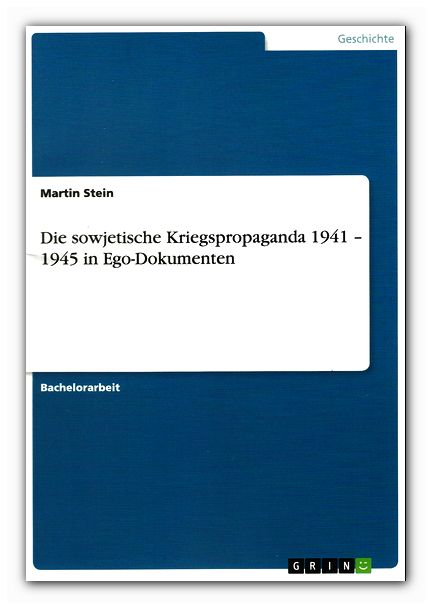
“Soviet War Propaganda 1941–1945 in Ego Documents”
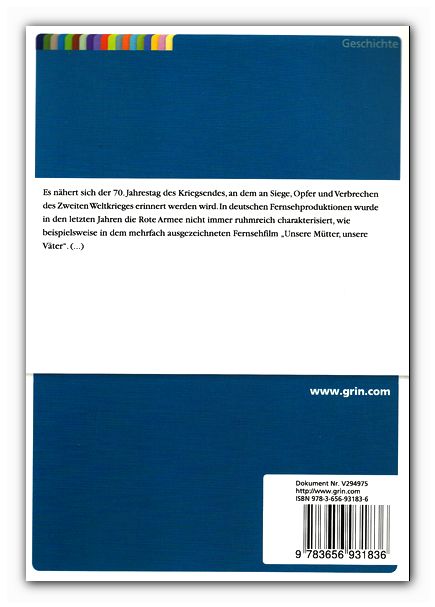
The 70th anniversary of the end of the war is approaching, an occasion on which the victories, victims and crimes of the Second World War will be remembered. In German television productions of recent years, the Red Army has not always been portrayed in a glorious light, for example in the multiple-award-winning television film Generation War (Unsere Mütter, unsere Väter).
That film gives the impression that the Red Army consisted solely of a group of “Hurrah”-shouting savages who murdered people in hospitals and raped innocent nurses in corridors. In West Germany, the image of the Red Army was long distorted by a certain attempt to ward off guilt and by a reversal of the roles of perpetrator and victim. In individual memories and in collective memory, violence, murder and rape committed on German territory were often associated with the depersonalized figure of the “Russian monster.” Thus, in these narratives, “the Russians” appeared primarily as perpetrators rather than as victims.
The real experiences of former Red Army soldiers were largely ignored and effectively excluded from such images. In reunified Germany, a simplified and generalized image of the Red Army became established as a force responsible for violence against many innocent German women, above all mass rape. To this day, a significant part of the German population apparently remains unwilling to regard the Red Army as liberators. Instead, it is more often seen as an unavoidable evil on the road to total and inevitable defeat.
Historical scholarship has been able to investigate, to some extent, acts of retaliation accompanying the Red Army's advance, including looting, killings, rape and destruction. East Prussia was particularly badly affected, but revenge and violence also occurred in Romania, Hungary and Berlin. Yet establishing precise statistics for these acts of retaliation remains extremely difficult.
Publication: Soviet War Propaganda 1941–1945 in Ego Documents
Author: Martin Stein
Paperback: 60 pages
Publisher: GRIN Verlag GmbH (2 April 2015)
Language: German
ISBN-10: 3656931836
ISBN-13: 978-3656931836
Dimensions/weight: 14.8 × 0.4 × 21 cm
Price: €24.99
Publication: Soviet War Propaganda 1941–1945 in Ego Documents
Author: Martin Stein
Format: DRM-free PDF eBook, 54 pages
Publisher: GRIN (2 April 2015)
Language: German
EAN: 9783656931829
File size: 720 KB
Price: €16.99
© grin.com/de
Vladimir Gelfand's Diary, 1945–1946
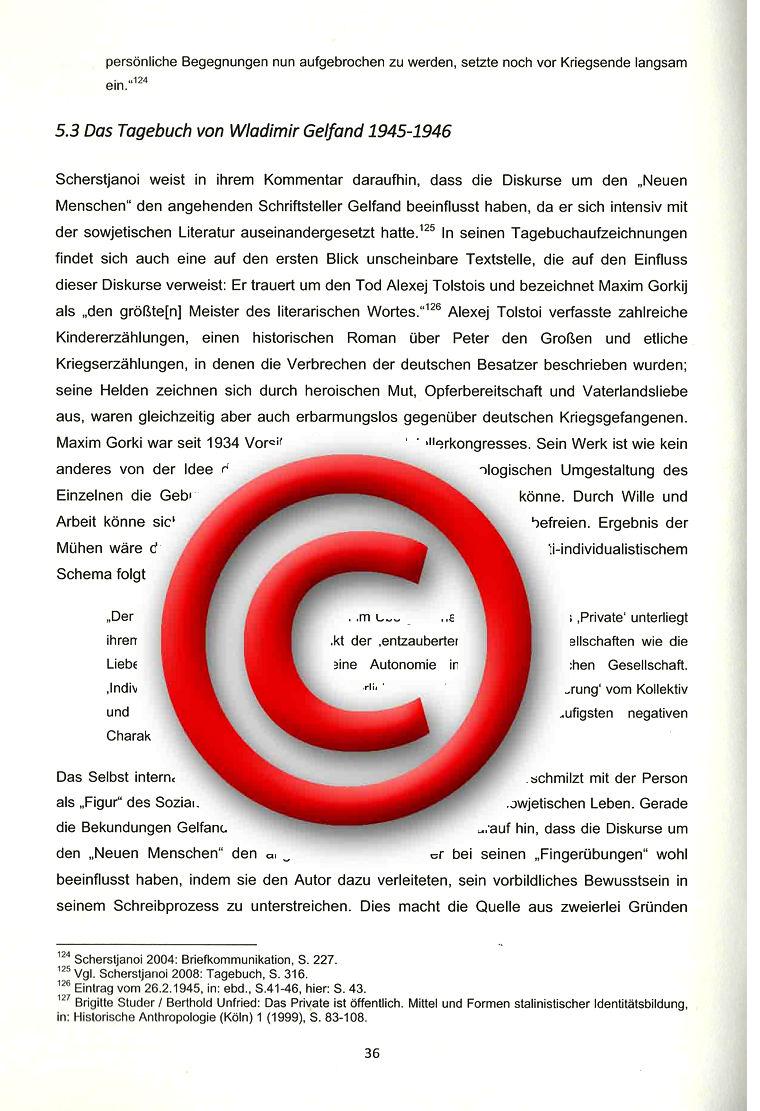
Scherstjanoi points out in her commentary that reflections on the “new man” influenced the promising writer Gelfand, who took an active interest in Soviet literature. A seemingly unremarkable but revealing passage in his diary testifies to this influence: he notes the death of Alexei Tolstoy with deep regret and calls Maxim Gorky the greatest master of the literary word.
Alexei Tolstoy is known as the author of numerous children's tales, the historical novel about Peter the Great, and works about the war that described the crimes of the German occupation authorities. His heroes displayed heroism, self-sacrifice and love of the Motherland while remaining merciless toward German prisoners of war.
Maxim Gorky, chairman of the writers' congress from 1934, expressed more clearly than almost anyone else the idea that the birth of the “new man” was possible only through a psychological transformation of the individual. According to Gorky, willpower enables a person to overcome the bonds of the past. Rebirth as a Soviet person is set against individualism and personal comfort. As Gorky put it: “A person thinks his life through the Party.”
In socialist society, phenomena such as love and art are not autonomous, while individualistic behavior is regarded as a manifestation of petty-bourgeois attitudes. Among the qualities most severely condemned in Stalinist rhetoric were isolation from the collective and an exaggerated sense of one's own importance.
Such ideas about culture and behavior shaped the “figure” of the Soviet person as a social type. Gelfand's invocation of Gorky as a model shows that ideas about the “new man” really did influence him as an aspiring writer. His regular “literary exercises”—his daily diary writing—served as a way to demonstrate his own consciousness and inner discipline.
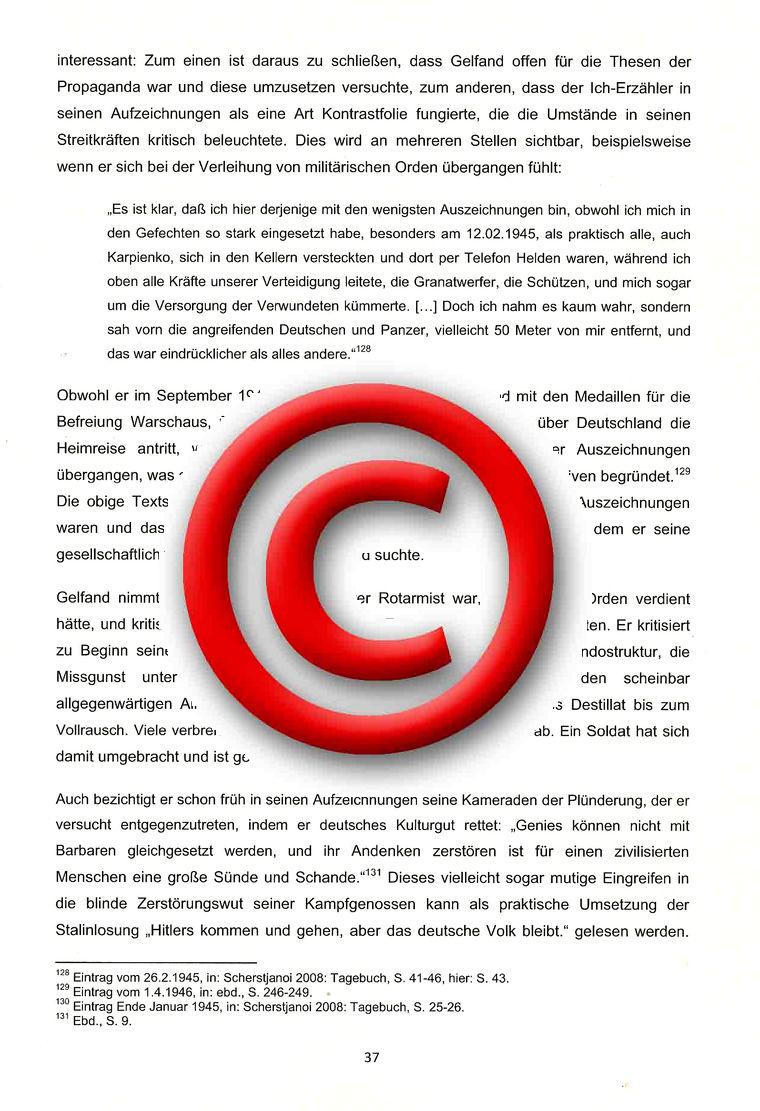
Gelfand's diary is therefore interesting from two points of view: first, as evidence that he was receptive to the ideas of Soviet propaganda and tried to put them into practice; and second, as a form of self-reflection that allowed him to think critically about the reality he encountered in the army. This is especially visible in passages where he feels that he has been treated unjustly, for example when he is overlooked during a military award ceremony:
“It is obvious that I have the fewest decorations, although I took part in combat far more actively than the others. Especially on 12 February 1945, when almost everyone, including Karpienko, was hiding in cellars and giving orders only by telephone, while I led the defense, fought with a grenade launcher and small arms, and even took care of the wounded. [...] I hardly noticed it, but I saw the Germans advancing, tanks approaching to within fifty meters—and that made a much stronger impression than everything else.”
Although Vladimir Gelfand returned home in September 1946 with the Order of the Red Star and the medals “For the Liberation of Warsaw,” “For the Capture of Berlin,” and “For the Victory over Germany,” he was repeatedly passed over at award ceremonies. In a letter to his father he attributed this to manifestations of antisemitism. Such episodes, like many others, show how important these decorations were to him: through them he felt that he belonged to the Soviet collective, sought recognition and a place in the social hierarchy, and saw himself reflected in the eyes of others.
Gelfand presented himself as an outstanding Red Army soldier deserving of numerous decorations, while at the same time openly criticizing army conditions. In his earliest entries he writes sharply about the disorganization of the command, dissatisfaction among the soldiers, theft within the unit and widespread drunkenness:
“People drink pure moonshine in insane quantities. Many of them burn out their insides, but that does not stop them. It kills a soldier—and he dies.”
He accused his comrades of looting while presenting himself as someone who tried to preserve cultural heritage. On one occasion he intervened to save a German bust:
“Geniuses cannot be equated with barbarians. The destruction of their memory is a great sin and a disgrace to civilized people.”
This intervention can be interpreted as an attempt to put into practice Stalin's slogan: “Hitlers come and go, but the German people remain.”
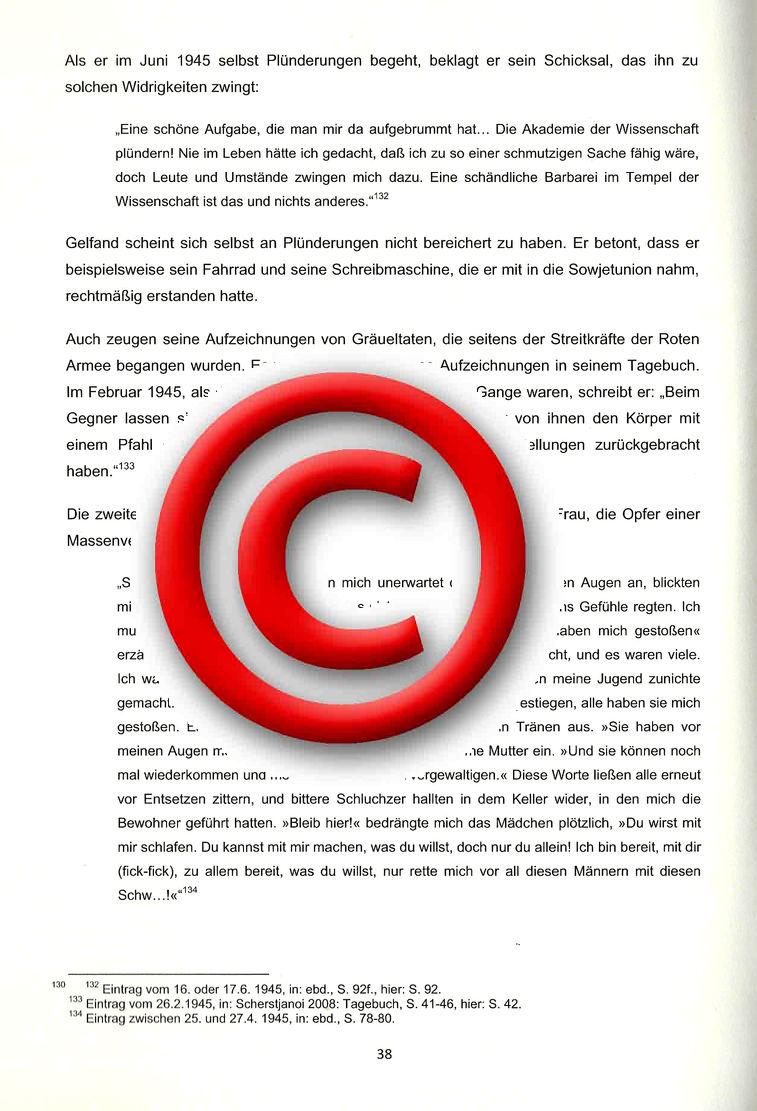
Nevertheless, in June 1945 he himself became involved in the looting of the Academy of Sciences. He recorded bitterly:
“A fine thing that you... dragged me into looting the Academy of Sciences! I would never in my life have thought I could sink so low. But people and circumstances force you. This shameful barbarism in the temple of science is nothing other than barbarism.”
At the same time, he stressed that he had not enriched himself through looting. According to him, he acquired his bicycle and typewriter legally and brought them back with him to the USSR.
His diary also contains evidence of brutality committed by Red Army soldiers. In February 1945, during active fighting, he recorded an episode that is difficult to read without horror:
“The enemy no longer sent women toward us because we impaled one of them on a stake and sent her back naked toward the German positions.”
On another occasion he described meeting a German woman who had survived a gang rape:
“She nodded, and suddenly her emerald eyes looked at me—unexpectedly, piercingly, with such force that something inside me trembled. I had to find out what was tormenting her. 'You must want me,' she said, lifting her skirt. 'They raped me all night. There were many of them. I was a virgin,' she whispered and burst into tears. 'They took my youth from me. There were old men among them, faces covered with pimples, and all of them, one after another, climbed onto me. There were more than twenty. Yes, more than twenty,'—and she sobbed again. 'Don't you want to sleep with my daughter? All those Russians wanted to!' And they may still come back and rape my girl again. These words made everyone tremble with horror again, and bitter sobbing swept through the cellar into which the residents had brought me. 'Stay here!' the girl suddenly threw herself at me. 'You will sleep with me. You can do whatever you want with me, but only you! I am ready to be with you, ready for anything you want, just save me from all those men with those black...!'”
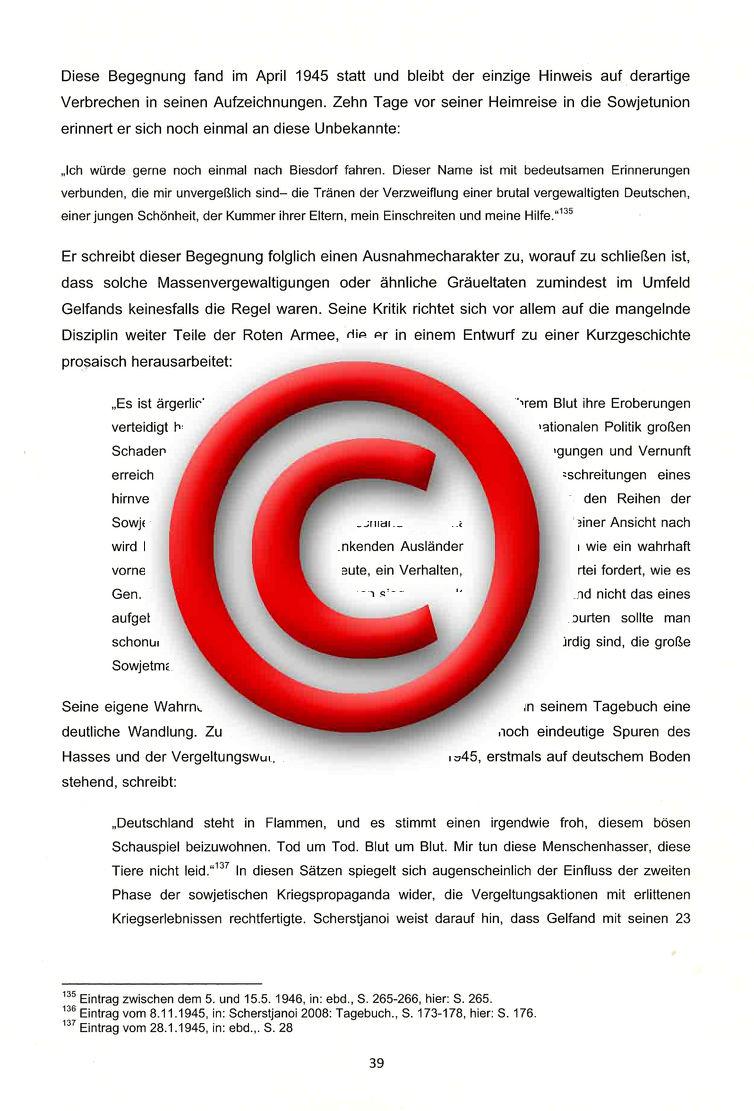
This meeting took place in April 1945, and Gelfand's notes contain only isolated references to crimes of this kind. Ten days before returning home to the Soviet Union, he remembered this unknown woman once again:
“I would like to go to Biesdorf again. That name is connected for me with a powerful memory that cannot be forgotten: my tears of despair, the brutally raped German woman, her youthful beauty, the grief of her parents, my intervention and help.”
He describes the encounter as exceptional, which suggests that mass rape or comparable atrocities were not the norm, at least in Gelfand's immediate surroundings. His criticism is directed primarily at the lack of discipline in large parts of the Red Army, and it appears in more prosaic form in a draft short story:
“It is infuriating that the very same people who repeatedly defended their achievements with their blood now, through their conduct abroad, inflict enormous damage on our international policy. Everything diplomats achieve through effort and common sense is ruined here by negligence, acts of violence and the outrageous behavior of drunkards—the very people who, by chance, have not yet been expelled from the Soviet occupation forces in Germany. I think no sober-minded foreigner can understand such behavior. Our Party demands that we persuade through our conduct—conduct that is genuinely noble, as the genius Stalin teaches and as befits victorious soldiers, not drunken rags lying in the road. All these scoundrels and all these antics must be ruthlessly eradicated and driven out of our midst, because they are unworthy to represent the Great Soviet power abroad.”
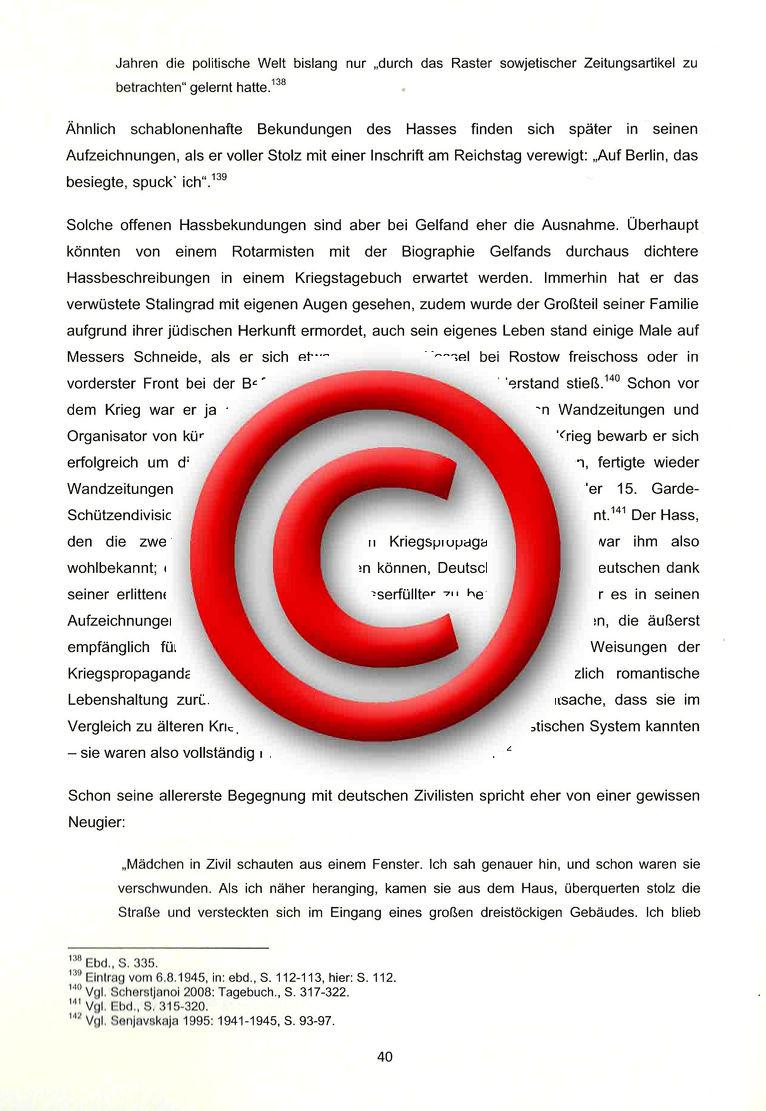
His own perception of the German civilian population changes considerably over the course of the diary. At the beginning of the entries there are even clear traces of hatred and vengeful anger. When he first reaches German soil in January 1945, he writes:
“Germany is in flames—and rightly so. I am glad to witness this evil drama. Death for death. Blood for blood.”
The influence of the second phase of Soviet wartime propaganda is clearly visible in phrases such as “these brutes, these animals—and one feels no pity for them,” words that justify acts of retaliation born of wartime experience. Scherstjanoi notes that, at the age of twenty-three, Gelfand perceived political reality exclusively “through the prism of articles in Soviet newspapers.”
Similar stereotyped manifestations of hatred can be found in later diary entries as well, for example in the proud inscription he left on a wall of the Reichstag: “Berlin is defeated; I spit on it.”
Even so, such open expressions of hatred are the exception rather than the rule in Gelfand's diary. Given the biography of a Red Army soldier like him, one might have expected far more intense hatred. After all, he had seen devastated Stalingrad with his own eyes, much of his family had been murdered because of their Jewish origin, and he himself had repeatedly come close to death—under fire at Rostov and later amid the enemy's fanatical resistance on the front line during the liberation of Berlin.
Before the war he had been a committed Komsomol member, editor of a wall newspaper and organizer of artistic recitation contests. During the war he successfully sought admission to the Communist Party, read the central newspapers, continued producing wall newspapers and wrote propaganda leaflets. In the 15th Rifle Division he was appointed deputy platoon commander for political affairs. The hatred fueled by the second phase of Soviet wartime propaganda was therefore very familiar to him. His wartime experience could certainly have led him to believe that he was entitled to describe Germany and Germans with the greatest possible hostility. At twenty-three he belonged to a generation exceptionally receptive to the regime's ideological assumptions, slogans and directives of wartime propaganda.
Senyavskaya points out that it was precisely the romantic worldview typical of that age, together with the absence of any conception of an alternative to the Stalinist system, that distinguished the younger generation from older participants in the war: they were products of Stalinist culture in the fullest sense of the word.
Already in his first contact with German civilians he displays curiosity rather than hostility:
“A girl in civilian clothes looked out of the window. I looked more closely—and they had already disappeared. When I came nearer, they came out of the house, proudly crossed the street and disappeared into the entrance of a large three-story building. I remained standing there. Their friendly faces and clothing caught my attention. Could these really be German women? I thought I had never met such a beautiful Fräulein.”
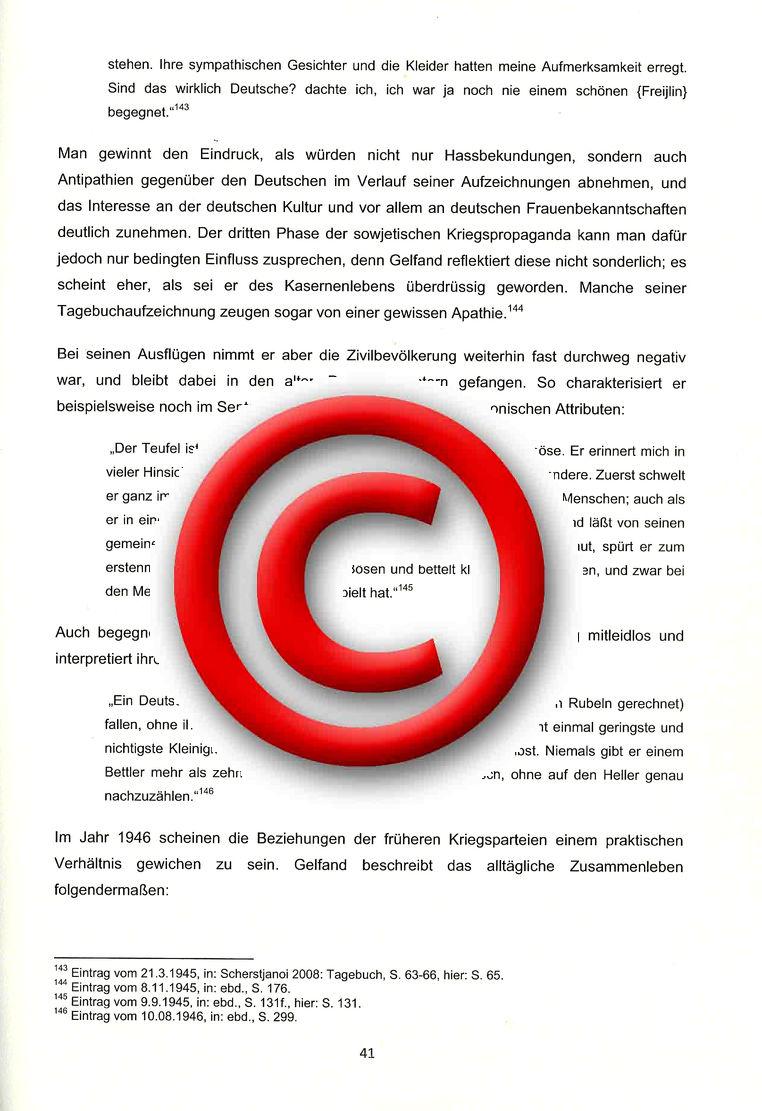
As the diary develops, it seems that not only Gelfand's open hatred but also his antipathy toward Germans weakens, while his interest in German culture and especially in meeting German women grows markedly. The influence of the third phase of Soviet wartime propaganda can only tentatively be invoked to explain this change, since Gelfand himself scarcely reflects it in his diary. Rather, he seems simply to have become tired of barracks life. Some entries even suggest a state of apathy.
During his travels, however, he still almost always perceives German civilians in negative terms and remains trapped in older interpretive patterns. In September 1945, for example, he attributes demonic traits to Germans:
“The devil is evil, cheerful, powerful and omnipresent. In many ways he reminds me of the Germans—how they rush from one extreme to another. At first he delights in evil, laughs, mocks people's feelings and habits. When he finds himself in an unpleasant situation, he does not lose his optimism and makes meanness into a habit. But when he finally looks death in the face, for the first time he feels the full horror of evil, collapses and, pitifully, begs mercy from the person to whom he had just been so cruel.”
He also interprets the needs and everyday struggle for survival of German civilians with ruthless contempt:
“A German will never let a pfennig go by without picking it up (less than a kopeck at the ruble exchange rate), and will never give away anything, however small, without receiving twice the benefit. He will never give a beggar more than ten kopecks, and will never leave a counter without discussing the price even of a cigarette lighter.”
By 1946, relations between the former enemies appear to have shifted toward pragmatic contact. Gelfand describes everyday coexistence as follows:
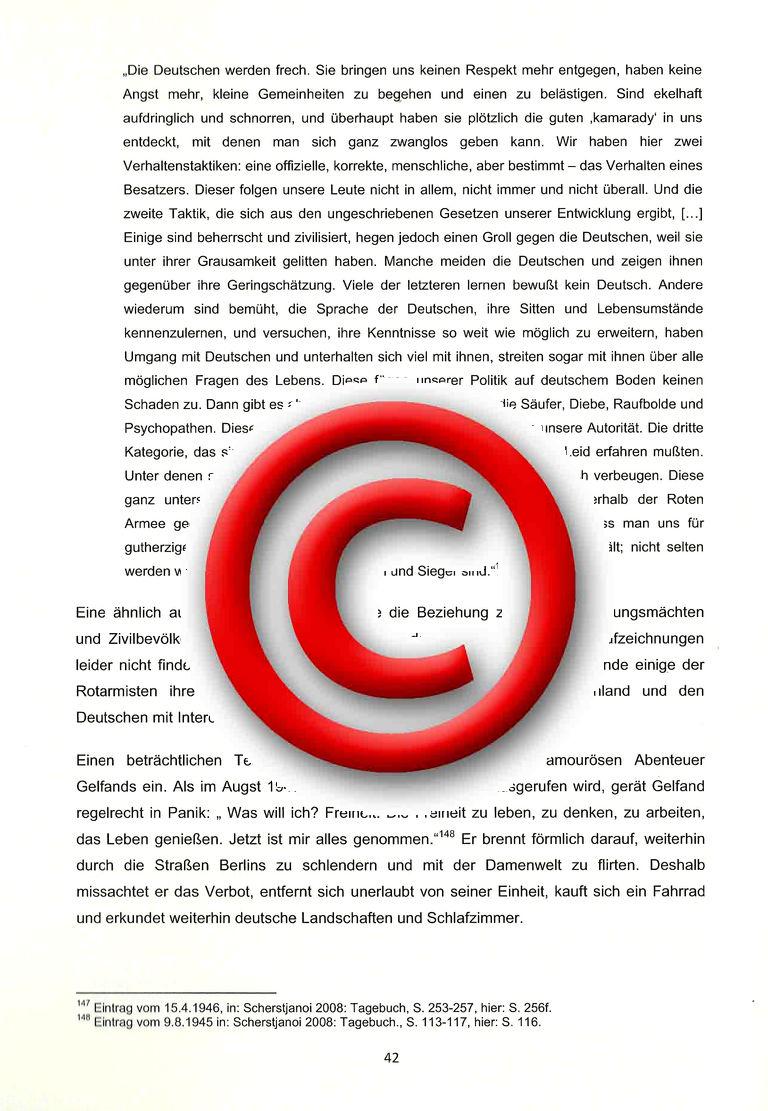
“The Germans are insolent. They show us no respect and are not afraid to play petty tricks on us or harass us. They are intrusive, they push their way everywhere, and then suddenly they become polite. 'Comrades' have been found in the USA—and everything becomes easy and simple. We have two tactics of behavior: the official one—correct, as befits a person who is conscious of being an occupier. Our people do not follow it always and everywhere. The second tactic is the result of the unwritten laws of our development. [...] Some behave with restraint and in a civilized manner, yet harbor resentment against the Germans because they themselves experienced German cruelty. Some avoid Germans and openly despise them. Many consciously refuse to learn German. Others, on the contrary, try to learn the language, understand their customs and living conditions, establish business relations, talk with them and argue about every subject. Such behavior does not harm our policy on German soil. And there is another category: drunkards, thieves, rowdies and psychopaths. They sow chaos and undermine our authority. There is also a third category—liberals who have come to believe that Hitler did no harm through the people. Some of them fall in love, enjoy themselves, bow and scrape. These extremely different levels of development and behavior within the Red Army toward the local population cause the Germans to regard us sometimes as kind and simple, sometimes as coarse and even savage. Often they despise us despite the fact that we are the masters and victors.”
Unfortunately, Gelfand's diary contains very few comparable descriptive episodes from 1945 depicting relations between the occupying power and the civilian population. It is quite possible, however, that at least after the end of the war some Red Army soldiers left their antipathy behind and began to take an interest in Germany and the Germans.
Gelfand's romantic adventures occupy a substantial part of his diary. When the ban on “fraternization” was officially announced in August 1945, Gelfand almost panicked:
“What do I want? Freedom! To live freely, work, think and enjoy life. And now none of that is for me.”
He continued walking the streets of Berlin, flirting with women and, quite literally, dying with desire. He ignored the prohibition, left his unit without authorization, bought a bicycle and set off to explore not only the German landscape but bedrooms as well.
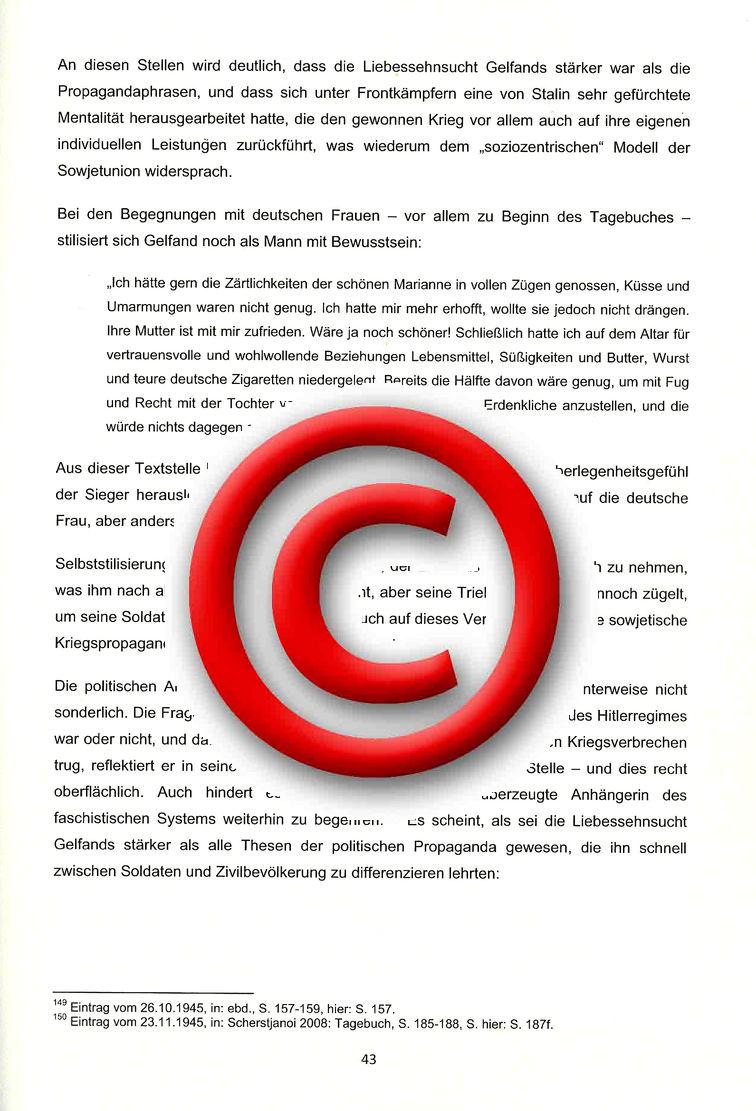
These episodes make clear that Gelfand's longing for love was stronger than propaganda slogans. Front-line soldiers were developing precisely the mentality Stalin feared: they had won the war to a large extent through their own efforts and personal qualities, something that conflicted with the “socially oriented” model of the Soviet state.
In episodes involving German women—especially at the beginning of the diary—Gelfand portrays himself as a man with a strong sense of his own dignity:
“I liked the loving caresses of beautiful Marianne: embraces and kisses were not enough. I hoped for more, but I did not insist. Her mother was pleased with me. More than that: she would have been entirely in favor! In the end I brought to the altar of our friendly and trusting relations sweets and butter, sausage and expensive German cigarettes. Half of those provisions alone would have been enough for me to do whatever I wanted with her daughter in front of her mother, and the mother would not have said a word against it.”
This episode reveals not only the victor's sense of entitlement and a certain condescension toward the German woman, but also Gelfand's self-stylization as a “noble” Red Army soldier who, despite all his sacrifices, believes himself entitled to take what life offers while restraining his instincts so as not to disgrace the honor of a Soviet soldier. Such behavior may also have been influenced by Soviet propaganda in the third phase of the war.
Gelfand is scarcely interested in the political views of his lovers. Whether a German woman was a convinced supporter of Hitler's regime or not is a question he raises only once in the diary and even then only superficially. This does not prevent him from continuing to desire intimacy even with convinced adherents of the fascist system. His longing for love seems to have been stronger than any political slogan teaching soldiers to distinguish Nazis from ordinary civilians:
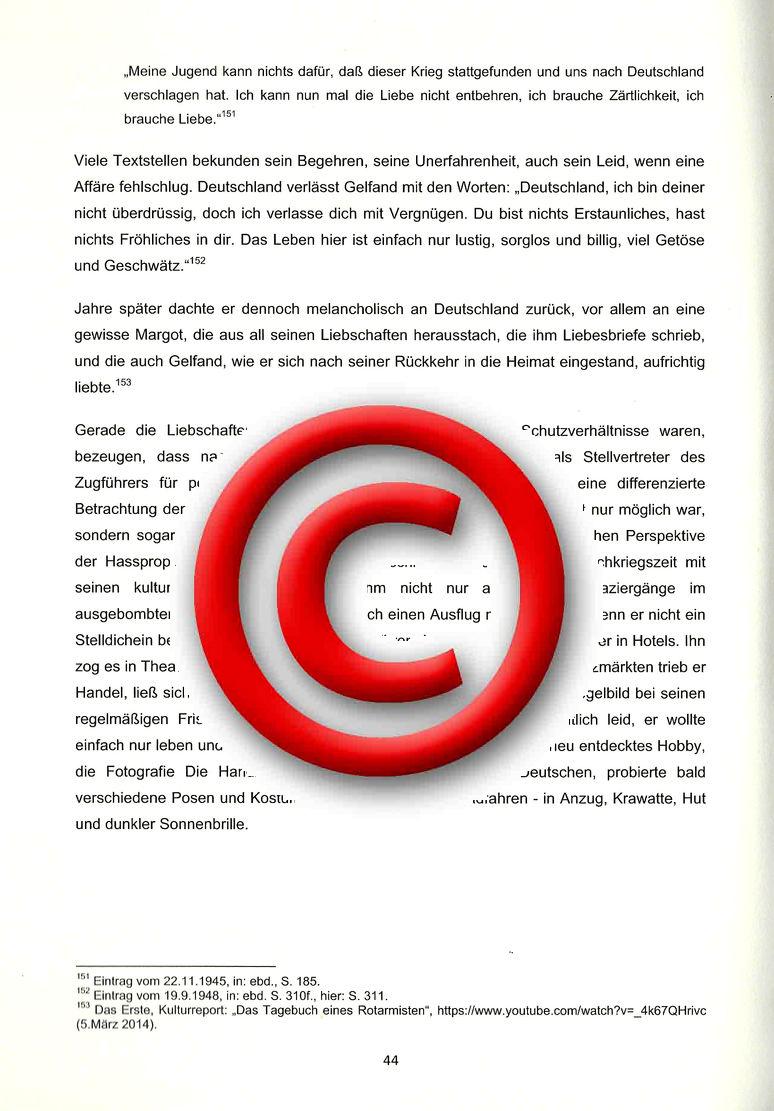
“My youth is not to blame for this war having taken place and for our having been brought to Germany. I simply cannot do without love; I need tenderness, I need love.”
Many passages in the diary express his passion, inexperience and suffering when nothing works out. As he leaves Germany he writes:
“Germany, I have not grown tired of you, yet I leave you gladly. There is nothing remarkable about you, nothing joyful in you. Life here is simply cheerful, carefree and cheap, full of noise and chatter.”
And yet, years later, he remembers Germany with melancholy, especially a certain Margot who stands out among all his romantic relationships. She wrote him love letters and, as he admitted, truly loved him even after he returned home.
Gelfand's contacts with German women that were not based on submission or fear demonstrate that, even after the phase of hate propaganda—in which he himself had actively participated as a deputy platoon leader responsible for political work—a more differentiated perception of Germans was not only possible but could lead to romantic relationships. Germany, previously seen through the lens of demonizing propaganda, exerted an attraction in the postwar period through its culture and charm.
He did not merely take long walks through bombed-out Berlin; he also traveled secretly to Weimar. When he did not have a date with a German girl at their camp, he stayed in hotels. He went to theaters, cinemas, bars and cafés, traded on the black market, bought suits, admired himself in the mirror with pleasure and regularly visited the barber. He was clearly tired of barracks life and simply wanted to live and be free.
This was especially evident in his new passion for photography. He obtained cameras from Germans and experimented with different poses and outfits: in a suit, with a tie, in a hat and dark glasses. He rode a bicycle and presented himself as a free, independent person—a victor who at last belonged to himself.
Notes
124. Scherstjanoi 2004: Briefkommunikation, p. 227.
125. Cf. Scherstjanoi 2008: Tagebuch, p. 316.
126. Entry dated 26 February 1945, in ibid., pp. 41–46, here p. 43.
127. Brigitte Studer / Berthold Unfried: Das Private ist öffentlich. Mittel und Formen stalinistischer Identitätsbildung, in: Historische Anthropologie (Cologne) 1 (1999), pp. 83–108.
128. Entry dated 26 February 1945, in Scherstjanoi 2008: Tagebuch, pp. 41–46, here p. 43.
129. Entry dated 1 April 1946, in ibid., pp. 246–249.
130. Entry from late January 1945, in Scherstjanoi 2008: Tagebuch, pp. 25–26.
131. Ibid., p. 9.
132. Entry dated 16 or 17 June 1945, in ibid., pp. 92f., here p. 92.
133. Entry dated 26 February 1945, in Scherstjanoi 2008: Tagebuch, pp. 41–46, here p. 42.
134. Entry between 25 and 27 April 1945, in ibid., pp. 78–80.
135. Entry between 5 and 15 May 1946, in ibid., pp. 265–266, here p. 265.
136. Entry dated 8 November 1945, in Scherstjanoi 2008: Tagebuch, pp. 173–178, here p. 176.
137. Entry dated 28 January 1945, in ibid., p. 28.
138. Ibid., p. 335.
139. Entry dated 6 August 1945, in ibid., pp. 112–113, here p. 112.
140. Cf. Scherstjanoi 2008: Tagebuch, pp. 317–322.
141. Cf. ibid., pp. 315–320.
142. Cf. Senjavskaja 1995: 1941–1945, pp. 93–97.
143. Entry dated 21 March 1945, in Scherstjanoi 2008: Tagebuch, pp. 63–66, here p. 65.
144. Entry dated 8 November 1945, in ibid., p. 176.
145. Entry dated 9 September 1945, in ibid., pp. 131f., here p. 131.
146. Entry dated 10 August 1946, in ibid., p. 299.
147. Entry dated 15 April 1946, in Scherstjanoi 2008: Tagebuch, pp. 253–257, here pp. 256f.
148. Entry dated 9 August 1945, in Scherstjanoi 2008: Tagebuch, pp. 113–117, here p. 116.
149. Entry dated 26 October 1945, in ibid., pp. 157–159, here p. 157.
150. Entry dated 23 November 1945, in Scherstjanoi 2008: Tagebuch, pp. 185–188, here pp. 187f.
151. Entry dated 22 November 1945, in ibid., p. 185.
152. Entry dated 19 September 1948, in ibid., pp. 310f., here p. 311.
153. Das Erste, Kulturreport: “Das Tagebuch eines Rotarmisten”, https://www.youtube.com/watch?v=_4k67QHrivc (5 March 2014).