Jews in the Red Army
Key Historical Questions
-
Methods of Struggle: What methods of struggle could the Jews of the Soviet Union use?
-
Motivations: What motivated Jews to join the struggle?
-
Challenges: What challenges did the different fighters face?
Jewish Struggle
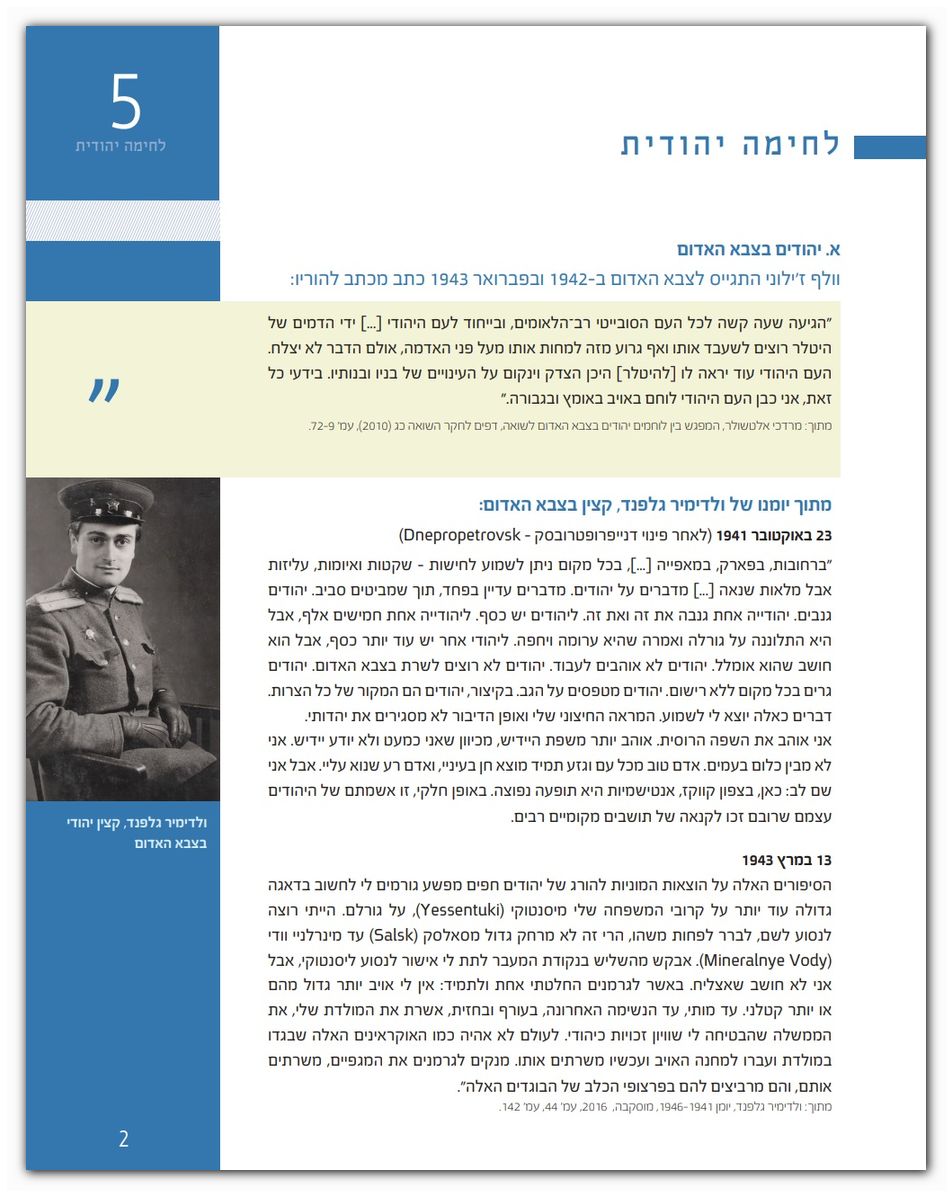
Photo: Vladimir Gelfand, Red Army officer
“For
the entire Soviet people, and especially for the Jewish people, a
difficult hour has come. The Nazis are raising their hand against our
people; they want to enslave them and, even worse, wipe them from the
face of the earth. But they will not succeed. The Jewish people will
yet show Hitler where justice lies and will avenge the suffering of its
sons and daughters. With my own hands, as a son of the Jewish people, I
am fighting the enemy with determination and courage.”
— Mordechai Altshuler, “Encounters of Jewish Fighters in the Red Army with the Holocaust,” pp. 72–79.
Excerpts from the Diary of Vladimir Gelfand
Context: Red Army Officer Vladimir Gelfand, writing from Dnipropetrovsk (before its occupation) and subsequent locations.
Dnipropetrovsk — October 23, 1941
“In
the streets and in the park, in the bread shop and in the queue for
kerosene — whispers can be heard everywhere. Quiet whispers,
terrible, cheerful, but hateful. They are talking about Jews. For now
they speak timidly, glancing around.
Jews
are thieves. One Jewish woman stole this and that. Jews have money. One
woman turned out to have 50,000, but she complained about her fate and
said she had nothing to wear and no shoes. One Jew has even more money,
yet he considers himself unfortunate. Jews do not like to work. Jews do
not want to serve in the Red Army. Jews live without residence
registration. The Jews have climbed onto their heads. In short, Jews
are the cause of every misfortune. I have to hear all this more than
once — my appearance and speech do not reveal that I am Jewish.
I
love the Russian language. I probably love it more than the Jewish
language, since I am almost unfamiliar with the latter. I do not divide
people by nationality. A good person of any nation or race is always
dear and pleasant to me, while a bad person is hateful. But I notice
that here, in the North Caucasus, antisemitism is a mass phenomenon. To
some extent the Jews themselves are also to blame, having in most cases
aroused the envy of many local residents.”
March 13, 1943
“These
stories about mass executions of completely innocent Jews make me think
with even greater anxiety about my dear relatives from Essentuki and
about their fate. If only I could go there and learn something —
after all, from Salsk to Mineralnye Vody is hardly any distance. I will
ask the commandant at the transit point for permission to go to
Essentuki, but I am unlikely to succeed.
As
for the Germans, I have made up my mind forever: there are no enemies
more evil or deadly to me than the Germans. Until the grave, until my
last breath, in the rear and at the front, I will serve my Motherland
and my government, which has guaranteed me equal rights as a Jew. I
will never become like those Ukrainians who betrayed the Motherland,
crossed over to the enemy camp, and now serve them. They clean their
boots and serve them, while the Germans beat them in their Judas-like
dog faces.”
Source: Vladimir Gelfand, Diary 1941–1946, Moscow, 2016, p. 44 and p. 142.
This edition was prepared thanks to the generous support of the Genesis Foundation.




 Hebrew