

|
|
|
|
|
|
 |
 German
By Tillmann Bendikowski
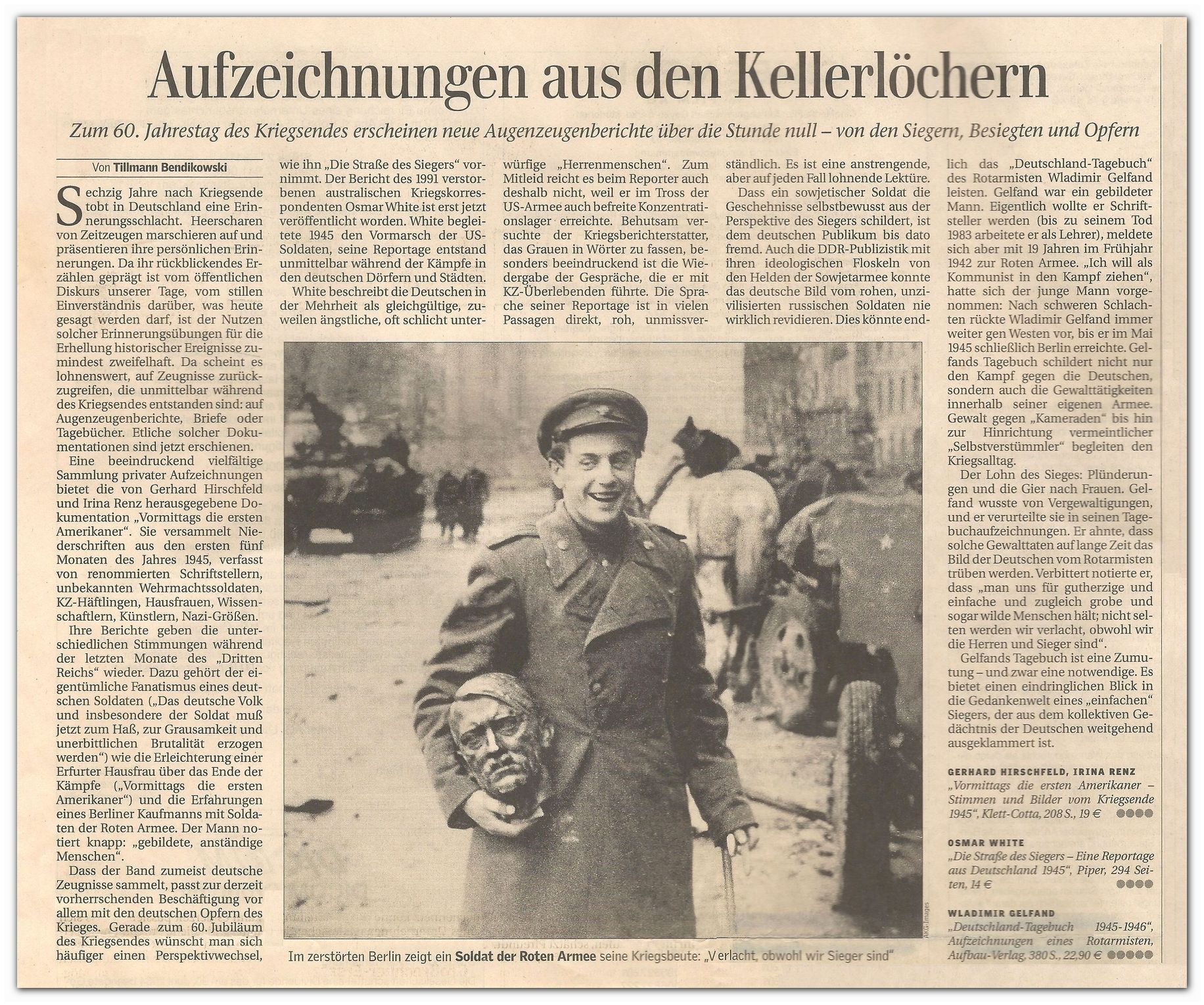
Sixty years after the end of the war, Germany is still engaged in an intense struggle over memory. Eyewitnesses step forward and present their personal recollections. Because retrospective storytelling is shaped by today’s public discourse and by the tacit agreement over what may now be said, the value of such exercises in memory for illuminating historical events is at least doubtful. It therefore seems worthwhile to return to testimonies written directly at the end of the war: eyewitness reports, letters and diaries. A number of such documentary collections have now appeared.
An impressively varied collection of private records is offered by Gerhard Hirschfeld and Irina Renz in In the Morning, the First Americans. It brings together writings from the first five months of 1945 by renowned authors, unknown Wehrmacht soldiers, concentration-camp prisoners, housewives, scholars, artists and leading Nazis. Their accounts convey very different moods during the final months of the “Third Reich”: the peculiar fanaticism of a German soldier — “The German people and especially the soldier must now be educated to hatred, cruelty and relentless brutality” — alongside the relief of an Erfurt housewife at the end of the fighting — “In the morning, the first Americans” — and the experiences of a Berlin businessman with Red Army soldiers, whom he tersely describes as “educated, decent people.”
The fact that the volume contains mainly German testimonies fits the present-day focus above all on German victims of the war. Especially on the sixtieth anniversary of the war’s end, one often wishes for a change of perspective, such as that undertaken in Conquerors’ Road. Australian war correspondent Osmar White, who died in 1991, accompanied the advance of U.S. soldiers in 1945; his report was written during the fighting in German villages and towns and has only now been published.
White portrays most Germans as indifferent, sometimes frightened, often simply submissive “master people.” The reporter has little room for pity, not least because in the wake of the U.S. Army he also reached liberated concentration camps. He tried cautiously to put the horror into words; his conversations with survivors are especially powerful. The language of his report is direct, rough and unmistakable — and therefore demanding, but certainly worthwhile reading.
A Soviet soldier’s description of the war from the victor’s perspective has until now been unfamiliar to the German public. Even East German publishing, with its ideological formulas about the heroes of the Soviet Army, never truly revised the German image of the crude, uncivilized Russian soldier. Wladimir Gelfand’s Germany Diary may finally do so. Gelfand was an educated man. He actually wanted to become a writer — until his death in 1983 he worked as a teacher — but at nineteen, in spring 1942, he joined the Red Army. “As a Communist, I want to go into battle,” the young man had resolved. After heavy fighting, he advanced ever farther west and finally reached Berlin in May 1945. His diary records not only the fight against the Germans but also violence within his own army, including violence against “comrades” and the execution of alleged “self-mutilators.”
The reward of victory was looting and a hunger for women. Gelfand knew about rapes and condemned them in his diary. He sensed that such violence would darken the German image of the Red Army soldier for a long time. Bitterly he noted that “we are regarded as kind-hearted and simple, yet at the same time crude and even wild people; not infrequently we are mocked, although we are the masters and victors.”
Gelfand’s diary is disturbing — and necessarily so. It offers an intense view into the mind of an “ordinary” victor who has largely been excluded from Germans’ collective memory.