


Badisches
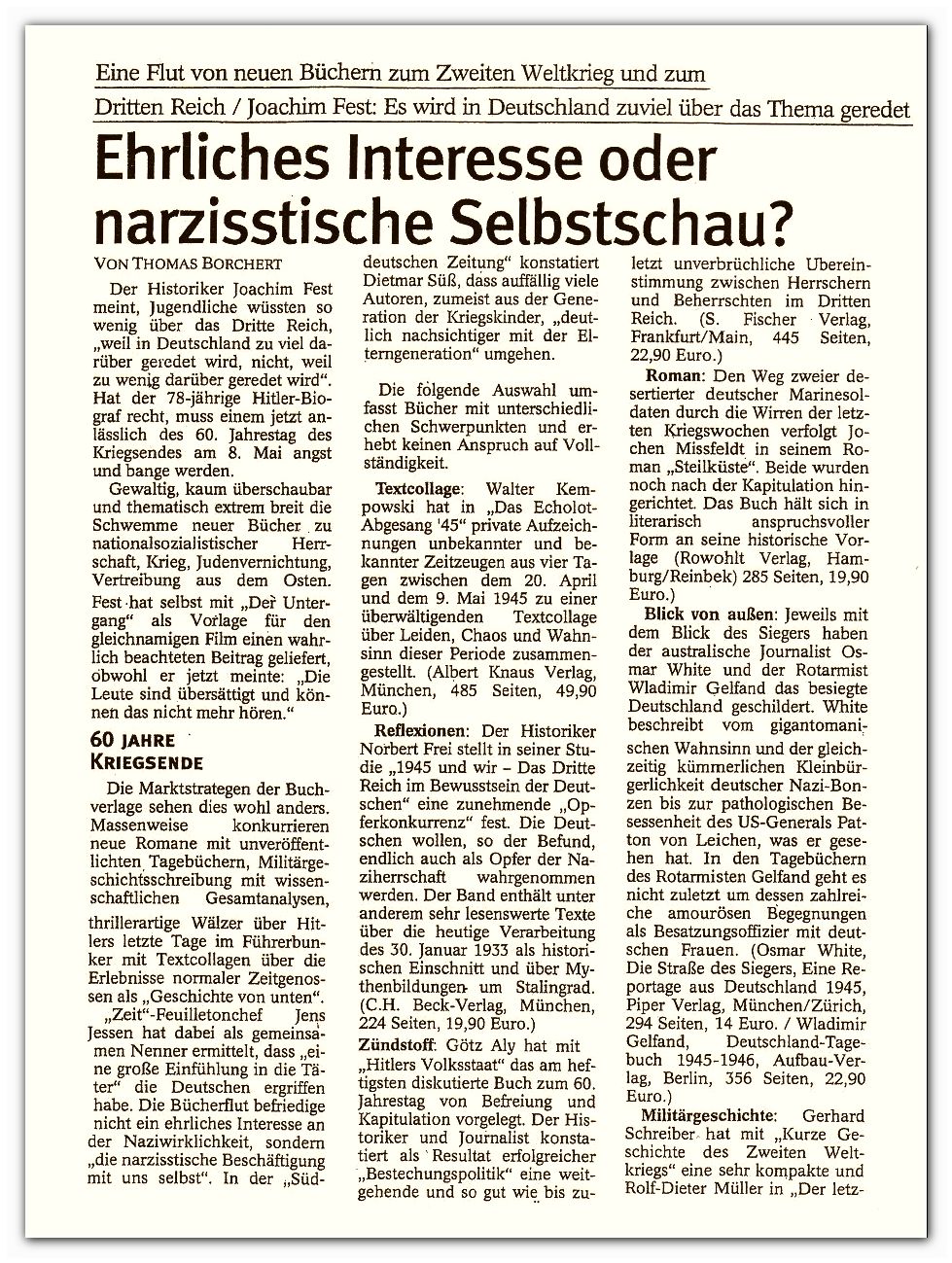
Tagblatt "Ehrliches
Interesse oder narzisstische Selbstschau?"

02. Mai.2005, Seite 20
© Badisches-Tagblatt.de

Badisches Tagblatt
Honest Interest or Narcissistic Self-Examination?
A Flood of New Books on the Second World War and the Third Reich
Historian Joachim Fest argues that young people know too little about the Third Reich "not because too little is said about it, but because too much is said." If the seventy-eight-year-old Hitler biographer is right, then the sixtieth anniversary of the end of the war on 8 May threatens to produce thematic overload.
The flood of new books about National Socialism, the war, the Holocaust and expulsion from the East is enormous, difficult to survey and exceptionally broad. Fest himself contributed significantly to the discussion as a co-writer of the film Downfall, based in part on his book, yet now observes that people are saturated with the subject and can no longer bear to hear about it.
Sixty years since the end of the war
Publishing strategists evidently see matters differently. The market is full of novels, previously unpublished diaries, military histories, scholarly studies, thrillers about Hitler's final days in the bunker and collages of ordinary contemporaries' memories presented as "history from below."
Jens Jessen argued that a common denominator of this publishing wave is a profound sympathy for perpetrators. In his view, many authors are less interested in genuinely examining the Nazi period than in a form of narcissistic self-examination. Historian Dietmar Suess has similarly argued that many writers, particularly from the generation of the "war children," show considerably greater indulgence toward their parents' generation.
The following selection presents books that approach the period in different ways and does not claim to be complete.
Text collage
Walter Kempowski collected private records by famous and unknown witnesses from 20 April to 9 May 1945 in Das Echolot - Abgesang 45, producing a powerful textual collage of suffering, chaos and madness. (Albert Knaus Verlag, Munich, 485 pages, EUR 49.90.)
Reflections
In 1945 und wir. Das Dritte Reich im Bewusstsein der Deutschen, historian Norbert Frei discusses the growing phenomenon of a "competition of victims," in which Germans increasingly demand recognition of their own victimhood under Nazism. The book contains readable essays on the modern interpretation of 30 January 1933 as a historical turning point and on myths surrounding the Battle of Stalingrad. (C.H. Beck, Munich, 224 pages, EUR 19.90.)
Provocative analysis
Goetz Aly's Hitlers Volksstaat offers perhaps the most debated interpretation associated with the sixtieth anniversary of liberation and capitulation. Aly argues that an effective policy of material favors and redistribution secured a broad and remarkably durable consensus between the ruling elite and much of the population of the Third Reich. (S. Fischer, Frankfurt am Main, 445 pages, EUR 22.90.)
Novel
In Steilkueste, Jochen Missfeldt follows two German naval servicemen who deserted during the final weeks of the war. Both were executed after the capitulation. The novel is based on a real historical case and is written in restrained but expressive prose. (Rowohlt, Reinbek/Hamburg, 285 pages, EUR 19.90.)
A view from outside
Australian journalist Osmar White and Soviet officer Vladimir Gelfand describe defeated Germany from very different perspectives. White records the scale of destruction, the petty-bourgeois self-confidence of former Nazi functionaries and the strange obsessive traits of American General Patton. The diaries of Red Army lieutenant Vladimir Gelfand, by contrast, deal with the routines of occupation service and with his many romantic encounters with German women. (Osmar White, Conquerors' Road: An Eyewitness Report of Germany 1945, Piper, Munich/Zurich, 294 pages, EUR 14. Vladimir Gelfand, Germany Diary 1945-1946, Aufbau, Berlin, 356 pages, EUR 22.90.)
Military history
Gerhard Schreiber's concise history of the Second World War summarizes the major events of the conflict in compact form, while Rolf-Dieter Mueller's work referred to in the article as "The Last..." appears to focus on the final phase of the war; the title is incomplete in the surviving text.
The publishing wave surrounding the sixtieth anniversary of the end of the war illustrates the very broad spectrum of approaches to Germany's Nazi past. The remaining question is whether these books offer genuinely new understanding or merely reinforce old, deeply rooted narratives.