





| About Yandex.Zen
Yandex
Zen is
a personal recommendation service. Zen helps internet postings find
their audience. Postings can either get posted automatically in
recommendation feeds from the author's site, or an author can create
content directly in Yandex Zen. Any companies, internet publications,
or independent authors can create their own channels in Yandex Zen. Learn
more about adding your
website to Yandex Zen. The content creator platform is available only in Russian.
Владимир Гельфанд Красноармеец, участвует в освбождении Польши и боевых действиях в Германии. Блог Владимира Гельфанда — часть проекта «Настоящий 1945» студии «История будущего», созданного при поддержке Издательства Яндекса. |
| 29 июля 2022 |
||
"Я влюбился в портрет Богоматери..." Из фронтовых дневников лейтенанта Владимира Гельфанда |
||
| |
||
|
В 20 лет, имея бронь от призыва в армию, Владимир попросился на фронт и стал сержантом миномётного взвода. Там он не изменил довоенной привычке: каждый день, даже под обстрелом, писал дневник. В 2002 году этот уникальный документ был опубликован в Германии на немецком. А в 2015 году - и в России. Вот некоторые записи 1944 года, когда началось освобождение Польши от нацистов. 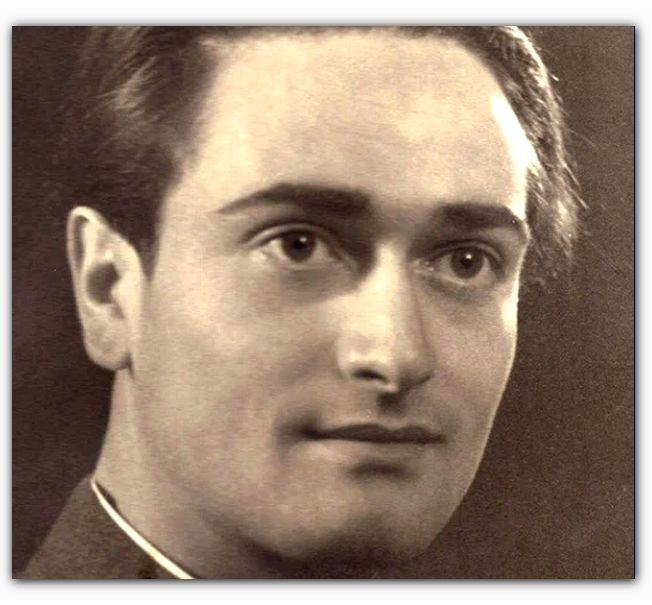 |
||
Национальные особенности22.10.1944.
Село Ганна. Эта
часть Польши, где много русских и украинцев, хорошо ещё нас встречает.
Но туда дальше - звери и руссконенавистники. Евреев тоже здесь не любят
и открыто называют «жидами». Ещё бедные люди,
особенно
русские и украинцы, те так-сяк, сочувствуют даже, но поляки... те со
скрежетом зубов отзываются о евреях. Гордые панночки24.10.1944
Село Грудск. Хозяева
дома, где я остановился, - настоящие трудящиеся-бедняки, люди добрые и
приветливые. Если бы такие были все в Польше, то лучшего не нужно было
и желать. "Немцы были лучше"25.10.1944. Наутро
проснулся рано и хотел начать писать, но не пришлось - хозяева опять
мне дали полстакана молока и немного картошки. Я поел, и тогда у нас
завязался разговор. Батраки и помещики28.10.1944.
Польша похожа на злого капризного ребёнка, с которым нянчатся, из-за
которого убивают много времени очень взрослые и очень серьезные люди.
Видел я Польшу и, насколько мог, изучил её нравы, быт и обычаи. Много
внимания здесь придаётся внешнему лоску. О любви21.11.1944.
Станция Лохув. После
обеда уезжаю. Какой парадокс мне встретился! Лида, эта молоденькая
славненькая девчушка - она замужем! Только что узнал от хозяйки. А ведь
ходил специально ради неё в мастерскую. Пан похож на...22.11.1944.
Польша. Минск-Мазовецкий. Нынче
утром на квартиру, где я остановился, явилась одна славненькая личиком
паненька. Я предложил ей стул и почти силком заставил сесть. Она
отмежёвывалась от моих ласок, а потом неожиданно сказала:
«Пан
похож на жидка». Марыся и самолёты23.11.1944.
Окраина Минск-Мазовецкого. Проснулся
сегодня рано. Хозяева оказались исключительно приветливыми поляками,
каких я ещё здесь не встречал. Старушка-мать, 61 год, её муж на восемь
лет старше, но мечтают дожить до окончания войны и увидеть хотя бы один
год мирного времени. |
||
| Источник:
Гельфанд В.Н. Дневники 1941-1946 // Журнал
«Самиздат», 2004. Проект «Настоящий 1945» создан студией «История Будущего» при поддержке Издательства Яндекса в рамках программы, направленной на развитие культурных и образовательных инициатив в области истории, литературы, искусства и философии. Читайте записи Владимира Гельфанда в его личном блоге, а также подписывайтесь на проект в Яндекс.Эфире и Яндекс.Коллекциях |
 |
 |
 |
 |
|
 |
 |
 |
 |
|
 |
 |
 |
 |
|
 |
 |
 |
 |
|
 Russian
“I Fell in Love with a Portrait of the Mother of God...” From the Front-Line Diaries of Lieutenant Vladimir Gelfand
At the age of twenty, although he had a deferment from military service, Vladimir asked to be sent to the front and became a sergeant in a mortar platoon. There he did not abandon a habit he had formed before the war: every day, even under shellfire, he kept a diary. In 2002 this unique document was published in Germany in German, and in 2015 it was published in Russia as well. Below are several entries from 1944, when the liberation of Poland from the Nazis began.
Vladimir Gelfand (1923–1983)
22 October 1944. Hanna village.
This part of Poland, where there are many Russians and Ukrainians, still receives us well. But farther on there are beasts and people who hate Russians. Jews are not liked here either and are openly called “zhids.” The poor people, especially Russians and Ukrainians, are more or less all right and even sympathetic, but the Poles... they speak of Jews through clenched teeth.
I was told about women: they would lure our soldiers into their arms, and when it came to bed they cut off their genitals, strangled them with their hands, and scratched out their eyes. Mad, savage, hideous females! One has to be careful with them and not get carried away by their beauty. And Polish women are beautiful, the bastards.
Here in the village I am alone. I spent a long time looking for Ukrainians with whom I could find lodging. But even that was dangerous. Fortunately I found good hosts who speak of Russians with respect and affection. They do not live particularly well, though not badly either, but they have no fats.
Our soldiers go around asking for milk and moonshine, stealing horses and livestock; in general the movement of the army is accompanied by the tears and lamentations of the inhabitants. The Germans did worse things, but people here are unhappy with us too. They also speak of the partisans with dislike, saying that the partisans robbed the population.
24 October 1944. Grudsk village.
The owners of the house where I am staying are genuine working poor people, kind and welcoming. If everyone in Poland were like them, one could wish for nothing better.
They did not even have bread in the morning, and they barely have enough food. Fuel is also difficult for them—they have no money to buy it. Even so, they shared their last things with me, and I cannot be angry with them.
About churches. Everyone here believes in God. Our non-believing soldiers and commanders are immediately, and without hesitation, called communists. This characterizes the poverty of thought of the average Pole.
Today my companions on the way to one of the villages were pretty Polish girls. They complained that there were no young men in Poland. They called me “pan,” but remained untouchable. I gently patted one of them on the shoulder in response to her remark about men and consoled her with the thought of going to Russia, where, I said, there were many men. She quickly moved aside and replied that they would find men here too.
25 October 1944.
I woke early in the morning and wanted to start writing, but did not get the chance—the hosts again gave me half a glass of milk and some potatoes. I ate, and then we started talking.
The hosts revealed their reactionary views to me. They said that the Germans had been better for them than we were; they claimed that the Germans had not imposed such heavy taxes on them, had not taken so much grain for the army, and had even paid with sugar and fats if they took anything.
“Stalin gave a little grain to the inhabitants of Warsaw, but before that he had taken an even larger amount of grain from the population. We do not consider the Red Army to be liberating us—it is bringing us another oppression, even heavier than the German one. Our people do not recognize the new government; they are traitors. The Poles laugh at Stalin’s appointees in Lublin and will not allow them to come to power. You came to us with weapons because you are stronger than we are. If we could, we would not have let you in, but those Poles who now hold power have betrayed the interests of our Poland.”
28 October 1944. Poland resembles an angry, capricious child who has to be fussed over and for whose sake very adult, very serious people waste a great deal of time. I have seen Poland and, as far as I could, studied its manners, way of life, and customs. Great importance is attached here to outward polish.
The inhabitants ride bicycles. They rarely walk. All the roads are paved, and some houses are very beautiful. But there is another, unattractive picture too. People wear sandals and bast shoes in winter; they eat borscht made only of beetroot and water; they plow with primitive plows. Methods of cultivating the land are manual. There is an almost cottage-industry economy: tiny brickworks and little factories. Fat, well-fed landowner masters, and impoverished workers and peasants—farm laborers—who have barely enough food to live on.
21 November 1944. Łochów station.
I am leaving after lunch. What a paradox I have encountered! Lida, that young, sweet little girl—she is married! I have only just learned it from the landlady. And I had been going to the workshop especially because of her.
The landlady’s daughter is pretty too, but far too shy, and her relatives are always watching; it is awkward to embrace her and uncomfortable to flirt with her. Yet there is such sadness and boredom in my heart that it seems impossible to dispel them without a girl’s affectionate embrace and tenderness.
I fell in love with the portrait of the Mother of God hanging here on the wall. What an amazingly beautiful combination of features the woman in the portrait has! Truly the ideal of maidenly beauty! There is something of Tamara here, but more refined; something of other girls—and again, better! I do not have enough words to describe all the qualities of the woman looking at me from the portrait.
I will say simply: I love her, and I would embrace her so tightly, so passionately, and cover her with kisses if only she were not a portrait and were not looking at me so motionlessly.
22 November 1944. Poland. Mińsk Mazowiecki.
This morning a young lady with a pretty face appeared at the lodging where I am staying. I offered her a chair and almost forced her to sit down. She kept herself apart from my caresses and then suddenly said, “Pan looks like a little Jew.”
“How am I supposed to understand that?” I asked in amazement.
“Pan looks like a Jew,” the girl explained.
“And perhaps I am a Jew,” I replied, and suddenly the young lady became repulsive to me.
How Jews are hated here! It is terrifying to think of the vulgarity of views and stupidity of outlook that Polish reaction has cultivated in people, and how deeply this rotten idea about people of other nations and nationalities has nevertheless soaked into the Polish spirit, reeking of bitter Piłsudski-ism.
23 November 1944. Outskirts of Mińsk Mazowiecki.
I woke early today. The hosts turned out to be exceptionally welcoming Poles, unlike any I have met here before. The old mother is sixty-one; her husband is eight years older, but they dream of living to see the end of the war and of experiencing at least one year of peace.
The kindness of these people knows no bounds. They begrudge nothing and are ready to share everything. They fried potatoes in butter for me, treated me to salted cabbage with onion, and twice during the evening made me drink tea with bread and butter and sugar. They prepared a luxurious bed, although doing so forced them to crowd themselves considerably.
Little Marysia is afraid of me and chirps merrily beside her old grandmother. She is two years old now, but she has already endured a great deal, and when the drone of an airplane is heard outside, she shrinks into herself and throws herself fearfully into her grandmother’s arms: “Oh, boo-boo-boo!”
And it hurts me, an adult, to see the terror experienced by this tiny child—a terror planted in her little heart by the savage, absurd, imperialist storm of war.
Source: V. N. Gelfand, Diaries 1941–1946, Samizdat magazine, 2004.
The “Real 1945” project was created by the History of the Future studio with the support of Yandex Publishing as part of a program aimed at developing cultural and educational initiatives in history, literature, art, and philosophy.
Read Vladimir Gelfand’s entries in his personal blog and follow the project on Yandex.Efir and Yandex.Collections.
© Yandex Publishing + History of the Future
© Zen
“Victory Day is partly bitter for me...” Foreign impressions of Red Army officer Gelfand.
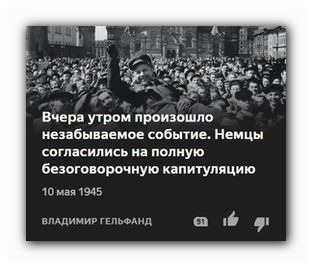
“Yesterday morning the unthinkable happened. The Germans agreed to complete, unconditional capitulation.” — 10 May 1945.
“However, it was not the production that carried me away, but a girl named Tosya.” — 10 April 1945.
“Over the last decades, life has known no figure of greater stature, no more powerful actor.” — near Küstrin, 13 April 1945.
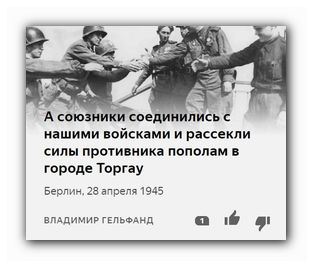
“And the Allies joined our troops and scattered forces hostile to us through the city of Torgau.” — Berlin, 28 April 1945.
“Captain Shestobitov introduced me: ‘Here he is, our most famous poet!’” — Bernau, 4 April 1945.
“Put German women on motorcycles!” The company split with penniless German women in the Soviet Union.
“All night long I did not close my eyes for a single second. Even though I did not sleep, I was full of energy!” — 16 April 1945.
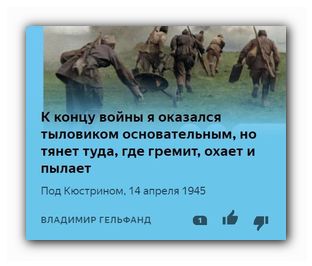
“By the end of the war I had become a rear-area founder, but I was drawn to where it thundered, roared, and blazed.” — near Küstrin, 14 April 1945.
“A whole settlement of large, beautiful buildings lay around the palace. It is difficult even to imagine how one could live here in such a...”
“I fell in love with the portrait of the Mother of God...” From the front-line diaries of Lieutenant Vladimir Gelfand.
“It was as good there as on a boulevard at home, a place for love and dreams.” — Germany, 9 April 1945.
“I became an impressive man. Only my cheeks were very hollow, and this spoiled the whole impression.” — Berlin, 7 May 1945.
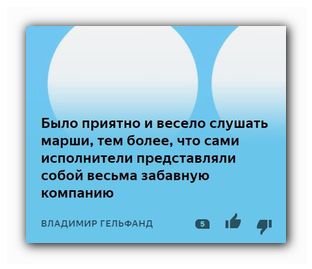
“It was pleasant and cheerful to listen to the march, especially since the performers themselves were a special, amusing company.”
“So this is what you are like now, Küstrin. I do not rejoice at your ruins, but with all my heart I welcome your fall.” — 12 April 1945.
“All day there was bustle in the area where we were quartered—the new settlers were looking for feather beds, beds, sheets, blankets...”
