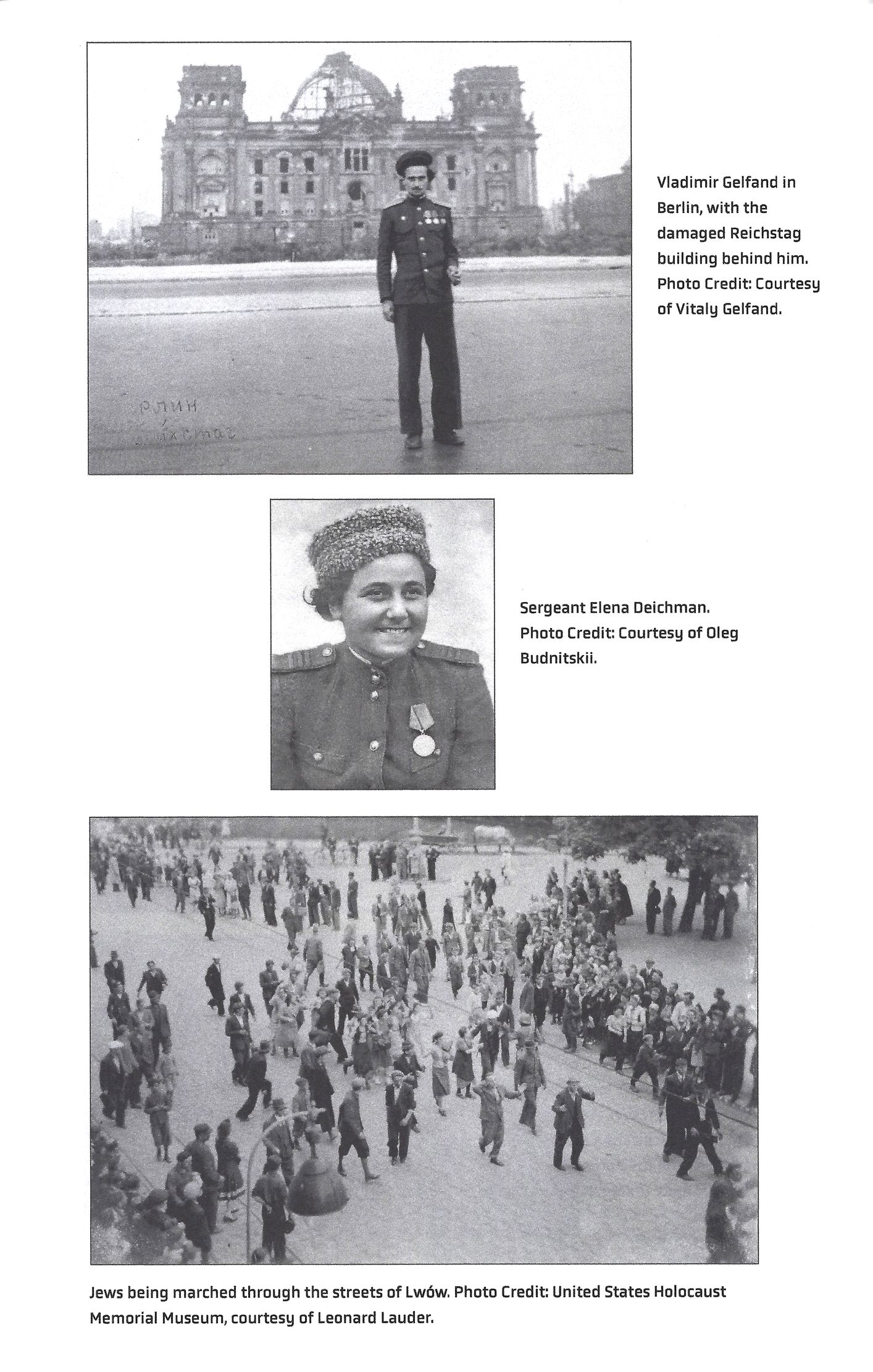
One
year younger than Gelfand, Private Yakov Forzun, a machine gunner,
suffered repeated severe wounds, spending more than a year in hospitals
between his August 1942 conscription and his medical discharge in early
1945.55
During his final six-month hospital stay, in Furmanov,
northeast of Moscow, he found himself mistaken for a Ukrainian and
heard the usual talk about Jews not fighting. His response, told to an
interviewer from the Commission of the USSR Academy of Sciences on the
History of the Great Patriotic War (the so-called Mints Commission)56
around the time of his discharge, resembled
Gelfand’s:
While
I was in the hospital, they told me that Jews were not visible at the
front, that the Jews were hiding. I didn’t raise any
objection to them,
because … if you tell them anything, they’ll kill
you in the first
battle. So for that reason I decided not to tell them anything. In that
respect it was very bad in the hospital. I spent a lot of time in
hospitals, and the conversation there was all the same: the Jews
don’t
want to fight. The patients conducted themselves badly. They
didn’t
know my nationality, and they began to say that the Jews did not want
to fight, only to hide in the rear. They talk[ed] and I remain[ed]
silent; I ma[d]e no response.
Forzun
was not a timid man; in combat he had distinguished himself for
bravery. Indeed, his exploits on the battlefield eventually spoke for
him in a manner available only to a few. At the time his final hospital
stay began, he had been nominated for the title of Hero of the Soviet
Union. Accordingly, he explained, “I kept waiting for news of
my award
to arrive; then they would see whether Jews wanted to fight or not.
After the order for my award was read out, everyone shut up. No one
said anything any more.” Absent the prestigious decoration,
however, he
appears to have been intimidated by “the many criminals who
had been
released from prison,” who had “ended up at the
front and later in the
hospital.”57
Forzun
and Gelfand reacted similarly to similar situations, but their
backgrounds were hardly similar at all. Gelfand, raised in
Dnepropetrovsk, was in all respects a typical “new”
Soviet Jew. Forzun,
by contrast, was the product of a shtetl (Korostyshev, near Zhitomir).
He described his upbringing as one of extreme poverty, exacerbated by
the great Ukrainian famine of 1932–1933, which, he told his
interviewer, had left him and his sister swollen from hunger. He had
studied only in Yiddish-language schools through the fourth grade,
first in his native town, later in Stalino, where his father had moved
in search of work. Although he eventually learned to read in Russian,
he reported having had few books to read. In short, the opportunities
for upward mobility that so many young Soviet Jews of his generation
enjoyed appear to have passed him by.58
Yet for all of the differences
between his early life and Gelfand’s, their respective
brushes with
prejudice did not move either man to a more assertive
self-identification as a Jew. Gelfand, better educated and with future
literary aspirations,59
expressed his aversion to such identification
in an unmistakable internationalist idiom: “Why do nations
exist at
all?”60
Fozun was less articulate; he accepted his lot as is, without
complaint. For him, the Red Army had offered a way out of a life that
he described simply as “bad.” After the war he went
to work as a plant
foreman in Zhitomir, joining the Communist Party in 1961.61
Other
Jewish soldiers, though, looked askance at such a reaction. Sergeant
Boris Komskii, an infantryman from Kiev, of the same age cohort as
Gelfand and Forzun,62
kept a diary while fighting in some of the war’s
bloodiest engagements, including the hellish Battle of Kursk in July
and August 1943, in which virtually all of his comrades were killed.63
In early January 1945, in the small Polish village of Nowe Malinowo,
just west of the September 1939 Boundary and Friendship Treaty line,64
he met a middle-aged former partisan who, recognizing Komskii as a
fellow Jew, confided that “terrible antisemitism”
(zhutkii
antisemitizm) among his comrades-in-arms had induced him to hide his
nationality. Komskii disapproved; the soldier’s effort, he
admonished
him, was useless:
His
name is Ilia Cherepakha, from Byelorussia. That’s where the
Germans
caught up with him. His entire family, 35 people, had perished. He
himself had been shot twice,65
but he had remained alive and had
crawled out from under the corpses at night. His wife was a Ukrainian.
She [then] married a Vlasovite.66
The two of them went around
pillaging; later they left for Germany. He himself had joined a
partisan platoon: “We drank their blood. I avenged my family
in full.…”
[He said that] there was a lot of antisemitism among the partisans as
well. A Jew who had held an officer’s rank wouldn’t
be appointed to a
[command] post. Only once the front got closer did the situation begin
to change. He related many facts about his life in the partisans as
well as about now, in the army, and I regretted telling him [that he was
concealing his identity] in vain.
What
moral right do I have to lecture and to judge the actions of a person
who has seen and experienced a thousand times more than I have? I
cannot justify people who deny their own nationality. But still,
“A
person is given life only once.…”67
And he had lost it twice.68
Komskii
had heard derogatory remarks about Jews earlier, including recently
from his direct superior.69
Nevertheless, this Communist Party member,
who as a schoolboy had written for a newspaper of the Party
children’s
organization, Pioneer, found “absolutely no reason”
to hide that he was
a Jew.70
After the war he remained in the army as a journalist,
publishing widely on military and patriotic themes. After retiring with
the rank of colonel, he became editor of a Russian-language Jewish
newspaper in post-Soviet Ukrainian Lviv.71
Until his death in 2011 he
bemoaned the demise of the USSR.72
Still other soldiers came through the war with feelings and
observations that made them even more difficult to place on a
Jewish-internationalist spectrum. In his diary entry for 19 November
1943, for example, twenty-one-year-old Sergeant Naum Rosenberg, a
combat engineer from Pavlograd, near Dnepropetrovsk, who had fought on
the southwestern, Don, and Stalingrad fronts,73
expressed concern over
“how far this hatred and contemptuous attitude toward the
Jews has
eaten its way” into Soviet society.74
Over the next six months, as he
proceeded westward with the advancing Soviet forces, he encountered
disdain many times. “There is a widespread opinion among the
people
(narod) that all Jews are afraid of death, afraid to fight, in a
word—cowards,” he wrote in early March 1944.75
Six weeks later, after
taking part in driving German forces from Krzemieniec, where he found
no Jews remaining out of the fifteen thousand who, he thought, had
lived there before the war, he was even more emphatic:
“Hatred and
scorn for the Jews flows in the blood of the Russian people.”76
He did
not report trying to conceal his own identity, but neither was he
proudly defiant. Instead, he sought an explanation that would help him
rebuff the prejudice he encountered and bear the insult he felt
acutely, yet allow him to go on not only fighting but believing in the
Soviet experiment:
The
mere fact that there are such [biased] opinions is painful. But it is
even more painful to admit to myself that to a certain degree they are
true. Deprived of a fatherland (otchizna) … , torn away from
their
maternal soil, not having to give their lives for their soil, for their
Motherland (Rodina), for more than two thousand years, the large
majority of Jews have ceased to be brave people. Having had to struggle
for its existence within other nations for two thousand years, having
withdrawn within itself, [having endured] the contempt and fear of
other peoples, dislike and hatred toward them— these are the
elements
(far from all) that have formed the characters [sic] of the Jewish
nation (natsiia). History shows that those Jews who found a homeland
for themselves or who made transforming the state their goal in
life—those Jews proved themselves worthy of their ancestors
at the time
of the destruction of Jerusalem Jerusalem and their dispersion across
the globe. This cannot be denied.77
Such
worthy Jews might not dispel prejudice, he averred: even though more
than a hundred of them had been named Heroes of the Soviet Union,
partisans had still refused to accept Jews into their ranks.
“Obviously,” he deduced, “they [the
partisans] were afraid of [the
Jews’] abilities.”78
Nevertheless, his understanding of Jewish history
guided him to a clear operative conclusion:
To
live simply and honestly and to fulfill my obligation to
Stalin—he is
my Motherland. I am a man of the world, but maybe I don’t
belong to
this world. I was accepted into the party as an equal; to my mind I too
belong to it and to no one else. It’s hard not to have a
motherland and
a people (space on earth and a tribe of one’s own), but for
me Russia
is a good place to find shelter, while the Jewish nation is not
entirely native. I was brought up in a semi-Jewish family, on Russian
soil; the party—the Central Committee—is my
Motherland and my people
(narod).79
After the war Rosenberg became a career officer in the Red Army,
retiring in 1974, aged fifty-two, with the rank of colonel.80