


Unveröffentlichte
Kritik "Aufzeichnungen eines Rotarmisten vom Umgang mit den Deutschen"

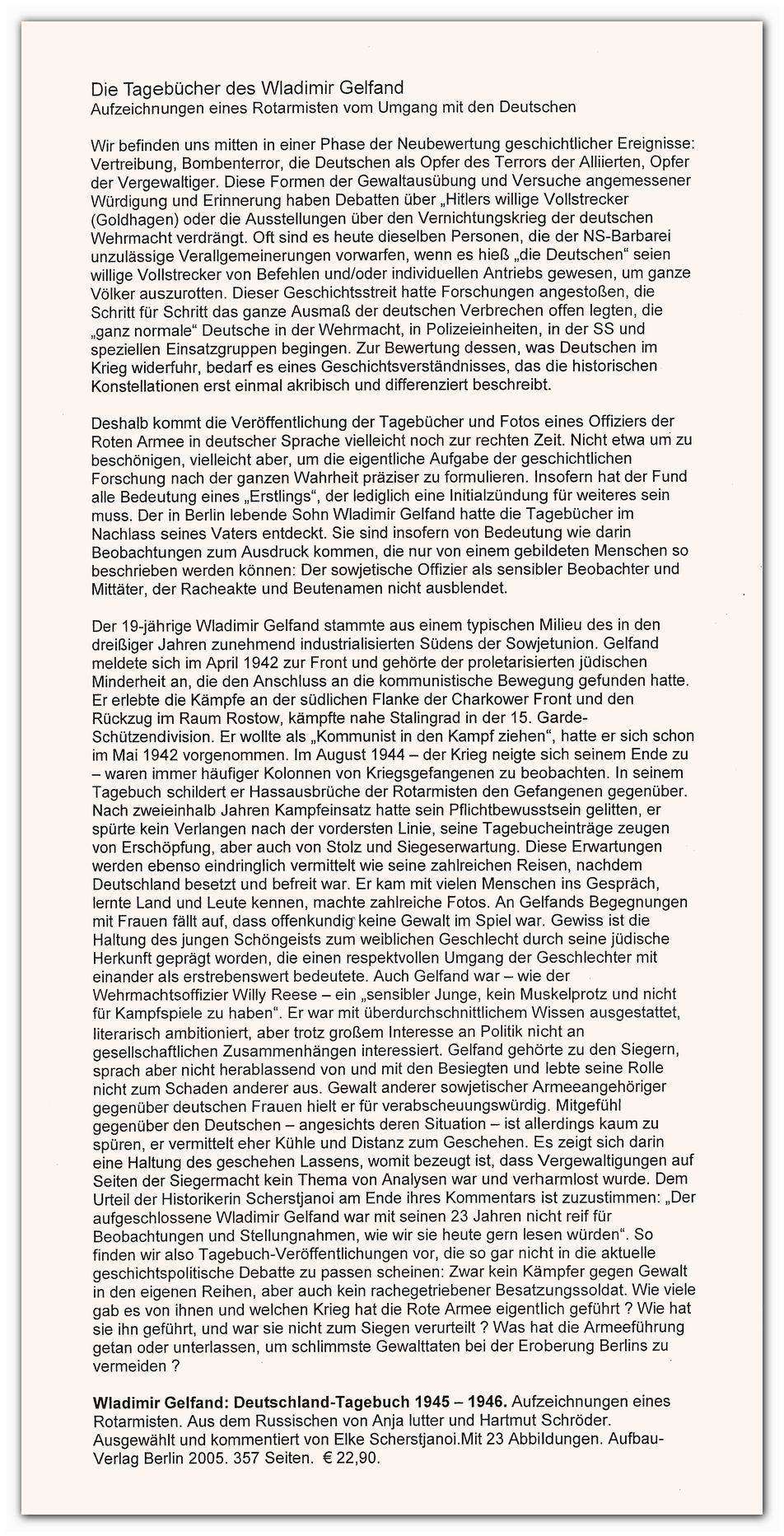 |
© Unveröffentlichte Kritik

Vladimir Gelfand's Diaries - A Red Army Soldier's Notes on Dealings with Germans
We are living through a period in which historical events are being reassessed: expulsion, bombing, Germans as victims of Allied terror and victims of violence. Attempts to judge these experiences fairly followed earlier controversies over Goldhagen's discussion of "Hitler's willing executioners" and the exhibition on the Wehrmacht's war of annihilation.
People who condemned Nazi barbarism have often resisted sweeping generalizations when Germans as a whole were described as willing executioners or as participants in the destruction of entire peoples. The historical disputes prompted research that gradually exposed the scale of German crimes. Ordinary soldiers of the Wehrmacht, police units, SS formations and special task forces also participated in mass crimes. If we want to assess objectively what happened to Germans themselves during the war, history must be studied carefully, in differentiated form and in its full dimensions.
Against this background, the publication in German of the diaries and photographs of a Red Army officer is especially important. The purpose is neither to conceal nor to distort, but to help historical research approach the truth. In that sense Gelfand's diary is an important first step that should encourage further investigation.
Vladimir Gelfand's son Vitaly, now living in Berlin, found the diaries among his father's papers. These are the notes not merely of a participant but of an educated observer capable of expressing himself in writing. We encounter a Red Army officer who is not blinded by a desire for revenge but repeatedly tries to understand and interpret what is happening around him.
Born in 1923 in the increasingly industrialized Ukraine, Gelfand came from the proletarian Jewish minority closely connected with the communist movement. In April 1942 he volunteered for the front. He experienced fighting on the southern sector of the Kharkiv front, the retreat near Rostov and the Battle of Stalingrad with the 15th Guards Rifle Division. Already in May 1942 he had resolved: "I want to go into battle as a communist."
By August 1944, when the outcome of the war was already becoming clear, he increasingly saw columns of German prisoners. His diary records eruptions of hatred toward the prisoners among Soviet servicemen. After two and a half years of war his sense of duty was becoming blunted by exhaustion, yet he also felt pride and growing anticipation of victory.
Gelfand's diaries describe his many journeys through Germany during the first months of occupation. He meets numerous people, studies the country and its inhabitants and takes many photographs. It is notable that violence is absent from his own encounters with women. One may speculate that his upbringing in a Jewish environment contributed to a more respectful attitude between the sexes. Like Wehrmacht soldier Willy Reese, another diarist described as a sensitive young man rather than a man of action, Gelfand was not someone eager for combat.
Gelfand was educated and literarily ambitious, although despite his political commitment he showed limited interest in wider social contexts. He belonged to the victors, but did not exploit his position as an occupier to harm others. He was repelled by violence committed by Soviet soldiers against German women.
At the same time his sympathy for Germans is restrained. He often maintains distance and a certain coldness toward their difficulties. This may reflect the fact that among some of his comrades rape and violence against civilians were not treated as subjects requiring deep analysis, but rather as consequences of war.
Historian Elke Scherstjanoi stresses in her afterword that the twenty-three-year-old Gelfand had not yet developed the detached perspective from which to make the observations and draw the conclusions modern readers might wish to find. That raises the broader question of how much a private diary can be expected to answer the questions of later historical debate.
Gelfand was not an activist fighting violence within his own ranks, but neither was he driven by revenge. The larger questions therefore remain open: how many soldiers were like him? What kind of war did the Red Army actually wage? How did it manage to win? And what did its commanders do - or fail to do - to prevent the worst acts of violence during the assault on Berlin?
Vladimir Gelfand: Germany Diary 1945-1946. Notes of a Red Army Soldier.
Translated from Russian by Anja Lutter and Hartmut Schroeder. Selected and annotated by Elke Scherstjanoi.
With 23 photographs. Aufbau-Verlag, Berlin 2005. 357 pages. EUR 22.90.