

|
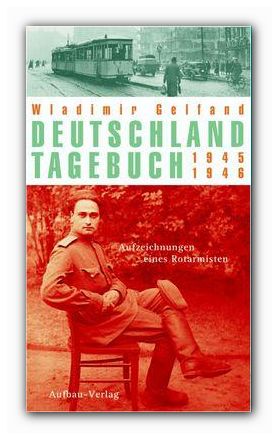
Ein erstaunliches Tagebuch
geführt von Januar 1945 bis September 1946 berichtet von den
Erlebnissen des jungen Leutnants der Roten Armee Wladimir Gelfand
im befreiten Berlin. |
||||||
|

 German
Kept from January 1945 to September 1946, it recounts the experiences of the young Red Army lieutenant Wladimir Gelfand in liberated Berlin.
“I spit on Germany,” the 22-year-old Red Army lieutenant Wladimir Gelfand scratches into the ruins of the Berlin Reichstag in August 1945. He had survived a war in which millions of his comrades-in-arms had fallen. Now, however, he belonged to the victors. Lieutenant Gelfand was young, hungry for life, and a self-confident occupier. He gets himself a bicycle and learns to ride it. He looks at the bleak shells of Berlin’s buildings, goes to the black market and buys a camera. He has plenty of German girlfriends, trades bread and fat for tenderness, and looks for love. And he keeps a diary. In it he also describes the brutalized relations among the soldiers, drinking bouts, rapes, and the starving German civilian population.
An unusual discovery
After Gelfand’s death, his son found this remarkable diary, covering January 1945 to September 1946, among his papers. These records by a Red Army soldier are remarkable for another reason as well: for military reasons, keeping a diary was forbidden in the Red Army. Wladimir Gelfand’s Germany Diary shows the year 1945 beyond the perspective of generals’ memoirs and beyond the continuing fixation on the apocalyptic mood of the Führerbunker. It presents, very directly, a Red Army soldier’s view of the defeated Germans. (Germany Diary 1945–1946 is published by Aufbau Verlag.)