



 German
Antje Weger
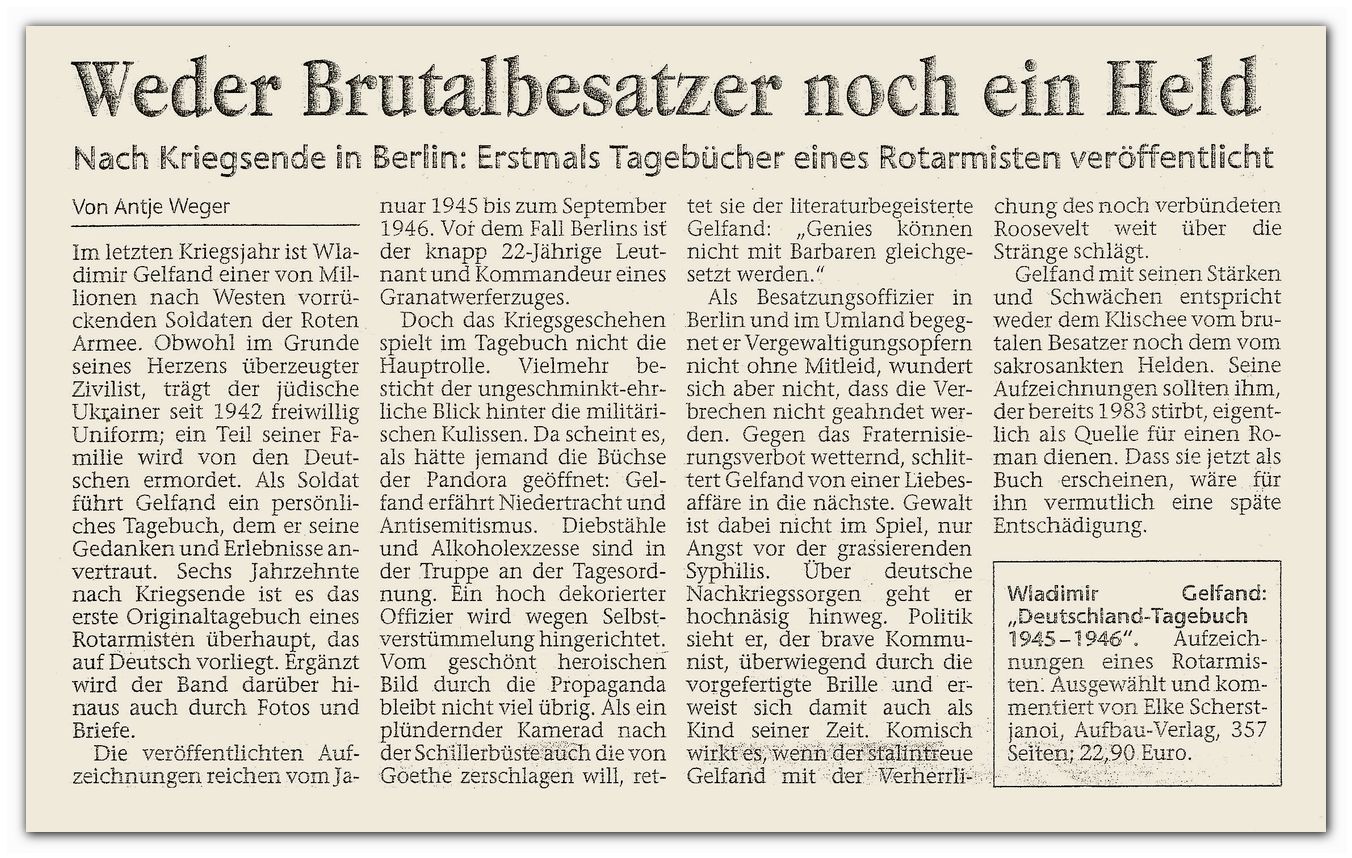
In the final year of the war Vladimir Gelfand is one of millions of Red Army soldiers moving westward. At heart he remains a civilian, but as a Jewish Ukrainian he has voluntarily worn military uniform since 1942. Part of his family has been killed by the Germans. As a soldier Gelfand keeps a private diary, committing his thoughts and experiences to paper. Six decades after the end of the war, his notes became the first original diary of a Red Army soldier published in German. The book is supplemented with photographs and letters, making the record still more valuable.
The entries cover January 1945 to September 1946. As Berlin's fall approaches, Gelfand is an almost twenty-two-year-old lieutenant commanding a mortar platoon. Yet the central subject of his diary is not combat but army life shown without embellishment. It is as though someone has opened Pandora's box: Gelfand encounters baseness, antisemitism, endless drinking and looting that have become normal among his comrades. Official propaganda presented the Red Army in heroic terms, but almost nothing of that idealized picture remains in these notes. When one comrade, seized by a looter's frenzy, wants to smash a bust of Goethe, Gelfand stops him, declaring: "Geniuses cannot be equated with barbarians."
After the war he remains in Germany as an occupation officer in Berlin and the surrounding area. Gelfand sympathizes with victims of violence but is not surprised that perpetrators remain unpunished. His behavior is contradictory: he protests against the ban on contact with German civilians while at the same time looking down on Germans. He readily begins love affairs but does not use violence as many of his comrades do. He is more concerned about the risk of syphilis than about moral questions.
Gelfand is a convinced communist, yet his views sometimes reach beyond official ideology. He genuinely admires Roosevelt, an attitude surprising in someone raised under Stalinist propaganda. This shows clearly that he is not only a product of his time but also a person capable of independent thought.
Ultimately Gelfand fits neither the stereotype of the brutal occupier nor the image of the faultless hero. His diary offers an honest and immediate view of wartime and postwar life through the eyes of a young man who found himself in the center of historic events without simply becoming part of them. The notes that were meant to provide material for a future novel remained diary entries. Years after his death in 1983 they gained a second life as a book—perhaps a form of belated compensation for him.