

 |
|||
| Dieser Eintrag stammt von Renate Seifert (*1938) aus Lübeck Ren5313.Seiwag@t-online.de Wiesbaden, August 2008 |
|||
 Kapitulation Erinnerungen
|
|||
| |
|||
Bildnachweise: Renate Seifert; Vitaly Gelfand (Fotografien, Privatbesitz)
Zur Person:
Renate Seifert wird 1938 in Königsberg in Ostpreußen geboren. Nach der Flucht nach Schleswig-Holstein 1945 besucht sie die Volksschule in Lunden, ehe sie nach Tuttlingen umsiedelt. Dort absolviert sie 1955 die mittlere Reife und macht eine Lehre bei der Sparkasse. 1962 legt sie die Kaufmannsgehilfenprüfung ab und heiratet im selben Jahr. 1963 und 1965 kommen ihre Kinder auf die Welt, 1967 lässt sie sich scheiden und arbeitet ab 1968 als Bankangestellte. 1973 wechselt sie zu einer anderen Bank nach Lahr (Schwarzwald) und wird dort 1979 Abteilungsleiterin. Von 1990 bis 1993 wird sie in die neuen Bundesländer in Gera (Thüringen) abgeordnet, bleibt aber weiterhin in Lahr im Schwarzwald wohnhaft, ehe sie nach Konstanz an den Bodensee zieht. 1998 geht sie mit 60 Jahren in Pension und beginnt ein Studium an der Fernuni. Im selben Jahr absolviert sie das Fachabitur im Bankfach. 2001 beginnt sie ein Studium der Soziologie, Literatur und Psychologie an der Fernuni Hagen und an der Universität Konstanz. 2006 zieht sie nach Lübeck, 2008 legt sie die Magister-Zwischenprüfung ab. 2009 folgt ein Umzug nach Wiesbaden. Renate Seifert widmet sich dem Schreiben und erforscht das Schicksal ihrer Cousine Dora.
 |
 |
 |
 German
MEMORIES OF MY COUSIN DORA FROM KÖNIGSBERG
My entire family comes from East Prussia. My mother’s parents last lived in Markthausen, formerly Popelken in the Labiau district, which in 1938, like so many other places in East Prussia, was renamed at the instigation of the Hitler government. My father’s parents lived in Königsberg in Prussia, on Haberberg.
My father had two married sisters. One had two daughters; the other had one daughter, Dora, my cousin, who was eleven years older than I was.
After our flight from Königsberg in 1945, I heard nothing about Dora for a long time.
I now remember again the visit my mother and I made in 1957 to the family of my father’s sister in Rangsdorf near Berlin. All the family members had survived the war: Uncle Karl, Aunt Liese, and their two daughters. Only Dora had not found her parents; they were missing as a result of the war. Aunt Lotte, my father’s other sister, and Uncle Paul had agreed with Dora in Königsberg that, if they lost one another in the turmoil of war, they would all try to make their way to the aunts in Berlin. Only Dora had managed to do so, and she had found her aunts.
We expected Dora in the garden that afternoon for coffee so that she could see us, my mother and me. Aunt Liese told my mother in a whisper—because, at nineteen, I was apparently not supposed to hear—that Dora had been raped by the Russians and that one of the aunts had been raped as well. My mother asked whether this was certain. Aunt Liese shrugged. “And how is Dora now?” “She wanted to take her own life,” and, “She doesn’t talk about it.” “And the aunt?” “There isn’t much one can do with her anymore; she spends most of her time in bed.” My mother’s distress was palpable.
Then Dora arrived. We saw each other for the first time since the war. We talked about all sorts of things, but not about what was supposed to have happened to her in Berlin.
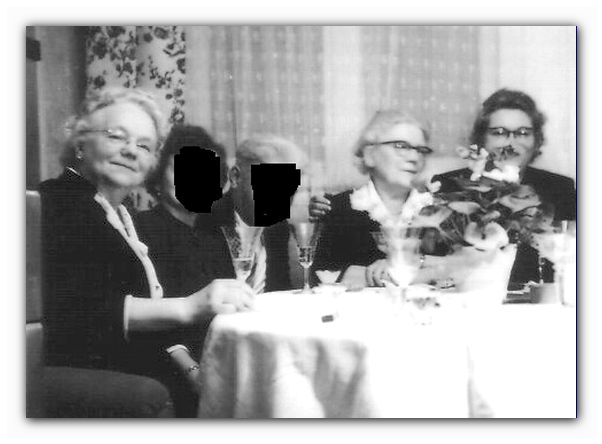
Dora with two aunts, 1959 Photograph Private collection © Renate Seifert, Lübeck © Stiftung Haus der Geschichte der Bundesrepublik Deutschland
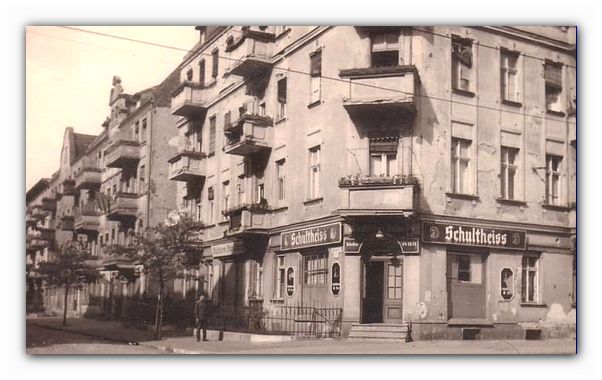
For her sixtieth birthday in 1987, Dora invited me to East Berlin. We passed a building—it must have been on Schönhauser Allee—and she remembered that the “Fröhlicher Zecher” restaurant had once been there and that she had lived in an attic room under the roof. She also told me that she had owned a red coat. I wondered why that fact seemed so important to her that she would tell me about it after so many years. There seemed to be a note of melancholy when she spoke about it. Unfortunately, the building looked barely inhabited. The signs were gone, the shutter over the restaurant door was closed, and it was as gray as almost everything in the GDR in those days.
© Stiftung Haus der Geschichte der Bundesrepublik Deutschland
Dora and I had not seen each other since the 1957 visit in Rangsdorf until she invited me to her sixtieth birthday. We both had demanding jobs that took up much of our time, so we did not even write letters to one another. It is also possible that Dora was forbidden to maintain contacts with people in the West. My mother and I had more contact with my other cousin because she lived alone and was more likely to write of her own accord. Later, however, Dora and I spoke on the telephone more often.
Dora died in 1995. When I tried to call her that day, as I did every Sunday, she no longer answered the telephone.
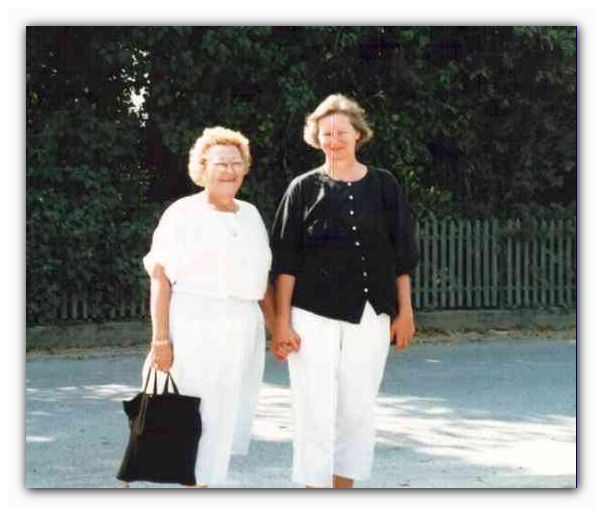
Renate Seifert with Dora at Lake Constance, 1987 Photograph Private collection © Renate Seifert, Lübeck © Stiftung Haus der Geschichte der Bundesrepublik Deutschland
Yet ten years after her death I encountered her again in two books.
Quite by chance, late one evening, I happened to switch to a television literary program. Hans Magnus Enzensberger appeared on screen in an interview. He said that under no circumstances would he reveal the name of “Anonyma,” and that he was disappointed by the way the publisher and the media were treating his “Other Library.” My curiosity about this Anonyma was awakened. Unfortunately, as so often happens, I did not pursue the subject because other things seemed more important. But the program with Enzensberger remained stored in my memory.
Months later, in April 2005, I saw a paperback among the new releases in a bookshop: Anonyma. A Woman in Berlin. Diary Notes from 20 April to 22 June 1945—the period when the Russians fought the final battle for Berlin in the Second World War and entered the city.
Interested, I bought it, began reading out of curiosity, and could not stop.
On the first pages Anonyma describes the people around her, among them my cousin. It simply could not be anyone else. The circumstances described fit Dora so precisely that they could hardly fit anyone better. I read and read; my breath catches and I get goosebumps. On Friday, 20 April 1945, at 4 p.m., “Anonyma” writes about the “cellar people”: three elderly sisters who were seamstresses and a refugee girl from Königsberg in East Prussia.
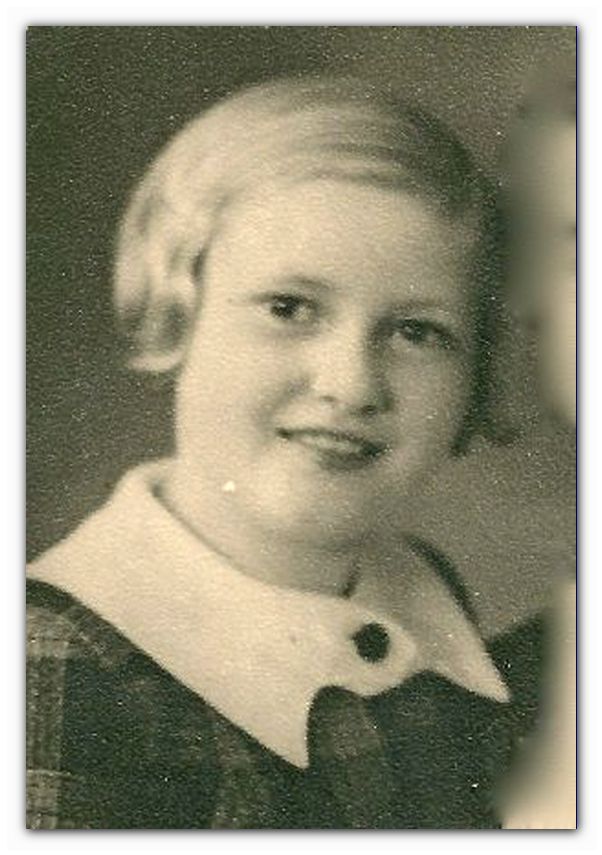
Dora as a child © Stiftung Haus der Geschichte der Bundesrepublik Deutschland
The refugee girl from Königsberg could be Dora, my cousin—the thought shot through my mind. She was nineteen at the time. The three elderly sisters would be her aunts. At that moment “Anonyma” probably could not have known that the seamstresses were the refugee girl’s actual aunts. I cannot imagine Dora without her aunts. They had moved from Königsberg to Berlin before the war because they expected to find a larger clientele there for their dressmaking business. Dora had made her way to them during her flight from East Prussia.
In later sections of the book I found my suspicion confirmed. The rape of the “refugee girl from Königsberg,” mentioned during our family visit to Rangsdorf in 1957, is described for 27 April 1945, as is the rape of the aunt on 4 May 1945.
Why did “Anonyma” write about “aunts” in her notes? Had she heard my cousin call the seamstresses “Aunt Lena,” “Aunt Trude,” or “Aunt Else”?
“Anonyma” refers to the other people in her notes by name or status; only the seamstresses are called “aunts”—strange. I cannot imagine that there were many sets of seamstresses in Berlin consisting of three unmarried sisters who lived together and ran a dressmaking business together. So, I believe, they must have been Dora’s aunts.
After reading “Anonyma’s” diary notes, I naturally wanted to know for certain whether the woman described really was my cousin. I began to investigate.
First I tried to determine the names of her aunts. I remembered only Aunt Trude and Aunt Lena; after so many years I had forgotten the third one’s name—it may have been Else. She died relatively soon after the rape, and after that her name was no longer mentioned. Certainly not during the years when contact with Dora was broken off while she lived in the GDR, because after our flight from Königsberg my mother and I ended up in West Germany, in Württemberg.
Even after German reunification, Dora remained silent about what she had experienced. Of the people described here, Dora’s raped Aunt Else died first, though only after our 1957 visit to Berlin—possibly toward the end of the 1950s, because a photograph from 1959 shows Dora with only two aunts. The other two lived well into the 1970s. Dora died in 1995, and “Anonyma” died in 2001. Jens Bisky revealed her identity in his article “When Boys Play at World History, Girls Have Silent Roles,” published in the Süddeutsche Zeitung on 24 September 2003.
By now I have at least found the dates of birth and death of two of the aunts and some of their Berlin addresses—possibly even the address where the events took place.
Since Christmas 2005 I had had the newly published book by Vladimir Gelfand, Germany Diary 1945-1946: Notes of a Red Army Soldier, lying around at home. I bought it along with several other books about the Second World War and about Königsberg. The book by a Russian soldier interested me because I wanted to read a counterpart to “Anonyma’s” diary and to learn about that period from a Russian point of view. I read it in mid-April 2006.
Now that I am retired, I finally have time to deal with my past, and I read one book after another about my hometown of Königsberg, about the war, about the fates of people from the East, and about children of the war.
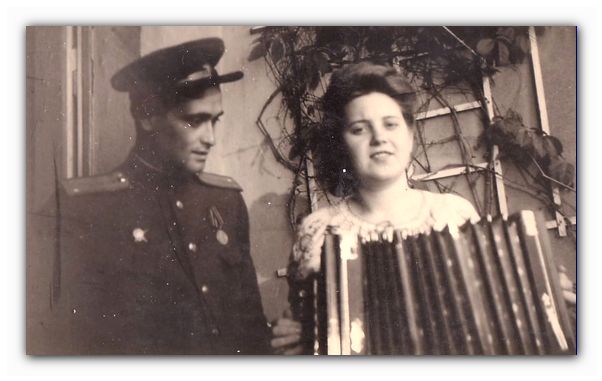
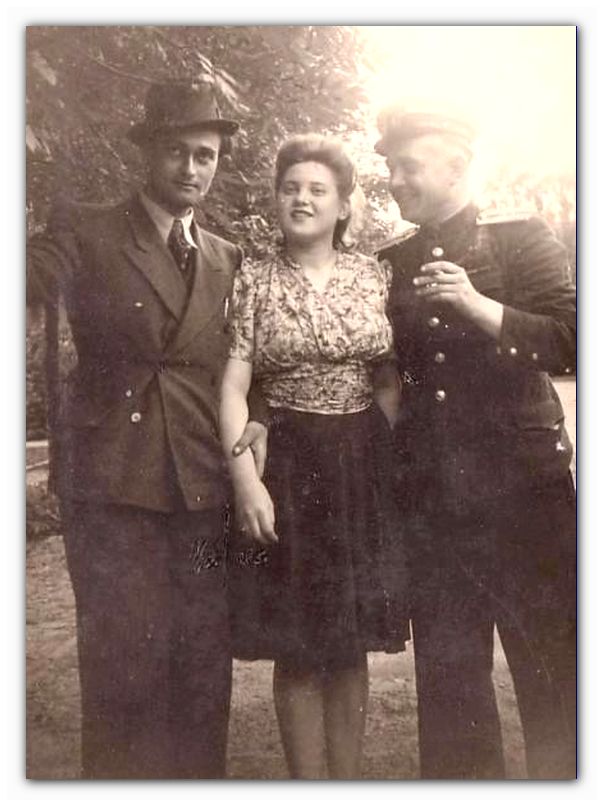
As always, I first look at the pages with photographs, then at the foreword or afterword and the bibliography, so that I can get an idea of the book’s contents and understand it better. Among the facsimile photographs in the middle of Gelfand’s book, under the heading “Invitation to a Rendezvous,” a letter to Lieutenant Gerhard is reproduced. On the second page the word “Wiedersehen” catches my eye. It looks as though my cousin Dora had written it. I am electrified.
It cannot be that after her death my cousin is now meeting me again in yet another book. I scarcely knew her before the last years of her life and hardly got to know her even during the final eight years before her death. It seems almost as if she wanted me, posthumously, to concern myself with her.
© Stiftung Haus der Geschichte der Bundesrepublik Deutschland
On 28 March 1946 at Nauen railway station, Gelfand writes about a German woman named Nora who had recently turned twenty-one and lived on Schönhauser Allee in Berlin. Everything would have happened as it had to happen, Gelfand writes, had an intimate detail not unexpectedly appeared: at the last moment, suddenly there was a bad smell. It repelled him, and all his excitement disappeared.
My cousin Dora told me this story. She did not want to become intimate with the soldier so quickly and defended herself in this way. She said that a respectable girl does not give herself to a man so quickly. Would I ever have thought of such an idea?
Later I wanted to ask her for more details, but then I forgot about it. In this connection she also told me about the letter she wrote to the soldier afterward and recited the poem in it. She liked him, and later regretted the way she had behaved. She had signed the letter “Helga” and had also made herself a little older, because she was only nineteen at the time and in those days legal adulthood did not begin until twenty-one. When Dora told me about it, I thought—not imagining that I would ever see the letter and recognize her handwriting—that because of the false name and false age the letter could never be attributed to her.
On her side, a love relationship then developed with Vladimir Gelfand, which he seems to have regarded more as a relationship of convenience, as I now know after reading his notes. When she spoke of its end, Dora told me regretfully that he had had to return to Russia. She told me this in 1987 or in the early 1990s, more than forty years later. Vladimir Gelfand must have been a great love of hers if she was still telling me the story after so many years.
Elke Scherstjanoi, who selected the texts for the edition of Gelfand’s diary and provided the commentary, kindly arranged a meeting between Vladimir Gelfand’s son and me. He made a copy for me of my cousin’s letter. On his computer he opened the Russian text, and I saw the name “Dora” written there in Russian. Because I had just begun learning a little Russian at the time, I immediately recognized Dora’s name from the Cyrillic letters. As I had already concluded, Dora was probably not to Vladimir Gelfand what she certainly wished she had been. This also explains why there was no photograph of my cousin in the photo albums his son showed me.
It is the fate of refugee children to search for their ancestors and discover that far too many of the people involved have already died and that, while they were still alive, we asked far too few questions. Only now, when I am old, do I realize how much I would like to know more about my parents, grandparents, and relatives, and how extremely difficult it is to verify memories. Unfortunately, out of consideration for the person I was speaking to, I asked far too little. I often did not want to intrude too deeply into another person’s emotional life, because people did not speak about the horrors of flight and what came afterward. Now I have to accept that much information simply can no longer be obtained.
© Stiftung Haus der Geschichte der Bundesrepublik Deutschland
The church registers from the former eastern territories relating to my relatives can no longer be found. The search for the past of Dora, my cousin, is almost hopeless, especially because she lived in the former GDR while I grew up in the Federal Republic. She was probably also forbidden to correspond with relatives in the West. When I contacted the Federal Archives in Berlin in writing at the beginning of 2005 to request access to her GDR file, there was no file, and my first letter of inquiry had disappeared even though an employee had confirmed that it had been received.
Dora and I look alike. We both have blond hair and dark eyes. She was very small; I am tall. Her mother and my father were siblings. I inherited the build of our grandmother, my father’s mother, who was tall and thin. Our grandfather seemed rather small. Dora’s mother, my Aunt Lotte, was also rather small and passed this build on to her daughter.
In 1943, when she was sixteen, Dora had to perform labor service in Königsberg. In that role she was supposed to help a family with several children, and at Christmas 1944 she brought me her toy shop. I was six years old then and she was seventeen. During that visit I consciously noticed my cousin Dora for the first time. She spoke to me. I liked her immediately. Her warmth and kindness won me over at once, and I liked the way she looked.
I was sad to see her leave again so quickly because she had to say goodbye. The toy shop was beautiful, made of wood and painted lime green, with little drawers, scales, and a cash register. Unfortunately, I did not get to enjoy this wonderful gift for long. In January 1945 we had to flee Königsberg ahead of the Russians and leave everything at home.
Events moved rapidly in the winter of 1944/45. Dora had no opportunity to leave the family for whom she was doing labor service and return to her parents in Königsberg. For a time she stayed with the labor-service family and probably fled East Prussia with them, but later she continued on her own.
During the flight, when Dora was squeezed together with many other people in a railway cattle car, her finger was caught as the wagon door was hurriedly pushed shut. The tip of her finger was injured, and she had to endure the wound and the pain as well. The fingertip was missing and the nail was mutilated—an enduring reminder of her flight from East Prussia.
At seventeen, left entirely to her own devices, she must have developed more than one survival strategy during that period. This girl, who a little more than a year earlier, at eighteen, had been raped by Russians and had wanted to take her own life, fell in love with a Russian. Unfortunately, I can no longer ask Dora about it. She has remained a mystery to me.
Dora’s story will not let me go. As someone obsessed with the truth, I absolutely want to know whether the woman in “Anonyma’s” book really is my cousin. In the case of Gelfand I am absolutely certain. A graphologist could surely confirm the match between the handwriting in the reproduced letter and her final letters to me.
Photo credits: Renate Seifert; Vitaly Gelfand (photographs, private collection)
ABOUT THE AUTHOR Renate Seifert was born in Königsberg, East Prussia, in 1938. After fleeing to Schleswig-Holstein in 1945, she attended primary school in Lunden before moving to Tuttlingen. There she completed intermediate secondary school in 1955 and trained at a savings bank. In 1962 she passed the commercial assistant examination and married in the same year. Her children were born in 1963 and 1965. She divorced in 1967 and worked as a bank employee from 1968. In 1973 she moved to another bank in Lahr in the Black Forest, where she became a department head in 1979. From 1990 to 1993 she was seconded to Gera in the new federal states of Thuringia, while continuing to live in Lahr in the Black Forest, before moving to Konstanz on Lake Constance. In 1998 she retired at the age of sixty and began distance studies. In the same year she completed the advanced technical college entrance qualification in banking. In 2001 she began studying sociology, literature, and psychology at the FernUniversität Hagen and the University of Konstanz. In 2006 she moved to Lübeck; in 2008 she passed the intermediate examination for her master’s degree. In 2009 she moved to Wiesbaden. Renate Seifert devotes herself to writing and to researching the fate of her cousin Dora.
This entry was written by Renate Seifert (*1938) in Wiesbaden in August 2008.
© Stiftung Haus der Geschichte der Bundesrepublik Deutschland