



 |
 |
 |
 German
Occupier, Aesthete, Nuisance, Lover
The Jewish Red Army soldier Vladimir Gelfand conquers Germany—and its women
Anke Westphal
Drinking bouts and feasts, looting and rape, but also long marches, the cramped routine of camp life, and shopping expeditions in search of trophies: this is one way to summarize what the heroic and celebrated Soviet soldiers were doing at the end of the Second World War and in its aftermath. In his diary, Lieutenant Vladimir Gelfand paints an unflattering portrait of his comrades-in-arms, describing them as uneducated and coarse, corrupt and thieving, hostile, and at times dangerously fond of alcohol.
At the end of April 1945, Gelfand enters Berlin with the Red Army. The twenty-two-year-old officer keeps a diary in which he records his impressions of the fighting on the way to the German capital and his experiences during his first year of service with the occupation forces. Yet it is not only the voice of a victor that speaks from these pages. As a Ukrainian Jew, he encounters open antisemitism within the army. He writes about racism among Soviet soldiers, even though such testimony was unwelcome at the time; his notes were at one point even confiscated.
Because of his background, he is long overlooked for decorations despite his participation in frontline fighting. More than once he records threats directed at him: “We’ll kill you at the next convenient opportunity.” In his “Notes of a Red Army Soldier,” Stalin’s army appears as a chaotic force in which brutality is directed not only against the enemy but also inward, against its own men.
This is the first personal diary of a Red Army officer to be published in German. Historian Elke Scherstjanoi selected material from Gelfand’s extensive archive, carefully annotated it, and prepared it for readers. The contents of his diary contrast sharply with the ritualized glorification of the Soviet Army that was once common in East Germany.
Following the publication of “A Woman in Berlin,” which described in detail the mass rape of women and girls by Soviet soldiers, Gelfand’s own notes also address this subject—and he finds little support among his comrades when he condemns the violence. The brutality of the victors fills him not only with disgust but also with the feeling that they are unworthy of their role.
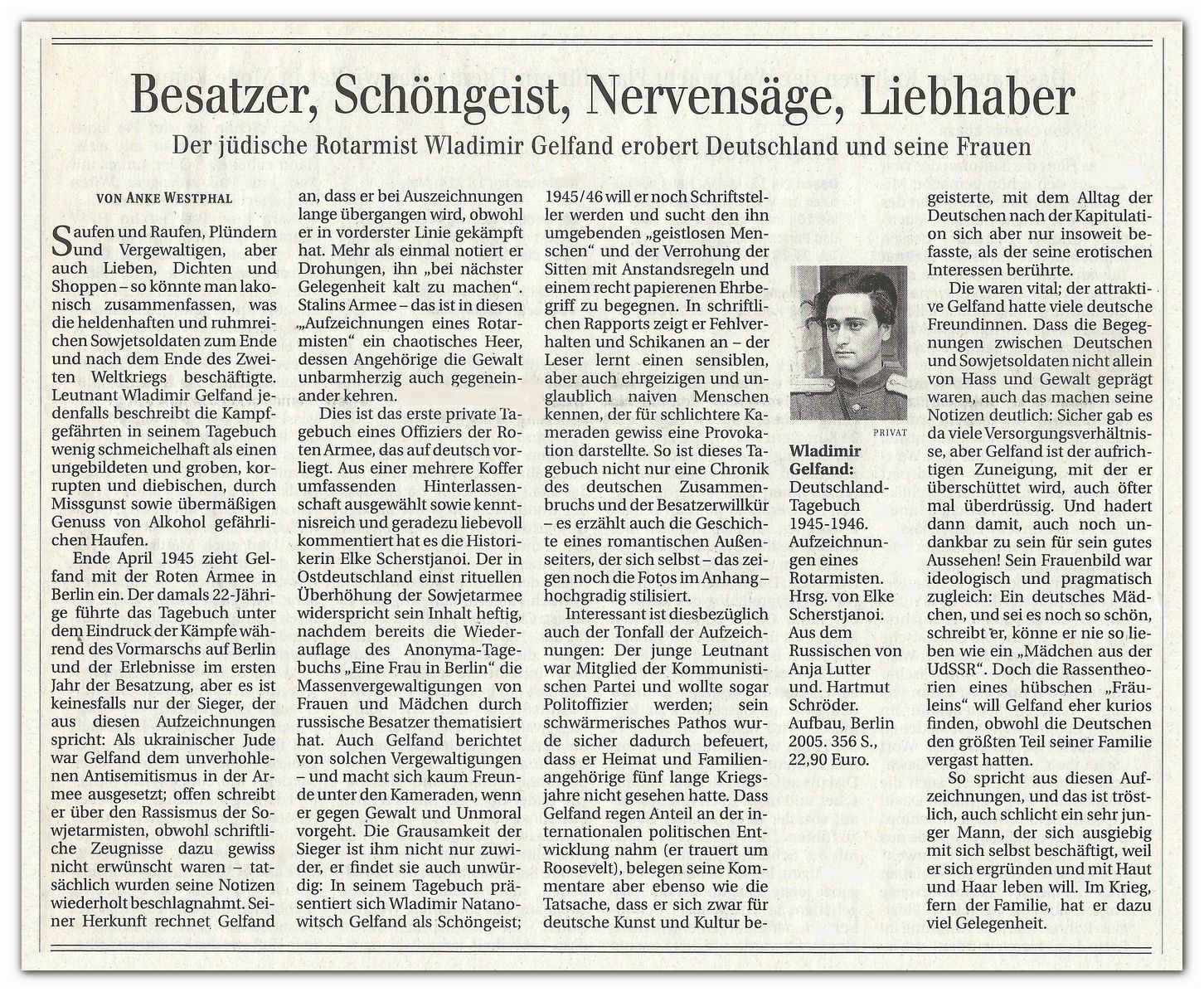
In the diary, Gelfand presents himself as a cultivated and educated man. In 1945–1946 he dreams of becoming a writer and resists the coarseness around him by clinging to good manners and ideals of honor, even if those ideals sometimes remain rather bookish and naive. His notes preserve not only a chronicle of the collapse of Nazi Germany and the arbitrary behavior of the occupiers, but also the story of a romantic outsider who—as the surviving photographs show—tries consciously to fashion a particular image of himself.
The tone of the diary is also striking. The young lieutenant was a member of the Communist Party and dreamed of becoming a political officer; his enthusiastic pathos can partly be explained by the fact that he had not seen his homeland or his family for five long years of war. He follows international politics closely and mourns Roosevelt’s death, yet his interest in German art and culture often emerges most strongly when it intersects with his private life—for example, with romantic relationships.
And those relationships were numerous. The attractive Gelfand had many German girlfriends. His notes show that relations between Soviet soldiers and Germans were not reducible to hatred and violence alone. To be sure, calculation was often involved—women sought protection and food—but Gelfand candidly admits that his affairs sometimes exhausted even him. He also complains, somewhat wounded, that despite his appearance he received too little gratitude.
His ideas about women were both ideological and pragmatic. He is firmly convinced that he could never love a German woman as he could a woman from the Soviet Union, however beautiful she might be. At the same time, he is astonished by racial ideas expressed by German women, knowing that much of his own family had been murdered by the Nazis.
What speaks through these notes above all—and this is perhaps the most reassuring aspect—is the voice of a very young man who wants to explore himself, live fully, and understand the world around him. War and separation from his family, paradoxically, give him every opportunity to do so.