



Wladimir Gelfand ist ein schwärmerischer
Schöngeist und als Jude Offizier der Roten Armee - keine
einfache Kombination.
Im April 1945 marschiert der 21-Jährige
als Sieger in Berlin ein. Sein Tagebuch erzählt, wie er den
Krieg erlebte - und die Stille danach.
 |
|
 |
|
 |
|
 German
Vladimir Gelfand is an enthusiastic aesthete and, as a Jew serving as an officer in the Red Army, a complicated combination. In April 1945 the twenty-one-year-old enters Berlin as a victor. His diary tells how he experienced the war—and the silence that followed.
Christian Eger
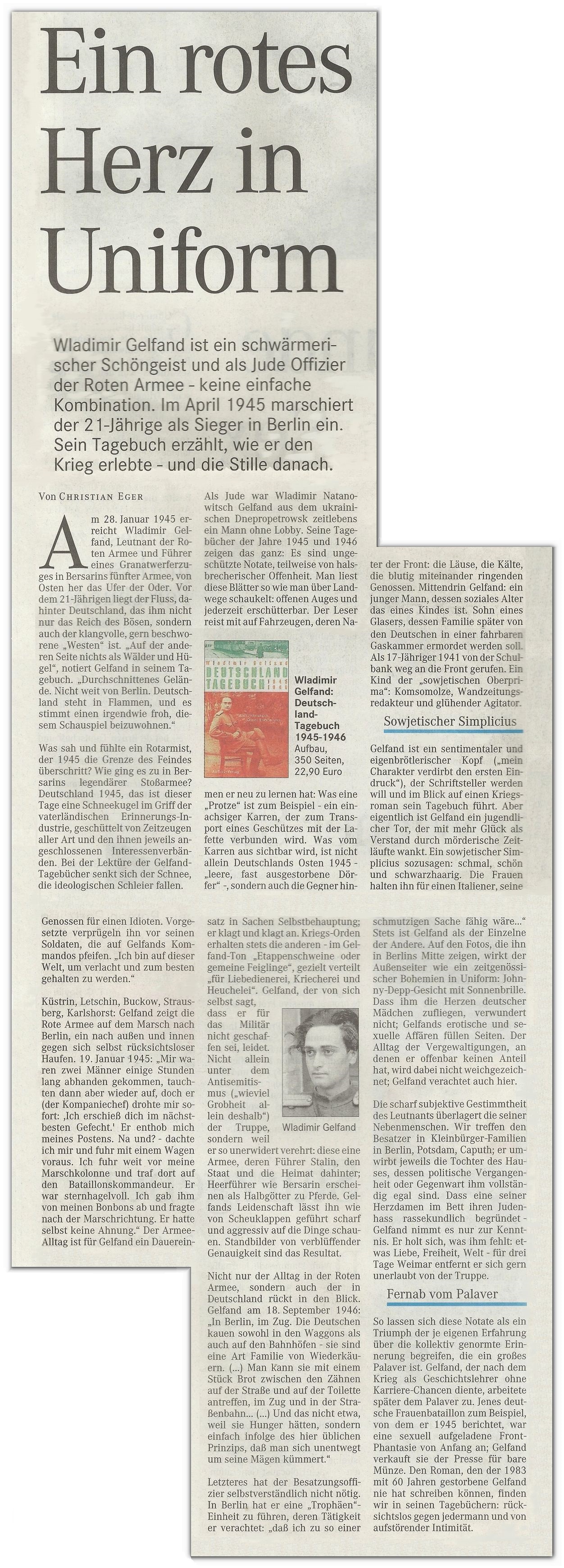
On 28 January 1945, Red Army Lieutenant Vladimir Gelfand, commander of a mortar platoon in Berzarin’s 5th Shock Army, reaches the eastern bank of the Oder. In front of the twenty-one-year-old officer lies the river; beyond it lies Germany, perceived not only as an “empire of evil” but also as a hostile “West” that can readily be cursed.
“On the other side there is nothing but forests and hills,” he writes in his diary. “Broken-up terrain. Not far from Berlin. Germany is burning—and rightly so, and there is even a certain pleasure in being present at the spectacle.”
What did a Red Army soldier feel when he crossed the border of the defeated enemy in 1945? What was life like in Berzarin’s legendary army?
Germany in 1945 has today become something like a snow globe in the hands of the national memory industry: it is shaken again and again until the flakes of the past swirl into a new arrangement. Newspapers of every persuasion and the groups associated with them present their own versions of events. But when one reads Gelfand’s diaries, the snow melts and the ideological coverings fall away.
A Jew from the Ukrainian city of Dnipropetrovsk, Vladimir Natanovich Gelfand remained throughout his life a man hungry for love. His diaries from 1945–1946 make this unmistakably clear. They are open records, at times desperately candid. Reading them is like traveling along a rutted dirt road with one’s eyes wide open, expecting a jolt at any moment.
The reader travels with him in vehicles whose names have to be learned anew. What, for example, is a “limber”? It is a two-wheeled carriage attached to a gun. What one sees from it is not only eastern Germany in 1945, with its “empty, almost dead villages,” but also the enemies behind one’s own lines: lice, cold, and comrades who fight one another almost as fiercely as they fight the Germans.
And in the middle of it all is Gelfand: a young man whose social maturity still sometimes seems almost childlike. He is the son of a glassworker, and members of his family later perish under German occupation in a mobile gas van. Called up while still very young and barely out of school, he is a product of the “Soviet graduating class”: a Komsomol member, editor of a wall newspaper, an ardent agitator.
A Soviet Simpleton
Gelfand is sentimental, original and inwardly contradictory. “My character spoils the first impression,” he writes in his diary. He dreams of becoming a writer, and in a sense his diary is the rough draft of a war novel. Yet Gelfand is above all a young man buffeted through a brutal world more by chance than by reason. He is, one might say, a Soviet simpleton: thin, black-haired, with refined features. Women mistake him for an Italian; his comrades take him for a fool. A commander can strike him in front of the formation, and soldiers may ignore his orders.
“I am in this world to be an object of ridicule and yet still to cling to what is best,” he writes.
Küstrin, Lebus, Buckow, Strausberg, Karlshorst—the Red Army moves toward Berlin, torn apart by conflict from without and within. On 19 January 1945 Gelfand writes:
“Two of my subordinates disappeared for several hours but then returned. The company commander immediately threatened me: ‘I’ll shoot you in the next battle.’ He removed me from command. So what? I thought, and decided to keep moving. I went far ahead of my column and ran into the battalion commander. He was completely drunk. I gave him some of my sweets and asked which way we were supposed to go. He himself had no idea.”
For Gelfand, daily army life is a constant struggle for his rights. He complains and protests: awards always go to others—“rear-area heroes or ordinary cowards,” as he calls them—people who know how to be “clever, ingratiating and dishonest.” Gelfand, who admits that he is not made for the army, suffers not only from antisemitism—“so much coarseness simply because of this”—but also from deep disappointment.
He worships institutions that do not forgive weakness: the army, Stalin, the motherland. Generals such as Berzarin appear to him almost like demigods on horseback. His intensity makes his gaze sharp and aggressive and his descriptions astonishingly precise.
But Gelfand’s diary is not only a chronicle of army routine. It is also a view of Germany after victory.
18 September 1946:
“In Berlin, on the train. The Germans chew everywhere, in the carriages as well as at the stations—they are like some species of ruminant animal. (...) You meet them everywhere with a piece of bread between their teeth: in the street, in the toilet, on the train, on the tram. (...) And it is not because they are hungry, but simply because there seems to be a principle here of constantly looking after one’s stomach.”
As an occupation officer, Gelfand himself does not suffer from a lack of food. But the duty imposed on him to “collect trophies” disgusts him: “How could I sink to such dirty work...”
He constantly feels like a stranger and a loner. In photographs from Berlin, Gelfand is an outsider, more like a bohemian in military uniform: an ingenuous Johnny in dark glasses. It is not surprising that German girls are attracted to him. His erotic and romantic experiences fill the diary, yet at the same time he does not turn his eyes away from the everyday violence around him—violence in which he apparently does not participate and which he despises.
His perception is sharply subjective, and that is precisely what gives it value. We meet the occupier in the homes of ordinary people in Berlin, Potsdam and Caputh, but he shows little interest in their past or their politics—he courts their daughters. When one of his lovers defends antisemitism with racial theories while they are in bed, he simply records it.
Gelfand searches for what he lacks: a little love, freedom and peace. He travels to Weimar for three days without permission, simply because he wants to escape himself for a while.
Far from the Chatter
These notes can be read as a triumph of personal experience over collectively standardized memory, which so often turns into empty chatter. Gelfand, who after the war worked as a teacher without real prospects for advancement, later began reworking his diary notes.
Some episodes—for example, the story of a “German women’s battalion” that he records in 1945—were from the outset little more than sexually colored front-line fantasy. Yet Gelfand accepted them as fact and offered them to the press as authentic testimony.
In the end, the novel he never managed to write already exists: it is scattered throughout his diaries. The entries are unceremonious, merciless toward everyone—including himself—and possess an almost disturbing intimacy.
Gelfand died in 1983 at the age of sixty, leaving behind not a finished novel but an open and unsparing chronicle of his time.