


   ·
|
|
|

Dr. Jürgen W. Schmidt
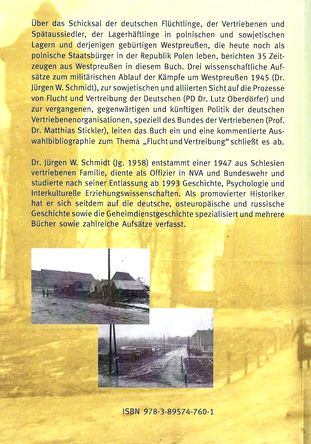
(Jg. 1958) entstammt einer 1947 aus
Schlesien vertriebenen Familie, diente
als Offizier in NVA und Bundeswehr und
studierte nach seiner Entlassung ab 1993 Geschichte,
Psychologie und
Interkulturelle Erziehungswissenschaften. Als promovierter Historiker
hat er
sich
seitdem auf die deutsche, osteuropäische und russische
Geschichte sowie
die Geheimdienstgeschichte
spezialisiert und mehrere Bücher sowie zahlreiche
Aufsätze verfasst.
|
Ergebnisse für Gelfand
Seite 42 …Gelfand (1923-1983), Granatwerferzugführer im III. Bataillon des 1052 Schütz… Seite 43 … Gelfand: DEUTSCHLAND-TAGEBUCH 1945-1946. Aufzeichnungen eines… Seite 52 ... Auch der sowjetische Leutnant Wladimir Gelfand von 1052. Schützenregiment... Seite 78 …Gelfand in seinem persönlichen Kriegstagebuch über das Plündern und die dabei… ... 233 Gelfand: S.29 Der kultivierte, etwas deutschsprechende Jude Wladimir Gelfan...
|
 |
|
Das Historisch-Politische Buch Preußische Allgemeine Zeitung |
 |
 German
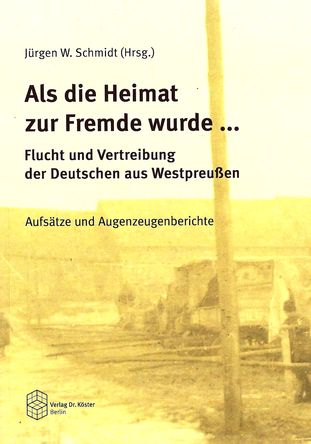
“When the Homeland Became Foreign”
Brief description
According to Polish estimates, around 70 percent of the population of West Prussia fled from the advancing Red Army when the fighting reached West Prussian territory in January 1945. The battles continued with exceptional severity and heavy losses on both sides until the fall of Danzig in March 1945. Refugee columns from West Prussia were often overtaken by the rapidly advancing Red Army even after reaching Pomerania and were forced to turn back. Many other refugees managed to escape, above all to Mecklenburg, Schleswig-Holstein and Lower Saxony, or by ship to Denmark. In doing so they at least saved their lives and some movable possessions, while countless others died or were killed during the flight.
Those who failed to escape, as well as West Prussians who wished to remain in their old homeland under any circumstances or were prevented from leaving by outside factors, faced a difficult fate. Tens of thousands were imprisoned without trial in various Polish and Soviet labor and penal camps. The West Prussian place name Potulitz acquired grim notoriety in this connection. Prisoners were compelled to perform forced labor under degrading conditions and with inadequate food.
In 1945–46, in West Prussia now under Polish administration, first “wild” and later organized expulsions of the remaining German population took place. From the late 1940s onward, these were followed by a wave of so-called late resettlers lasting for decades — people unwilling to accept continuing discrimination as Germans and the poor social conditions that affected Germans and Poles alike in communist Poland. For all these West Prussians, 1945 made their homeland into a foreign place, one that nevertheless remained unforgettable despite all the suffering associated with it.
The book presents the fate of German refugees, expellees and later resettlers, of prisoners held in Polish and Soviet camps, and of people born in West Prussia who continued to live as Polish citizens in the Republic of Poland. Thirty-five contemporary witnesses from West Prussia tell their stories. The volume opens with three scholarly essays: Dr. Jürgen W. Schmidt on the military course of the fighting for West Prussia in 1945; PD Dr. Lutz Oberdörfer on Soviet and Allied perspectives on the flight and expulsion of the Germans; and Prof. Dr. Matthias Stickler on the past, present and future policies of German expellee organizations, especially the Federation of Expellees (BdV). A commented selected bibliography on “Flight and Expulsion” concludes the volume.
Press
Das Historisch-Politische Buch: “The work demonstrates a methodologically practical way of dealing with oral history. Even more important, however, is the fact that this edited volume approaches the politics of expellees against prevailing fashions and on the basis of factual evidence.”
Preußische Allgemeine Zeitung: “Historian Jürgen W. Schmidt is concerned with resisting forgetting and suppression. With the volume he edited [...] he has made an impressive contribution to that effort.”
Junge Freiheit, Literature:
“A remarkable volume containing essays and eyewitness accounts on the expulsion from West Prussia.”
About the author
Dr. Jürgen W. Schmidt, born in 1958, comes from a family expelled from Silesia in 1947. He served as an officer in the National People’s Army of the GDR and later in the Bundeswehr. After leaving military service in 1993, he studied history, psychology and intercultural education. Since completing his doctorate, he has specialized in German, East European and Russian history as well as the history of intelligence services, publishing several books and numerous articles.
About the publisher
Dr. Köster Verlag was founded in Berlin in 1994 by Dr. Hans-Joachim Köster and publishes scholarly works. Its main areas include established book series on security policy, contemporary history and intelligence services. Alongside military history, questions of international security are a major focus.