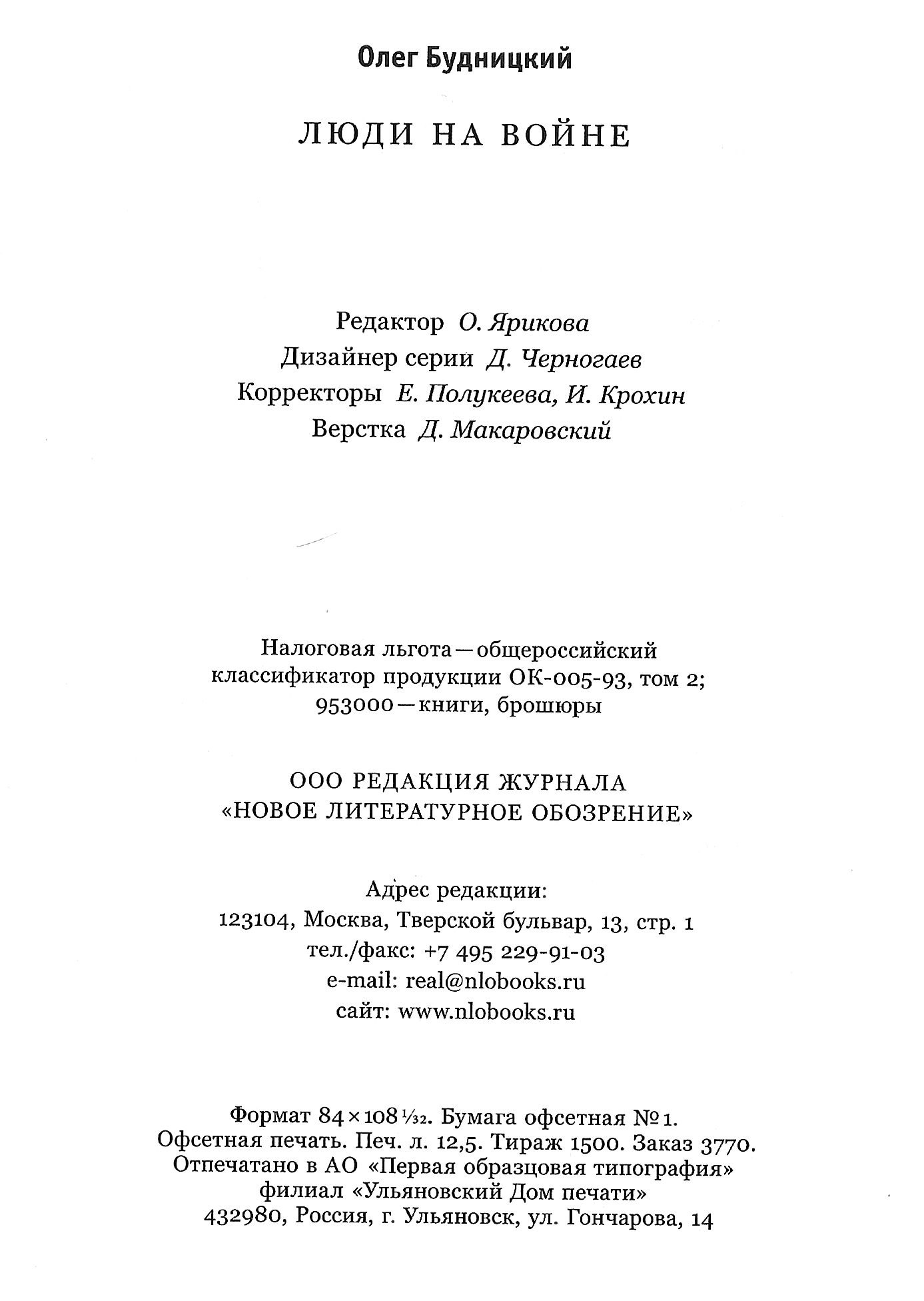
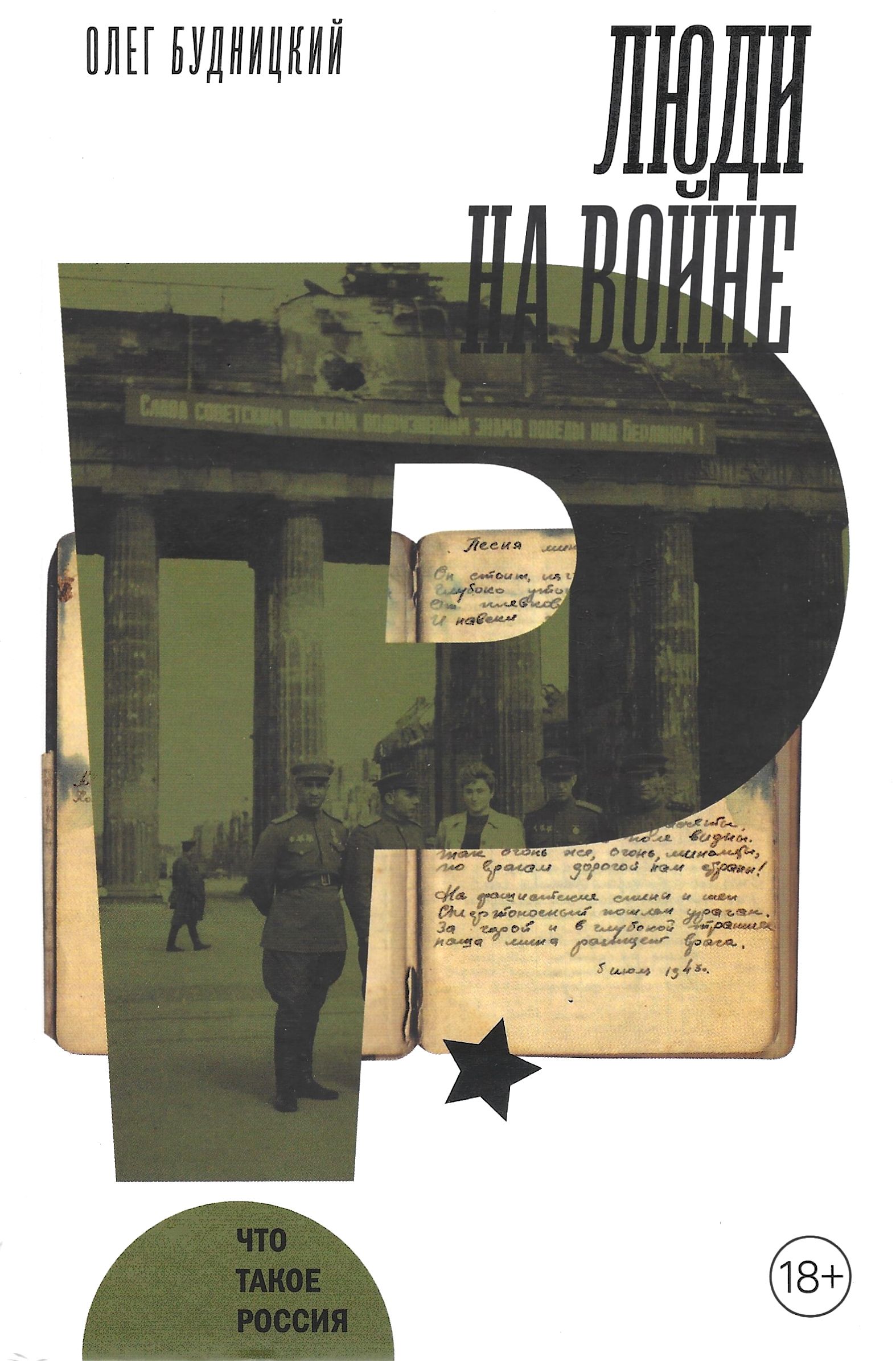
People at War
New Literary Observer · Oleg Budnitsky
Book: People at War · Author: Oleg
Budnitsky · Publisher: New Literary Observer · 400 pages,
54 illustrations · Paperback price shown on the original page:
787 rubles · ISBN 978-5-4448-1534-2 · Weight: 486 g
· Dimensions: 205 × 140 × 23 mm · Print run:
1,500 copies · Year: 2021 · Language: Russian ·
Hardcover · Series: What Is Russia?
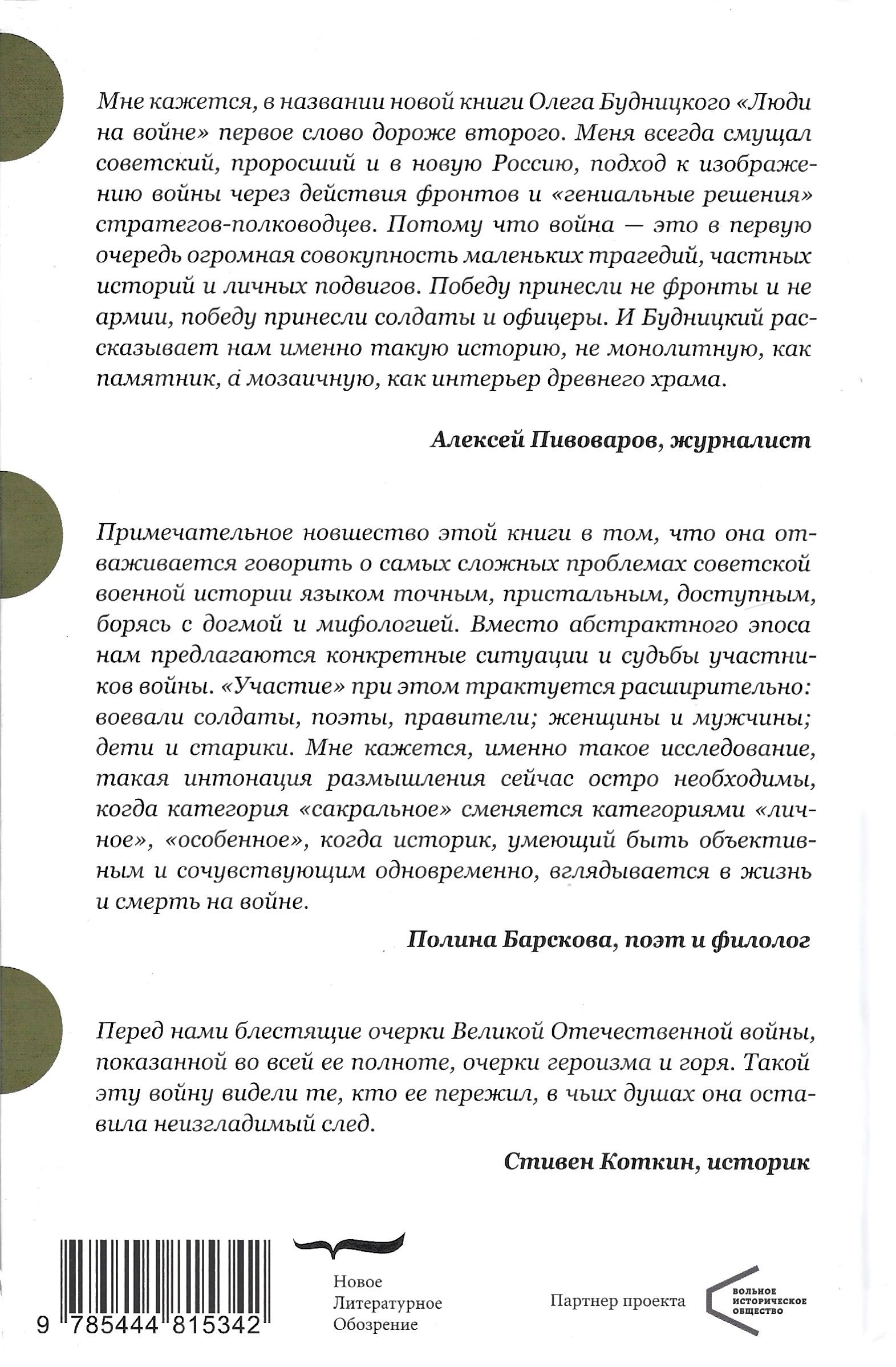
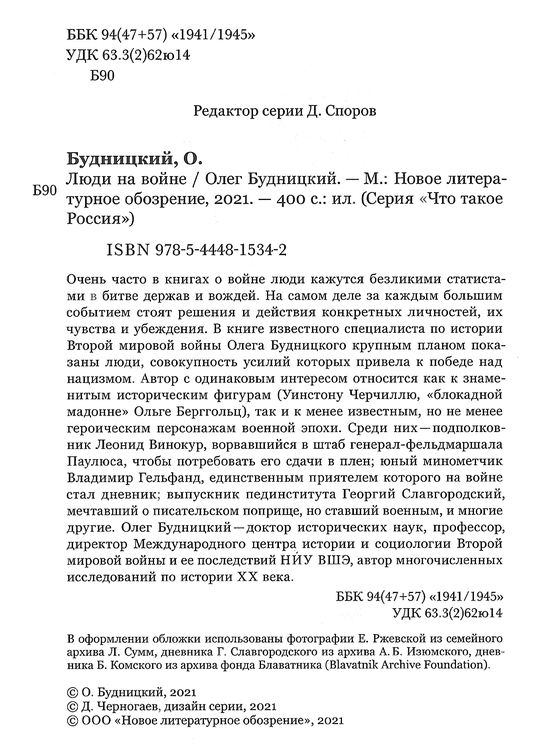
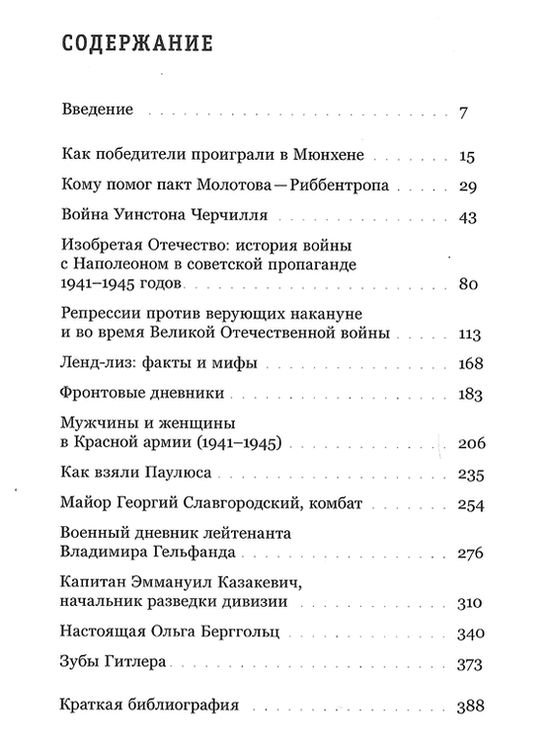
A collection of essays and articles by historian
Oleg Budnitsky, People at War, has been published. In it the author
describes social and everyday aspects of the Great Patriotic War, from
repression of believers on the eve of and during the war to myths and
legends about Lend-Lease.
The book includes a text about Lieutenant Vladimir
Gelfand’s wartime diary. A radio story about Emmanuel Kazakevich,
a writer who served in frontline reconnaissance, became the basis for
an essay about the expression “Patriotic War.”
The collection also includes an article from
Ogonyok magazine devoted to the capture of Field Marshal Paulus and to
the decisive role Lieutenant Colonel Leonid Vinokur played in that
capture.
The author devoted the article “Men and
Women in the Red Army (1941–1945)” to women’s fates
at the front, the newspaper Kommersant reports.
Earlier, a historical-documentary collection
titled Majdanek was presented in Moscow. A new edition—the photo
album The Feat of the Soviet People Is Immortal…—was
presented at the Brest Fortress memorial museum.
It was also reported that the Holocaust Research
and Education Center published a documentary collection of letters and
diaries about the events of the Great Patriotic War and Nazi crimes in
occupied Soviet territory, written by Soviet Jews and members of their
families.
Olga Bergholz spent June 22, 1949, in the village
of Staroye Rakhino in the Novgorod region, where only 50 of 450 men had
returned home. That day she wrote: “People read more about the
war, although they themselves have only just lived through it. Yet it
still seems that this is not the same war, that there was another
one—beautiful and heroic.”
The texts collected in this book are about the war
as it actually was, not as it appeared in novels, films, or on
television. The author of these lines, being a professional historian,
understands that the ideal formulated by Leopold von Ranke almost two
hundred years ago—“to show how events actually happened,
without becoming a judge of the past or lecturing
contemporaries”—is unattainable, but nevertheless believes
that one should strive toward it.
Few people would dispute the fact that the history
of the war—and when people in our country simply say “the
war,” everyone understands which war is meant—arouses
greater public interest than any other event in world history.
According to sociologists, at the beginning of the twenty-first century
78 percent of Russians surveyed named victory in the Great Patriotic
War as the most important event that determined the country’s
fate in the twentieth century; 87 percent said they were proud of the
victory—almost in Lev Losev’s formulation, “The only
good thing was the war.” At the same time, 68 percent believed
that we still did not know “the whole truth” about the
Great Patriotic War.
It is difficult to argue with the latter
statement. The “truth” about the war changed so many times
depending on the political climate or departmental interests that
one’s head could literally spin. For example, in March 1946
Joseph Stalin stated in an interview with Pravda: “As a result of
the German invasion, the Soviet Union irretrievably lost in battles
with the Germans, and also as a result of the German occupation and the
deportation of Soviet people to German penal servitude, about seven
million people.” Fifteen years later, in November 1961, Nikita
Khrushchev gave a figure almost three times as high in a letter to the
Swedish prime minister: “Can we sit idly by and wait for a
repetition of 1941, when the German militarists unleashed a war against
the Soviet Union that cost twenty million Soviet lives?” Finally,
on May 9, 1990, Mikhail Gorbachev announced that the war “claimed
almost 27 million Soviet lives.” Statistics on Soviet Armed
Forces losses, including the largest battles of the Great Patriotic
War, were made public in the military historians’ book The
Secrecy Stamp Has Been Removed only in 1993, almost fifty years after
the war ended.
Or take a very recent example of a radical change
in attitudes toward another historical event. For more than forty years
the USSR denied the very existence of the secret protocols to the
Molotov–Ribbentrop Pact. In 1948 the U.S. State Department
published the text of the secret protocols from a captured German
photocopy, along with other documents on Soviet-German relations on the
eve of the war. The Soviet Ministry of Foreign Affairs responded
quickly with a publication titled Falsifiers of History, subtitled
“Historical Information.” Calling the publishers of the
documents “falsifiers and slanderers,” the anonymous
authors of this “historical information” did not mention
the secret protocols even once. A brochure printed in half a million
copies was not supposed to contain even a hint of the dangerous
document. In 1989 the Second Congress of People’s Deputies of the
USSR denounced the Molotov–Ribbentrop Pact, declaring the secret
protocols “legally null and void from the moment of their
signing.” The denunciation was based on copies, although the
original was kept in the CPSU General Secretary’s “sealed
package.” Gorbachev, however, “could not bring
himself” to publish it. The originals were finally shown
“to the city and the world” after the collapse of the
communist regime, at a press conference on October 27, 1992.
Nevertheless, even at the beginning of the present
century a quarter of Russian citizens surveyed by sociologists refused
to believe that the protocols were authentic. Today, however—to
use the naval command, “all turn together”—some
Russian politicians have proclaimed the Molotov–Ribbentrop Pact
the greatest achievement of Soviet diplomacy. Moreover, a bill has been
submitted to the State Duma of the Russian Federation declaring
inapplicable on Russian territory the 1989 resolution of the Congress
of People’s Deputies condemning the Molotov–Ribbentrop
Pact. It will be interesting to see where matters stand when this book
reaches the reader.
One of the disputed questions examined in the book
is who actually benefited from the Molotov–Ribbentrop Pact. The
book contains several intersecting lines, including international
aspects of wartime history—the Munich Agreement and
Lend-Lease—which ultimately affected the fates of its
protagonists. Whether I am discussing prewar diplomacy or other
subjects, I try to show events through the perceptions of
contemporaries, both the principal actors and “outside”
observers, who sometimes assessed events with astonishing
accuracy—far more accurately than the politicians of the time.
The main heroes of this book are the people whose
combined efforts ultimately led to victory over Nazism—alongside,
of course, the efforts of millions of others. They include historical
figures such as Winston Churchill; military men who played significant
roles, such as Lieutenant Colonel Leonid Vinokur, who “with
Bolshevik brusqueness” burst into the headquarters of the newly
promoted Field Marshal Paulus to demand his surrender; Olga Bergholz,
the “voice of besieged Leningrad”; yesterday’s
schoolboy and mortar officer Lieutenant Vladimir Gelfand, whose only
“friend” in the war became his diary; and Georgy
Slavgorodsky, a graduate of a teachers’ institute who dreamed of
becoming a true intellectual and writer but achieved success in a
completely different field—the military.
Very often in books about war people are treated
as a function. I tried to show what they were like and how they lived.
And, as people do, they lived by more than war alone. At war people do
not only fight. They fall in love, drink, play cards, steal, and dream.
In almost every case I relied on ego-documents: mainly diaries, but
also accounts recorded immediately after events, wartime letters, and,
rarely, memoirs written “for the desk,” not for
publication. These—especially diaries—are the most
authentic testimonies of the Second World War / Great Patriotic War.
Crucially, the diarists do not know how one is “supposed”
to write about war; sometimes they do not know whether they will live
until the next day, or even the next hour.
Another theme running through the book is
Stalinism and the war. Military historians and historians of Stalinism
seem to belong to different “castes.” There is an enormous
literature on the 1930s; much less, though still quite a lot, has been
written about late Stalinism; but during the war Stalinism, if it does
not disappear from the literature, is transformed beyond recognition.
In reality, it is rather the historians of Stalinism who
“disappear”: in the words of British historian Stephen
Lovell, they “do not really know what to do with the wartime
period.” During the war the Stalinist regime did indeed
demonstrate, on the one hand, an ability to adapt to circumstances; on
the other, its essential nature did not fundamentally change. Society
continued to be governed to a considerable extent through violence:
more than sixteen million people were convicted in 1941–1945.
This exceeds any comparable period in Soviet history. The dual nature
of Stalinist wartime policy is especially clearly demonstrated by the
history of “relations” with the Church. I put
“relations” in quotation marks because there was no
“dialogue” to speak of. The state used the Church for its
political, primarily foreign-policy, interests while simultaneously
repressing clergy and ordinary believers, especially those who did not
want dealings with the Sergian church. It was a one-way street, and for
many that street led to the camps.
The history of wartime Stalinism, however, is not
only the history of a regime. It is the history of people: how they
perceived reality, and how they related to the regime and its leader.
Georgy Slavgorodsky, one of those who considered himself a beneficiary
of the regime—without, of course, using that word—wanted to
convey his impressions of the Stalin era to future generations.
Vladimir Gelfand confided his most intimate feelings to his diary:
“My Stalin, immortal and simple, modest and great, my leader, my
teacher, my glory, genius, my great sun.” Others never mention
Stalin, the Motherland, or the Party at all. Olga Bergholz was fully
aware of the duality of her own existence and behavior. As early as
April 1942 she understood “what lies and nightmare everything
that is happening amounts to” and foresaw that “after the
war nothing will change.” Her prediction came true. Forced, like
other writers, to work as an agitator during elections, she observed:
“Elections in general are a cynical and shameful farce whose
‘democratic summit’ is an indecent hosanna to Papa?.. And
I, clearly understanding this, will babble something at the agitation
point before the old women and peasant women gathered here—about
democracy, candidates, and so on! I do this for the simplest reason:
out of fear, fear of prison. That is the whole essence of our democracy
today.” But I will not retell the whole book.
Finally, another theme of the book is women at
war. There is an extensive literature on women in the Red Army. It is
devoted primarily to the military exploits of women. More has been
written about female snipers and pilots than about all other women in
uniform combined. Yet almost half a million women served in the army.
One of the principal problems they faced—as did female snipers
and aviators—was their relationship with men. It is obvious that
relations between men and women changed fundamentally during the war.
They could hardly have failed to change when around thirty-four million
men were drafted on the eve of and during the war, creating a situation
in which women were left without men and men without women. Moreover,
the ratio of women to men was exactly opposite at the front and in the
rear: in the rear there was a shortage of men; at the front, a shortage
of women. As in all the other cases, gender relations in the Red Army
are examined primarily through wartime ego-documents.
© New Literary Observer Publishing House · © Oleg Budnitsky
(pp. 276–309)
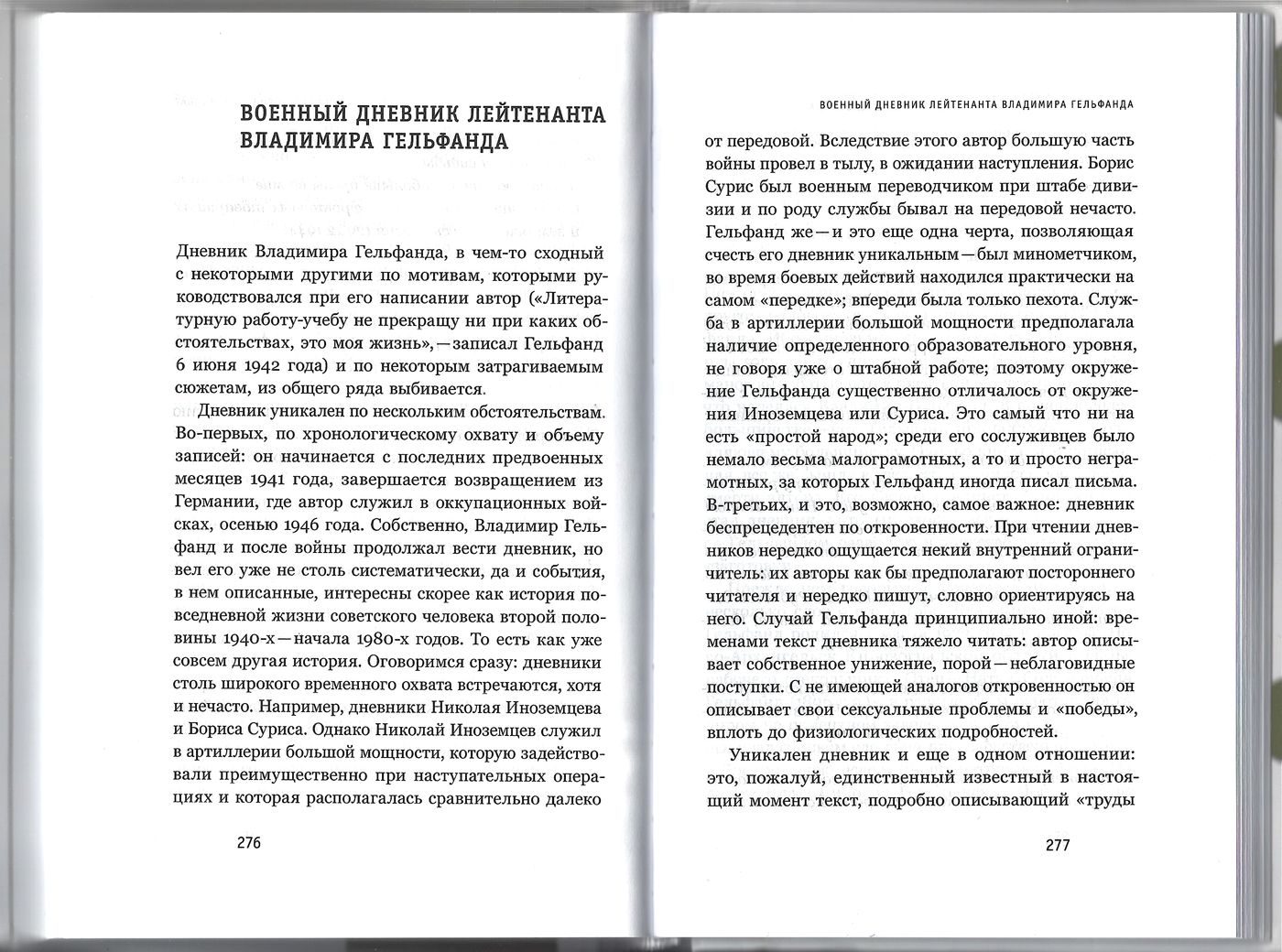
Pages 276–277 — “The Wartime Diary of Lieutenant Vladimir Gelfand”
Vladimir Gelfand’s diary resembles some
other diaries in the motives that guided its author (“I will not
stop my literary work and study under any circumstances; this is my
life,” Gelfand wrote on June 6, 1942) and in some of the subjects
it touches on, but it nevertheless stands apart from the general run.
The diary is unique for several reasons. First, in
chronological scope and in the volume of its entries: it begins in the
final prewar months of 1941 and ends with the author’s return
from Germany, where he served in the occupation forces, in the autumn
of 1946. Gelfand actually continued keeping diaries after the war, but
much less systematically, and the events described in them are
interesting more as a history of the everyday life of a Soviet person
from the second half of the 1940s to the early 1980s. Diaries covering
such a broad span of time do exist, though rarely—for example
those of Nikolai Inozemtsev and Boris Suris. Yet Nikolai Inozemtsev
served in heavy artillery, whose units were used mainly in offensive
operations and were positioned relatively far from the front line.
Consequently, the author spent much of the war in the rear waiting for
offensives. Boris Suris was a military interpreter at divisional
headquarters and, by the nature of his service, seldom found himself at
the forward edge.
Gelfand, by contrast—and this is another
feature that makes his diary unique—was a mortar man and during
combat operations was practically at the very front; only the infantry
was ahead of him. Service in heavy artillery assumed a certain distance
from the forward line, not to mention headquarters work.
Gelfand’s surroundings therefore differed substantially from
those of Inozemtsev or Suris. They were what one might call
“ordinary people”: among his comrades there were few who
were illiterate, but simply not very educated, and Gelfand sometimes
wrote letters for them.
Third, and perhaps most important, the diary is
unprecedented in its candor. When one reads diaries, the presence of an
internal limitation is almost always apparent: their authors seem to
assume that an outsider may read them and often write as though
orienting themselves toward that reader. Gelfand’s case is
fundamentally different. At times the diary text is so intimate that it
creates genuine embarrassment; at other times it records unattractive
deeds. With a frankness that has few parallels he describes his sexual
problems and “victories,” down to physiological details.
The diary is also unique in another respect: it is
perhaps the only text currently known that describes in detail the
“labors and days” of a Red Army officer in occupied Germany
in 1945–1946, his relations with Germans—especially German
women—without omissions or glances over the shoulder.
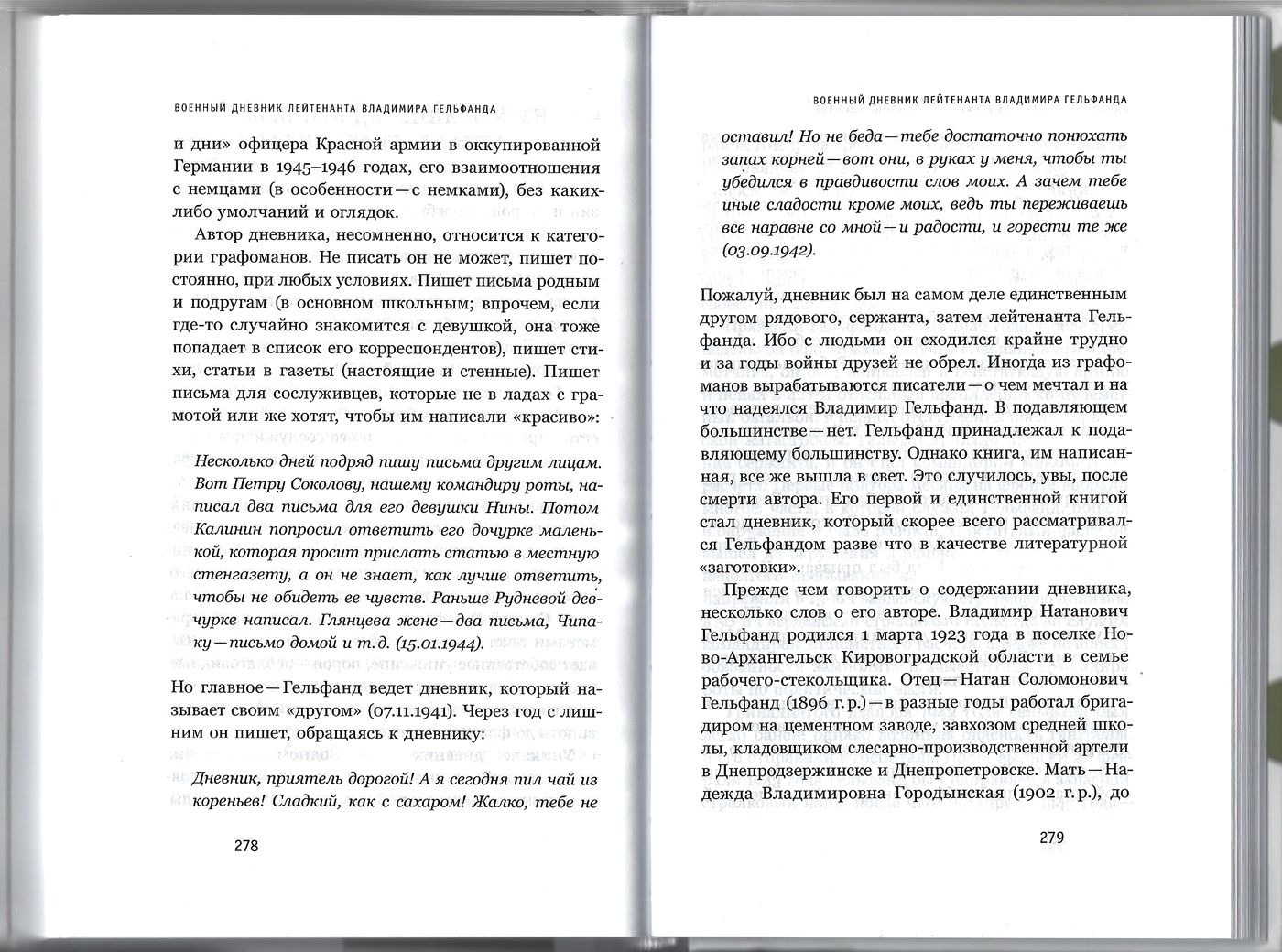
Pages 278–279
The author of the diary unquestionably belonged to
the category of graphomaniacs. He writes constantly, under every
possible circumstance. He writes letters to relatives and female
friends—mostly former schoolmates, though any girl he happened to
meet might also join his list of correspondents—writes poems and
articles for newspapers, genuine and wall newspapers. He writes letters
for fellow servicemen who are at odds with grammar or who simply want
someone to write something “beautifully” for them:
“For several days in a row I have been
writing letters for other people. For Petr Sokolov, our company
commander, I wrote two letters to his girlfriend Nina. Then Kalinin
asked me to reply to his little daughter, who asked him to send some
fashion pictures to the wall newspaper, and he did not know how best to
answer without hurting her feelings. Earlier I wrote a letter to
Rudneva’s girlfriend. Two letters to Glyantsev’s wife, a
letter home for Chipchuk, and so on.” (January 15, 1944)
But most important, Gelfand keeps a diary, which
he calls his “friend” (November 7, 1941). A year and more
later he writes, addressing the diary:
“Diary, dear friend! Today I drank tea
made from roots! Sweet, as if with sugar! It is a pity I did not leave
you any! But never mind—you need only smell the roots—here
they are, in my hands, so that you may be convinced that my words are
true. And why do you need any other sweets besides mine? You experience
all hardships with me—and joys and sorrows as well.”
(September 3, 1942)
The diary was apparently Lieutenant
Gelfand’s only true close friend. He found it extremely difficult
to get along with people and made no friends during the war years.
Sometimes graphomaniacs do become writers—something Vladimir
Gelfand dreamed about and hoped for. In the overwhelming majority of
cases, they do not. Gelfand belonged to the overwhelming majority. Yet
the book he wrote was nevertheless published. Sadly, this happened
after the author’s death. His diary became his first and only
book, although Gelfand himself regarded it, rather, as literary
“raw material.”
Before discussing the contents of the diary, a few
words about its author. Vladimir Natanovich Gelfand was born on March
1, 1923, in the settlement of Novo-Arkhangelsk in the Kirovograd
region, in the family of a glassworker. His father, Natan Solomonovich
Gelfand (born 1896), worked at various times as a foreman at a cement
plant, as head of a secondary-school supply office, and as a
storekeeper at a metalworking cooperative in Dneprodzerzhinsk and
Dnepropetrovsk. His mother, Nadezhda Vladimirovna Gorodinskaya (born
1902), before the Revolution gave private Russian lessons in the
families of prosperous individual peasants in the village of Pokotilovo.
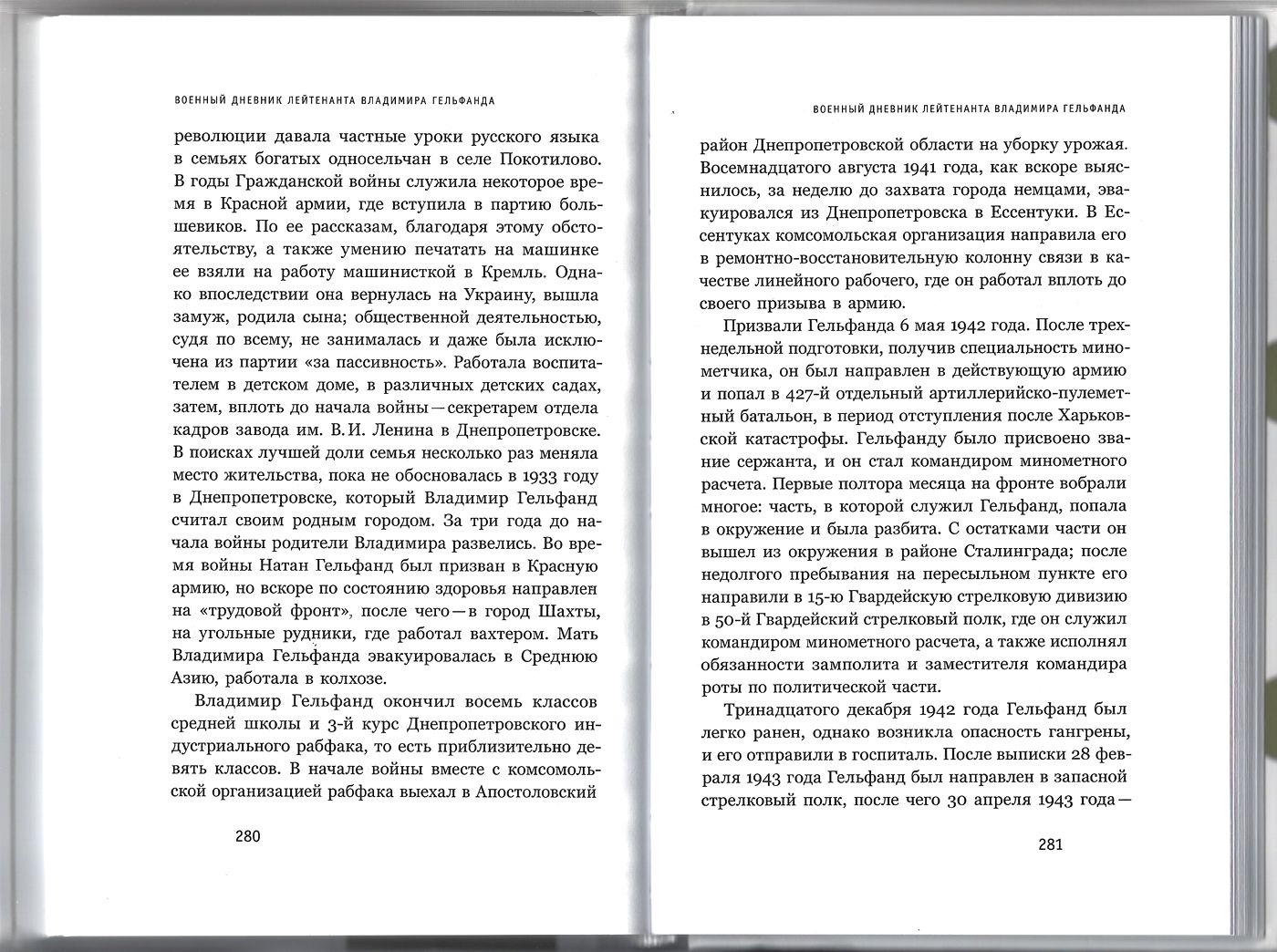
Pages 280–281
During the Civil War Gelfand’s mother served
for a time in the Red Army, where she joined the Bolshevik Party.
According to her own account, thanks to this fact, as well as her
ability to type, she was hired as a typist in the Kremlin. Later,
however, she returned to Ukraine, married and had a son; for family
reasons she did not work and was even expelled from the Party
“for passivity.” She then worked as an educator in an
orphanage and in various kindergartens, and until the beginning of the
war as secretary of the personnel department at the Lenin Plant in
Dnepropetrovsk. In search of a better life, the family changed
residence several times before settling in Dnepropetrovsk in 1933,
which Vladimir Gelfand regarded as his native city. Three years before
the war his parents divorced. During the war Natan Gelfand was drafted
into the Red Army, but for health reasons was soon sent to the
“labor front,” and then to the town of Shakhty, to the coal
mines, where he worked as a weighman. Vladimir’s mother was
evacuated to Central Asia and worked on a collective farm.
Vladimir Gelfand completed eight grades of
secondary school and the third course of the Dnepropetrovsk industrial
workers’ faculty—roughly equivalent to nine grades. At the
beginning of the war, together with the workers’ faculty Komsomol
organization, he went to the Apostolovo district of the Dnepropetrovsk
region to harvest crops. In August 1941, as soon as it became clear
that the city might be captured by the Germans within a week, he was
evacuated from Dnepropetrovsk to Essentuki. There the Komsomol
organization sent him to a repair-and-restoration railway column as an
ordinary worker, where he remained until he was drafted into the army.
Gelfand was called up on May 6, 1942. After three
weeks of training as a mortar man, he was sent to the active army and
assigned to the 427th Separate Artillery-and-Machine-Gun Battalion
during the retreat following the Kharkov catastrophe. Gelfand was given
the rank of sergeant and became a mortar-crew commander. The first
month and a half at the front brought much: his unit was encircled and
destroyed. With the remnants he escaped encirclement near Stalingrad;
after a brief stay at a transit point he was sent to the 15th Guards
Rifle Division, to the 50th Guards Rifle Regiment, where he served as a
mortar-crew commander and also performed the duties of a deputy company
commander for political affairs.
On December 13, 1942, Gelfand was lightly wounded,
but gangrene threatened and he was sent to hospital. After discharge on
February 28, 1943, Gelfand was sent to a reserve rifle regiment; on
April 30, 1943, he was sent to army courses for junior lieutenants of
the 28th Army.
Pages 282–283
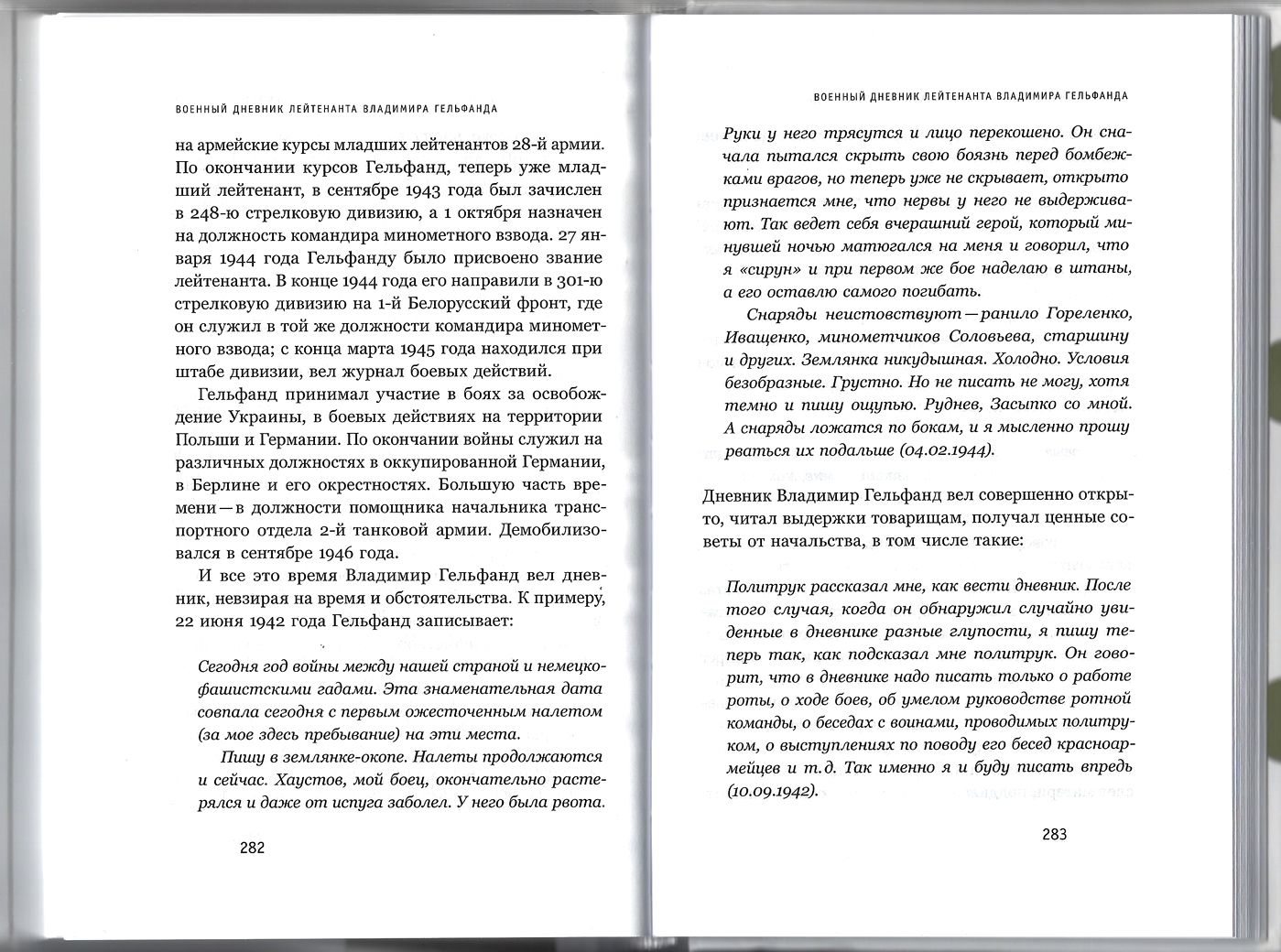
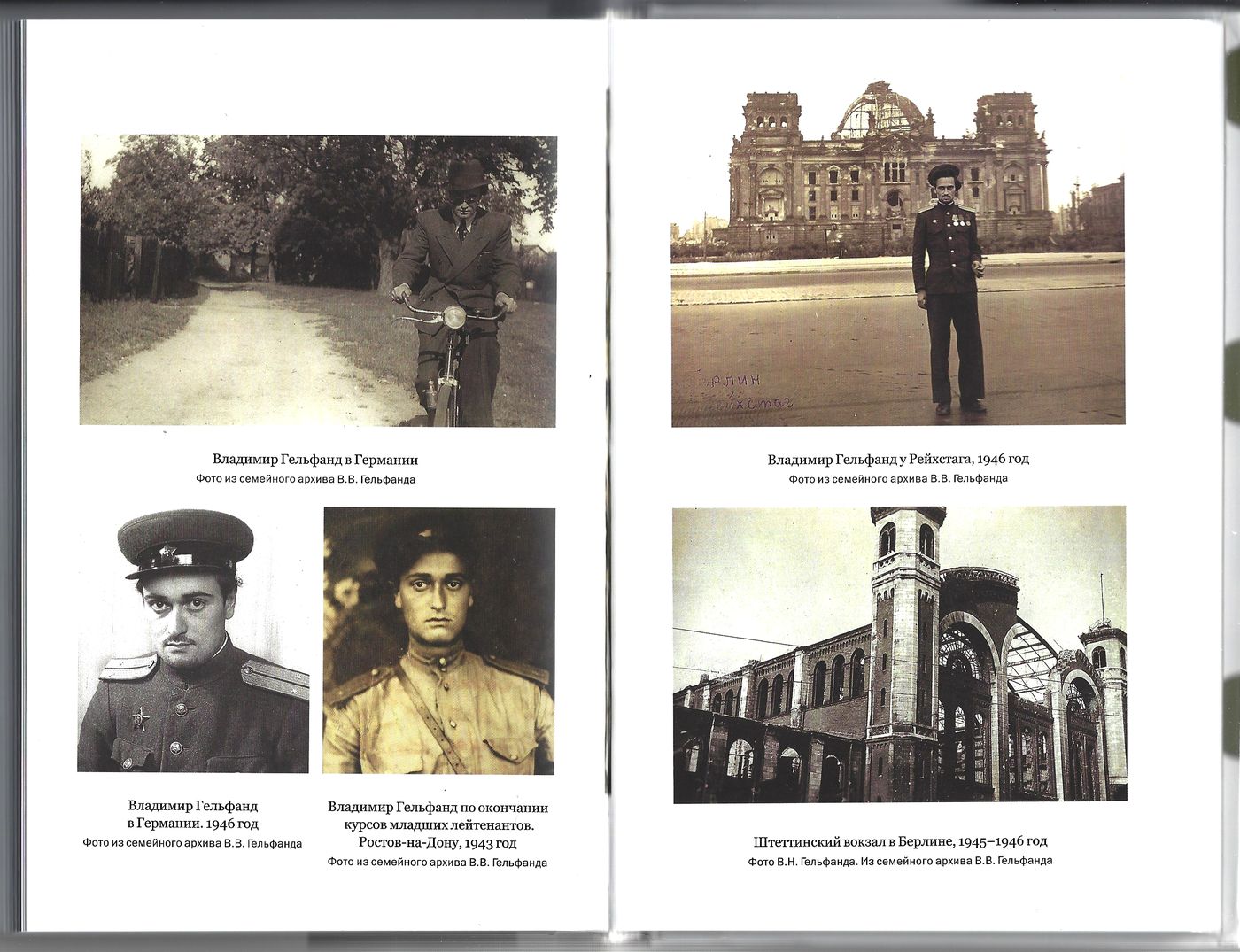
After completing the courses, Gelfand—now a
junior lieutenant—was assigned in September 1943 to the 248th
Rifle Division and on October 1 was appointed commander of a mortar
platoon. On January 27, 1944, he was promoted to lieutenant. At the end
of 1944 he was sent to the 301st Rifle Division of the 1st Belorussian
Front, where he served in the same post as mortar-platoon commander;
from the end of March 1945 he was on the division headquarters staff
and kept the combat journal.
Gelfand took part in the battles for the
liberation of Ukraine and in combat in Poland and Germany. After the
war he served in various posts in occupied Germany, in Berlin and its
environs, spending most of his time as assistant chief of the transport
department of the 2nd Tank Army. He was demobilized in September 1946.
Throughout this time Vladimir Gelfand kept a
diary, regardless of time and circumstances. For example, on June 22,
1942, he wrote:
“Today marks a year of war between our
country and the German-Fascist reptiles. This significant date has
coincided today with the first fierce raid on these places during my
stay here. Our anti-aircraft gunners continue firing even now.
Khaustov, my soldier, has completely lost his nerve and has even fallen
ill from fright. He was vomiting. His hands shake and his face is
distorted. At first he tried to hide his fear of the bombing raids from
me, but now he no longer conceals it; he openly admits to me that for
the first time in his life his nerves cannot stand it. This is how
yesterday’s hero behaves—the man who last night swore at me
and said I was a ‘chicken,’ and who at the very first
battle messed his trousers and left him alone to die. Senior lieutenant
Gorelenko, Ivashchenko, mortar men Soloviev, the sergeant major, and
others are missing. The dugout is useless. It is cold. Conditions are
atrocious. Sad. But I cannot write, though my heart is aching and my
soul is troubled. Rudnev, Zasypko are with me. Shells fall to either
side, and in my thoughts I ask them to explode farther away.”
(February 4, 1944)
Vladimir Gelfand kept his diary quite openly, read
excerpts to comrades, and listened to valuable advice from his
superiors, including advice of this sort:
“The political instructor told me how to
keep a diary. After that incident, when he discovered some nonsense
written by accident in the diary, I now write as the political
instructor advised me. He says that one should write in a diary only
about the company’s work, the course of battles, about the
skillful leadership of the commander, about conversations with soldiers
conducted by the political instructor, about his speeches concerning
his conversations with Red Army men, and so on. That is exactly how I
shall write from now on.” (September 10, 1942)
Pages 284–285
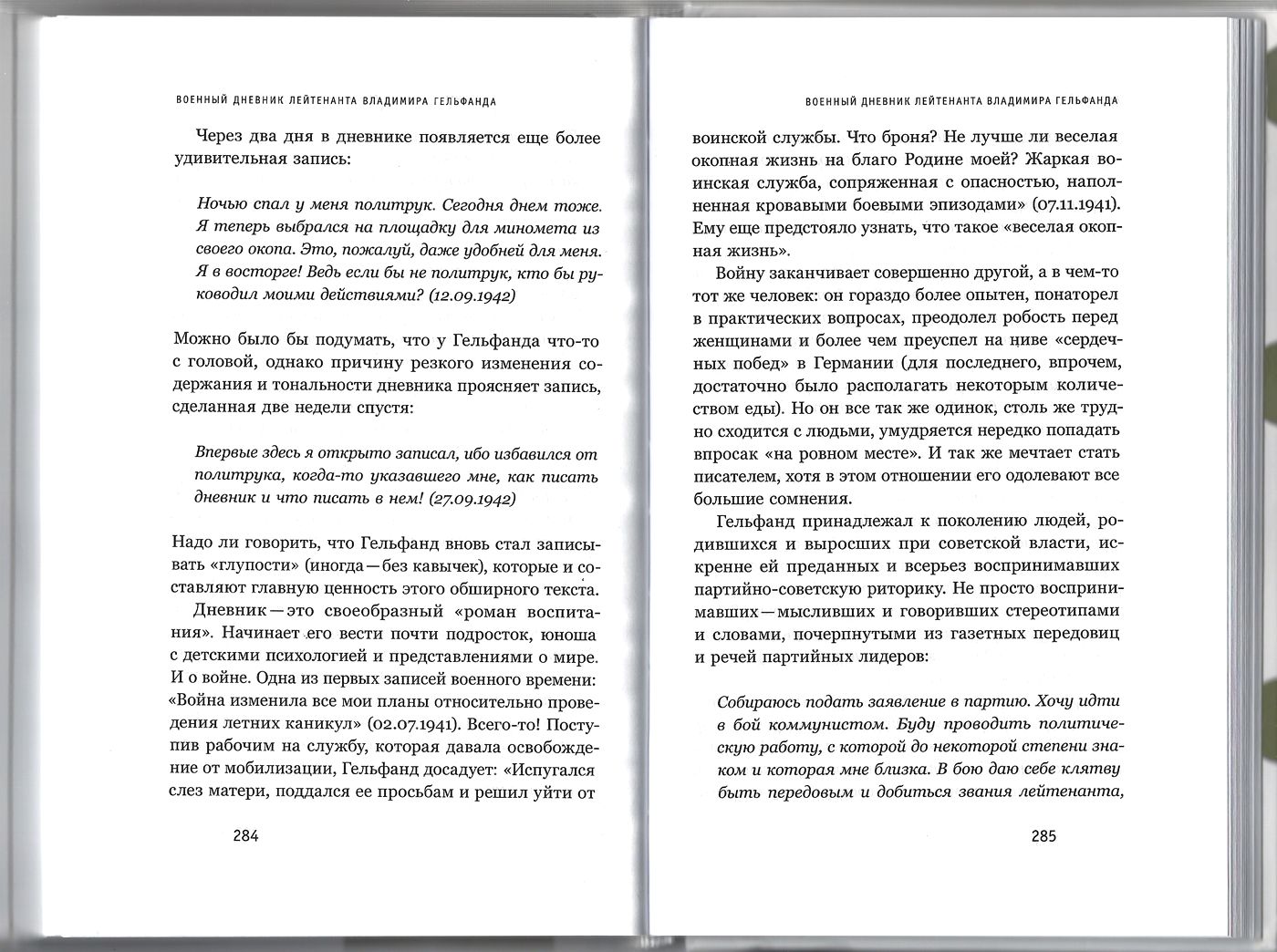
Two days later an even more astonishing entry appears in the diary:
“The political instructor slept at my
place last night. During the day as well. And now I have chosen a spot
in the square for a machine-gunner from my own trench. This is perhaps
even more convenient for me. I am delighted! For if it were not the
political instructor, who would direct my actions?” (September
12, 1942)
One might think that something was wrong with
Gelfand’s head, but an entry made two weeks later explains the
abrupt change in the diary’s content and tone:
“For the first time here I have written
openly, for I have got rid of the political instructor who once
instructed me how to keep a diary and what to write in it!”
(September 27, 1942)
Needless to say, Gelfand once again began
recording the “nonsense”—sometimes without quotation
marks—that constitutes the chief value of this extensive text.
The diary is a peculiar “novel of
education.” Its author is a young man with teenage psychology and
ideas about the world. And about war. One of his first wartime entries
reads: “The war has changed all my plans concerning my behavior
during the summer holidays” (July 2, 1941). Instead of going to
work at the plant, which would have exempted him from mobilization,
Gelfand regrets: “I was frightened by my mother’s tears,
yielded to her pleas, and decided to leave military service. What
nonsense? Would not a cheerful trench life for the good of my
Motherland be better? Ardent military service, associated with danger
and filled with bloody combat episodes?” (November 7, 1941). He
still has to discover what “cheerful trench life” actually
is.
He ends the war an entirely different person,
though in some ways the same one: much more experienced and
sophisticated in practical matters; he has overcome shyness before
women and achieved more than a little success in the field of
“romantic victories” in Germany—for the latter it was
enough, however, to possess a certain amount of food. Yet he remains
lonely, has just as much difficulty getting along with people, manages
to fall “out of the blue,” and still dreams of becoming a
writer, although ever greater doubts overcome him in this respect.
Gelfand belonged to the generation born and raised
under Soviet rule, sincerely devoted to it and thoroughly imbued with
Party-Soviet rhetoric. He did not merely accept the stereotypes and
slogans he drew from newspaper editorials and speeches by Party
leaders; he thought and spoke in those terms:
“I am preparing to submit an application
to join the Party. I want to go into battle as a Communist. I shall
carry out the political work with which I am to some extent familiar
and which is close to me. In battle I swear to be among the foremost
and to earn the rank of lieutenant, which by force of circumstance I
did not have the chance to receive at school. Much is still unfamiliar
and unclear to me, but I will study so as to know more. I will not stop
my literary work and study under any circumstances, for this is my
bread, my nourishment, my dear life.”
Pages 286–287
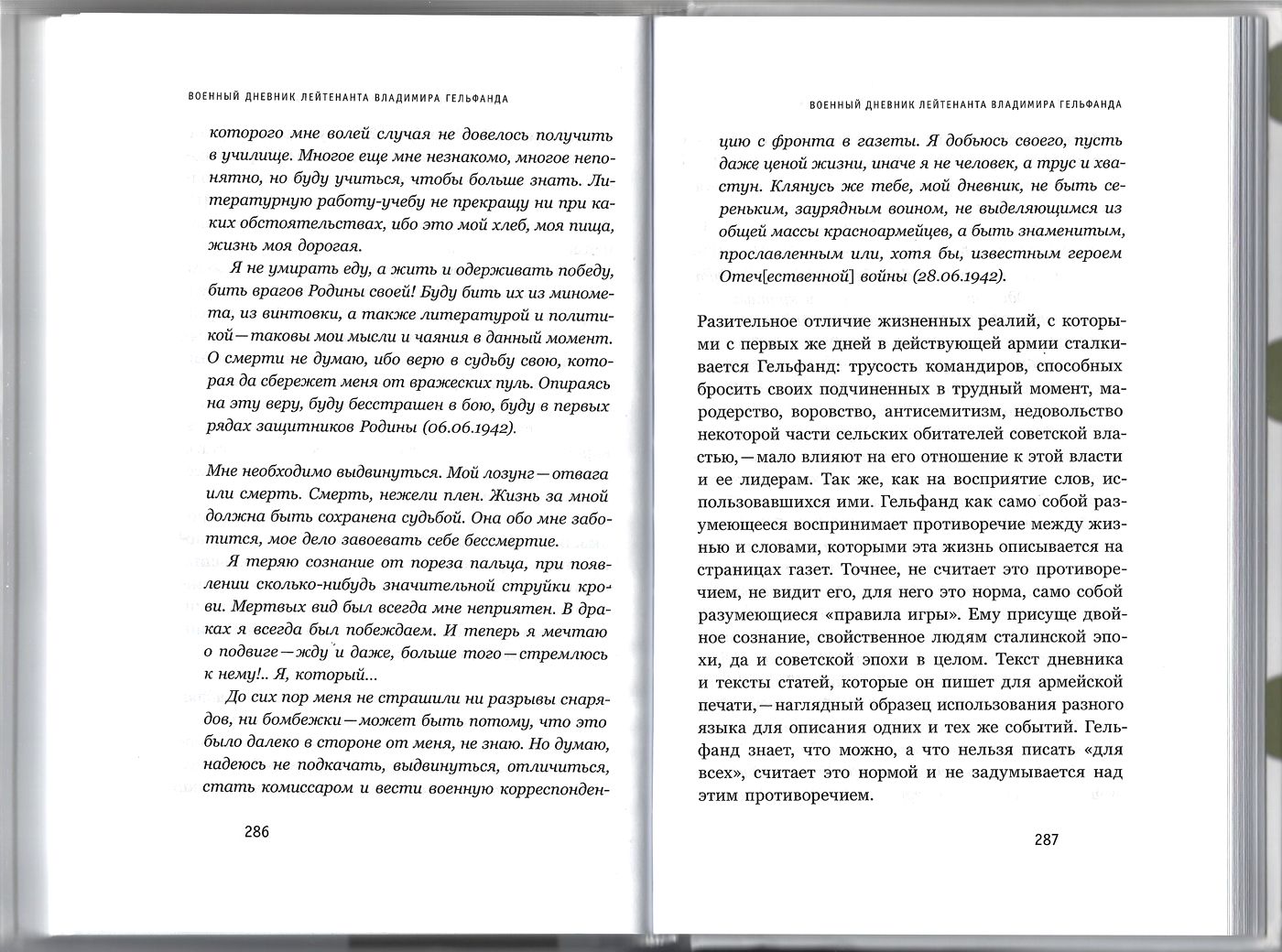
“I am not going to die; I am going to
live and win, to beat the enemies of my Motherland! I shall beat them
with mortar, rifle, bayonet, as well as with literature and
politics—such are my thoughts and hopes at this moment. I do not
think about death, for I believe in my fate, which will protect me from
enemy bullets. Relying on this faith, I shall fearlessly go into
battle, being in the front ranks of the defenders of the
Motherland.” (June 6, 1942)
“I need to distinguish myself. My slogan
is courage or death. Death, cowardice and captivity are impossible.
Life behind me must be preserved by destiny. It will take care of me;
my task is to win immortality for myself. I lose consciousness at the
sight of a cut finger, at the appearance of even a slightly significant
trickle of blood. I have always found a dead man unpleasant to look at.
In fights I was always defeated. And now I dream of a feat—I wait
for it and even more, I strive toward it!... Me, who... Until now
neither the terrible explosions of shells nor bombing raids have
frightened me—perhaps because it was far away from me, I do not
know. But I think, I hope not to lose heart, to distinguish myself, to
excel, to become a commissar and to conduct military-correspondence
work from the front for newspapers. I will achieve my aim, even at the
cost of my life; otherwise I am not a man, but a coward and a boaster.
I swear to you, my diary, not to be a gray, ordinary soldier who does
not stand out from the mass of Red Army men, but to be famous,
glorified, an outstanding hero of the Patriotic War.” (June 28,
1942)
The striking difference between the realities of
life Gelfand encountered in his very first days in the active
army—cowardice among commanders capable of abandoning their
subordinates at a difficult moment, looting, theft, antisemitism,
dissatisfaction among some rural inhabitants with Soviet rule—has
little effect on his attitude toward that government and its leaders.
Nor does it affect his perception of the words they use. Gelfand, as
though taking for granted the contradiction between the life and words
that compete on newspaper pages, does not regard it as a contradiction
at all; he simply does not see it. For him these are naturally
coexisting “rules of the game.” He possesses a dual
consciousness characteristic of people of the Stalin era and, more
broadly, of the Soviet era as a whole. The diary text and the articles
he writes for the army press are a vivid example of how different
languages could be used to describe the very same events. Gelfand knows
what can and cannot be written “for everyone,” regards this
as normal and does not reflect on the contradiction.
Pages 288–289
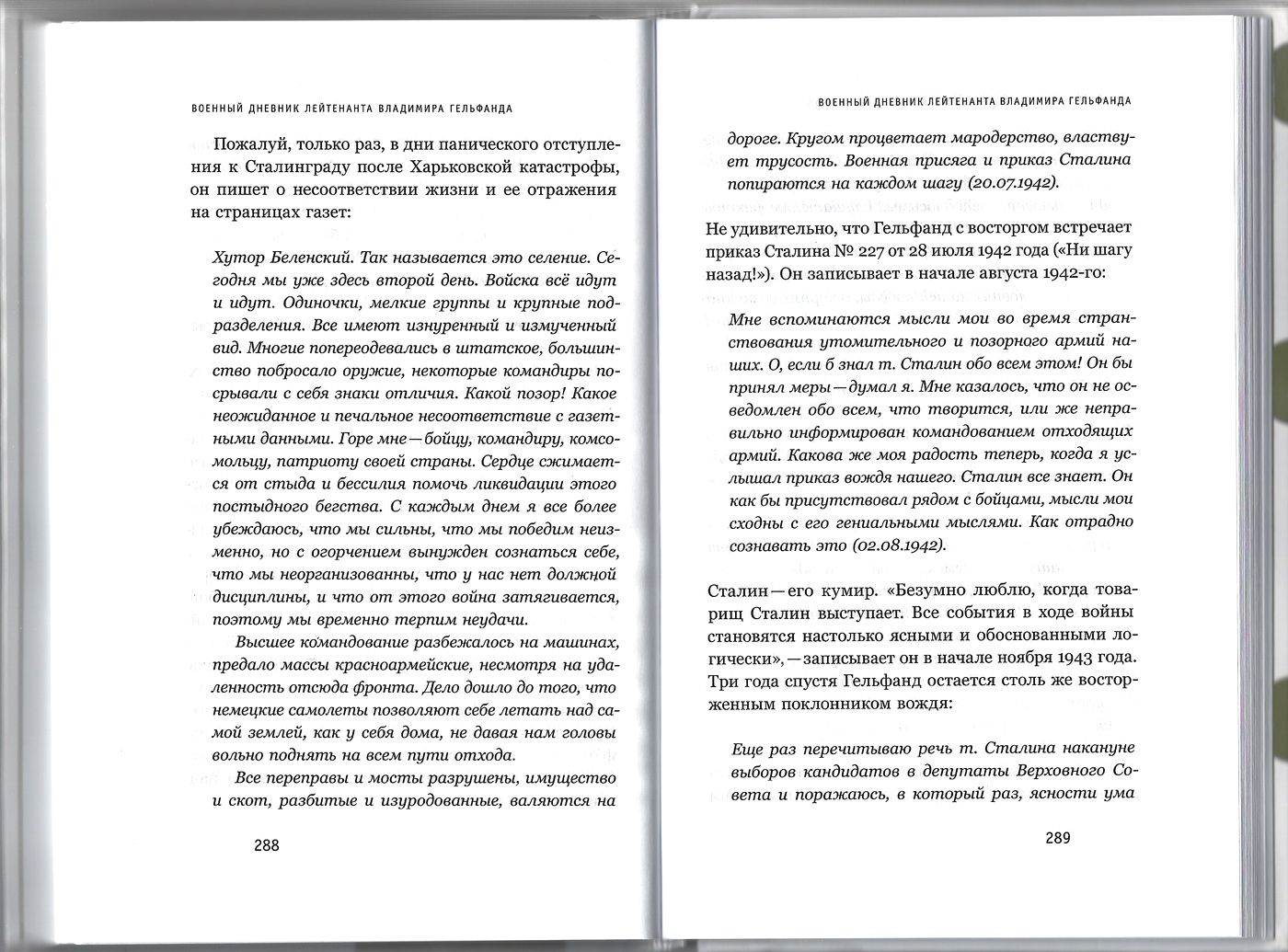
Perhaps only once, during the panicked retreat to
Stalingrad after the Kharkov catastrophe, does he write about the
discrepancy between life and the way newspapers reflect it:
“Khutor Belensky. That is the name of
this settlement. Today is already our second day here. Troops keep
moving and moving. Stragglers, small groups, and large units. Everyone
has an exhausted and worn-out appearance. Many have changed into
civilian clothes; most have thrown away their weapons; some commanders
have torn the insignia from themselves. What a disgrace! What an
unexpected and sad discrepancy with the newspaper reports. Woe is
me—a fighter, commander, Komsomol member, political propagandist
of my country. My heart contracts with shame and helplessness to help
eliminate this shameful flight. With every day I become more and more
convinced that we are strong, that we will inevitably defeat the
Germans, but at the same time I am forced to realize that we are
disorganized, that we lack proper discipline, and that because of this
the war is dragging on and we are temporarily suffering setbacks.
“The higher command has scattered itself
in cars, betraying the mass of Red Army men despite the remoteness of
the front’s withdrawal. Things have reached the point that German
aircraft allow themselves to fly over the ground itself, as if at home,
without even letting us raise our heads toward the clear paths of
retreat. All crossings and bridges are destroyed; property and
livestock, smashed and mutilated, lie along the roads. Looting
flourishes all around, cowardice reigns. The military oath and
Stalin’s order are violated at every step.” (July 20, 1942)
It is not surprising that Gelfand enthusiastically
welcomes Stalin’s Order No. 227 of July 28, 1942—“Not
One Step Back!” At the beginning of August 1942 he writes:
“I recall my thoughts during the
exhausting and disgraceful wandering of our armies. Oh, if Comrade
Stalin knew about all this! He would take measures, I thought. It
seemed to me that he was not aware of everything that was happening, or
that the commanders of the retreating armies were misinforming him. How
great is my joy now that I have heard the order of our leader. Stalin
knows everything. It is as though he had been standing beside the
soldiers; my thoughts coincide with his brilliant thoughts. How
comforting it is to realize this.” (August 2, 1942)
Stalin is his idol. “I love it madly when
Comrade Stalin speaks. All events in the course of the war become so
clear and logically substantiated,” he writes at the beginning of
November 1943. Three years later Gelfand remains just as enthusiastic
an admirer of the leader:
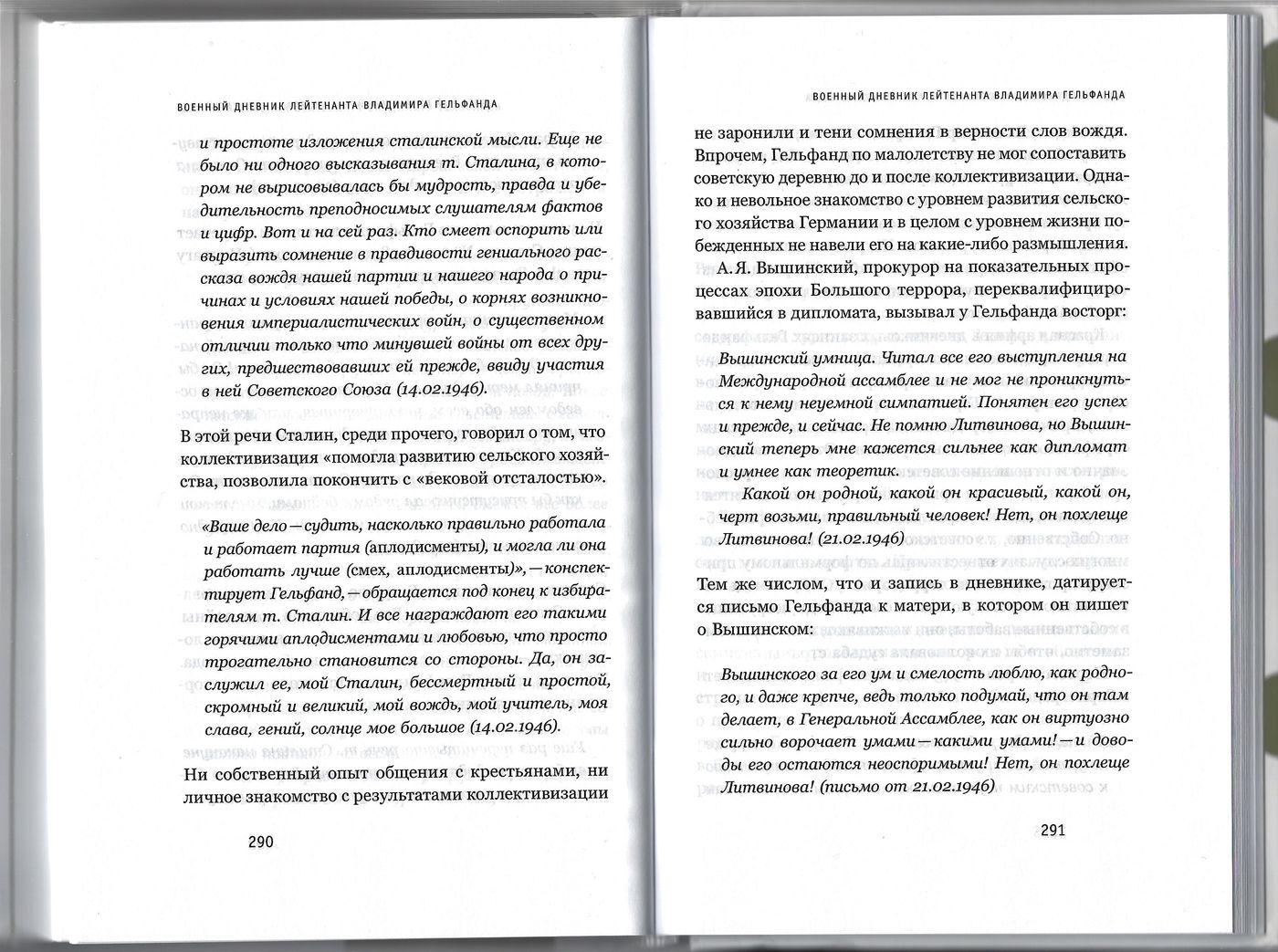
Pages 290–291
“Once again I reread Comrade
Stalin’s speech on the eve of the elections of candidates to the
Supreme Soviet and was struck yet again by the simplicity, clarity of
mind and simple exposition of Stalin’s thought. There has never
been a single statement by Comrade Stalin that did not radiate wisdom,
truth and the convincing presentation of facts and figures to his
listeners. This time too. Who can dispute or cast doubt on the
correctness of the brilliant account by the leader of our Party and our
people of the causes and conditions of our victory, the roots of the
emergence of imperialist wars, or the significant difference of the
last war from all those preceding it because of the Soviet
Union’s participation?” (February 14, 1946)
In this speech Stalin, among other things, said
that collectivization “helped agricultural development and made
it possible to put an end to ‘centuries-old
backwardness.’”
“‘It is your business to judge how
correctly the Party worked’—applause—and whether it
could have worked better—laughter, applause—Comrade Stalin
states in his address to the voters at the end. And everyone rewards
him with such thunderous applause and love that it simply becomes
touching from the outside. Yes, he deserved it, my Stalin, immortal and
simple, modest and great, my leader, my teacher, my glory, genius, my
great sun.” (February 14, 1946)
Neither his own experience with peasants nor
personal knowledge of the results of collectivization causes the
slightest doubt in him about the leader’s words. Gelfand, because
of his youth, could not compare the Soviet countryside before and after
collectivization. Yet even a casual acquaintance with the level of
agricultural development in Germany and with the standard of living of
the defeated Germans in general did not lead him to any reflections.
A. Ya. Vyshinsky, prosecutor at the show trials of the Great Terror era who retrained as a diplomat, fills Gelfand with delight:
“Vyshinsky is clever. I read all his
speeches at the International Assembly and could not break away for a
moment. His success there, and earlier and now, is obvious. I do not
remember Litvinov, but Vyshinsky now seems to me stronger as a diplomat
and smarter as a theoretician. What a native, what a beautiful, what a
devilishly handsome, fine man! No, he is better than Litvinov!”
(February 21, 1946)
That same day, an entry in the diary is dated in which Gelfand writes to his mother about Vyshinsky:
“I love Vyshinsky for his intelligence
and courage as though he were a dear native. And I am even pleasantly
aware that he defeats them there, in the General Assembly, how
masterfully and forcefully he turns minds—what minds!—and
his arguments remain indisputable! No, he is better than
Litvinov!” (letter of February 21, 1946)
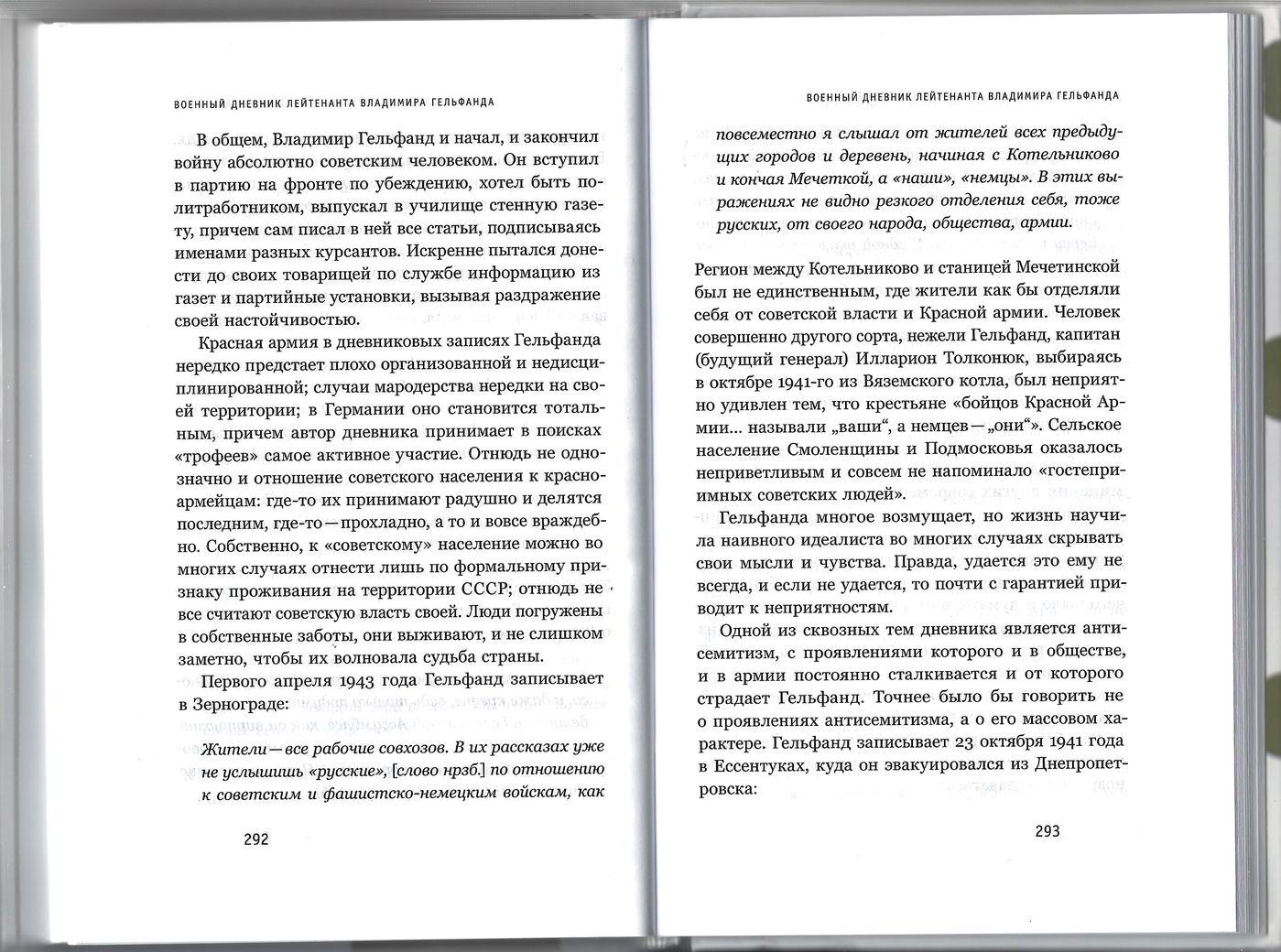
Pages 292–293
In general, Vladimir Gelfand began and ended the
war as an entirely Soviet person. He joined the Party at the front out
of conviction, wanted to become a political worker, produced a wall
newspaper while at school, and on arriving at a military school
undertook to write articles, signing them with the names of various
cadets. He sincerely tried to convey information from newspapers and
Party directives to his fellow servicemen, irritating them with his
persistence.
In Gelfand’s diary entries the Red Army
often appears badly organized and undisciplined; cases of looting are
common on its own territory, while in Germany it becomes total, and the
diarist himself takes the most active part in searching for
“trophies.” Nor is the attitude of the Soviet population
toward Red Army men unambiguous: in some places they are welcomed
warmly and given their last food; elsewhere they are coolly received or
even openly hostile. Strictly speaking, in many cases the population
could be called “Soviet” only by the formal criterion of
residence within the USSR; not everyone regarded Soviet power as their
own. People were busy with their own concerns, and it was not too
evident that the fate of the country troubled them.
On April 1, 1943, Gelfand wrote in Zernograd:
“The inhabitants are all state-farm
workers. In their stories you will no longer hear the word
‘Russians’ used in relation to Soviet and German-Fascist
troops, as I heard everywhere from the inhabitants of all the previous
towns and villages, from Kotelnikovo to Mechetka; instead it is
‘ours’ and ‘the Germans.’ In these expressions
I clearly see that this department considers itself, perhaps, Russian,
its people, society, army.”
The region between Kotelnikovo and Mechetinskaya
station was not the only place where inhabitants seemed to separate
themselves from Soviet rule and the Red Army. A man of an entirely
different sort from Gelfand, Captain—later General—Ilarion
Tolkonuk, who escaped from the Vyazma pocket in October 1941, was
unpleasantly surprised to discover that Red Army men were called
“yours” and the Germans “theirs.” The rural
population of the Smolensk and Moscow regions proved unfriendly and
bore little resemblance to “hospitable Soviet people.”
Gelfand is angered by much, but life teaches the
naive idealist in many cases to conceal his thoughts and feelings. He
does not always succeed, and when he does not, it almost inevitably
leads to trouble.
One of the recurring themes of the diary is
antisemitism, manifestations of which Gelfand constantly encounters
both in society and in the army and from which he himself suffers. More
precisely, he did not speak about isolated manifestations of
antisemitism, but about its mass character. On October 23, 1941, in
Essentuki, where he had been evacuated from Dnepropetrovsk, Gelfand
wrote:
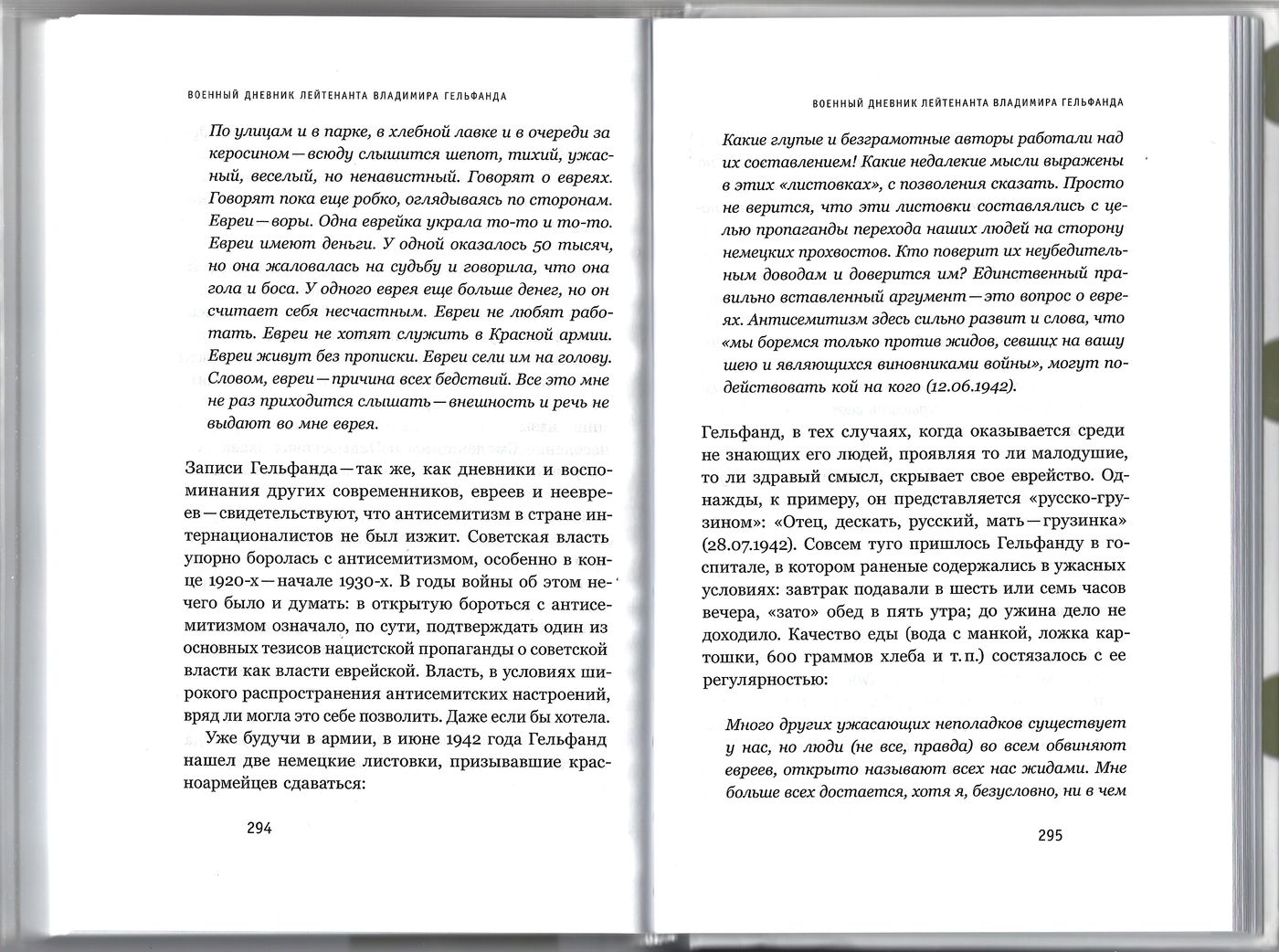
Pages 294–295
“In the streets and in the park, in the
bread shop and in the queue for kerosene—everywhere, in whispers,
quietly, terribly, cheerfully, but with hatred, they talk about Jews.
They say worse of Jews, look askance at me. Jews are thieves. A Jewish
woman stole this and that. Jews have money. One had fifty thousand, but
she complained about her fate and said she was hungry and poor. Another
Jew has even more money, but he considers himself unfortunate. Jews do
not like to work. Jews do not want to serve in the Red Army. Jews live
without residence permits. The Jews have climbed onto their heads. In
short, Jews are the cause of all calamities. I have heard all this more
than once—outwardly calm, though inwardly the Jew in me has cried
out.”
Gelfand’s entries—as well as diaries
and memoirs of other contemporaries, Jews and non-Jews—show that
antisemitism had not been eradicated in the country of
internationalists. Soviet power stubbornly fought antisemitism,
especially in the late 1920s and early 1930s. During the war it was
better not even to think about it: openly combating antisemitism meant,
in effect, confirming one of the principal theses of Nazi propaganda
about Soviet power as Jewish power. In conditions of broad
dissemination of antisemitic attitudes, the authorities were hardly in
a position to permit that, even had they wanted to.
Already in the army, in June 1942, Gelfand found two German leaflets calling on Red Army men to surrender:
“What stupid and illiterate authors
worked on their composition! What shallow thoughts are expressed in
these ‘leaflets,’ if I may say so. I simply cannot believe
these leaflets were prepared with the deliberate propaganda aim of
turning our people over to the German scoundrels. Who will believe
their unconvincing arguments and trust them? The only correctly
inserted argument is the Jewish question. Antisemitism is strongly
developed here, and the words that ‘we fight only against the
Jews who have sat on your necks and are the culprits of the war’
may have some effect on some people.” (June 12, 1942)
When among people who did not know him, Gelfand,
whether from youthful foolishness or common sense, concealed his
Jewishness. Once, for example, he introduced himself as
“Russian-Ukrainian”: “Father, they say, is Russian,
mother Georgian” (July 28, 1942). Gelfand had to taste the
consequences of this in a hospital where the wounded were kept in
appalling conditions: breakfast was served at six or seven in the
evening, “then” lunch at five in the morning; food was
insufficient. The quality of the food—water with semolina, a
spoonful of potatoes, 600 grams of bread and so on—matched its
irregularity:
“Many other terrible disorders exist
here, but people—not all, it is true—blame the Jews for
everything, openly call all of us ‘Yids.’ I get the worst
of it, although I am, of course, not guilty of anything. They take out
their anger on me and insultingly shout ‘Yid’ at me, swear,
and never allow me to say a word or make a comment when they make a
mess and eat at my table.” (December 29, 1942)
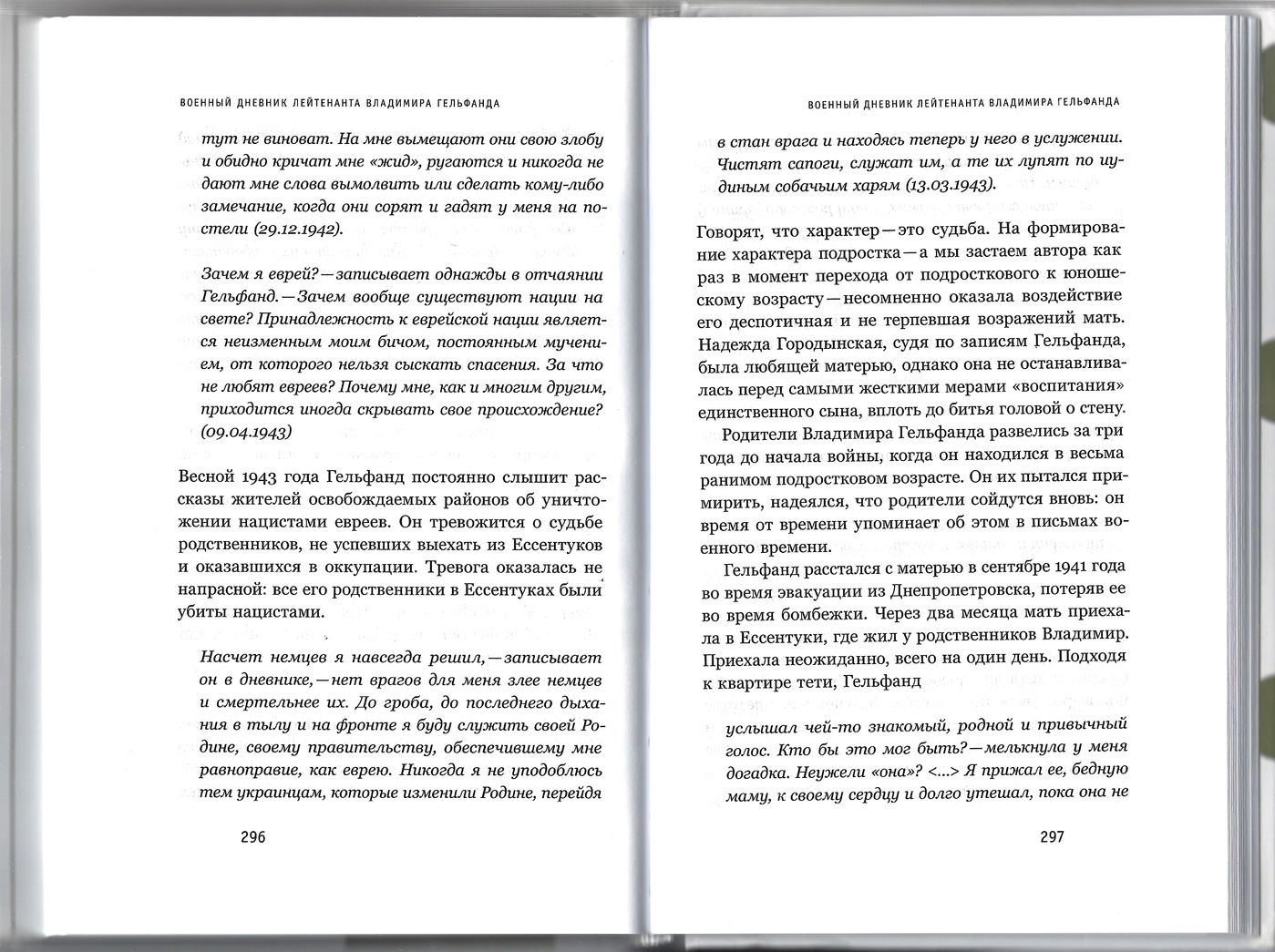
Pages 296–297
“Why am I a Jew?” Gelfand once
writes in despair. “Why do our people on earth exist at all?
Belonging to the Jewish nation is an indelible stain on my being, a
permanent torment from which there is no salvation. Why are Jews not
loved? Why do I, like many others, sometimes have to hide my
origin?” (April 9, 1943)
In the spring of 1943 Gelfand constantly heard
accounts from inhabitants of liberated districts about the
extermination of Jews by the Nazis. He worried about the fate of
relatives who had failed to leave Essentuki and had remained under
occupation. His fears were justified: all his relatives in Essentuki
were murdered by the Nazis.
“As for the Germans, I have decided once
and for all,” he writes in his diary, “there are no enemies
more vicious and deadly to me than the Germans. To the grave, to my
last breath, I will be on the side of my Motherland, my government,
which guarantees me equality as a Jew. I will never become like those
Ukrainians who betrayed the Motherland, went over to the enemy camp and
now serve him in humiliation. They clean boots, serve them, and the
Germans beat them on their filthy dog-like faces.” (March 13,
1943)
People say character is destiny. The formation of
an adolescent’s character—and we encounter the author
precisely at the transition from adolescence to youth—was
unquestionably affected by his despotic mother, who tolerated no
objections. Nadezhda Gorodinskaya, judging from Gelfand’s
entries, was a loving mother, but she did not stop short of the
harshest “educational” measures for her only son, even
beating his head against a wall.
Vladimir Gelfand’s parents separated three
years before the war, when he was at a very vulnerable adolescent age.
He tried to reconcile them and hoped they would come together again;
from time to time he mentions this in wartime letters.
Gelfand parted from his mother in September 1941
during the evacuation from Dnepropetrovsk, losing track of her during a
bombing raid. Two months later she came to Essentuki, where Vladimir
was staying with relatives. She arrived unexpectedly, for just one day.
Approaching his aunt’s apartment, Gelfand heard a familiar, dear
and habitual voice. “Who could it be?” flashed through his
mind. “Could it really be her?” He pressed his poor mother
to his heart and comforted her for a long time until she stopped crying.
Pages 298–299
“These were tears of joy, tears of
grief, tears of longing for the past and despair before the future. But
then the first minutes of this unforgettable meeting with my mother
passed, and our conversation took its ordinary form. Mother’s
mood returned to the condition it had been in before my
appearance...” (October 31, 1941)
There followed a conversation full of
reproaches—perhaps in some respects justified—but attempts
by the son to explain himself led only to his mother’s face
becoming distorted and taking on a savage expression. Gelfand wrote:
“Before me was the same mother as
before, the same old unpleasant pictures of our life together. I was
thrown into a fever at the memory of it. Mother’s face became
alien and unpleasant, as it had in moments of our quarrels, when she
lost control and, contrary to me and herself, to hell with everything
that came to hand.” (October 31, 1941)
In family quarrels there is rarely a single
“right” side, but that is not the point here. The methods
of upbringing used by Vladimir’s mother were highly peculiar and
hardly helped the child grow self-confident. The psychological traumas
received in childhood were apparently never overcome by Vladimir.
Almost five years after the difficult scene described above in
Essentuki, after the war, Gelfand wrote:
“Mother is nervous and difficult. She
could rarely caress me as I would wish, but almost always she scolded
me and was cold. In my heart I felt she loved me passionately and
tenderly, but in my mind such love did not fit with her manner toward
me. As a child I was spoiled by incomparable warmth, but at that time I
had not yet encountered a cruel coldness from my mother; loving
feelings prevailed over all others, and so grievances were soon
forgotten in wild affection—upside down from my head—and
with evil reproaches and a fight by every possible means.” (July
1, 1946)
However that may be, Vladimir Gelfand was not
distinguished by strength of character. His comrades quickly recognized
his weakness—as often happens in any closed male community, where
the weaker person becomes an object of mockery and abuse, a
“victim.” This happened to him almost everywhere. The
soldiers did not obey him, both when, as a future private, his rank was
seniority, and when, after becoming a lieutenant, he commanded them on
perfectly legal grounds. This was partly explained by his young age and
inexperience: men who were less educated but older and with some
understanding of life did not wish to submit to him. It was partly
explained by the “strangeness” of his behavior: a commander
who was constantly writing something plainly seemed odd to them. Add
Gelfand’s idealism and his fierce fight for the triumph of
justice, expressed among other things in reports to his superiors, and
it is not surprising that he often found himself an outcast.
Pages 300–301
The soldiers, sensing weakness, took advantage of
it. Once a signal sergeant from a neighboring unit drove Gelfand out of
a trench the sergeant himself had dug. Among other things, the sergeant
justified his behavior by saying that although Gelfand was a commander,
he belonged to another unit and therefore the sergeant was not obliged
to obey him (November 11, 1943). There were plenty of officers who
would simply have shot the sergeant on the spot—and would
probably not have been punished for it—but the diarist preferred
to leave. Evidently the sergeant, like other soldiers who allowed
themselves to cross the line in relation to a commander, sensed that in
this case a bullet did not threaten him.
Gelfand was quite aware of his own peculiarities.
Once he recorded a fellow soldier’s story that he had been
expelled from school seven times, commenting:
“How I now regret that only once, and
even then for a few days, was I expelled from school. It would have
been better if in childhood and youth I had been a brawler and hooligan
rather than such an indecisive and trusting person as I am now.”
(July 17, 1944)
Gelfand’s truth-seeking, his desire to bring
life into conformity with newspaper articles and Party directives, did
not contribute to a good attitude toward him. He knew this perfectly
well:
“The Party organizer of the regiment
gave me a questionnaire for joining the Party. I will have to write a
statement and an autobiography—the questionnaire I filled out,
but I did not do the rest. I have been a candidate for about ten months
already. It is time to become a member. I want to hurry before they get
to know me better here, because later I will quarrel or argue with
someone among the superiors, and then the Party will not see me as its
own, just as I could not see my ears without a mirror.” (October
11, 1943)
Not long before the end of the war he stated:
“Yes, fate did not offend me, having
endowed me generously with appearance and intelligence. But my
character ruins my impressions of those around me and turns them away
from me. That is why life is so difficult for me in this world; that is
why I am often insulted by my comrades without cause and
unjustly.” (March 22, 1945)
It seems that Gelfand felt relatively comfortable,
morally speaking, when circumstances left him alone—for example
on the road from a hospital back to his unit—or at the front,
especially during combat operations. The latter statement may seem
strange at first, but it is precisely the conclusion one reaches from
reading his accounts of fighting, often written under fire or during
brief pauses in battle. Here is one such entry:
“Yesterday I fired all day. I released
about seven hundred mortar bombs, so as not to lie. How many
‘cucumbers’ I shot, as they call them on the telephone
here, nobody counted; only they asked every minute how many mines
remained...”
Pages 302–303
“I was also responsible for the
logistical and administrative work—bringing up mines, vodka,
food—and combat work—training mortar men, cleaning mortars,
sight adjustment, positioning men and maintaining order in the battery,
and the very process of firing—as well as political
work—distributing and reading newspapers. I commanded the whole
machine with satisfaction—four mortars are my command—and
it was pleasant to shout loudly, feeling the eyes of soldiers and
superiors passing us, admiring the simultaneity of the shots and the
beauty of the firing.” (November 11, 1943)
Gelfand, it seems, lacked fear of death, convinced that nothing would happen to him.
“The German has begun firing from
Vanyusha [a German multiple rocket launcher—O.B.]. There it is!
The earth trembled. Explosions all around, but so far they do not reach
us. Yes, what of it! Whatever is destined will happen! I will not
become nervous because of that, as some do—because the German
fires heavily and they begin shooting now here, now there at us.”
(November 18 or 19, 1943)
Death was often very close, but when it aroused
emotion in him it was more often astonishment than horror. One such
incident, which apparently occurred on October 18, 1943, is described
by Gelfand, who had already lost count of days amid continuous
fighting, “from the number”:
“When I went to the trench to rest,
shells began exploding. I took a head of cabbage with me into the
trench and began cleaning it. Suddenly a shell exploded. So close that
it deafened me. The trench collapsed, covered me with earth, and
finally something struck me painfully in the hand, in the chin, on the
lip, on the eyebrow. I immediately decided I had been badly wounded,
for I could not move my arm, and three streams of blood ran down my
face. For several minutes I could not get up. My head was buzzing, and
the impression of what had happened would not leave it. Finally I
decided to go and have a dressing put on. When I came out, everyone
cried, ‘Alive?!’ and then, ‘Wounded!’ I looked
at the shell hole and was astonished—the shell had fallen right
onto the edge of my trench near my feet. The wall collapsed, but one
fragment hit me in the face. I was not concussed precisely because the
shell fell past me and all its force was directed away from me. My face
was about a meter and a half from the explosion, plus the trench wall.
I looked at the pouches of mines lying in front of the trench—if
viewed from our side, from the rear—they were all cut by
fragments. Miraculously—again miraculously—I remained
whole. And when I was examined in the mirror, to my great surprise I
was convinced that I had been scratched by one small fragment. It flew,
apparently, alone, grazing my face in three places and stopping, it
seems, in the last—in my eyebrow. But it does not trouble me.
Only my hand hurts more when I touch it, for even the hole in the wound
was absent, although blood did flow. So I got off lightly this time as
well.”
Pages 304–305
On at least two occasions, other people were struck by enemy shells. On one occasion a shell lands in a trench from which Gelfand
had driven the signal sergeant mentioned above at an inconvenient hour;
on another, under intensified fire Gelfand gallantly gives up a deeper
trench to a young female medical orderly and moves into the next one:
“The trench was a little smaller than
the one in which Maria was, and I was one meter to her right. No sooner
had I moved into the trench than another shell howled, hissed violently
and struck the ground furiously. I fell backward in the trench, feeling
a terrible blow to my thigh and head. For a minute I could not come to
myself from all that had happened; when I recovered, I realized that
the shell had caused it all. My pilotka was not on my head, blood
sprayed from my nose and my temples ached dully. I threw off the earth
covering me and stood up; I began calling Maria. But she did not
answer. It was already dark, and I decided she had fallen asleep in the
trench. When the medical orderlies came at my call, they found one
place where Maria and her trench had been. The shell, flying to the
surface of the earth about ten meters away and making a long groove in
the ground, fell and exploded in Maria’s trench. Naturally
nothing remained of her but a memory...
“I never found my pilotka. Only in the
morning did I discover it meters away from the saving trench in which I
had been. Maria was dug up in the morning. They found one leg, kidneys,
and nothing more... Maria was buried and traces in the earth were left
without any sign or memory. I ordered my soldiers to make a T-shaped
plaque and, having written a small obituary on it in memory of Maria,
placed it on her grave. Thus ended the life of Maria Fedorova, born in
1919, an Astrakhan woman, medical orderly and candidate member of the
VKP(b), a sergeant major of the medical service.” (entry made in
mid-November 1943)
According to Ministry of Defense data,
twenty-one-year-old Maria Arkhipovna Fedorova, a medical-service
sergeant major, was killed on October 26, 1943. Vladimir Gelfand was
the last person to speak with Maria, and the entry in his diary is the
only eyewitness testimony to her death. Whatever one’s view of
Gelfand’s interpretation of events, his diary entries are
distinguished by accuracy, detail, and openness. Once again: this is a
valuable source for the history of everyday life in war—more
precisely, of life and death.
* * *
Vladimir Gelfand returned to his native
Dnepropetrovsk in early October 1946. His parents were already there.
His mother had returned to Dnepropetrovsk in 1944 and resumed her
former job at the Lenin Plant as secretary of the labor-organization
department. His father worked as commandant of a vocational school.
Pages 306–307
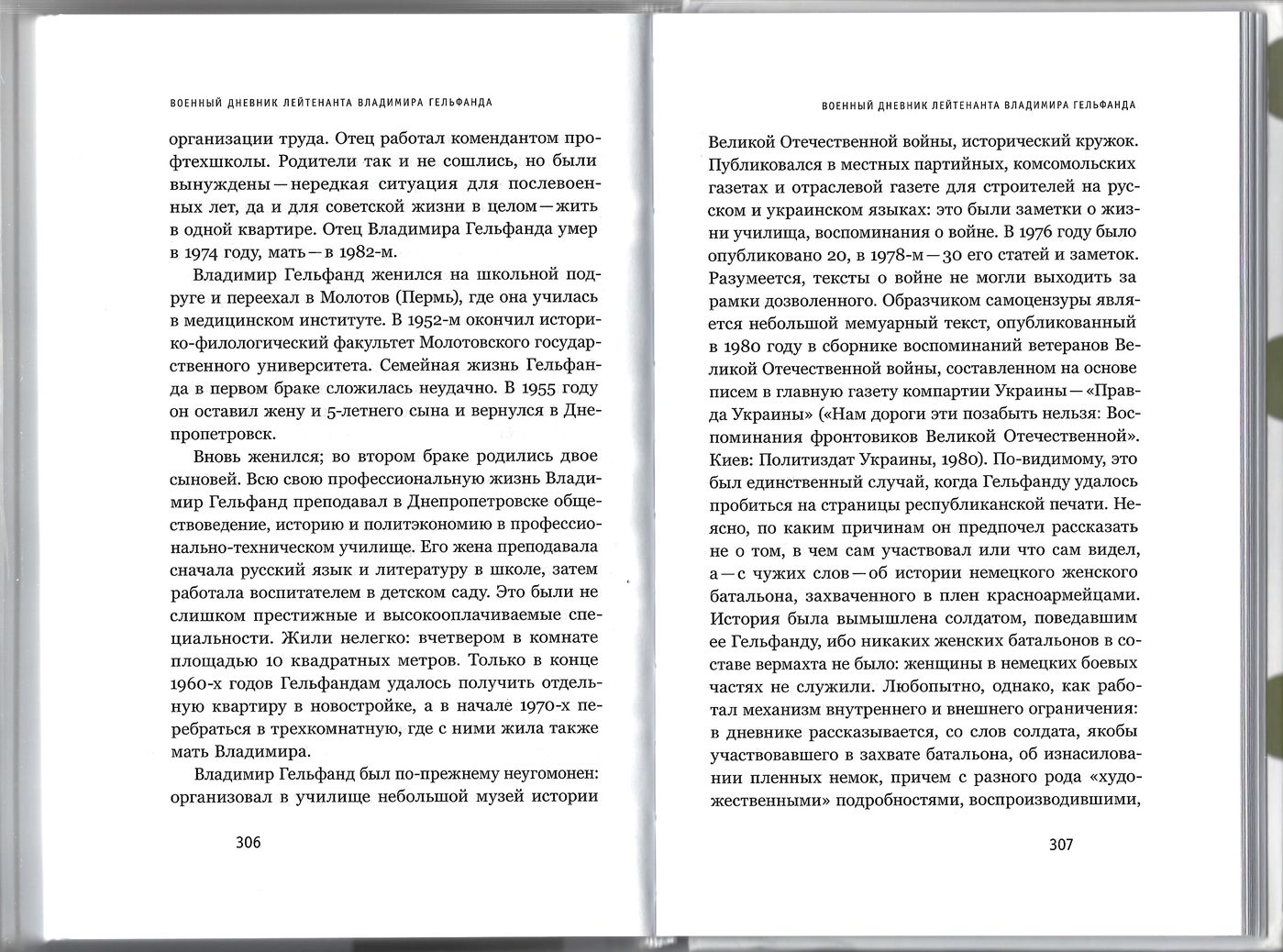
Gelfand’s parents never reconciled, but were
forced—a situation not uncommon in the postwar years, and indeed
in Soviet life generally—to live in the same apartment.
Vladimir’s father died in 1974, his mother in 1982.
Vladimir Gelfand married a school friend and moved
to Molotov (Perm), where she was studying at a medical institute. In
1952 he graduated from the Faculty of History and Philology of Molotov
State University. Gelfand’s family life in his first marriage was
unsuccessful. In 1955 he left his wife and five-year-old son and
returned to Dnepropetrovsk.
He married again; two sons were born in his second
marriage. Throughout his professional life Vladimir Gelfand taught
social studies, history and political economy at a vocational-technical
school in Dnepropetrovsk. His wife first taught Russian language and
literature at school and later worked as a kindergarten teacher. These
were not particularly prestigious or well-paid occupations. The
Gelfands huddled together in a ten-square-meter room. Only at the end
of the 1960s did they manage to obtain a separate apartment in a new
building; at the beginning of the 1970s they moved to a three-room
apartment, where Vladimir’s mother also lived with them.
Vladimir Gelfand remained tireless: he organized a
small museum of the history of the Great Patriotic War at the school
and a history club. He published in local Party and Komsomol newspapers
and in a trade newspaper for construction workers, in Russian and
Ukrainian—notes about life at the school and reminiscences of the
war. In 1976 around twenty of his articles and notes were published; in
1978 about thirty. Naturally, texts about the war could not exceed what
was permitted. A small memoir text published in 1980 in a collection of
recollections of Great Patriotic War veterans, based on letters to the
main newspaper of the Communist Party of Ukraine, Pravda Ukrainy,
serves as an example of self-censorship: “We Cannot Forget Those
Roads: Recollections of Front-Line Soldiers of the Great Patriotic
War.” Kiev: Politizdat Ukrainy, 1980. Apparently this was the
only case in which Gelfand managed to reach the pages of the republican
press.
It is unclear why he chose to tell not about what
he himself participated in or witnessed but, in other people’s
words, about the story of a German women’s battalion captured by
Red Army men. The story had been invented by a soldier who told it to
Gelfand, for the Wehrmacht never had any women’s battalions:
women did not serve in German combat units. It is curious, however, how
the mechanism of internal and external restriction worked. In the diary
the soldier’s account, supposedly from someone who had
participated in the battalion’s capture, tells of the rape of
female prisoners, complete with various “artistic” details
that reproduced, apparently, little more than the sexual fantasies of
Red Army men.
Pages 308–309
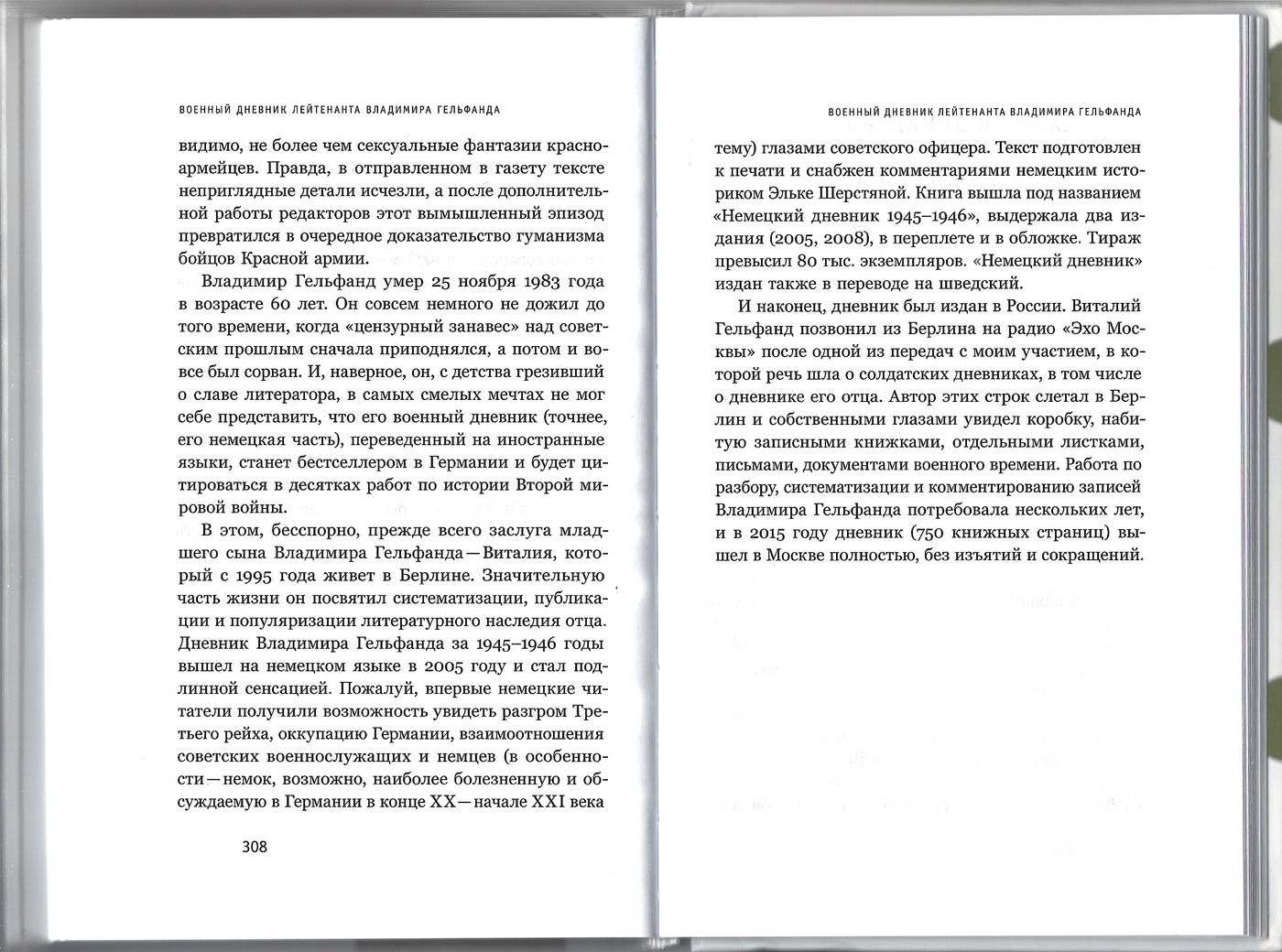
The diary account, however, was later transformed.
Unpleasant details disappeared in the newspaper version, and after
additional editorial work the invented episode became yet another piece
of evidence for the humanity of Red Army soldiers.
Vladimir Gelfand died on November 25, 1983, at the
age of sixty. He lived only a short time before the “censorship
curtain” over the Soviet past first began to lift and then
disappeared entirely. And, probably, even from the height of his
boldest dreams about literary fame, he could not have imagined that his
wartime diary—or rather, its German part—would be
translated into foreign languages, become a bestseller in Germany and
be cited in dozens of studies on the history of the Second World War.
The credit for this belongs above all to Vladimir
Gelfand’s younger son Vitaly, who has lived in Berlin since 1995.
He devoted a substantial part of his life to systematizing, publishing
and popularizing his father’s literary legacy. Vladimir
Gelfand’s diary for 1945–1946 appeared in German in 2005
and became a genuine sensation. Perhaps for the first time German
readers had the opportunity to see the defeat of the Third Reich, the
occupation of Germany, and relations between Soviet servicemen and
German women—especially German women, perhaps the most painful
and controversial subject in Germany at the end of the twentieth and
beginning of the twenty-first century—through the eyes of a
Soviet officer.
The text was prepared for publication and supplied
with comments by the German historian Elke Scherstjanoi. The book
appeared under the title Germany Diary 1945–1946, went through
two editions (2005 and 2008), in both hardcover and paperback, and its
print run exceeded 80,000 copies. The Germany Diary was also published
in Swedish translation.
Finally, the diary was published in Russia. Vitaly
Gelfand called from Berlin to Ekho Moskvy radio after one of the
programs in which the author of these lines had discussed diaries,
including his father’s. The author flew to Berlin and saw with
his own eyes a box filled with notebooks, loose sheets, letters and
wartime documents. It took several years to sort, systematize and
comment on Vladimir Gelfand’s entries, and in 2015 the
diary—750 printed pages—was published in Moscow in full,
without omissions or abridgments.








 Russian