


Norrköpings
Tidningar
"En blick från andra sidan"
 |
 |
 |
|
 |
 |


A View from the Other Side
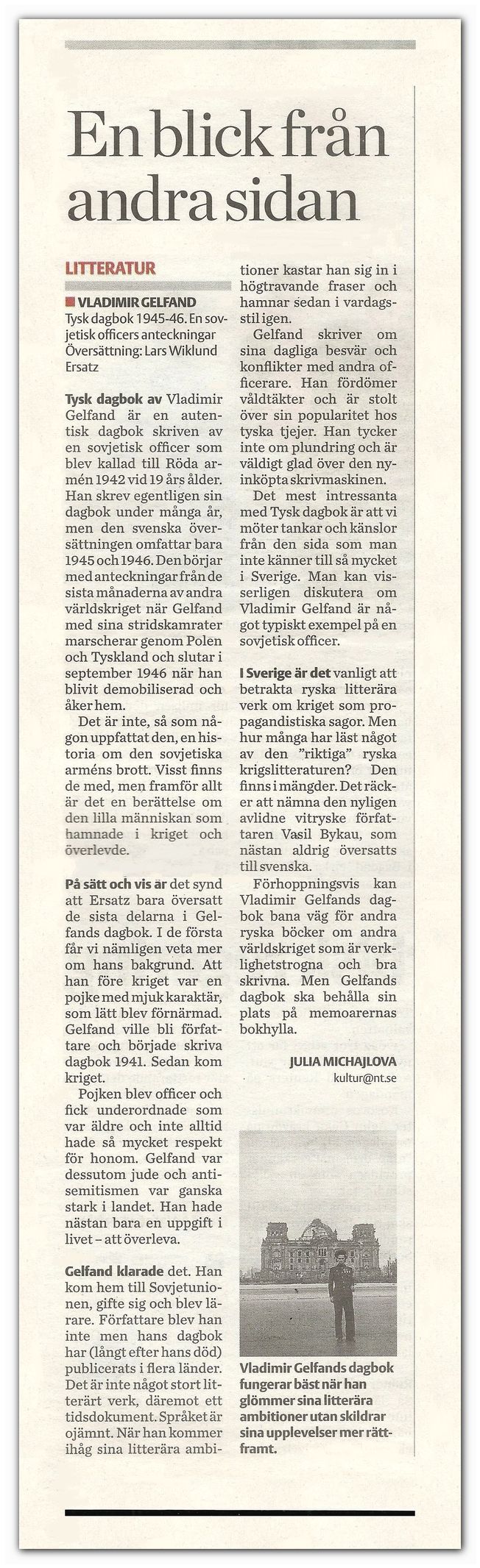
Vladimir Gelfand's Germany Diary is an authentic diary by a Soviet officer who was called into the Red Army in 1942 at the age of nineteen. He actually kept a diary for many years, but the Swedish edition covers only 1945 and 1946. It begins with the final months of the Second World War, when Gelfand and his comrades marched through Poland and Germany, and ends in September 1946 when he was demobilized and returned home.
This should not be understood simply as a story about crimes committed by the Soviet army. Such episodes are certainly present, but above all it is the story of an ordinary individual who found himself in a war and survived.
In one respect it is regrettable that Ersatz translated only the later portions of Gelfand's diary, because the earlier entries explain his background. Before the war he was a gentle and easily hurt young man who wanted to become a writer and began keeping a diary in 1941. Then the war came. The boy became an officer, and older subordinates did not always respect him. Gelfand was also Jewish at a time when antisemitism remained strong. He had one overriding aim: to survive.
He succeeded. Gelfand returned to the Soviet Union, married and became a teacher. He never became the writer he had hoped to be, but many years after his death his diary was published in several countries. It is not a great literary work so much as a document of its time. The language is uneven: when he remembers his literary ambitions he reaches for an elevated style, then falls back into ordinary everyday prose.
Gelfand writes about daily problems and conflicts with other officers. He condemns rape and takes pride in his popularity with German girls. He dislikes looting, yet is delighted when he manages to acquire a new typewriter.
The most interesting aspect of Germany Diary is that it gives us thoughts and feelings from a side of the war that is relatively unfamiliar in Sweden. One can debate whether Vladimir Gelfand was a typical Soviet officer.
In Sweden Russian literary works about the war are often dismissed as propaganda tales. But how many readers have encountered genuine Russian war literature? There is a great deal of it. One example is the recently deceased Belarusian writer Vasil Bykau, whose work was almost never translated into Swedish.
One may hope that Vladimir Gelfand's diary will help open the way for other Russian books about the Second World War that are both truthful and well written. Gelfand's diary will in any event retain a place on the shelf of important memoirs.
Julia Mikhailova