



 |
 |
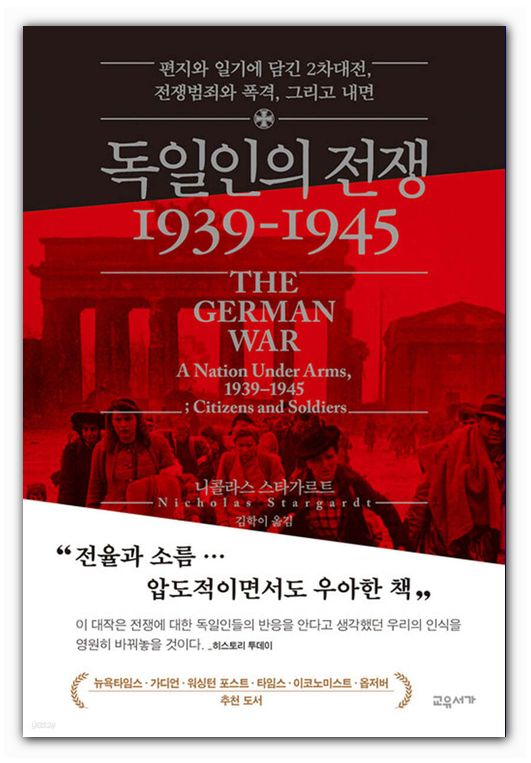
| 니 콜라스 스타가르트 저 / 김 학이 역 | 교 유서가 | 2024 년 02월 29일 | |
| |
|
 
|
|
| |
|
| 책소개 그들은 알고 있었다. 학살과 폭격의 의미를 히틀러, 괴벨스, 독일군, 독일 시민 승자와 가해자, 공포와 희망의 뒤섞임 일기와 편지와 법정 기록으로 들여다보는 전범국의 내면 “탁월하다! 이 책이 우리를 사로잡는 이유는 저자가 광범한 정치적?군사적 전개를 생생한 일상사와 결합시키기 때문이다. 나치 수뇌부의 비밀스러운 책략가로부터 평범한 독일인들이 그것들을 경험하면서 갖게 된 믿음과 감정으로 나아간다.” _가디언(The Guardian) * 영국 펜(PEN)이 수여하는 헤셀틸트먼상 수상작(역사 부문) 독일인들은 무엇을 위해 싸웠는가? 그들에게 2차대전은 나치즘보다 정당했다 1944년 11월 17일, 독일군 장교인 빌름 호젠펠트는 바르샤바의 한 주택에 들어섰다. 해골 모습의 유대인이 부엌에서 음식을 찾고 있었다. 밤이 되자 호젠펠트는 유대인이 피아노로 연주하는 쇼팽의 곡에 귀기울였다. 그 유대인이 바로 영화 〈피아니스트〉에 등장하는 브와디스와프 슈필만이다. 호젠펠트는 슈필만이 건물 다락에 숨도록 도와주었다. 그 후 몇 주 동안 정기적으로 음식도 가져다주었다. 1936년과 1938년의 뉘른베르크 나치당 전당대회에서 강렬하고 신비스러운 전율을 느꼈던 독일군 장교와 호젠펠트는 동일한 인물이다. 그는 모순적인 인물이었다. 그렇다면 호젠펠트는 2차대전에서 무엇을 위해 적과 싸웠을까? 독일이 일으킨 전쟁은 그의 내면을 어떻게 변화시켰을까? 그리고 언제 그는 독일의 전쟁범죄를 인식했을까? 이 책은 2차대전 사료로 독일인의 혼란스러운 속내에 접근한다. 집이나 길거리에서 포착된 수많은 내밀한 이야기로 2차대전의 편견을 헤집는다. 일기, 편지, 보고서, 법정 기록에 담긴 독일인의 생생한 육성은 전체주의의 전쟁범죄에 숨은 낯설고 새로운 진실을 증언한다. 그 진실이란 독일 국민이 패전의 순간까지 적극적으로 2차대전에 임했다는 사실이다. 이 책은 그들이 내면에 품었던 민족방어 전쟁 논리가 나치즘과 결부되며 어떻게 발전했는지 뒤따라간다. 이 책의 저자는 정보의 넓이를 담보하고자 편지와 일기와 공문서 등을 검토했다. 슈투트가르트 현대사도서관에서 편지 약 2만 5천 통을 살펴보거나 베를린 예술아카데미, 독일 일기아카이브, 베를린에 있는 독일 역사박물관과 커뮤니케이션 박물관 전선병사 아카이브와 독일 연방문서보관소, 프라이부르크 독일 연방문서보관소-군사아카이브를 찾아갔다. 정보원들의 공문서, 독일군 우편행낭을 무작위로 검사한 검열관들의 보고서, 개인의 비밀스럽고 솔직한 일기 등을 채록했다. 정보의 깊이를 확보하고자 저자는 사회적 출신이 각양각색인 사람 중에서 특정 개인들을 선택했다. 그들의 사적인 희망과 계획이 전쟁 과정과 어떻게 얽히는지 오랫동안 추적했다. “이 책은 그 길었던 전쟁에 관한 이야기이다. 이 책은 그 전쟁에서 발생한 독일 사회의 변화를 목록화하고 갈수록 통제할 수 없다고 느끼게 된 전쟁에 각 개인이 적응해간 미묘한 방식들, 종종 되돌릴 수 없던 그 방식들을 기록한다. 또한, 이 책은 사람들이 자신을 형성해간 사건들을 통과하면서 겪은 변화하는 기대와 파동하는 희망과 두려움을 기록한다. 그들의 구체적인 삶은 경험을 재는 감정적인 잣대인 동시에 자기 파괴의 길을 가던 한 사회를 나타내는 도덕적 기압계였다.” _48쪽 저자는 전쟁에 대한 해석이 학문적 연구와 대중적 의식 모두에서 둘로 나뉜다고 주장한다. 그 두 가지 해석은 전쟁 시기의 독일인을 이야기할 때 상충한다. 한쪽은 모든 독일인을 희생자로 간주하고 다른 쪽은 모든 독일인을 가해자로 분류한다. 저자는 2005년의 종전 50주년 기념 과정들을 지켜보며 이 책의 출발점인 생각과 마주했다. 그는 기존의 역사가들이 올바른 교훈을 전쟁사에서 이끌어내려다가 역사 연구의 본질적 과제 중 하나를 외면했다고 판단했다. 그것은 역사가가 무엇보다도 우선 과거를 이해해야 한다는 사실이다. 1939년 8월 26일에 동원령이 공포되었을 때 독일인은 미래를 몰랐다. 그들은 과거를 떠올렸다. 1차대전 패전이라는 불안한 그림자가 그들에게 드리웠다. 전쟁의 위기가 사회를 과격하게 변화시킨다는 생각은 나치 정권과 독일 사회의 관계를 재고하게 한다. 역사가 대부분은 함부르크 폭격과 스탈린그라드 패배가 독일인을 패배주의로 몰아넣었다고 가정했다. 그러나 독일인은 전쟁을 포기하지 않았다. 나치즘 때문이 아니었다. 그들의 복잡하고 혼란스럽고 역동적인 내면에 집중하는 이 책은 상식과 다르게 2차대전을 설명한다. 독일인에게 2차대전은 나치즘보다 정당했다. 그 이유는 전쟁이 생산해낸 종말론에 있었다. 그들은 의도적이고 폭력적인 정복 전쟁을 민족 방어 전쟁으로 여겼다. 전황이 악화될수록 애국적 헌신으로 더욱 단호히 제 나라를 방어하려고 했다. 독일 사회가 종말론적 사고방식을 수용한 일이야말로 2차대전 후반기에 독일인에게 발생한 결정적 변화였다. 목차 지도 서언 편지와 일기의 주요 주인공들 |
|
 |
 |
 |
 |
책 속으로이 책은 내가 지난 20년 넘게 2차대전 동안 독일에 살았거나 독일 점령하에 살았던 사람들의 경험을 이해하려고 노력한 결과물이다. 원래 나는 이 책을 쓰려고 하지 않았다. 나는 2005년에 『전쟁의 증인들: 나치 치하 어린이들의 삶』을 발간한 뒤, 나 자신과 그리고 내 이야기를 들으려 하던 다른 이들에게 이제 더는 어린이, 홀로코스트 혹은 나치 독일에 대하여 쓰지 않겠다고 약속했었다. 이 책은 2차대전에서 독일인들이 무엇을 위해 싸웠는가에 대한 짤막한 논문으로 시작되었다. 나는 그 문제에 대해 뭔가 말해야 앞으로 나아갈 수 있다고 느꼈다. 그 작업이 내가 2006~2007년에 베를린 자유대학교에서 안식년을 보내는 동안 커지기 시작했다. p.17 이 책은 그 길었던 전쟁에 관한 이야기이다. 이 책은 그 전쟁에서 발생한 독일 사회의 변화를 목록화하고 갈수록 통제할 수 없다고 느끼게 된 전쟁에 각 개인이 적응해간 미묘한 방식들, 종종 되돌릴 수 없던 그 방식들을 기록한다. 또한, 이 책은 사람들이 자신을 형성해간 사건들을 통과하면서 겪은 변화하는 기대와 파동하는 희망과 두려움을 기록한다. 그들의 구체적인 삶은 경험을 재는 감정적인 잣대인 동시에 자기 파괴의 길을 가던 한 사회를 나타내는 도덕적 기압계였다. p.48 학살 작전은 대부분 사람들 눈을 벗어난 숲이나 연병장에서 자행되었지만, 일부는 구경꾼들 앞에서 벌어졌다. 1939년 10월 7일 토요일 저녁 스비에치에 주둔중이던 병사들이 그날 낮시간에 벌어진 학살 작전에 대하여 이야기를 나누었다. 작전은 다음날 일찍 재개될 예정이었다. 그날 아침 이른 시각 파울 클루게 상병이 학살 구덩이 가까이로 갔다. 학살 기록을 남긴 병사들은 흔히 자신이 목격한 첫 장면을 기록한다. 그때 받은 인상이 가장 강렬하기 때문이다. 클루게는 기록했다. 버스가 유대인 묘지에 도착하고 한 여성이 아이 셋과 함께 내렸다. 가족은 30미터를 걸어 구덩이까지 갔다. 여자는 막내는 품에 안은 채 구덩이 안으로 기어내려갔고, 이어서 위에 서 있던 다른 한 아이를 안아서 구덩이 바닥에 내려놓았다. 마지막 아이는 친위대원이 들어서 아래로 건네주었다. 여자가 아이들과 함께 구덩이 안에 엎드렸다. 클루게는 구덩이 안을 들여다볼 수 있는 곳까지 갔다. 친위대원 네 명이 20센티미터 떨어진 지점에서 엎드린 네 사람의 목에 총을 겨누었다. 일을 끝낸 그들이 구경하던 클루게에게 시체를 흙으로 덮으라고 요구했다. 클루게는 주저하지 않고 복종했다. p.75~76 알브링과 몰덴하우어와 달리 독일군에는 ‘처형 여행자들’이 많았다. 그들은 유대인들과 빨치산들이 공개적으로교수되는 모습을 찍었다. 예비경찰대 대원 헤르만 기셴은 브레멘에서 가게를 하던 사람이었다. 그는 자신의 경찰 대대가 어려운 과제를 맡았다는 것을 알고 있었다. 그는 그 일이 ‘폴란드에서와 조금 비슷할 것’이라고 상상했다. 리가에서 그는 영사기를 구입했다. 경찰 대대가 라트비아와 러시아에서 행할 작전을 찍어놓으면 그 필름이 ‘후에 기록이 되고 우리 아이들에게 매우 흥미로울 것’이라고 기대한 것이다. 1941년 8월 7일 그는 아내 한나에게 그의 경찰대가 벌인 작전에 대하여 썼다. 전날 밤 ‘유대인 150명이 사살되었어. 남자들, 여자들, 아이들, 모두 제거되었어. 유대인들은 완전히 절멸되고 있어. 사랑하는 H, 제발 그것에 대해 아무 생각도 하지 말아요. 그것은 그냥 그래야 해요.’ p.252 1941년 11월 초 그 포로수용소에 친위 특공대가 도착했다. 전쟁포로와 민간인 중에서 유대인을 빗질하기 위해서였다. 특공대는 그때 가려낸 유대인들 일부를 시멘트 공장 지하실에서 사살했다. 야라우쉬는 집에 보낸 편지에서 그 일에 대하여 암시만 했다. 그에게 러시아어를 가르쳐주던 포로는 절반의 유대인이었는데, 야라우쉬는 아내 샤를로테에게 보낸 편지에 그 남자에게 어떤 일이 벌어졌는지 쓰지 않았다. 다만 ‘유대인들이 맨발로 눈 위를 걷는 것’을 보았다고, ‘내가 막을 수 없던 힘든 것들이 매우 고통스러운 인상을 주었는데, 그 일에 대해서는 (집에서) 말로 설명하겠다’라고만 썼다. 이틀 뒤 그는 새로운 러시아어 선생으로서 자신과 마찬가지로 학교 교사인 모스크바인에 대해서는 보다 열성적으로 묘사했다. 그가 투르게네프 소설을 큰 소리로 읽어주자 ‘마치 내가 그 나라의 영혼을 만지는 느낌, 그 영혼이 스스로를 지각하고 아는 방식으로 그 영혼을 만지는 느낌’을 받았다. p.279~280 한스 알브링은 집단군중부 후미의 소도시 벨리시에서 겨울을 났다. 1942년 1월 말 소련군이 공격해오자 병사들은 끔찍한 조건 속에서 8주일을 버텼다. 씻지 못하고, 이에 갉히고, 배고픔에 시달리던 한스는 그 상황을 ‘최후의 심판과 비교하는 것이 지나친 과장은 아니’라고 믿었다. 1942년 3월 21일 그는 친구 오이겐 알트로게에게 ‘이 경험 속에서 나는 잃은 것보다 더 많은 것을 얻었다’라고 쓴다. 소련군의 공격이 멈추고 2주일이 지난 뒤 알브링은 뮌스터의 가톨릭 선배로부터 받은 편지에 열광했다. 알브링은 그 편지를 길게 인용함으로써 그동안 자기가 갖게 된 관점을 분명히 했다. ‘그리고 누가 알겠어. 우리가 지난 수백 년 동안 그릇되고 갈수록 왜곡되어간 인간관을 추종하다가 이제야 비로소 새롭고도 진정한 인간관이 우리 내면에서 올라오고 있다는 것, 아마 그것이 이 전쟁의 형이상학적인 의미일 거야.’ p.308 결단했다. ‘오늘 우리는 함께 죽음으로 간다.’ 예수가 손을 들어 식사를 축복하는 그림을 걸어놓고 그들은 바닥에 엎드려서 그 그림과 서로의 얼굴을 바라보았다. 수면제와 가스가 작동하고 있었다. p.374~375 의 유대인과 과장 아돌프 아이히만과 만날 수 있도록 주선했다. 아이히만은 클레퍼에게 아무에게도 발설하지 말라고 경고하면서 말했다. ‘알았다는 최종적인 답을 드릴 수는 없습니다. 그러나 일은 잘 진행될 거라고 생각해요.’ 클레퍼가 이번에도 아내 얘기를 꺼내자 아이히만이 단호하게 답했다. ‘합동 이민은 허용되지 않습니다.’ 다음날 오후 아이히만이 레나테 문제의 결과를 알려주겠다며 클레퍼를 호출했다. 1942년 12월 10일의 두번째 만남에서 아이히만은 레나테의 출국 비자가 거부되었다고 통고했다. 요헨, 요한나, 레나테는 그들 방식으로 독일을 떠나기로 1945년 4월 중순 독일군 군집단B에게는 무기와 탄약이 없었고, 군대는 루르의 숲과 도시 속으로 용해되고 있었다. 4월 15일 아우구스트 퇴퍼빈의 도시 졸링겐 시민들이 탱크 방어벽을 허물었고, 이튿날까지 그곳의 거의 모든 군인에게 민간인 옷을 건네주었다. 심지어 육군 소령조차 명령권을 포기한다고 선언했고, 이어서 맞지 않는 슈트를 걸치고 스포츠 모자를 썼다. 1945년 4월 17일, 졸링겐이 함락된 그날 군집단B의 총사령관 발터 모델 장군이 군대에 ‘해산’ 명령을 내림으로써 부대가 미군에게 항복하는 것을 피했다. 장군 30명을 포함하여 31만 7천 명이 포로로 잡혔다. 모델은 상식과 충성의 자부심 사이에서 괴로워하다가 히틀러가 스탈린그라드의 파울루스 장군이 행하기를 원했던 행동을 실천했다. 그는 숲으로 들어가 권총으로 자살했다. 다음날 미군 제97보병사단이 뒤셀도르프에 진입했다. 마리안네 스트라우스는 독일 당국에 체포될지 모른다는 공포에 너무나 시달렸던 나머지 열흘 뒤에야 자신이 안전하다는 것을 깨달았다. p.712~713 |
 ‘관심과 커다란 만족감’을 보여주었다. 강제이송 작전은 1938년 11월의 포그롬 이후 처음으로 유대인에게 가해진 집단적 가해 스펙터클이었다. 1938년의 포그롬이 히틀러청소년단과 독일소녀연맹의 소년 소녀들이 가세한 대중 축제가 되었던 바로 그 장소에서, 아직 떠나지 않고 있던 유대인들이 줄을 지어 걸어가는 행렬을 향하여 신구新舊 욕설들로 범벅이 된 구호들과 저주가 쏟아졌다. ‘저 건방진 유대인들을 보라!’ ‘이제 저들은 게토로 간다!’ ‘쓸모없는 식충 무리들!’ 바트 노이슈타트에서 늙고 못 먹은 유대인들이 시장 광장에 집합하자, 나치 활동가들이 사진을 찍었다. 그후 그 사진들은 포스터 크기로 확대되어 도시 중심가에서 전시된다. 유대인 행렬이 시장 광장에서 기차역으로 출발하자 ‘시끄럽게 떠드는 학동들 무리’가 기차역까지 행렬을 따라갔고, ‘기차가 떠날 때까지 소리를 질렀다.’ p.343 키이우에 유대인이 한 명도 남지 않았다고 알렸다. 1942년 6월에 휴가를 나왔을 때 발터는 자신이 목격한 대량 학살과 다른 병사에게서 들은 프랑스 유대인 가스 학살에 대하여 카를 뒤르케펠덴과 대화를 나누었다. 뒤르케팔덴은 일기에 고백했다. ‘발터가 거듭해서 강조했다. …… 우리가 유대인이 아니라는 사실이 얼마나 다행인지 몰라.’ 카를이 충격을 받자, 발터가 설명을 내놓았다. ‘나도 처음에는 이해하지 못했어. 그러나 나는 이제 알아. 우리가 죽느냐 사느냐가 걸린 문제야.’ 처남은 히틀러가 끊임없이 반복했던 주문呪文을 수용했던 것이다. 민족이 종말론적인 선택에 직면했다. ‘사느냐 죽느냐 그것이 문제다’. 카를이 반박했다. ‘그러나 그것은 살인이잖아’. 발터가 곧바로 내놓은 대답은 바로 나치 언론이 공급한 대답이었다. ‘이제까지 진행된 것으로 확실해진 것은, 우리가 패배하면 그들은 우리가 그들에게 행했던 바로 그것을 우리에게 행할 것이라는 거야.’ 카를 뒤르케팔덴은 대화를 끝내야 한다는 것을 알았다. 처남에게 반대하면 가족 안에 공개적인 균열을 일으킬 위험이 있었다. 최악의 경우에는 게슈타포로 밀고가 들어갈 수도 있었다. 그러나 그보다는 가족 내 관계가 뒤틀리고 자신이 고립될 가능성이 컸다. p.353~354 있었다. 그녀는 유대인 혈통의 가톨릭 개종자들이 발트해 지역으로 이송된 뒤 어떤 일이 일어났는지 정보를 수집하고, 또 주교들에게 전달했다. 그녀는 내무부 고위 관리인 한스 글로프케로부터 비밀 정보를 얻기도 했다. 좀머가 보고한 바에 따르면, 오스나브뤼크의 주교 베르닝이 1942년 2월 5일에 확언했다. ‘유대인을 완전히 절멸시키려는 계획이 분명 존재한다.’ 이는 하이드리히가 비밀 반제회의, 즉 고위 행정관리들에게 1,100만의 유럽 유대인의 임박한 학살에 대하여 알린 고위급 회의가 열리고 2주일밖에 지나지 않은 시점이었다. 그러나 베르닝과 프라이징이 ‘인권을 조롱하는 방식으로 비아리아인들을 이송하는 것’에 대하여 항의하는 진정서를 주교회의에 상정했을 때는 그로부터 무려 18개월이 지난 시점이었다. 더욱이 1943년 8월의 풀다 주교회의는 그 제안을 거부했다. 거부하지 않았어도 실상 너무 늦은 시점이었다. 그때는 유대인 대부분이 사망한 뒤였다. 독일 가톨릭에서 가장 영향력이 컸던 베르트람 추기경은 마가레트 좀머가 제출한 보고의 수신조차 거부했다. 그는 프라이징이 교차 서명을 통하여 진실성을 보장하는 한에서만 좀머의 보고서를 수신하겠다고 밝혔다. 물론 그는 그런 절차가 좀머와 프라이징을 게슈타포에게 노출하리라는 것을 잘 알고 있었다. 베르트람이 유대인에게 벌어지고 있는 일을 몰랐다고 가정하더라도, 이는 그가 알려는 노력을 기울이지 않았기 때문일 것이다. p.355~356 |
 |
 |
|
 |
 |
목 차
|
상 품필수정보
|

© 니콜라스
스타가르트 저
© 교유서가 / 문학동네

Nicholas Stargardt, The German War 1939–1945. Korean edition.
“World War II in letters and diaries: war crimes and massacres, and the inner world — The German War 1939–1945.”
Author: Nicholas Stargardt
Translator: Kim Hak-yi
Publisher: Gyoyuseoga
Publication date: February 29, 2024
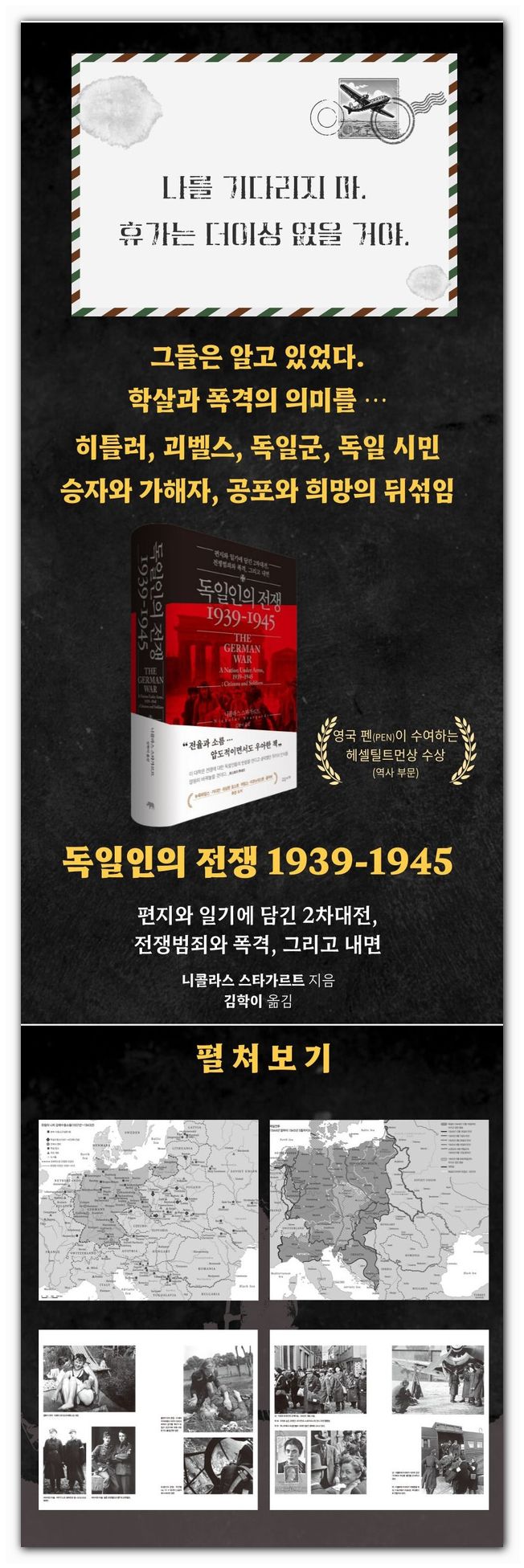
They knew: the meaning of massacre and bombing.
Hitler, Goebbels, German soldiers, German citizens.
Victors and perpetrators; fear and hope intertwined.
The inner world of a perpetrator nation, seen through diaries, letters, and court records.
“Outstanding! What makes this book so gripping is the way the author combines broad political and military developments with vivid everyday history, moving from the secret strategies of the Nazi leadership to the beliefs and emotions ordinary Germans developed as they experienced them.” — The Guardian
Winner of the PEN Hessell-Tiltman Prize for History.
For them, the Second World War was more legitimate than Nazism.
On November 17, 1944, German army officer Wilm Hosenfeld entered a house in Warsaw. A skeletal-looking Jew was searching for food in the kitchen. That night Hosenfeld listened as the man played Chopin on a piano. The Jew was Władysław Szpilman, later portrayed in the film The Pianist. Hosenfeld helped Szpilman hide in the attic and regularly brought him food over the following weeks. This was the same German officer who had felt intense, mysterious excitement at the Nazi Party rallies in Nuremberg in 1936 and 1938. He was a contradictory man. What, then, was Hosenfeld fighting for in the Second World War? How did the war Germany had begun change his inner world? And when did he recognize Germany’s war crimes?
This book approaches the confused inner lives of Germans through sources from the Second World War. It cuts through familiar prejudices with countless intimate stories captured in homes and on the streets. The living voices preserved in diaries, letters, reports, and court records testify to unfamiliar and unsettling truths hidden behind the war crimes of a totalitarian regime. One of those truths is that the German population remained actively committed to the war until the moment of defeat. The book follows the way their idea of a national defensive war developed and became intertwined with Nazism.
To ensure breadth of information, the author examined letters, diaries, and official records. He reviewed about 25,000 letters at the Library of Contemporary History in Stuttgart and worked in the Berlin Academy of Arts, the German Diary Archive, the German Historical Museum in Berlin, the front-soldier archive of the Museum for Communication, the German Federal Archives, and the Federal Archives–Military Archives in Freiburg. He collected official reports from informants, reports by censors who randomly inspected German military mailbags, and private diaries that recorded secret and candid thoughts. To gain depth, he selected individuals from very different social backgrounds and followed them over long periods, tracing how their private hopes and plans became entangled with the course of the war.
“This book is the story of that long war. It charts the changes that took place in German society during it, and records the subtle, often irreversible ways in which individuals adapted to a war they increasingly felt they could no longer control. It also records their changing expectations and their fluctuating hopes and fears as they passed through events that shaped them. Their concrete lives were both an emotional measure of experience and a moral barometer of a society on the road to self-destruction.” — p. 48
The author argues that interpretations of the war are divided in both scholarship and popular memory. When wartime Germans are discussed, two competing interpretations often appear: one sees all Germans as victims, while the other classifies all Germans as perpetrators. Watching the commemorations of the end of the war in 2005, the author encountered the idea from which this book grew. He concluded that, in trying to extract the “right” lessons from the history of the war, previous historians had neglected one of the essential tasks of historical study: before anything else, the historian must understand the past.
When mobilization was announced on August 26, 1939, Germans did not know the future. They remembered the past. The anxious shadow of defeat in the First World War hung over them. The idea that the crisis of war could radically transform society forces a reconsideration of the relationship between the Nazi regime and German society. Historians have often assumed that the bombing of Hamburg and the defeat at Stalingrad drove Germans toward defeatism. Yet Germans did not abandon the war. The reason was not Nazism. By concentrating on their complicated, confused, and dynamic inner world, this book explains the Second World War in a way that challenges common assumptions. For Germans, the war was more legitimate than Nazism. The reason lay in the apocalyptic mentality produced by the war. They interpreted a deliberate, violent war of conquest as a national war of defense. The worse the military situation became, the more resolutely many tried to defend their country out of patriotic commitment. The German society’s adoption of an apocalyptic way of thinking was the decisive change that occurred among Germans in the latter half of the war.
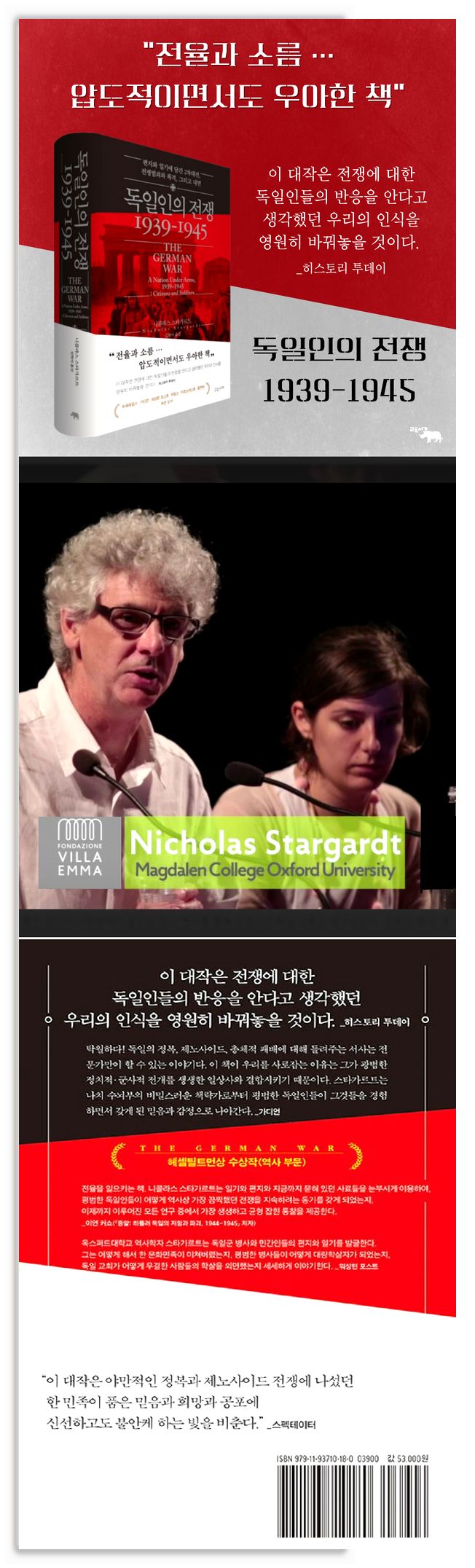
Promotional panel for the Korean edition: “They knew: the
meaning of massacre and bombing”; “The inner world of a
perpetrator nation seen through diaries, letters, and court
records”; winner of the PEN Hessell-Tiltman Prize for History.
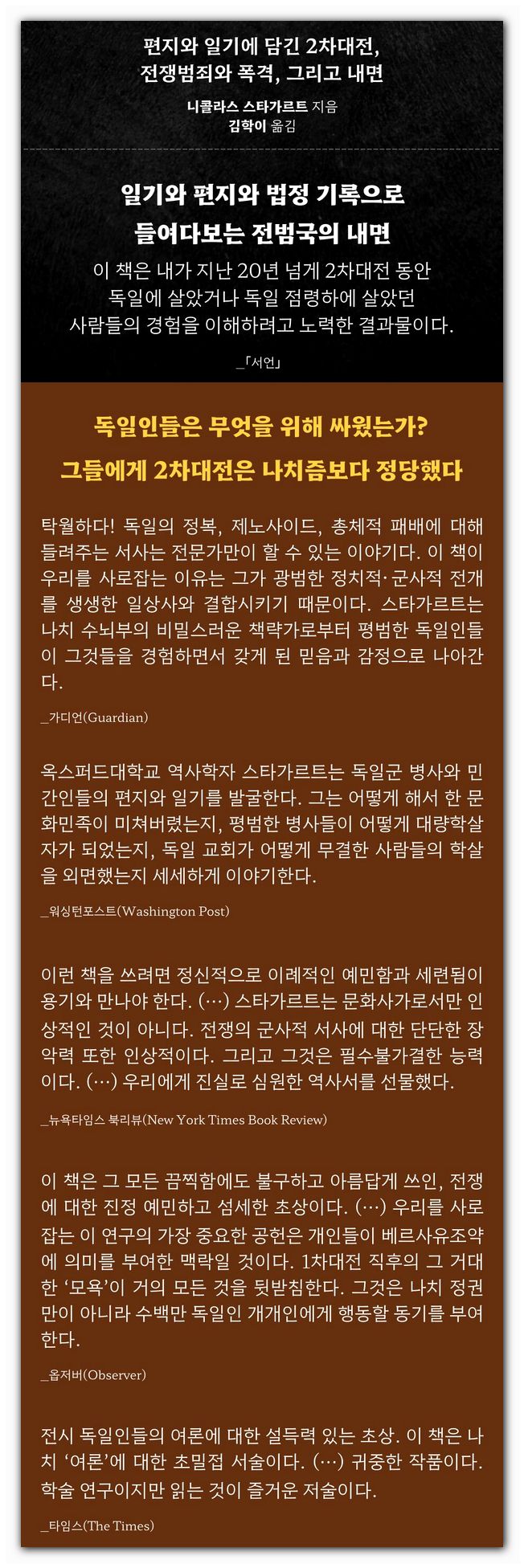
World War II in letters and diaries: the shock of war crimes and massacres, and the inner world.
Nicholas Stargardt, translated by Kim Hak-yi. “The inner world of
a perpetrator nation seen through diaries, letters, and court
records.” The panel includes the author’s statement that
the book grew out of more than twenty years of trying to understand the
experiences of people who lived in Germany or under German occupation,
and reviews emphasizing the book’s combination of high-level
military and political history with the everyday beliefs and emotions
of ordinary Germans.
Promotional panel for Nicholas Stargardt’s The German War 1939–1945,
highlighting the Hessell-Tiltman Prize and reviews describing the book
as an elegant, powerful account that changes how we understand German
responses to the war.
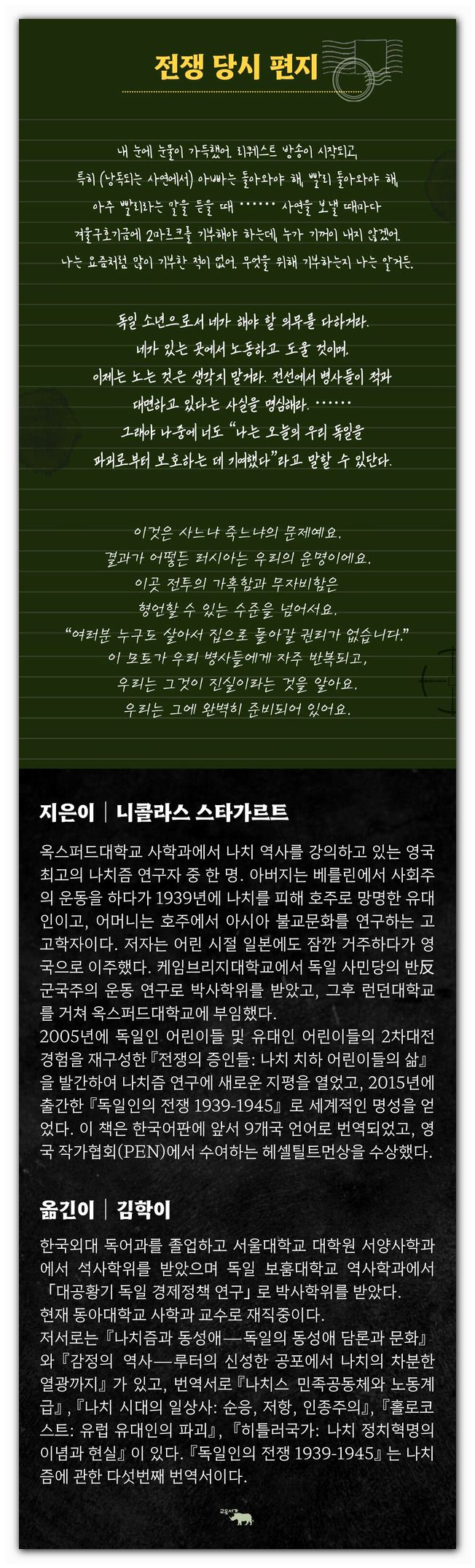
Letters during the war. The panel reproduces
wartime letters in which family members speak of air-raid warnings,
duties expected of a German boy, and the conviction that the war with
Russia was a matter of life and death. It also presents biographies of
Nicholas Stargardt and translator Kim Hak-yi. Stargardt, an Oxford
historian and leading scholar of Nazism, is the author of Witnesses of War: Children’s Lives under the Nazis and The German War 1939–1945;
the latter was translated into numerous languages and won the PEN
Hessell-Tiltman Prize. Kim Hak-yi is a historian of modern Germany and
a translator of works on Nazism and twentieth-century German history.
“This book is the result of more than twenty years during which I have tried to understand the experiences of people who lived in Germany or under German occupation during the Second World War. Originally I did not intend to write it. After publishing Witnesses of War: Children’s Lives under the Nazis in 2005, I promised myself, and others who were prepared to listen, that I would no longer write about children, the Holocaust, or Nazi Germany. This book began as a short paper about what Germans fought for in the Second World War. I felt that I had to say something about that question before I could move on. The project began to grow while I was on sabbatical at the Free University of Berlin in 2006–2007.” — p. 17
“This book is the story of that long war. It charts the changes that took place in German society during it and records the subtle, often irreversible ways in which individuals adapted to a war they increasingly felt they could no longer control. It also records their changing expectations and fluctuating hopes and fears as they passed through events that shaped them. Their concrete lives were both an emotional measure of experience and a moral barometer of a society on the road to self-destruction.” — p. 48
Mass-killing operations were usually carried out in forests or on parade grounds away from public view, but some took place before spectators. On the evening of Saturday, October 7, 1939, soldiers stationed at Świecie discussed the killing operation that had taken place earlier that day and was to resume early the next morning. At dawn Corporal Paul Kluge went near the killing pit. Soldiers who recorded such killings often described the first scene they witnessed because it left the strongest impression. Kluge wrote that a bus arrived at the Jewish cemetery and a woman got out with three children. The family walked about thirty meters to the pit. Holding the youngest child, the woman climbed down into it, then took another child from above and lowered it to the bottom. An SS man lifted the last child and handed it down. The woman lay face down in the pit with her children. Kluge went close enough to look inside. Four SS men aimed at the necks of the four people from a distance of about twenty centimeters and shot them. When they had finished, they ordered Kluge, who had been watching, to cover the bodies with earth. He obeyed without hesitation. — pp. 75–76
Unlike Albring and Moldenhauer, many German soldiers became “execution tourists,” photographing the public hanging of Jews and alleged partisans. Hermann Gieschen, a member of a reserve police battalion and formerly a Bremen shopkeeper, knew that his unit had been assigned difficult work and imagined it would be “somewhat like Poland.” In Riga he bought a movie camera, hoping that films of his battalion’s operations in Latvia and Russia would later become a record and would be “very interesting for our children.” On August 7, 1941, he wrote to his wife Hanna about an operation carried out by his police unit the previous night: “150 Jews were shot. Men, women, children — all removed. The Jews are being completely exterminated. Dear H., please do not think about it. It simply has to be.” — p. 252
At the beginning of November 1941 an SS commando arrived at a prisoner-of-war camp to identify Jews among prisoners and civilians. Some of those selected were shot in the cellar of a cement factory. Jarosch only hinted at the event in letters home. The prisoner who had been teaching him Russian was half Jewish, but Jarosch did not tell his wife Charlotte what had happened to the man. He merely wrote that he had seen “Jews walking barefoot in the snow,” and that “difficult things which I could not prevent made a very painful impression on me; I will explain them verbally [at home].” Two days later, however, he enthusiastically described his new Russian teacher, a Moscow schoolteacher like himself. When the man read Turgenev aloud, Jarosch felt “as if I were touching the soul of that country, touching it in the way in which that soul perceives and knows itself.” — pp. 279–280
Hans Albring spent the winter in the small town of Velizh behind Army Group Center. When Soviet forces attacked at the end of January 1942, the soldiers endured eight weeks in dreadful conditions. Unable to wash, tormented by lice, and hungry, Hans believed that “to compare the situation with the Last Judgment would not be too great an exaggeration.” On March 21, 1942, he wrote to his friend Eugen Altrogge, “In this experience I have gained more than I have lost.” Two weeks after the Soviet attack stopped, Albring was delighted by a letter from an older Catholic acquaintance in Münster. Quoting it at length, he made clear the view he had developed: “And who knows — perhaps, after following for centuries a false and increasingly distorted conception of humanity, a new and true conception of humanity is only now rising within us; perhaps that is the metaphysical meaning of this war.” — p. 308
A family made its decision: “Today we go to death together.” They hung a picture of Jesus raising his hand to bless a meal, lay down on the floor, and looked at the picture and at one another. Sleeping pills and gas were beginning to work. — pp. 374–375
Jochen Klepper obtained a meeting with Adolf Eichmann, the official responsible for Jewish affairs. Eichmann warned him not to tell anyone and said, “I cannot give you a final answer that it has been approved, but I think things will go well.” When Klepper again raised the subject of his wife, Eichmann replied firmly, “Joint emigration is not permitted.” The next afternoon Eichmann summoned Klepper to report the result concerning Renate. At their second meeting, on December 10, 1942, he informed him that Renate’s exit visa had been refused. Jochen, Johanna, and Renate decided to leave Germany in their own way.
By mid-April 1945 Army Group B had virtually run out of weapons and ammunition, and the army was dissolving into the forests and towns of the Ruhr. On April 15, residents of August Töpperwien’s city of Solingen dismantled anti-tank barriers; by the following day almost every soldier there had been given civilian clothes. Even an army major announced that he was relinquishing command, then put on an ill-fitting suit and a sports cap. On April 17, the day Solingen fell, General Walter Model, commander of Army Group B, avoided formally surrendering his formation to the Americans by ordering it “dissolved.” Some 317,000 men, including thirty generals, became prisoners. Torn between common sense and pride in loyalty, Model did what Hitler had wanted General Paulus to do at Stalingrad: he went into the woods and shot himself. The next day the U.S. 97th Infantry Division entered Düsseldorf. Marianne Strauss had lived so long in fear of arrest by the German authorities that it took ten days before she realized she was safe. — pp. 712–713
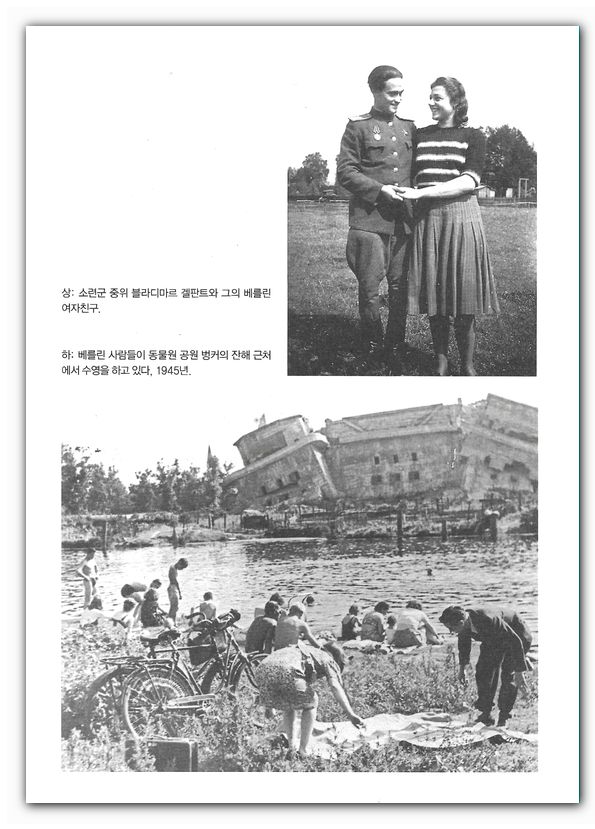
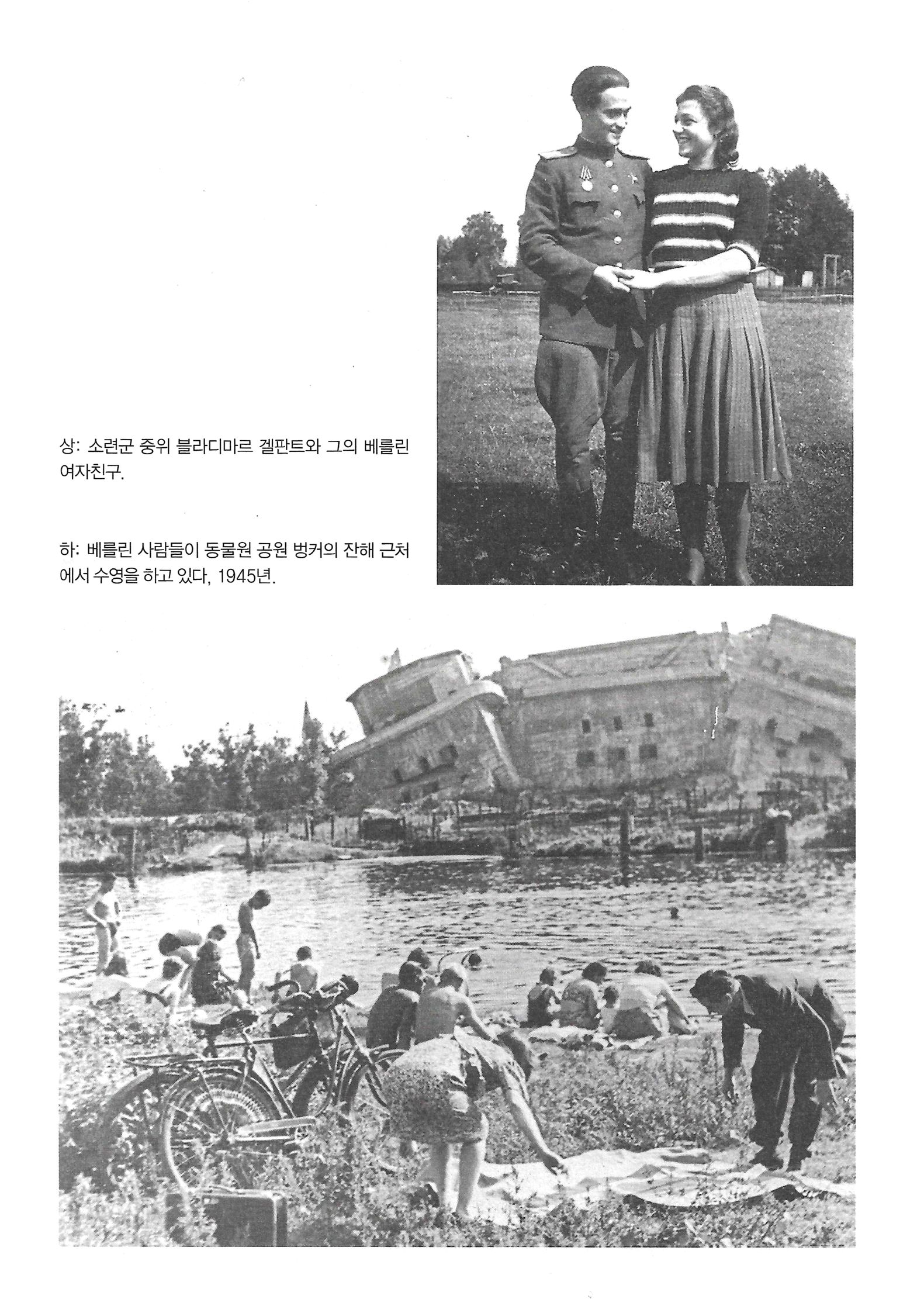
Top: Soviet lieutenant Vladimir Gelfand and his Berlin girlfriend.
Bottom: Berliners swimming near the ruins of the bunker in the Tiergarten, 1945.
The deportation operation became the first public spectacle of collective violence against Jews since the pogrom of November 1938. In places where that pogrom had become a popular festival joined by boys and girls from the Hitler Youth and League of German Girls, the remaining Jews were now forced to walk in rows while people shouted a mixture of old and new abuse and curses: “Look at those impudent Jews!” “Now they’re going to the ghetto!” “Useless parasites!” In Bad Neustadt, old and undernourished Jews were assembled in the market square and photographed by Nazi activists. The photographs were later enlarged to poster size and displayed in the city center. When the column of Jews set off from the market square toward the railway station, “a noisy crowd of schoolchildren” followed them and “shouted until the train departed.” — p. 343
Walter reported that no Jews remained in Kyiv. During leave in June 1942, he spoke with Karl Dürkefelden about mass killings he had witnessed and about the gassing of French Jews described by another soldier. Dürkefelden confessed in his diary: “Walter kept emphasizing … how glad we should be that we are not Jews.” When Karl reacted with shock, Walter explained, “At first I didn’t understand either. But now I know. It is a question of whether we live or die.” His brother-in-law had absorbed Hitler’s endlessly repeated formula: the nation faced an apocalyptic choice, “to live or to die.” Karl objected, “But that is murder.” Walter immediately gave the answer supplied by the Nazi press: “What has happened so far makes one thing certain: if we lose, they will do to us exactly what we have done to them.” Karl Dürkefelden knew he had to end the conversation. Openly opposing his brother-in-law could create a rupture within the family and, in the worst case, lead to denunciation to the Gestapo; more likely, it would distort family relations and isolate him. — pp. 353–354
Margarete Sommer collected information about what had happened to Catholic converts of Jewish origin after they were deported to the Baltic region and passed it on to bishops. She also obtained secret information from Hans Globke, a senior official in the Interior Ministry. According to Sommer, Bishop Berning of Osnabrück stated on February 5, 1942: “There clearly exists a plan to exterminate the Jews completely.” This was only two weeks after Heydrich’s secret Wannsee Conference, at which senior officials were informed of the impending murder of eleven million European Jews. Yet another eighteen months passed before Berning and Preysing submitted to the bishops’ conference a petition protesting the deportation of “non-Aryans in a manner that mocks human rights.” Even then, the Fulda Bishops’ Conference in August 1943 rejected the proposal. In practical terms it was already too late: most Jews were dead. Cardinal Bertram, the most influential figure in German Catholicism, even refused to receive Sommer’s report unless Preysing guaranteed its authenticity by countersigning it — although he knew this procedure would expose both Sommer and Preysing to the Gestapo. Even if one assumes that Bertram did not know what was happening to the Jews, that would be because he had made no effort to find out. — pp. 355–356
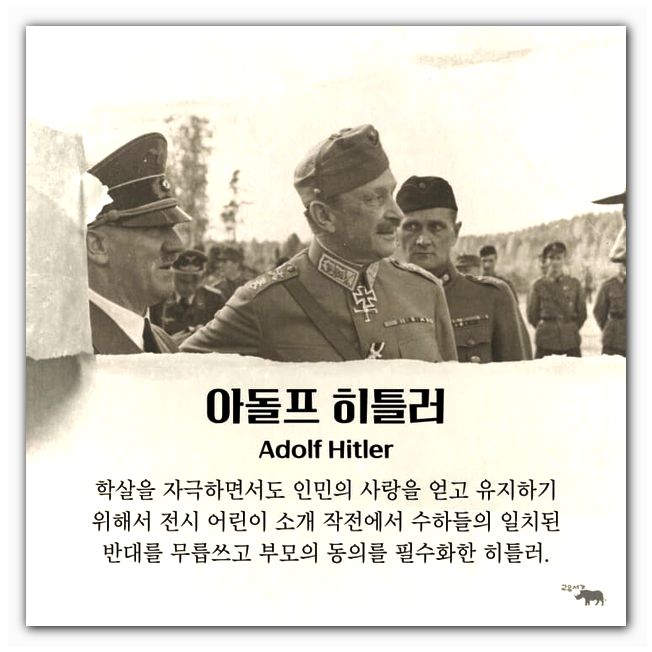
Adolf Hitler. “While inciting massacres,
Hitler nevertheless required parental consent for the wartime
mobilization of children in order to win and maintain the
people’s affection.”
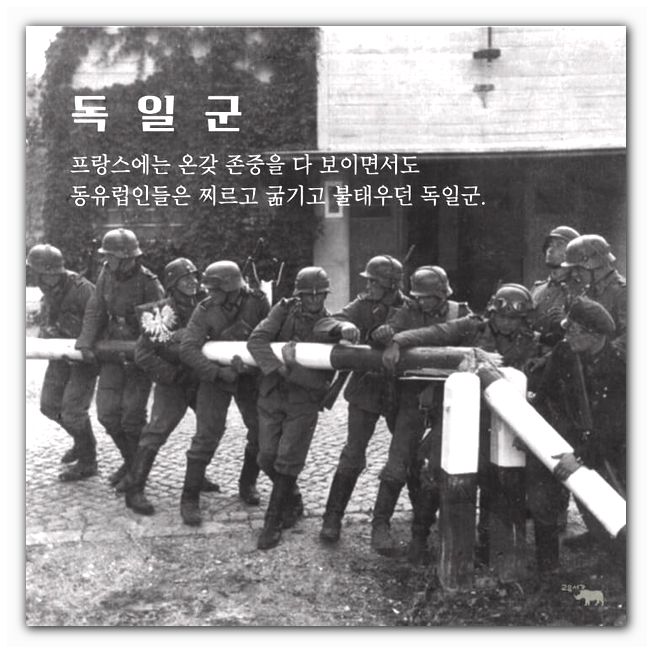
German Army. “The German army showed every courtesy to the French while stabbing, starving, and burning Eastern Europeans.”
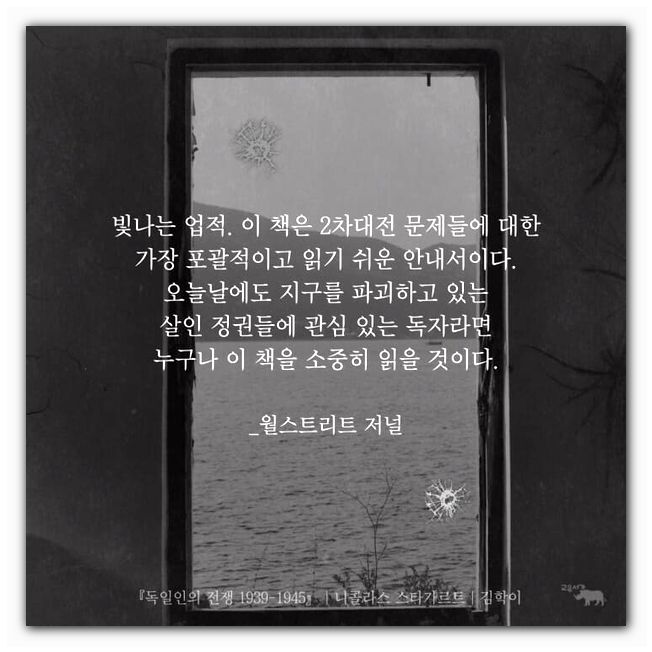
“A brilliant achievement. This book is the most
comprehensive and readable guide to the problems of the Second World
War. Any reader interested in the murderous regimes that are still
destroying the world today will read this book with care.”
— The Wall Street Journal
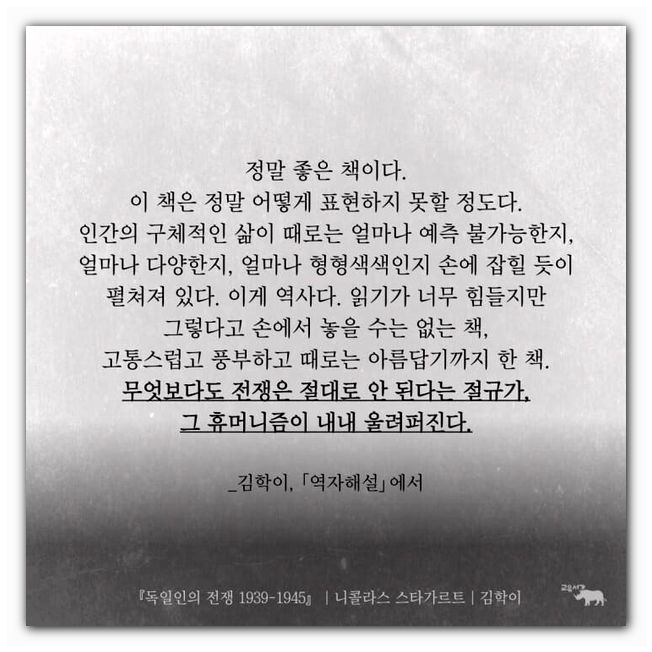
“A truly excellent book. It is almost impossible to find
words for it. It unfolds, almost tangibly, how unpredictable, diverse,
and multicolored concrete human lives can be. This is history. It is
very difficult to read, yet impossible to put down; painful and rich,
at times even beautiful. Above all, a cry that war must never happen,
and its humanism, resound throughout.” — Kim Hak-yi, from the translator’s commentary
Map
Preface
Main protagonists in the letters and diaries
Prologue
Part I. Defensive War: September 1939–spring 1940
1. A War Germans Did Not Welcome
2. Preventing Cracks in the Ranks
3. Extreme Measures
Part II. Masters of Europe: May 1940–summer 1941
4. Advance
5. Victors and Vanquished
Part III. Shadow of 1812: summer 1941–March 1942
6. The German Crusade
7. First Defeat
Part IV. Stalemate: early 1942–March 1943
8. Sharing the Secret
9. Plunder of Europe
10. Letters to the Dead
Part V. War Reaches Germany: March 1943–summer 1944
11. Bombing and Revenge
12. Holding On
13. Borrowed Time
Part VI. Total Defeat: summer 1944–May 1945
14. A Country Turned into a Trench
15. Collapse
16. The End
Epilogue: Across the Abyss
Abbreviations | Notes | Translator’s Commentary: Unspeakable War Crimes and Inner Reflection
Book title: The German War 1939–1945
Author / publisher: Nicholas Stargardt / Gyoyuseoga
Size: 163 × 232 mm
Pages: 976
Product composition: one volume
Publication date: February 29, 2024
Contents or book description: see product details.
Exchange / return address: Kyobo Book Centre, 249 Munbal-ro, Paju-si, Gyeonggi-do 10881 (Munbal-dong), Republic of Korea.
© Nicholas Stargardt
© Gyoyuseoga / Munhakdongne