


 |
||
PUSAT MEDIA VIRAL |
 |
© Ahlul Bait Nabi Saw
© Pusat Media Viral Malay
Ahlul Bait Nabi Saw / Pusat Media Viral — March 2016
Beginning in May 1945, the suffering of many German women became unbearable. They became victims of revenge by the Soviet Red Army.
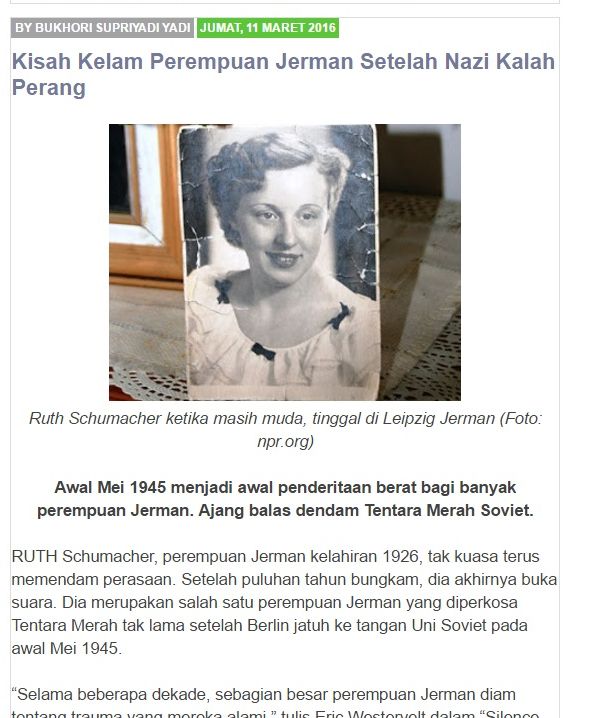
Ruth Schumacher lived in Leipzig, Germany, when she was young. Photo: npr.org.
Ruth Schumacher, born in Germany in 1926, struggled for decades with the feelings caused by what she had experienced. After years of silence, she finally spoke. Ruth was one of many German women raped by Red Army soldiers shortly after the fall of Berlin in May 1945.
“For decades most German women kept silent about the trauma they had endured,” Eric Westervelt wrote in an article about the breaking of the silence surrounding mass rape by the Red Army in Germany.
Ruth Schumacher’s story illustrates war crimes committed by Red Army soldiers at the end of the Second World War. The silence of survivors and deliberate Soviet efforts to conceal these events, the article argues, long surrounded them with a dark fog of oblivion.
The fall of Berlin and the Soviet advance through Eastern Europe became a catastrophe for many German women. Anthony Beevor is cited as writing in Berlin: The Downfall 1945 that nuns, girls, elderly women, pregnant women and even women who had just given birth became victims of rape. Such crimes occurred even before the Red Army entered Berlin. Girls in Poland and other occupied places were forced to choose between preserving their honor and preserving their lives.
Ruth was one of these victims. In Leipzig, after Allied bombing and the retreat of German troops, she was raped by a group of five Soviet soldiers, according to the later recollections of the widow of a German submariner.
Gabriele Köpp, then only fifteen, suffered a similar fate. After fleeing her home and promising her mother that she would return, Soviet soldiers seized her in a village. Susanne Beyer is cited as writing that the girl was taken to another house and raped by soldiers one after another, and then raped again by two more men in a barn the next morning.
Middle-aged women were often used as a “decoy” to protect younger girls. Many mothers deliberately sacrificed themselves in an attempt to save their daughters, as happened in Köpp’s case. Sometimes mothers themselves encouraged girls to seek the protection of Red Army officers.
Related evidence is also found in the diaries of Vladimir Gelfand, a lieutenant and mortar-platoon commander in the 301st Rifle Division. On the outskirts of Berlin he encountered a young woman whose mother effectively handed her over to him in the hope of saving her daughter from an even worse fate. Frederick Taylor is cited as writing that in late April, on Berlin’s outskirts, Gelfand met an attractive girl whom her mother effectively entrusted to him to protect her from gang rape.
Adult women sometimes found ways to adapt. The article gives the example of a journalist who had survived rape and later described her experience in a book: she deliberately entered a relationship with a Soviet officer in order to avoid further assaults.
For many Soviet soldiers, the article says, rape became an act of revenge for atrocities committed by Germans on Soviet soil. Michael Jones is cited as observing that many wanted vengeance for the suffering inflicted on their people. In the absence of clear orders, some soldiers asked commanders how they should treat German women and were allegedly told to do as they wished so long as discipline was not broken.
The article states that Joseph Stalin did not intend to punish his soldiers for rape, viewing their brutality in the context of the hardships and embitterment caused by years of war.
It cites historians’ estimates that about two million women in Germany suffered sexual violence. Psychiatrist Philipp Kuwert is quoted as saying that, on average, women in the affected areas were assaulted many times.
Mass rape caused not only profound psychological trauma. Many women suffered hormonal disorders and loss of menstruation, sometimes called the “Russian sickness.” Gabriele Köpp reportedly did not menstruate for seven years. Many unwanted pregnancies ended in abortion or the birth of unwanted children. Some women died from the consequences of the violence; others withdrew into themselves for the rest of their lives. The silence was especially strong in East Germany, where the authorities discouraged discussion of crimes committed by the Red Army “liberators.”
In later interviews Ruth Schumacher said: “Those memories never left me throughout my life. At night I could not sleep.”
© Ahlul Bait Nabi Saw
© Pusat Media Viral
