



Алла Шендерова
 |
премьера театр Аглая Романовская театру училась везде и понемногу: в Берлине, где прошло ее детство, во Франции, где в городе Монпелье она основала собственное театральное дело, и в Москве – на стажировке у Юрия Погребничко. Широта интересов у режиссера тоже впечатляющая – от современного танца до советской пьесы и вербатима. Последний госпожа Романовская изучала в московском Театр.doc и пару лет назад поставила там спектакль "Яблоки земли" о жизни обитательниц женской колонии. Вдохновившись случайно купленным на блошином рынке солдатским разговорником времен второй мировой, она решила сделать вербатим о войне. Идея парадоксальная, поскольку нарушается главный принцип вербатима (то есть пьесы, в основу которой положена прямая речь очевидца), да и всей новой драмы, объектом изучения которой становятся самые актуальные события. Спору нет, война, неумение людей договориться между собой, языковой и прочие барьеры – тема вечная. Но того, что заставило бы актеров и зрителей воспринимать события 50-летней давности как происходящее на наших глазах, в спектакле нет. |
|
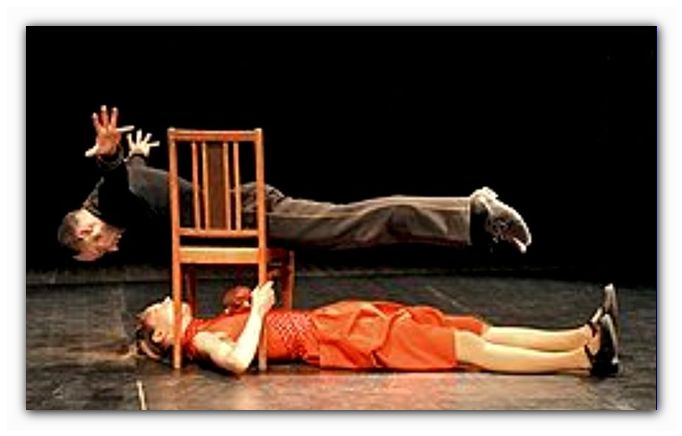
| Языковые параллели в разговорнике не способствуют сближению героев | ||
| Полтора часа зрители удивленно,
но
вежливо (все-таки война – святое!) слушают русско-немецкие
диалоги из
серии "хенде хох" и смотрят, как шесть актеров (немцы, русские и
австрийцы) разыгрывают политкорректные до стерильности и невероятно
банальные этюды о том, как трудно договориться жертве и захватчику.
Солдату (Илья Плетнер) хочется любви, а девушка (Эва Янковски)
упирается. "Умеешь ли ты подмахивать?" "Mitmahen?" –
переспрашивает
девушка. На небольшом экране появляется перевод: "mitmahen" по-немецки
– "искупить". Он и она попеременно валят друг друга на пол,
словно еще
не решив, любить или убить, но делают это на удивление вяло. Отстранение, умение отступить на шаг от своего персонажа и оценить его со стороны – все то, что так виртуозно умеют в театре Юрия Погребничко, у актеров госпожи Романовской кажется вялостью и отсутствием профессионализма. Впрочем, когда Федор Степанов со звонким пафосом зачитывает чьи-то дневниковые оды Сталину, становится еще хуже. В памяти мгновенно выстраиваются бесконечные шеренги насквозь советских фильмов и спектаклей. Так что спасибо создателям "Разговорника" хотя бы за то, что на сцене почти не кричали. |

Изо всех сил пытаясь нащупать
новый
неожиданный поворот военной темы, режиссер в каждой следующей новелле
(всего их восемь) меняет правила игры: заставляет героев распевать как
ораторию "Вашу мать, за Сталина, вашу мать, за Родину..."; рассуждать о
схожести немецкого и советского строя (от страха перед русскими юные
немки шустро переделывают флаг гитлеровской Германии в советский
– для
этого надо всего лишь спороть с красного полотна свастику и нашить серп
и молот); петь "Ой ты, степь широкая..." и "Лили Марлен". Не обходится
и без любимого госпожой Романовской современного танца: время от
времени актеры совершают какие-то ритуальные движения вокруг стульев
–
такие же простые, но непонятные и ни к чему не ведущие, как фразы из
разговорника.
| Подлинное
напряжение возникает только
однажды, когда актеры начинают произносить их как стихи. "Сколько коров
в деревне? / Где стоит водокачка? / Куда ведет река?.." –
скандируют
они, и в самом этом рубленом ритме вдруг слышится надрыв и обреченность. В финале ритм снова замедляется, бесстрастные голоса на пленке читают дневниковые записи немецкой девушки и русского красноармейца. Фраза чудом выжившей немки "Я могла бы жить и пустить корни только в Берлине" вдруг наводит на мысль о том, что сама постановщица никак не может пустить корни – не столько в географическом, сколько в профессиональном смысле. Пробует то, другое, третье, скользя по поверхности и не в силах определить свой театральный путь, требующий рано или поздно простоты выбора, сравнимой с солдатской прямотой советского разговорника. |
© Коммерсантъ
 Russian
Alla Shenderova
On the stage of Yuri Pogrebnichko’s theatre, a production has been mounted based on phrases from a soldier’s phrasebook dating from the Second World War. To Alla Shenderova, the production recalled a school assembly held for Victory Day.
Premiere / Theatre
Aglaia Romanovskaya learned theatre here and there: in Berlin, where she spent her childhood; in France, where in Montpellier she founded her own theatrical venture; and in Moscow, where she trained with Yuri Pogrebnichko. The director’s range of interests is equally impressive—from contemporary dance to Soviet drama and verbatim theatre. She studied the latter at Moscow’s Teatr.doc and a couple of years ago staged Apples of the Earth there, a production about the lives of women in a penal colony.
Inspired by a Second World War soldier’s phrasebook she happened to buy at a flea market, Romanovskaya decided to make a verbatim production about the war. The idea is paradoxical, because it violates the basic principle of verbatim theatre—a play constructed from the direct speech of witnesses—as well as that of the whole “new drama” movement, whose object of study is the most immediate reality. War, people’s inability to reach agreement, language barriers and other barriers are of course eternal themes. But the production contains nothing that would compel actors and spectators to experience events of more than half a century ago as if they were unfolding before our eyes.
The language parallels in the phrasebook do not bring the characters closer together.
Photo: Pavel Smertin / Kommersant
For an hour and a half the audience listens with surprise but politeness—after all, war is sacred—to Russian-German exchanges of the “Hände hoch!” variety, and watches six actors (Germans, Russians, and Austrians) perform sketches that are politically correct to the point of sterility and astonishingly banal, about how difficult it is for victim and occupier to understand each other.
A soldier (Ilya Pletner) wants love, while a young woman (Eva Jankowski) resists. “Do you know how to thrust?” “Mitmachen?” the girl asks back. A translation appears on a small screen: in German, “mitmachen” means “to take part.” He and she alternately knock each other to the floor, as though they have not yet decided whether to love or kill one another, but they do it with surprising listlessness.
Detachment—the ability to step back from one’s character and assess that character from the outside—is something the actors of Yuri Pogrebnichko’s theatre handle with virtuosity. In Romanovskaya’s actors, however, it looks like sluggishness and lack of professionalism. Things become still worse when Fyodor Stepanov, in a ringing and pompous tone, recites someone’s diary odes to Stalin. The mind instantly fills with endless ranks of thoroughly Soviet films and stage productions. So one can at least thank the creators of the Phrasebook for the fact that almost no one shouts on stage.
Trying with all her might to find some new and unexpected angle on the war theme, the director changes the rules of the game in each succeeding episode—there are eight in all. She makes the characters sing, like an oratorio, “Damn you, for Stalin, damn you, for the Motherland…”; discuss the similarity between the German and Soviet systems (frightened by the Russians, young German women quickly remake the flag of Hitler’s Germany into a Soviet one: all that is needed is to rip the swastika from the red cloth and sew on a hammer and sickle); and sing “Oh You, Wide Steppe…” and “Lili Marleen.” Romanovskaya’s beloved contemporary dance also makes an appearance: from time to time the actors perform ritual-like movements around chairs—just as simple, incomprehensible, and aimless as the phrases in the phrasebook.
Real tension appears only once, when the actors begin to recite those phrases like poetry. “How many cows are there in the village? / Where is the pumping station? / Where does the river lead?…” they chant, and suddenly the chopped rhythm itself conveys strain and doom.
At the end, the pace slows again. Dispassionate recorded voices read diary entries by a German girl and a Russian Red Army soldier. The line spoken by the German woman who miraculously survived—“I could live and put down roots only in Berlin”—suddenly suggests that the director herself cannot put down roots, not so much geographically as professionally. She tries one thing, then another, then a third, skimming the surface and unable to determine her own path in theatre—a path that sooner or later demands a simplicity of choice comparable to the soldierly directness of the Soviet phrasebook.
© Kommersant