



 |
||
 |
||

The Only Road of History
A ReplyKatrine Kielos, writing in Expressen on 16 January, misrepresented the argument in my article about Vladimir Gelfand's diary, published in Germany in German and covering 1945-46. My article in Flamman did not excuse rapes committed by Red Army soldiers during the advance into Germany. I accept that Ilya Ehrenburg's anti-German rhetoric, although criticized at the highest level, nevertheless had an influence.
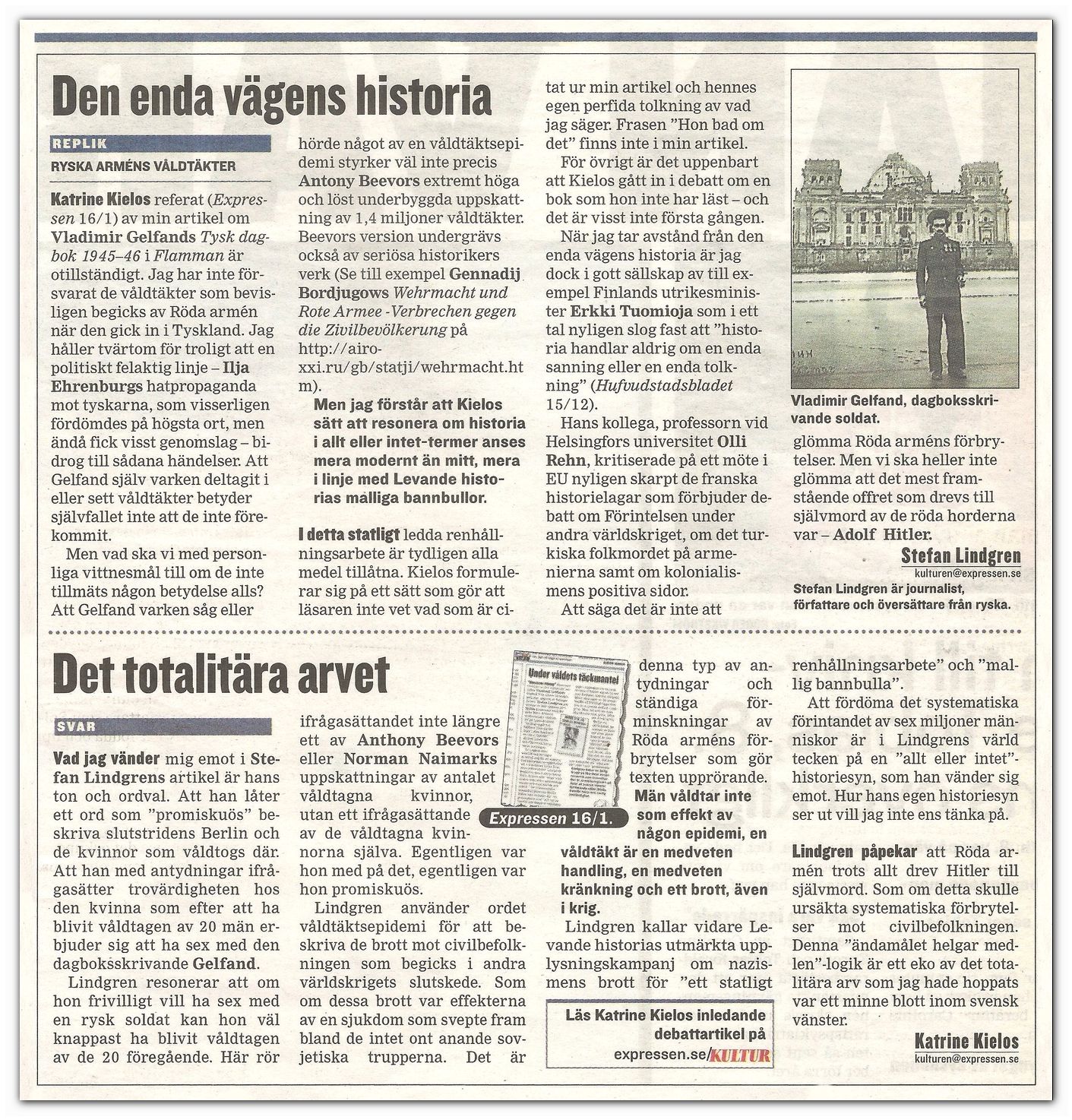
Gelfand did not take part in rapes and did not witness them. That of course does not mean that such crimes did not take place. But does contemporary personal evidence have no value? Gelfand does not describe mass rape, and his diary does not support Antony Beevor's disputed estimate of 1.4 million victims. Beevor's figures have been challenged by other historians, among them Gennady Bordyugov.
I understand that Kielos approaches history through an "all or nothing" principle, which seems more fashionable today than my attempt to weigh conflicting evidence. She writes in a way that blurs the line between quotation and interpretation. The phrase "She asked him," for instance, does not occur in my article. It also appears that she has entered a debate about a book she has not read.
A multi-sided view of history is hardly eccentric. Finland's foreign minister Erkki Tuomioja has said that history is never one single truth or one single interpretation. Olli Rehn has likewise criticized laws that restrict discussion of historical questions.
I do not deny crimes committed by the Red Army. But it is also worth remembering that the most famous person driven to suicide by the "Red hordes" was Adolf Hitler.
Stefan Lindgren, journalist, writer and translator from Russian.
The Totalitarian Legacy - Response
The reason I cannot accept Stefan Lindgren's articles lies in his tone and choice of words. He uses language suggesting sexual promiscuity when writing about women raped during the final battle for Berlin, and he questions the testimony of a woman who, according to Gelfand's diary, had been raped by twenty men and later offered to have sex with Gelfand.
Lindgren argues that if this woman voluntarily wanted sex with a Soviet soldier, it becomes doubtful that she had really been raped by the previous twenty. The issue is therefore not only Antony Beevor's or Norman Naimark's estimates of the number of victims. It is also whether an individual woman's account is to be believed at all. Her testimony is cast into doubt because Lindgren regards her sexual behavior as promiscuous.
Lindgren uses the word "epidemic" to describe the mass rapes of the Second World War, as if the crimes were a disease that suddenly struck unsuspecting Soviet soldiers. Such language, together with the repeated minimizing of Red Army crimes, makes the argument unacceptable. Rape is not an illness and not an accidental side effect of war. It is a deliberate act of violence and a conscious crime, even in wartime.
He calls the work of the Living History project, which preserves the memory of Nazi crimes, "state sanitation" and an "impudent prohibition of freedom of opinion." If condemnation of the Holocaust and the murder of six million people becomes an example of the "all or nothing" view of history that he opposes, then meaningful discussion becomes extremely difficult.
Lindgren also points out that the Red Army ultimately drove Hitler to suicide, as though that could excuse systematic crimes against civilians. The logic that the end justifies the means is itself an echo of totalitarian thinking that one would hope belongs to the past.
Katrine Kielos - kulturen@expressen.se